Does Vinegar Kill Gnats? What Works Instead
Is vinegar effective against gnats? Learn why it attracts fruit flies, fails on fungus gnats, and what to do for plants, kitchens, and drains.
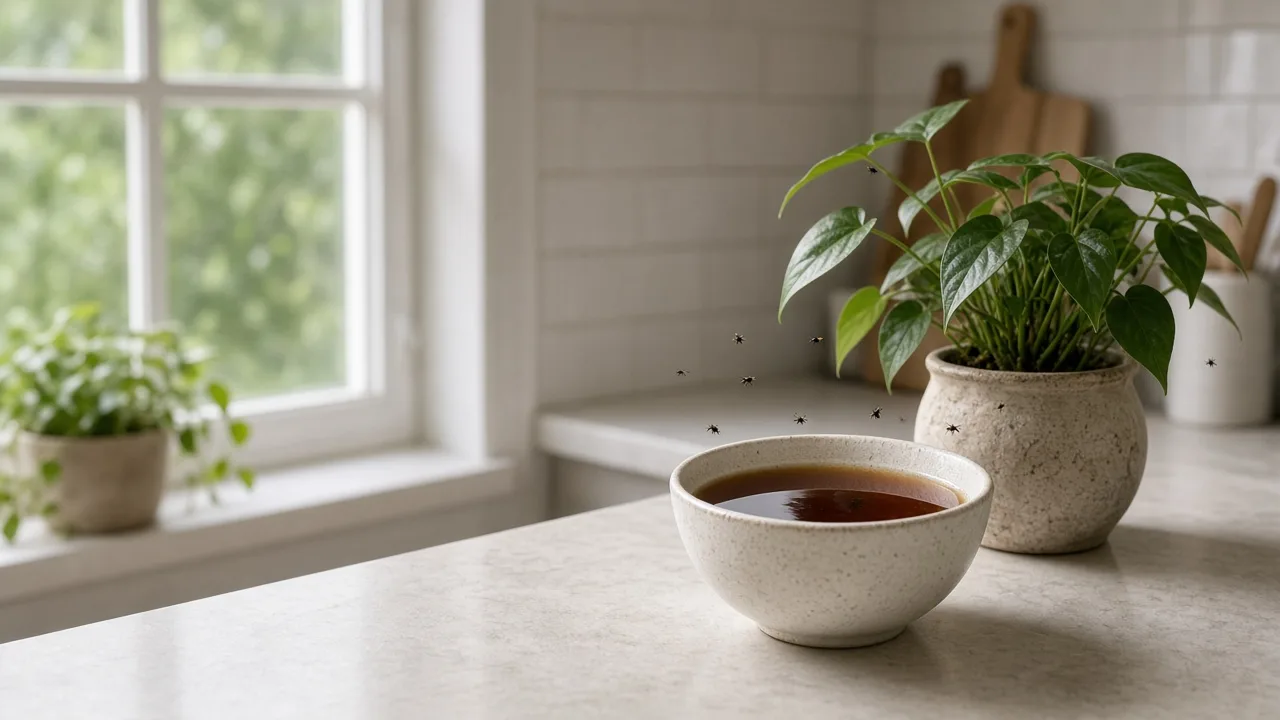
Vinegar is useful against one kind of tiny indoor fly, but it is not a universal gnat killer. Apple cider vinegar can lure fruit flies into a trap; it usually does not solve fungus gnats breeding in potting soil, and it is a poor answer to drain flies developing in organic film inside plumbing.
That distinction matters because “gnat” is a household label, not one insect. If you put vinegar beside a plant when the real problem is fungus gnat larvae in wet soil, you may catch a few adults while the next generation is already developing. If you put it beside a drain, you may add another attractive odor without touching the breeding film. The first step is not mixing a stronger bait. It is identifying where the insects are coming from.
Quick answer: vinegar is a trap bait, not a gnat cure
Use vinegar only when the evidence points to fruit flies, also called vinegar flies. They are the tiny flies that hover around ripe bananas, fermenting produce, juice, beer, recycling containers, trash, or a sticky spot beneath an appliance. Utah State University Extension lists vinegar traps as a way to catch fruit flies that come indoors, while University of Wisconsin–Madison Extension describes short-term baited-jar control alongside the more important job of removing breeding sites (Utah State University Extension’s fruit-fly guidance, University of Wisconsin–Madison Extension’s fruit-fly guide).
Do not use vinegar as a drench on houseplant soil, a spray on foliage, or a substitute for cleaning a drain. Fungus gnats are primarily a moisture-and-soil problem, and drain flies are a wet organic-buildup problem. In both cases, a bowl of vinegar can distract you from the place where eggs and larvae are actually developing.
The practical rule is simple: if the flies gather at fermenting food, vinegar may help; if they rise from soil or sit on a drain, start somewhere else. Source removal stops the next wave.
First identify which “gnat” you have
Look at the location before you look at the recipe. A cloud of flies around a fruit bowl points toward fruit flies. Flies that lift off when you touch a pot point toward fungus gnats. Small, fuzzy, moth-like insects resting on a bathroom wall or hovering over a sink point toward drain flies.
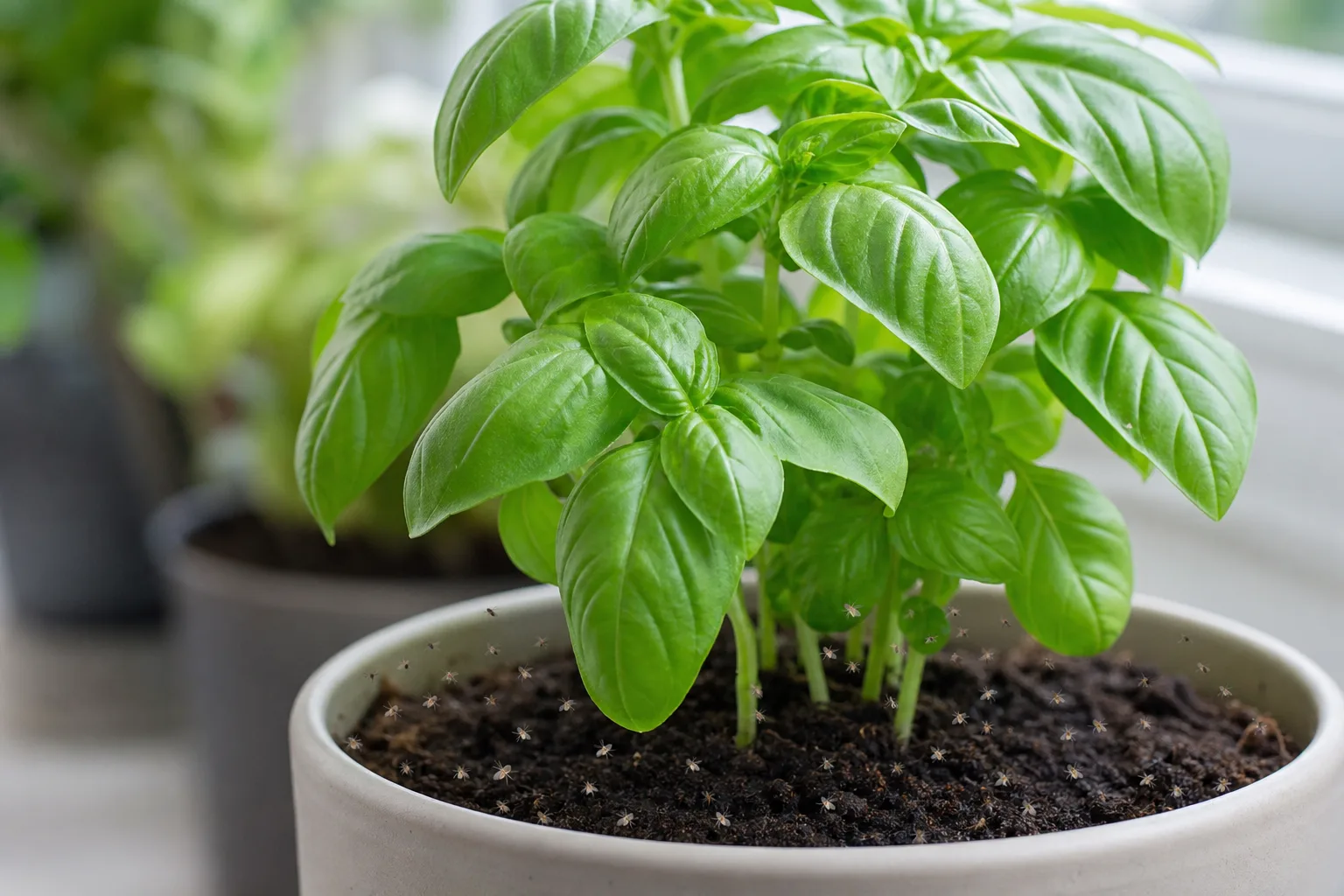
Fungus gnats: dark flies rising from potting soil
Fungus gnats are delicate, dark flies that often look a little like miniature mosquitoes. They are weak fliers and may walk across the soil surface, hover around leaves, or collect at windows and lamps. The most useful clue is not their size; it is their relationship with moist potting mix.
Adults are mostly a nuisance, but their larvae live in the growing medium. They feed mainly on fungi, algae, and decaying organic matter, and large populations can also injure fine roots. Colorado State University Extension notes that the life cycle can finish in roughly three to four weeks indoors, with females laying as many as 200 eggs in moist growing media (Colorado State University Extension’s fungus-gnat guidance). That overlapping life cycle is why killing a few flying adults rarely ends the problem.
To confirm a plant connection, tap the pot gently or water only when the plant actually needs it and watch where the adults emerge. You can also place a small raw potato slice on the soil surface and check underneath after a few days. Larvae that migrate to the slice are a stronger clue than a single adult seen near a window.
Fruit flies: tan or brown flies around fermenting food
Fruit flies are usually rounder and more compact than fungus gnats. Some common species have bright red eyes, and you will normally find them around ripe or overripe fruit, vegetables, wine, beer, soda, recycling, garbage disposals, or a damp, food-soiled cloth.
Their name is a little misleading because the breeding material can be a forgotten onion, potato, banana peel, bottle, or smear of juice rather than a fruit bowl. University of Wisconsin–Madison Extension notes that eggs are laid near fermenting or rotting material and the life cycle can be completed in about eight to 10 days (the extension guide to fruit flies in the home).
This is the one situation in which vinegar makes sense as a lure. It smells like a fermenting food source to the flies. It still works best as a temporary adult trap after you remove the food or moisture source.
Drain flies: fuzzy moth-like flies near sinks and showers
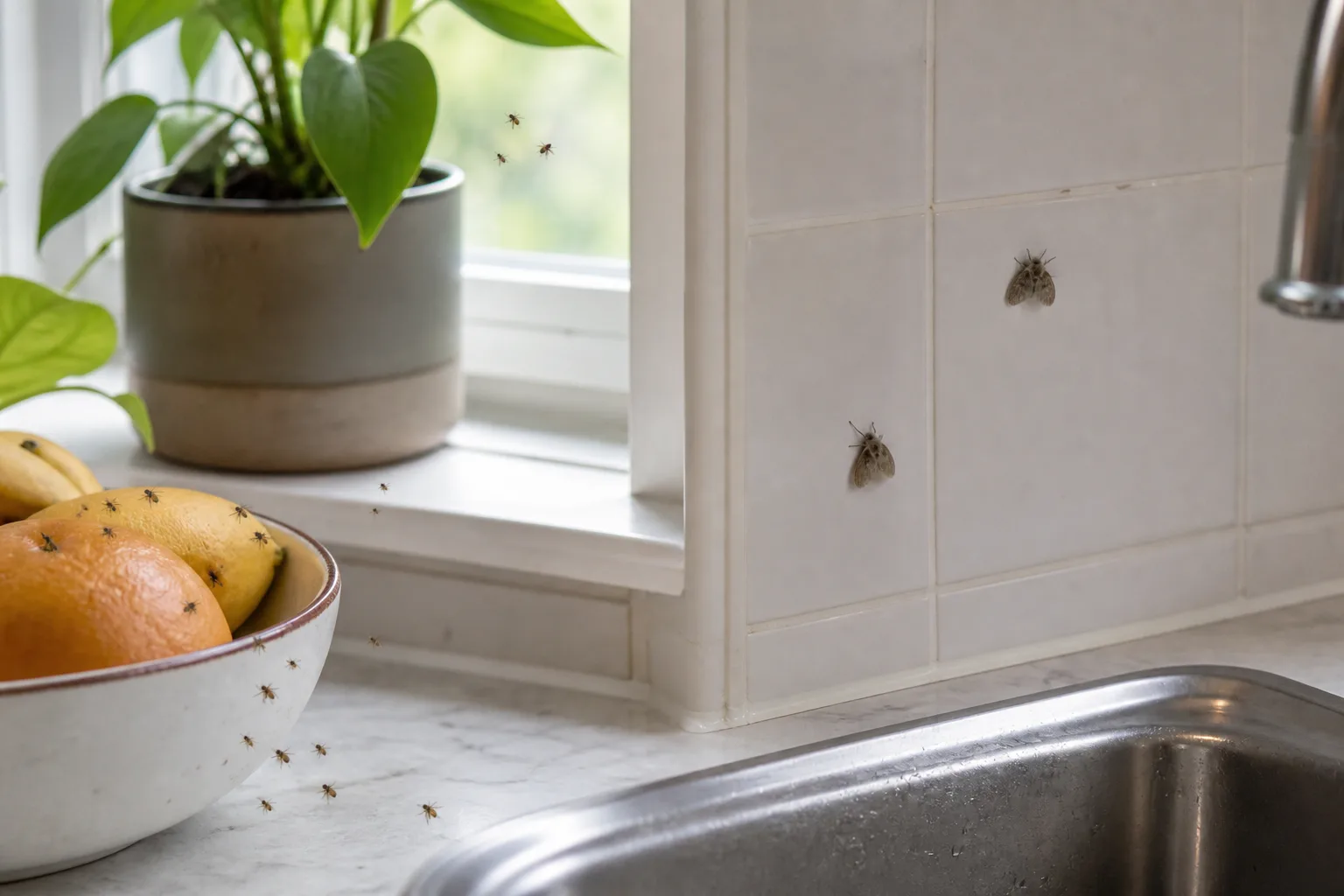
Drain flies, also called moth flies, have a fuzzy or dusty appearance and tend to rest rather than zip around the room. They show up near sinks, tubs, showers, floor drains, or rarely used guest bathrooms. If you see them on a wall close to plumbing, do not assume a fruit-fly trap is the right first move.
The larvae develop in wet organic sludge on the inside surfaces of drains and plumbing. Arkansas Extension explains that adults are difficult to drown because their fine body hairs repel water, and that killing the visible adults does not interrupt the life cycle (University of Arkansas System Division of Agriculture Extension’s drain-fly guide). The source may be a sink drain, a shower trap, a floor drain, a leaking pipe, or more than one site at once.
Why vinegar can backfire
Vinegar smells fermented, which is why fruit flies investigate it. That helps only when the liquid is in a real trap and the original breeding source is being removed; an open bowl can attract adults without reducing hidden larvae.
The same logic does not transfer cleanly to fungus gnats. University of Wisconsin–Madison Extension specifically says vinegar traps and other methods used to monitor fruit flies do not work for monitoring fungus gnats. Fungus gnat adults are better monitored with yellow sticky cards near the plant canopy, while the larvae are addressed by changing the moisture conditions in the growing medium (Wisconsin Horticulture’s fungus-gnat guidance).
Vinegar can also create a false sense of progress. You may see dead adults in a cup and assume the infestation is shrinking, while eggs, larvae, and pupae continue developing in soil, produce scraps, or drain buildup. Count fewer emerging flies over several days, not one successful trap, as the real test.
The vinegar trap that is worth using
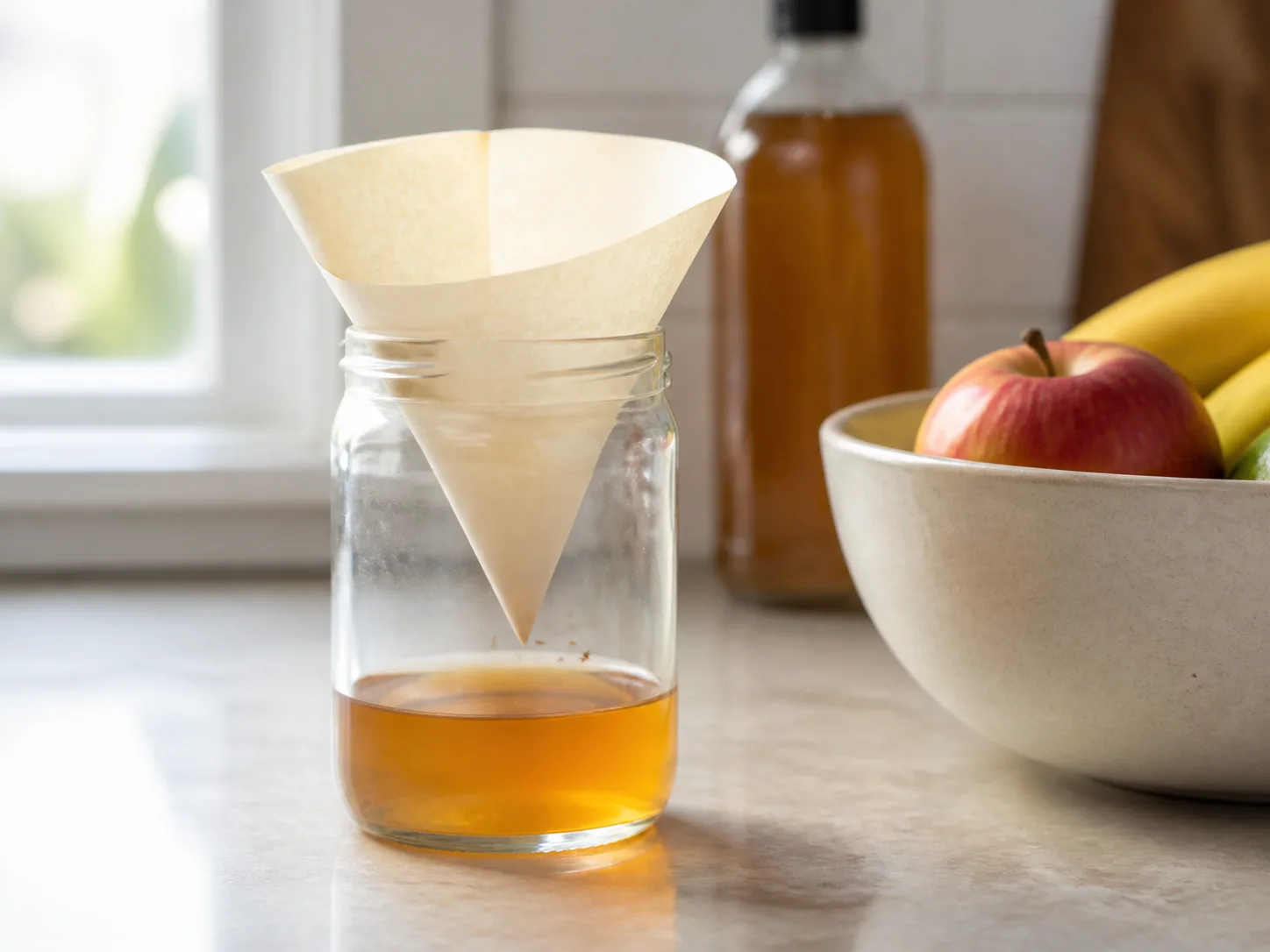
For a suspected fruit-fly problem, use a small trap rather than an open dish. Put a shallow amount of apple cider vinegar in a jar or cup and add one or two drops of dish soap. The soap lowers the liquid’s surface tension, making it harder for a fly that lands on the bait to escape.
How to set it up
- Add enough apple cider vinegar to cover the bottom of a small container; a shallow pool is easier to refresh than a full jar.
- Add a drop or two of dish soap and swirl gently. More soap is not better, especially around children, pets, or food-preparation areas.
- Cover the container with plastic wrap and poke a few small holes, or use a paper funnel whose narrow end stays above the liquid.
- Place the trap beside the suspected source, not across the room where it competes with every other odor in the house.
- Empty and wash the container when it collects flies or becomes dusty, then make a fresh batch while the source-control work continues.
You can use a commercial fruit-fly trap instead if you prefer a closed design. Keep any trap away from children, pets, exposed food, and a plant’s root zone.
Where it should go
Put one trap near the fruit bowl, another near a recycling bin or garbage disposal if activity is concentrated there, and a third only if the room has a separate hot spot. More traps are not a substitute for inspection. If the flies ignore the bait and remain around a potted plant or bathroom drain, stop adding vinegar and change your diagnosis.
What to do if the flies are around houseplants
Treat fungus gnats as a soil-management problem with an adult-monitoring step. The goal is to make the surface less attractive for egg-laying, reduce survival of eggs and larvae, and catch adults before they reproduce again.
Dry the surface without stressing the plant
First, stop watering by calendar. Check the plant’s soil and pot weight, then allow the top inch or two to dry before watering again if that dry-down suits the species. Colorado State University Extension recommends allowing the growing medium to dry between waterings, especially the top one to two inches, because dry conditions reduce egg and larval survival and make the surface less attractive to egg-laying adults.
Do not turn “let it dry” into “let every plant wilt.” Ferns, seedlings, moisture-loving tropicals, and plants in very small pots may need a different interval from a snake plant or succulent. Move an infested plant away from the collection, empty its saucer, improve drainage, and increase the interval only as far as the plant can tolerate.
If the pot stays wet, check for a blocked drainage hole, a cachepot holding runoff, compacted mix, low light, or a container too large for the root ball. N.C. Cooperative Extension also recommends checking leaks, damp utility rooms, crawlspaces, and other excess-moisture areas (its source-control guidance).
Trap adults and target larvae
Place yellow sticky cards at the soil line or just under the plant canopy. They are useful for reducing adult numbers and for showing whether your changes are working. Replace them when they fill with insects or dust, and keep the cards where pets and small children cannot contact the adhesive.
For larvae, use the potato-slice check before choosing a treatment. If larvae are present, a labeled product containing Bacillus thuringiensis subsp. israelensis (Bti) or beneficial nematodes such as Steinernema feltiae may be appropriate, depending on local availability and the plant. Colorado State University Extension notes that Bti targets larvae rather than eggs, pupae, or adults, while its guidance on nematodes describes a larval treatment delivered as a growing-medium drench. Follow the product label; do not improvise a concentration.
A thin layer of coarse sand or fine gravel can make the surface less inviting, but it is not a cure and it can hide moisture. Yates recommends allowing the top 25 to 50 millimeters of potting media to dry and not leaving pots in trays full of water (Yates’ fungus-gnat control guide). If you cover the surface, continue checking the soil below rather than watering by what the top dressing looks like.
Expect a lag. Because indoor fungus gnats can have overlapping generations, you may continue seeing adults for several weeks after the first watering change. A steady decline on the sticky cards is more meaningful than a clear room for one afternoon.
What to do if they are in the kitchen
If the flies gather around food, vinegar can be part of a 48-hour source hunt, not the whole treatment. Remove or refrigerate ripe produce, wash the fruit bowl, take out trash, rinse recycling, and inspect onions, potatoes, bread, lunch containers, and the spaces beneath appliances.
Remove the breeding material
Clean sticky spills beneath the refrigerator, microwave, toaster, and trash can. Wash the bottom of the trash container, wring out sour-smelling mops and cloths, and check the drip pan under the refrigerator if it is accessible and safe to clean. Empty the garbage disposal and scrub its splash guard rather than relying on a quick rinse.
Do not assume the fruit bowl is the source. Check hidden produce, food-soiled trash cans, recycling bottles, drain traps, floor drains, and wet decaying plant material. The trap matters after the source is gone; before that, it only harvests symptoms.
What to do if they are near a drain
Drain flies need a different sequence: confirm, clean, repeat, inspect for leaks. Do not pour insecticide, bleach mixtures, or an unlabelled pesticide down a drain. Arkansas Extension warns that no insecticide products are registered for use in drains or sewer systems and that such products can damage sewer or septic systems without eliminating the breeding site.
Confirm the drain before cleaning
At night, cover a suspect drain with a clear cup or jar coated lightly inside with vegetable oil or petroleum jelly, or use clear tape over the opening where appropriate. The goal is to monitor emerging adults, not to seal a plumbing problem permanently. Check several nearby drains because more than one may be producing flies.
Once you identify a source, remove the organic film with a drain brush or another fixture-appropriate method, then use a labeled drain cleaner. A hot-water rinse or vinegar pour may not remove the sludge where larvae feed. Maintain the cleaning long enough to interrupt the life cycle; Arkansas Extension recommends at least three weeks or longer.
If flies continue after all accessible drains are cleaned, look for a broken pipe, leaking shower pan, damp crawlspace, floor drain, or hidden plumbing issue. A plumber or pest professional is more useful at that point than another homemade trap, especially if the smell, moisture, or activity suggests a concealed source.
Mistakes that keep the infestation alive
The most common mistake is treating gnat as an identification or killing adults while leaving eggs and larvae in place. A spray, swatter, sticky card, or vinegar cup can lower visible numbers without solving the source.
Do not over-dry a moisture-loving plant, keep refilling vinegar while hidden produce or recycling remains, or pour random chemicals into a drain. Household vinegar can injure plant foliage and is aimed at the wrong life stage.
When to stop DIY and get help
Call a pest professional when the insects are widespread, the source remains hidden, the problem persists after several weeks of source control, or you suspect a leak, crawlspace, wall cavity, or commercial drain system. Sewage backup, standing contaminated water, or a plumbing failure needs infrastructure repair before adult-insect control.
For houseplants, ask a nursery professional or extension service for help when seedlings are collapsing, roots are badly damaged, the soil never dries, or you are unsure about a longer dry interval. Use the label for Bti, nematodes, or any insecticide.
Conclusion
Vinegar is not useless, but it is specific. It can lure adult fruit flies into a soapy trap after you remove the fermenting food source; it does not treat fungus-gnat soil or drain-fly breeding film.
Start with the location: soil means moisture control and sticky cards, food means sanitation plus a fruit-fly trap, and drains mean source testing and cleaning. Once the breeding site is gone, the flying adults finally have nowhere to replace themselves.



