Japanese Lilac Tree Care and Growing Guide
Learn how to grow a Japanese lilac tree with the right site, planting depth, water, pruning window, cultivars, and fixes for poor bloom or leaf problems.
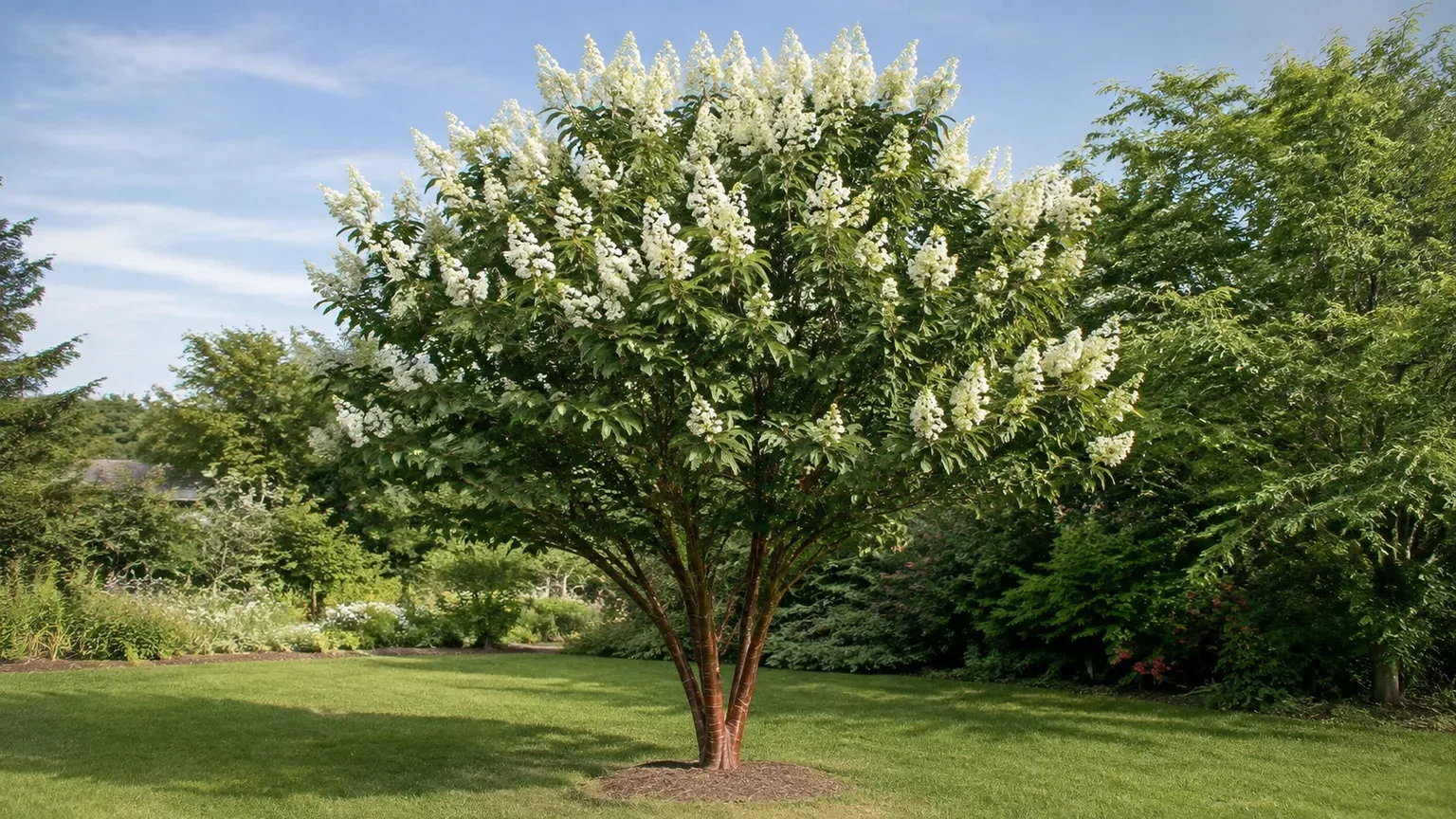
A Japanese lilac tree earns its space by doing more than producing flowers. Syringa reticulata offers a rounded canopy, reddish-brown bark marked with horizontal lenticels, fragrant creamy-white panicles in early summer, and dry seed capsules that can persist into winter. It is also one of the more forgiving lilacs—provided you give it sun, drainage, and enough room to mature.
The most important care decision happens before planting: choose a site that receives at least six hours of direct sun and does not stay wet after rain. Once established, this is a low-maintenance ornamental tree. The work that matters most is structural training while it is young, immediate-after-flowering pruning, and consistent watering during its first two growing seasons.
Japanese Lilac at a Glance
Use this table as a planning checkpoint. The figures describe the species and common tree forms; a named cultivar or a multi-stem specimen may be smaller or shaped differently.
| Care factor | Practical target | Why it matters |
|---|---|---|
| Botanical name | Syringa reticulata | A tree-form lilac in the olive family, Oleaceae |
| Mature size | About 20–30 feet tall and 15–20 feet wide | It is a small landscape tree, not a compact shrub |
| Hardiness | USDA Zones 3–7 | Cool winters suit it; hot, humid climates are a poor match |
| Light | Full sun; light shade is tolerated | More direct sun generally means more flowers and drier foliage |
| Soil | Moist but well-drained, average to organically rich | Clay is acceptable only when water can leave the root zone |
| Water | Medium while establishing; less supplemental water once mature | Deep, infrequent watering is better than shallow daily wetting |
| Bloom | Creamy-white panicles in late spring to early summer | The display is seasonal and lasts roughly two weeks |
| Pruning | Light maintenance; shape immediately after flowering | Late-winter pruning can remove next year’s flower buds |
| Best uses | Specimen, lawn, patio edge, street tree, or small group | Choose a spot where the canopy and fragrance can be appreciated |
NC State Extension describes the species as a medium-growing, low-maintenance tree that can reach about 30 feet, tolerate clay and urban conditions, and attract hummingbirds, butterflies, and other insect pollinators. Its profile also notes the short bloom window and the tendency for the scent to be more privet-like than the sweet perfume associated with common lilac. (NC State Extension Plant Toolbox)
Know What You’re Buying
“Japanese lilac” can refer to a species, a subspecies, or a cultivar sold as a grafted or trained tree. Read the nursery tag for the full botanical name and mature dimensions instead of assuming every tree lilac reaches the same height. Some plants are grown with one trunk; others are intentionally sold as attractive multi-stemmed shrubs.
The species is deciduous and naturally forms an oval to rounded crown. Its leaves are simple, dark green, and pointed, while the bark begins reddish brown and becomes grayer and more scaly with age. Upright panicles of small cream or white flowers appear later than many spring-flowering lilacs, filling the transition between spring bloomers and summer plants.
Tree form, shrub form, and common-lilac differences
A tree-form plant has a defined trunk and canopy, which makes it useful near a patio, lawn, or sidewalk. A multi-stemmed plant has more basal growth and can look fuller from the ground up; it is often the better choice when you want a large shrub or a relaxed woodland shape. Neither form is inherently healthier, so buy the structure that fits your site rather than forcing every plant into a single-trunk standard.
Compared with common lilac (Syringa vulgaris), Japanese tree lilac is usually taller and more tree-like, blooms in early summer rather than the main late-spring rush, and has white-to-cream flowers instead of the familiar purple, pink, or white shrub blooms. The fragrance is subtler and can read as musky or privet-like. The payoff is a more durable small-tree silhouette and ornamental bark after the flowers fade.
The Royal Horticultural Society lists S. reticulata as a deciduous tree or shrub for full sun and moist but well-drained soil, with a mature height that can exceed 8 meters under suitable conditions. It also records minimal pruning as the norm and recommends trimming immediately after flowering when shaping is necessary. (Royal Horticultural Society plant profile)
Choose a Site That Solves the Biggest Problems
Japanese lilac is tolerant of several soil textures, but it is not tolerant of a site that stays saturated. Before you dig, watch the proposed location through one rainfall cycle. If water sits in the planting hole for hours or the area receives roof runoff, correct the drainage or choose a different place; adding a little compost to a chronically wet hole will not make it suitable.
Sun and air movement
Give the tree full sun whenever possible—roughly six or more hours of direct light during the growing season. Light shade will keep the plant alive, but it commonly produces a thinner canopy and fewer flower panicles. A sunny location also dries leaves faster after rain, which reduces the conditions that favor powdery mildew.
Leave open space around the canopy rather than wedging the tree between a fence and a dense hedge. Good air circulation is a recurring recommendation in the plant profiles from NC State Extension and the Missouri Botanical Garden, and it is a simple way to reduce crowded, humid foliage without reaching for a spray bottle.
Space, utilities, and hardscape
Plan for the mature spread, not the size of the nursery pot. For a typical 15- to 20-foot canopy, place the trunk far enough from a house, fence, or walkway that branches will not immediately overhang the structure. A cultivar such as ‘Ivory Silk’ may stay closer to 20–25 feet, while a species tree can be larger.
Do not plant any Japanese lilac directly beneath power lines just because it is sold as a “small tree.” Mature height, pruning history, and site conditions all vary. If an established tree is close to utility lines or requires a ladder or chainsaw, use a qualified arborist; never work on a tree that touches a power line.
Its roots are not known for the aggressive behavior of some running shrubs, but that does not make every distance harmless. Keep the root flare and trunk away from mower traffic, avoid compacted construction fill, and leave enough room for the root zone to extend beyond the drip line. A broad mulched bed is usually easier on the tree than turf growing tight against the trunk.
Planting Step by Step
Spring planting after the soil becomes workable is a reliable choice in colder regions. Early fall can also work when the tree has several weeks to establish roots before the ground freezes. Avoid planting a new tree into frozen soil, during a heat wave, or when the site cannot be watered consistently.

Container-grown and balled-and-burlapped trees should be planted promptly once the root ball is sound and the site is ready. If you receive a bare-root tree, keep the roots moist, soak them for a few hours if they have dried, and plant as soon as practical. Gardening Know How notes that Japanese tree lilacs are available in container, balled-and-burlapped, and bare-root forms and generally transplant well. (Gardening Know How growing guide)
Timing and plant preparation
- Measure the root ball’s height and width before digging. Make the hole two to three times wider than the root ball, but no deeper than its height.
- Find the root flare—the point where the trunk begins to widen and major roots emerge. On a young nursery tree it may be buried under potting mix; expose it gently before setting the plant.
- Slide a container plant out without pulling on the trunk. If roots are circling tightly, loosen only the outermost roots enough to encourage outward growth. Do not shred a healthy root ball.
- For a balled-and-burlapped plant, cut away twine and remove or fold back burlap from the top portion of the root ball. Do not leave synthetic material around the trunk.
Planting depth and first watering
Set the root flare level with, or slightly above, the surrounding soil. A tree planted too deeply can develop a buried trunk, poor oxygen exchange, and chronic moisture problems even when the top of the soil looks dry. Backfill with the soil you removed, breaking up large clods but resisting the urge to create a rich, soft pocket that holds water around the roots.
Water slowly across the entire root ball and the backfilled area so air pockets settle naturally. Do not tamp the soil with your feet or build a permanent basin against the trunk. Add a 2- to 3-inch layer of organic mulch over the root zone, keeping it several inches away from the bark.
Stake only if the root ball is unstable or the site is unusually windy. If you stake, allow slight trunk movement and remove the supports after the first growing season. A tree that can flex develops stronger trunk movement than one held rigid for years.
Watering for Establishment and Mature Trees
For the first growing season, check the soil at the edge of the root ball every few days during hot or dry weather. Water deeply when the upper few inches begin to dry, applying enough to moisten the full root ball without leaving standing water. The exact interval depends on temperature, soil texture, rainfall, mulch, and the size of the tree, so “once a week” is only a starting observation—not a rule.
In the second season, begin checking a wider area as new roots move into the surrounding soil. Lengthen the interval between waterings while increasing the area you wet. This encourages a broader root system and prevents the common mistake of keeping only a narrow circle beside the trunk damp.
An established Japanese lilac generally needs supplemental water during prolonged drought, severe heat, or unusually dry winters, but it should not be irrigated automatically every day. Feel the soil, look for wilt that persists into the morning, and check whether the tree is competing with turf or other thirsty plants. Yellowing combined with wet soil is a drainage warning, not a request for more water.
Soil, Mulch, and Fertilizer
The useful soil target is moist but well-drained, not permanently wet. Japanese lilac can tolerate clay, sand, loam, and neutral to mildly acidic or alkaline conditions, but compacted clay that holds water at the root flare is a different problem from ordinary clay soil. If you are unsure, dig a test hole, fill it with water, let it drain, and refill it; persistently slow drainage calls for a new site or professional drainage solution.
If the wider bed is poor, incorporate finished compost into the planting area rather than replacing the hole’s soil with pure compost. Organic matter improves structure over time, while a sharply different backfill can create a small bowl that roots never leave. The RHS profiles describe this tree as adaptable to clay, loam, sand, chalk, neutral, and alkaline soils when drainage is good.
Refresh mulch in spring or early summer, keeping it flat and broad rather than piled against the trunk. Mulch moderates soil temperature, slows evaporation, and reduces competition from grass. Pull it back temporarily if the bark stays damp or rodents begin nesting under it.
Do not fertilize automatically because a young tree is growing slowly. First rule out shade, drought, buried roots, compacted soil, and planting shock. If a soil test or persistent weak growth points to a nutrient need, use a slow-release or balanced product at the label rate in spring, spread over the root zone, and water it in. High-nitrogen feeding can produce lush, weak shoots without improving flowering and may worsen some blight problems.
Pruning for Flowers, Form, and Safety
Japanese lilac usually needs less pruning than a shrub lilac. Start with the smallest useful cut: remove dead, broken, diseased, crossing, or rubbing branches, and take out suckers that emerge from the base if you want to preserve a defined trunk. Make cuts just outside the branch collar rather than leaving stubs or cutting flush against the trunk.

The best time for routine shaping is immediately after flowering. Lilacs form the next season’s flower buds on older growth, so late-summer, fall, winter, or early-spring reshaping can remove the buds you were waiting to see. The NC State Extension woody-ornamentals handbook lists lilac among spring-flowering woody plants that should be pruned as soon as flowers fade for maximum flowering, while the RHS gives the same after-flowering window for Japanese tree lilac. (NC State Extension woody ornamentals handbook)
Dead or damaged wood is the exception: remove it when you notice it, regardless of the season, if leaving it would create a safety or disease problem. For a healthy mature tree, avoid removing more than about one-quarter of the canopy in one year. Topping the tree to force a smaller size creates weak regrowth and does not solve a site that is fundamentally too small.
Train a single trunk gradually
If you bought a young single-trunk tree, inspect its framework once or twice each growing season. Remove competing leaders when one is clearly weaker, keep branches with strong attachment angles, and shorten or remove branches that cross through the center. Make structural corrections over several seasons instead of trying to redesign the entire canopy at once.
Do not strip every low branch immediately after planting. Young lower branches help feed the tree, shade thin bark, and build trunk taper. Once the tree is established, remove one or two low branches at a time if you need more clearance, always preserving a balanced crown.
If your plant is naturally multi-stemmed, you can keep that form. Forcing several equal trunks into one leader years after planting creates large wounds and may make the structure less stable. A multi-stemmed Japanese lilac can be an excellent specimen when the stems are spaced, vigorous, and free of rubbing or tight, included unions.
Know when to call an arborist
Hire an arborist for high branches, large limbs, storm damage, extensive structural defects, or any tree near utility lines. A pruning saw on the ground is appropriate for reachable small branches; it is not a reason to climb with a chainsaw or use a pole saw around wires.
For routine cuts, use sharp bypass pruners for small twigs, loppers for medium branches, and a pruning saw for larger wood. Clean tools between diseased cuts, especially when you see suspicious dark streaking or cankers. A professional can also tell whether a weak fork is worth correcting or whether removing it would create a larger problem.
Cultivars and Tree-Lilac Types
Choose by mature size, form, and foliage—not just by the largest flower photograph on the tag. The three commonly discussed tree-lilac groups are the Japanese subspecies, Peking lilac, and Amur lilac. Their size and habit can overlap in nursery descriptions, so the cultivar name and local nursery information matter more than a common name alone.
| Type or cultivar | General character | Best fit |
|---|---|---|
| S. reticulata subsp. reticulata | Full-size tree form, rounded to upright habit, creamy-white early-summer flowers | A specimen tree with room to mature |
| Peking lilac, subsp. pekinensis | Often smaller, arching, and shrub-like, with attractive bark | A looser border or smaller landscape setting |
| Amur lilac, subsp. amurensis | Commonly more compact and multi-stemmed | A large shrub or small-group planting |
| ‘Ivory Silk’ | Compact tree form, typically about 20–25 feet tall and 15–20 feet wide | A named tree for a lawn, patio edge, or street setting |
| ‘Summer Snow’ | Compact, rounded habit with large flower clusters | A smaller, rounded specimen |
| ‘Chantilly Lace’ | Variegated foliage with cream-colored margins | A foliage-focused site with enough light to maintain vigor |
The Missouri Botanical Garden lists ‘Ivory Silk’ for Zones 3–7, full sun to part shade, medium water, and low maintenance, with the best growth in cool-summer climates. Its profile also recommends removing faded panicles before seed set when practical and pruning immediately after flowering. (Missouri Botanical Garden Plant Finder: ‘Ivory Silk’)
Blooming and Seasonal Care
Expect the main show in late spring or early summer, often around June in temperate regions. Upright panicles can reach roughly 6–12 inches, but the flowers are the feature for a short window—about two weeks—rather than a season-long display. Afterward, green-to-yellow or brown capsules may remain into winter and provide texture and some wildlife value.
To maximize flowers, prioritize full sun, steady moisture while the tree establishes, and the after-flowering pruning window. Do not chase blooms with high-nitrogen fertilizer. If a young tree produces leaves but no flowers, give it time; transplanting, a small root system, and juvenile growth can delay a strong display.
Use this seasonal rhythm:
- Late winter: Inspect for storm damage, but postpone healthy shaping until after flowering. Check mulch depth and pull it away from the trunk if it has drifted.
- Spring: Watch for frost after early warm spells because flower buds can be injured. Refresh mulch, monitor soil moisture, and fertilize only when a test or clear deficiency supports it.
- After flowering: Remove spent panicles if you want to reduce seed set, then complete light shaping and structural corrections.
- Summer: Water deeply during drought, check new growth and branch unions, and watch crowded foliage for mildew or leaf damage.
- Fall and winter: Let the bark, branching, and persistent capsules carry the display. Remove only hazardous or clearly dead wood and avoid a cosmetic haircut.
Common Problems and What to Do First
This species is generally less troublesome than common lilac, but “low maintenance” does not mean problem-proof. The first response should match the symptom rather than defaulting to fertilizer or pesticide.
No flowers or very few flowers: Check light first, then ask whether the tree was pruned before it bloomed. Next look at drought during bud formation, transplant stress, and excess nitrogen. If the canopy is healthy but flowering is sparse for several years in a shady or overheated site, moving an established tree is usually more disruptive than improving the surrounding light or accepting a foliage-focused specimen.
White powder on leaves: Powdery mildew is more likely when foliage is crowded, shaded, or kept damp overnight. Improve air movement, avoid overhead irrigation, and remove badly affected fallen leaves. The problem is often cosmetic on an otherwise vigorous tree, so do not strip healthy foliage or apply a product without identifying the disease and reading its label.
Black spots, dark streaks, wilted shoots, or dying flower clusters: These symptoms can fit bacterial blight or another disease, especially after wet weather, excess nitrogen, or injury. Prune back to healthy wood with clean tools, remove the debris from the site, reduce crowding, and contact a local extension service if the problem is spreading rapidly or affecting major limbs.
Tunnels, sudden branch wilt, or broken stems: Lilac borer larvae tunnel into woody stems. Look for small holes, sawdust-like material, and dieback rather than assuming every wilted twig is drought. Remove and destroy badly infested reachable stems, maintain consistent watering, and ask an extension professional to confirm the pest before using any treatment.
Winding pale trails in leaves: Leaf miners can create visible tunnels in early summer. A few affected leaves are not a reason to spray the whole tree; remove and discard the worst leaves when the tree is small, and monitor new growth. Broad sprays can harm beneficial insects that visit the flowers.
Buds killed after a warm spell: Early spring warmth can advance flower buds, followed by frost injury. Brown, shriveled buds may not recover that season, but the tree can still leaf out and grow normally. Wait for live growth before doing corrective pruning, and judge the plant over the next bloom cycle.
The RHS also lists leaf-mining moths, thrips, scale insects, blight, leaf spots, wilt, root rot, and canker as possible issues, while the Missouri Botanical Garden and NC State Extension describe the species as having no serious routine pest or disease burden. That difference is useful: a problem can occur without being the usual reason to treat every tree. (RHS Japanese tree lilac profile)
Propagation from Softwood Cuttings
Japanese lilac can be propagated from softwood cuttings in early summer, when new shoots are flexible but beginning to firm. Propagation is not the fastest way to obtain a flowering tree, and success is variable, so start several cuttings rather than relying on one.
- Choose a healthy non-flowering shoot and cut a 4- to 6-inch section just below a node.
- Remove the lower leaves, leaving a small set at the tip. If the leaves are large, trim them slightly to reduce water loss.
- Dip the base in a rooting hormone labeled for softwood cuttings if you choose to use one, then insert it into a sterile, airy rooting mix such as a blend designed for cuttings.
- Cover the container with a clear humidity dome or loose plastic that does not touch the leaves. Keep it in bright shade, warm but not hot, and evenly moist—not waterlogged.
- Check for resistance after several weeks, but do not pull repeatedly. Once roots are established, acclimate the cutting gradually to lower humidity and pot it into a well-drained mix before hardening it outdoors.
The RHS lists softwood cuttings as a suitable summer propagation method, while NC State identifies seed and stem cuttings as propagation strategies for the species. Seed-grown plants will not reliably reproduce a named cultivar, and a seedling may take many years to reach flowering size. (RHS propagation and plant profile)
Conclusion
Japanese lilac tree care is mostly about getting the first decisions right. Give Syringa reticulata full sun, room for a 15- to 20-foot canopy, soil that drains after rain, and deep attention to watering during establishment. Mulch broadly, fertilize only when evidence supports it, and prune immediately after flowering so you do not remove the next season’s buds.
Train young tree form gradually, keep a natural multi-stem form when it suits the plant, and treat symptoms by diagnosis rather than panic. With those habits, this cool-climate ornamental can provide a dependable early-summer flower display, distinctive bark, and a useful small-tree structure with surprisingly little annual work.