How to Grow and Care for Chinese Silver Grass
Is Chinese silver grass right for your garden? Compare cultivar size and seed fertility, plant it well, and avoid common care and spread problems.
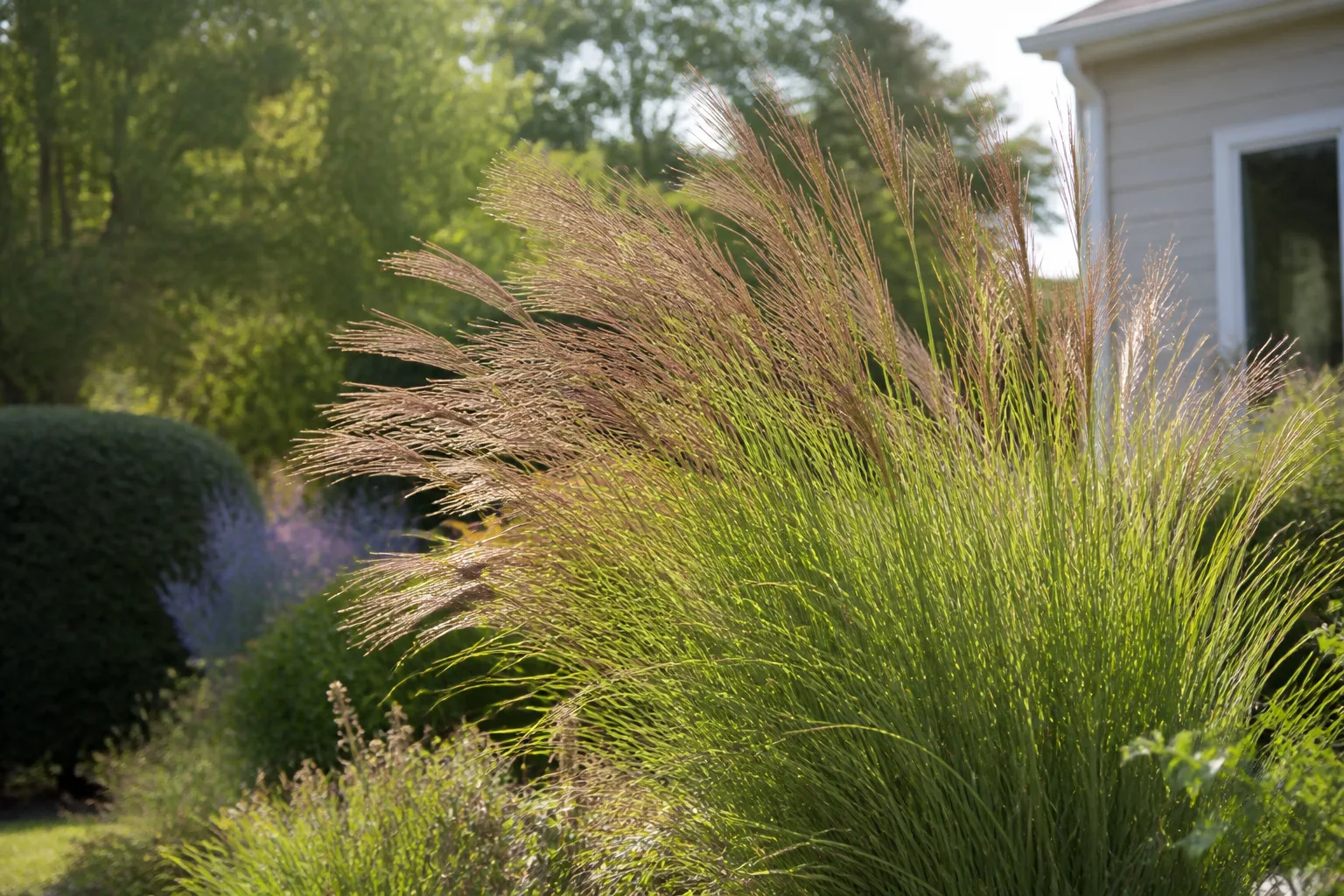
Chinese silver grass has the look of a fountain built from leaves: narrow blades arch out from a dense base, then late-season plumes rise above the foliage and hold their shape after frost. It is often sold as Japanese silver grass, eulalia, or maiden grass. Those names usually refer to Miscanthus sinensis, but a cultivar name matters because mature size, foliage pattern, bloom timing, and seed production can differ markedly from one selection to another.
Before you buy it, check one thing many plant labels leave out: whether the species or cultivar is suitable in your region. The species can escape gardens, produce wind-dispersed seed, and create persistent stands in some parts of North America. If it is listed as invasive or regulated where you live, choose a locally appropriate grass instead; routine pruning cannot make an unsuitable plant ecologically harmless.
First, identify what you are buying
Miscanthus sinensis is a deciduous, warm-season perennial grass from East Asia. It begins growth later than cool-season grasses, forms a clump rather than a lawn, and typically produces upright or arching foliage with a pale central midrib. Flower plumes appear above the leaves in late summer or fall, then change from pink, reddish, or silvery tones toward tan as they mature. The species is highly variable: the Royal Horticultural Society lists plants ranging from compact forms to selections that can reach several meters, so a generic label is not enough to predict the footprint (RHS plant profile).
The common names are not a reliable way to distinguish species from cultivar. “Maiden grass” can refer broadly to M. sinensis or to particular selections, while “Japanese silver grass” and “Chinese silver grass” are also used for the species. Read the full botanical name on the pot or catalog page, including the cultivar in single quotation marks, and confirm the plant’s mature height and width before choosing a location.
The growth is seasonal, not a sign of failure. In early spring the old clump may look lifeless while the ground is still cool. Wait for warmer soil before deciding it has died; once new blades emerge, the plant grows quickly and fills out over the summer.
Is Chinese silver grass a good choice for your region?
There is no single answer for every garden. NC State Extension describes M. sinensis as invasive in North Carolina, while the Missouri Botanical Garden notes that the species has escaped cultivation in many central and eastern states and can invade valuable grasslands and forest openings. Regional invasive-plant groups also document its spread in disturbed habitats and flag the dry foliage as a fire concern in their service area (NC State Extension, Missouri Botanical Garden, WNY PRISM).
That evidence does not establish the plant’s status in every county or state. Check your state department of agriculture, local extension service, or regional invasive-species council before planting, especially near open land, roadsides, prairies, wetlands, or natural areas. In some places, sale or movement may be restricted; a nursery’s willingness to sell a plant is not a substitute for checking local rules.
What low-fertility and sterile labels really tell you
Cultivars bred or selected for reduced fertility can lower the chance that viable seed will spread, but “low fertility” is not the same as “cannot spread.” A clump can still enlarge from its short rhizomes, and one cultivar’s performance should not be generalized to every plant sold under a common name. NC State identifies selections such as Bandwidth and My Fair Maiden as reduced-fertility choices and lists some named cultivars as sterile or low seed set; it also still advises considering alternatives for the species in North Carolina.
If seed spread is the main concern, buy an exact, named cultivar and look for documentation from an extension or botanical source that addresses seed viability—not merely a tag that says “non-invasive.” Ask the nursery for the cultivar’s complete name and the basis for its claim. Remove volunteer seedlings promptly, and do not share divisions or seed with gardeners in regions where the plant is discouraged.
Choose a cultivar by mature size and seed risk
Choose the plant for its eventual dimensions and behavior, not just the color in a catalog photo. A large selection may be more than 8 feet tall and several feet wide once plumes rise; compact selections fit smaller gardens but still need room for foliage to arch. The following are useful starting points, not universal size guarantees:
| Cultivar | What it offers | What to check before buying |
|---|---|---|
| ‘Gracillimus’ | Fine green leaves with a silvery midrib and a rounded, fountain-like outline | Its mature clump is substantial; verify local fertility guidance rather than assuming the popular cultivar is sterile |
| ‘Morning Light’ | Narrow leaves with pale striping that give the plant a bright, shimmering effect | NC State reports that this cultivar does not produce viable seed; confirm your local recommendation and allow for its full spread |
| ‘Silberfeder’ | Tall growth and large pinkish-silver plumes for a broad border or screen | It reaches a large scale; NC State describes it as sterile, but it still forms a perennial clump |
| ‘Strictus’ or ‘Zebrinus’ | Horizontal yellow bands across the foliage create a strong graphic pattern | Patterned leaves may scorch in very hot sun; allow plenty of space and check cultivar fertility |
| ‘Adagio’ or ‘Little Kitten’ | More compact proportions for a smaller bed or large container | Compact does not mean tiny; use the supplier’s mature dimensions and inspect drainage needs |
Descriptions and fertility claims can change with the exact selection, and nursery names are sometimes abbreviated. For specific cultivars, compare the label to extension profiles such as NC State’s Morning Light and Silberfeder entries. If the grower cannot identify the cultivar or substantiate its seed behavior, treat it as potentially fertile.
Plan for the mature clump in your landscape
A mature plant is a broad, moving mass, not a narrow column. Put it where the leaves and flower stems can spread without blocking a path, crowding a neighboring perennial, or leaning across a driveway. A single clump can anchor the back of a mixed border, soften a fence, or bring movement to an open slope; repeating clumps can make a loose screen, although the lower foliage may not form a year-round privacy wall. That multi-season role—as a border backdrop, focal point, and winter-texture plant—is also emphasized in Epic Gardening’s maiden grass guide.
Use the plumes and winter silhouette as part of the placement plan. Backlighting can make the seed heads glow, and a dark hedge or evergreen background makes pale plumes easier to see. If the grass is close to a building, dry landscape, or wildfire-prone area, check local firewise guidance before planting: dry stems add fine fuel, and ornamental grass is not a good choice in a required defensible-space zone.
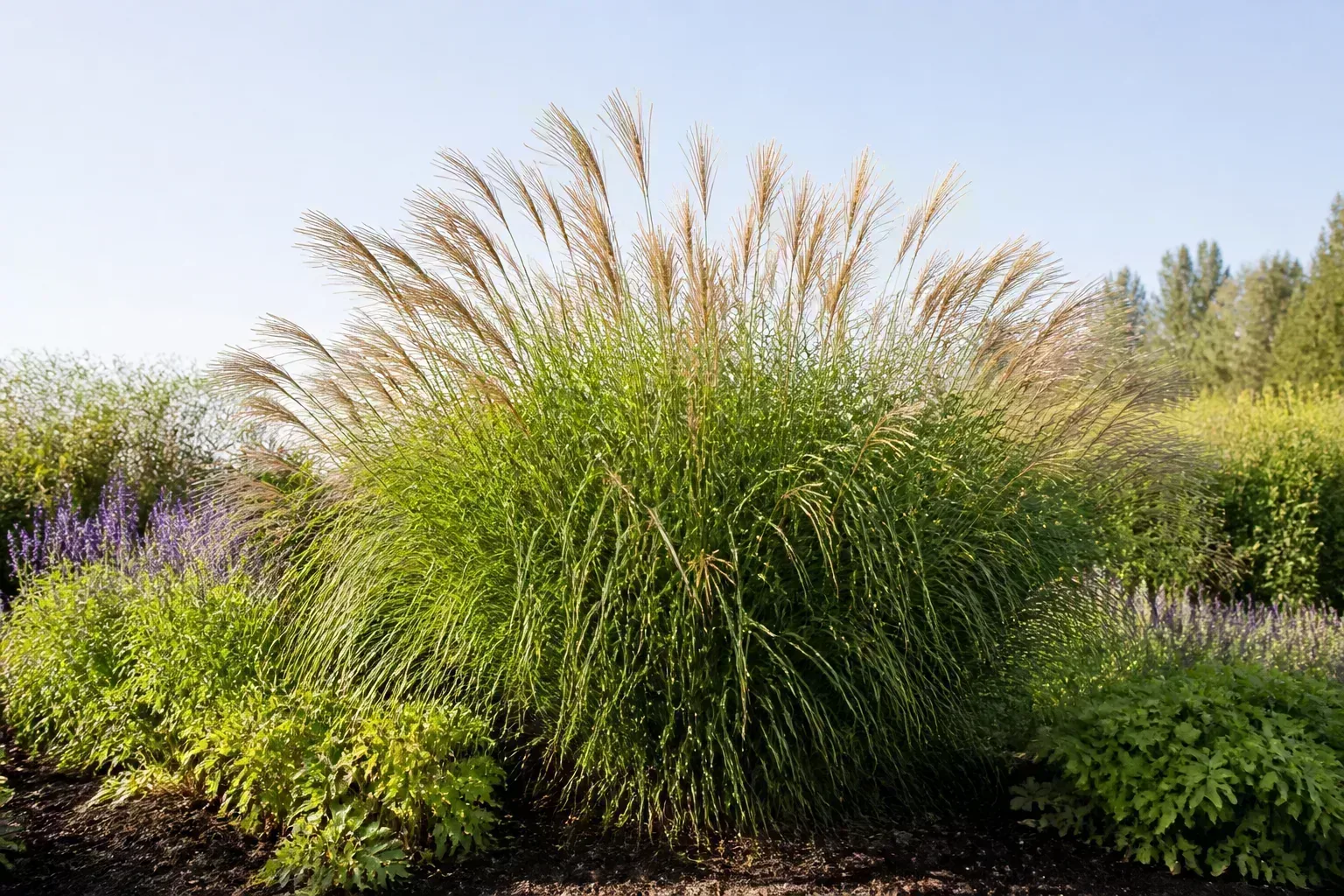
Plant it at the right time and depth
Plant a nursery-grown clump in spring after the soil is workable, or early enough in fall that roots can settle before hard frost. Spring planting gives the grass a full growing season to establish; in a region with hot summers, a fall planting can work only when there is enough mild weather and reliable moisture left for roots to grow. Avoid transplanting a small, stressed plant into peak heat or saturated winter soil.
Dig a hole about twice as wide as the root ball and no deeper than the plant was growing in its pot. Loosen circling roots gently, set the crown at ground level, backfill with the original soil, and water thoroughly to settle air pockets. A deep planting hole or a crown buried under mulch holds moisture against the base and can contribute to decline, particularly where winters are wet.
Space plants by their adult width
The RHS lists the species as variable in spread, and mature cultivars range from compact clumps to much broader forms. Use the specific selection’s mature width as the minimum distance to the next plant; if you want each grass to retain its fountain shape, add room for the foliage to arch without rubbing neighboring plants. A tight screen will fill sooner but is harder to divide and may look crowded once all plants mature.
For a mixed border, set the grass far enough behind shorter plants that its summer leaves do not smother them. For a screen, remember that the foliage dies back in winter: use evergreen shrubs or a fence if you need dependable year-round coverage. Measure from the center of each planting hole, not from the edge of the nursery pot.
Give it sun and soil that drains
Full sun gives most Chinese silver grasses the strongest flowering and firmest stems. A site with roughly six hours of direct sun is a practical starting point; light shade is tolerated, but deep shade usually means fewer plumes and a looser, more floppy clump. In the hottest climates, some afternoon shade may protect variegated cultivars from scorching, though too much shade can reduce bloom.
The plant adapts to many garden soils, including clay, but the key is drainage. The RHS recommends moderately fertile, moist but well-drained ground and warns against excessive winter wet; Missouri Botanical Garden notes that the plant tolerates a range of soils but performs and flowers best in sun. Do not amend an entire bed with sand or rich compost just to “fix” ordinary soil. If water stands for days after rain, move the plant to a better-drained location or choose a grass that is adapted to wet ground.
Water deeply during establishment
Water a newly planted clump when the root zone begins to dry rather than on a fixed weekly schedule. During the first growing season, check soil a few inches below the surface; if it is dry at root depth, water slowly around the base so moisture reaches the root ball and surrounding soil. Frequent shallow sprinkling wets the surface without encouraging roots to move outward.
Once established, Chinese silver grass tolerates dry spells better than a new transplant, but it still grows and flowers best with reasonable moisture during active growth. Let rainfall set the routine and water during an extended dry period when the soil is dry below the surface. If the soil is already wet, more water is not the answer to yellowing or weak growth; check drainage and the crown first.
Feed sparingly to protect the shape
Most clumps in average garden soil do not need regular fertilizer. A heavy dose of nitrogen may push fast, soft leaf growth that leans outward and makes the plant look untidy, especially when heavy plumes develop. If growth is pale and weak across the whole clump and the site is not waterlogged or deeply shaded, assess soil fertility before applying a modest spring feed according to its label.
Avoid making fertilizer the first response to poor bloom. Less sun, a newly planted clump, an old congested center, or a cultivar that flowers late in your climate can explain a sparse display. A thick layer of compost used as a surface mulch is also not necessary every year; keep any mulch away from the crown so spring growth can emerge cleanly.
Follow the grass through the seasons
Chinese silver grass has a clear annual rhythm. New foliage is late to appear in spring; the clump builds leafy height through summer; flowers rise in late summer or fall, with timing varying by cultivar and climate; and the dry seed heads remain as winter structure. This warm-season growth pattern explains why it can look slow in April and impressive by August.
Use the calendar as a cue, not a deadline:
- Late winter to early spring: Cut back last year’s stems before new blades become tangled in them. Divide or move clumps as growth starts.
- Spring and early summer: Plant, water new divisions, and keep the crown free of heavy mulch. Skip routine fertilizer in decent soil.
- High summer: Water established plants only through meaningful dry spells; check that tall selections are not shaded or crowded.
- Late summer and fall: Enjoy flowering and inspect for seedlings. If seed escape is a concern locally, remove flower heads before they shed.
- Winter: Leave healthy standing foliage for structure, but follow local fire-safety guidance where dry grasses pose a hazard.
Gardeners who expect the plant to look lush in early spring often cut too late or dig it up unnecessarily. Wait until the local warm-season grasses begin to show new green shoots before deciding whether a clump has survived winter.
Cut back old foliage before new shoots rise
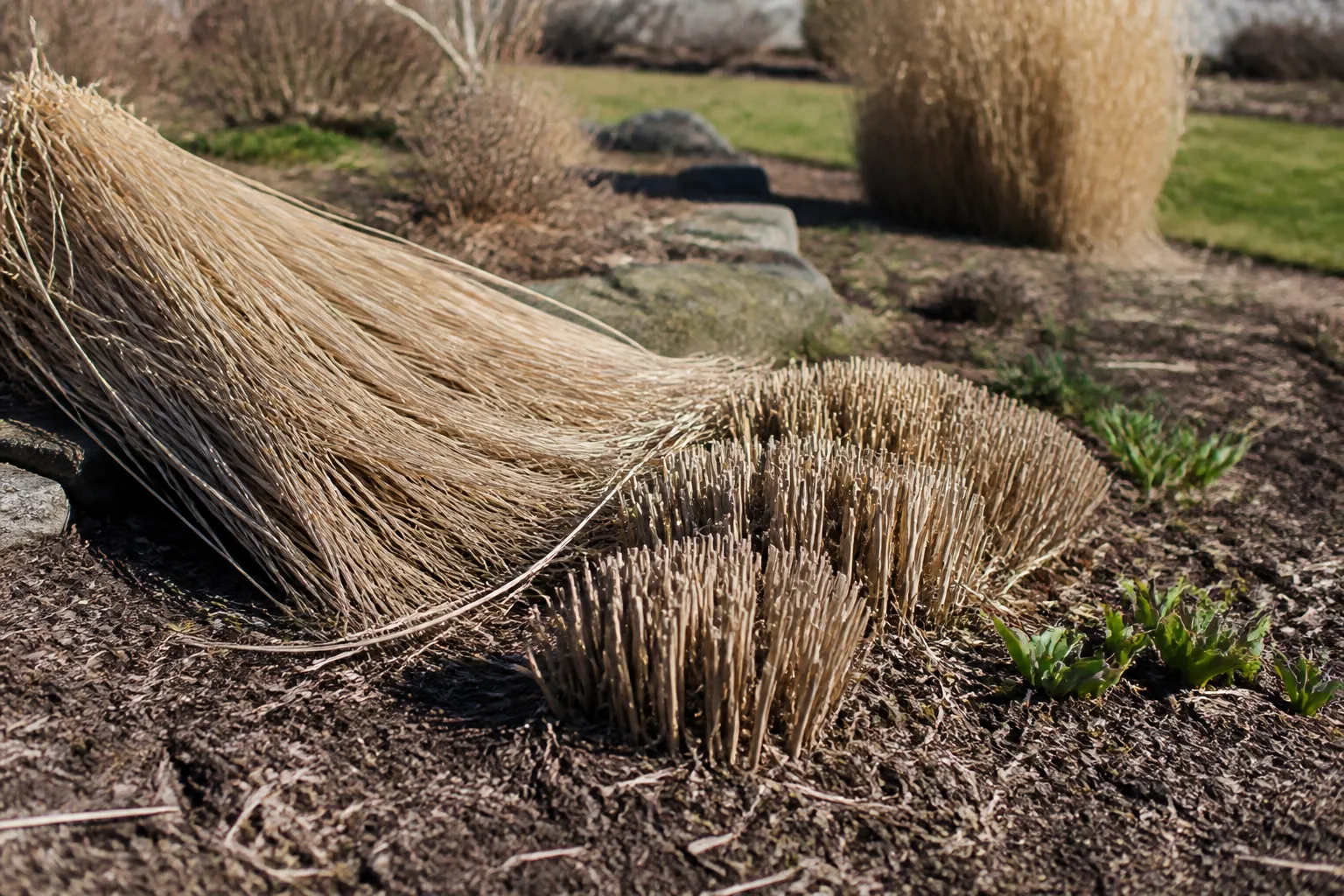
Leave the previous season’s blades in place through winter if it is safe to do so; they give the garden texture and help mark the crown. In late winter or early spring, cut the bundle down to a few inches above the soil, just before fresh leaves lengthen. The RHS recommends removing dead foliage and old flower stems in spring, while Missouri Botanical Garden describes cutting close to the ground before new shoots appear.
Tie the dry clump loosely with twine before cutting so the stiff leaves are easier to collect. Wear gloves and long sleeves because grass edges can be sharp, and avoid cutting into the crown or emerging green shoots. Do not burn the clump to clear it; collect and dispose of dry foliage under local yard-waste and fire rules, particularly in dry or wildfire-prone areas.
Divide a crowded or hollow clump
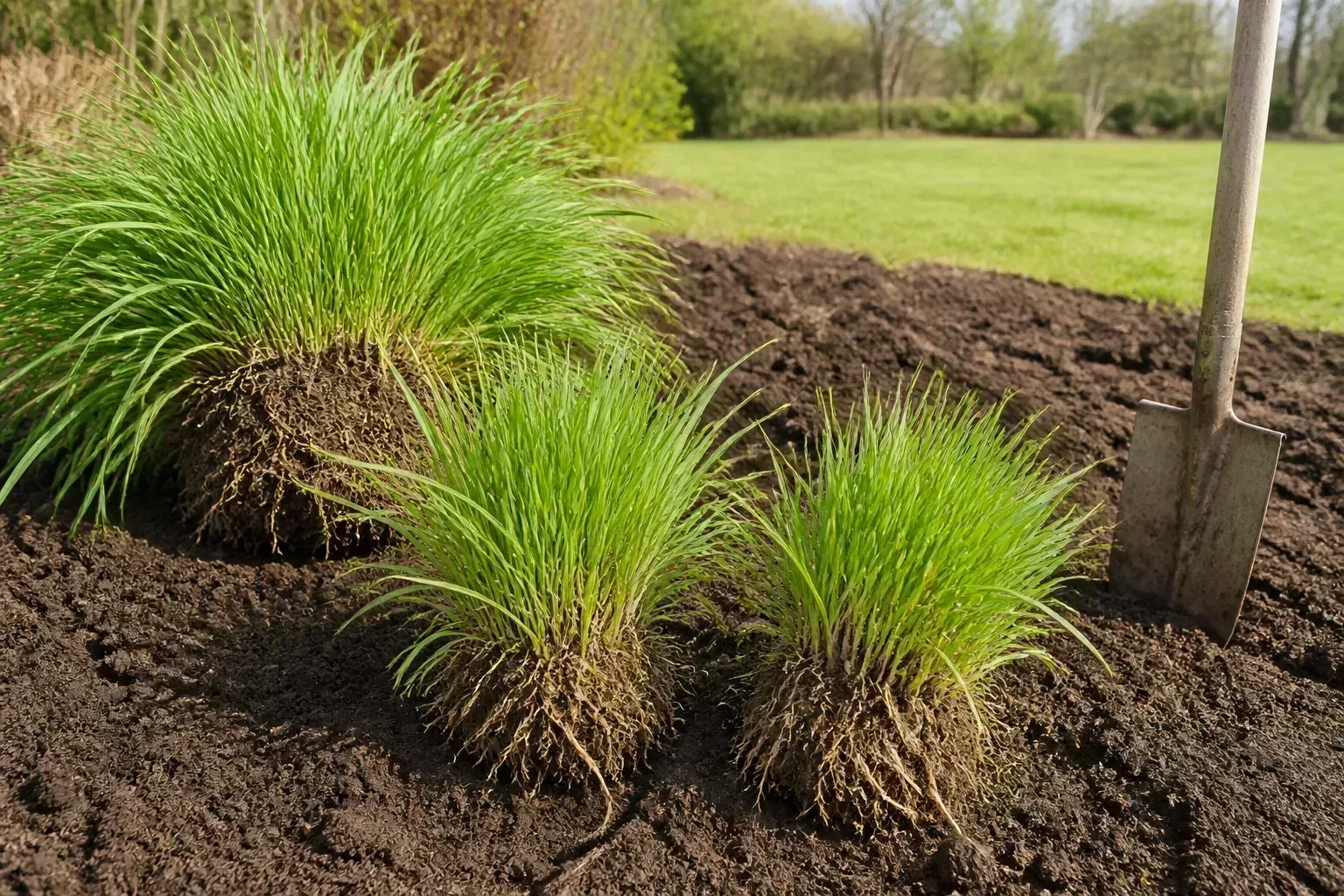
A healthy Miscanthus clump expands slowly, but older plants can become crowded, develop a weak or hollow center, or outgrow the space allocated to them. Divide when the living growth has moved to the outside and the middle is bare, or when flowering and vigor decline despite suitable light and drainage. The RHS recommends spring division; this also gives new sections time to establish during active growth. Gardening Know How likewise treats a dying center as a useful signal to divide, while Epic Gardening describes replanting divisions and watering them well so they can establish.
Water the plant the day before if the ground is dry, then cut back the old stems and dig around the clump’s outer edge. Lift as much of the root mass as practical and split it with a sharp spade or root saw into sections that each have healthy roots and several live shoots. Discard the woody, dead center instead of replanting it, reset the divisions at their previous depth, and water them in. Large clumps are heavy and fibrous, so using two forks or getting help is often safer than trying to lift the entire mass alone.
Do not divide and share an invasive or uncertain cultivar just because it is easy to propagate. Check local recommendations first; a division moves the plant and its rhizomes to a new site, where it can persist even if seed production is low.
Grow a smaller cultivar in a container
Container culture can work for a dwarf selection, but it is less forgiving than planting in the ground. Choose a heavy, wide pot with drainage holes so wind does not tip the top-heavy foliage. Use a quality, free-draining potting mix, keep the crown at the same depth, and water when the upper mix begins to dry; pots heat and dry faster than garden soil.
A container limits root room but does not make the plant sterile or remove its ecological risks. If the cultivar sets seed, clip the plumes before they release it and dispose of them responsibly. In cold climates, a pot exposes roots to lower temperatures than the ground; move it to a sheltered position or insulate the container, and do not let the pot sit in a water-filled saucer through winter.
Diagnose weak bloom, flopping, and thin centers
A plant that looks disappointing usually has a site or age problem rather than a complicated disease. Sparse flowering commonly follows deep shade, a young transplant, a short growing season, or an older crowded clump. A plant can still be healthy without flowering every year in a marginal climate, so compare its growth over several seasons before moving or replacing it.
Flopping can have more than one cause. Too little light produces stretched growth, excess fertilizer produces lush stems, and a mature clump can simply become too broad and heavy for its base. After storms, some outward arching is normal; if the clump consistently collapses, evaluate its light and fertility first, then divide it if the center is crowded. Do not stake a broad ornamental grass as a permanent fix when it needs more sun or a smaller cultivar.
A brown center is not automatically root rot. Some thinning in a mature clump is a normal signal to divide, while a crown that is soft, foul-smelling, or declining in wet soil points to a drainage problem. Check the base and the moisture level before treating leaves or adding feed.
Start with the site before reaching for a product
Use this order when a clump underperforms: first check whether spring growth has begun; then assess direct sun, standing water, and competition from nearby plants; next consider age and mature size; finally review fertilizer and local seedling spread. Each step rules out a more common cause before you try a treatment. If the plant has been planted in a region where it is invasive, removal or replacement may be the right fix rather than further maintenance.
Keep pests and diseases in perspective
The RHS describes Miscanthus as generally pest- and disease-free, although the Missouri Botanical Garden notes that miscanthus mealybug, blight, and leaf rust occur in some areas. A few dry outer leaves in autumn are part of normal seasonal senescence; do not diagnose a disease from browning alone. Look for rust-colored pustules, unusual widespread dieback, or stunted growth that continues during the active season.
Improve airflow by removing dead material during spring cutback and avoid keeping the crown waterlogged. If symptoms persist, take clear photos and a sample to a local extension diagnostic service before applying a pesticide or fungicide. The exact diagnosis matters, and product labels—not generic online recipes—govern any pesticide use.
Pick a native alternative when Miscanthus is a poor fit
If your local invasive-plant authority advises against Chinese silver grass, you can preserve the design function without planting the same species. NC State Extension lists native alternatives for its region, including switchgrass (Panicum virgatum), little bluestem (Schizachyrium scoparium), Indiangrass (Sorghastrum nutans), and several other native grasses. Western New York PRISM suggests options such as prairie cordgrass and big bluestem for its region. These plants differ in mature height, soil tolerance, and seasonal color, so ask a local native-plant society or extension office which species suit your site rather than choosing by appearance alone (NC State Extension, WNY PRISM).
For a screening effect, consider a row of regionally native tall grasses or shrubs; for a compact fountain shape, choose a native bunchgrass that matches the available width. If the site is close to a natural area, prioritize local provenance and ecological value over a cultivar’s ornamental traits. The best substitute is the plant that fills the same visual role without creating a new containment problem.
Conclusion
Chinese silver grass can provide height, movement, and winter structure with modest routine care, but the right choice starts with the full botanical name and your local invasive-plant guidance. Where planting is appropriate, match a named cultivar to its mature width and seed behavior, give it sun and well-drained soil, water new clumps through establishment, and cut back only as spring growth is about to begin.
If the species is discouraged where you garden, choose a local native grass instead. If it is already growing in your yard, remove seedlings early, avoid distributing divisions without checking local guidance, and reassess the plant if it is spreading beyond the space you can manage.