How to Grow and Care for Jessenia Pothos Indoors
Grow a healthy Jessenia pothos with a clear watering test, bright-light guidance, airy soil, repotting cues, and fixes for fading color or yellow leaves.
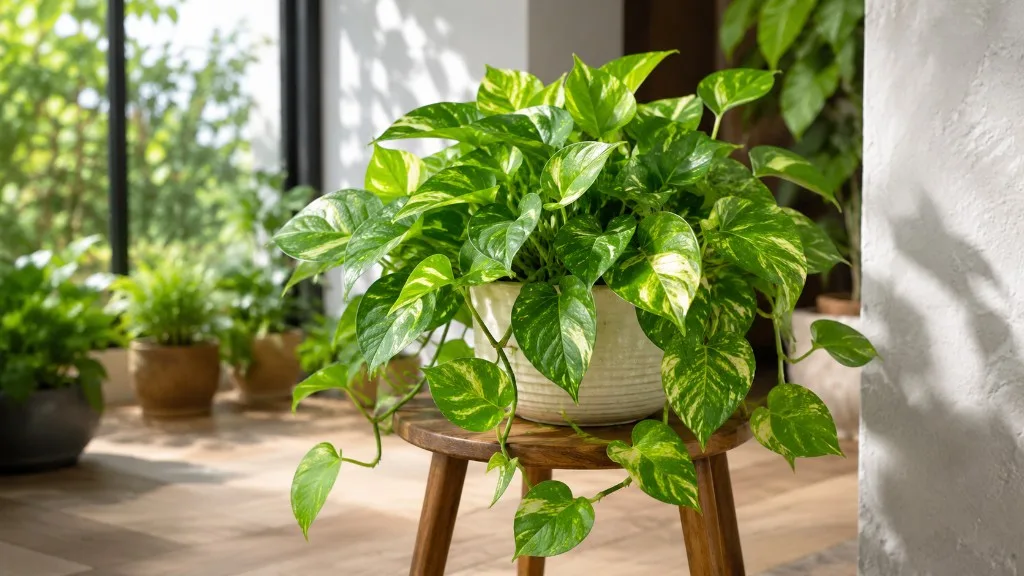
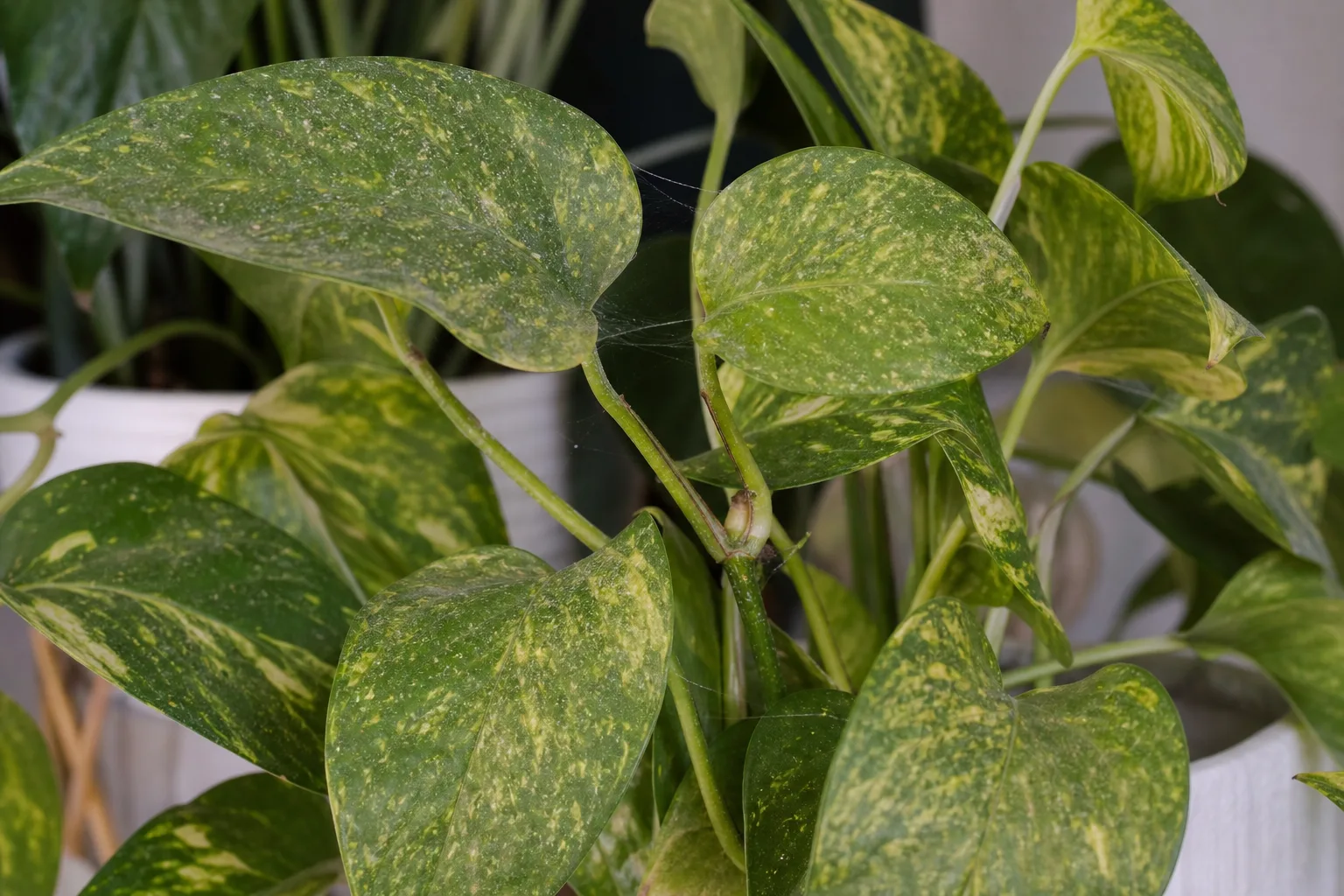
Jessenia pothos is a variegated form of Epipremnum aureum with medium-green leaves marked by chartreuse. Its basic needs are familiar if you have grown another pothos, but the light question is slightly different: Jessenia handles moderate indirect light better than some white-heavy cultivars, yet it still needs enough brightness to keep its lime pattern visible and its vines from stretching.
For a reliable routine, place it in bright filtered light, water only after the mix has dried partway, and use a pot that lets excess water escape. Then judge success by healthy new growth rather than by one older leaf. This distinction helps you avoid overcorrecting with fertilizer, repeated repotting, or a sudden move into harsh sun.
Jessenia pothos care at a glance
| Care choice | Practical starting point |
|---|---|
| Light | Bright, indirect light; moderate indirect light is workable, but deep shade dulls the variegation and slows growth. |
| Water | Check the upper part of the mix and the pot’s weight; water when the surface layer has dried, then let the pot drain fully. |
| Soil | Use a loose indoor potting mix amended with perlite or fine bark if it stays wet or compacts. |
| Pot | Choose a nursery pot with drainage holes; use a cachepot only as an outer cover that can be emptied. |
| Temperature | Keep it in a comfortable, stable room away from cold glass and direct heat or AC blasts. |
| Feeding | Apply a balanced houseplant fertilizer conservatively during active growth, following its label. |
| Growth habit | Let it trail, or guide it onto a stable support; pruning can encourage branching but will not make old bare sections leafy again. |
| Safety | Like other pothos, it is toxic if chewed; keep vines and clippings away from pets and children. |
These are starting points, not a calendar. A small plant in a bright, warm room can use water faster than a larger plant in a cool corner, even when both grow in the same mix. NC State Extension describes E. aureum as tolerant of a range of indoor conditions while recommending indirect light and a well-drained medium that dries between waterings; that species guidance is useful, but the amount of chartreuse on Jessenia makes light quality especially visible in the plant’s appearance (NC State Extension’s pothos profile).
What makes Jessenia different from other pothos?
Jessenia is a named cultivar of Epipremnum aureum, not a separate species with a wholly different care system. Costa Farms, which introduced the cultivar, describes it as a stable sport of Marble Queen discovered in 2014, with medium-green leaves liberally splashed with chartreuse (Costa Farms’ pothos profile). Clemson Cooperative Extension describes Jessenia as a chartreuse-variegated form and notes its more slender leaves compared with Golden pothos.
That identity matters when you buy a plant or diagnose its color. Jessenia’s pattern is usually green-on-green: lighter lime or chartreuse areas against a darker green base. It is not the nearly uniform neon of Neon pothos, nor the yellow-gold splashes typical of Golden. A label can be wrong, and individual leaves vary, so compare several leaves and the overall pattern rather than deciding from one unusually pale or plain-green blade.
Jessenia vs. Golden, Marble Queen, and Neon
| Cultivar | Common leaf pattern | Useful distinction |
|---|---|---|
| Jessenia | Medium green with chartreuse to lime-green marbling | Green-on-green contrast; new leaves may vary in how strongly the pattern shows. |
| Golden pothos | Green with yellow, cream, or gold splashes | The warm yellow contrast is usually more obvious than Jessenia’s lime pattern. |
| Marble Queen | Green and cream or white marbling | Larger pale sectors make it look brighter but can reduce its margin for dim placements. |
| Neon pothos | Mostly uniform chartreuse leaves | The whole leaf reads bright lime, instead of showing Jessenia’s contrasting green fields. |
The distinction is practical, not just collector trivia. Clemson notes that Jessenia tolerates lower light than Marble Queen and Snow Queen, while still describing light as a factor in maintaining pothos foliage quality. That means Jessenia can be a more forgiving choice for a medium-light room, not a plant for a dark hallway with no window. If the plant was sold under a vague “variegated pothos” label, compare its leaves with the cultivar descriptions from Clemson Extension and Costa Farms before deciding that a normal pattern difference is a problem.
Set the plant where its chartreuse pattern can hold
Aim for a bright room with filtered or reflected light: near an east-facing window, a little back from a bright south or west window, or behind a sheer curtain where afternoon sun is strong. A few feet from the glass is a sensible first trial, but window direction, trees, screens, season, and neighboring buildings all change the light reaching a leaf. Rotate the pot occasionally if vines grow toward one side of the window.
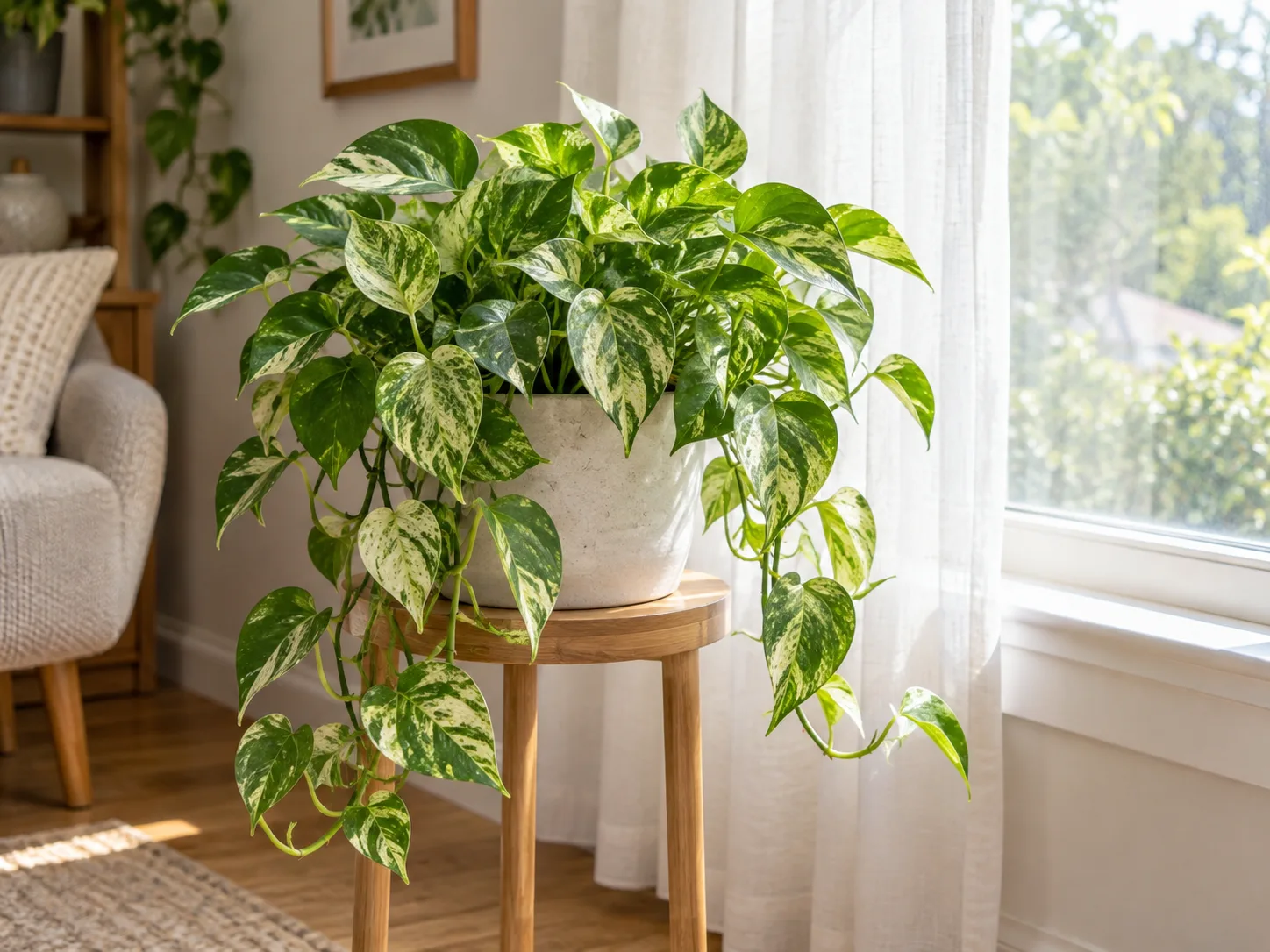
Jessenia can keep growing in moderate indirect light, but color and structure are separate signals. If new leaves become more solid green, smaller, or spaced farther apart, move the plant one step closer to bright filtered light and watch the next few leaves. Older leaves will not recolor after a move, so do not keep shifting the pot because an established leaf still looks plain. If a bleached or crisp patch appears only on the window-facing side, direct sun is too intense; filter it rather than moving the plant into a darker room.
A grow light can help in a windowless or deeply shaded room, but it needs a consistent placement and schedule. Keep the fixture at the distance its maker recommends and adjust gradually, especially if the plant has been in dim light. Clemson’s cultivar comparison is a helpful guardrail: Jessenia is less demanding than white-heavy varieties, but “tolerates lower light” describes survival better than best color or compact growth.
Gardenia’s species-level care guide also recommends bright, indirect light and warns against intense direct sun; use that general guidance as a baseline, then watch Jessenia’s newer leaves for the cultivar-specific color response (Gardenia’s golden pothos guide).
Water when the root zone has dried partway
Do not water Jessenia pothos by weekday. Press a finger into the mix and assess more than the surface: the upper layer should feel dry while deeper mix is no longer sodden, and the pot should feel noticeably lighter than it did after watering. Once those cues line up, water slowly across the surface until a little drains from the bottom. Empty standing runoff from the saucer or cachepot so roots are not left in a reservoir.
Penn State Extension recommends watering pothos when the soil is dry and warns that excess water can lead to root rot; Costa Farms’ general pothos care advice likewise recommends waiting until the top couple of inches of mix are dry rather than keeping it saturated (Penn State Extension; Costa Farms’ pothos care notes). These are useful cues, not an exact number of days. A plant in a bright, warm room may dry in a week, while one in lower light or a large plastic pot may need much longer.
If the surface is dry but the pot remains heavy and cool, check deeper before watering. Dense soil, a blocked drainage hole, or a nursery pot sitting in a water-filled cachepot can keep the root ball wet even when the top looks dusty. On the other hand, if water runs down the sides and the root ball stays dry, the mix may have shrunk away from the pot; water in two slow passes and allow full drainage. Drooping alone does not diagnose thirst because damaged roots can also leave a plant limp.
During cooler, darker months, the plant usually uses water more slowly, so check less often and let the pot tell you when it is ready. Do not compensate for dry room air by keeping the soil constantly damp. Roots need both moisture and oxygen; repeating small splashes can wet only the surface while leaving the center inconsistently dry.
Use airy mix and a pot that drains
A forgiving potting setup holds some moisture but leaves air pockets around the roots after watering. Start with a quality houseplant mix. If it packs down or stays wet for several days in your conditions, loosen it with perlite or pumice and a small amount of fine orchid bark. There is no cultivar-specific “Jessenia formula”; drainage and the pot’s dry-down matter more than a precise recipe.
Choose a container with at least one open drainage hole. If you like a decorative pot without holes, keep the plant in a plastic nursery pot inside it and remove that inner pot for watering, or lift it out and pour away collected water. Avoid placing gravel at the bottom as a substitute for drainage; it does not empty water trapped in the soil. Also avoid moving a small root system into a much larger pot, since unused mix can remain wet long after the plant has taken up what it needs.
If the pot dries in a day or two, consider whether the plant is root-filled, the room is hot, or the mix is unusually coarse before adding frequent water. If it stays wet and heavy for a long stretch, inspect the hole, root ball, and mix structure. Changing the pot, soil, light, and watering routine all at once makes it difficult to learn which factor was responsible.
Keep temperatures steady; treat humidity as optional support
An ordinary comfortable living space is generally adequate for Jessenia. Keep it away from a cold window in winter, exterior-door drafts, and air-conditioning or heating vents that blow directly on its leaves. Penn State Extension gives a broad indoor temperature range for pothos, while the plant usually signals temperature stress through stalled growth or damaged foliage rather than a precise humidity requirement (Penn State Extension).
Average home humidity is usually workable. If your room is exceptionally dry and leaf edges keep crisping after you have ruled out inconsistent watering, salts, and root trouble, measure the humidity before making changes. A room humidifier can raise the surrounding moisture; misting gives only a short-lived effect and can leave foliage wet without improving the room’s baseline. A pebble tray is optional and does not replace a proper watering routine.
Feed lightly when active growth justifies it
Fertilizer supports new growth, but it cannot restore variegation lost in a dim position or rescue rotting roots. If the plant is producing leaves in spring and summer, use a balanced liquid houseplant fertilizer at the label rate—or a more diluted rate if the product permits—after the mix is already moist. A plant growing slowly in winter may not need feeding until brighter days return.
Avoid stacking fertilizer, compost tea, and slow-release granules because excess salts can accumulate in a container. A crust on the mix or pot rim, or tip damage that follows repeated feeding, is a reason to pause. If the roots are healthy and the mix drains, flush with plain water and let it drain well before considering another feed. Do not fertilize a stressed plant simply because it looks pale; first check the light, watering, and roots.
Choose a trailing or climbing shape, then prune with a purpose
Jessenia can trail from a hanging basket or shelf, or climb a stable trellis or pole using aerial roots at its nodes. A support changes how the vine is displayed and may help a pothos grow larger leaves over time when light and warmth are adequate, but it is optional for an indoor plant. Choose a support you can actually maintain: a dry trellis needs little attention, while a moss pole intended for roots to enter must be kept suitably moist.
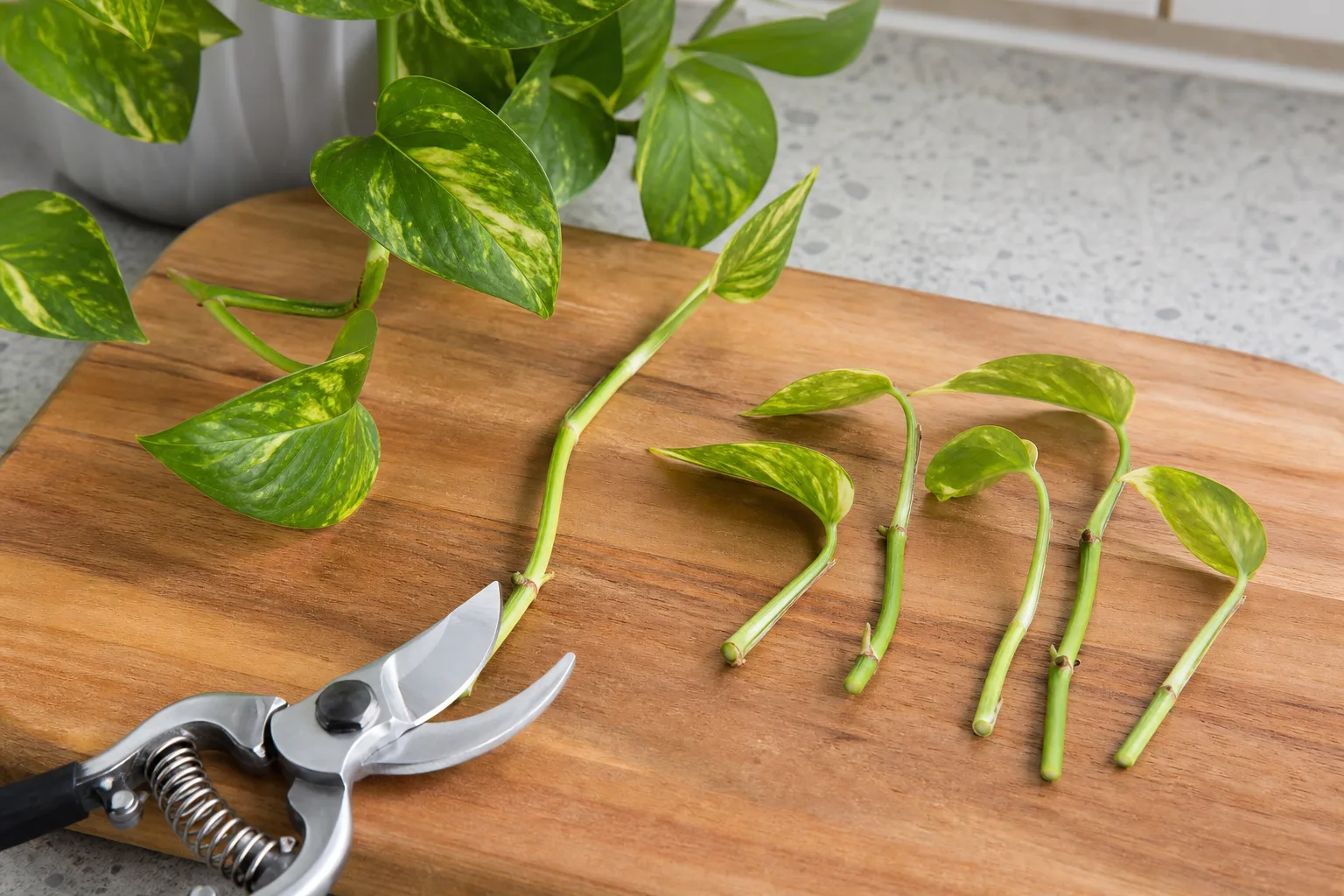
Prune when vines outgrow the display, become bare near the pot, or need damaged sections removed. Use clean scissors and cut just above a node, the joint where a leaf and aerial root emerge. Light, repeated pruning during active growth is easier on the plant than removing most of its foliage at once. Cutting back a vine can stimulate buds near the remaining nodes; it cannot make leaves grow from every old stretch of bare stem.
If a long vine has leaves only at its end, improve light before expecting pruning to solve the underlying shape. You can take healthy node-bearing sections as cuttings and plant rooted pieces back into the pot for a fuller-looking top. This is a display strategy as much as propagation: several rooted starts in one container fill space sooner than waiting for a single old stem to branch everywhere.
Propagate a healthy vine from a stem node
Jessenia propagates like other E. aureum cultivars: each cutting needs at least one node, because a leaf without stem tissue cannot produce a new vine. Select a healthy, well-patterned section, cut below a node with clean shears, and root it in water or a lightly moist, airy medium in bright indirect light. Keep any leaf above the waterline, and pot up once roots are established rather than leaving the cutting in a jar indefinitely.
The cutting clones its parent, but the color of future leaves still depends on growing conditions. A cutting from a well-variegated vine rooted in a dark corner may produce greener leaves than expected; that does not prove it is a different cultivar. The Sill’s pothos guide likewise recommends placing node-bearing cuttings in water or moist soil in a warm, bright spot out of direct sun; for the full Jessenia-specific method, timing, and transplant cues, see our Jessenia pothos propagation guide (The Sill). Do not take material from a plant you do not own or have permission to propagate.
Repot when roots or the mix signal a need
Repot when roots circle densely around the root ball, emerge from drainage holes, or the pot dries unusually quickly despite a sensible watering routine. A yearly schedule is not mandatory. If roots are healthy and the current pot drains, Jessenia can remain slightly snug while you wait for the active growing season, when it can resume growth after the disturbance.
Move up only one pot size, keeping the new container just a little wider than the root ball. Loosen circling roots gently, remove clearly dead or mushy sections with clean shears, and use fresh airy mix. Set the plant at the same soil depth, water once to settle the mix, and let it drain. For a plant whose medium stays wet or smells sour, fixing the root environment is more urgent than waiting for spring; for a healthy root ball, repotting just because a calendar says so adds avoidable stress.
Diagnose common Jessenia pothos problems in the right order
Look at patterns across several leaves, then check the soil and roots before changing care. One aging lower leaf is different from a wave of yellow leaves; one faded leaf is different from several new leaves emerging small and solid green. First inspect moisture and drainage, then light and recent changes, and only then consider pests or fertilizer.
Yellow leaves: check age, moisture, and roots
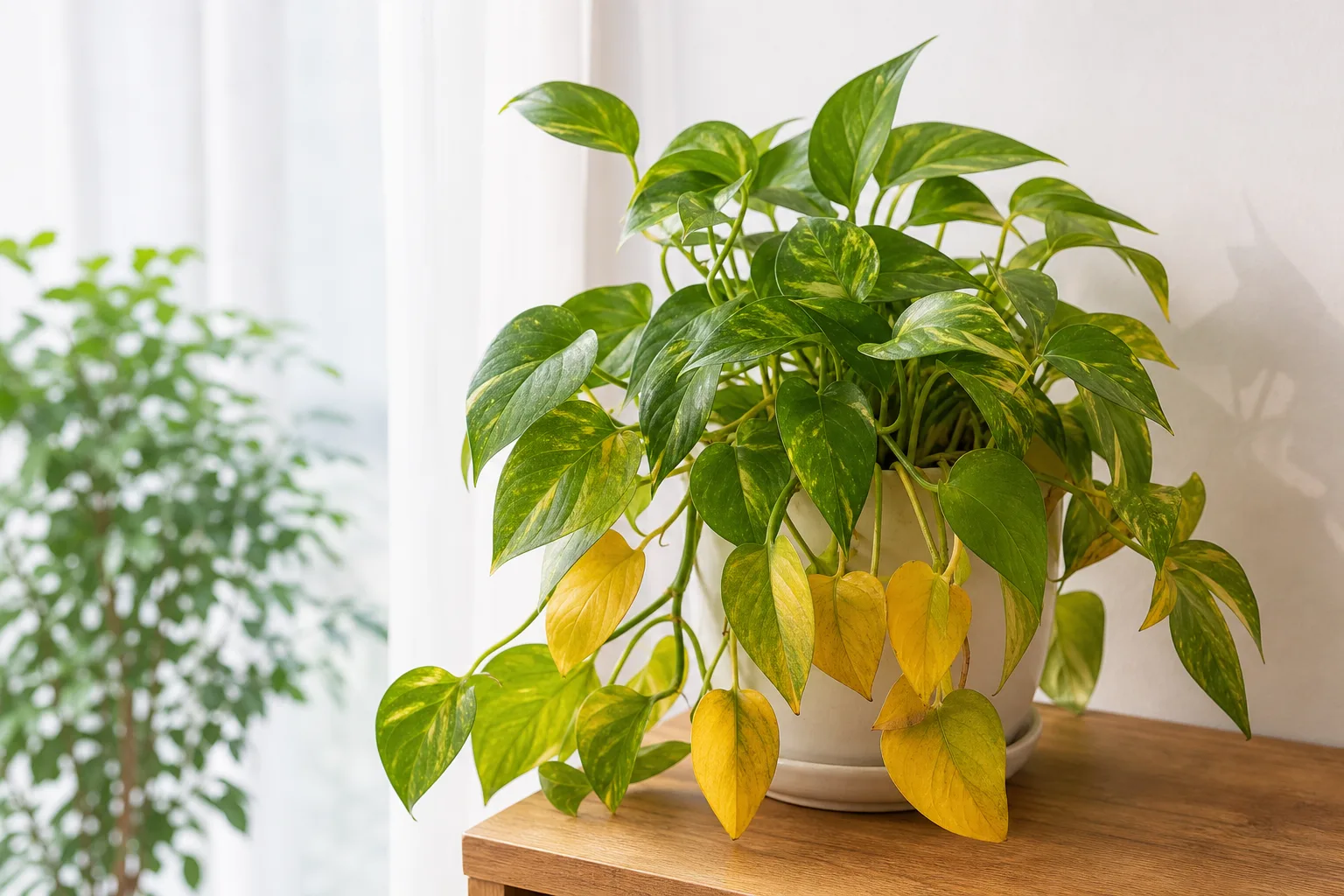
A single older leaf near the base can yellow as it ages. If several leaves yellow while the mix stays wet, the pot remains heavy, or stems feel soft, suspect slow drainage or root stress before assuming the plant needs more light or food. Lift the nursery pot from its cachepot, confirm the drainage hole is open, and inspect roots if the mix smells sour or the plant continues declining.
If the mix is bone dry and leaves are limp, water thoroughly and let excess drain; then observe whether the plant firms up. If foliage yellows while new growth is stretched and pale, the plant may be too far from useful light. Change one condition at a time and give the plant time to show a response in new growth. Removing already yellow leaves improves appearance, but it does not correct the cause.
Green or small new leaves: inspect light and the vine
Jessenia can become greener in lower light, and new leaves may differ naturally in color. Move it closer to a bright filtered window in gradual steps and compare the next two or three leaves, not the old foliage. If only one branch produces plain-green growth and that stem grows faster than the rest, prune back the reverted section to a node where the patterned vine remains; do not cut away every leaf that looks slightly greener than your favorite reference photo.
Small leaves and long gaps between them can also point to weak light, an old vine, or a plant that has not been pruned. Fertilizer is not the first fix. Check the placement and root health, then trim leggy tips if the plant is otherwise stable. A trellis can improve display, but it will not compensate for a dark corner.
Brown tips, soft stems, and pests: look for patterns
Crisp brown tips can follow a long dry spell, direct hot sun, fertilizer-salt buildup, or root damage, so use the timing and pattern to narrow the cause. Dry pot plus crisp edges suggests inconsistent moisture; a salty crust after frequent feeding points toward excess fertilizer; a wet pot with soft stems requires a drainage and root check. Trim only the dead portion of a leaf if you prefer, leaving a small margin rather than cutting into healthy tissue.
Inspect leaf undersides, petiole joints, and the stem near the soil for mealybugs, scale, or spider mites. Fine webbing, stippling, cottony clusters, or sticky residue are more useful clues than a vague “unhealthy” look. Isolate an affected plant, wipe or rinse accessible insects, and use a pesticide only if the product is labeled for indoor plants and the pest; follow its directions and keep people and pets away as directed. Do not spray a stressed plant in strong sun or treat it with several products at once.
Keep Jessenia away from pets and curious children
Jessenia is not a pet-safe pothos. The ASPCA lists Epipremnum aureum as toxic to cats and dogs because it contains insoluble calcium oxalates; chewing plant tissue can cause oral irritation, burning, drooling, vomiting, or difficulty swallowing (ASPCA Animal Poison Control). Cultivar names do not change the species-level caution.
Put trailing vines, water-rooted cuttings, and pruning scraps where animals and children cannot reach them. A high shelf is not safe if a cat can climb to it or a long vine can dangle within reach. If a pet chews the plant, contact a veterinarian or the ASPCA Poison Control line listed on its plant guidance promptly; do not wait for symptoms or attempt a home treatment. If your household includes a persistent plant chewer, choose a non-toxic alternative for low shelves and floor pots.
Conclusion
Jessenia pothos is a relatively forgiving E. aureum cultivar, but it looks its best when its placement supports the chartreuse pattern. Give it bright indirect light, water when the mix has dried partway, use an airy medium and a draining pot, and feed only while it is actively growing. Let the plant’s new leaves, pot weight, and root condition guide adjustments instead of relying on a calendar or trying several fixes at once.
When growth gets sparse, correct light and prune selectively; when leaves yellow in a wet pot, inspect drainage before watering again. Repot only when roots or the mix show a clear need, and keep the vines and cuttings away from pets. Those few checks make this pothos easier to enjoy—and make changes in color or growth much easier to understand.