Murphy Oil Soap for Aphids: What Works on Houseplants
Can you use Murphy Oil Soap on aphids? Get the evidence-based answer, safer first steps, label rules, phytotoxicity warnings, and a repeatable treatment plan.
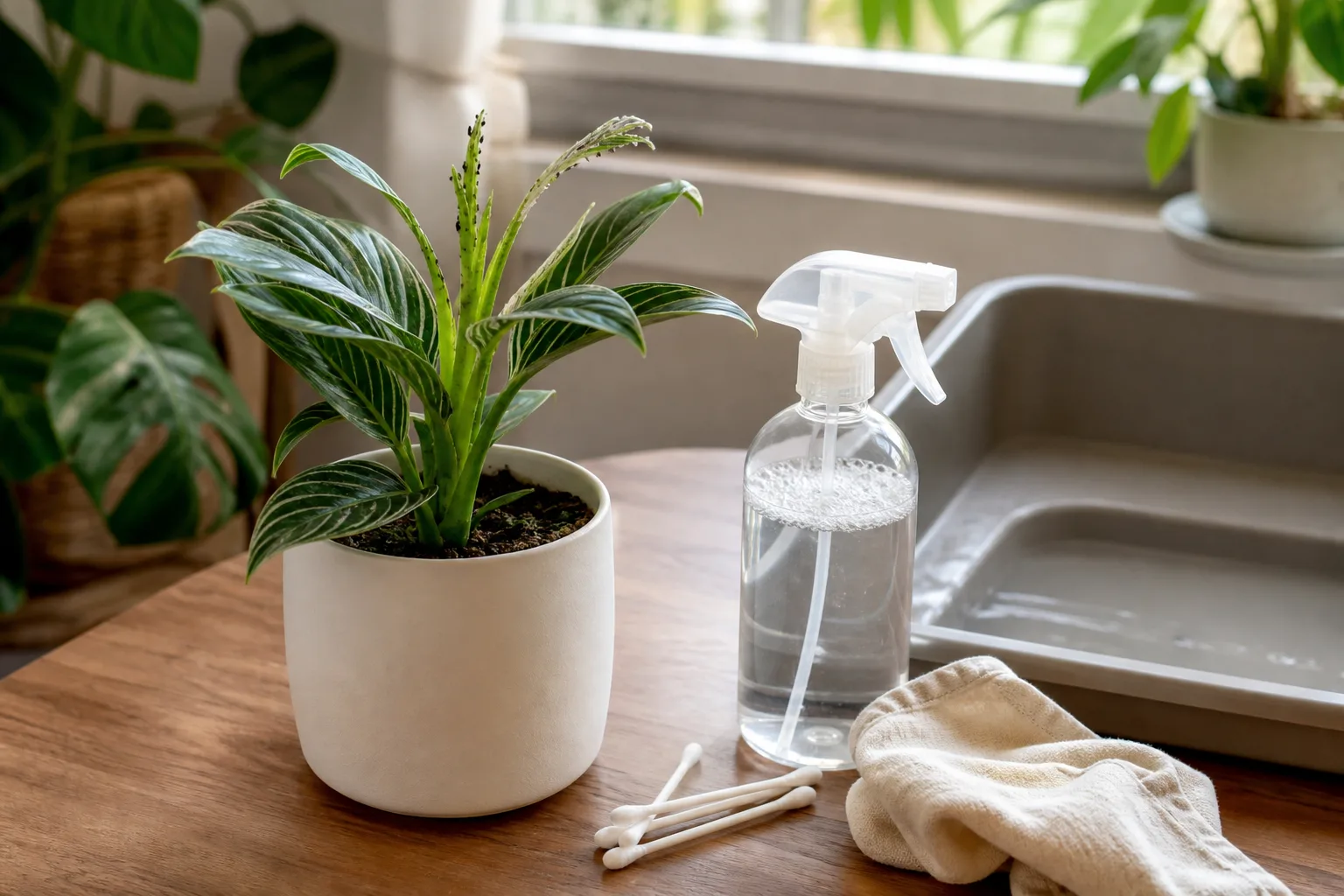
If you found aphids on a houseplant and reached for Murphy Oil Soap, pause before mixing a spray bottle. A soap can kill a soft-bodied aphid when it coats the insect, but Murphy Oil Soap Original is marketed as a wood cleaner, not as an insecticidal soap for plants. Its official product information gives dilution directions for floors and other household surfaces, not for aphids or houseplant foliage (Murphy Oil Soap’s official product page).
That distinction changes the safest answer. I would not treat an internet recipe such as “a few tablespoons per quart” as a validated Murphy rate, and I would not spray a valuable plant simply because a household product is described as natural or biodegradable. Start with isolation and water. If those steps do not bring the population down, choose an insecticidal soap whose label specifically allows the plant and pest, then follow that label, spot-test first, and repeat only when scouting shows that live aphids remain.
The short answer: do not treat Murphy as insecticidal soap
Murphy Oil Soap may kill aphids that it directly wets, but that does not make it a dependable or label-supported houseplant pesticide. The killing action comes from contact with exposed soft-bodied insects, not from the plant absorbing the soap and becoming protected. Aphids tucked into a folded leaf, at a stem joint, or behind dense new growth can survive, and a dry soap film does not give lasting protection.
The product question is separate from the chemistry question. Commercial insecticidal soaps are made for pest control, tested for efficacy and plant safety, and sold with directions that tell you what plants, pests, rates, and conditions are covered. Colorado State University Extension specifically warns that homemade remedies made from household liquids or cleaning products should not be used as pesticides because their formulations are not consistently tested and can contain detergents, degreasers, emulsifiers, preservatives, and other ingredients that injure foliage (Colorado State University Extension’s insecticidal soap guidance).
So the practical decision is simple: do not use Murphy as your default aphid spray. A shower of plain water is a better first move for a small indoor colony, and a plant-labeled insecticidal soap is the more defensible escalation when a spray is genuinely needed.
Confirm that the pest is actually an aphid
Do not choose a treatment from the word “bug” alone. Aphids, mealybugs, thrips, whiteflies, scale, and spider mites can all cause weak or discolored houseplants, but they occupy different places and respond differently to control methods.
Signs that point to aphids
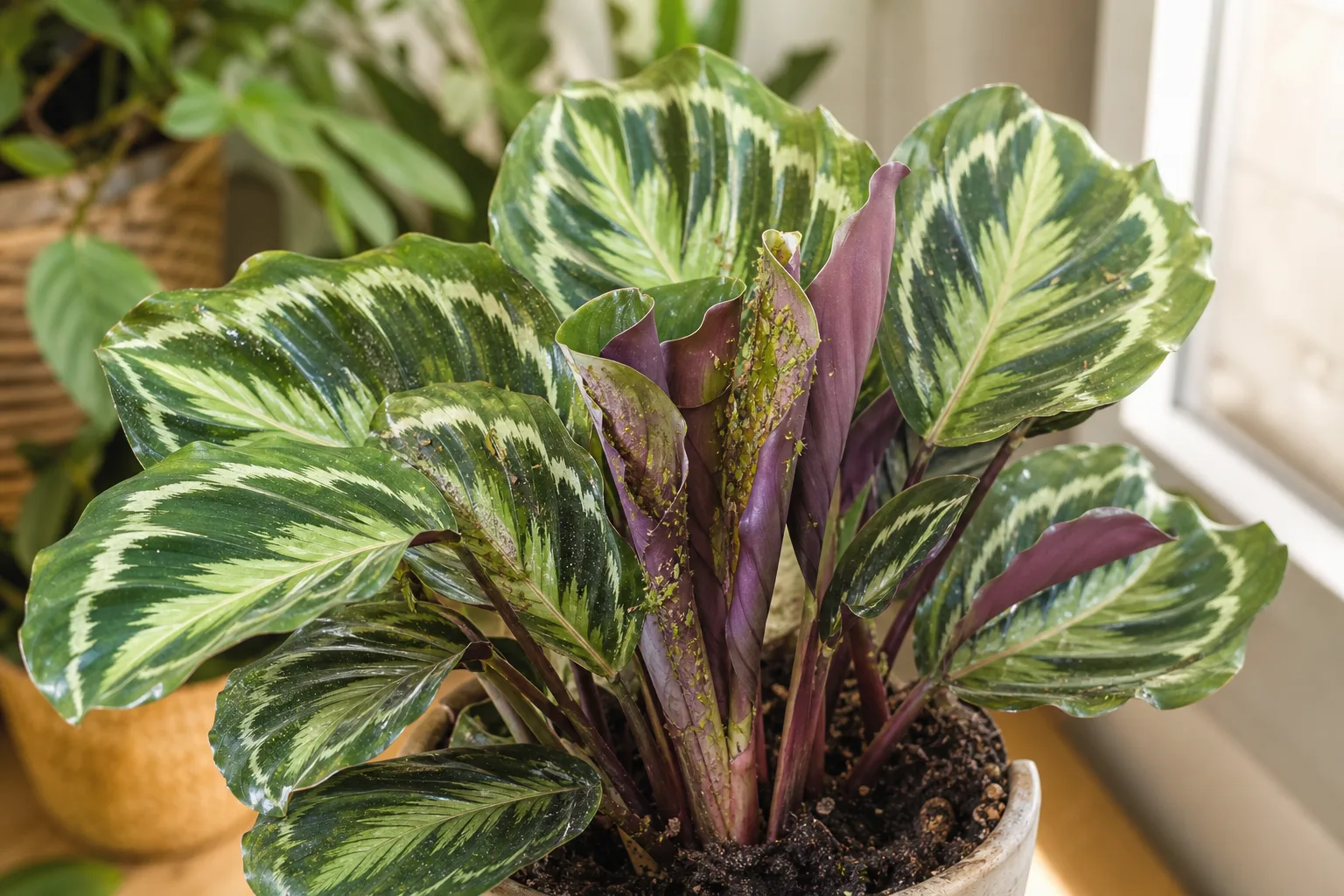
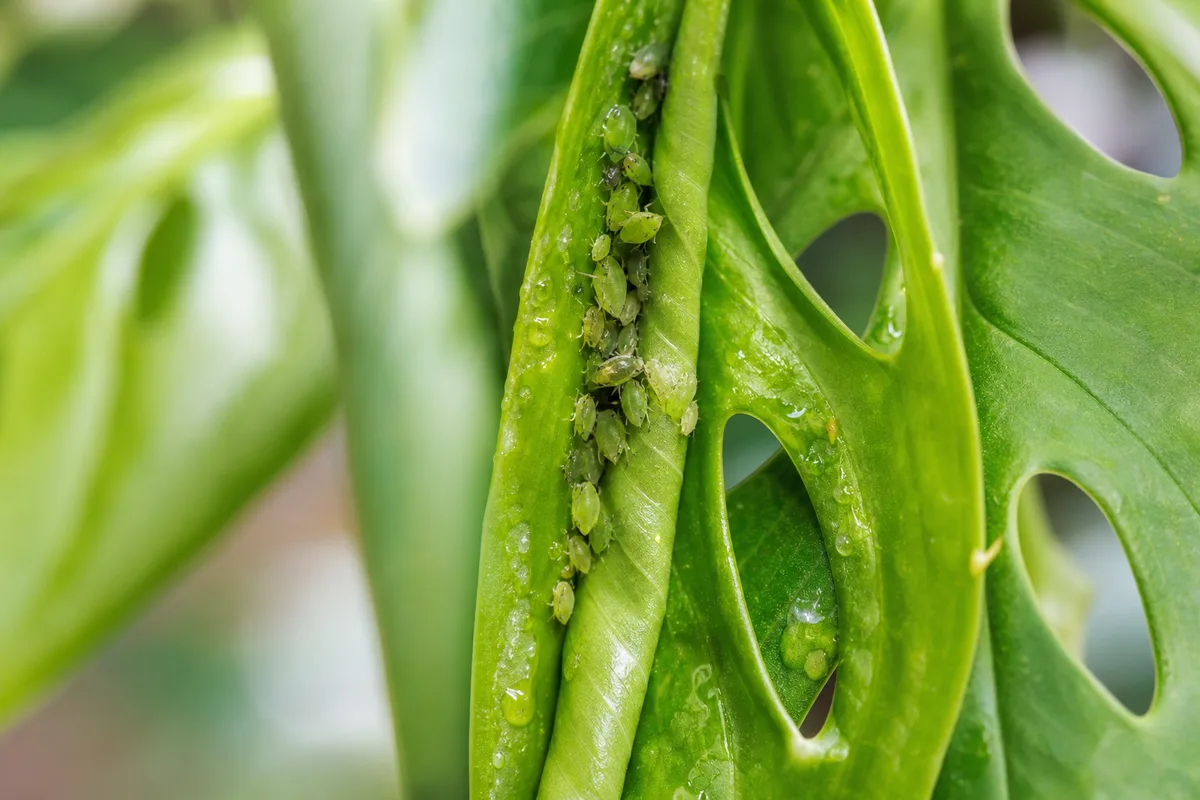
Aphids are usually tiny, soft-bodied, pear-shaped insects clustered on new leaves, tender stems, flower buds, and the undersides of leaves. They may be green, yellow, brown, black, pink, or almost translucent, so color is a poor identification shortcut. Look for adults mixed with smaller nymphs, pale shed skins, and a colony that seems to gather around the softest growth.
The other strong clue is honeydew. Aphids excrete a clear, sticky liquid as they feed, leaving leaves tacky and sometimes encouraging black sooty mold. Ants may appear indoors or on a balcony because they collect the honeydew, which can help keep the colony supplied. Heavy feeding can distort new leaves, cause curling or yellowing, slow growth, and leave a plant looking tired even when the pot is watered correctly.
If you see cottony white masses, suspect mealybugs. Fine stippling and webbing point more toward spider mites, while silvery scarring and black specks on leaves are more consistent with thrips. Hard bumps attached to stems may be scale. When the insects are too small to identify, place a white sheet of paper under a branch and tap it gently; moving the plant into brighter inspection light and using a phone macro photo can reveal whether the bodies are pear-shaped aphids or a different pest.
Why a soap can kill aphids on contact
Insecticidal soap is not a plant tonic and it is not a repellent. It works while wet, when the soap contacts a susceptible insect and disrupts the insect’s cell membranes and protective outer coating. University of Connecticut Extension describes insecticidal soaps as potassium salts of fatty acids and emphasizes that they have no residual insecticidal activity after drying (UConn’s insecticidal soap factsheet).
That mechanism explains both the appeal and the limits. Aphids are soft-bodied, so direct coverage can kill them quickly. A soap treatment does not sterilize the plant, prevent a winged aphid from landing tomorrow, or affect eggs and hidden insects that the spray never touches. The treatment succeeds when the spray reaches the colony, not when the leaves merely look wet from above.
This is also why stronger is not automatically better. More cleaner or soap can increase the chance of dissolving the leaf’s protective cuticle, leaving brown spots, scorched edges, or a general loss of leaf quality. More product may also mean more residue, more runoff, and more injury without improving coverage of aphids hiding inside curled leaves.
Murphy Oil Soap versus labeled insecticidal soap
The names sound similar, but the products should not be treated as interchangeable.
| Question | Murphy Oil Soap Original | Labeled insecticidal soap |
|---|---|---|
| Primary marketed job | Household wood and surface cleaner | Control of listed insect and mite pests |
| Plant-use directions | The official page gives household-surface directions, not a plant rate | The label supplies permitted plants, pests, dilution, timing, and precautions |
| Formulation certainty for foliage | A cleaner formulation with plant-derived cleaning ingredients, fragrance, and synthetic ingredients | Formulated and tested for pesticide use and plant tolerance |
| Contact action on aphids | May affect aphids it directly wets, but performance and plant safety are not established by a plant label | Designed to kill listed soft-bodied pests on contact when used as directed |
| Safest default | Do not use as an aphid spray | Choose only when the label covers your plant and pest |
The table is not a claim that every labeled soap is harmless. UConn Extension notes that phytotoxicity can depend on plant vigor, cultivar, temperature, humidity, spray concentration, pH, timing, and frequency. A product can be legal for houseplants and still injure a sensitive begonia, fern, jade, palm, ivy, or a plant with tender new growth.
Why dilution and the label matter
Dilution is a product instruction, not a universal soap formula. A rate that appears on a blog for a formulated insecticidal soap cannot be transferred to Murphy Oil Soap, dish detergent, castile soap, or another cleaner. Even two bottles that both contain the word “soap” can differ in fatty-acid chemistry, detergents, fragrance, emulsifiers, preservatives, and intended use.
Read the entire pesticide label before opening the sprayer. The target plant or plant group should be covered, the target pest should be listed or included by the label’s wording, and the application rate, maximum frequency, protective equipment, ventilation, storage, and disposal instructions should be clear. Colorado State University Extension also stresses that if a recommendation conflicts with the current label, the label controls (CSU’s houseplant pest guidance).
For edible herbs, do not improvise with Murphy, dish soap, or a leftover household mix. Use only a product labeled for that crop and observe its harvest interval and washing instructions. “Food-safe,” “natural,” “biodegradable,” and “low odor” are not substitutes for a crop-use label.
The safest first response for a small infestation
For a few aphids on one houseplant, the best first response is often mechanical rather than chemical. Move the plant away from its neighbors, inspect the newest growth and leaf undersides, and take a photo before treatment so you can compare the colony later.
Put the plant in a bathtub, shower, sink, or washable basin. Use a gentle-to-moderate stream of lukewarm water to dislodge aphids from the top and bottom of leaves and from stems. Support fragile leaves with your free hand or shield them from the full force of the stream; thin-stemmed plants and delicate ferns can be damaged by an aggressive spray. Let the foliage drain, and empty standing water from the saucer so the plant is not left cold and waterlogged.
For a small colony, a damp cotton swab or soft cloth can wipe aphids from the undersides of leaves and growing tips. Repeat the inspection after the plant dries because the first pass often misses insects tucked into a fold. Water physically removes aphids; it does not create a residual barrier, so follow-up is part of the method rather than evidence that the method failed.
A houseplant aphid treatment plan
Think in stages: contain the problem, lower the population, then decide whether a labeled contact product is worth the risk. Spraying every plant in the room is usually less useful than treating the plant that actually has live aphids and monitoring its neighbors.
Isolate and inspect neighboring plants
Place the infested plant in a separate room or at least several feet away from the collection. Check nearby plants, especially those sharing a shelf, touching leaves, or receiving a recently purchased plant as a neighbor. Colorado State University recommends quarantining new plants for at least three weeks because pests are frequently introduced on recently purchased or gifted plants (CSU’s houseplant pest management guidance).
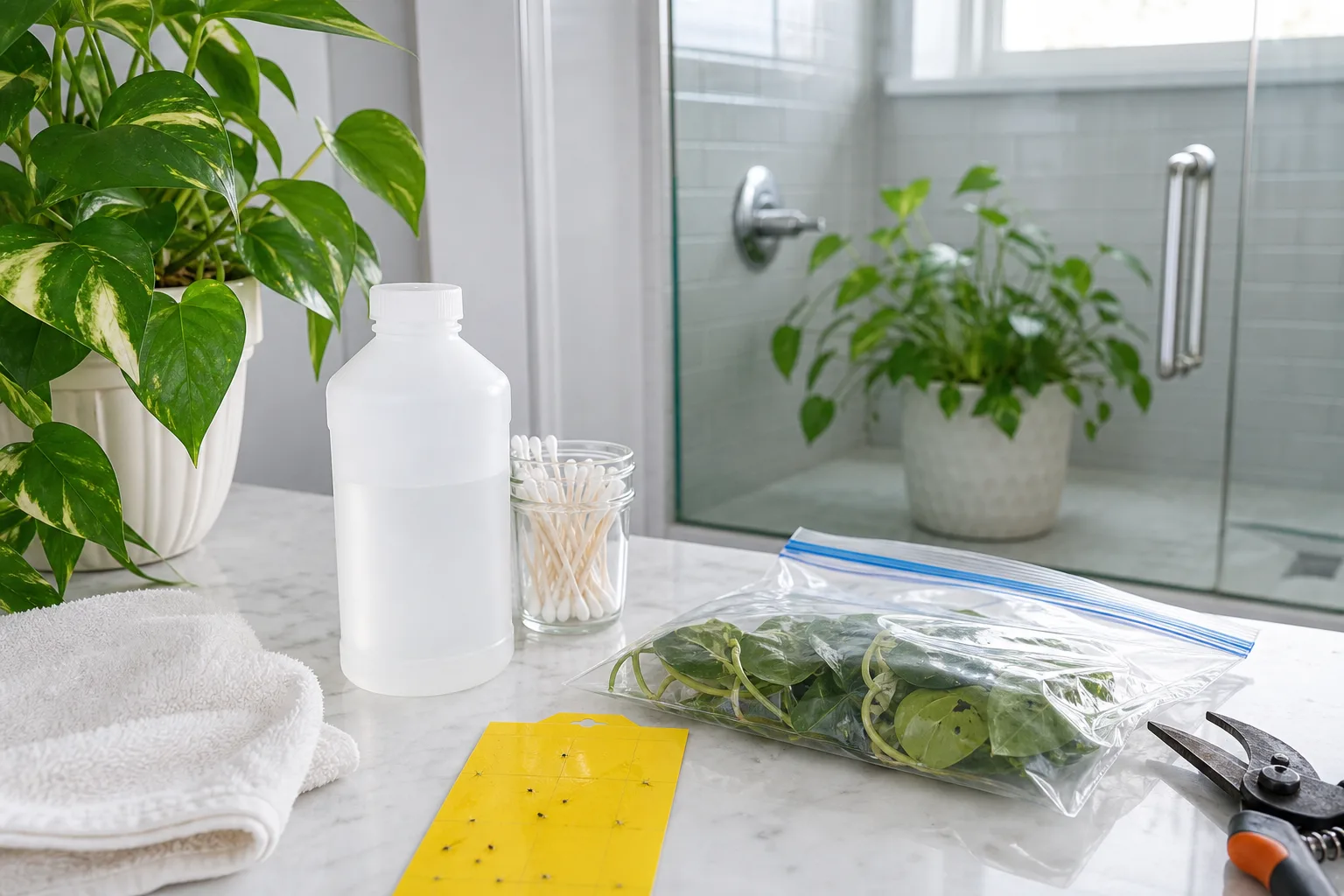
Clean the shelf, windowsill, cachepot, and saucer. Bag heavily infested prunings and discard them rather than placing them in indoor compost. Wash reusable tools and the outside of the pot before returning the plant to a shared plant zone. If winged aphids are present, a yellow sticky card near—but not touching—the plant can help you notice flyers; it will not control the colony by itself.
Wash and prune the colony
Begin with water, then remove the worst leaves or soft shoot tips if aphids are concentrated there and the plant can spare them. Cut just below the infested section with clean scissors, seal the material in a bag, and remove it from the growing area. Avoid stripping every leaf from a stressed plant; it still needs enough foliage to recover.
Check the underside of every remaining leaf, the petiole junctions, and the newest unfurling leaves. Aphids often sit where a spray nozzle cannot reach in one pass. If a leaf is curled around a dense colony, pruning it may reduce the population more reliably than soaking the outside of the curl and hoping the liquid penetrates.
Escalate to a labeled insecticidal soap
Escalate when live aphids return quickly after two or three careful wash-and-inspect cycles, when the plant has too many colonies to wipe by hand, or when the newest growth is being distorted faster than the plant can replace it. Select a ready-to-use or concentrate product whose label covers indoor plants and aphids; do not choose by the word “soap” on the front of the bottle.
Before treating, move a portable plant to a well-ventilated location that is protected from direct sun and away from food preparation. Wear the protection specified by the label, keep children and pets away from wet foliage, and do not mix the product with neem oil, horticultural oil, dish soap, vinegar, alcohol, or another pesticide unless the label explicitly permits the combination.
How to apply labeled insecticidal soap without burning leaves
The safest application is controlled and targeted. Do not spray on a schedule simply because a calendar says it is time; check whether live aphids are still present and whether the plant is healthy enough to tolerate another wetting.
Spot-test, cover the pest, and rescout
Mix a concentrate exactly as directed using a measuring tool reserved for garden products. Use the water quality the label allows; UConn Extension warns that hard water can bind with soap, create a precipitate, reduce effectiveness, and increase risk to the treated plant. Do not add extra soap to compensate for cloudy water. If the label does not address your water and you see scum or separation, stop and ask a local extension service or choose a ready-to-use product rather than guessing.
Apply the mixture to one or two inconspicuous leaves first. Wait at least 24 hours, and longer if the label or your local extension guidance says so, while watching for translucent patches, brown spots, scorched tips, curling, or a greasy-looking film. The test is not a guarantee for every leaf, but it catches obvious incompatibility before you cover the whole plant.
Treat in the cool part of the day, away from strong sun, heat, and drying wind. UConn identifies hot conditions above 90°F, humidity stress, drought, young transplants, unrooted cuttings, and soft new growth as higher-risk situations for plant injury. Let the solution wet the aphids and the surfaces where they are hiding, including leaf undersides and stem joints, but do not spray beyond the point of runoff.
After the label’s required contact time, do not assume more wetness means more control. Soap is a contact material, so a second careless soaking does not reach a hidden colony any better than a careful first pass. Let the plant dry in bright, indirect light with air movement, then inspect it again the next day and again several days later.
Follow-up timing belongs to the product label and the pest’s return rate. Some extension guidance describes four- to seven-day intervals for certain pests, while practical horticulture sources describe wider intervals for particular products and situations. That variation is exactly why a universal “spray every week” rule is weaker than the bottle’s directions plus a live-pest check. If aphids are gone, stop spraying and continue scouting.
When not to use a soap spray
Skip a soap spray for now when the plant is drought-stressed, recently repotted, chilled, heat-stressed, badly sunburned, or carrying very tender new growth. Also pause when the leaves are wet from another treatment, the plant is in direct sun, the room is unusually hot, or you cannot provide ventilation. Give the plant time to return to normal hydration and temperature before asking its leaf surface to tolerate a contact product.
Be especially cautious with delicate ferns, begonias, impatiens, palms, ivy, jade, gardenia, schefflera, and plants with open flowers. The UConn factsheet lists several sensitive groups and explains that flowers and waxy leaf coatings can be injured. A plant that looks robust can still react differently from another cultivar of the same broad type, so a spot test is more useful than a promise that a product is “safe for all plants.”
Do not spray beneficial insects on patio plants, and do not blanket-spray flowering plants while pollinators are active. Insecticidal soaps are more selective than many broad-spectrum pesticides, but a soft-bodied beneficial or predatory mite that receives the same wet coating can also be harmed. Indoors, the equivalent precaution is to avoid spraying ladybugs, lacewing larvae, or any biological control you intentionally introduced.
What to do if Murphy Oil Soap already touched the plant
If you already sprayed Murphy on a houseplant, do not add another product to “neutralize” it. Move the plant out of direct sun and heat, and if the foliage is still wet or visibly coated, rinse the leaves gently with clean, lukewarm water. Allow the pot to drain fully and keep the plant separated while you watch for spotting, scorched margins, curling, or sudden leaf drop over the next several days.
Do not panic if no damage appears immediately. Phytotoxicity can be influenced by the plant’s hydration, the spray concentration, temperature, light, humidity, water chemistry, and how many times the product was applied. Avoid further soap treatments until the plant has recovered and the aphids have been reassessed. If symptoms are severe, the plant is valuable, or a child or pet was exposed to wet product, consult the product’s safety information and a local extension or poison-control resource appropriate to the exposure.
Why aphids keep returning
Aphid control often feels unsuccessful because the visible adults are only one part of the problem. A few survivors in a leaf fold can repopulate tender growth, winged aphids can arrive from another plant or an open window, and a neighboring plant may be carrying a colony that was never inspected. Soap also has no residual activity, so the plant is unprotected as soon as the application dries.
Ants can make the cycle more persistent by harvesting honeydew and defending aphids from predators. Wipe sticky surfaces, inspect for an ant trail, and close the route by which ants reach the plant rather than pouring an indoor ant pesticide into the pot. If the plant is on a balcony or patio, inspect nearby weeds and heavily infested ornamentals that can act as bridges.
Plant stress and excessive nitrogen can also make a problem harder to manage. Correct weak light, drought swings, poor drainage, or a sudden flush of soft growth, but do not respond to aphids by repeatedly fertilizing a struggling plant. A healthier plant is better able to replace damaged leaves, yet good care does not make it immune to aphids.
Water, soap, neem, and other tools compared
Use the least disruptive tool that fits the situation. For a few aphids, water and hand removal are usually enough. For a persistent cluster, a labeled insecticidal soap offers a direct-contact option. Horticultural oil can cover some pests that soap does not, but it brings its own plant-sensitivity and label restrictions.
Neem is not a single interchangeable product. Some neem products are oils used as contact sprays; others contain azadirachtin and have different uses and modes of action. Savvy Gardening’s comparison explains that insecticidal soap is an on-contact option while neem products vary by formulation and intended effect (Savvy Gardening’s insecticidal soap and neem comparison). Read the active ingredient and directions rather than assuming that any bottle labeled “neem” gives longer protection or is gentler.
Biological control can be useful in suitable greenhouse or conservatory conditions, but it is a poor fit if the plant will immediately be sprayed. Colorado State University lists aphid predator midges and green lacewings among biological options for houseplant settings, while also noting that these approaches depend on conditions and availability. On an indoor shelf with one small plant, water, pruning, isolation, and a correctly labeled contact product are usually more practical than releasing insects that cannot establish.
Epic Gardening likewise places water, pruning, beneficial insects, and plant care within an integrated approach rather than treating one spray as a complete solution (Epic Gardening’s aphid management guide). That is the useful way to think about Murphy Oil Soap too: a household cleaner is not the missing “secret weapon”; accurate identification, coverage, timing, and follow-up are what determine whether the colony actually declines.
Prevention and a 10-minute weekly inspection
Once the plant is clean, spend ten minutes each week checking the newest growth and the lowest leaf undersides. Turn the pot so the back side receives light, look along petioles and stems, wipe away honeydew, and note whether the plant is producing distorted leaves. Early detection lets you use water or remove one leaf instead of spraying an entire canopy.
Keep new plants apart from the collection for at least three weeks, inspect them more than once, and clean the outside of their pots before they join a shared shelf. Avoid placing a new plant directly beside a known aphid host during the quarantine period. If you move houseplants outdoors for summer, inspect them again before bringing them back inside; outdoor aphids and their winged forms can be easy to miss in dense foliage.
Keep plants growing steadily without overfertilizing. Match watering to the plant and pot, provide adequate light for sturdy new growth, and remove dead leaves that can hide pests. For outdoor containers, encourage flowering plants that support aphid predators, but remember that a soap spray can still harm any soft-bodied beneficial that it wets.
Record what you see after each treatment: date, product, label rate, plant, pest stage, weather or room conditions, and the number of live colonies. That small record prevents the common mistake of increasing concentration when the real failure was poor underside coverage or a missed neighboring plant.
Conclusion
Murphy Oil Soap is not the only tool you need to keep aphids away from houseplants, and it is not the product I would choose as a routine foliage spray. It may kill an aphid on direct contact, but the bottle is sold as a wood cleaner and does not provide a validated houseplant aphid dilution. A household formula can injure leaves even when it sounds mild.
Start with isolation, inspection, lukewarm water, and selective pruning. If the colony persists, use a labeled insecticidal soap that covers your plant and aphids, spot-test it, spray the leaf undersides and new growth carefully, and rescout before repeating. That sequence controls the pest while respecting the plant, the people and pets in the home, and the beneficial insects you do not want to remove.