Garden Harvest Baskets: Choose a Hod, Trug, or Tote
Find a harvest basket for your produce: compare mesh hods, woven trugs, colanders, and totes, with practical checks for fit, cleaning, and care before you buy.
The source story behind this guide was published in 2025, so its celebrity-focused hook is historical context, not a live shopping recommendation. It is not proof that a particular basket is endorsed, currently available, or right for every gardener; the useful question is simpler: what kind of container makes your own harvest easier to carry and handle?
A dedicated harvest basket can be charming, but it is not essential equipment. The right one should fit the crops you pick, the route between garden and kitchen, and the way you clean and store produce; if a clean bowl or colander you already own does that job, you may not need to buy anything.
What a harvest basket needs to do
A harvest basket is a short-trip container. It should let you gather without bruising produce, keep the load manageable, and make it easy to bring vegetables indoors before they sit in sun or weather. It does not need to cure onions, store greens, or replace a kitchen sink; those are separate jobs with crop-specific requirements.
Start with your routine. A gardener who clips a handful of herbs beside the back door needs a small, stable container, while someone carrying squash across a large yard needs a stronger handle and a base that will not tip when the load shifts. The best-looking basket is a poor choice if you leave it behind because it is awkward to carry or difficult to clean.
It also helps to separate three jobs that product descriptions often blur together: gathering, rinsing, and storing. One basket may carry clean, dry produce comfortably but be a poor fit for washing; another may drain at the sink but expose tender fruit to bumps on a long walk. Choose for the step you find hardest, then use a second ordinary container for the rest instead of expecting one decorative basket to perform every task.
Start with the crops, not the look
Write down what you actually harvest in a typical week, not everything you might grow someday. Include whether the crop is small enough to fall through openings, soft enough to bruise, dirty enough to need brushing, or long enough to lie flat; these details matter more than a basket’s name. Readiness cues also vary by vegetable, as Gardening Know How explains in its crop-by-crop vegetable harvesting guide, so choose the basket around the crops you actually bring in rather than a single generic “vegetable harvest.”
| Your usual harvest | Useful container traits | Trade-off to check |
|---|---|---|
| Cherry tomatoes, berries, peas | Smooth interior, smaller openings, shallow enough to avoid a deep pile | Open mesh may snag stems or let small produce escape |
| Leafy greens and herbs | Wide opening, room for loose leaves, light weight | A deep container can compress greens at the bottom |
| Potatoes, carrots, squash | Stable base and comfortable grip for a heavier load | Soil adds weight; an attractive but fragile basket may be a poor fit |
| Cut flowers or long stems | Long, shallow space and a handle that clears the stems | A standard round basket may bend or crowd stems |
Small, delicate produce
Small fruit and tender vegetables do best when they are not bouncing around in a deep container. A wide, shallow bowl or basket keeps the pile visible and makes it easier to set each handful down gently; smooth sides also avoid catching stems or soft skins.
Mesh can still be useful, but inspect the gap size rather than assuming every hod will hold berries or cherry tomatoes. If the openings are large, line it with a clean, washable food-safe insert only if its maker says it is intended for that contact, or carry a separate small colander inside the basket.
For fragile crops, harvesting in several small passes is often easier than filling a large container to the rim. Keep tomatoes, raspberries, and soft stone fruit from being buried under heavier vegetables, and do not shake a basket to settle its contents; rearrange the load by hand or make another trip. These are handling choices, not guarantees against bruising: ripeness, cultivar, travel time, and temperature all affect how well produce holds up.
Heavy or soil-covered crops
Root crops and winter squash need a container that stays steady when loaded. A broad base and a handle that feels secure matter more than extra depth, because loose produce can roll, strike one another, and make the basket harder to balance as you walk.
If you routinely lift muddy potatoes or carrots, choose a container you can clean without worrying about trapping soil in seams or woven gaps. A hod’s open construction may make rinsing debris away convenient, but it is not a reason to pile delicate produce with heavy roots or to assume the basket is clean just because water passed through it.
Some gardeners find it simpler to bring roots in a dedicated tub and keep salad greens in a second, cleaner container. That separation also keeps a clump of damp soil from being tipped over tender leaves while you unload at the door. If you harvest only a few roots at a time, however, a washable plastic tub or bucket may be all you need; a purpose-built basket is optional.
Long stems and flowers
For cut flowers, asparagus, scallions, or other long harvests, length and a shallow base can be more useful than a tall basket. Lay stems in the container instead of forcing them upright under a short handle, and keep the cut ends from being crushed by heavier items.
If you gather flowers and edible produce on the same walk, consider two clean compartments or a separate container. Sap, soil, and crushed petals make an untidy mix, and a flower caddy designed to hold water may not be intended for food contact; check its labeling rather than guessing from its material or finish.
Hod, trug, colander, or tote?
The words are useful starting points, not quality grades. Gardenary’s harvest-basket guide to trugs and hods describes a trug as a shallow wooden basket and a hod as an open, mesh-sided form; in stores, designs and materials vary, so inspect the actual item rather than relying on the label.
Mesh hods
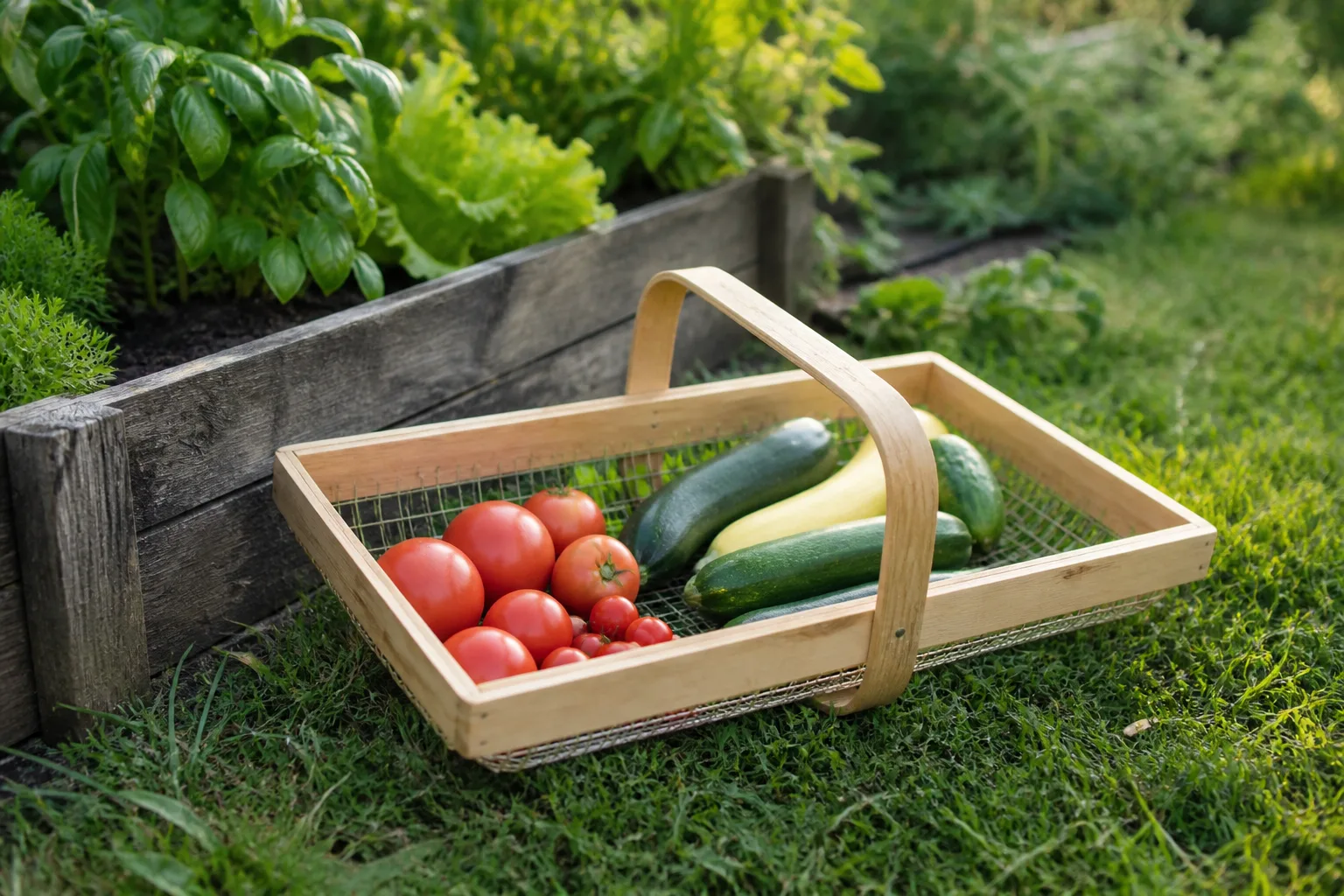
A hod is worth considering when you want produce to drain and you expect to rinse it while it is contained. The open sides make soil and water easier to see and remove than in a solid-sided basket, and the structure can be useful for larger vegetables that will not slip through its openings.
That design has limits. Small fruit can escape, delicate leaves can snag, and an open basket can expose a harvest to sun and wind during a long trip; a wire edge or poorly finished handle may also feel uncomfortable under load. Check the joints, smoothness, opening size, and grip in person, and use another container when the mesh does not match the crop.
Not every mesh-sided product has the same coating, frame, or construction, so do not infer weight limits or food-contact suitability from a photo of a similar hod. If the maker publishes a maximum load or care instructions, use those; otherwise keep the load moderate and inspect the handle attachment and mesh for damage before each season.
Shallow trugs and woven baskets
A shallow trug or woven basket suits gardeners who want to lay out greens, herbs, flowers, or a modest handful of fruit without stacking everything deeply. It may also work as a kitchen display basket after harvest, but that second use is aesthetic rather than a storage recommendation; perishable crops still need appropriate crop-specific handling.
Natural woven materials can look appealing, yet the weave and finish determine how easily you can remove soil and moisture. Do not soak, hose down, or use a cleaning product on a woven basket unless its maker allows it; if food will touch the inside, look for a clear food-contact statement or use a separate food-safe insert with its own care instructions.
The trug’s low sides can make it easier to see what you have gathered and to arrange long or easily marked produce in one layer. The trade-off is less capacity per trip and, for some designs, more care after wet or muddy use; treat the maker’s directions as specific to that basket rather than assuming all wood, wicker, or woven products behave alike.
Colanders, tubs, totes, and crates
A kitchen colander is often the simplest solution for a small harvest because it is easy to carry to the sink and already made for food handling. A light, rigid tote or crate may be better for bulky crops or longer walks, while a washable garden tub can handle especially messy roots; none needs to be sold as a “harvest basket” to do the job.
Fabric totes fold away easily, but check whether the material and seams can be cleaned after contact with damp soil. A solid container does not drain, so do not leave wet produce sitting in rinse water or assume that a basket that carried vegetables is automatically ready for the next harvest without cleaning.
Think about where you will set the container down. A flat-bottomed colander or tote may sit more securely on a kitchen counter, but it can tip on uneven garden soil; a bucket may be sturdy to carry but make delicate produce hard to reach at the bottom. If you need a free hand for pruners or a gate latch, a basket with one comfortable handle can help, but do not choose an awkward shoulder strap simply because it advertises hands-free carrying.
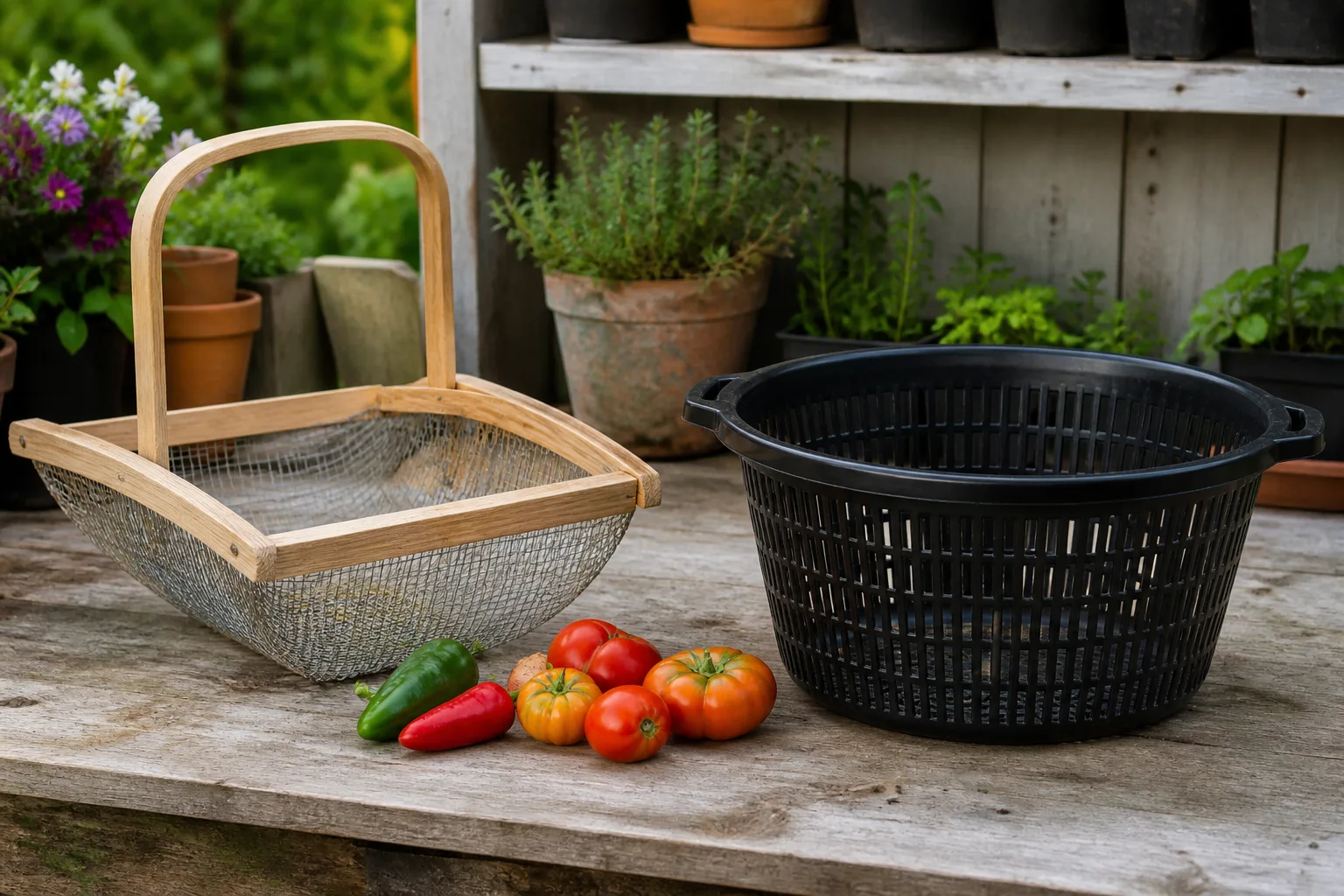
A quick fit test before you buy
If possible, test the basket with the kind of load you expect to carry. Place a few representative vegetables inside, pick it up by its handle, and walk the route you normally take; note whether the load tips, shifts, bangs against the sides, or pulls your wrist into an awkward angle.
Use this checklist before you choose:
- Match the opening to the smallest crop. Small fruit should not fall through or wedge between slats.
- Check the base with a partial load. It should sit flat on a bench or counter without rolling produce toward one side.
- Try the grip. A handle should feel comfortable in your hand and leave enough room for knuckles and long stems.
- Consider the full route. Measure narrow gates, steps, storage shelves, and the sink if you plan to rinse inside the basket.
- Read the care and food-contact information. Do not infer it from “natural,” “rustproof,” “non-toxic,” or an attractive finish.
Think about empty weight as well as capacity. A large basket encourages overfilling, and a rigid container that feels light in the shop can become tiring once it holds wet greens, dense roots, or several heavy fruits. If you need to make multiple short trips, a smaller basket may be more comfortable and may protect delicate produce from being buried.
Check how the basket behaves when you set it down and pick it up again. A handle that folds or swings may be convenient for storage, but it should not collapse over the opening while you load produce; a high handle may clear the contents yet catch on a shelf. If you cannot test the basket in person, compare the maker’s listed dimensions with a container you already own and use those measurements as a reality check, not as a substitute for a listed weight limit.
Cleaning and food-contact considerations
Separate garden soil from food preparation. Virginia Cooperative Extension’s safe-handling and storage guide for raw fruits and vegetables recommends rinsing produce with clean running water before use and cautions against soap or household cleaning solutions on fruits and vegetables; it also advises against rinsing produce before storage when added moisture could encourage spoilage.
The basket itself is a surface that may touch food. The Vermont Agency of Agriculture’s produce-safety guidance on food-contact surfaces distinguishes food-contact surfaces from ordinary garden equipment, while UF/IFAS Extension’s field-sanitation guidance for reusable produce containers, hosted by USDA NIFA, emphasizes keeping reusable containers clean before they carry produce. For a home garden, remove soil promptly, wash a compatible container with an appropriate method, and let it dry fully; follow the maker’s care instructions if it specifies a sanitizer or says not to use one.
Do not treat “rinseable” as the same thing as “sanitized.” A mesh hod can help hold larger vegetables under running water, but the sink and basket still need to be clean, and washing produce in a basket does not make the basket suitable for every food-contact purpose. If the product listing does not clearly state that its finish, liner, or coating is intended for food contact, ask the manufacturer or use a separate container that is.
For the produce, use crop-specific handling rather than a one-rule-fits-all routine. Virginia Cooperative Extension advises washing just before eating or preparation and drying produce with a clean disposable towel; some crops also need curing or dry storage, so a basket should not become a damp holding bin. If a source or product label gives more specific directions for a particular crop or surface, follow that guidance instead of improvising a bleach mixture or detergent rinse.
The practical sequence is simple: tip out loose debris, remove visible soil, wash the basket only with a method its maker permits, rinse away cleaner if the instructions call for it, and let the surface and joints dry before putting it away. Cleaning removes residue; sanitizing is a separate step, and the right method depends on the surface and intended use. Farm-level recommendations may specify procedures that are not interchangeable with household products, so do not copy a chemical concentration from a different container or label.
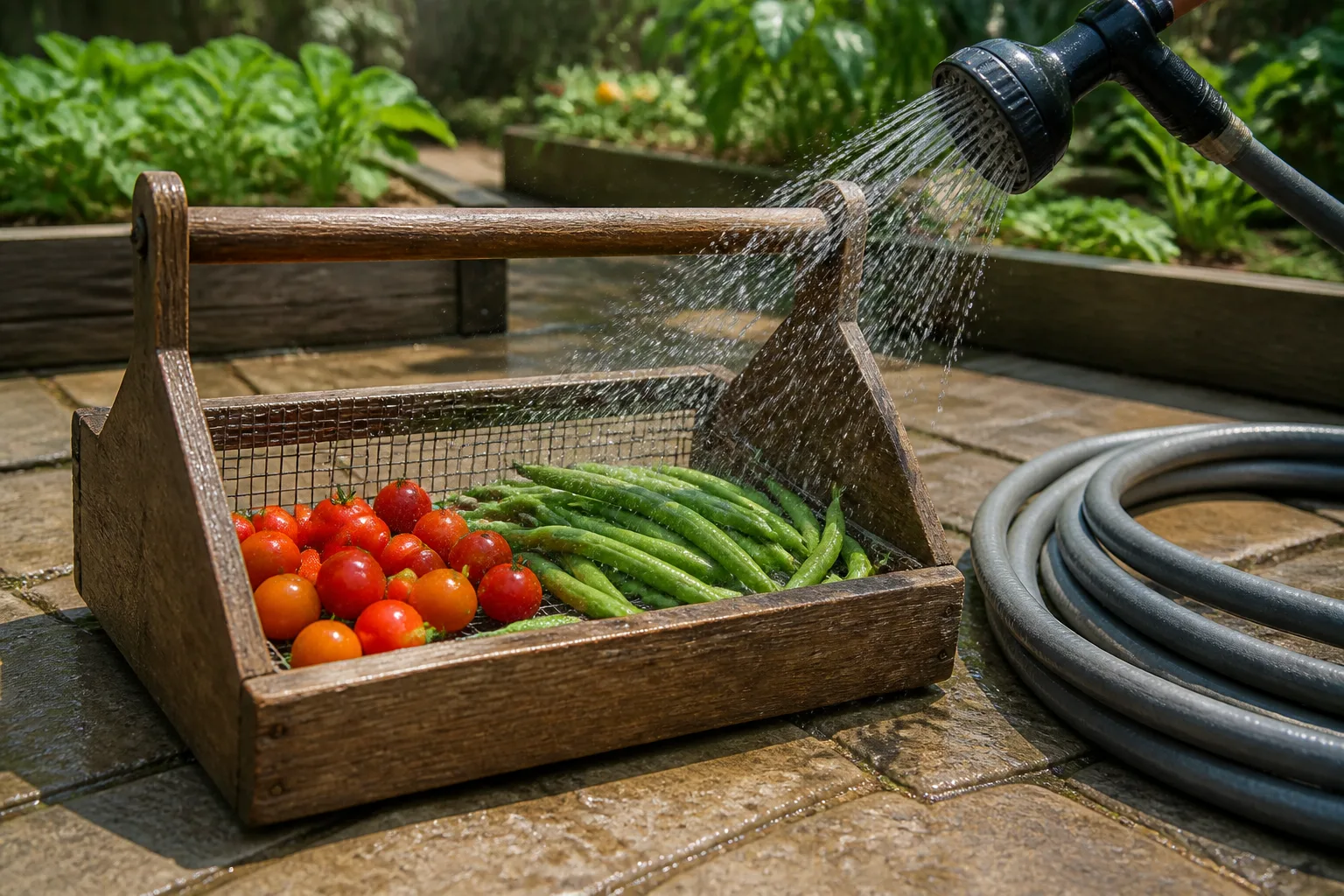
Carrying, storing, and making a basket last
Bring produce inside soon after picking, especially when a hot, sunny path separates the garden from the kitchen. Set the basket on a stable surface, sort out bruised or damaged items, and transfer each crop to the storage conditions it needs; Virginia Cooperative Extension’s produce storage guidance makes clear that storage varies among produce, so a basket is a temporary carrier rather than a universal pantry.
After the trip, empty loose leaves and soil before they dry into corners. Wash according to the material’s care instructions, allow the basket to dry completely, and store it somewhere it will not sit in standing water or get crushed under heavy tools; if its handle loosens, mesh frays, or lining cracks, stop using it for food until the maker’s repair guidance says it is safe.
Keep the garden carrier distinct from long-term storage. A basket left by the sink is a useful staging spot while you sort, but greens, berries, roots, and curing crops do not all want the same temperature or moisture. Transfer the harvest the same session, and clean the basket before it goes back to the potting bench if it touched soil or decaying plant material.
Keep the 2025 headline in perspective
A useful accessory can be worth keeping close, but no one basket suits every garden and no headline makes a particular model a necessity. The original 2025 framing should not be read as a current price or stock check, nor as evidence of an endorsement of a named product; this guide compares basket types and selection criteria rather than claiming a specific celebrity uses or recommends one.
If a basket makes you more likely to pick herbs, gather ripe fruit before it falls, or carry vegetables in one comfortable trip, it may earn its place. If it mostly sits on a shelf, a clean bowl, colander, or tub you already own is the more practical choice.
Common buying mistakes to avoid
Buying by appearance alone is the easiest trap. A deep decorative basket can hide small fruit at the bottom, a wide mesh can lose peas, and a woven container may not tolerate the rinse routine you imagined; verify the details that affect your own crops before paying for a look.
Assuming bigger is better often leads to overloading. A basket that carries a dramatic harvest in one trip may be heavy, awkward through a gate, and too deep for delicate produce; capacity is useful only when you can lift and clean the full container comfortably.
Treating materials as a safety label is another mistake. Wood, metal, plastic, or a coated mesh does not by itself prove that a specific finish or assembly is intended for direct food contact, and a seller’s marketing phrase is not a substitute for clear product instructions. Check the manufacturer’s care and intended-use details, especially if you plan to rinse food in the basket.
Buying a basket that is difficult to store can erase the convenience too. Measure the shelf, hook, or cabinet where it will live, and consider whether a fixed handle, removable liner, or nesting shape will actually fit; a foldable feature only helps if it stays secure and can be cleaned as intended. Finally, avoid treating a decade-old price, a current marketplace listing, or a social-media image as a durable comparison of quality—availability and versions change, while crop fit and comfort are the useful criteria that last.
Finally, do not leave produce in a wet basket because it seems convenient. The Virginia Cooperative Extension guidance notes that extra moisture can affect safe storage; wash produce at the appropriate time, dry it when needed, and move it out of the garden carrier rather than storing every crop in the same container.
A small-garden harvest kit without overspending
Most home gardens do not need a collection of specialty baskets. Start with one washable, stable container that fits your most common harvest; add a small food-safe bowl or colander for berries and cherry tomatoes if they fall through its openings, and keep a separate tub for especially muddy roots if the first container is hard to clean.
For cut flowers, use a long, shallow vessel only if you gather stems often enough to justify it. For a few herbs, a small bowl or clean kitchen container may be easier than carrying an empty full-size hod around the yard; you can always upgrade after a season once you know what feels uncomfortable or repeatedly slows you down.
Before buying, compare the actual basket with the containers you already own. The new item should solve a specific problem—less bruising, easier rinsing, a more comfortable carry, or a better fit for long stems—rather than merely adding another attractive object to the potting bench.
One useful starter system is a shallow clean container for tender produce, a separate washable tub for soil-covered roots, and a pair of clean snips if your crops need cutting rather than pulling. Add a purpose-built hod only if you regularly carry crops that benefit from its open construction, and add a trug only if its shape makes your routine easier enough to justify the storage space.
Conclusion
A good harvest basket is the one that matches your crops, your carry distance, and your cleaning routine. Mesh hods can suit larger produce and rinsing; shallow trugs and woven baskets can keep delicate harvests visible; colanders, totes, and tubs may be the simpler answer for small gardens or muddy jobs.
Treat the original 2025 source story as dated context, not a current endorsement or shopping list. Test what you already own, verify care and food-contact information before buying, and choose a container that will make harvest day easier after the novelty wears off.