How to Grow and Care for a Philodendron Rio Indoors
Grow Philodendron Rio indoors with bright indirect light, check-based watering, an airy aroid mix, safe pruning, propagation steps, and pet-safety advice.
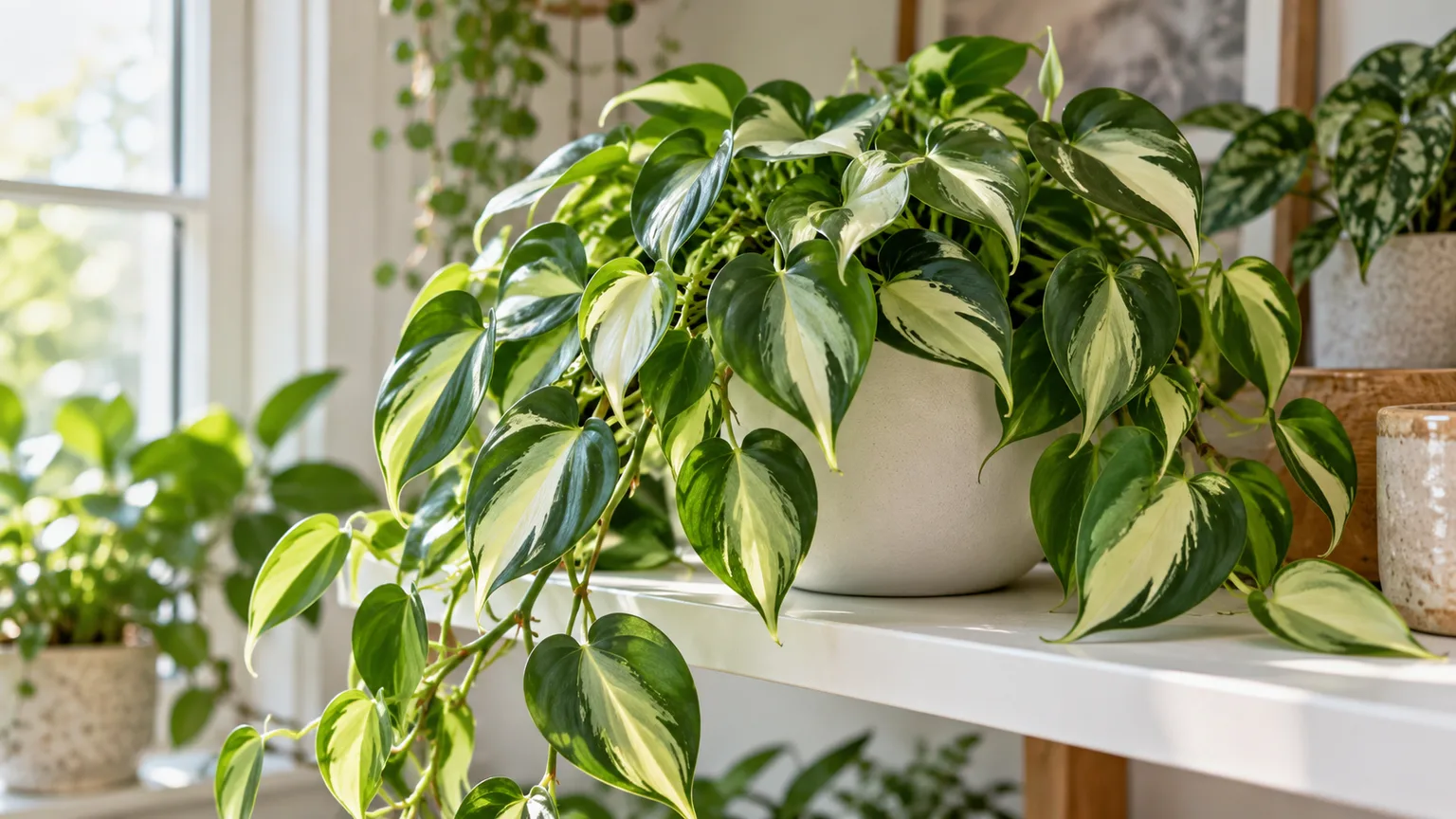
Philodendron Rio is a trailing or climbing heartleaf philodendron with a silver-and-cream stripe through the center of many leaves and deep green edges. Give it bright, filtered light, an airy potting mix, and a thorough drink only after the upper soil has dried; that combination supports steady growth without leaving its roots waterlogged.
Rio is sold under the botanical name Philodendron hederaceum ‘Rio’. It is a cultivar, not a separate species, so the basic growth pattern and many care needs follow the familiar heartleaf philodendron. The details that need more attention are its distinctive variegation, the way light affects the shape of new growth, and the fact that every philodendron should be kept away from pets that chew plants.
What a Philodendron Rio is—and how to identify it
The Rio’s main identifying feature is its leaf pattern: silver and cream color through the center, framed by darker green margins. NC State’s Plant Toolbox lists ‘Rio’ among the cultivars of heartleaf philodendron and describes that central silver-and-cream variegation; the same source describes the species as a tropical vine that can trail or climb when given support. NC State Extension Plant Toolbox The trailing stems carry leaves at regular nodes, and new leaves unfurl from a protective sheath before they flatten and harden.
A single leaf may not display every color equally. The amount of cream, silver, and green can vary from leaf to leaf, and a fresh leaf can look lighter before it matures, so identify the plant by the repeating pattern across several leaves rather than by one unusually pale or dark leaf. If a seller’s listing shows only a stock photo, ask for a current photo of the actual plant and look for the silvery center, dark margins, and healthy stems.
‘Rio’ is part of the botanical species Philodendron hederaceum; Kew’s Plants of the World Online treats the species’ botanical variety separately from horticultural cultivar names. Kew Plants of the World Online That distinction matters because care articles for “philodendron” can refer to several very different plants, including upright, self-heading species. For Rio, follow advice for the vining heartleaf type, then adapt watering and light to your room.
Rio vs. Brasil: read the central stripe
Brasil usually has a more obvious lime, yellow, or cream-green stripe through the middle of each leaf; Rio’s central color is characteristically silver mixed with cream. NC State describes ‘Brasil’ with a yellow-to-light-green stripe and ‘Rio’ with silver and cream in the center, both edged in green. NC State Extension Plant Toolbox The two can look similar in dim photos or under different lighting, and nurseries do not always use cultivar names consistently.
When you are comparing plants, judge the actual leaves rather than the tag alone. Look for a consistent silvery cast in Rio’s middle stripe and darker green margins, and check that the pattern occurs on several leaves rather than only one. A glossy, heart-shaped vine labeled “Rio” but showing only yellow-green streaks may be Brasil or another variegated heartleaf cultivar; ask the seller how the plant was identified before paying a premium.
Give Rio bright, filtered light
Place Rio near a bright window where the leaves receive abundant daylight without being hit by strong afternoon sun for hours. An east-facing window often gives a useful mix of gentle direct morning light and brighter ambient light; at a south- or west-facing window, move the pot back from the glass or soften the beam with a sheer curtain. Window direction depends on your hemisphere and the building around it, so use the plant’s response as well as the compass direction.
Heartleaf philodendrons can survive in lower light, but “survive” is different from making compact, evenly spaced growth. Clemson Extension says heartleaf philodendrons tolerate low light, while the Royal Horticultural Society notes that insufficient light can produce leggy growth and fewer or smaller leaves. Clemson Extension Royal Horticultural Society With a variegated cultivar, a dim spot can leave long bare spaces between leaves and make each new leaf smaller; it does not make mature leaves regain color when you move the pot.
Use a simple check before relocating it: observe the newest two or three leaves and the distance between their nodes. If the vine is extending with increasingly long bare sections or new leaves are shrinking, move it closer to daylight gradually over a week or two. If pale, dry patches appear only on the window-facing side, direct sun may be too intense; reduce exposure instead of moving it into a dark corner.
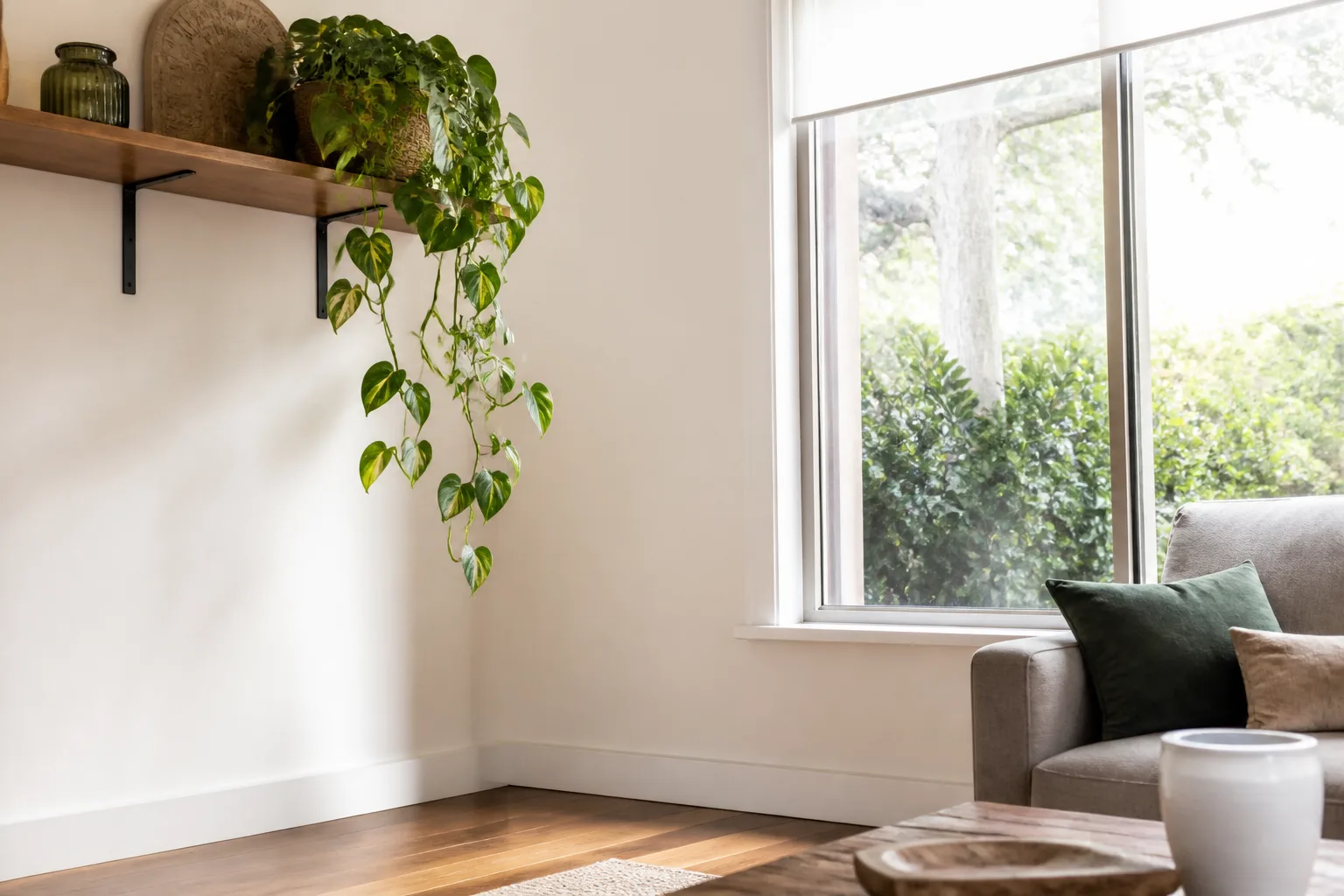
Dust on the broad face of a leaf can also reduce the light reaching it. Wipe leaves gently with a damp, soft cloth when they look dusty, supporting the stem with your other hand so you do not bend a brittle node or tear the leaf.
Water by checking the root zone
Water Rio when the upper layer of potting mix has dried, then soak the mix thoroughly and let every bit of excess drain away. In a typical medium pot, the top 1 to 2 inches are a useful first check, but the depth is only a guide: a small starter pot dries faster than a deep container, and a cool, dim room dries more slowly than a bright, warm one. The Gardening Cook’s heartleaf care guidance also recommends checking the upper inch or two instead of following a calendar. The Gardening Cook
Press a finger into the mix or use a clean wooden skewer to check below the surface. If the top is dry but the skewer comes out cool and damp from deeper down, wait and recheck; if the root zone feels dry and the pot is noticeably lighter, water. This combination is more reliable than a fixed weekly routine because light, pot material, room temperature, root density, and season all change the rate of dry-down.
When it is time to water, pour slowly over the surface until water runs through the drainage holes. Empty the saucer or decorative cachepot after the pot finishes draining; leaving the base in standing water deprives roots of air and raises the chance of root rot. UConn’s philodendron guidance stresses that the mix should be moderately moist rather than saturated and that excess water must drain. University of Connecticut Home and Garden Education Center
Adjust the dry-down check to pot size and season
In spring and summer, active growth and brighter light often shorten the time between waterings. In late fall and winter, the plant may use water more slowly, especially if it sits farther from a window or near a cool draft, so recheck rather than automatically watering on the same day each week. A careful moisture check protects against both extremes: a bone-dry root ball that repeatedly wilts and a constantly damp root ball that loses healthy roots.
If the nursery pot is inside a decorative cachepot, lift the inner pot to check its weight and make sure it is not standing in collected water. A light plastic nursery pot is easy to lift, while a heavier ceramic or terracotta pot can make weight checks less obvious; in that case, use the skewer or finger test. If water rushes straight through a very dry, peat-heavy root ball without wetting it, water slowly in two passes a few minutes apart rather than leaving the whole pot submerged for a long soak.
Build an airy, moisture-holding aroid mix
Rio needs a mix that holds enough water for its roots to take up moisture but has enough large pores for air and excess water to move through. One workable home blend is two parts quality peat-free potting mix or coir-based mix, one part perlite or pumice, and one part fine orchid bark. The proportions are not a formula that must be measured to the gram; adjust the bark and perlite so the mix feels springy and drains freely after a thorough watering.
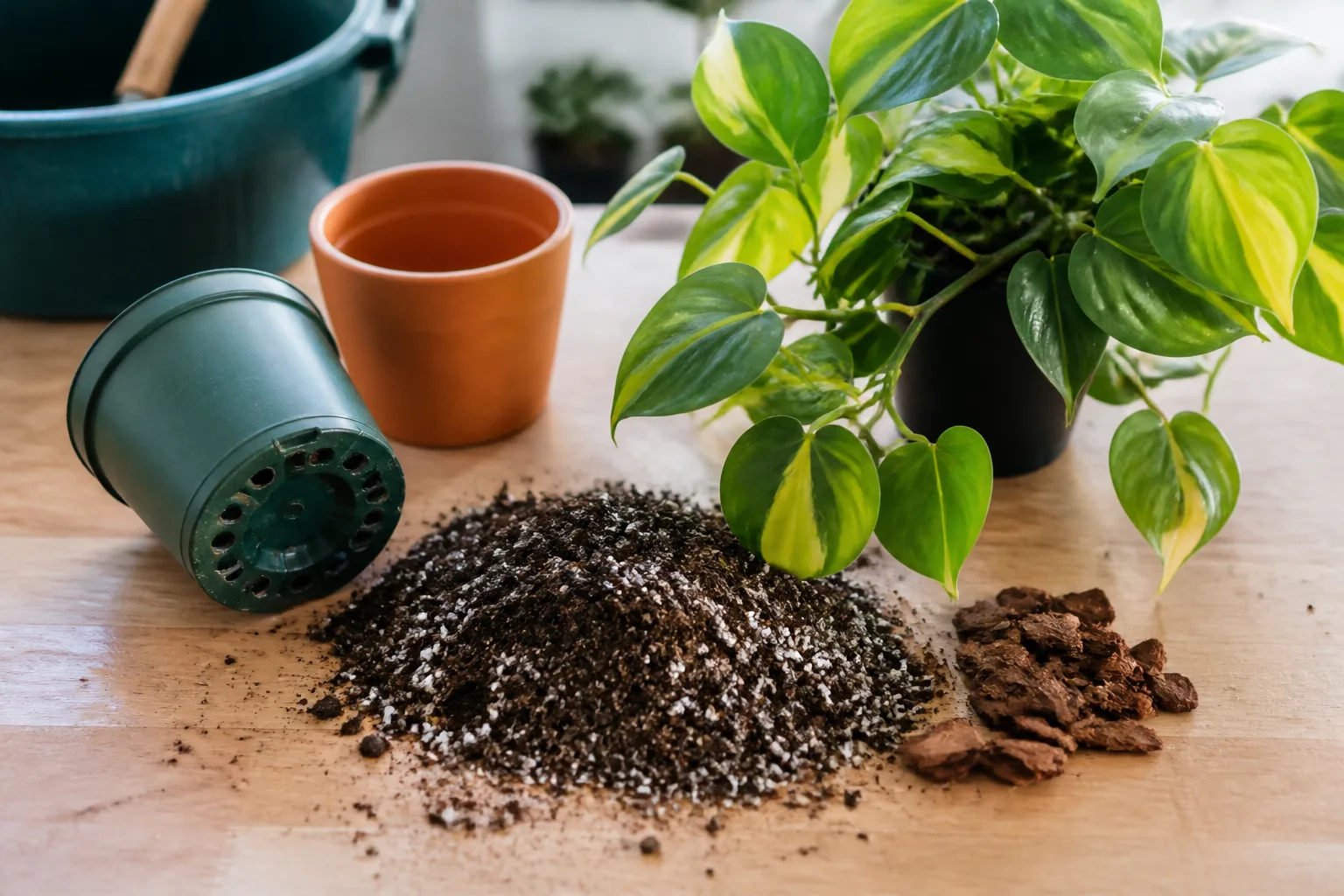
Avoid planting Rio into dense garden soil or a compacted, water-retentive blend with no drainage hole. UConn recommends loose, well-drained soil with organic matter for philodendrons, and the RHS advises using free-draining compost rather than a pot much larger than the root ball. UConn Home and Garden Education Center RHS Growing Guide If a bagged indoor mix stays soggy for many days in your room, add more coarse aeration material or choose a lighter mix instead of watering less while leaving the roots in a dense, airless medium.
The mix should not dry into a hard, hydrophobic plug, either. If water beads on top or channels down the pot’s sides, loosen and rehydrate the root ball gradually; at the next repot, replace badly compacted mix with a fresh, open blend.
Keep temperatures steady and humidity practical
A comfortable, stable room is usually more important than creating a tropical display case. The RHS recommends keeping philodendrons above about 59°F (15°C), while Clemson gives warm day and night ranges for many philodendrons; keep Rio away from cold glass, open winter doors, air-conditioner drafts, and hot radiator air. RHS Growing Guide Clemson Extension
Average household humidity is often adequate for a heartleaf philodendron. If your home is very dry and new leaves repeatedly emerge with damaged edges or stall while unfurling, measure the room with a hygrometer before buying equipment; a small humidifier near the plant can raise humidity more reliably than misting. Keep air moving gently and avoid soaking the foliage at night, which leaves wet surfaces lingering without fixing dry potting mix or a damaged root system.
Feed lightly while new growth is active
Rio is not improved by heavy doses of fertilizer. During the brighter months, when you see leaves and stems actively extending, use a balanced houseplant fertilizer diluted according to its label; a conservative half-strength dose every four to six weeks is a reasonable starting point for a plant in an unfertilized mix. A plant already growing in potting mix with a slow-release charge may not need extra food right away.
The University of Connecticut notes that more frequent, dilute feeding is safer than a single strong dose for philodendrons, especially because roots can be injured by concentrated fertilizer. University of Connecticut Home and Garden Education Center Skip feeding when growth has slowed in winter or after repotting into fresh, enriched mix. If a white mineral crust forms on the soil or pot rim, pause fertilizer and water thoroughly until the drainage runs clear; do not add more fertilizer to solve pale leaves caused by low light or root stress.
Train or prune the vine without losing good nodes
Rio can trail from a shelf or hanging pot, or climb a trellis, moss pole, or other stable support. Trailing is the lower-maintenance option and keeps the stems accessible for inspection; climbing gives the plant a vertical path and helps you control where new growth goes. Choose a support based on the space and the weight of the mature vine, not on an assumption that every philodendron needs a moss pole.
Attach stems loosely with soft plant ties and keep ties away from petioles, the short stalks that hold leaves. Avoid tightening a tie around an expanding node or fastening a long stem so rigidly that it kinks as it grows. The RHS recommends supporting climbing philodendrons and pruning straggly stems in spring, cutting just after a leaf node so the parent plant retains a point from which new growth may emerge. RHS Growing Guide
To shorten a vine, use clean, sharp scissors and cut a little above a healthy node; the section you remove may be used as a cutting if it includes a node. Remove dead or badly damaged leaves at the stem rather than pulling them off, and wear gloves because philodendron sap can irritate skin. Pruning will not make a damaged leaf turn green again, and cutting every long stem at once can reduce the plant’s leaf area just when it needs energy to recover.
Propagate from a healthy, patterned stem
A Rio cutting needs at least one stem node, the joint where a leaf and often an aerial root emerge; a leaf by itself cannot make a new vine. Choose a vigorous section with a visible node and a leaf whose pattern resembles the parent plant. If you cut from a stem that has been producing entirely green leaves, the new plant may carry that same less-variegated growth rather than the pattern you wanted.
Clemson and UConn both describe stem or tip cuttings as standard ways to propagate vining philodendrons. Clemson Extension University of Connecticut Home and Garden Education Center Smart Garden Guide also describes water and soil as practical options for heartleaf cuttings. Smart Garden Guide Use a clean blade and handle the cut stem carefully; the sap is irritating, and the parent plant should retain several healthy leaves after you take a cutting.
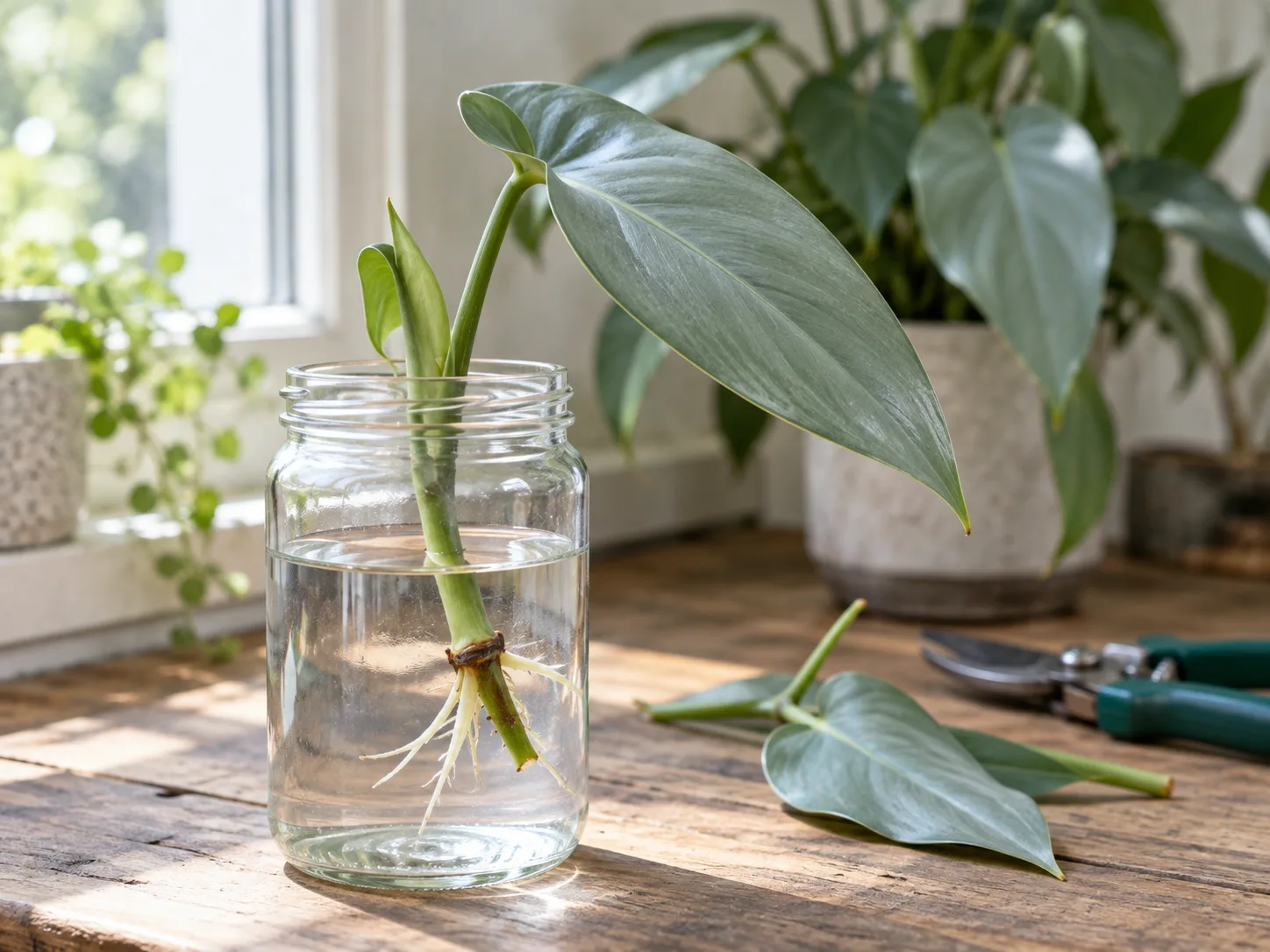
Root a node cutting in water or potting mix
For water propagation, cut just below a node, remove any leaf that would sit underwater, and place the node in a clean glass with the leaf above the waterline. Keep the cutting warm in bright, indirect light, refresh the water if it becomes cloudy, and watch for several roots rather than expecting a particular date; the pace depends on warmth, light, and the cutting’s condition.
For a soil start, place the node into a small pot of lightly moist, airy mix and keep the medium gently moist—not saturated—while roots establish. A clear propagation box can help in an unusually dry room, but open it for ventilation and remove it if condensation stays heavy. Pot a water-rooted cutting once it has multiple roots long enough to anchor in the mix, then keep the mix evenly damp for the first week before returning to the normal dry-down check.
One rooted cutting can fill a thin-looking pot more quickly when you plant it back around the original vine, but only do this if the main plant and cutting are healthy. A recently repotted, pest-stressed, or root-damaged Rio benefits more from steady recovery than from extra propagation work.
Repot only when roots or mix show a reason
Rio does not need a larger pot every year. Repot when the roots are densely circling the root ball, emerging repeatedly from drainage holes, or using water so quickly that the plant needs watering again soon after a complete soak; replace degraded, compacted mix even if the pot size is still suitable. The RHS recommends waiting until roots become densely packed and moving only a few centimeters up in pot diameter, since an oversized volume of wet compost can remain damp too long. RHS Growing Guide
Choose a container with unobstructed drainage, only one size wider than the current root ball. Slide the plant out gently, loosen only the outermost tight roots, and remove roots that are black, mushy, or hollow rather than cutting healthy firm roots just to make them fit. Set the original root-ball height in fresh mix, water until the excess drains, and return the plant to similar light while it settles.
If the plant is not root-bound but the old mix has broken down, refresh the medium in the same pot. Repotting a healthy Rio during the brightest, warmest part of its growth cycle usually gives it more time to resume root growth; in winter, delay routine repotting unless the mix is staying waterlogged or the roots are deteriorating.
Troubleshoot changes in leaves and growth
Read a symptom together with its location and the potting mix, not as a diagnosis by color alone. A few older leaves may yellow naturally as the vine grows, but several new leaves changing at once deserve a check of moisture, light, temperature, and roots before you apply fertilizer or move the plant dramatically.
Sort yellowing, browning, and curling by pattern
| What you see | First checks | A measured first step |
|---|---|---|
| Several leaves yellow while the mix remains wet | Drainage, cachepot water, mushy or dark roots | Let the mix dry partly; inspect roots if the plant continues declining |
| Lower, older leaf yellows one at a time | Age of the leaf, active new growth, overall vine condition | Remove the spent leaf only after it detaches easily |
| Dry brown patches on the window side | Direct sun or heat at the glass | Soften or reduce the direct exposure; damaged tissue will not recover |
| Brown tips on several leaves | Dry air, erratic dry-down, mineral or fertilizer buildup | Check room humidity and the mix before adding water or fertilizer |
| Leaves curl while the root ball is dry | Missed watering or a pot that dries too quickly | Water completely, drain well, and recheck the pot’s dry-down interval |
| Leaves curl while the mix is wet | Poor aeration, cold stress, or root injury | Hold watering and inspect the root zone instead of adding more moisture |
Yellow leaves alone do not prove overwatering. Root rot becomes more likely when yellowing appears alongside persistently wet mix, soft stems near the base, or brown and mushy roots; conversely, a light pot and dry root ball point toward underwatering. Clemson Extension identifies overwatering and poorly draining soil as common causes of root rot in philodendrons. Clemson Extension
For crispy edges, test the simplest causes first: has the mix swung from bone dry to soaked, has fertilizer residue accumulated, is the plant beside a heater, or did a bright sun patch shift with the season? Low humidity can contribute, but a humidifier will not repair roots sitting in soggy soil. Make one change, note where the next leaf develops damage, and adjust only when the pattern supports it.
Separate fading variegation from a green shoot
The leaf pattern is built into the plant tissue; moving an older leaf into better light will not paint silver or cream back into it. A new leaf that looks darker or less contrasting may simply be immature, so wait until it expands fully before judging it. Compare several mature leaves along the same stem, not one leaf that is still unfurling.
If an entire stem repeatedly produces solid-green leaves, inspect the point where that growth began and compare it with the variegated parts of the vine. Improve the light to a bright, filtered position first, then wait for new growth rather than escalating to direct sun; intense rays can scorch foliage without restoring the pattern. If the all-green section continues to grow faster than the patterned portions and the pattern matters to you, prune that stem back to a node with more balanced variegation.
Keep the plant away from pets and curious children
Philodendron Rio is not pet-safe. The ASPCA lists heartleaf philodendron as toxic to dogs and cats and identifies insoluble calcium oxalates as the toxic principle; Poison Control explains that philodendron crystals can cause immediate irritation after chewing and that sap can irritate skin or eyes. ASPCA Animal Poison Control Poison Control
A high shelf is not a reliable barrier for a climbing cat, and trailing stems can hang within reach of children or pets. Use a room they cannot enter, a stable enclosed plant cabinet, or another genuinely inaccessible location, and keep pruning pieces and fallen leaves off the floor. Wear gloves when cutting; wash sap from skin, and rinse eyes promptly if exposed.
If a person chews a philodendron, rinse the mouth and spit out plant material; do not force fluids. In the United States, call Poison Control at 1-800-222-1222 for exposure guidance, and seek emergency help for severe swelling or difficulty swallowing or breathing; use your local poison center elsewhere. Poison Control For a pet that chews the plant, contact a veterinarian or an animal poison-control service rather than assuming that a hanging pot makes the exposure harmless.
Acclimate a new Rio before changing its care
When the plant arrives, check the leaves, stems, soil surface, and undersides for pests, then keep it separate from the rest of your collection while you observe it. The point is to catch hitchhiking insects and learn how quickly its existing nursery mix dries before you add a new pot, fertilizer, humidifier, and watering routine at the same time.
For the first week, place it in bright, filtered light, let it settle, and note the pot’s weight after watering and as the mix dries. Do not repot solely because the nursery container looks plain; repot sooner if the mix stays soggy, the pot has no drainage, or the roots show clear distress. Once you know how the plant responds in your home, make only the changes that solve an observed problem.
A new leaf may take time to appear after a move because light, temperature, and root conditions have changed. Judge success by firm stems, healthy roots, and the quality of the next fully expanded leaves—not by whether a variegated plant changes overnight.
Conclusion
Philodendron Rio care becomes simple once you stop treating it as a fragile collector plant and start reading its growing conditions. Give it bright filtered light, water after checking the root zone, use a loose mix and a draining pot, and feed only while it is actively growing.
Its silver-and-cream center stripe distinguishes it from the greener, often yellow-toned Brasil, but neither careful lighting nor fertilizer can guarantee an identical pattern on every leaf. Keep it out of reach of pets and children, inspect symptoms before changing care, and let the plant’s own dry-down and new growth guide your routine.



