Plant Diseases: Identification, Treatment & Prevention
Learn how to tell plant diseases from watering, pest, or nutrient problems, identify common signs, choose safer treatments, and prevent repeat outbreaks.
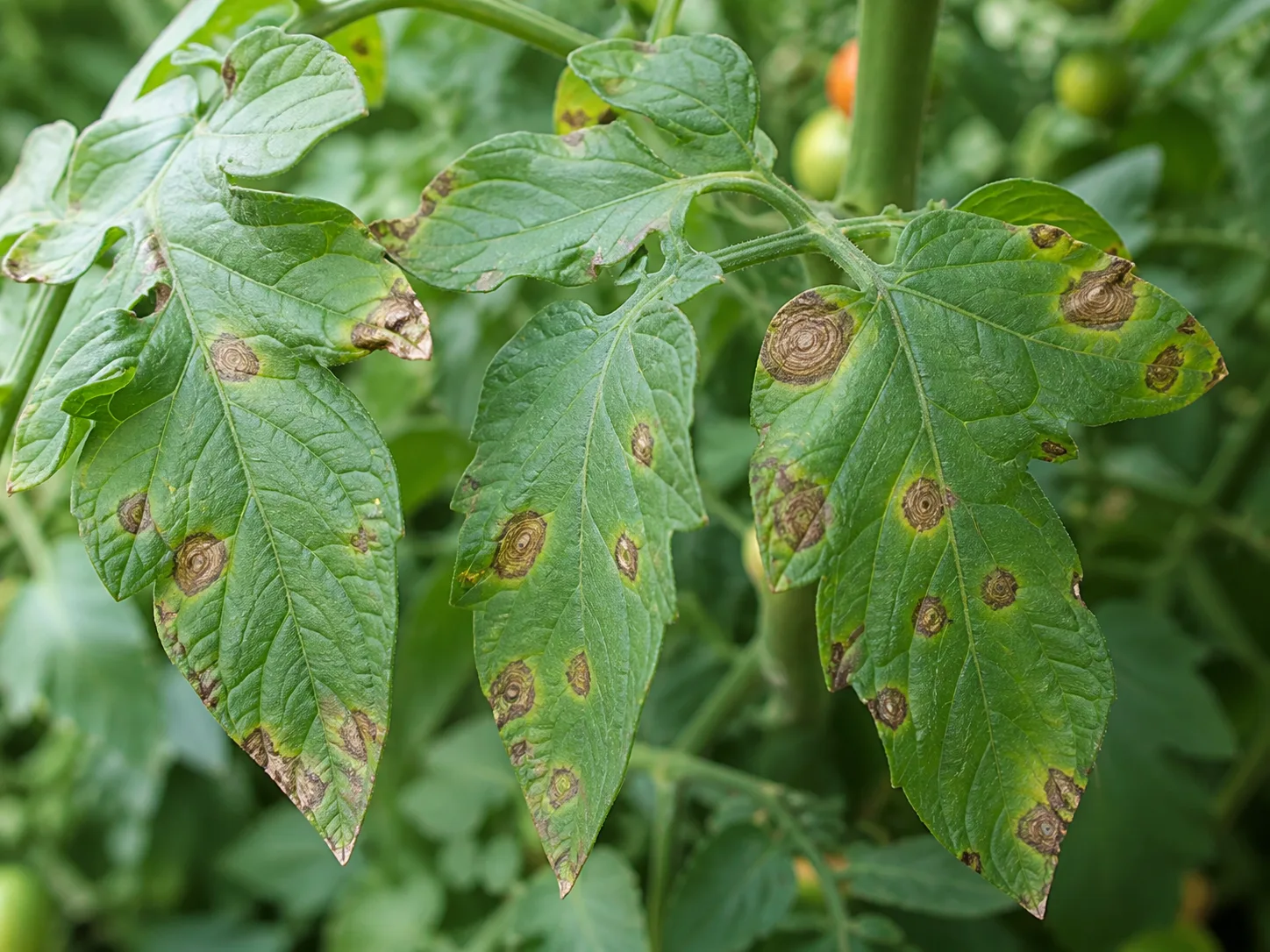
A plant with spotted leaves or sudden wilt may have an infectious disease, but the same symptoms can follow drought, saturated soil, cold, fertilizer injury, a pest, or a damaged root system. Before cutting, spraying, or replacing it, look at the whole pattern: which plant is affected, where symptoms began, how quickly they changed, and what happened in the growing area recently. Those clues help narrow the cause and prevent a wrong treatment from adding stress.
Plant disease management works best when it interrupts the conditions an organism needs to infect a susceptible host. A single leaf mark rarely identifies the exact pathogen, and a product sold as a fungicide will not fix every plant problem. The practical goal is to decide whether action is needed, contain a likely infectious problem, and choose a response that matches the best-supported diagnosis.
Plant disease or plant stress? Make the first distinction
A pathogen causes disease; growing conditions cause disorders
In plant-health terms, a disease is an ongoing harmful process caused by an infectious agent such as a fungus, oomycete, bacterium, virus, or nematode. A disorder is injury from a noninfectious cause: too much or too little water, unsuitable light or temperature, root restriction, salt buildup, nutrient imbalance, herbicide drift, or mechanical damage. Both can cause yellowing, leaf drop, lesions, stunting, or wilting, so the visible symptom alone is not a verdict.
This distinction changes what you do next. A fungal leaf spot may spread from infected debris or splash water; sun scorch will not move from one plant to another, and extra fungicide will not shade a plant or correct salty soil. The Washington State University PNW Gardeners’ Handbook notes that many plants submitted for diagnosis have cultural or environmental problems rather than insect or disease organisms, which is why site conditions and care history belong in the first assessment (WSU Extension’s plant-health and IPM guidance).
Pests can create a third look-alike category. Chewed edges, holes, mines, stippling, honeydew, webbing, or insects on the undersides of leaves point toward an animal pest or its feeding damage, although a stressed or wounded plant can also develop a secondary infection. BBC Gardeners’ World’s plant-damage guide is useful for comparing disease signs with insects, nutrient symptoms, and other causes, but use it as a shortlist rather than a definitive diagnosis (BBC Gardeners’ World: What’s damaging my plant leaves?).
The disease triangle is a useful mental model: disease develops when a susceptible host, a pathogen, and favorable conditions overlap long enough. You may not be able to remove a pathogen already in the soil, but you can sometimes reduce leaf wetness, improve drainage, choose a resistant cultivar, or remove infected material. Colorado State University Extension uses this model in its plant-health guidance and recommends an IPM approach that starts with observation and diagnosis before selecting controls (Colorado State University Extension’s IPM and plant-health guide).
A symptom is the plant’s response—such as a yellow patch or wilt. A sign is direct evidence of the causal organism or its activity, such as visible fungal spores, a fruiting body, bacterial ooze, or an insect. Signs can strengthen a diagnosis, but even visible mold may be colonizing tissue that was already dead; context still matters.
Read the pattern before naming the problem
Where symptoms start and how they progress
Start by asking whether the problem is isolated or shared. One plant with symptoms while nearby plants remain healthy may point to an individual root, watering, or exposure issue; the same pattern on one species across a bed raises the odds of a shared host-specific disease or common environmental exposure. Symptoms on many unrelated species at once suggest checking irrigation, weather, soil, drift, or a recent application before assuming a new pathogen has spread through the garden.
Look for the first affected part and the direction of change. Older lower leaves that develop spots first may reflect soil splash or a disease that begins on low foliage; new growth that is distorted across several plants may indicate a systemic infection, herbicide injury, or a nutrient-uptake problem. A symptom that appears abruptly after a cold night, heat wave, repotting, or spray application carries different clues from one that expands gradually over several weeks.
Compare upper and lower leaf surfaces, stems, flowers, fruit, and the root zone. Angular lesions bounded by veins, circular spots with halos, fuzzy growth, sunken cankers, or a one-sided wilt can guide what to check next, but many diseases overlap in appearance. Note whether the pattern follows leaf veins, begins at the edge, appears on the sun-facing side, or is concentrated where soil or irrigation water splashes.
Signs and symptoms that offer clues
Visible patterns can narrow possibilities without confirming them:
| What you notice | What it may suggest | What to check next |
|---|---|---|
| White, talc-like patches on leaves or stems | Powdery mildew or residue | See whether patches expand on living tissue and compare both sides of leaves |
| Orange or rust-colored powder, often underneath leaves | Rust disease | Look for corresponding pale or yellow spots on the upper surface |
| Dark spots that enlarge, merge, or develop halos | Fungal or bacterial leaf spot; also scorch or chemical injury | Check whether lesions follow veins, spread after wet weather, or occur on exposed leaves |
| Water-soaked or translucent areas, sometimes with ooze | Possible bacterial disease or cold injury | Note temperature, rain, and whether affected tissue smells or collapses |
| Wilting despite wet soil | Root damage, root rot, vascular wilt, or waterlogged roots | Check drainage and inspect a small root sample for firm versus soft tissue |
| Mottling, rings, persistent distortion, or stunting in new growth | Possible virus, herbicide injury, mites, or nutrient problem | Inspect for pests and compare plants of the same species and age |
The descriptions above are clues, not diagnosis. For example, yellowing may arise from root stress, low light, nutrient availability, aging leaves, or infection. A photograph also cannot show drainage, root condition, recent spray exposure, or whether lesions are expanding; write those details down instead of trying to infer them from color alone.
Common plant disease groups and their clues
Leaf spots, blights, mildew, and rust
Leaf spots describe a symptom category, not one disease. Fungi and bacteria can both produce spots, and their appearance varies by plant and pathogen. Some fungal leaf spots form circular lesions with dark margins or tiny fruiting dots; bacterial spots can look water-soaked or angular, but those visual patterns overlap and do not prove the cause. Affected leaves may yellow and drop as lesions merge, yet sunscald, spray damage, and nutrient stress can also produce dead patches.
Blight generally describes rapidly developing tissue death rather than a single organism. A blight that advances across foliage or stems during wet weather deserves prompt attention because some agents spread quickly, but do not assume “blight” means the same disease on every plant. For a vegetable crop or valuable ornamental with fast-moving lesions, photograph both surfaces, record recent rain and irrigation, and seek an extension diagnosis before applying a product.
Powdery mildew often looks like white or gray powder sitting on leaf surfaces; downy mildew tends to produce growth on undersides with yellow or angular areas above, though host and conditions matter. Rust commonly produces orange, yellow, or brown spore-like pustules, often on leaf undersides. The Epic Gardening overview of common garden diseases illustrates how familiar names such as mildew, rust, and blight cover different organisms and management needs (Epic Gardening’s common garden diseases guide).
Powdery mildew is also a good reminder not to rely on the simplistic rule that all fungal disease requires water sitting on leaves. Some powdery mildew pathogens do well with humid air while leaves are not continuously wet; other diseases, including many leaf spots and downy mildews, are favored by prolonged leaf wetness. Base the response on the particular plant and likely disease, not a universal watering slogan.
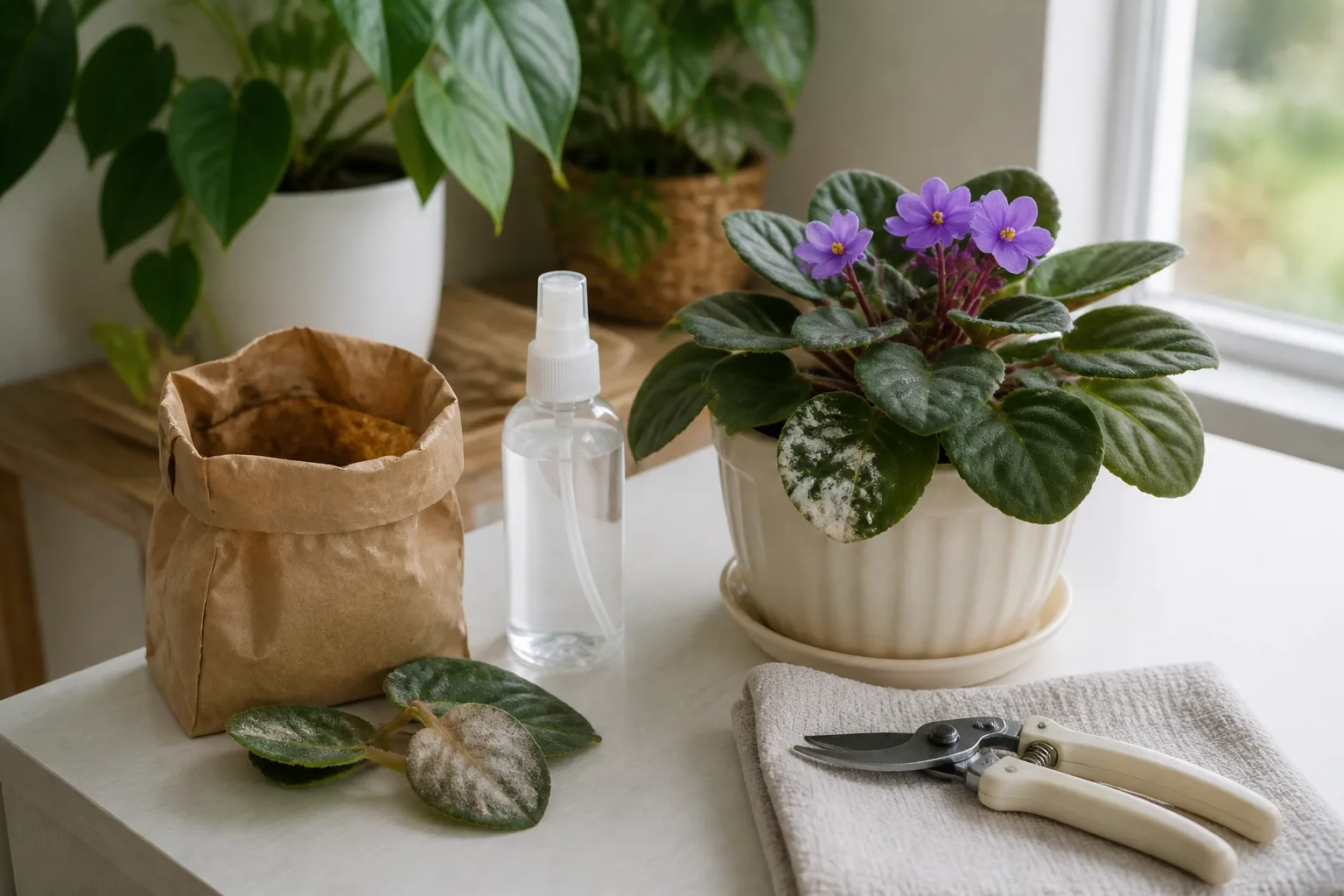
Powdery growth is one clue to investigate, not proof of a single universal treatment.
Wilts, root rots, cankers, and viruses
A plant that wilts in wet soil needs a root check before it gets more water. Healthy fine roots are generally firm; rotted roots are often brown or black and soft, and a sour smell may accompany advanced decay. Waterlogged potting mix can itself suffocate roots, while soil-borne oomycetes or fungi may invade weakened roots, so removing the cause of prolonged saturation is essential even if an infectious agent is also involved.
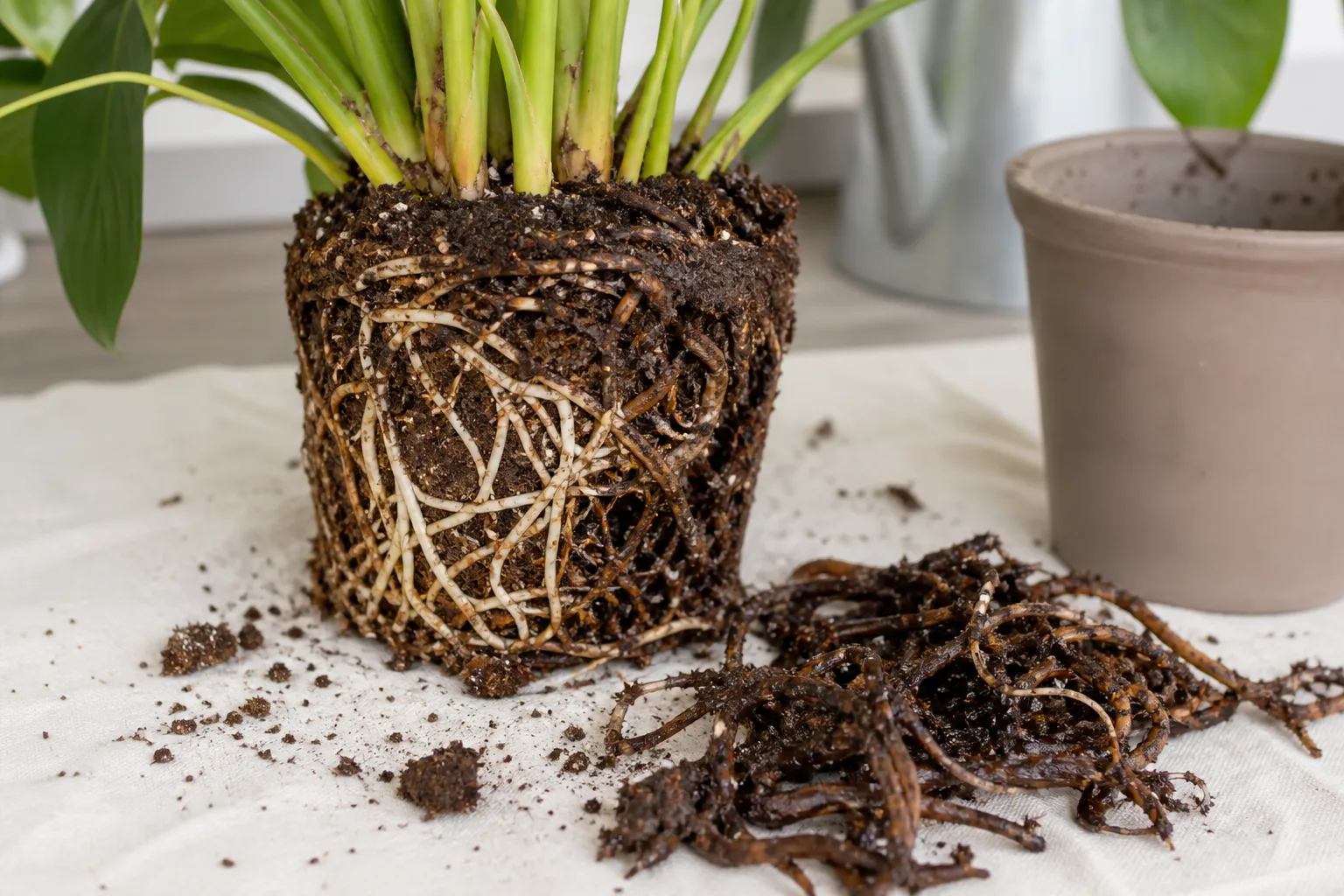
Inspect a representative root section gently before disturbing more of the plant or bed.
Vascular wilt diseases interfere with water movement, but drought, root damage, stem injury, and waterlogged soil can create similar above-ground collapse. If only one branch or one side of a shrub wilts, inspect that section and the stem rather than diagnosing the whole plant from leaf color. Woody cankers, bark cracks, gumming, or dieback should be treated as a higher-stakes problem: avoid pruning in wet weather, photograph the boundary of healthy and damaged tissue, and seek a local diagnostic opinion before removing major limbs.
Viruses may cause mosaic patterns, rings, yellowing, unusual leaf shape, or stunting, but those signs can also follow herbicide exposure, mites, or nutrient stress. A pesticide cannot cure a viral infection inside a plant. If a virus is confirmed or strongly suspected, ask an extension service about the host-specific response; removal of an infected plant may limit a source of spread, while vector control and clean propagation material can help protect nearby susceptible plants.
Root and soil problems are not always solved by replacing the top layer of soil or pouring a fungicide into a pot. Soil-borne pathogens may persist, but their host range and survival differ, and some roots fail primarily because a container has no drainage or irrigation is too frequent. Disturbing all nearby soil without an identification can spread contaminated material or damage otherwise healthy roots.
A step-by-step plant disease diagnosis
1. Identify the plant and map the damage
Write down the plant’s common or botanical name, cultivar if known, age, and whether it is grown indoors, in a container, or in the ground. Disease susceptibility often differs among cultivars of the same species, and a diagnosis made without the host identity may be too broad to guide treatment.
Map where symptoms occur rather than recording only “leaves are brown.” Note whether one plant, one branch, one bed, or several unrelated plants are involved; whether lower, upper, new, or old growth is affected; and whether the symptom is spreading. Take a clear photo of the whole plant and close-ups of both leaf surfaces, the stem, and—if relevant—roots, with an unaffected part for comparison.
2. Inspect closely, including leaf undersides
Use a hand lens if you have one, and look for insects, eggs, webbing, frass, powdery growth, pustules, ooze, or repeated lesions. Check the underside of leaves and the place where stems meet the soil; early evidence is often easier to see there than from above. Do not handle suspicious material and then move straight to another plant, especially if you may be dealing with a contagious disease.
Keep the inspection gentle. Pulling every spotted leaf, digging up a whole bed, or cutting into a trunk can destroy useful evidence and add injury. If roots need checking, inspect one representative plant or a small section first, unless rapid collapse makes prompt removal necessary.
3. Reconstruct weather and care history
Record what changed in the previous few weeks: rainfall, irrigation frequency, standing water, an unusually hot or cold period, pruning, repotting, fertilizer, herbicide or pesticide use, new plants, and recent construction or root disturbance. A symptom timeline often separates gradual disease development from a sudden exposure. If several plant species developed symptoms in the same area at the same time, look for a common cause such as drift or water before treating each plant as a separate infection.
Check the actual root-zone conditions. A dry surface does not guarantee a dry root ball, and a damp top layer does not prove the entire pot is waterlogged. In garden beds, consider compaction, drainage, shade, and whether irrigation wets foliage late in the day; for houseplants, check that drainage holes are open and that water is not left in an outer cachepot.
4. Compare evidence and test when needed
Use a university extension diagnosis page or plant clinic to compare the host, symptoms, signs, and conditions together. Penn State Extension’s plant-health diagnosis framework specifically recommends assessing site conditions, management history, symptoms, and references rather than treating a single visual symptom as a complete diagnosis (Penn State Extension’s plant diagnosis guidance).
If the disease is spreading quickly, could affect many plants, involves a mature tree, or would lead you to use a pesticide, seek a second opinion before acting. A lab or extension clinic may need a fresh sample that includes both affected and healthy tissue, roots, or the whole small plant; requirements differ, so check the lab’s instructions before mailing anything. Include the plant name, location, symptom timeline, weather and watering conditions, and any treatments already used. Diagnosis services may charge a fee, but they can prevent repeated purchases of a product that cannot affect the actual cause.
How to manage a disease once identified
Sanitation, pruning, and environmental corrections
Start with controls that reduce spread and improve conditions. If an infected leaf or fruit is clearly serving as a source and the plant can tolerate its removal, prune selectively with clean tools and bag or dispose of the material according to local waste rules. Do not automatically strip a plant of every marked leaf; excessive removal reduces photosynthetic area and may stress it more than a limited infection.
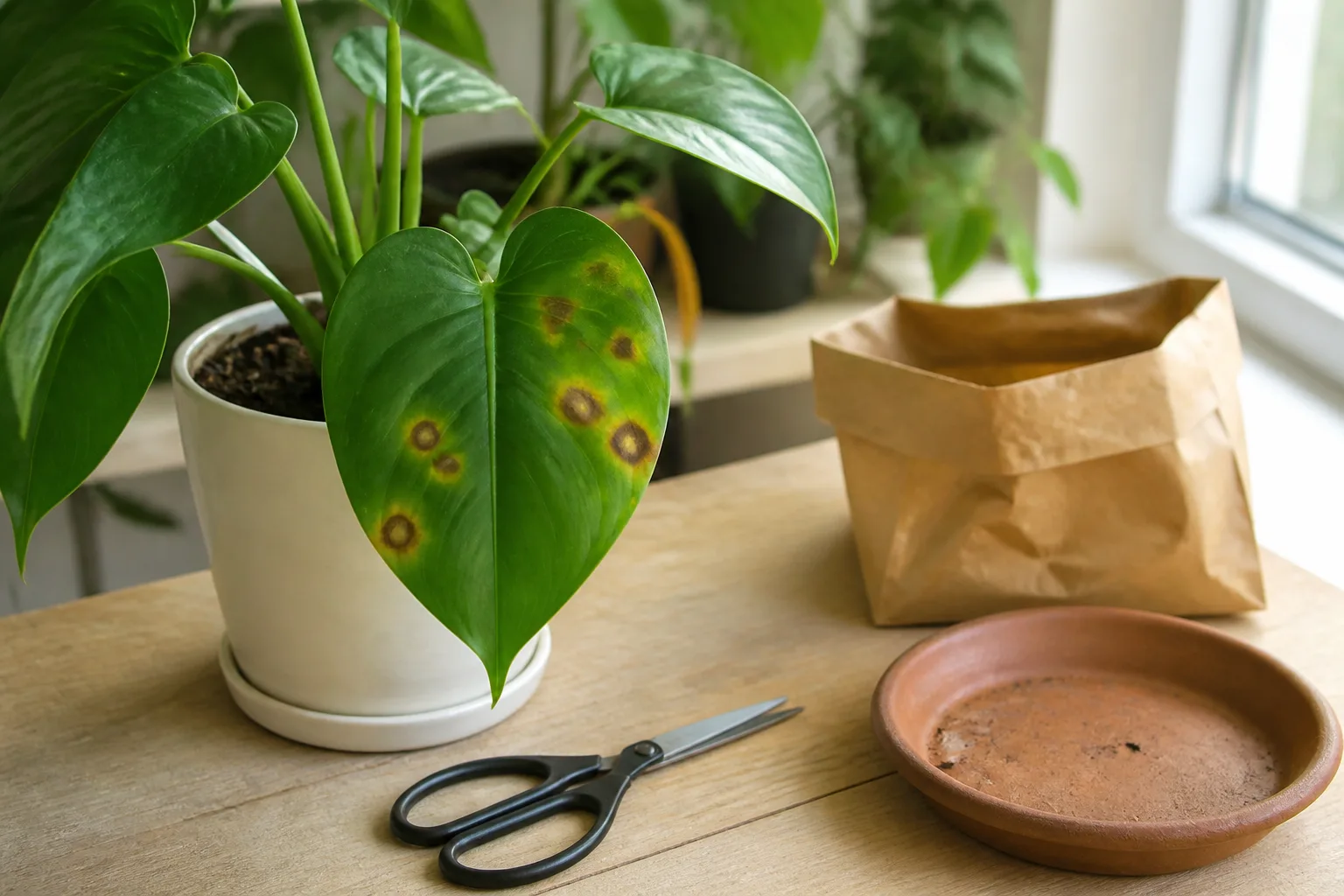
Remove only tissue that helps reduce spread and leave enough healthy foliage for recovery.
Clean visible debris from tools, then disinfect between plants when handling suspected viral, bacterial, or vascular disease, or when a diagnostic service recommends it. Alcohol-based tool disinfection is one option for appropriate pruners; use it safely, allow tools to dry, and keep it away from flame. For ordinary pruning, proper cleaning and preventing contact with wet infected tissue may be sufficient; the right sanitation level depends on the suspected pathogen.
Correct the condition that favors the problem: improve drainage, water the root zone when practical, space plants for mature size, remove weeds or debris that harbor a known pathogen, or move an indoor plant into brighter airflow if the species tolerates it. Do not water by calendar alone. Consistent moisture is helpful for some plants, but constantly saturated soil encourages root failure, while drought can stress plants and make recovery harder.
Composting is not automatically safe for every diseased plant. Some pathogens survive in plant debris or a cool backyard pile; others pose little risk once tissue is fully decomposed. When the disease is unknown or known to persist in debris, follow your local extension or waste guidance and keep the material out of a home compost pile unless the composting process is appropriate for that pathogen.
When a fungicide is worth considering
A fungicide is not a general “plant disease medicine.” It only targets certain fungal or fungus-like diseases, may work best before infection or early in disease development, and will not repair tissue that is already dead. Some products have limited activity after infection for particular disease-host combinations, but there is no universal curative spray; check a reliable disease-specific recommendation before choosing one.
Use a product only when its label lists the plant or site and the disease, and follow the label’s directions for rate, protective equipment, application timing, re-entry, and harvest intervals. Do not increase the concentration, combine products, or spray a stressed plant because an online recipe promises a quick fix. Organic or natural products still require label-compliant use and can injure plants or affect non-target organisms.
A fungicide often protects new or uninfected tissue rather than clearing old lesions. Some pathogens develop resistance when the same mode of action is repeatedly applied, so follow label directions and any extension recommendation on rotating products; do not invent a rotation schedule or shorten intervals. Penn State Extension’s disease-management materials frame treatment as one part of disease prevention and IPM, not a substitute for accurate identification, sanitation, and appropriate growing conditions (Penn State Extension’s Plant Disease Management 101).
Prevent diseases from coming back
Prevention starts before planting. Choose healthy, reputable nursery stock and cultivars with resistance to the particular disease known in your region; “resistant” does not mean immune to every disease or stress. Match the plant to site light, soil, moisture, and mature spacing so it is not under chronic stress or crowded into a humid canopy.
Use watering practices that fit the plant and disease risk. Where foliar disease is a concern, watering near the soil and giving leaves time to dry can reduce splash and extended leaf wetness; drip or soaker irrigation can help in beds. Do not keep foliage bone-dry in all circumstances—some plants and conditions need different care—and never compensate for poor drainage by watering more often.
Clean up only with a reason. Remove fallen leaves or crop residues known to carry a disease, keep weeds from serving as alternate hosts when relevant, and clean pots, trays, and tools before reusing them for susceptible plants. Rotate crops from different botanical families when a soil-borne pathogen or pest is known to build up in a bed; rotation is not a universal cure, especially for pathogens with broad host ranges or long survival in soil.
Monitor at regular intervals and act while a problem is small. A quick walk every week or two during active growth is enough to notice new symptoms, compare plants, and record changes before memory blurs the sequence. The point is not to remove every imperfect leaf; it is to catch a growing, actionable pattern and distinguish it from harmless cosmetic damage.
When to get expert help
Contact a local cooperative extension office, university plant clinic, or qualified arborist when symptoms spread rapidly, several plants are affected, a valuable tree or shrub is declining, or treatment would require a pesticide. Also ask for help when the likely diagnosis involves a virus, vascular wilt, root disease, canker, or a regulated plant pathogen, because the right response can depend on the host, region, and local disease pressure.
Send the kind of sample the clinic requests. A useful submission may include a fresh transition between healthy and affected tissue, the whole small plant, roots with attached soil, and sharp photos of the whole plant and close details. Do not ship wet, sealed, decaying foliage unless the lab specifically requests it, and do not mail a potentially regulated plant without checking local instructions first.
Conclusion
Treat plant symptoms as evidence to investigate, not a name to guess. Identify the host, map where the problem appears, inspect for signs, reconstruct the weather and care history, then compare the full pattern with a reliable diagnostic source or plant clinic. That sequence can keep ordinary stress from being mislabeled as infection and help you catch a contagious disease before it spreads.
Once you have a likely cause, start with the least disruptive action that can change the outcome: correct drainage or watering, improve airflow, remove a confirmed source selectively, or choose a plant-specific treatment supported by the label and extension guidance. A careful diagnosis is often the most effective plant disease treatment because it tells you what not to spray, cut, or disturb.



