How to Grow and Care for Podocarpus Trees
Choose the right Podocarpus for a hedge, patio, or specimen planting, then get clear advice on first-year watering, soil, pruning, and cold protection.
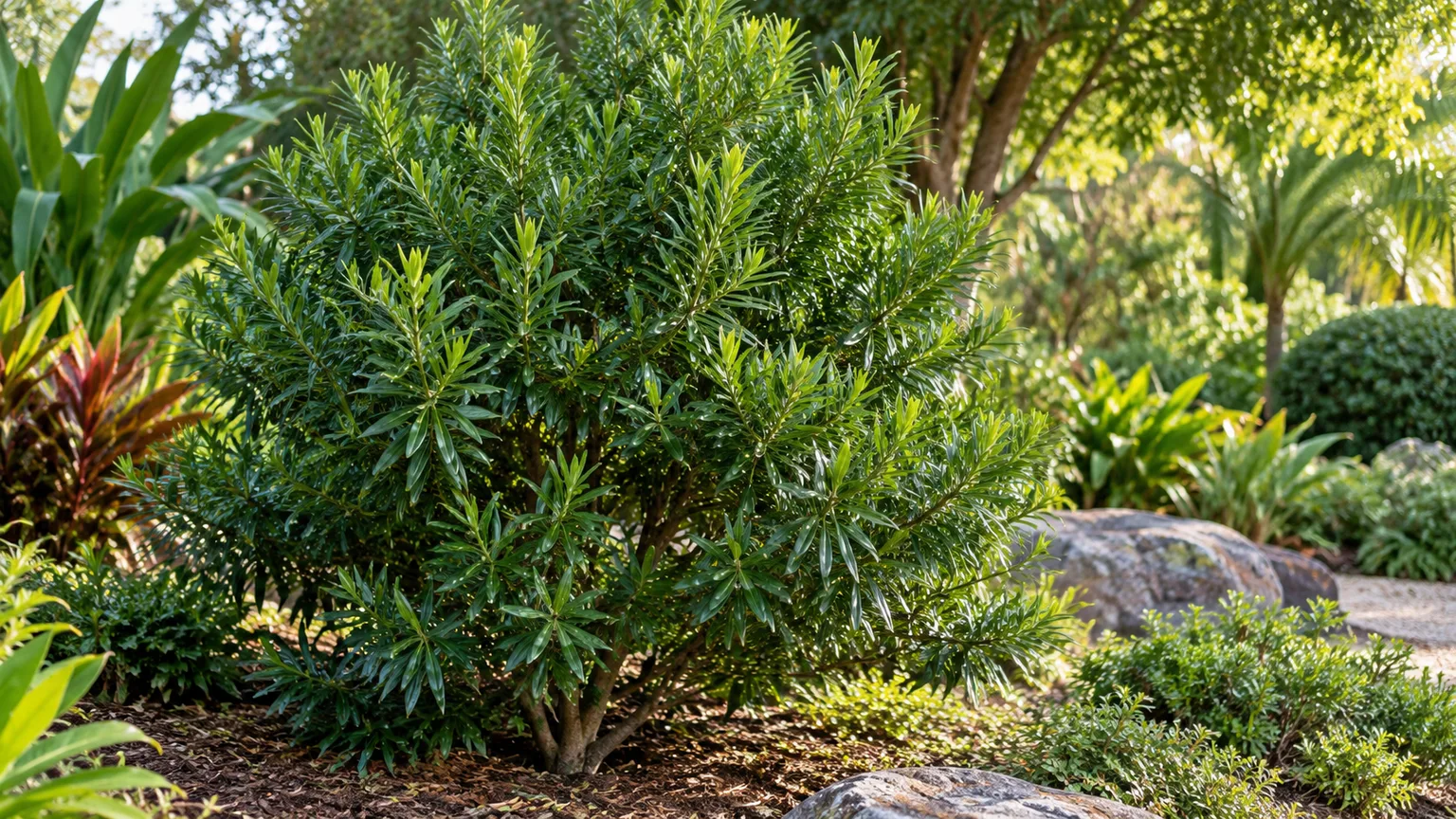
Podocarpus is often sold as an easy evergreen for a hedge, screen, or clipped accent, but the name covers a large genus and the familiar landscape plant can become a real tree if you let it. For most U.S. gardeners, the subject is Podocarpus macrophyllus, also called yew pine, Buddhist pine, or Japanese yew. Its narrow, flat, leathery leaves look like needles at a glance, yet this conifer is neither a true pine nor a true yew.
The practical rule is simple: identify the species or cultivar on the plant tag, give it a site where water drains, and make room for the size it can reach. P. macrophyllus tolerates sun to partial shade and becomes more drought tolerant after establishment, but “low maintenance” does not mean that it can sit in saturated soil, remain exposed to hard freezes, or be cut back indiscriminately.
| Care question | Practical answer |
|---|---|
| Best-known landscape species | Podocarpus macrophyllus |
| Mature size | Several feet as a selected cultivar; roughly 35 to 50 feet as a tree form |
| Light | Full sun to partial shade; growth is looser in shade |
| Soil | Moist but well drained; avoid a site that stays wet |
| Water | Keep the root ball evenly moist while roots establish; water established plants during prolonged drought |
| Pruning | Shape lightly during the growing season; avoid a late-season flush before cold |
| Cold range | Published ranges vary; verify the exact cultivar and local conditions |
| Pet caution | ASPCA lists Buddhist pine as toxic to dogs, cats, and horses |
Start With the Right Podocarpus
Before choosing a planting site, read the botanical name and cultivar on the nursery label. A mature P. macrophyllus can be a tree, a large hedge, or a small shrub under repeated pruning; a compact cultivar is not interchangeable with a standard tree. The label is therefore more useful than the generic word “podocarpus” or a photo of a trimmed nursery specimen.
A standard P. macrophyllus can work as a specimen tree, screen, street tree, or formal hedge, while a named compact form can fit a foundation bed or container more easily. NC State Extension’s profile of var. maki describes it as a slow-growing, dense selection that reaches about 8 to 10 feet tall and 3 to 5 feet wide. That still is not a miniature plant, so check the mature spread against the width of the bed and the access you need around it.
Yew pine is not a true yew or pine
Common names are a source of genuine confusion. Yew pine, Japanese yew, and Buddhist pine can refer to P. macrophyllus, which belongs to Podocarpaceae; true yews belong to Taxus. The foliage is flat and straplike rather than a cluster of true pine needles. If you are comparing cold tolerance or toxicity, use the botanical name rather than applying care instructions for a plant simply because it is called a “yew.”
The genus contains many species, and “fern pine” may refer to a different podocarpus than the one sold as Japanese yew pine. Their final size, climate range, and leaf form are not guaranteed to match. This guide focuses on landscape-grown P. macrophyllus and its cultivated forms. If a tag names another species, look up that exact plant before relying on the watering or hardiness notes below.
Check Mature Size and Cold Range Before You Plant
Size figures for P. macrophyllus vary by source because the same species can be grown as a dense shrub or left as a tree. UF/IFAS reports a typical landscape tree around 35 to 40 feet high and 10 to 15 feet wide, while its introduction notes that an unpruned plant can reach 35 to 50 feet. NC State lists a broader potential range, with tree forms reaching 50 feet and smaller shrub forms kept much lower. Treat the larger figure as a real planning possibility, not as an unlikely exception.
Hardiness references also differ. UF/IFAS gives a broad range from USDA Zone 7B to 11, while NC State’s plant profile lists 7a through 9b for its regional context; named cultivars may have their own published ranges. The NC State profile and UF/IFAS landscape guide are useful starting points, but neither turns a zone number into a guarantee for every yard. Cold duration, wind, soil moisture, exposure, plant age, and cultivar all change the outcome.
Use the hardiness listing as a first filter, then ask whether your planting site is sheltered or exposed and whether you can protect the plant during a severe cold event. A sheltered courtyard near a warm wall is not equivalent to an open site with winter wind. If your area regularly drops below the published range, use a container that can be moved or choose a locally proven evergreen instead of banking on a marginal in-ground planting.
Measure the location before buying. Include the canopy’s mature width, not only its height: a tree that is 12 feet wide can overwhelm a narrow strip even if you keep clipping its sides. UF/IFAS notes that podocarpus roots are generally not a problem around sidewalks, but that does not make every tight foundation bed suitable; the crown still needs room, light, airflow, and access for maintenance.
Give Podocarpus the Right Light
Podocarpus grows in full sun and partial shade, and established plants can tolerate more shade than many conifers. The trade-off is form: with less direct light, the plant generally grows more slowly and more loosely. If your goal is a dense privacy screen, choose a spot with strong light on as many sides as the site allows rather than trying to make a dark corner behave like a sunny hedge.
More sun means denser growth, not automatic drought tolerance
Full sun is a good fit for a tree or hedge when the root zone drains and the plant receives water while it establishes. In hot inland or reflected-heat locations, partial afternoon shade can reduce stress, especially for container-grown plants. A shaded wall or overhang may also block rainfall, so do not assume that a low-light plant is receiving enough water just because the soil around it looks cool.
For hedges, inspect both sides of the proposed row. If one side is shaded by a building or a neighboring hedge, that face may remain thinner. Pruning cannot substitute for light: trimming the bright side more aggressively will not fill the shaded side and can make the screen uneven. For a broader comparison of plants by shade and screen use, see our guide to evergreen shrubs for shade.
Choose Well-Drained Soil
Moist, well-drained soil is the target. UF/IFAS reports that P. macrophyllus tolerates a range of soil textures and pH, while NC State describes its preference for fertile, slightly acidic soil with good drainage. The practical common ground is more important than an exact mix recipe: water should move through the root zone rather than pooling around the trunk or remaining trapped in a planting hole.
Before planting, check the site after a soaking rain or dig a test hole and see how quickly water leaves it. If a low spot holds water, improve the overall drainage or plant on a broad raised area; adding a little sand or compost to one small hole can create a soil pocket that drains differently from the surrounding ground. Do not bury the root flare under soil or mulch, and do not place a root ball in a basin that catches roof runoff.
The University of North Florida Botanical Garden profile describes the species as adaptable to average garden soil but still specifies a well-drained site. That distinction is useful: podocarpus is tolerant of different soil textures, not a plant for roots that stay submerged after rain.
A soil test helps if new leaves turn yellow while the veins remain green, because alkaline soil can make iron or manganese harder for the plant to access. Do not respond to every pale leaf with fertilizer. First check pH and root conditions, then correct only what the test supports. If the bed is heavy and frequently saturated, a different plant is usually a better long-term choice than repeated attempts to amend a poorly drained site.
Water to Establish Roots
During the first growing season, water deeply enough to moisten the root ball and the surrounding soil, then let excess water drain before watering again. The right interval depends on rainfall, soil texture, temperature, wind, and the size of the nursery root ball. Check the soil at the root zone instead of following a fixed weekly schedule: sandy soil may dry quickly, while clay soil can stay wet long after the surface has dried.
Water slowly at the base so moisture reaches the roots rather than running across the surface. After planting, check more often during the first few weeks and during hot or windy weather. As new growth appears and the root system expands into the surrounding soil, reduce the frequency but continue checking during dry spells. A plant can look fine for weeks while a small root ball dries inside a larger, damp-looking planting area.
Once established, podocarpus tolerates dry periods better than it did as a new plant, but prolonged drought can still cause browning, sparse growth, or leaf drop. Give it a slow soak during an extended dry spell, then allow the soil to drain. Do not compensate for a hot week by keeping the bed constantly wet; waterlogged roots have less access to oxygen and can decline in soil that never dries between irrigations.
Grow Podocarpus in a Container
A container is a practical option if you live outside the plant’s reliable in-ground range, want a patio specimen, or are growing a compact form such as ‘Maki’. Choose a sturdy pot with several open drainage holes and a free-draining container mix. The pot should be only modestly larger than the root ball; a very large volume of wet mix can remain cold and saturated around a small root system.
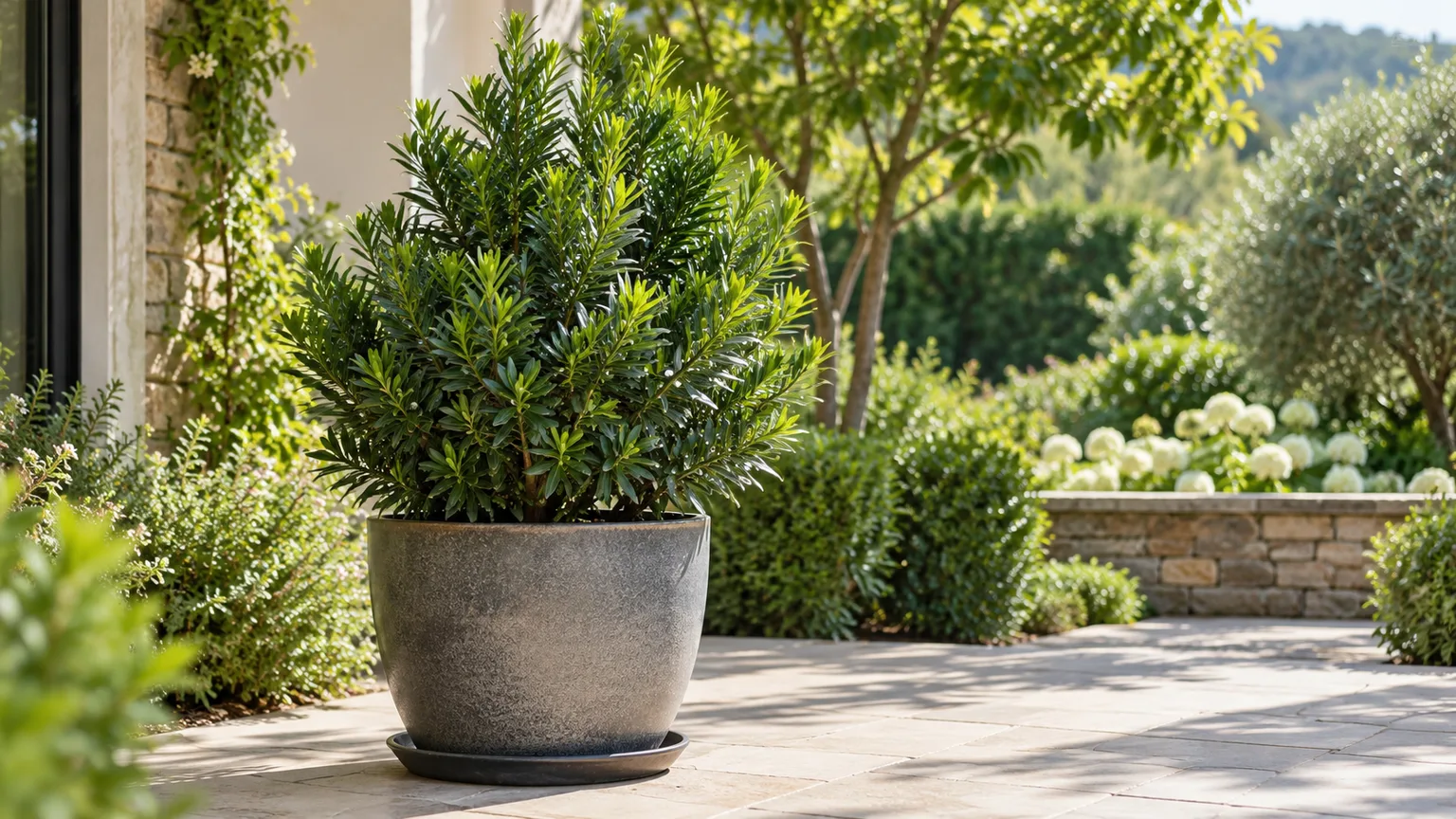
Place the pot where it receives bright light, and rotate it if growth begins to lean toward one direction. Water thoroughly until water drains from the bottom, then empty any standing water in the saucer. Check more often during warm weather and less often in winter, when growth slows and the mix dries more slowly. Repot when the roots fill the container or water runs through without wetting the root ball evenly, moving up one pot size rather than jumping to an oversized planter.
In cold regions, move the pot to a bright, protected, frost-free location before damaging cold reaches the plant. Container roots are more exposed to temperature swings than roots in the ground, so a pot that survives a short chill on a sheltered patio may not tolerate the same cold as a landscape plant. A bonsai is a separate growing system with a much smaller root volume and specialized pruning and watering; use a bonsai-specific species guide for that form rather than applying landscape-pot advice unchanged.
Use Podocarpus for Hedges and Screens
A podocarpus screen can be a row of naturally upright plants or a regularly shaped hedge. Decide which look you want before choosing a cultivar and spacing. For a loose screen, allow plants to grow toward their mature spread and fill the gaps gradually. For a clipped hedge, ask the nursery for the cultivar’s mature width and choose an interval that closes the screen without forcing the roots and branches into permanent crowding.
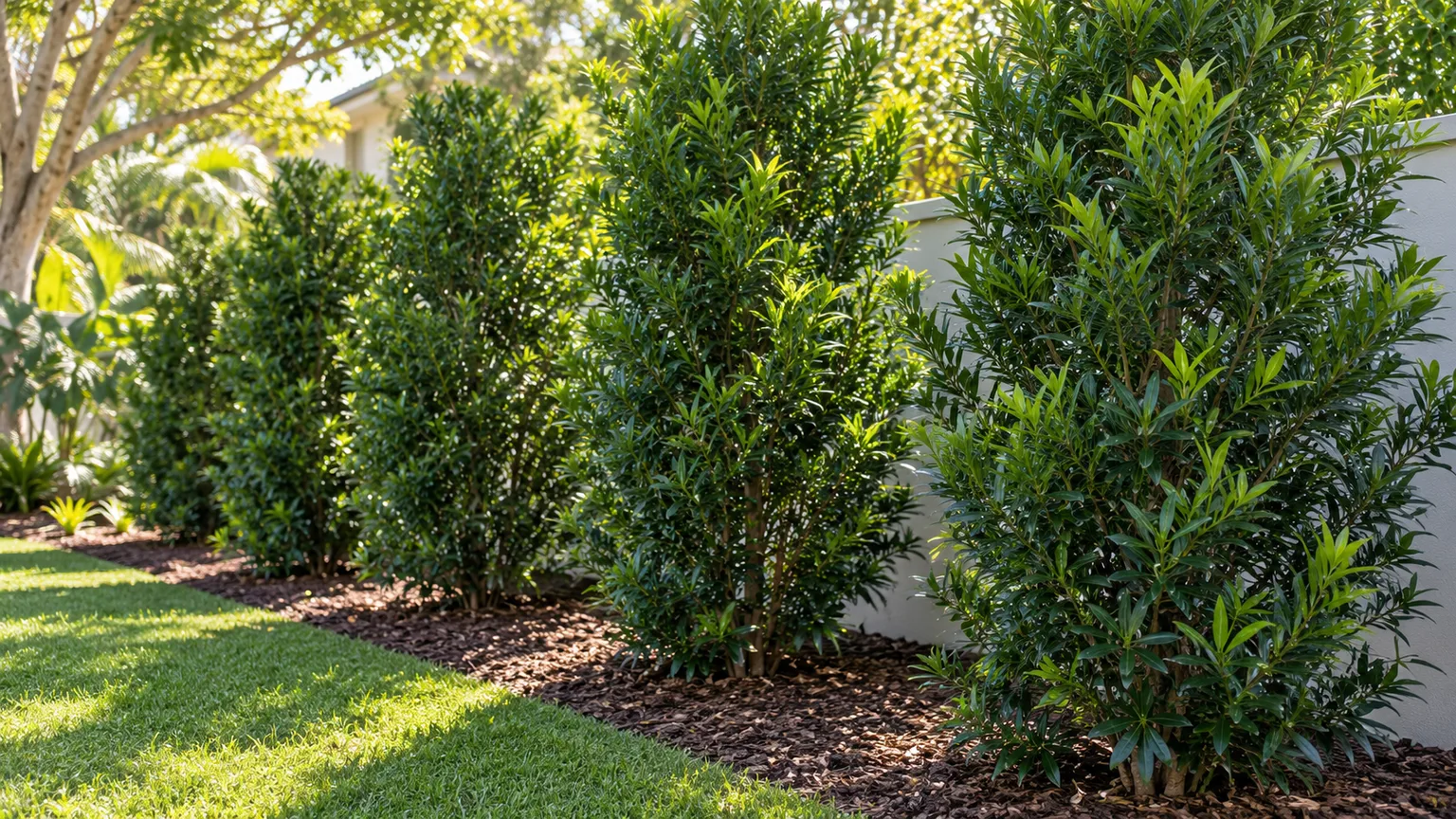
Gardenia’s profile for the compact cultivar Mood Ring lists a mature spread of roughly 4 to 6 feet and recommends it for hedges, containers, and mass plantings. That is a cultivar-specific example, not a universal spacing rule for podocarpus. Plan from the label’s mature width, then account for how quickly you need the screen and whether you can wait for slower growth. Planting close together may hide a fence sooner, but it increases competition for water and leaves less room to reach the inner branches.
Use the ground around each plant as part of the screen design. Mulch can suppress weeds and reduce moisture swings while the hedge establishes, but keep it away from stems. Check irrigation coverage from end to end; the first and last plants in a row may receive different amounts of sun, reflected heat, and water. A hedge is only as healthy as its most stressed section, and a dry corner can open a permanent gap if you notice it after neighboring plants have already filled in.
Prune for Shape Without Exposing the Interior
Prune to maintain a specific size or shape, remove damaged wood, or improve structure; do not assume that every podocarpus needs frequent shearing. UF/IFAS notes that the plant can be made into a hedge but often looks better when shaped selectively with hand pruners rather than repeatedly cut with a hedge trimmer. Selective cuts preserve the plant’s layered branch structure and let you see whether a branch is dead, crossing, or simply growing outside the outline.
For a screen, establish the intended height and width gradually. Trim the new outer shoots lightly during active growth, then step back and inspect the whole plant before making another pass. Keep the lower portion slightly wider than the top so light can reach the lower branches. If you clip the top wider than the base, the upper foliage can shade out lower growth; once the interior becomes bare, restoring density may take several seasons.
Avoid cutting back blindly into old, leafless wood. Podocarpus may reshoot after pruning, but recovery is not a license to remove half the crown at once, especially on a mature screen with sparse interior growth. Renovate an overgrown hedge in stages and retain enough green foliage to support recovery. Late-season pruning can stimulate soft growth that is more vulnerable to cold, so do substantial shaping earlier in the growing season and leave a buffer before your usual first frost.
Use clean, sharp tools and remove dead or diseased branches when you see them. A few targeted cuts each year are easier on the plant than allowing a hedge to become much too large and then shearing it hard. If the plant repeatedly outgrows its allotted space, replace it with a cultivar that naturally fits the site instead of keeping it in a permanent cycle of severe reduction.
Fertilize Only When the Plant Needs It
Podocarpus is not a plant that needs heavy feeding to stay green. If it is producing normal new growth in suitable soil, skip fertilizer or apply a light, slow-release tree-and-shrub product according to its label in spring. More fertilizer will not fix waterlogged roots, a buried root flare, or a cultivar planted in too little light, and excess nitrogen can encourage growth that is tender when cold weather arrives.
If growth is weak or foliage is pale, diagnose before feeding. Test soil pH when chlorosis appears, inspect the root zone for standing water, and look for scale or mite activity on stems and leaf undersides. UF/IFAS reports occasional magnesium deficiency on sandy soil, but that does not mean every yellow plant needs magnesium. Use a soil test or local extension recommendation to identify a deficiency, then apply only the nutrient and rate recommended for that condition.
A thin layer of organic mulch can moderate soil temperature and reduce evaporation without being mixed into the planting hole. Keep the mulch a few inches away from the trunk, and replenish it only when it has decomposed or thinned. Avoid building a deep pile against the stems; constant moisture at the base can contribute to bark and root problems.
Diagnose Yellow Leaves, Brown Tips, and Pests
Podocarpus is generally considered a low-problem landscape plant, but “few serious pests” is not the same as “no problems.” NC State notes that scale may occur indoors and that alkaline soil can cause chlorosis; UF/IFAS also lists occasional scale, mites, and sooty mold. When foliage changes, inspect the whole plant and the root zone before reaching for a treatment.
Yellow leaves: check soil pH and roots before feeding
If yellowing is concentrated on the newest leaves and the veins stay greener, test soil pH and consider a nutrient-availability problem, especially in alkaline soil. If yellowing is widespread, lower leaves are dropping, or the soil stays wet for days, investigate drainage and root health first. A few older leaves yellowing and falling while new growth remains healthy can be normal turnover; a whole branch or one side yellowing needs closer inspection.
Also look for scale insects along stems and leaf undersides. Their fixed, shell-like coverings can be mistaken for natural bumps; sticky residue or black sooty growth may follow sap-feeding insects. Confirm the pest before using an insecticide, and use only a product labeled for the plant and pest where you live. Correct a cultural cause first when possible: drainage, water stress, or shade will not be cured by spraying.
Brown tips or dieback: assess drought, cold, and drainage
Crispy tips after a dry, hot period point toward water stress, especially on a recently planted shrub or a container. Brown or bronzed foliage after a cold snap suggests exposure damage, while soft, declining growth in persistently wet soil may indicate roots are failing. These patterns overlap, so inspect moisture below the surface and note when the symptoms began before changing the watering schedule.
If only the windward side shows damage after a cold event, protect young plants from exposure and wait to see where new growth resumes before removing living branches. If the soil is saturated, stop routine watering and address drainage rather than adding fertilizer. If browning continues despite appropriate moisture, inspect for scale or mites and seek a local extension diagnosis instead of treating an unidentified problem with a broad pesticide.
Propagate With Cuttings or Seed
Cuttings are the more practical route when you want a young plant to keep the general characteristics of its parent. UF/IFAS lists propagation by both seed and cuttings and notes that hardwood cuttings can root readily. Even when the method is simple, rooting speed and success vary with the cutting’s maturity, temperature, moisture, and the parent plant’s condition, so take more than one cutting if the cultivar is important to your plan.
Use clean pruners to take a healthy, nonflowering shoot, remove the foliage from the portion that will sit below the surface, and place it in a small pot of clean, free-draining propagation mix. Keep the mix lightly moist, not waterlogged, and provide bright indirect light while the cutting forms roots. Resist tugging on it to check progress; new top growth alone does not prove that roots are established.
Seed is slower and less predictable for a named landscape form. Seed-grown plants may not match a selected cultivar, and the fleshy seed structures can attract birds or children. If you are propagating a named or trademarked nursery selection, check the plant label and obtain permission where required before distributing plants. For a hedge, screen, or cultivar-specific specimen, buying a correctly labeled nursery plant is often the more reliable path.
Understand Seed and Pet Safety
The fleshy structure on a female podocarpus can look like a berry, but it is not a reason to treat the whole plant as edible. NC State Extension describes the fleshy aril as edible while warning that the seed is poisonous. The ASPCA lists Buddhist pine as toxic to dogs, cats, and horses, with vomiting and diarrhea among the clinical signs. That difference matters: a note about human use of one plant part does not establish safety for a pet, a child, or another species of podocarpus.
Keep fallen seeds and clippings out of reach of animals and small children, and do not let pets chew branches or fruit. The ASPCA entry uses a different spelling of the scientific name, so match the common name and family as well as the botanical label when checking plant-safety references. If an animal may have eaten any part, contact a veterinarian or animal poison-control service promptly and provide the plant’s label or a clear photograph for identification.
Conclusion
Podocarpus is easiest to grow when you choose the exact form for the job before planting. A standard P. macrophyllus can become a substantial tree; a compact selection such as ‘Maki’ suits a smaller screen or container, but still needs room, bright light, and a well-drained root zone. Use local hardiness guidance for the named cultivar rather than assuming every plant sold as podocarpus has the same cold tolerance.
Water new plants by checking their root balls, then reduce irrigation as they establish; give older plants a deep drink only through prolonged dry spells. Prune lightly to preserve green growth, investigate yellowing through soil and root checks before feeding, and keep seeds, fruit, and clippings away from pets. With those few decisions made in the right order, podocarpus can serve as a long-lived screen, shaped evergreen, or patio specimen without becoming a recurring rescue project.