15 Purple-Blooming Trees for Curb Appeal
Compare 15 purple-blooming trees by USDA zone, mature size, bloom season, fragrance, drought tolerance, and the site mistakes that cause trouble.
Purple flowers are uncommon enough in a front-yard canopy to look intentional, but the bloom color is only the first filter. A tree that is perfect for a cool Midwest lot may fail in a humid Southern summer, while a drought-tolerant desert species can struggle in a lawn watered every day. A shrub or vine trained into a tree form may solve a small-space problem beautifully, but it still needs the pruning and support that its growth habit demands.
This list pairs each choice with the decision that matters most: mature size, bloom season, climate, soil, fragrance, wildlife value, or maintenance. Use the table as a shortcut, then read the notes for the exceptions. Plant names and zone ranges are approximate landscape guidance; a cultivar tag, local extension recommendation, and your actual site should make the final call.
Choose by Climate, Mature Size, and Maintenance
Start with the site, not the flower color
Before buying, write down four facts: your USDA hardiness zone, the number of hours of direct sun, how quickly water drains after rain, and the width available when the plant is mature. Add a fifth if the tree will sit near a walkway or driveway: whether fallen petals, leaves, pods, berries, or seed capsules will be annoying there. A gorgeous specimen in the wrong spot becomes a pruning problem long before it becomes a curb-appeal feature.
Zone is a useful cold-limit filter, not a promise of performance. Heat, humidity, reflected pavement, winter wind, late frosts, and a container-grown root ball can all change the outcome. For example, a plant may be listed for a warm zone yet need excellent drainage, while a cold-hardy lilac may fail to flower without enough winter chill and full sun.
Mature width is more important than the height of the tree in the nursery pot. A practical clearance rule is to keep the eventual canopy away from the foundation, roof, utilities, and high-traffic paths; one broad small-tree reference recommends at least 10 feet from a foundation or power line for trees expected to stay under 30 feet, and at least 15 feet for larger trees. Better Homes & Gardens offers that useful starting point, but follow local utility and arborist guidance when a large tree is involved.
If the site is narrow, favor a naturally small tree or a named compact cultivar instead of promising to keep a large species small with annual topping. If the soil stays saturated, solve drainage or choose a wet-site plant rather than filling a hole with compost and hoping the roots adapt. If your priority is fragrance, place the tree where the scent can be enjoyed from a door, window, or path; if your priority is pollinators, avoid spraying the flower display and choose a locally appropriate species.
15 Purple-Blooming Trees Worth Considering
Spring bloomers for cool and temperate gardens
Redbud, magnolias, lilacs, and crabapples
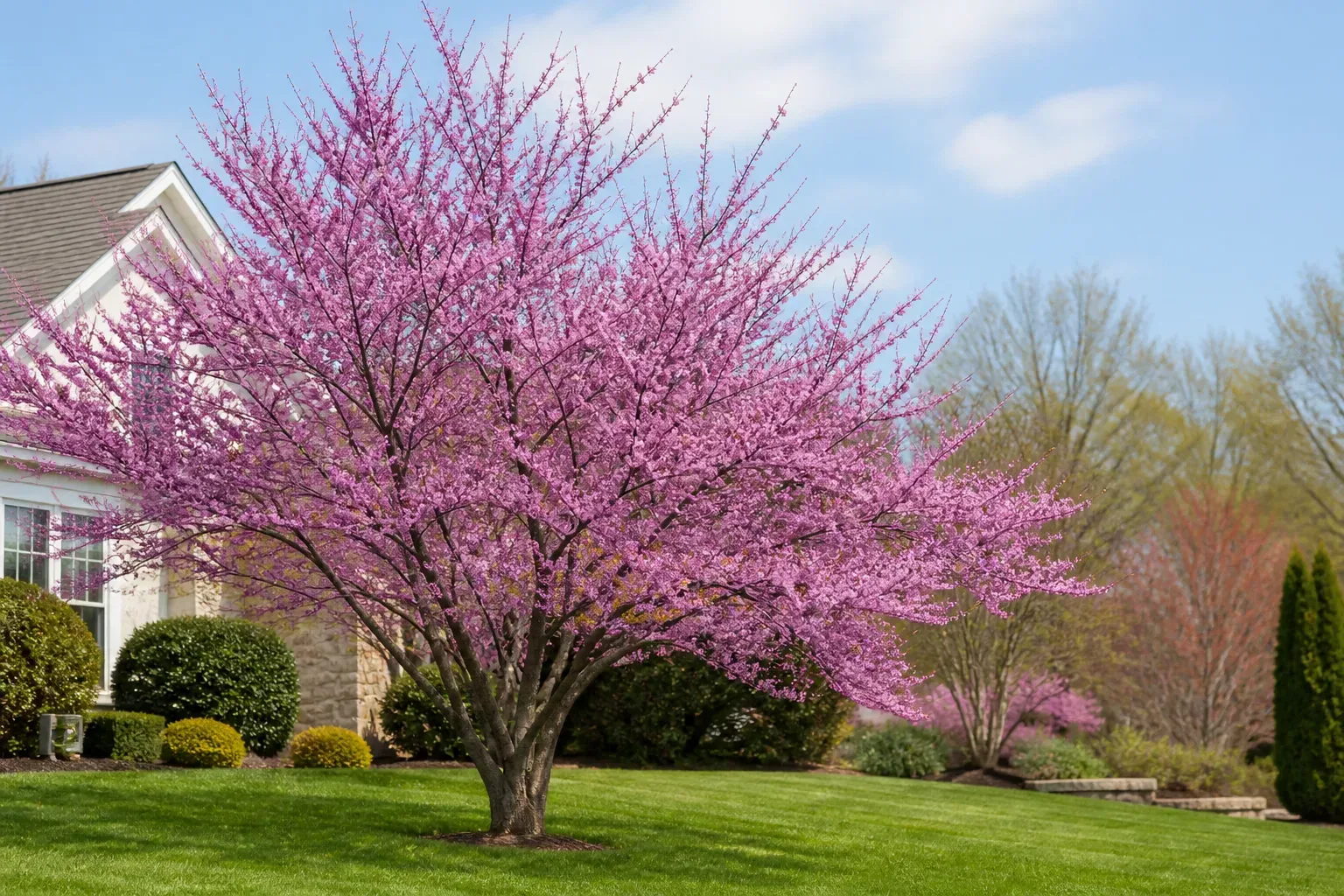
1. Eastern redbud (Cercis canadensis)
Eastern redbud is the best all-around choice when you want a small native tree with spring flowers, heart-shaped leaves, and wildlife value. Clusters of rose-pink to light purple flowers appear on bare branches before the leaves, usually in early spring. NC State Extension lists a typical mature range of about 20 to 30 feet tall and 20 to 35 feet wide, with full sun to part shade and hardiness across Zones 4 through 9. NC State Extension’s redbud profile also warns that heat, drought, wet soil, root disturbance, and exposed sites can shorten its performance.
Use redbud as a lawn specimen, woodland-edge tree, or pollinator-garden anchor. Give it a protected site and water it consistently while establishing; the branches can be brittle, and the plant does not appreciate being dug up and moved. ‘Forest Pansy’ is worth considering when dark foliage matters, while ‘Lavender Twist’ offers a weeping, smaller habit, but confirm the mature dimensions of the exact cultivar.
2. ‘Royal Purple’ magnolia
This is a choice for gardeners who want the drama of a magnolia without committing to one of the largest species. Deep purple or reddish-purple flowers and a relatively restrained habit can work near a front walk, but the name “royal purple” is not a substitute for a real cultivar label. Magnolia selections differ substantially in mature height, flower shape, hardiness, and susceptibility to late-frost damage, so buy by botanical name and mature size.
Give it full sun to light shade, medium moisture, and well-drained soil. Avoid a warm southern wall that can wake flower buds too early, and leave the fleshy roots undisturbed once planted. A magnolia is most beautiful when it has room to keep its natural form; repeated hard reduction creates large wounds and does not turn a too-large selection into a truly small tree.
3. Common lilac (Syringa vulgaris)
Common lilac is technically a shrub, but an old, multi-stemmed specimen can reach 15 feet and read as a small tree in a front-yard border. Its purple flower panicles are intensely fragrant in mid- to late spring, and its cold tolerance makes it one of the strongest choices for Zones 3 through 7. Choose it when scent matters as much as color and when you have room for a broad, suckering plant.
The trade-off is pruning timing. Lilacs form next year’s flower buds on wood made during the current season, so major pruning belongs immediately after flowering, not in late summer or fall. Savvy Gardening recommends removing spent flowers, thinning crowded stems, and limiting renewal pruning to about one-third of the stems in a year; older wood can be cut to the ground in stages. Savvy Gardening’s lilac-pruning guidance is especially useful for an overgrown plant that still needs to bloom.
4. ‘Purple Prince’ crabapple (Malus)
Choose ‘Purple Prince’ crabapple when you want a spring flower display followed by fruit and dark, bronze-tinged foliage. The flowers are more reddish-purple than blue-violet, but they read richly against a pale house or green lawn. Crabapples are available in many habits, so use the cultivar’s mature size rather than a generic crabapple estimate.
This is a good wildlife and four-season choice if you can tolerate fruit drop or want birds to use the tree. Full sun and moist, well-drained soil support the best bloom and foliage color. Ask a nursery about disease resistance in your region; a tree that is genetically prone to recurring leaf or fruit disease may create more cleanup and spraying than the flowers are worth.
5. Korean lilac tree (Syringa meyeri or a related tree-form selection)
Korean lilac is the compact, rounded answer for a sunny porch, patio, or small front yard. It usually stays shorter and denser than common lilac, with fragrant lavender-purple flower clusters in mid- to late spring. Many selections can be grown in large containers for a time, but a container is not a permanent solution for a plant whose roots and canopy continue to expand.
Give it at least six hours of sun, free-draining soil, and enough air around the crown. Deadhead after flowering if you want a tidier look, then make only light shaping cuts in that same post-bloom window. If your winters are mild and your spring is warm early, bloom may be less reliable than the zone label suggests because lilacs need a suitable dormancy period.
6. ‘Purple Lily’ magnolia (Magnolia liliiflora cultivar)
Lily magnolia is one of the better magnolias for a modest yard: a slow-growing, rounded shrub or small tree commonly about 8 to 12 feet tall and wide. Its upright, lily-shaped flowers open before the foliage, with purplish-red outer tepals and lighter interiors. NC State Extension lists it for Zones 5 through 8 and recommends full sun to part shade, organic-rich but well-drained soil, and protection from strong winds. Read the NC State lily magnolia profile before choosing between the species and a named hybrid.
The best planting decision is to place it once and leave it alone. Its fleshy root system is easily damaged during transplanting, and a warm exposure can encourage premature buds that are then caught by a late freeze. ‘Susan’ and other Little Girl magnolias can offer a later, compact bloom, but verify the exact cultivar because mature size and flowering time vary.
Warm-climate standouts
Jacaranda, chaste tree, desert willow, and crape myrtle
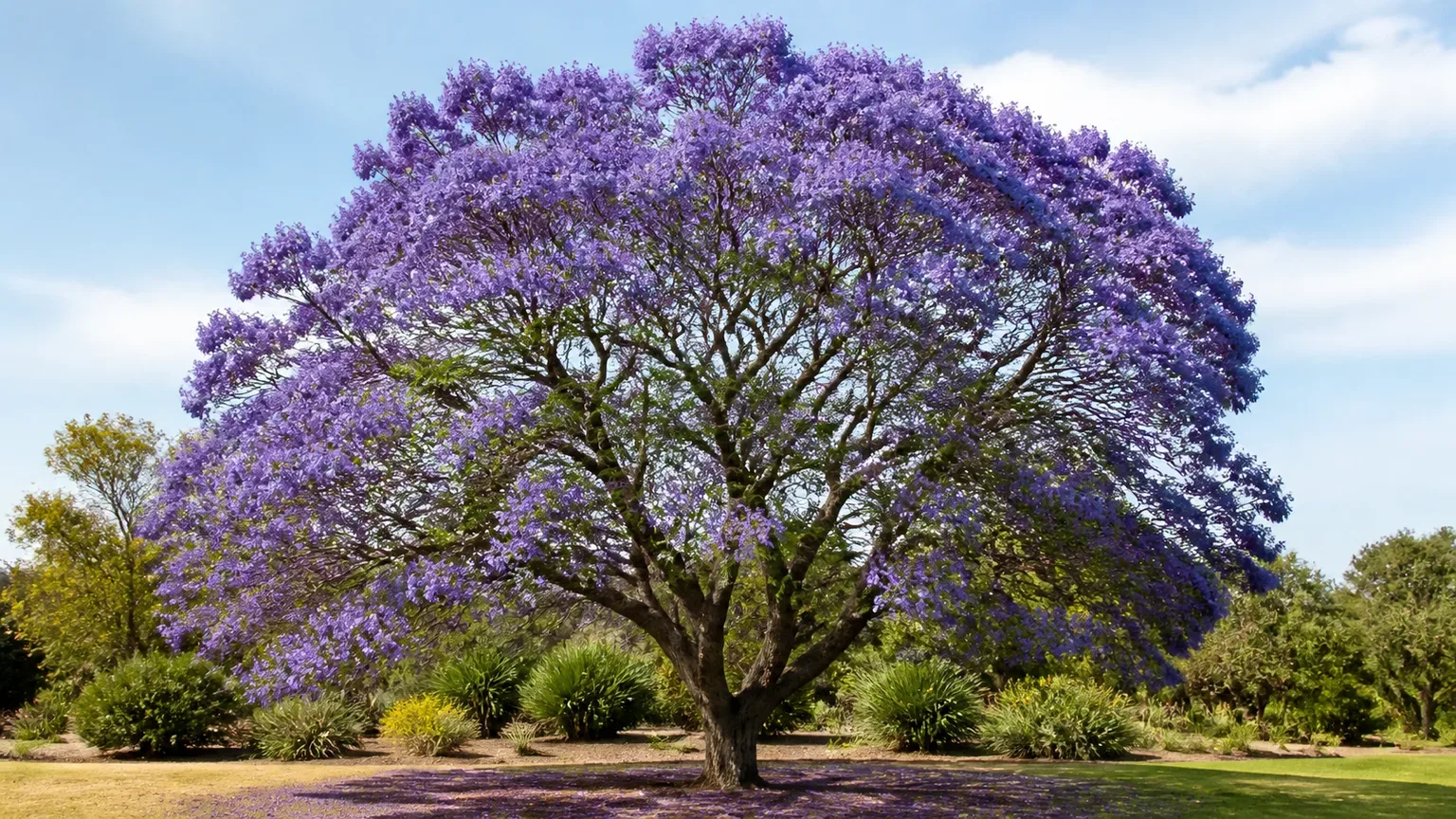
7. Jacaranda (Jacaranda mimosifolia)
Jacaranda is the choice for a warm, sunny site where a large spreading canopy and seasonal litter are acceptable. Fernlike foliage and lavender-blue trumpet flowers create a spectacular display in spring or summer, often before or as new leaves expand. It is generally a Zones 10 to 11 tree, frost-sensitive in cooler regions, and too large for a narrow foundation strip; young trees can also need structural training to prevent weak branch unions.
Give it full sun, excellent drainage, and room for surface roots. The flowers, leaves, and woody seed capsules fall, so avoid planting directly over a pool, narrow walkway, or roof drainage route. A young jacaranda can overwinter in a container in a cool climate, but it is not a realistic permanent houseplant or a dependable indoor flowering tree.
8. Chaste tree (Vitex agnus-castus)
Chaste tree is a fast-growing small tree or large shrub with fragrant lavender, blue, pink, or white flower panicles. It flowers on new wood, which gives you more pruning flexibility than a lilac, and it tolerates drought, heat, deer browsing, and some salt after establishment. NC State Extension lists it mainly for Zones 7 and 8, with typical landscape sizes from about 8 to 20 feet depending on cultivar and training. Its plant profile notes both its pollinator value and its potential to become invasive, especially in southern areas.
Use a small cultivar such as ‘Blue Diddley’ or ‘Blue Puffball’ where a shrub-sized plant is enough. In warm regions, a single-trunk form can look tree-like, but keep an eye on root suckers and dry fruit that can become a litter issue. Check your state or county invasive-plant list before buying; “drought tolerant” is not a reason to ignore spread risk.
9. Texas mountain laurel (Dermatophyllum secundiflorum)
Texas mountain laurel is an evergreen Southwest native for hot, dry gardens with rocky or alkaline soil. Its dense purple flower clusters are strongly grape-scented in early spring, and the leathery foliage gives year-round structure. It is slow-growing, usually 10 to 15 feet tall at maturity though capable of becoming larger, and works best in Zones 7 through 10 with full sun or light shade and sharp drainage.
This plant has an important safety caveat: its bright red seeds are poisonous if eaten. NC State Extension identifies the toxic alkaloid cytisine and describes serious effects from ingestion, so do not use it where children or pets are likely to chew fallen pods, and never treat the seed necklaces sometimes associated with the plant as harmless décor. NC State’s Texas mountain laurel profile also supports its drought-tolerant, rocky-soil profile.
10. Desert willow (Chilopsis linearis)
Desert willow is technically a willow look-alike rather than a true willow, and it is one of the best options for a hot, dry landscape. Slender leaves frame fragrant pinkish-purple, trumpet-shaped flowers that can continue from late spring into summer and sometimes fall. NC State Extension lists it for Zones 7 through 11, full sun, dry or occasionally dry soil, and a mature size around 15 to 25 feet tall by 10 to 15 feet wide. The NC State desert willow profile describes its deep-rooted relationship with desert washes and its strong heat and drought tolerance.
Train the young plant into a multi-trunk tree or prune it as a large shrub. It blooms on new wood, so dormant-season reduction can stimulate branching and flowers, while removing spent blooms can extend the show. The drawback is self-seeding: choose a sterile selection such as ‘Art’s Seedless’ when available, or monitor seedlings before they become established in nearby ground.
11. Rose of Sharon tree form (Hibiscus syriacus)
Rose of Sharon is another shrub commonly trained onto a single stem. Purple, lavender, or blue flowers arrive in summer and can continue into fall, filling the gap after spring trees finish. It is useful for a small garden because many cultivars stay around 8 to 12 feet, but a tree form needs early training and can be more wind-exposed than a low, multi-stemmed shrub.
Choose full sun, average soil that drains well, and a location where late-summer flowers can be seen from the house. Major pruning belongs in late winter or early spring because the plant flowers on new wood. Seed capsules can create volunteers, and regional status varies, so select a low-seed cultivar only after checking local guidance rather than assuming every “sterile” label is absolute.
12. Crape myrtle (Lagerstroemia indica)
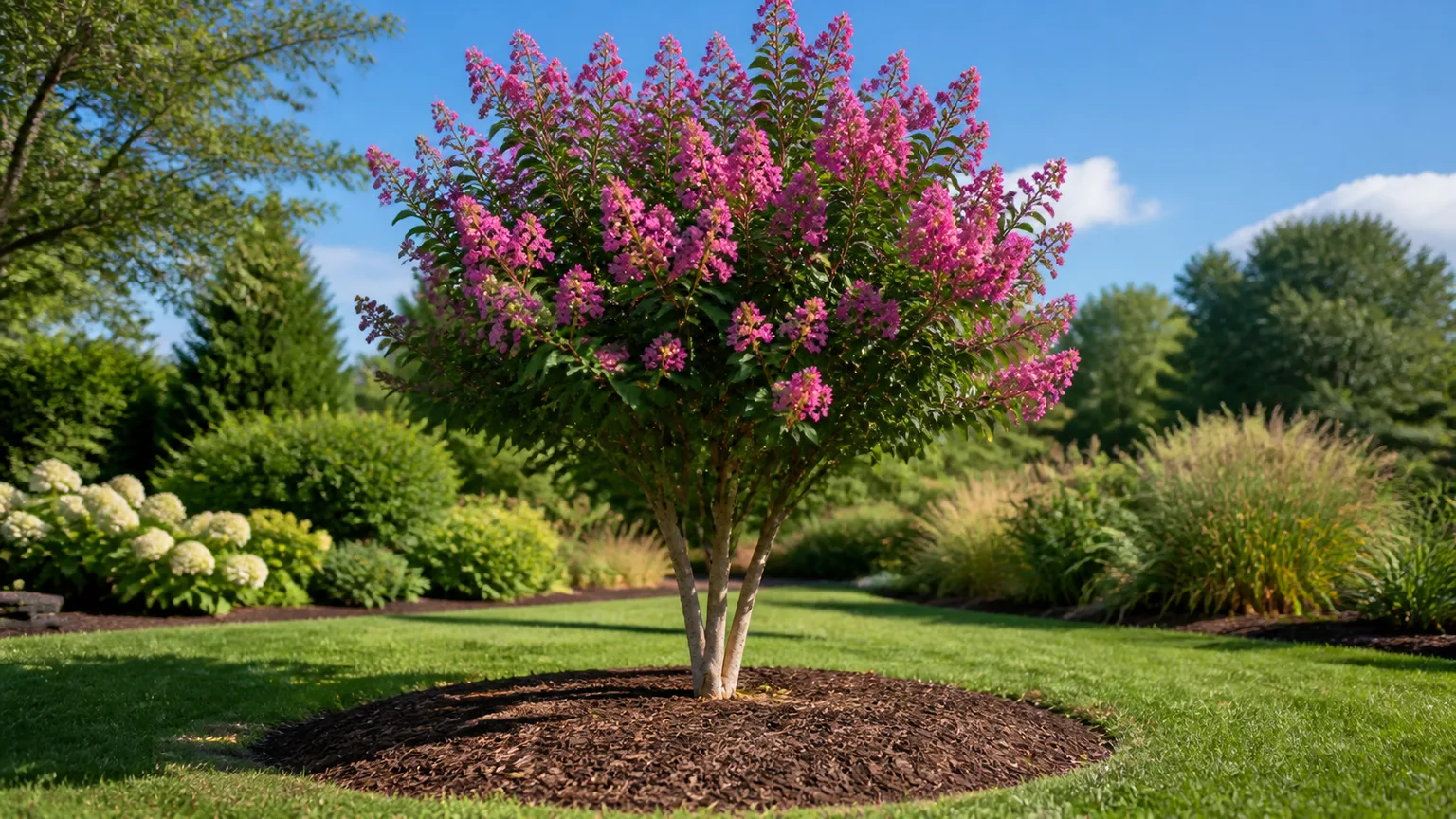
Crape myrtle is the long-season performer for warm gardens: frilly flowers in purple, lavender, pink, or red can continue from summer into early fall, and peeling bark adds winter interest. It is available in forms from shrubs to small trees, making the cultivar more important than the species name. NC State Extension lists common crape myrtle across Zones 6 through 9, full sun, well-drained soil, and a broad mature range of roughly 6 to 30 feet. Its extension profile recommends avoiding severe topping and pruning only to thin or correct the structure.
Do not plant it in shade and then blame the cultivar for weak bloom. Give the crown full sun, keep lawn fertilizer away from the root zone, and remove crossing or dead branches in late winter or early spring before new growth begins. In colder parts of its range, select a hardy cultivar and protect a young root system; in warmer areas, check regional disease and invasive-plant information before planting large numbers.
Flexible picks for small yards and trained forms
Rose of Sharon, purple robe locust, Texas mountain laurel, and wisteria
13. ‘Royalty’ crabapple (Malus cultivar)
‘Royalty’ crabapple is a dramatic alternative to ‘Purple Prince’, with burgundy-leaning flowers, dark foliage, and small fruit after bloom. It makes the most sense when you want a stronger foliage-and-fruit composition rather than a purely violet flower color. As with every crabapple, confirm mature height, width, disease resistance, and fruit persistence for the exact nursery selection.
Plant it in full sun to light shade and well-drained soil, but expect the strongest flower color in brighter light. A single tree is usually self-fertile, so you do not need a second specimen simply to obtain fruit. Give it enough lawn or bed space for its crown and keep low perennials outside the trunk flare rather than piling soil or mulch against the base.
14. Purple Robe locust (Robinia pseudoacacia ‘Purple Robe’)
Purple Robe locust creates a late-spring display of fragrant, wisteria-like flower clusters and tolerates dry soil better than many showy flowering trees. It can become a large tree, commonly around 30 to 40 feet, so it belongs in a spacious yard rather than a narrow foundation bed. The open canopy can provide light shade, but brittle branches and aggressive growth are reasons to plan the site carefully.
Use it when you need scale, fragrance, and tolerance of lean soil, not when you need a tidy small tree beside paving. Remove root suckers early, keep turf and structures outside the mature canopy, and ask your local extension service about cultivar availability and regional behavior. A tree that fits a rural frontage may be a poor choice in a compact suburban lot.
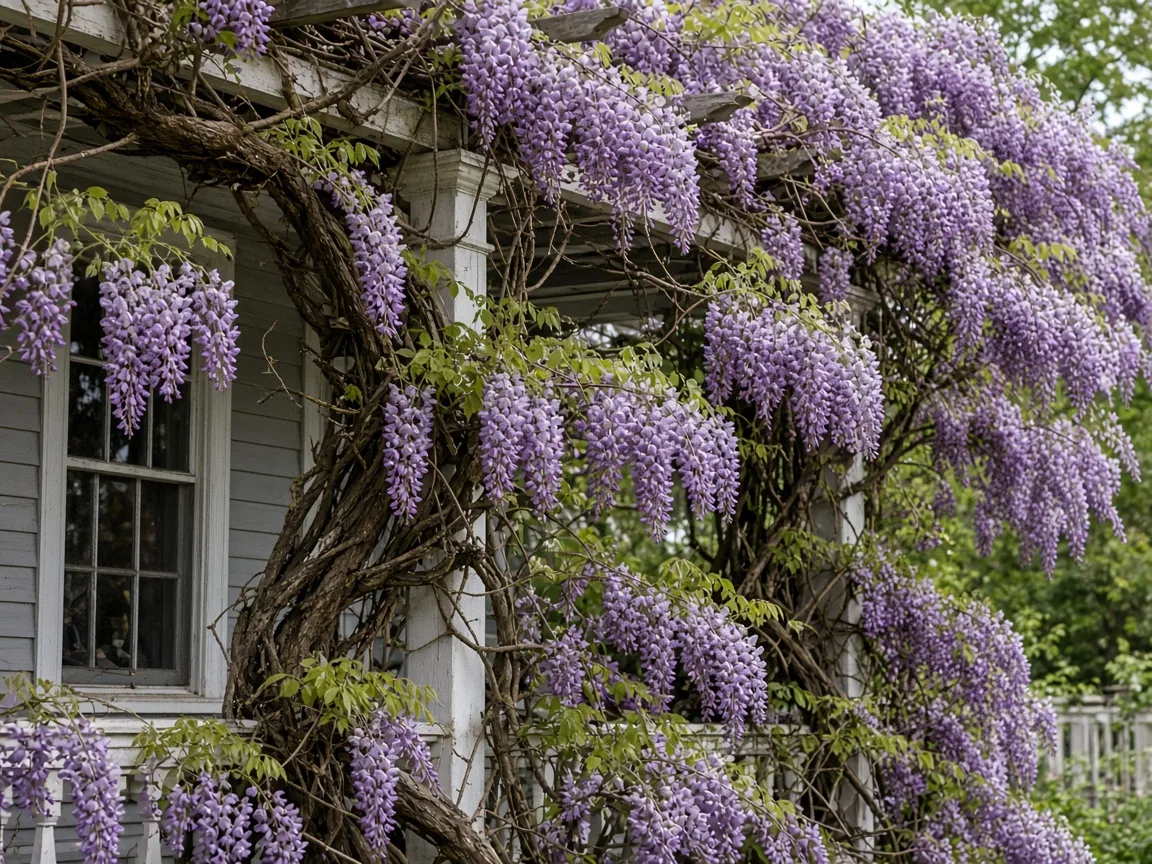
15. American wisteria (Wisteria frutescens)
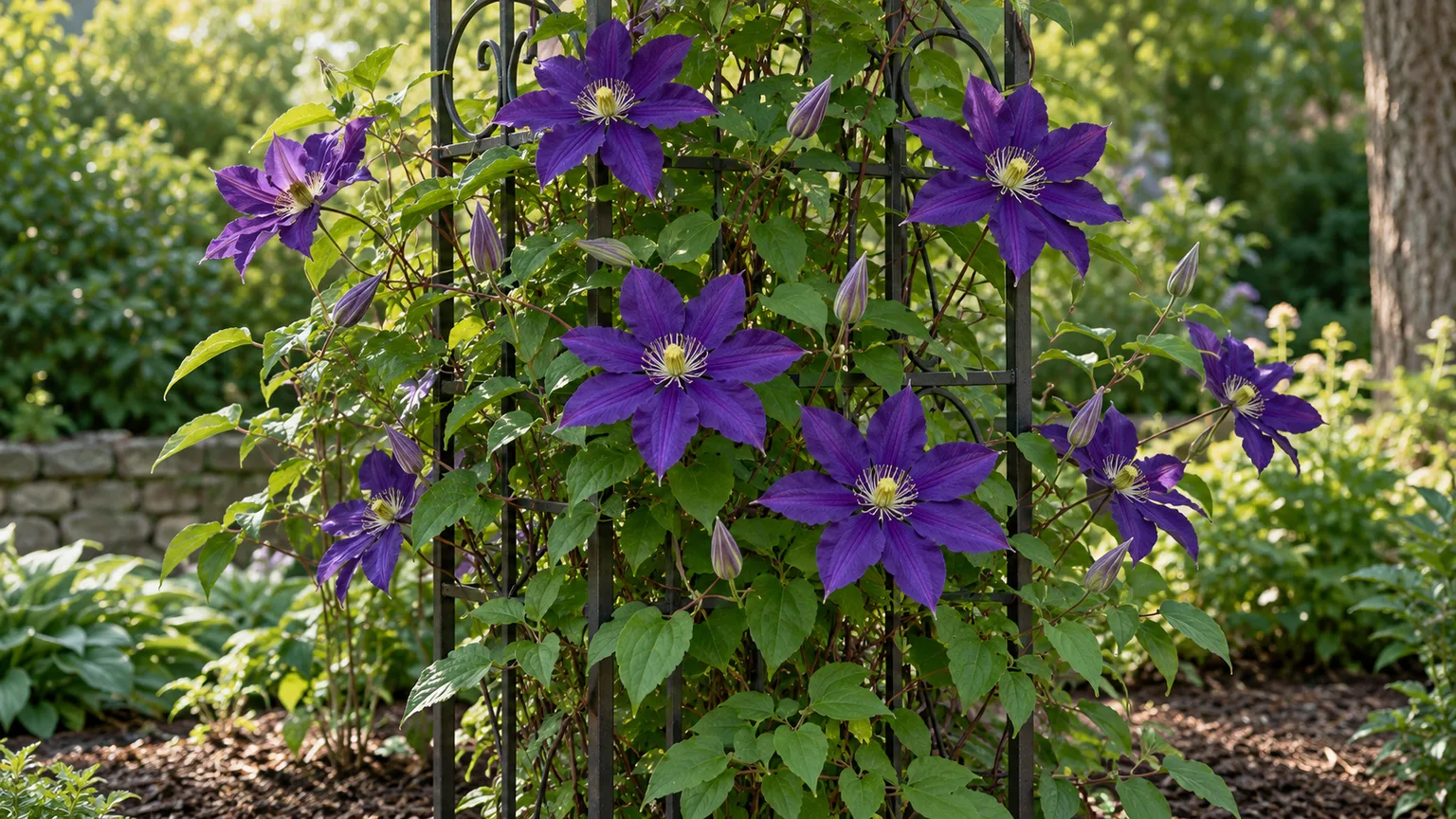
American wisteria is a woody vine, not a tree, but it can create a tree-like purple canopy when trained over a properly engineered arbor or pergola. The native species is generally less aggressive than Asian wisterias, and its lavender-purple racemes are a strong choice for a front entry where vertical support already exists. NC State Extension lists it across Zones 5 through 9 and emphasizes full sun, a sturdy support, regular pruning, and the fact that seed-grown vines can take years to flower. See the NC State American wisteria profile for its growth habit, support requirements, and regional native range.
Do not attach wisteria to siding, a small trellis, a porch railing, or a young tree. The stems become heavy, and the plant needs enough clearance for pruning and inspection. Choose American wisteria where available, verify local status, and remember that its seeds and pods should not be eaten; NC State identifies toxic characteristics for the species. Propagate from a cutting or rooted layer when you want a known cultivar, because seedlings can be slow and variable.
Compare the 15 Trees at a Glance
| Plant | Approx. zones | Typical mature size | Main bloom window | Best reason to choose it | Watch-out |
|---|---|---|---|---|---|
| Eastern redbud | 4–9 | 20–30 ft. tall, 20–35 ft. wide | Early spring | Native wildlife value and small-tree form | Weak branches, drought, wet soil |
| ’Royal Purple’ magnolia | 6–9 | About 15–20 ft. | Mid to late spring | Magnolia flowers in a smaller footprint | Verify the exact cultivar and frost risk |
| Common lilac | 3–7 | Up to about 15 ft. | Mid to late spring | Fragrance and cold hardiness | Suckers and old-wood pruning |
| ’Purple Prince’ crabapple | 4–8 | About 18–20 ft. | Mid to late spring | Flowers, foliage, fruit, and birds | Fruit litter and disease differences |
| Korean lilac tree | 3–8 | About 6–10 ft. | Mid to late spring | Compact rounded habit and fragrance | Less reliable without suitable winter chill |
| ’Purple Lily’ magnolia | 5–8 | About 8–12 ft. | Early to mid-spring | Compact purple-red flowers before leaves | Fleshy roots and late frost |
| Jacaranda | 10–11 | About 25–50 ft. | Spring or summer | Large warm-climate lavender canopy | Frost, surface roots, litter |
| Chaste tree | 7–8 | About 8–20 ft. | Late spring to fall | Heat, drought, and new-wood bloom | Weedy or invasive in some regions |
| Texas mountain laurel | 7–10 | About 10–15 ft. | Early spring | Evergreen foliage and grape scent | Poisonous seeds; slow growth |
| Desert willow | 7–11 | About 15–25 ft. | Spring to fall | Heat and drought tolerance | Self-seeding unless a sterile form is used |
| Rose of Sharon | 5–8 | About 8–12 ft. | Summer to fall | Late-season color and tree-form option | Seed capsules and regional spread |
| Crape myrtle | 6–9 | About 6–30 ft. | Summer to early fall | Long bloom season and bark | Shade and severe topping |
| ’Royalty’ crabapple | 4–8 | About 25–30 ft. | Mid to late spring | Burgundy foliage and fruit | Confirm disease resistance and width |
| Purple Robe locust | 4–8 | About 30–40 ft. | Late spring | Fragrance and dry-soil tolerance | Large size, suckers, brittle branches |
| American wisteria | 5–9 | Vine to 40 ft. or more | Mid to late spring | Native alternative for a pergola | Needs a strong support and pruning |
The table exposes the most important pattern: there is no universal “best” purple tree. For a cold-climate front yard, start with redbud, lilac, a compact magnolia, or a suitable crabapple. For a hot, dry site, compare desert willow, chaste tree, and Texas mountain laurel. For a warm garden that can handle litter and a broad canopy, jacaranda or crape myrtle may deliver the longest visual payoff.
Planting and Establishment Care
Give the root flare and mature canopy room
Plant in spring after severe frost or in early fall while the soil is workable and several weeks of root growth remain. Container plants can be planted at other times in mild climates, but a heat wave or deep freeze immediately after planting makes establishment harder. Water the nursery plant before you start, inspect for circling roots, and reject stock with a buried trunk flare, major wounds, or a weak fork that is already splitting.
Dig a hole two to three times wider than the root ball and no deeper than the root flare requires. Set the tree so the flare is visible at or slightly above grade, backfill with the soil removed from the hole, and water slowly to settle it. Do not amend only the hole with a rich, fine-textured pocket; roots can circle inside that pocket while the surrounding soil remains compacted.
Mulch in a broad, two- to four-inch ring that extends toward the future drip line as the tree grows. Keep mulch several inches away from the trunk and do not bury the flare. A wide ring reduces turf competition and moderates moisture, while a “volcano” of mulch against bark can keep the trunk wet and hide a planting-depth mistake.
Water deeply, then taper by soil conditions
For the first eight to twelve weeks, check the root ball and surrounding soil every few days. Water slowly when the upper few inches begin to dry, wetting the whole root zone rather than sprinkling the trunk. Sandy soil, wind, heat, and a small root ball shorten the interval; clay, rain, shade, and a poorly draining site lengthen it.
After the first season, extend the interval and water deeply during prolonged drought. Do not treat a drought-tolerant label as permission to let a new tree dry out, and do not add water automatically when leaves wilt. Wilting, yellowing, and leaf drop can also occur when saturated soil has deprived damaged roots of oxygen. Check soil moisture several inches down before choosing between irrigation, drainage correction, or a pest and disease inspection.
Most of these trees need little or no routine fertilizer once established in decent soil. If growth is weak, flowers are absent, or foliage is unusually pale, test the soil and inspect light, drainage, pruning timing, and root damage before applying nitrogen. A lawn-fertilizer spill can push leafy shoots while doing nothing to correct shade or a tree planted too deeply.
Protect Next Year’s Flowers
Pruning should follow the plant’s flowering wood. Lilac and most spring-flowering magnolias set buds before winter, so major cuts after flowering protect the next display. Crape myrtle, rose of Sharon, chaste tree, and desert willow flower on current-season growth, so late winter or early spring pruning is generally the more useful window. Redbud needs only selective structural pruning and removal of dead or damaged wood; cutting it heavily for shape can remove the very framework that makes the tree graceful.
Use clean, sharp tools and remove dead, broken, crossing, or rubbing branches first. Make cuts just outside the branch collar, never flush to the trunk, and avoid topping. When a shrub is being trained into a tree form, remove competing basal shoots gradually and preserve a strong central stem; when a vine is trained over an arbor, shorten long side shoots in the plant’s appropriate pruning season while keeping the support safe.
If a lilac or other old-wood bloomer is overgrown, renew it in stages rather than removing every large stem in one afternoon. A phased one-quarter-to-one-third reduction preserves some bloom and gives new shoots time to replace old wood. If a mature tree has a crack, a split union, a hanging limb, or branches over a roof or public path, use a qualified arborist instead of climbing with a saw.
Avoid the Costliest Mismatches
Buying by flower color alone: Purple can mean pale lavender, pink-purple, blue-violet, or burgundy. Look at the plant in person when possible, but prioritize mature size, bloom timing, and winter or summer limits over a catalog photograph.
Treating a shrub or vine as a low-maintenance tree: Lilac, rose of Sharon, chaste tree, and wisteria can all be trained or displayed in tree-like ways, but their pruning, sucker, seed, or support needs remain. Label the plant honestly in your plan so you do not expect a one-time planting to stay in a permanent shape.
Ignoring local spread or toxicity information: Chaste tree, rose of Sharon, desert willow, and some wisterias can be weedy or invasive in certain regions, while Texas mountain laurel and American wisteria have poisonous parts if eaten. Check your local invasive-plant list and keep seed pods away from children and pets; regional conditions matter more than a generic national list.
Planting into wet soil and compensating with more care: Drainage is a site property, not a watering schedule. If water stands after ordinary rain, move the tree, raise the planting area, or select a species suited to that moisture; do not create a deeper hole that traps water around the roots.
Pruning at the wrong time: A late-summer cut on a lilac can remove the following spring’s buds, while a spring cut on a new-wood bloomer may sacrifice the current season’s flowers. Identify whether the plant flowers on old or new wood before you reach for the pruners.
Conclusion
The best purple-blooming tree is the one whose mature shape, bloom season, and climate needs fit the space you actually have. Eastern redbud, compact magnolias, lilacs, and crabapples cover many cool and temperate yards; desert willow, chaste tree, Texas mountain laurel, crape myrtle, and jacaranda suit warmer conditions when their trade-offs are acceptable. Rose of Sharon and American wisteria expand the list when a trained form or support structure is part of the design.
Measure the site before you buy, keep the root flare visible, water by soil conditions during establishment, and prune according to flowering wood. Those four decisions do more for long-term curb appeal than choosing the darkest purple flower on the nursery bench.