Pink Dogwood Tree Care: Grow It From Seed or Tree
Learn pink dogwood tree care from planting through pruning, watering, disease prevention, and seed propagation, including why seedlings may not stay pink.
Pink dogwood is not difficult because it needs constant attention; it is difficult because it dislikes the wrong site. Give a flowering dogwood moist but well-drained soil, a protected root zone, dependable water while it establishes, and relief from the harshest afternoon sun in hot climates, and routine care becomes fairly light. Plant it too deeply, keep the roots saturated, let drought repeatedly stress it, or injure the trunk with lawn equipment, and problems become much more likely.
There is one especially important point if you are choosing between seeds and a nursery tree: seed-grown dogwoods are genetically variable. A seed collected from a pink-flowering parent should not be treated as a clone of that parent. If a specific pink shade or named cultivar matters, buy a correctly labeled plant or use vegetative propagation rather than relying on seed.
Pink Dogwood at a Glance
| Care factor | Practical target |
|---|---|
| Light | Partial shade is the safest default; morning sun with afternoon protection is especially useful in hotter climates. |
| Soil | Moist, fertile, well-drained soil; flowering dogwood performs poorly in chronically saturated sites. |
| Water | Keep the root zone evenly moist while establishing, then water deeply during dry spells rather than keeping soil constantly wet. |
| Temperature | Most flowering dogwoods are grown across USDA Zones 5–9, but heat and exposure matter as much as the zone number. |
| Humidity | Normal outdoor humidity is fine; prioritize air movement and root-zone moisture over trying to manage humidity. |
| Fertilizing | Do not feed on a calendar. Use a soil test or a clear deficiency/growth reason before applying fertilizer. |
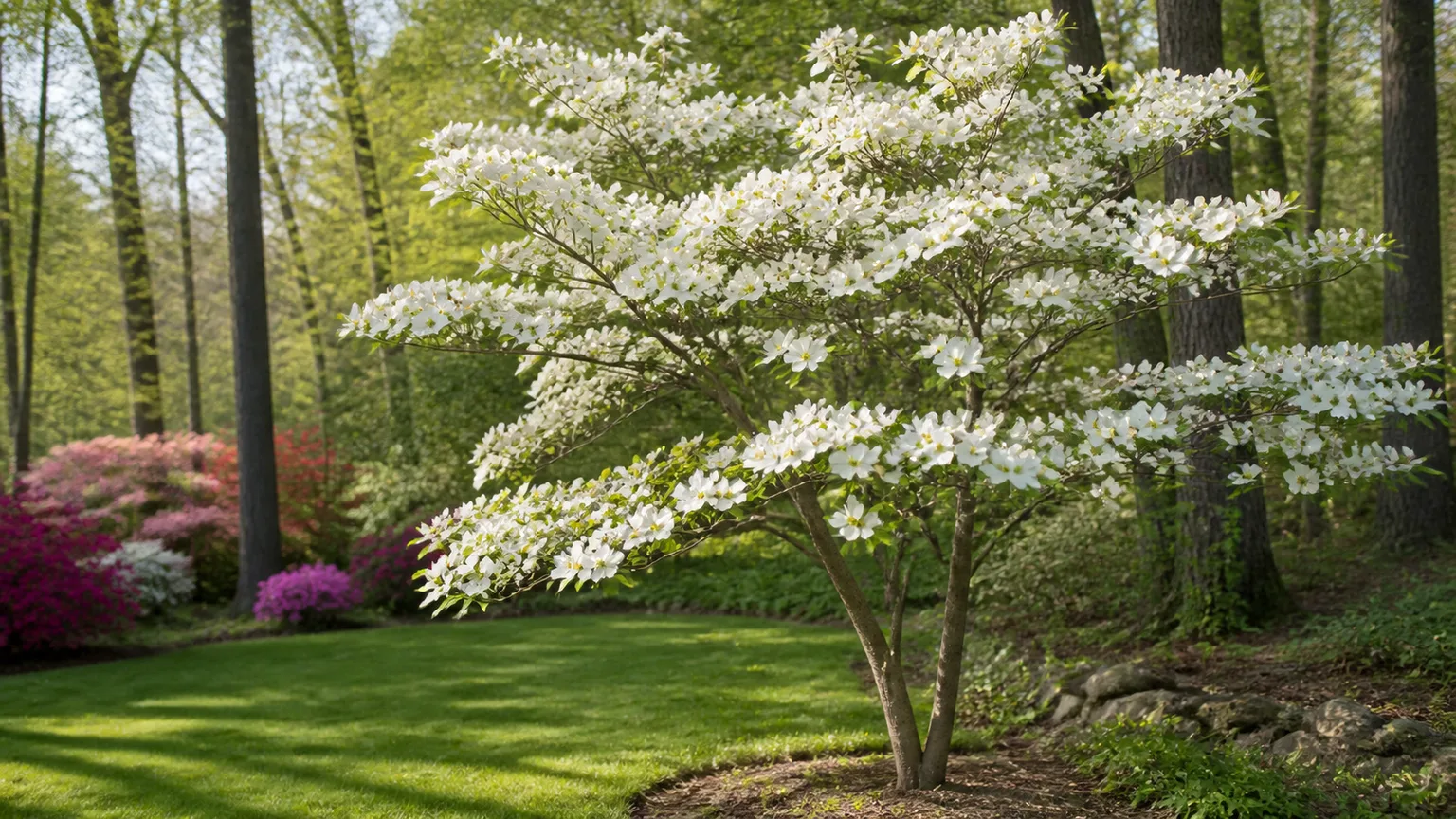
A mature flowering dogwood is usually a small landscape tree rather than a towering shade tree. University extension references commonly place it around 15 to 30 feet in landscape settings, with mature size changing with exposure, cultivar, and local conditions. Its spring display comes from colored bracts surrounding small true flowers; later, the tree can add red fruit and red-to-purple fall color.
For a new tree, the best care sequence is simple: choose a compatible site, expose the root flare at planting, mulch without touching the trunk, monitor soil moisture for the first several growing seasons, and avoid unnecessary pruning or fertilizer. That sequence prevents more trouble than trying to correct a stressed tree later.
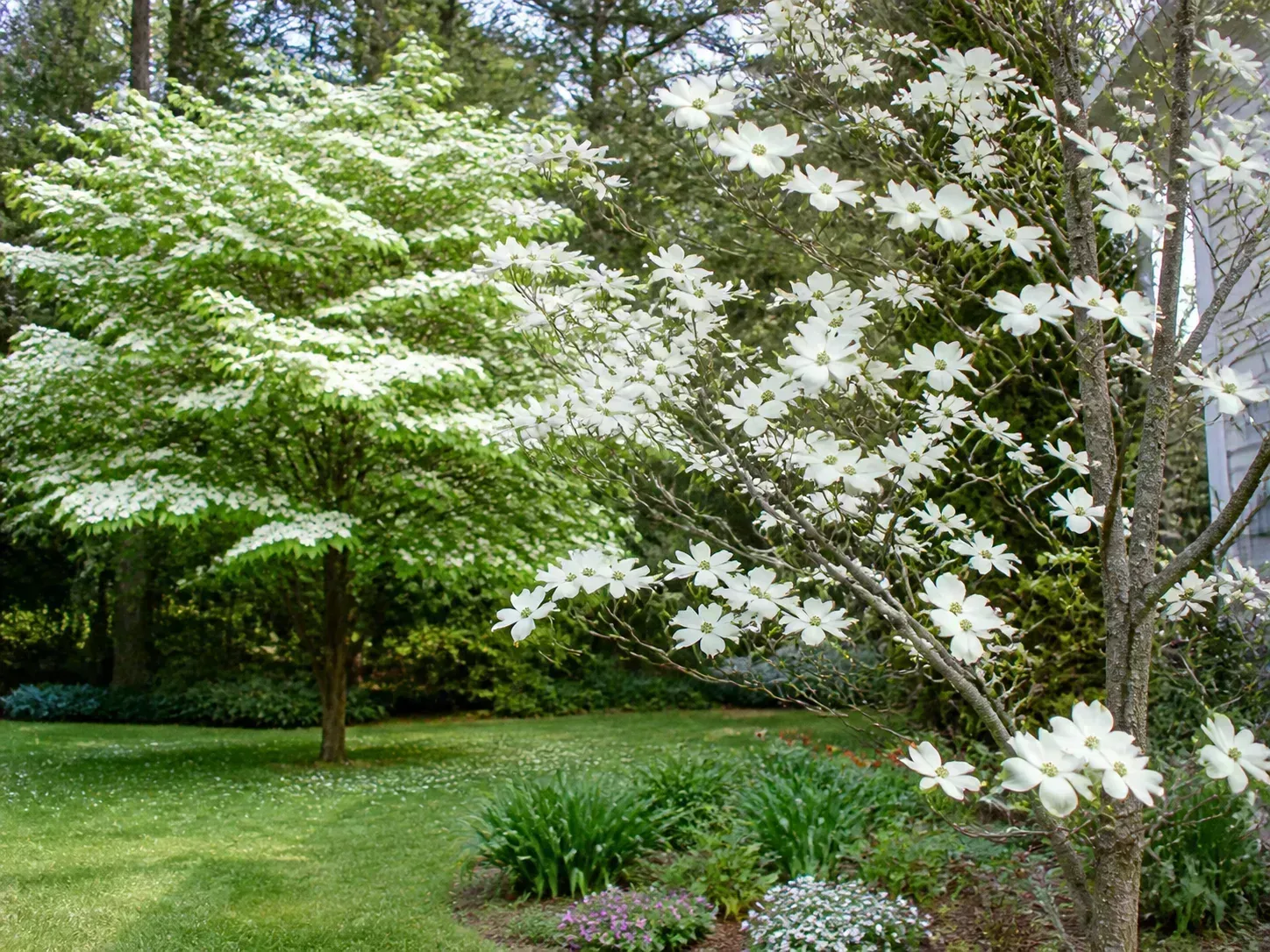
The spring display is produced by showy bracts around the small true flowers.
What Pink Dogwood Actually Is
“Pink dogwood” usually refers to pink-flowering forms or cultivars of flowering dogwood, Cornus florida. You may see pink plants labeled Cornus florida var. rubra, Cornus florida f. rubra, or by a cultivar name. Horticultural naming can vary between sources and nurseries, so the cultivar name on the plant tag is often more useful to a gardener than arguing over the rank of “rubra.”
The showy pink structures are bracts, not the tree’s true petals. Clemson Cooperative Extension explains that the small true flowers sit in the center of those modified leaves. This matters when you compare plants: “pink dogwood” can describe a general color form, while a named cultivar represents a selected clone with more predictable ornamental traits.
Flowering dogwood is native to the eastern United States and naturally behaves as an understory or woodland-edge tree. That ecology explains much of its care. Its roots benefit from cool, organic-matter-rich soil and reliable moisture, while the canopy can use filtered or partial sun. A dogwood planted in an exposed, reflected-heat site beside pavement has a very different stress load from one planted where the root zone stays cool.
If color is your priority, buy the plant for the exact trait you want. Some named pink or red flowering selections are chosen for deeper bract color, while other cultivars are selected for disease resistance. A local extension office or reputable regional nursery can be more useful than a national cultivar list because disease pressure and heat tolerance vary by region.
Choose the Right Site Before Planting
A healthy pink dogwood starts with a site that can support it for decades. Before digging, look up: allow room for a small spreading tree without forcing the crown under wires, gutters, or dense overstory. Then look down: avoid locations that stay waterlogged after rain, compacted construction soil, and narrow strips where turf or pavement will compete with the shallow root system.
University of Maryland Extension describes flowering dogwood as best suited to a partially shady location with moist, well-drained soil, and emphasizes minimizing tree stress. That is a useful default for most home landscapes.
The root zone deserves as much planning as the canopy. Dogwoods have relatively shallow roots and do not compete especially well with turfgrass. A broad mulched bed reduces competition, moderates soil temperature, conserves moisture, and keeps mowers and string trimmers away from the trunk. If your only possible location requires grass right up against the bark, the maintenance pattern itself becomes a risk factor.
Light: Prioritize Afternoon Protection
“Partial shade” is the safest one-line recommendation, but sun tolerance is climate-dependent. Clemson notes that flowering dogwood prefers partial shade, especially afternoon shade, while trees in sunnier sites may be denser and flower more heavily if moisture is adequate. The University of Florida IFAS similarly notes that afternoon shade is particularly valuable toward the southern end of the tree’s range.
Use this rule: the hotter and drier your summers, the more valuable afternoon protection becomes. In a cool northern garden with non-reflective soil and dependable irrigation, more sun may be workable. In a hot southern exposure beside masonry, all-day sun increases water stress and leaf scorch risk.
Do not compensate for a punishing site by keeping the soil permanently wet. Roots need oxygen. If foliage wilts on a hot afternoon, check soil moisture before watering; temporary heat wilt and genuinely dry soil are not the same problem.
Soil and Drainage: Fix the Site, Not the Symptom
Flowering dogwood prefers moist, fertile, well-drained soil. “Moist” and “wet” are not interchangeable. If a test hole repeatedly fills with water or the site stays saturated after ordinary rain, fertilizer and mulch will not correct the basic drainage problem.
Clemson warns that flowering dogwoods are prone to Phytophthora root rot in poorly drained or frequently flooded sites. If drainage is marginal, choose a better location or improve the grade before planting rather than burying the root system in an amended pocket that acts like a bathtub.
Soil pH is often described as slightly acidic. Maryland Extension gives a preferred range around pH 5.6–6.5. Do not acidify blindly: test the soil first, especially if you are considering sulfur or other amendments. The practical priorities remain good drainage, adequate organic matter, and consistent moisture.
How to Plant a Pink Dogwood Tree
Planting depth is one of the highest-leverage decisions you will make. A dogwood can be watered and fertilized correctly for years and still decline if the trunk flare was buried from day one.
- Find the root flare before measuring the hole. Remove excess potting mix from the top of the root ball if necessary until you can see where the trunk widens into the upper structural roots.
- Dig wide, not deep. The hole should give roots loosened soil laterally, while the root flare finishes at or slightly above the surrounding grade. Do not automatically use the top of the nursery potting mix as your depth reference.
- Correct circling roots when practical. Container-grown trees can have roots circling the root ball. Loosen or correct obvious defects rather than dropping an intact root-bound mass into the hole.
- Backfill primarily with the excavated soil. Avoid creating a small, radically different pocket of rich mix that discourages roots from moving into native soil.
- Water thoroughly after planting. This settles soil around roots and helps you assess drainage. Add soil only where genuine voids appear; do not mound soil over the flare.
- Mulch the root zone, not the trunk. Maryland Extension recommends mulch no deeper than about 3 inches and specifically warns against piling it against the trunk.
- Stake only when the site or root ball actually requires support. If staking is needed, allow some trunk movement and remove support after establishment rather than leaving ties indefinitely.
Do not pile a “mulch volcano” around the trunk. Moist mulch against bark can hide the root flare, keep bark chronically damp, encourage adventitious roots, and make inspection for trunk injury harder.
Fall or early spring planting is often easier on the tree because evaporative demand is lower than during summer heat. If you plant a container tree during warm weather, success depends on close moisture monitoring rather than the calendar alone.
Watering: Consistent Moisture Without Soggy Roots
Newly planted dogwoods need active moisture monitoring while roots expand into surrounding soil. A fixed schedule such as “one gallon every day” is less reliable than checking the actual root zone because soil texture, rainfall, temperature, wind, mulch, and root-ball size all change water use.
Maryland Extension recommends checking soil moisture 4 to 6 inches deep and watering when it is dry at that depth during establishment. That is more useful than judging by the surface, which can look dry while the root ball is still moist. Check both the original root ball and nearby native soil; water can move differently through the two materials.
Water slowly enough to wet the root zone rather than producing runoff. Then allow excess water to drain. During drought or unusually hot weather, check more often. An established dogwood still benefits from deep irrigation during prolonged dry periods, particularly in a sunnier location.
Watch for two opposite mistakes. Crisp margins and persistent wilt can result from heat or drought stress, but similar decline can follow root damage in saturated soil. Before adding more water to a struggling tree, feel the soil and inspect drainage. “Browning leaves” is a symptom, not a watering instruction.
Mulching and Fertilizing
A broad mulch ring is one of the most useful dogwood-care tools because it reduces turf competition, limits mower damage, slows soil-water loss, and buffers root-zone temperature. Use organic mulch in a modest layer and pull it back from the trunk so the root flare remains visible.
Do not keep increasing mulch depth each year without accounting for the old layer. If last year’s chips have not broken down, top-dressing with another thick layer can gradually bury the flare.
Fertilizer is less important than correct soil, water, and root care. Maryland Extension recommends fertilizing according to soil-test results rather than as a routine. That is a sound approach for pink dogwood: if the tree is making appropriate growth and foliage looks normal, “more food” is not automatically helpful.
Excess nitrogen can push soft growth without solving a drainage, root, or light problem. If a soil test indicates a nutrient need, follow the lab’s recommendation and account for any nutrients supplied by lawn fertilizer within the root zone. Compost or decomposed organic mulch can improve soil organic matter gradually without turning every spring into a fertilizer event.
Pruning Pink Dogwood Without Creating New Problems
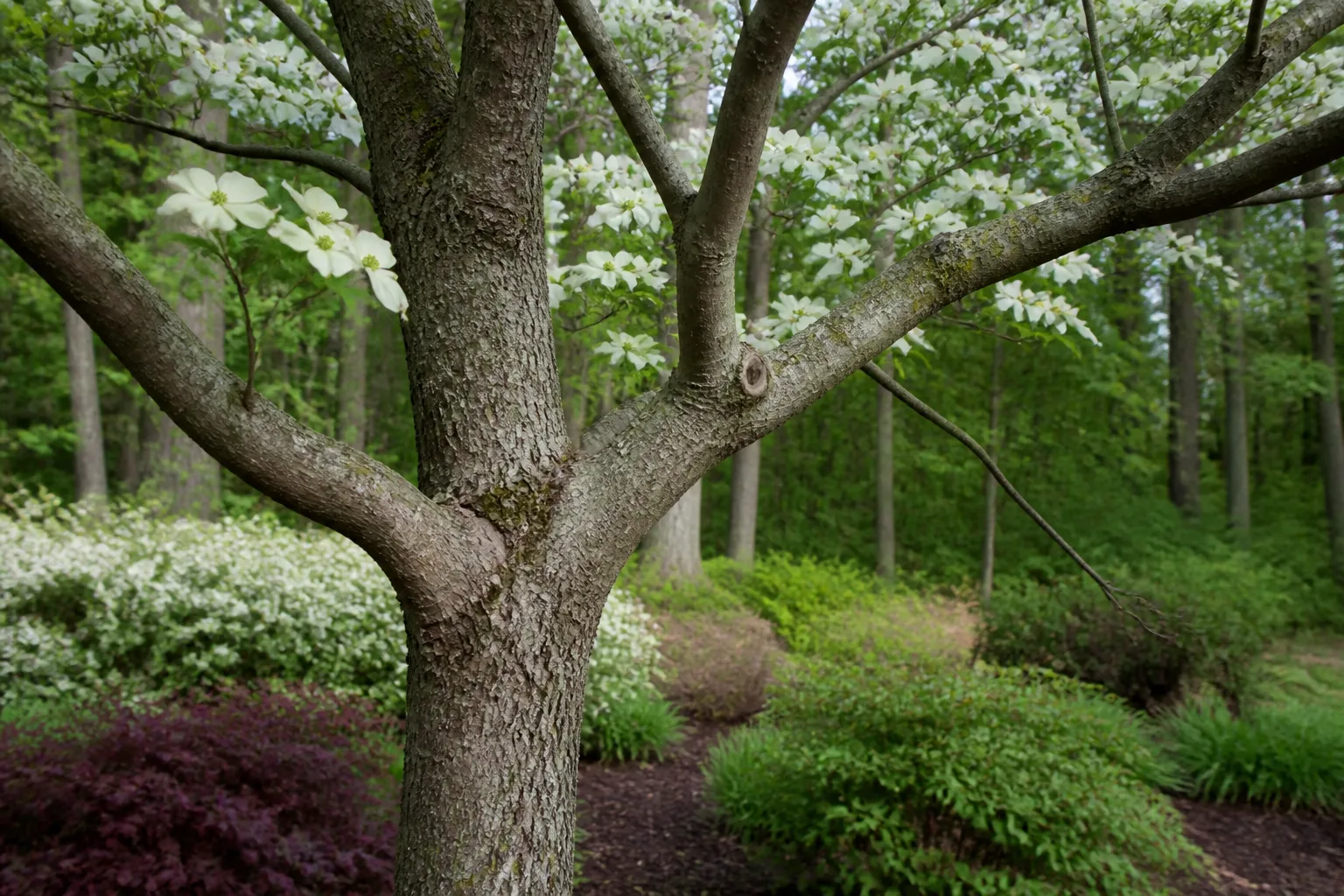
Inspect branch unions and damaged wood before making a cut.
A flowering dogwood naturally develops an attractive branching structure, so routine hard pruning is unnecessary. Prune for a reason: remove dead, broken, diseased, or rubbing branches; correct a serious structural problem while branches are small; or provide needed clearance.
Clemson advises keeping pruning to a minimum and pruning after flowering in early summer for flowering dogwood. Other horticultural guidance, including the Royal Horticultural Society, often favors dormant-season pruning for flowering cornus. That difference is a reminder to match timing to your goal, climate, and disease pressure rather than following a single date everywhere.
For ordinary homeowners, three rules matter more than a narrow calendar window: avoid heavy canopy reduction, avoid large unnecessary wounds, and use clean cuts just outside the branch collar. Never top a dogwood to control size. If the tree must be repeatedly cut back to fit its space, the site was too small for the plant.
Keep lawn equipment away from the trunk before worrying about perfect branch shape. Trunk wounds are particularly important because stressed or injured dogwoods are more vulnerable to borers and cankers.
How to Grow Pink Dogwood From Seed
You can grow Cornus florida from seed, but seed propagation is best viewed as a way to raise a flowering-dogwood seedling, not a dependable way to copy a particular pink tree.
Start with fully ripe fruit from a healthy tree where collection is permitted. Remove the fleshy pulp and clean the seed. Dogwood seed has dormancy requirements, so immediate warm-room sowing is not the same as sowing an annual flower. The U.S. Forest Service summarizes research in which warm, moist stratification followed by an extended cold period improved germination, while the RHS describes cleaning ripe seed and giving it a cold period before spring sowing.
For a home gardener, the exact protocol is less important than three principles: clean the seed, prevent it from drying excessively during stratification, and provide the seasonal temperature treatment required to break dormancy. Label batches and expect germination to be uneven. If you need one landscape tree rather than a propagation project, buying a named nursery plant is faster and more predictable.
Once seedlings emerge, give them bright but protected light, even moisture, and excellent drainage. Do not rush tiny seedlings into an exposed lawn site. Grow them until they have enough root system and woody growth to tolerate normal outdoor fluctuations, then harden them gradually to the intended conditions.
What Seedlings Will — and Won’t — Preserve
Seed combines genetic material rather than copying the parent. That means a seedling can differ in bract color, intensity, growth habit, disease response, and time to flowering. University of Missouri Extension notes that seedlings are more variable in growth and flowering pattern than named cultivars, while selected pink cultivars are valued for more predictable color.
So if your goal is “a dogwood that might eventually flower pink,” seed can be an interesting experiment. If your goal is “another plant with the same deep-pink bracts as this named tree,” seed is the wrong cloning method.
This distinction also helps when shopping online. A packet described only as “pink dogwood seed” cannot offer the same genetic certainty as a grafted or vegetatively propagated named cultivar. Treat strong promises about exact seedling color cautiously unless the seller explains the genetics and propagation method.
How to Propagate a Pink Dogwood That Stays Pink
To preserve the traits of a specific pink dogwood, use vegetative propagation. Commercial nurseries commonly use budding or grafting because the scion comes from the selected plant and therefore preserves its cultivar identity. Softwood cuttings are another option for skilled home propagators, although rooting success can be variable and the young material dries quickly.
RHS guidance recommends taking softwood cuttings in late spring or early summer from healthy, soft current-season shoots, preparing them promptly, and placing them into a suitable propagation medium before the leaves lose moisture. A humidity-controlled propagation setup can help, but it must not become stagnant or waterlogged.
For a homeowner who needs one dependable pink-flowering tree, the practical ranking is:
- Most predictable: buy a correctly labeled, vegetatively propagated cultivar from a reputable nursery.
- Good propagation project: take softwood cuttings from a known parent and accept that not every cutting will root.
- Advanced and reliable for cultivar identity: graft or bud selected material onto compatible rootstock.
- Least predictable for matching the parent: grow from seed.
If a mature tree is valuable or historically important, ask an experienced propagator or nursery about grafting rather than removing large amounts of cutting material. Propagation should not compromise the parent tree.
Common Problems and the First Thing to Check
When a pink dogwood looks stressed, start with the site and recent care history before reaching for a spray. Ask four questions: Is the root flare visible? Is the soil actually dry, moist, or saturated several inches down? Has the trunk been damaged? Has weather recently been unusually hot, dry, or wet?
Those checks separate environmental stress from many look-alike symptoms. Leaf-edge browning can come from heat and drought; decline in a wet site can come from damaged roots; sparse growth may follow deep planting; and trunk injury can open the door to secondary pests.
Clemson Extension’s dogwood disease and insect guide emphasizes cultural care as the first line of defense. That is especially important for flowering dogwood because several common diseases become harder to manage after a chronically stressed tree is already declining.
Anthracnose, Powdery Mildew, and Leaf Spot
Flowering dogwood can be affected by dogwood anthracnose, spot anthracnose, powdery mildew, and other leaf diseases. Symptoms and severity depend on the pathogen, weather, cultivar, and site, so do not diagnose every spotted or curled leaf as the same disease.
Powdery mildew often appears as a whitish coating or distorted, scorched-looking foliage. Clemson notes that dense, shady settings with poor air circulation can favor it and lists disease-resistant cultivars for regions where mildew is a recurring problem. For a new planting, choosing a locally recommended resistant cultivar can be more effective than planning for repeated treatment.
Anthracnose diseases deserve correct identification because management differs. Remove dead wood, reduce avoidable stress, manage fallen infected material when recommended locally, and improve air movement without aggressively thinning the tree. If disease is severe, recurring, or spreading into twigs and branches, take photos and samples to your county extension service or a qualified arborist before applying fungicides. Product choice and timing are disease-specific.
Borers, Trunk Injury, and Root Rot
Dogwood borer risk is closely tied to trunk injury and tree stress. Clemson specifically calls out damage from mowers and string trimmers as a risk factor. A mulch ring that keeps machinery away from the trunk therefore does double duty: it improves the root environment and prevents wounds.
Inspect the lower trunk periodically. Loose bark, sunken areas, sawdust-like material, or unusual cracking deserve closer attention, especially on a recently injured tree. Do not cover symptoms with mulch or wound paint as a substitute for diagnosis.
Root rot is the opposite sort of hidden problem. In chronically wet soil, roots lose oxygen and may be attacked by water-mold pathogens such as Phytophthora. A tree with damaged roots can wilt even while the soil is wet because the root system can no longer move water effectively. Adding irrigation to that situation makes it worse.
If water stands in the planting area after rain, solve the drainage issue. For a new landscape, that may mean moving the planting location rather than trying to engineer a vulnerable dogwood into a site it does not suit.
Seasonal Care Calendar
Late winter to early spring: Inspect branch structure before leaf-out, but do not prune merely because the canopy is easy to see. Remove dead or broken wood when needed. Check that mulch has not accumulated against the trunk. If you plan to fertilize, base the decision on a soil test rather than habit.
Spring: Enjoy the bract display and watch new growth for unusual distortion or spotting. Newly planted trees need careful moisture checks as temperatures rise. This is also a good time to confirm that the root flare remains visible after winter soil movement or new landscaping.
Late spring to early summer: Softwood cutting material is generally available if you are propagating. In areas where Clemson-style after-flowering pruning is appropriate, make only the corrective cuts the tree actually needs. Monitor for powdery mildew and leaf-spot symptoms as humidity and foliage density increase.
Summer: Water during dry spells, especially for young trees and sunnier sites. Afternoon leaf wilt is a cue to check soil, not an automatic order to irrigate. Keep turf and weeds out of the mulched root zone, and prevent string-trimmer contact with the trunk.
Fall: Healthy flowering dogwoods can develop strong red to purple fall color and red fruit. Collect ripe fruit for seed only if you actually want variable seedlings. Refresh mulch if needed, but keep the layer modest and the trunk clear.
Winter: The bare framework makes structural defects and trunk damage easier to see. Protect young trunks from repeated mechanical or animal injury where browsing is a local problem. Avoid turning winter dormancy into an excuse for major size-reduction pruning.
Conclusion
Successful pink dogwood care is mostly about avoiding chronic stress. Choose a site with good drainage and sensible light, keep the root flare at grade, protect the shallow root zone with a broad but shallow mulch layer, water according to actual soil moisture, and prune only when there is a clear reason. Those choices reduce the pressure from many of the diseases and pests that make flowering dogwood seem more demanding than it needs to be.
For propagation, decide what you value before you start. Seeds are worthwhile if you enjoy raising genetically variable flowering dogwoods and are comfortable with uncertainty in eventual color and form. If the exact pink bracts or traits of a named cultivar matter, use a vegetatively propagated plant, cutting, bud, or graft. That single distinction can save years of waiting for a seedling that was never genetically capable of being a copy of its parent.