6 Reasons Your Lawn Is Turning Brown
Why is your lawn turning brown in summer? Learn to tell dormancy from disease, pests, dry soil, mowing stress, and chemical injury—and what to do next.
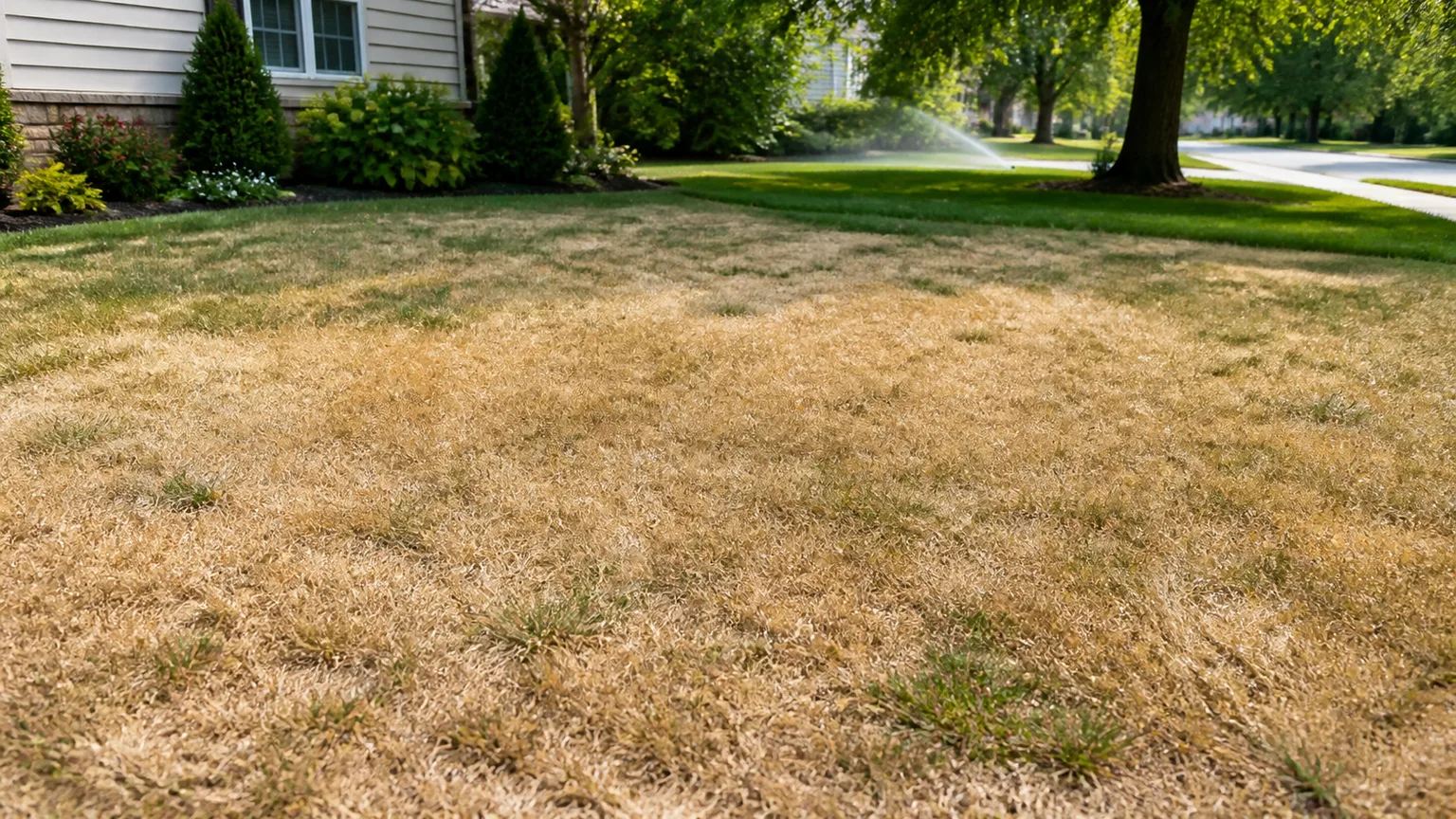
When a lawn turns brown in summer, the instinct is to turn on the sprinkler. That is sometimes right, but brown grass can also be dormant, poorly watered, scalped, diseased, insect-damaged, or injured by something that never needed water in the first place.
The fastest way to narrow it down is to read the pattern, test moisture below the surface, and inspect a small piece of turf. A broad, even tan color during a hot dry spell calls for a different response than circular patches that expand, turf that rolls back, or brown strips that match a sprinkler’s missed coverage.
Start with the Brown Pattern, Not the Hose
Broad Tan Color Versus Sharp, Localized Patches
Stand back before you touch the irrigation controller. If most of the lawn changes color during the same stretch of heat and drought, seasonal stress or dormancy is more likely than a single pest. If the damage is confined to strips, rings, edges, low spots, or the area beneath a tree, look for a local cause.
The pattern is a clue, not a diagnosis. Brown strips may mean blocked or misaligned sprinklers, but they can also follow mower passes or fertilizer spills. Circular patches may be disease, yet a buried object, pet traffic, or a dry pocket around tree roots can create a similar outline.
Notice what the grass does under your feet. Footprints that remain visible, blades that fold or curl, and a gray-green cast before the tan color appears all support water stress, while slimy tissue, a spreading edge, or turf that lifts cleanly points elsewhere. Those signs become much more useful when paired with the weather and the history of that exact patch.
A Five-Minute Root and Crown Check
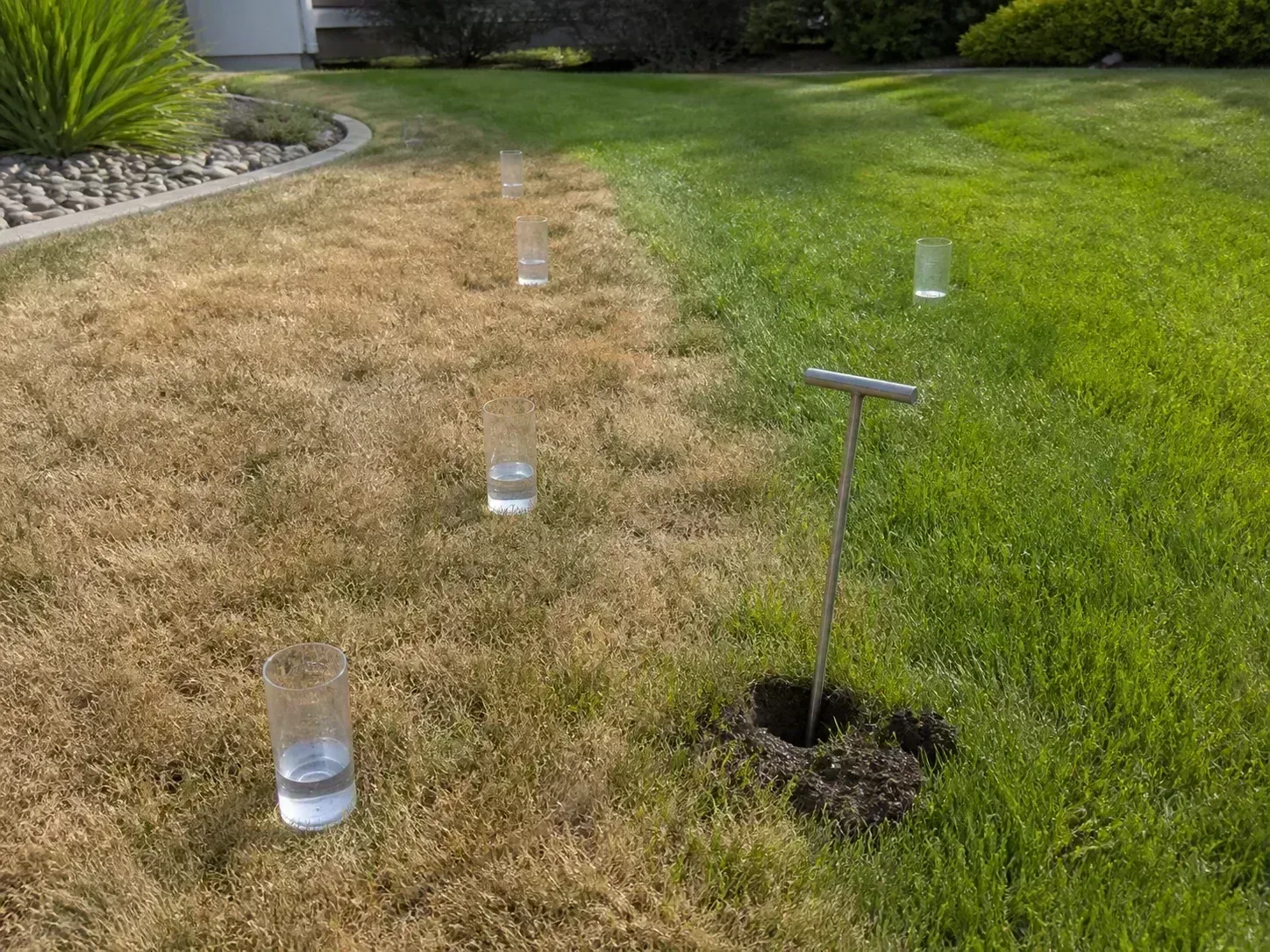
Push a screwdriver or narrow soil probe into both a brown area and a healthy area. Compare how far it goes and whether the soil feels damp several inches down. A wet surface over dry soil suggests a short or uneven irrigation cycle; wet soil with brown blades means more water is unlikely to be the first fix.
Next, part the blades at the soil line and look at the crown, the small growing point where the stems meet the roots. A firm, pale crown with attached roots is a better sign than loose, black, or mushy tissue. Give a small tuft a gentle tug rather than yanking the whole patch: resistance suggests living roots, while turf that lifts easily deserves a root and soil inspection.
1. Heat and Drought Triggered Dormancy
Dormancy is a survival response, not proof that the whole lawn is dead. During prolonged heat or drought, grass slows growth and may turn tan while the crown and roots wait for temperatures or moisture to improve. Penn State Extension’s seasonal lawn guide notes that drought, heat, and unusual weather can change the normal lawn-care calendar, and that mowing may not be needed until active growth resumes after rain.
Cool-Season and Warm-Season Turf Behave Differently
Cool-season grasses such as Kentucky bluegrass, perennial ryegrass, and fescues are most comfortable in cooler weather. A cool-season lawn may stop growing or brown during a hot, dry summer even when it is otherwise healthy. Warm-season grasses such as bermudagrass, zoysiagrass, St. Augustinegrass, and centipedegrass are built for summer growth, but they can still go dormant when drought or root damage outpaces their water supply.
Use the season and the pattern together. A uniform change after a heat wave is more compatible with dormancy than a few expanding circles. If an established lawn is allowed to rest, avoid repeatedly soaking it just long enough to green the blades and then stopping; that uneven cycle can spend water without solving the underlying stress. New sod and newly seeded turf are exceptions because their shallow roots need a consistent establishment schedule.
Grass mixtures complicate the picture. One section of a lawn may contain fescue, bluegrass, ryegrass, or a warm-season species with different heat responses, so a mixed yard can show green and tan turf at the same time without one part being diseased. Shade, mowing height, soil depth, and tree roots can also make a living lawn go dormant sooner in one area than another.
To test dormancy, inspect the crown, tug gently, and wait for a meaningful change in weather or moisture. Gardeners’ World recommends adjusting mowing height and letting an established drought-stressed lawn recover rather than treating every brown blade as a reason for intensive intervention. A practical drought-recovery guide also uses firm roots and soil moisture as clues, but recovery may be uneven and a dormant lawn can still contain patches that died from a separate problem.
2. Irrigation Is Uneven or the Soil Is Too Dry to Absorb It
Sometimes the lawn is brown because water did not reach the active root zone. A brief spray can wet leaves and the top layer of soil while the roots remain dry. Compaction, thick thatch, sloping ground, hydrophobic dry soil, or heavy clay can make the mismatch worse by sending water sideways as runoff.
Penn State Extension recommends managing the lawn according to actual conditions rather than a fixed calendar. Sandy soil, exposed slopes, wind, shade, tree-root competition, sprinkler pressure, and recent rainfall all change how much water a particular area can use.
Measure Sprinkler Coverage Instead of Guessing by Minutes
Place several straight-sided cans or rain gauges across one sprinkler zone: one in the brownest spot, one in a green area, and others near the edges. Run the system for its usual cycle and compare the water depth. A large difference between containers means the problem is distribution, not necessarily total runtime.
Watch the soil while the zone runs. If water starts pooling or flowing downhill before the root zone is wet, pause the cycle and let the ground absorb it before resuming. On clay or a slope, shorter soak periods can deliver more usable water than one long session. Repair tilted or clogged heads and keep spray off pavement before increasing the schedule.
When the root zone is dry, water slowly and deeply enough to wet the active roots, then allow the surface to dry somewhat before watering again. Early morning is a sensible default because it reduces midday evaporation and gives foliage time to dry. Do not use a universal number of minutes as a substitute for measuring the output of your own system.
A rough weekly figure such as one inch from rain and irrigation combined can be a starting reference during active growth, not a promise that every lawn needs that amount. A sandy lawn may need smaller, more frequent applications, while clay may need cycle-and-soak. Watering restrictions, storm forecasts, turf species, and local evapotranspiration can all change the responsible schedule.
3. Mowing or Fertilizer Added Stress in the Heat
Summer mowing can turn a marginally stressed lawn into a visibly brown one. Cutting too short removes the leaf area that shades the soil and produces energy, while a dull blade leaves shredded tips that dry out and look straw-colored.
Fertilizer can create a second problem. Nitrogen may encourage tender top growth when the roots are already short of water, and a concentrated spill or uneven spread can burn a stripe or patch. Penn State Extension recommends applying fertilizer according to the label and using soil testing to guide phosphorus and potassium decisions rather than guessing from color.
Hold Off on Two Common Summer Mistakes
First, do not scalp a brown lawn to remove the color. If the grass is still growing, raise the deck and remove no more than one-third of the blade in a cut. If it has stopped growing during severe drought, pause mowing until growth resumes; cutting dormant turf adds stress without making the roots healthier.
Second, do not fertilize simply because you want faster green-up. Skip nitrogen during severe heat, drought, or suspected active disease, and wait until the lawn is growing and the soil can support recovery. A soil test and local turf guidance are more useful than a high-nitrogen rescue application. Keep mower blades sharp and leave clippings when the cut is light enough that they do not clump.
If only the ends look tan after mowing but the crowns and roots are firm, mowing stress may be the main issue. If the brown follows the exact path of a spreader or a spilled bag, fertilizer or chemical injury is more likely. A clean mowing pattern does not rule out drought, but it helps you avoid treating a cut-injury problem with irrigation or fungicide.
4. Brown-Patch Disease or Another Turf Disease Is Spreading
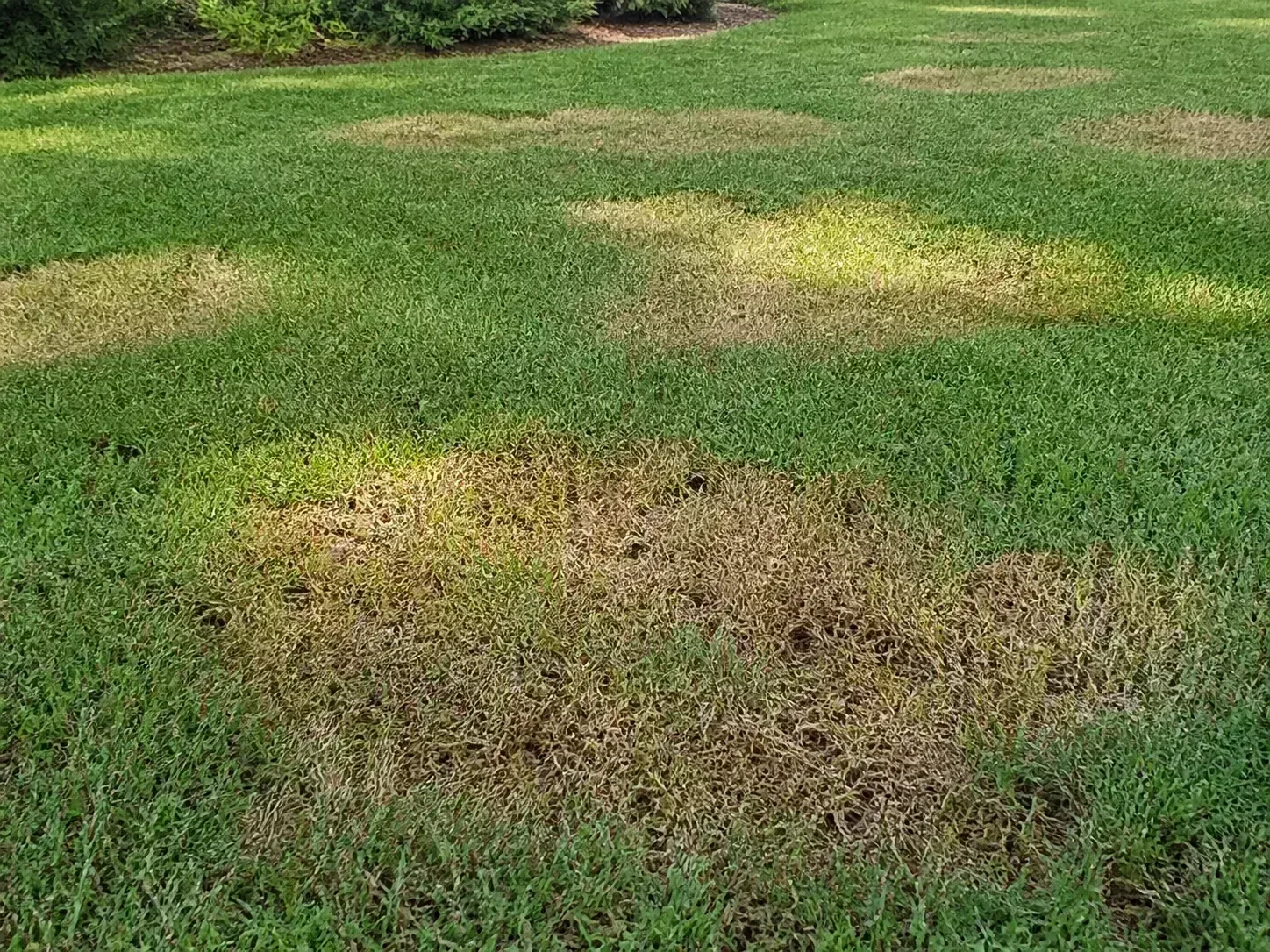
Disease becomes more plausible when the damage is localized, spreading, or linked to warm, humid, wet conditions. Penn State’s brown-patch reference describes it as a summer foliar disease caused by Rhizoctonia solani. On high-cut turf, it can appear as light-brown circular patches from a few inches to several feet across; in damp early-morning conditions, white fungal growth may be visible among the leaves.
Clues That Point to Disease
Look closely at individual blades, not only the patch from across the yard. Tan lesions with darker borders, a ring that expands or merges, thinning inside a patch, or white mycelium on dew-covered grass are more informative than “the grass is brown.” Brown patch is more likely during hot, humid weather and on lush, heavily fertilized turf, but not every summer circle is brown patch.
Avoid automatic fungicide use. Different diseases need different conditions and products, and a wrong treatment can waste money while the real problem—poor mowing, excess nitrogen, evening irrigation, or compacted soil—continues. Water early enough for the foliage to dry and avoid pushing lush growth during a disease-prone stretch. If the patch is spreading or the diagnosis is uncertain, photograph the blades and contact a local extension office or turf diagnostic service.
Other summer diseases can produce small straw-colored spots, reddish threads, or larger rings, and their likelihood changes with grass type, leaf wetness, fertility, and temperature. That is why a source-backed diagnosis is safer than choosing a product by the word “brown” on a label. The useful first action is to reduce the conditions favoring the disease while you identify it, not to spray the whole lawn on a guess.
5. Grubs, Chinch Bugs, or Other Pests Are Damaging the Turf
Insects can injure roots below the surface or feed on the blades above it. Penn State Extension’s lawn-care guide reports that white grubs can damage roots severely enough for sod to roll back like carpet, while chinch bugs and sod webworms can injure turf during hot, dry weather.
Inspect Roots Before You Treat
Use a garden spade to lift a small square of turf at the edge of the brown area. Check whether the roots are present and attached, then inspect the top few inches of soil and thatch. Penn State’s white-grub guide describes grubs as C-shaped, pale larvae with brown heads and legs near the front. Their presence alone does not prove they caused the browning, so note how many you find and whether the turf is loose or rootless.
For chinch bugs, inspect the margin where green and brown grass meet. Penn State describes a simple float test: set a can with both ends removed a few inches into the soil, fill it with water, and watch whether insects rise to the surface within about 10 to 15 minutes. This is an observation step, not permission to apply a product without identifying the pest and following the label.
Pesticide timing varies with the insect’s life stage, local weather, and the product label. Do not treat every brown patch “just in case,” especially if the roots are firm and the pattern is broad and weather-linked. A county extension office can help confirm whether the pest and population justify control.
Season matters too. White grubs are often easiest to find when they are near the surface and actively feeding, while leaf-feeding insects are more visible around the margin of a stressed patch. Record the date and inspect more than one square foot if the first sample is empty; one clean sample does not rule out a patchy infestation.
6. Soil, Salt, Pet, and Reflected-Heat Injury Made a Local Patch
A lawn can brown where the grass is not receiving the same soil conditions as the rest of the yard. Compacted footpaths, construction debris, shallow rocky soil, tree-root competition, and thick thatch can all restrict water and oxygen. BBC Gardeners’ World recommends addressing compaction after the soil has dried enough to work, using aeration to improve drainage and root growth rather than walking or mowing repeatedly on fragile ground.
When the Damage Has a Sharp Edge
Trace the boundary of the brown area. A strip next to a sidewalk or driveway may be suffering from reflected heat, salt, or compacted edge soil. A spot beneath a grill or fire pit may have heat injury. A fertilizer pile, de-icing product, herbicide drift, or cleaning solution can leave a shape that follows a spill or spray path instead of the weather.
Pet urine can create small spots with a greener margin, but do not assume every circular mark has that cause. Remove the source when possible, test the soil moisture, and compare the spot with nearby turf. Water may help dilute some salt exposure after the source is gone, but it cannot revive tissue that has already died.
Soil problems deserve a slower repair plan. A laboratory soil test can identify pH or nutrient issues, but it will not explain every summer patch and it is not a reason to add lime or fertilizer immediately. Hidden rubble, shallow soil over rock, a leaking downspout, or a tree’s feeder roots can keep defeating the lawn even when a basic nutrient test looks normal.
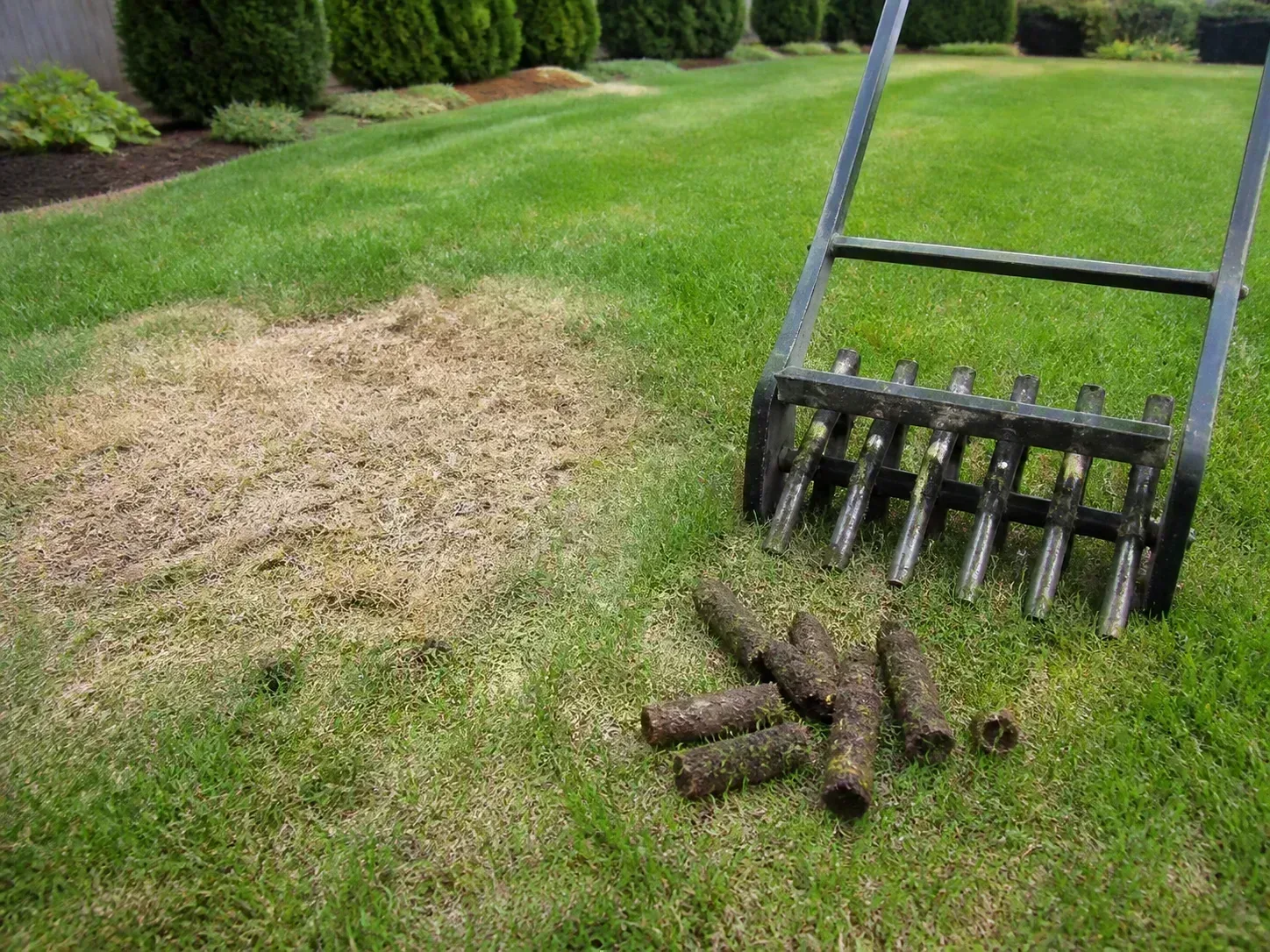
Do not try to fix compaction in peak heat by aggressively dethatching or aerating a dormant lawn. Penn State advises aerating during cooler active-growth periods when the soil is moist enough for the machine to remove cores and the grass can recover. Treat the cause first; reseeding a patch while the same salt, shade, traffic, or runoff problem remains only repeats the failure.
What to Do in the Next 24 Hours
Make the first response small and diagnostic:
- Photograph the overall pattern and a close-up of a few blades.
- Probe the soil in both brown and green areas several inches down.
- Check the crown and tug a small tuft gently.
- Run the irrigation zone with catch cans if the brown area is near a sprinkler pattern.
- Pause fertilizer, pesticide, aggressive mowing, and unnecessary irrigation until the evidence points to a cause.
If the soil is dry, water slowly enough to infiltrate. If it is wet, skip the hose and investigate disease, roots, compaction, mowing, or a local chemical injury. Keep equipment and heavy foot traffic off soil that is saturated or baked hard. For a related decision sequence when the lawn stays brown after watering, see why your lawn is still brown after watering.
If the lawn is only mildly stressed and still growing, the safest short-term care is boring: mow high enough to leave shade, keep people off the weakest areas, remove obvious debris, and correct a sprinkler head that is visibly missing the patch. Do not make several major changes on the same day, because you will lose the evidence that tells you which correction helped.
When to Aerate, Reseed, or Replace Turf
Wait to make structural repairs until the grass and weather can support them. Core aeration is useful for verified compaction, but it belongs in an active-growth window with moist—not saturated or rock-hard—soil. Dethatching is for an excessively thick thatch layer, not every brown lawn; Penn State advises avoiding it during high temperatures and drought.
Reseed when the cause is corrected and the seasonal window fits your turf. Cool-season lawns generally have a better establishment opportunity in late summer to early fall, while warm-season lawns are usually repaired during active warm growth. Clear dead material, loosen the surface, press seed into soil, and keep the seedbed consistently moist according to the seed mix instructions.
Replace sod only when the turf is genuinely dead or the patch is too large or eroded for seed to establish. If the area keeps failing, spend the effort on a soil test, drainage correction, grading change, or turf-type decision before buying more seed or sod.
Give recovering turf time. New green blades can appear before the root system is strong, so avoid immediately mowing low, fertilizing heavily, or opening the area to hard traffic. If a patch does not improve after favorable moisture and temperature return, lift a small sample and reassess roots, soil, and the original cause before renovating it.
When the Lawn Needs a Local Diagnosis
Call for help when brown patches expand quickly, the turf lifts easily, fungal signs recur, a pesticide seems necessary, or the lawn contains several overlapping patterns. A local professional or extension office can account for grass species, climate, soil, recent weather, irrigation water, and legal product restrictions that a general article cannot see.
Bring useful evidence: photos from above and close to the soil line, the date the color changed, recent mowing and fertilizer details, irrigation timing, rainfall, and a small description of what the tug and probe tests showed. That record is more valuable than a single photograph of a brown patch.
Conclusion
The right answer to a brown summer lawn is not always more water. Read the pattern, test moisture below the surface, inspect the crown and roots, and identify the grass and recent weather before treating anything.
A broad tan lawn during a hot, dry spell may be resting. Brown circles, dry sprinkler stripes, loose turf, blade lesions, sharp chemical edges, or wet soil beneath brown grass call for a different investigation. Once you match the response to the evidence, you can protect surviving turf now and save aeration, reseeding, and replacement work for the season when those repairs have a real chance to succeed.



