11 Reasons Why Your Orchid's Leaves Are Droopy
Droopy orchid leaves can mean dry roots, root rot, heat, or pests. Learn what to check first, tell wet and dry root problems apart, and choose the right fix.
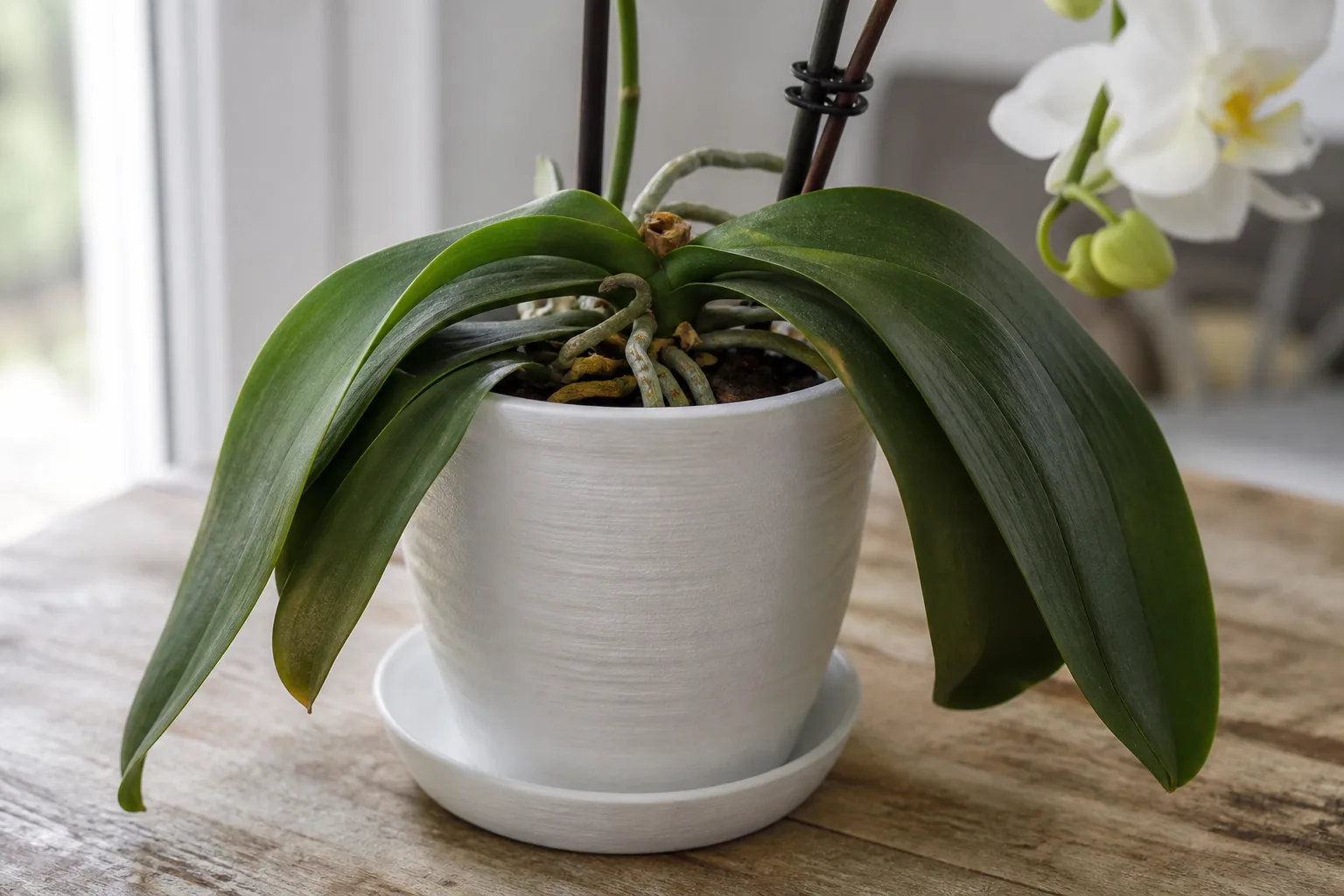
Drooping orchid leaves tell you that the plant is stressed, but they do not identify the cause. Both a dry root system and one damaged by constant wetness can leave leaves limp, so watering again is not a safe first move.
Start by checking the growing medium and roots, then look at the crown, leaf texture, light, and recent changes in the room. That order helps separate a thirsty orchid from one that cannot use the water already in its pot, and it avoids the most common wrong turn: treating every droop as dehydration.
What to check before watering a droopy orchid
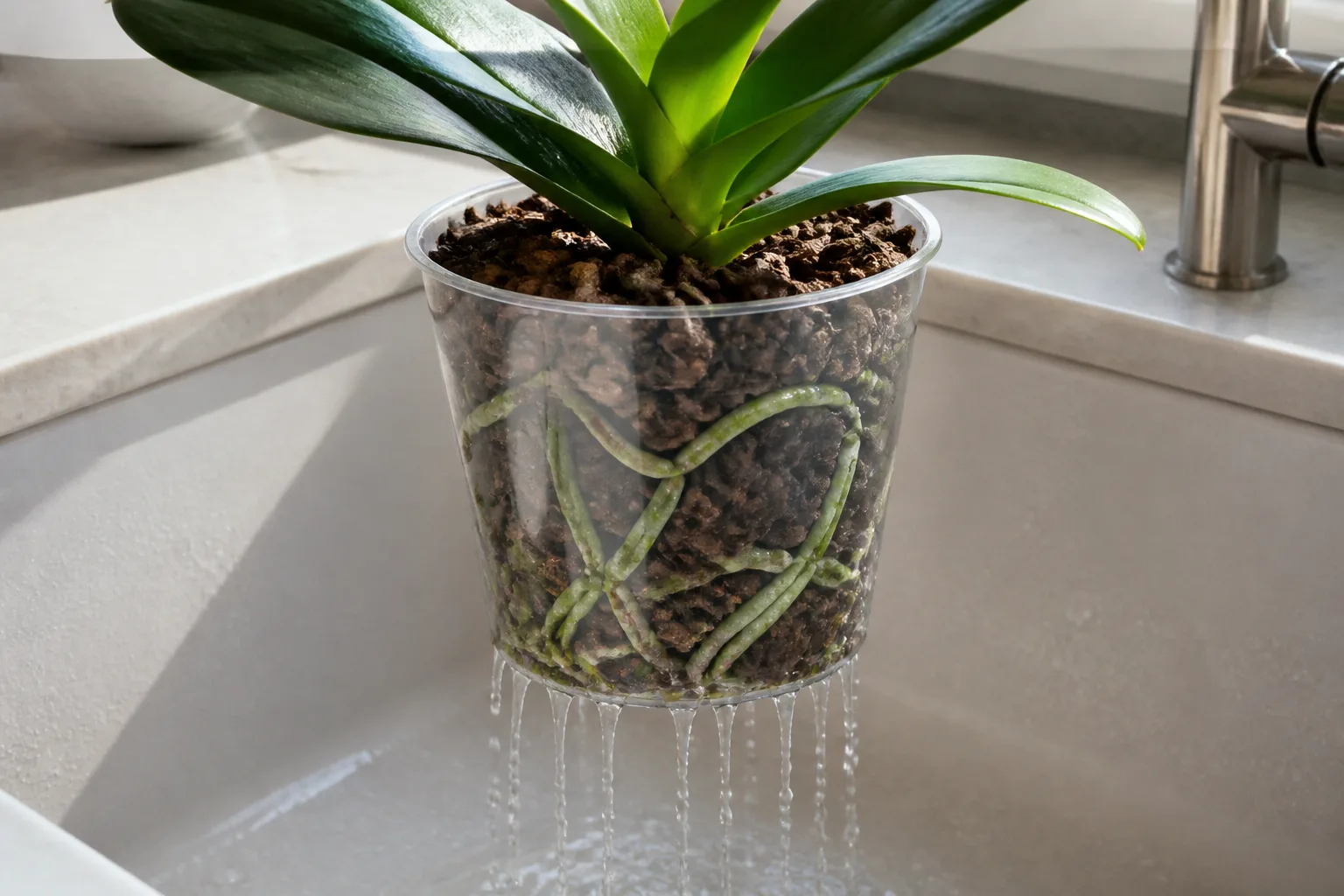
If the orchid is in a clear inner pot, inspect several roots through the sides. Living Phalaenopsis roots are usually firm and may look green when wet or silvery when dry; a root that is brown, hollow, mushy, or collapsing is more concerning than one that is simply pale. In an opaque pot, lift the grow pot to compare its weight with a freshly watered pot, feel the medium near a drainage opening, and check whether the pot is sitting in water inside a decorative cover.
Look at the leaves as well. A wrinkled or pleated surface often appears after a long dry spell, but it can also happen when rotting roots have stopped taking up water. Smooth, limp leaves with wet bark or a sour smell point away from “just thirsty.” If the crown—the point where new leaves emerge—is soft, dark, or wet-looking, keep water out of it and treat the problem as urgent.
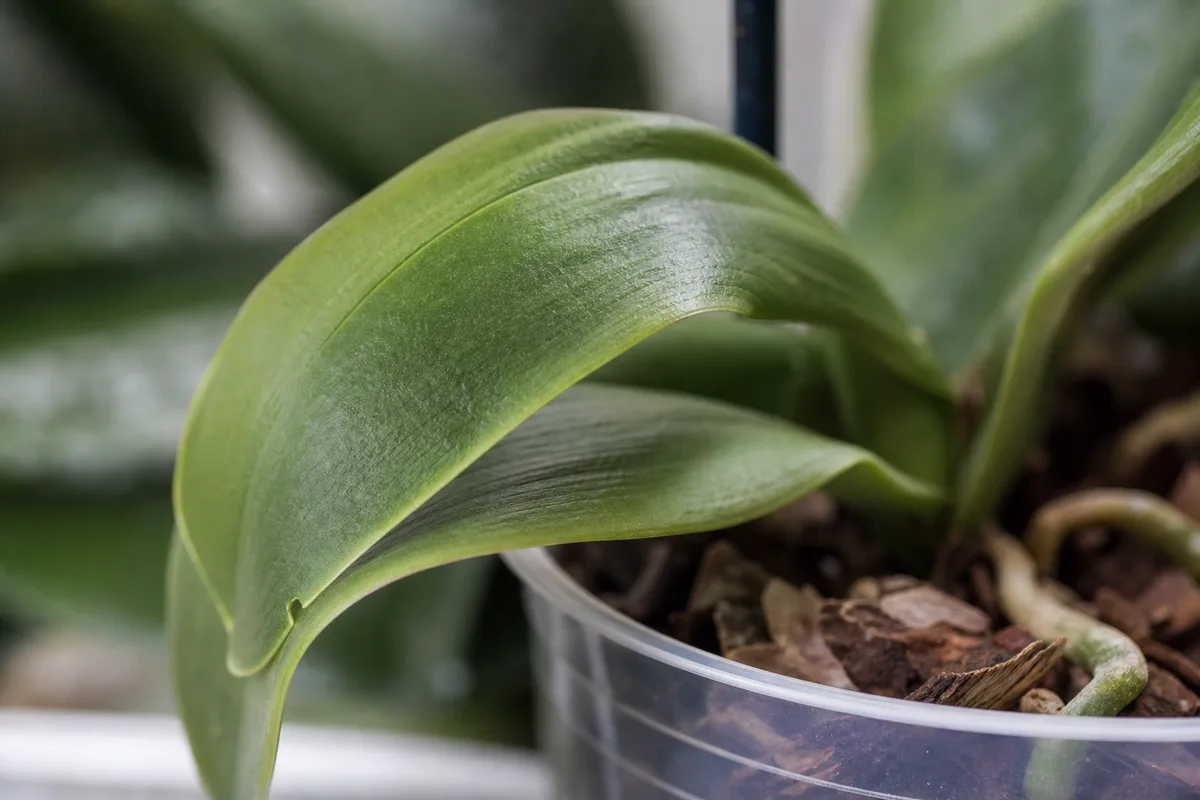
The American Orchid Society notes that orchids take most of their water through roots and that “overwatering” describes growing medium that does not dry quickly enough, not simply a large amount delivered on one occasion. Poor airflow, high humidity, low light, and a medium that holds too much water can all slow drying (American Orchid Society: Watering). For the common indoor moth orchid, root condition and the medium’s wet-to-dry pattern are therefore more useful than a calendar.
11 causes of drooping orchid leaves
1. Overwatering has damaged the roots
An orchid can look thirsty while standing in wet bark. When a root stays saturated and short of air, it can lose the firm outer covering that absorbs water; once enough roots fail, the plant cannot send water to its leaves. Look for bark that remains wet for many days, a pot that stays heavy, green roots that begin turning brown or translucent, or roots that feel soft rather than springy.
Do not add more water just because the leaves hang low. Take the plant out of its cachepot, empty standing water, and inspect the grow pot’s drainage. If several roots are soft or collapsing, remove only the failed tissue with clean scissors and repot into fresh, airy orchid medium. A few dark marks are not proof of rot: rinse a questionable root and test its firmness before cutting.
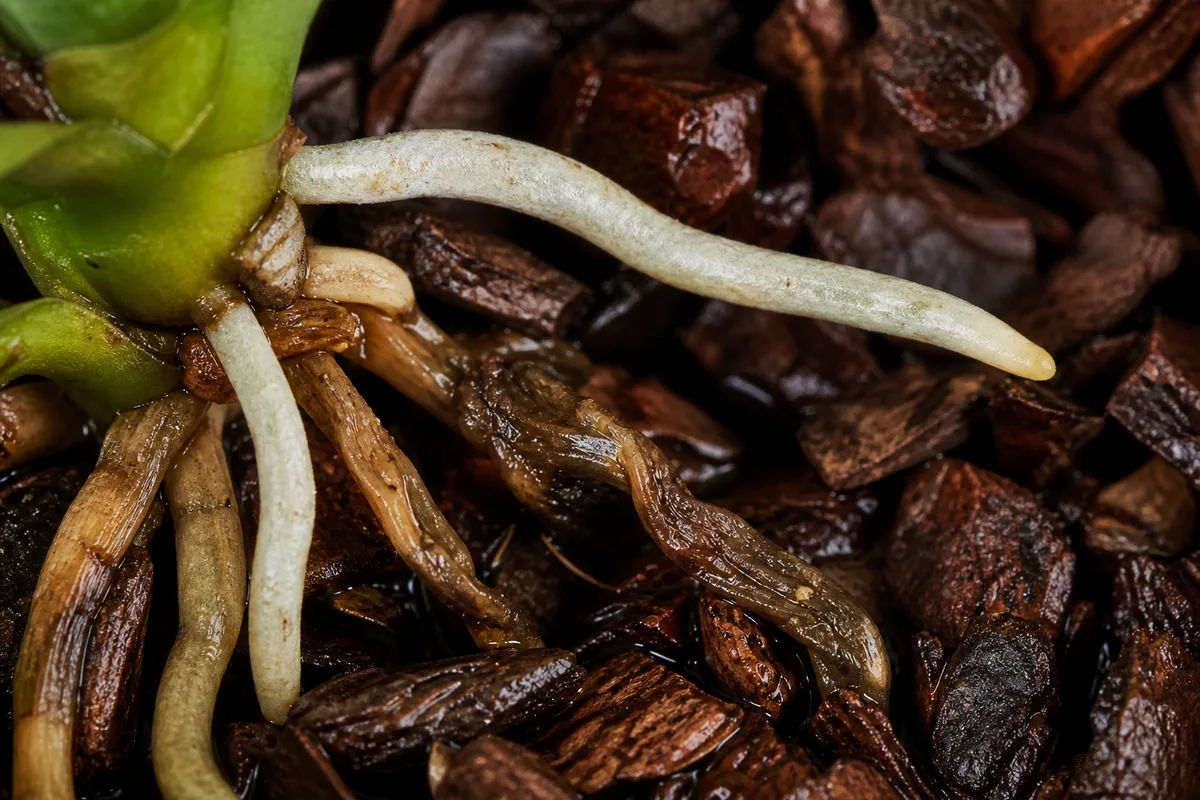
A clear pot can help reveal the pattern before you unpot the orchid. Roots that remain wet for a long time are not automatically diseased, but they deserve attention when paired with limp leaves, a sour odor, or medium that has broken down. The American Orchid Society’s definition of overwatering is useful here: the question is whether the root zone dries at a rate the orchid can tolerate, not whether you watered on the “wrong” weekday.
2. The roots have dried out between waterings
When the mix has been dry too long, roots may become thin, wrinkled, brittle, or papery. A Phalaenopsis with thirsty but living roots often has limp leaves that are also creased lengthwise. The pot may feel very light and the bark dry all the way through, while the crown remains firm.
If roots are dry but still solid, water the pot thoroughly with lukewarm water and let it drain completely. A brief soak can help rehydrate very dry bark, but do not leave the pot submerged or return it to a cover pot full of water. One careful watering is a better test than several small pours on consecutive days; give the plant time to respond before deciding it needs more.
If the roots are so desiccated that their outer layers slip off or only hollow strands remain, water alone will not rebuild them. Keep the crown and any remaining firm roots clean, and focus on steady, appropriate moisture while the plant produces new roots. Gardening Know How describes both underwatering and overwatering as causes of wrinkling, and recommends judging dryness in the medium instead of following an arbitrary schedule (Gardening Know How: Orchid Leaves Wrinkled).
3. The pot or medium stays wet too long
A poorly draining pot, a blocked drainage hole, or a dense, decomposing medium can keep roots damp even if you do not water often. Old bark breaks into fine pieces that hold water and close the air spaces around roots. Compact sphagnum can hide a wet center beneath a dry-looking surface, so checking only the top inch gives a misleading signal.
Inspect the lower half of the pot, not just the surface. If the medium is sour-smelling, mushy, or packed into a solid mass, or if water pools instead of flowing from the drainage holes, repotting may be more useful than cutting back watering by a day. Use a pot with open drainage and a mix appropriate for that orchid; standard houseplant soil is too dense for most epiphytic moth orchids.
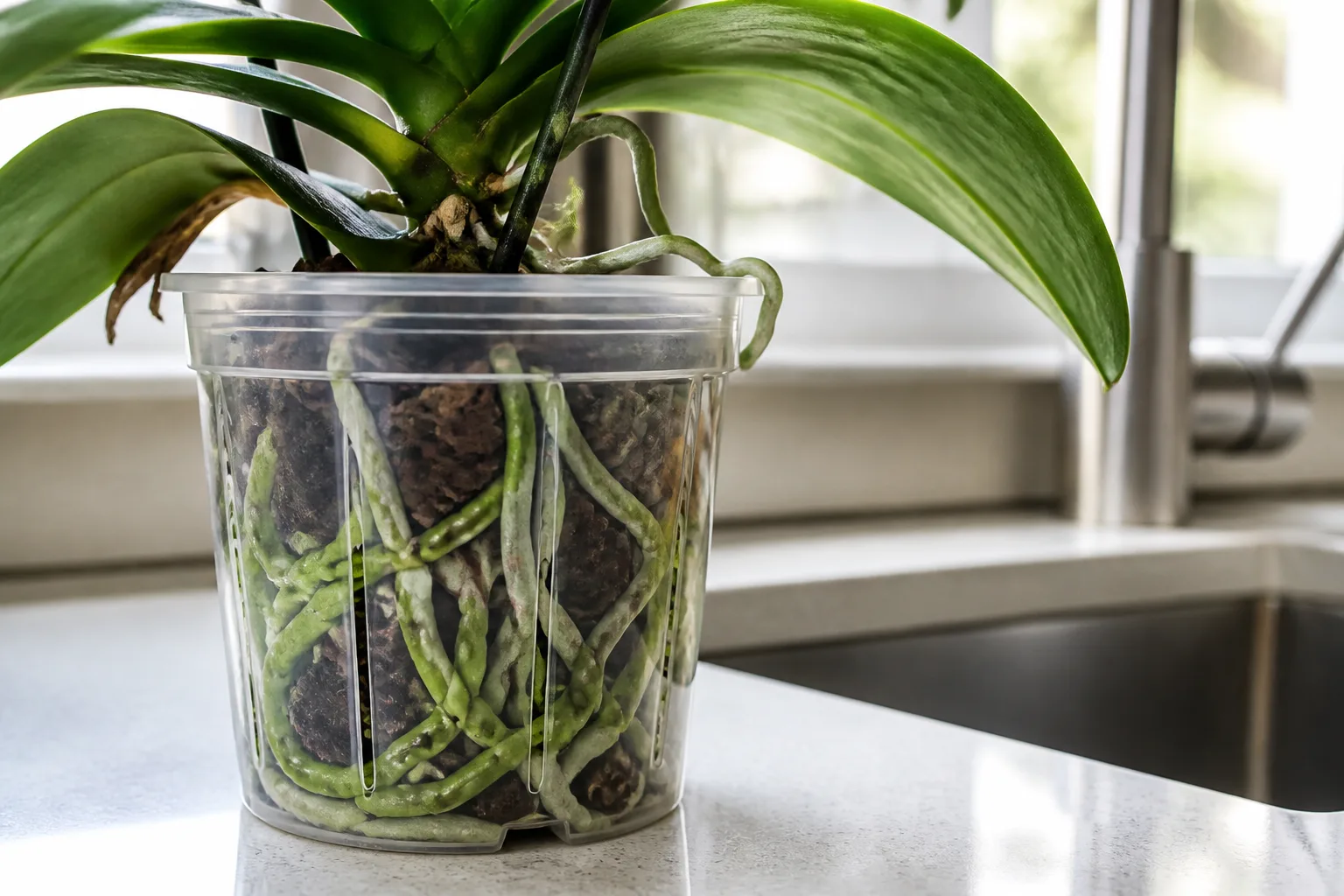
A transparent nursery pot is a tool, not a requirement. It lets you see roots and condensation, but an opaque pot can work if it drains well and you check weight and medium moisture. Epic Gardening also emphasizes inspecting roots and using orchid-appropriate medium when drooping follows excess moisture (Epic Gardening: How to Cure Droopy Orchid Leaves).
4. The watering routine does not fit the orchid or its setup
There is no reliable “water every Sunday” rule for every orchid. A Phalaenopsis in coarse bark can dry much faster than one packed into moss; a mounted Vanda may dry in a day, while a Paphiopedilum may prefer more consistent moisture. Temperature, pot size, light, airflow, and the season all change how fast a particular container dries.
Identify the orchid if you can, then establish a routine from evidence. Lift the pot after watering and again as it dries, check the center of moss with a skewer, and watch visible roots as they move from green toward silver. Water when that plant and medium approach the right dry-down point, then soak the root zone and allow all excess water to escape. If the leaves are drooping but you cannot see or feel the roots, investigate the pot rather than guessing from the species name alone.
5. Humidity is too low for the growing conditions
Very dry room air can increase water loss from leaves and exposed roots, especially near a heater or in a drafty room. It is more likely to aggravate drooping when roots are already damaged, the plant is mounted, or the orchid is a type adapted to humid conditions. Low humidity alone should not be assumed when the potting mix is saturated or roots are rotting.
Use a small hygrometer if the room seems unusually dry, and move the plant away from a heat register before adding equipment. If raising room humidity is useful, a room humidifier is more measurable than misting leaves. A pebble tray can slightly change the air immediately above its surface, but it will not repair damaged roots or substitute for adequate watering and air movement.
6. Heat or temperature swings outpace water uptake
A sudden hot spell, a cold draft, a radiator, or a window that heats up in afternoon sun can cause leaves to lose water faster than roots replace it. Stress often follows a move, a change in season, or a heating and cooling cycle. Heat injury may accompany limp leaves with pale, bleached, or scorched patches; cold injury may look dark, wet, or damaged rather than simply thirsty.
Check the plant’s actual location at the time the stress occurs. A windowsill can be much warmer in direct afternoon sun than the room, while an air-conditioning vent can chill one side of the plant. The American Orchid Society notes that temperature needs differ among orchids and that climate-controlled indoor conditions are generally safe, so the generic advice to create a fixed day-to-night temperature drop does not diagnose every drooping plant (American Orchid Society: Temperature). Stabilize the location first, and do not move a stressed orchid repeatedly between hot and cool spots.
7. Direct sun or a hot window is stressing the leaves
Most common indoor orchids do well in bright, indirect light, but a little direct sun can be useful if the plant is acclimated. The trouble is abrupt exposure: a moth orchid moved from a dim store shelf to a hot south- or west-facing window can heat up quickly. Sun-stressed leaves may develop bleached areas, yellow patches, or dry brown margins in addition to drooping.
Move the orchid a short distance back from the glass or filter the light with a sheer curtain. Do not put it in a dark corner as a cure for sunburn. Damaged areas may remain discolored, so judge the correction by whether new leaf growth stays healthy and the existing damage stops expanding.
8. Light is too weak to support steady growth
Too little light is usually a slower, indirect contributor rather than the cause of an orchid that suddenly droops overnight. Over time, weak light can slow root and leaf growth, reduce flowering, and make recovery from another stressor harder. A plant can appear green in a room that looks bright to you but still receive little usable light several feet from a window.
Move it closer to a bright window while avoiding hot direct sun, or use a grow light at the distance recommended for that fixture. Make changes gradually, and watch for leaf heating or fading. If a light adjustment does not stop an active decline, return to the roots and medium; low light does not make mushy roots firm again.
9. Still air and wet foliage favor rot
Stagnant air does not usually make healthy orchid leaves droop by itself. It becomes a problem when water stays in the crown or leaf joints, the medium dries slowly, or a disease is already present. Repeatedly misting the leaves can leave water sitting where a fan or gentle room movement would otherwise help it evaporate.
Keep the growing area ventilated without aiming a strong fan directly at the plant. Water around the root zone, do not leave droplets pooled in the crown, and let leaves dry before night if they get wet. The Royal Horticultural Society describes oedema as excess water uptake when a plant cannot transpire it, and notes that orchids can be affected; its advice is to correct wet conditions and improve ventilation rather than removing every marked leaf (RHS: Oedema).
10. Fertilizer salts or a real nutrient shortage are affecting roots
Fertilizer is not a first-line treatment for limp leaves. Too much fertilizer or accumulated salts can injure roots, which then absorb water poorly; the leaf symptom can resemble drought even if the medium is damp. A genuine nutrient shortage is more plausible when growth has been weak for a while and leaves show progressive discoloration, rather than when one leaf suddenly sags.
If there is a crust on the medium or pot, or root tips are browning after heavy feeding, pause fertilizer and flush the medium with clean water that can drain away. Resume only with a fertilizer labeled for orchids and at its stated dilution, adjusted for the plant’s active growth and your water quality. The American Orchid Society’s nutrient guidance describes deficiencies through patterns such as gradual chlorosis or damage to developing growth, which helps distinguish them from a sudden root-water problem (American Orchid Society: Nutrient Deficiencies).
11. Pests or infectious disease are injuring the plant
Inspect both sides of leaves, leaf bases, and the crown for scale, aphids, mealybugs, thrips, webbing, sticky residue, stippling, or cottony clusters. Sap-feeding pests can weaken a plant over time, but they rarely explain droop as cleanly as a water-uptake problem unless there are other visible signs. Isolate a suspect orchid before treating it, especially if other plants are nearby.
Disease needs a different response from simple dehydration. Watch for quickly expanding, water-soaked brown or black patches, sunken lesions, a soft crown, or tissue that smells foul; those are not ordinary wrinkles. The Connecticut Agricultural Experiment Station’s orchid guidance describes bacterial soft rot and brown spot as wet, dark lesions that can progress rapidly, and recommends sanitation, isolation, and avoiding splashed foliage (Connecticut Agricultural Experiment Station: Orchid Diseases and Insects). Keep the plant away from others, disinfect tools between cuts, and seek an orchid society or extension service’s help if the damaged area continues to spread.
How to correct the problem without adding stress
Change one thing at a time, beginning with what the roots and medium show. If the roots are firm and silver and the bark is dry, water thoroughly and drain; if roots are soft or the mix is wet and stagnant, stop watering and inspect the root system. If the roots look healthy but symptoms began after a move, draft, or sun exposure, stabilize that condition before repotting or feeding.
Repot only when there is a reason: the medium has broken down, the pot will not drain, or roots are confirmed to be rotting. Use clean tools, preserve firm roots even if they are tan or silver, and do not bury the crown. Avoid trimming leaves just because they droop; green tissue still contributes energy. If a leaf is fully yellow and dying, let it detach naturally unless rot or active disease requires removing affected tissue.
Keep a brief record of watering, pot weight, and any new symptoms for two or three weeks. That makes it easier to tell whether a change is helping, and prevents a second or third adjustment before the first one has had time to work. For exact wet-dry cues in bark, moss, or a mounted setup, use a medium-specific method rather than copying a calendar from another grower (our guide to watering orchids).
Will droopy orchid leaves recover?
Leaves that have gone limp from a short dry spell may regain some firmness after the roots are rehydrated, but recovery is not always immediate. If roots were lost to rot, the plant must grow new roots before it can reliably supply water to its leaves. That can take weeks or longer, especially when light, temperature, and the growing season slow growth.
A leaf that is deeply pleated, split, yellowing, or badly damaged may stay marked even after the orchid is stable. Look for the next signs of recovery: a firm crown, fresh root tips, no new spots, and new leaves that emerge firm. Do not force those signs with extra fertilizer or daily watering.
One lowest leaf turning yellow slowly can be normal aging if the rest of the orchid remains firm and healthy. Several leaves collapsing at once, a soft crown, a strong sour smell, or spreading water-soaked lesions are not normal leaf turnover. When the pattern is unclear, take clear photos of the plant, roots, and potting medium and ask an experienced orchid grower or local extension service before using a pesticide or fungicide.
Conclusion
When orchid leaves droop, inspect roots and potting medium before reaching for the watering can. Dry, firm roots in dry bark call for a thorough soak and complete drainage; soft roots in wet or sour-smelling medium call for an urgent root and pot check, not more water.
Then look for clues from the plant’s type, room conditions, light, air movement, fertilizer, and pests. Change only the condition that fits the evidence, and measure recovery by healthy roots and new growth rather than expecting every old leaf to spring upright again.



