How to Water Orchids in Bark, Moss & More
Learn how to water orchids in bark, sphagnum moss, tree fern fiber, clay pellets, and mounts using root color, pot weight, drainage, and season.
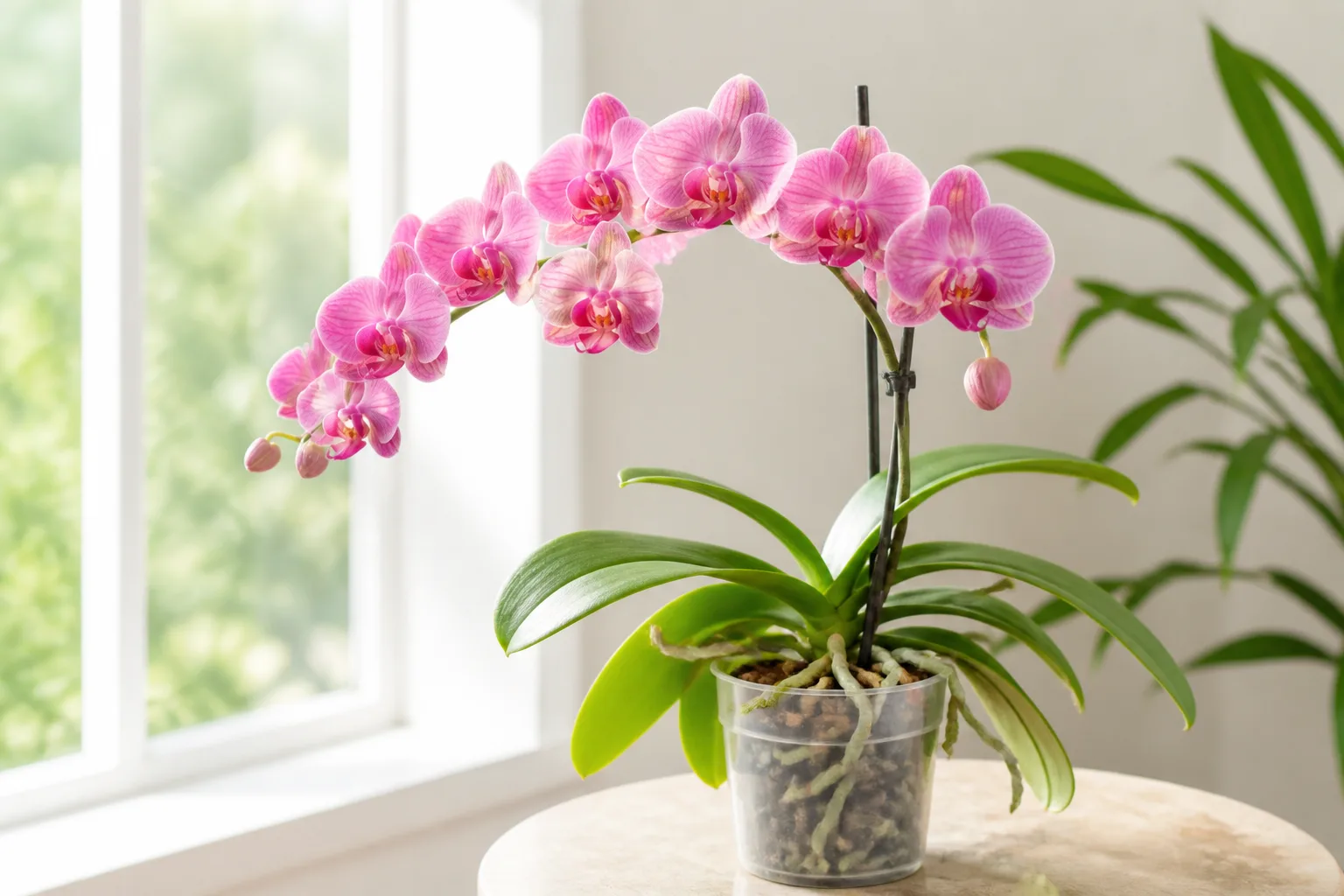
The safest way to water an orchid is to wait until its particular medium is nearly dry, then wet the root zone thoroughly with tepid water and let every excess drop drain away. That rule sounds simple, but “nearly dry” looks different in chunky bark, tightly packed sphagnum moss, tree fern fiber, an inorganic mix, or no potting medium at all.
The calendar is only a starting clue. A small orchid in a warm, bright room may dry in three days; the same plant in a cool room and dense moss may still be wet after ten. The American Orchid Society explains that humidity, air movement, light, and the type and age of the medium all affect timing, so a fixed weekly dose cannot be reliable for every plant (American Orchid Society: Watering Techniques for Success).
Quick answer: water by dry-down, not by weekday
For most potted epiphytic orchids, water when the medium is almost dry and the roots have had a chance to breathe—not while the pot is still saturated, and not after the plant has been dry for so long that active root tips have sealed. Water until it runs freely from the drainage holes, allow the pot to drain completely, and empty any decorative cover pot or saucer before returning the orchid.
Use a clear pot or lift the plant when possible. Green, plump roots usually have recently absorbed water; silver or pale gray velamen generally indicates a dry root. A light pot and an almost-dry wooden skewer support the same decision. These are more useful than a reminder that says “water every seven days.”
There is one important split. Orchids with pseudobulbs—swollen storage organs found in many Cattleyas, Oncidiums, and Dendrobiums—can usually dry fully between waterings. Phalaenopsis and Vanda, which lack that storage structure, should be watered just before the medium becomes completely dry. Paphiopedilum and Phragmipedium also deserve their own care guidance because many are adapted to more consistently moist conditions.
Why orchid media change the watering schedule
Most familiar houseplants are rooted in a fine mix that holds a fairly even film of moisture. Many orchids are different. Their roots evolved in exposed, airy places such as tree branches or rock crevices, where rain can be abundant but water does not remain packed around the roots for days. A pot must provide both hydration and air; supplying only one is not successful watering.
The living root is wrapped in a spongy layer called velamen. It takes up water quickly and then dries back toward a silvery color. If the velamen remains saturated for too long, the root’s inner tissues can suffocate and rot. Once roots are lost, the leaves may wrinkle from lack of uptake even though the medium is wet, which is why adding more water can make the diagnosis worse.
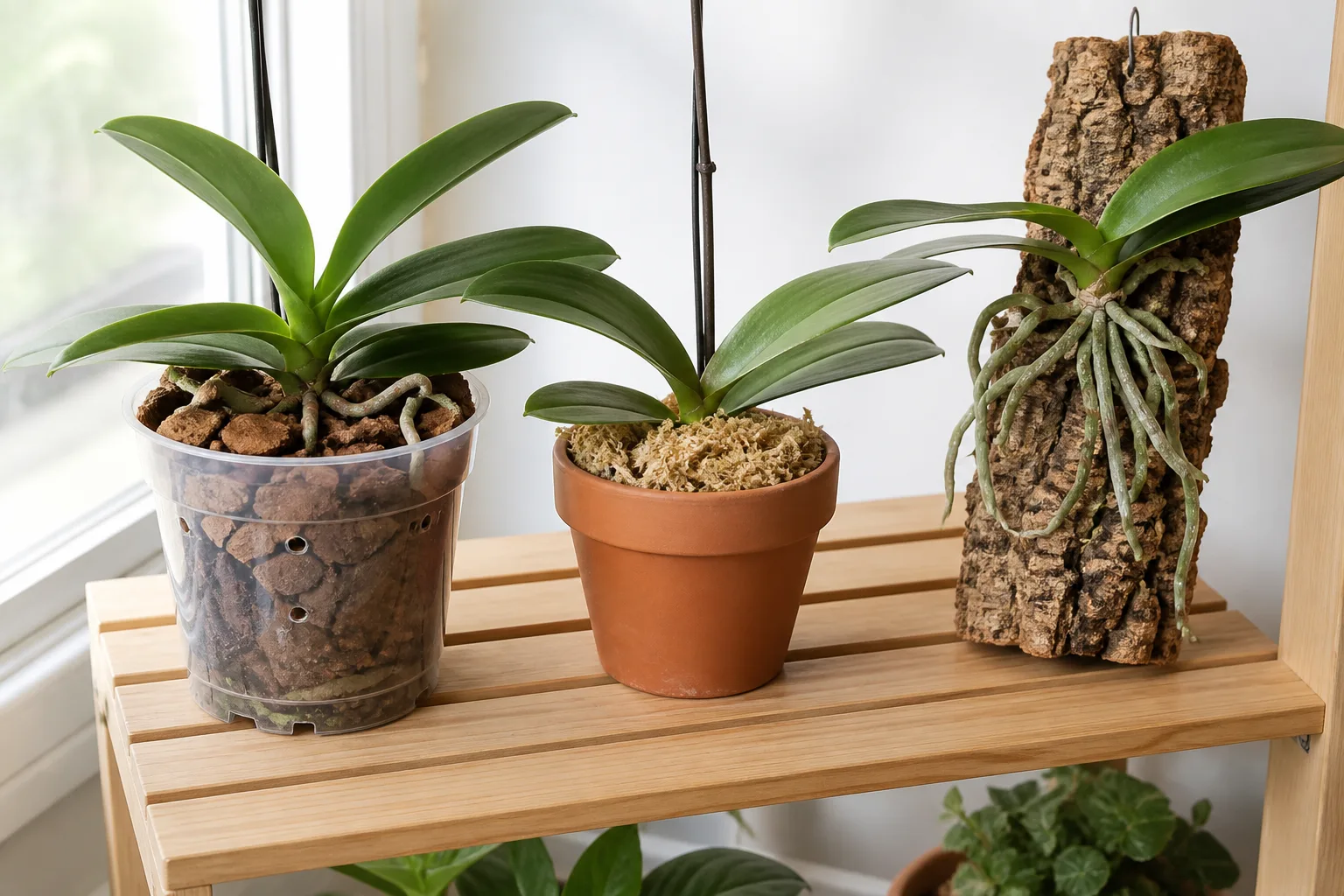
Bark chunks leave large air spaces and often dry unevenly from the surface inward. Sphagnum moss can hold a surprising amount of water in the center while looking dry at the top. Fine, decomposed material can block drainage in either one. Perlite, gravel, charcoal, and expanded clay drain quickly, but quick drainage does not mean the orchid never needs a complete soak. It means you must check more often and make sure the pot does not dry beyond the plant’s tolerance.
Read roots, pot weight, and the growing stage together
No single signal is perfect. Roots can be hard to see in an opaque pot, a wooden skewer can pass through a dry pocket in moss, and an orchid with damaged roots can have limp leaves whether the mix is wet or dry. Use at least two checks before you change the routine.
Start with the pot. Lift it just after watering, then lift it again as it dries; the difference becomes a practical moisture gauge. Next, inspect visible roots or slide a skewer down the side of the pot rather than stabbing through the rootball. In a clear plastic pot, compare several roots: green and firm after watering is normal, while silvery or pale roots signal that the dry-down is progressing.
Finally, identify the plant’s growth stage. A Phalaenopsis making new roots, leaves, or a flower spike may use water faster than a resting plant. A Cattleya with firm pseudobulbs has a storage reserve that makes a full dry period safer. The American Orchid Society summarizes the decision as watering “just as they dry out,” with the exact threshold changing by orchid type and growing conditions (AOS: Watering Techniques for Success).
How often to water based on orchid type
Think in ranges, not promises. Many indoor Phalaenopsis orchids in bark are checked every four to seven days, while moss-packed plants may need water every seven to fourteen days. A hot, breezy room, a small clay pot, or a mount can shorten those intervals dramatically. A cool room, low light, large pot, or old compact medium can lengthen them—and also increase the risk that the center stays wet too long.
Phalaenopsis and other orchids without pseudobulbs
Moth orchids are the common example. Let the medium approach dryness, but do not make a vigorous plant endure repeated, prolonged drought. In a clear pot, roots changing from green to silver are a useful cue. If the inner core is still dark and the moss feels cool and damp, wait; if most roots are silver, the pot is light, and the skewer comes out nearly dry, water thoroughly.
Phalaenopsis sold in moss often look as though they need frequent water because the top surface dries quickly. Check the lower and center portions before watering. If the moss has become a tight, water-repellent plug, a quick splash may run around the outside while leaving the rootball dry. Rewet it slowly from several directions or briefly soak the grow pot, then drain it completely. If the plug repeatedly stays saturated or smells sour, the better fix is fresh medium at the next suitable repotting time.
Cattleya, Oncidium, Dendrobium, and other pseudobulb orchids
Pseudobulbs store water and help these orchids tolerate a more complete dry-down. That does not make them drought-proof. Water when the mix is dry, the pot is light, and the pseudobulbs are beginning to lose their firm, full appearance. Do not wait for severe shriveling as a routine signal; by then the plant has spent part of its reserve.
During active root or shoot growth, increase checks because new tissues use water. During a cooler or dormant period, reduce both frequency and volume. The ideal dry interval also varies with the genus: a thick, coarse Cattleya mix may need to dry substantially, while an Oncidium in a finer mix can need a careful balance between drying and steady access to moisture.
How to water orchids in bark
Bark is a good medium for many epiphytic orchids because its large particles create drainage and air spaces. It is not automatically easy to wet. Fresh or very dry bark can repel water at first, and the top layer may look dry while the bottom remains damp.
When the pot is ready, take the grow pot out of its decorative container and place it in a sink or basin. Run tepid water slowly over the bark and around the roots until it flows freely from the holes. Pause for a few minutes, then flush again so the inner bark has time to absorb water. A brief soak can help a thoroughly dried bark mix rehydrate, but do not leave a potted orchid submerged as a default routine.
Watch the outflow. Water should move through the pot without pooling for minutes at the surface. If it trickles through a dense, fine mass, the medium may be breaking down or the drainage holes may be blocked. The AOS notes that slow flow can indicate a mix dense enough to deprive roots of air, while fine particles resembling coffee grounds in the runoff are a sign that the mix is decomposing (American Orchid Society: Watering Techniques for Success).
Let bark drain until the pot stops dripping before it goes back into a cachepot. For a clear pot, the roots should look hydrated after watering, but the spaces between bark pieces should not remain a stagnant reservoir. If the bark is still wet at the next scheduled check, skip the calendar and wait.
How to water orchids in sphagnum moss
Sphagnum moss is more water-retentive than chunky bark, especially when it is packed tightly around the roots. That makes it useful for some young plants and dry homes, but unforgiving when a grower waters by habit. The goal is moisture with air, not moss that stays saturated.
Run tepid water over the whole pot until it drains freely. Turn the pot slightly as you water so the stream reaches the center, not just the gap between moss and container. If the moss is dry and hydrophobic, let water enter gradually, pause, and repeat rather than pouring one fast stream that bypasses the rootball.
After watering, allow the pot to drain for several minutes. If a flexible inner pot is packed with moss and retains too much water, gently compress the outside of the pot or wick excess from the bottom; do not squeeze the roots or twist the plant. Fine Gardening’s practical guidance for moth orchids emphasizes that soggy moss and poor drainage are bigger problems than a missed calendar day, and that the plant should be thoroughly soaked in a sink before it is returned to its spot (Fine Gardening: Keep Moth Orchids Happy).
Check the bottom half of the moss before watering again. A surface that is pale and dry does not prove the center is dry. If the pot remains heavy and cool for more than a week, roots may be getting too little air; improve the pot or medium rather than adding a smaller amount of water more often.
Tree fern fiber and mixed orchid media
Tree fern fiber, coco coir, bark, perlite, charcoal, and other components can be combined into a medium that drains quickly while holding a modest moisture reserve. The recipe matters less than the finished texture. Two bags labeled “orchid mix” can dry at very different speeds depending on particle size, the amount of fine material, and how firmly the plant was packed.
Water a mixed medium when the pot is light and a skewer comes out almost dry, then flush until water runs out of the drainage holes. Tree fern fiber and coir can remain damp inside even when the outer layer feels dry, so test in more than one place. A mix that is fresh and coarse may need frequent watering; an older mix that has collapsed into fines may need less frequent watering but be more dangerous because it holds stagnant moisture.
Use the plant’s response as a second feedback loop. Firm roots, active root tips, and new growth indicate that the wet-dry rhythm is working. Repeated yellowing, sour odor, or roots that detach as a soft sleeve point toward root loss, not a need for more frequent watering. When the medium has changed texture, revise the routine immediately; a schedule that worked before repotting is no longer evidence.
Gravel, charcoal, perlite, LECA, and clay pellets
Inorganic materials drain and dry faster than moss, but they still create a local moisture pattern around each root. Gravel and charcoal hold little water; perlite holds some moisture in its pores; expanded clay pellets can provide a reservoir only when the container is designed and managed for that purpose. Do not assume that a pot filled with pellets can be treated like a self-watering system.
For a freely draining inorganic setup, water slowly and thoroughly until the root zone is wetted, then allow the container to drain. Check it more frequently than a moss pot, especially in bright light, warm air, or strong airflow. If the orchid is in a reservoir or semi-hydro arrangement, follow the design’s waterline rather than topping it up blindly; roots adapted to air can rot if the entire root mass is kept submerged.
These materials are useful when you tend to overwater because they make excess water easier to remove, but they do not solve a pot with no drainage. A decorative container without a drainage hole is still a water trap, no matter how airy the mix looks at the top.
How to water mounted and bare-root orchids
Mounted orchids and Vandas dry far faster because the roots are exposed to air. They may need watering daily in hot, bright conditions and less often in a cool, humid room. Check the root surface and growing root tips rather than borrowing the schedule of a potted Phalaenopsis.
Water the mount with tepid water until the roots are fully wetted. A hand sprayer can wet the surface, but a thorough stream or hose with gentle pressure is more reliable for a mount that has dried hard. Let it drain in place. For a very dry plant, water once, wait a few minutes, and water again; this gives the roots time to absorb more than a single quick pass.
Avoid dunking several mounted or bare-root orchids in a shared bucket. Runoff can carry pathogens from one plant to another. Fairchild Tropical Botanic Garden’s orchid guidance specifically recommends two short waterings a few minutes apart for mounted plants and cautions against communal dunking (Fairchild: Orchid Basics—How and When to Water). Give each plant its own clean water source or rinse and disinfect the container between plants.
Mounted plants also need a realistic humidity and airflow balance. A mount in dry air may need frequent watering, but a mount in stale, enclosed air can remain wet around a leaf or crown and develop rot. More water is not the substitute for appropriate ventilation.
A safe top-watering routine for potted orchids
Top watering is a good default when you can remove the grow pot and let it drain. Use this sequence every time:
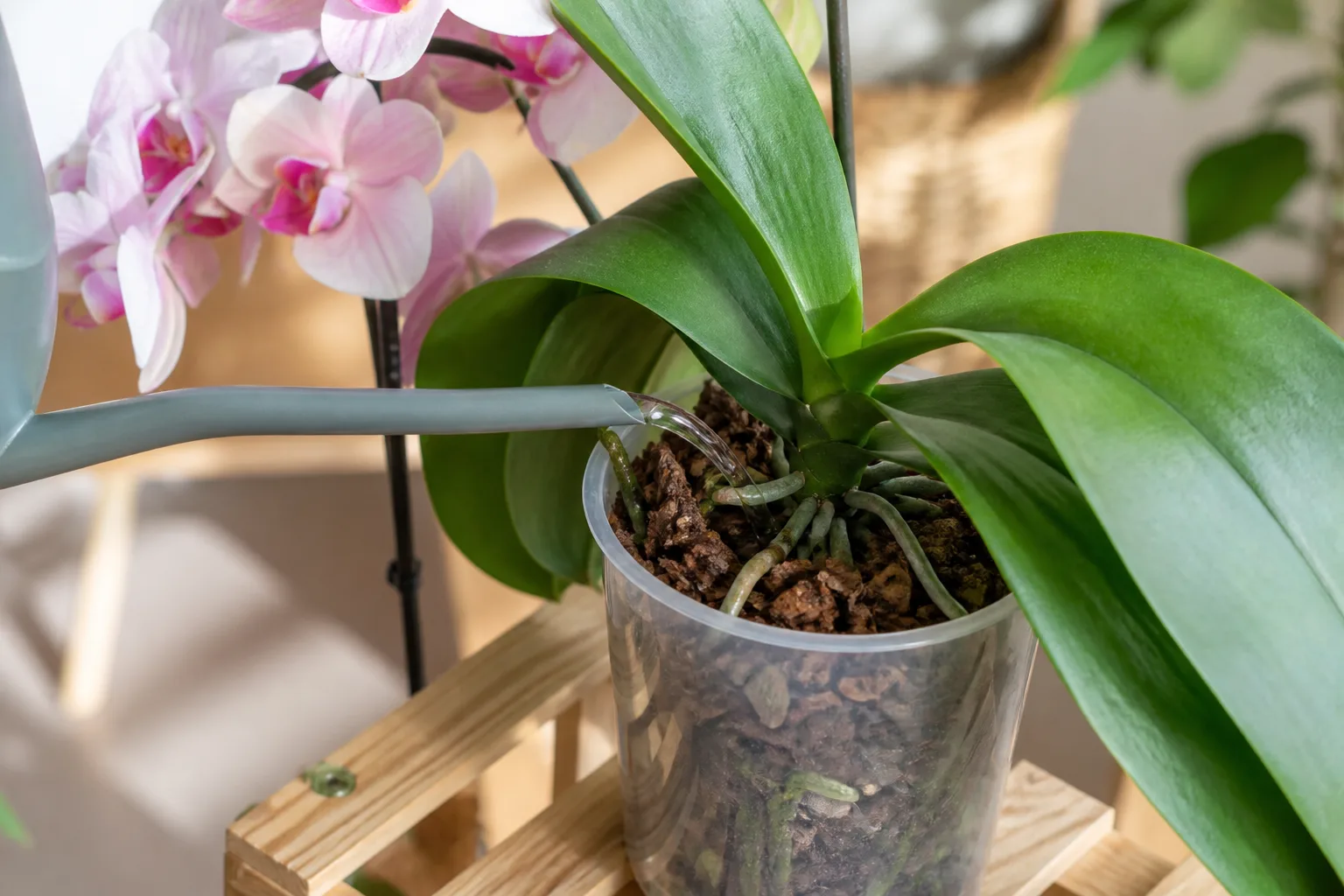
- Check the pot weight, medium, and visible roots before turning on the water.
- Use tepid water and keep the stream directed at the medium and roots, not the crown or flower centers.
- Wet the pot slowly until water exits every drainage opening.
- Wait a few minutes and repeat if the bark or moss was very dry.
- Tip the pot gently so trapped water leaves the base, then let it drain fully.
- Empty the saucer or cover pot before the orchid returns to its growing position.
Water in the morning when possible. That gives splashed leaves and crown crevices more time to dry while the plant is warm and active. If water collects in the crown—the central cup formed by the newest leaves—wick it away with the corner of a clean paper towel without rubbing the tissue.
Top watering is also a chance to observe the medium. Water that beads and runs away indicates a dry or hydrophobic mix; water that sits on top indicates compaction, fine breakdown, or a blocked hole. Either condition is a setup problem, not a signal to water a little every day.
Top watering versus bottom watering
Both methods can work when the pot drains completely. Top watering is faster and makes it easier to flush fertilizer salts through the medium. It also lets you see whether water passes freely and whether the crown is protected.
Bottom watering can rehydrate a very dry, water-repellent rootball. Set the grow pot in a shallow container of tepid water so the lower portion can absorb moisture, then remove it before water reaches the crown or remains trapped in the pot. Follow with a full drain. Do not leave an orchid standing in a saucer as a permanent bottom reservoir unless the plant and system were intentionally designed for that culture.
Immersion is more practical for some potted orchids than for mounted collections. A clean container and one plant at a time reduce disease risk. The American Orchid Society and Fairchild guidance put the emphasis on thorough wetting, full drainage, and air around the roots, not on whether the first water arrives from above or below.
Water quality, fertilizer, and the monthly flush
Most orchids tolerate ordinary household tap water, rainwater, or bottled spring water, but avoid water from a salt-based water softener. Such systems replace hardness minerals with sodium, which can accumulate in a small orchid pot. If you see a crust on the pot or bark, browning tips, or a plant that declines despite good moisture, water quality and salt buildup deserve attention.
Use room-temperature or tepid water. Ice cubes may limit the volume delivered, but they do not give the root system a thorough flush and can expose a warm-climate orchid to an unnecessary cold pulse. The AOS advises against the ice-cube habit because cold and unflushed dissolved salts can create problems over time (AOS: Water Requirements).
Fertilizer belongs in a measured orchid-feeding routine, not in every emergency watering. If you feed, follow the label for the specific product and water the medium thoroughly enough to prevent concentrated salts from lingering. At least occasionally during active growth, run plain water through the pot until it drains freely. This flush carries dissolved residues out of the bark or moss, but it cannot rescue a medium that has decomposed into a dense plug.
Troubleshoot wet, dry, and root-loss symptoms
Start with the roots or the medium, not the leaves alone. Green leaves can coexist with dying roots for a while, and wrinkled leaves occur after both drought and root rot. If the pot is dry and light, water once thoroughly and observe new growth. If the pot is heavy, cold, sour-smelling, or slow to drain, stop watering until you inspect the root system and correct the medium or container.
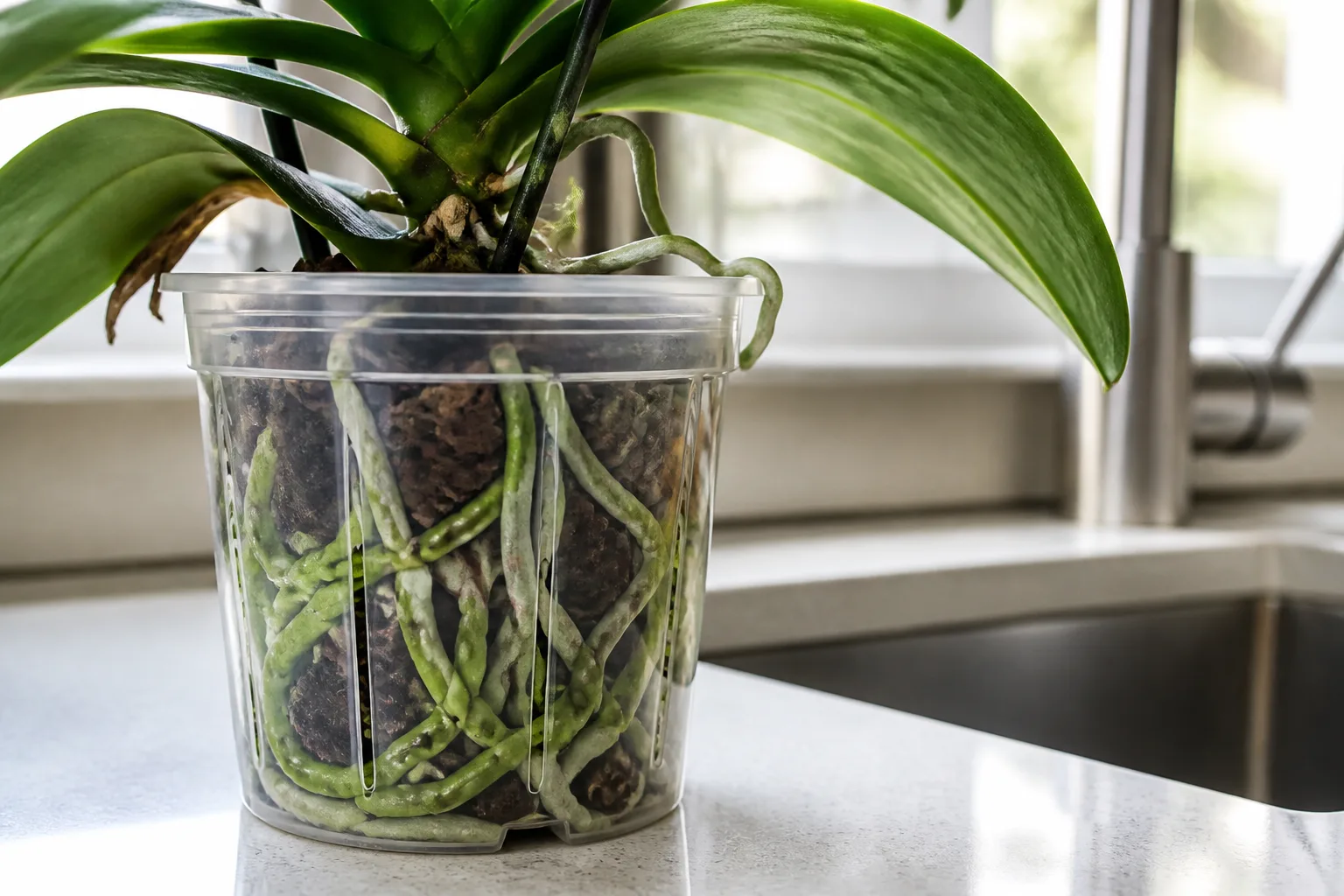
Healthy roots are firm. Wet roots may be green, while dry roots are often silver, white, or gray and still intact. Dead roots are typically brown or black, soft, hollow, or mushy; underwatered roots can be dry and brittle rather than slimy. Do not cut a root just because it is silver. Silver is a normal dry velamen color; softness and collapse are the stronger evidence of rot.
If rot is present, remove the orchid from the pot, discard broken-down medium, and use sterilized scissors to cut only dead tissue. Keep firm roots, clean or disinfect the container, and repot into fresh, appropriately sized medium. A plant with substantial root loss may need smaller, more cautious drinks while it regrows roots, but it still needs air around the remaining roots.
When leaves wrinkle but the medium is wet
Do not water again automatically. Wrinkling with wet moss or bark often means the roots have rotted and can no longer transport water, so the leaves are thirsty for a different reason. Check the roots, smell the medium, and look for yellowing or collapse at the base.
Wrinkling with a very light pot and silver, firm roots points more toward drought or a mount that is drying too quickly. Water thoroughly, then shorten the next interval rather than leaving the plant submerged. If the roots are mostly gone, watering more frequently cannot replace the missing tissue; repair the root environment first.
Brown leaf spots, soft crown tissue, or water trapped in leaf axils require a separate response from simple underwatering. Keep water off the crown, increase gentle airflow, and isolate a plant with rapidly spreading soft tissue while you identify the problem. When symptoms do not fit a moisture pattern, consult a local orchid society or extension service instead of escalating irrigation.
Seasonal changes, airflow, and humidity
Water use rises with light, temperature, active growth, and airflow. A Phalaenopsis near a bright east window in a warm kitchen may dry sooner than one several feet back in a cool room. A Vanda on a breezy balcony can need multiple wettings in hot weather, while a shaded indoor mount may stay hydrated longer.
In winter or during a cool, low-light rest, reduce frequency and check more carefully. Do not keep watering at the summer interval simply because the weekday has arrived. Pseudobulb orchids may need a more pronounced dry period; non-pseudobulb orchids still need enough moisture to avoid prolonged dehydration, but they should not sit in cold, wet media.
Humidity changes how quickly a surface dries, but it does not cancel drainage. A humid room can keep bark or moss wet longer, while a dry heated room can desiccate a mount rapidly. Misting is not a replacement for watering the root zone; frequent droplets that collect in leaf axils can cause more trouble than they solve. Improve the surrounding humidity and airflow, then keep the medium on its own evidence-based dry-down cycle.
Common orchid watering mistakes to retire
The first mistake is using a universal schedule. “Every Sunday” can be harmless only when it happens to match the plant’s pot, medium, light, and season. Otherwise, it trains you to ignore the signals that matter.
The second is giving small sips. A teaspoon may wet the surface while leaving dry bark around the roots and never flush accumulated salts. A thorough soak followed by complete drainage is more useful than repeated shallow splashes.
The third is treating moss like bark. Moss can hide water in its center, so surface dryness is not enough evidence. Test lower in the pot and feel the weight; if it remains heavy for many days, address compaction or the container.
The fourth is confusing humidity with wet roots. Orchids appreciate suitable ambient humidity, but their roots still need oxygen. A pebble tray or humidifier cannot make a pot with no drainage safe, and a constantly wet crown is not healthy humidity.
The fifth is relying on ice cubes, misting alone, or a decorative cachepot as a watering system. These shortcuts can restrict water delivery, leave salts behind, or hide standing water. Water the plant’s roots deliberately, use clean tepid water, and return it only after the pot has drained.
Conclusion
To water orchids well, match the method to the medium and the timing to what the roots are telling you. Bark usually needs a thorough flush and a real dry-down; sphagnum moss needs deeper checking because its center can stay wet; inorganic media drain quickly but still require complete wetting; mounted orchids may need frequent, repeated watering because their roots are exposed.
Let pot weight, root color, skewer moisture, orchid type, and season work together. Water with tepid water, protect the crown, drain the pot fully, avoid salt-softened water, and inspect roots whenever wrinkled leaves disagree with a wet medium. Once you stop treating every orchid as a weekly calendar task, watering becomes a manageable observation routine—and root air stays as important as root water.



