How to Grow and Care for Rockspray Cotoneaster
Rockspray cotoneaster brings tiered branches, spring flowers, and red berries. Get planting, pruning, watering, propagation, and spread-control advice.
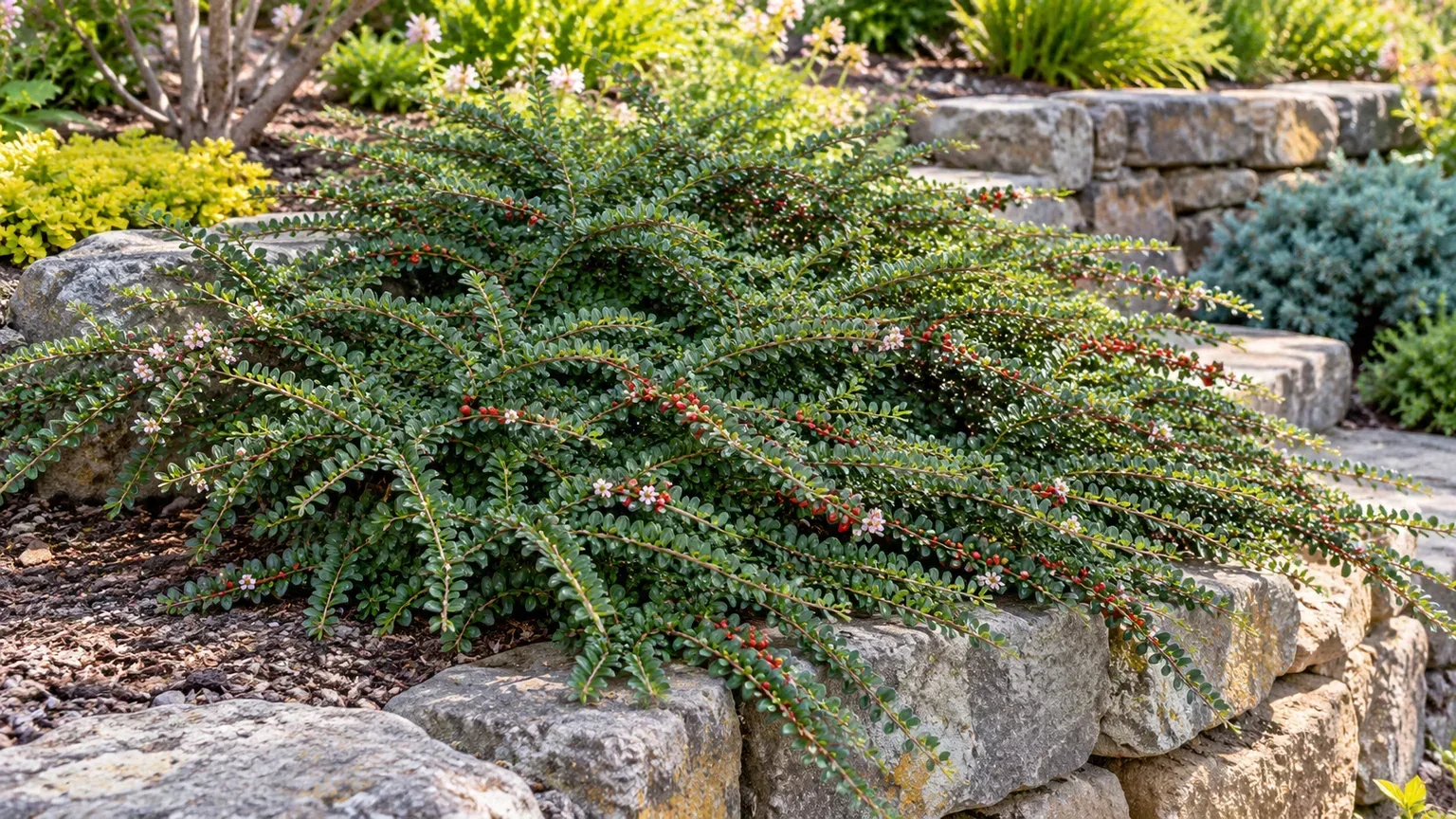
Rockspray cotoneaster (Cotoneaster horizontalis) earns its place through structure as much as flowers: its branches fan out in flat, fishbone-like tiers, with small glossy leaves, modest spring blossoms, red fruit, and fall color where it loses its foliage. It is a low shrub, but not a small one. NC State lists a common size of about 2 to 3 feet tall and 6 to 8 feet wide, while published profiles range from 3 to 6 feet wide to 10 feet or more. Because cultivar and site influence the final spread, plan for the broader footprint you can accommodate and verify the label rather than treating one measurement as a guarantee.
That habit can be excellent on a dry bank, in a rock garden, or trained across a low wall. It can also become a recurring pruning and seedling-removal task near paths or natural areas. Before planting, check your regional invasive-plant guidance, then decide whether you want a spreading groundcover or a shrub you can keep sharply within a small boundary.
Is Rockspray Cotoneaster Right for Your Garden?
This species belongs to the rose family, Rosaceae, and is native to western China. Its common names include rock cotoneaster and wall cotoneaster. The horizontal arrangement of its branches is its most recognizable feature; it creates a layered silhouette that looks especially clear against a wall or stone. The Oregon State University Landscape Plants profile describes a low, spreading shrub with small leaves, spring flowers, and bright red fruit, while NC State Extension lists it as a slow-growing, dense shrub commonly used on slopes, in rock gardens, and trained against structures.
Expect a shrub that expands more sideways than upward. Its stems may arch outward, and a branch that rests against moist soil can sometimes root. Birds also eat the fruit and may carry seed beyond the bed. These traits are useful when the goal is to cover a slope, but they make the plant harder to contain in a narrow foundation strip or beside a frequently used walkway. If you need a low, tidy plant that stays within a fixed footprint without monitoring, choose a more compact alternative.
The plant is often described as deciduous or semi-evergreen. The answer depends on winter severity and growing conditions: in colder places it typically drops its leaves, while in milder climates it may hold some foliage. Likewise, published hardiness descriptions vary, and a USDA zone does not measure summer heat, humidity, drainage, or exposure. Treat the plant label and regional extension advice as a starting point, not a promise that every climate will suit it.
Choose a Site That Leaves Room for Its Spread
Plan for mature width before you dig. A single specimen needs enough open ground for the branches to develop without repeatedly covering a path, drain, neighboring shrub, or property line. For a continuous groundcover, closer spacing fills gaps sooner but also increases crowding and future pruning; spacing plants near their mature width takes longer to knit together but makes each plant easier to inspect and shape.
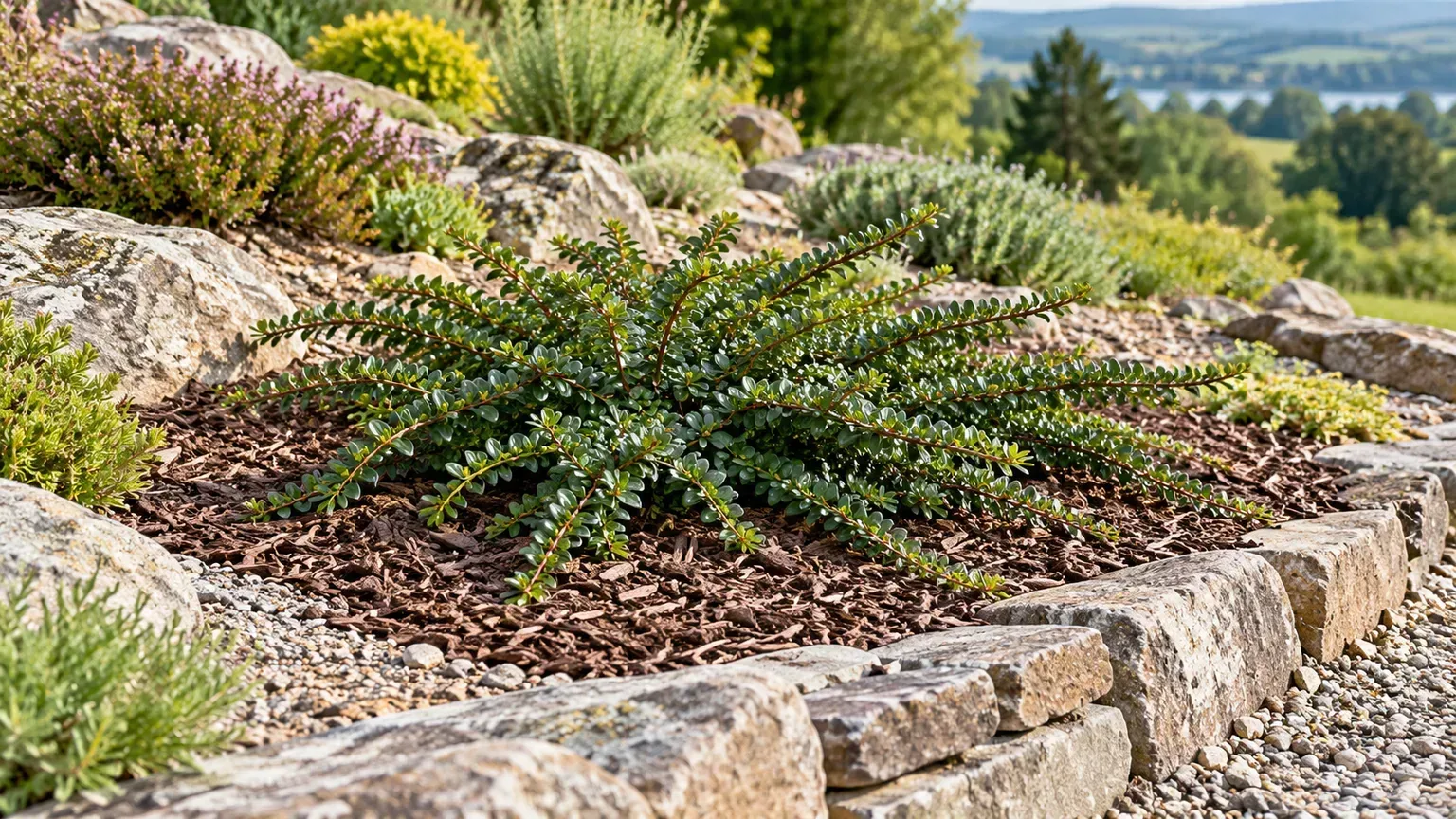
Rockspray cotoneaster is most at home where its layered outline can be seen. A low retaining wall, a sunny slope, a gravel garden, or an open bed with room at the edges shows off its branching better than the center of a dense shrub border. Leave space behind it for access. If you cannot reach the back of a wall-trained plant, later pruning and pest checks become awkward, and old branches can hide dead wood.
Sunlight, Shade, and Summer Heat
Full sun generally supports heavier flowering and fruiting and stronger fall color. Part shade is workable, especially where afternoons are hot, but a deeply shaded position can produce a thinner, less floriferous plant. The Fine Gardening profile recommends full sun or partial shade. That flexibility is helpful, but it does not mean light is irrelevant: if berries and autumn color are priorities, give the shrub the brighter of two suitable sites.
Summer heat is a separate issue from winter hardiness. NC State notes that the species prefers cooler conditions and may perform poorly in locations with hot summers, typically south of zone 7. In a hot-summer region, avoid reflected heat beside a south-facing wall or paved surface, and be prepared to water during establishment. A little afternoon shade can help, but it will not correct waterlogged soil or make a persistently humid, hot site ideal.
Soil, Drainage, and Slopes
Good drainage matters more than a narrow soil-pH target. The shrub tolerates a range of soil types, including less fertile ground, but roots are vulnerable where water stands for long periods. Before planting in heavy clay, watch the site after a soaking rain. If water remains in the planting area into the next day, choose a raised or sloping position, or select a plant that tolerates wet soil rather than trying to fix a low, saturated pocket with a little grit in the hole.
On a slope, the roots and spreading branches can help occupy bare ground, but do not treat one shrub as instant erosion control. Planting through established weeds is difficult, and a young root ball can dry quickly on an exposed bank. Clear perennial weeds first, set the plant securely, and use a light mulch to reduce evaporation while keeping mulch away from stems. Avoid enriching the whole area heavily; excess fertility can encourage long, loose shoots that need more shaping.
Plant It at the Right Depth and Spacing
Plant container-grown cotoneaster in spring or early fall when the soil is workable and temperatures are moderate. Fall planting can work well in climates with enough mild weather for roots to settle before freezing; in colder regions or where winters arrive abruptly, spring gives a new shrub more of the growing season to establish. Avoid planting into frozen, waterlogged, or baked-dry ground.
Dig a hole about as deep as the root ball and wider than it. Loosen circling roots at the outside of a pot-bound root mass, then set the plant so the top of the root ball is level with the surrounding soil. Do not bury the stem base to make the shrub look more upright; a buried crown stays wet and can decline. Backfill with the soil you removed, firm gently to eliminate large air pockets, and water slowly until the root zone is moist.
Set individual shrubs far enough apart that their mature branches can spread without immediately merging into an impenetrable mat. If you deliberately want a faster groundcover, you can space more closely, but consider that overlapping branches are harder to inspect and may root where they touch soil. Planting against a wall requires enough room at the base for the plant to expand outward; the wall is a support and backdrop, not a reason to cram the roots into a narrow slot.
After planting, add a modest mulch layer over the root zone if the site is exposed or dries quickly. Keep it a few inches away from the stems, and do not mound soil or mulch over the crown. Water again after mulch is in place so the original root ball and adjacent soil make contact. A label stake can help identify the planting while it is small, but remove it once the shrub is stable so it does not rub or constrain branches.
Water Carefully While Roots Establish
A newly planted shrub needs regular attention even though an established one tolerates dry spells. For the first growing season, check the root ball and nearby soil every few days during warm, dry weather. Water deeply when the root zone begins to dry rather than sprinkling the foliage or giving a small amount every day. The exact interval depends on rainfall, soil texture, temperature, wind, and the size of the nursery container; sandy soil and exposed slopes dry faster than loam in a sheltered bed.
A common establishment failure is to water the soil around the shrub while the original potting mix remains dry. Feel the root ball itself as well as the surrounding soil. If the root ball has pulled away from the backfill or water runs off a slope, apply water slowly in two or three passes so it can soak in rather than wash downhill.
Once roots have grown into the surrounding soil, reduce supplemental water and let rainfall do more of the work. During a prolonged drought, water slowly at the root zone if leaves wilt in the morning or new growth stalls. Do not use drought tolerance as a reason to leave a new plant dry, and do not respond to yellowing by adding water without checking drainage. Wilting can be caused by damaged roots or saturated soil as well as drought.
Keep Routine Feeding and Mulch Light
Rockspray cotoneaster is not a plant that needs a strict fertilizer calendar. If it is growing steadily, flowering, and holding healthy leaves, leave it alone. When growth is weak, check the basics first: light, drainage, establishment, root damage, and whether nearby trees are competing for moisture. Fertilizer cannot compensate for a wet planting hole or deep shade.
A thin layer of compost can be used on genuinely poor soil, but do not pile it against stems or turn a low-fertility slope into a rich, soft planting bed. Heavy feeding may push excess leafy growth without improving the structure that makes this shrub valuable. If you use a packaged fertilizer, follow its label and avoid applying it to dry or stressed roots. A light organic mulch is mainly useful for moderating soil moisture and suppressing weeds; replenish only as it decomposes.
Prune to Contain It Without Erasing Its Form
Pruning is optional for health but useful for boundaries, access, and shape. The aim is usually to preserve the plant’s characteristic horizontal tiers while removing branches that cross, root where they touch the ground, or reach into a path. A hedge trimmer can flatten the edges, but frequent shearing hides the herringbone structure and encourages a dense outer shell that shades out interior growth.
For a single plant, inspect the entire shrub before cutting. Trace an unwanted branch inward to a junction with a larger branch, then make a clean cut just outside the branch collar. This selective approach shortens the plant without leaving a row of blunt ends. Remove broken, dead, rubbing, or clearly diseased branches first; then step back and decide whether additional shaping is actually needed.
Choose Timing Based on Flowers and Fruit
The flowers form in spring, and the red fruit develops later in the season. If you want both, do major size control before flower buds form or wait until after flowering for light shaping. Pruning after bloom sacrifices fewer developing flowers, while a hard cut at the wrong time can reduce the season’s berry display. Avoid routine late-summer and autumn shearing if fruit and fall color are part of why you planted the shrub.
For wall-trained plants, small corrections after flowering can keep shoots within their allotted space. Nature & Garden’s cotoneaster guide similarly recommends shortening overlong shoots after flowering when the plant is trained against a wall; its calendar reflects a UK growing season, so adjust the month to your local bloom time rather than copying its dates. For a neglected shrub, spread renovation over more than one season instead of stripping most of the canopy at once.
Cut Crossing Branches and Rooted Shoots
Use clean, sharp bypass pruners for smaller stems and loppers for branches that are too thick for hand pruners. Take out branches that point toward the center, rub against another stem, or press against a building or path. Keep cuts close to a healthy branch junction without cutting flush into the trunk; a short stub can die back, but a deep flush cut can injure the branch collar.
Check the perimeter after rain or irrigation. Where a low branch has begun to root, decide whether you want another plant. If not, lift the branch gently, sever it from the parent with a clean cut, and remove the rooted portion before it becomes difficult to separate. When reducing a branch for size, cut it back to a lateral shoot that points in a useful direction rather than clipping every tip to the same line.
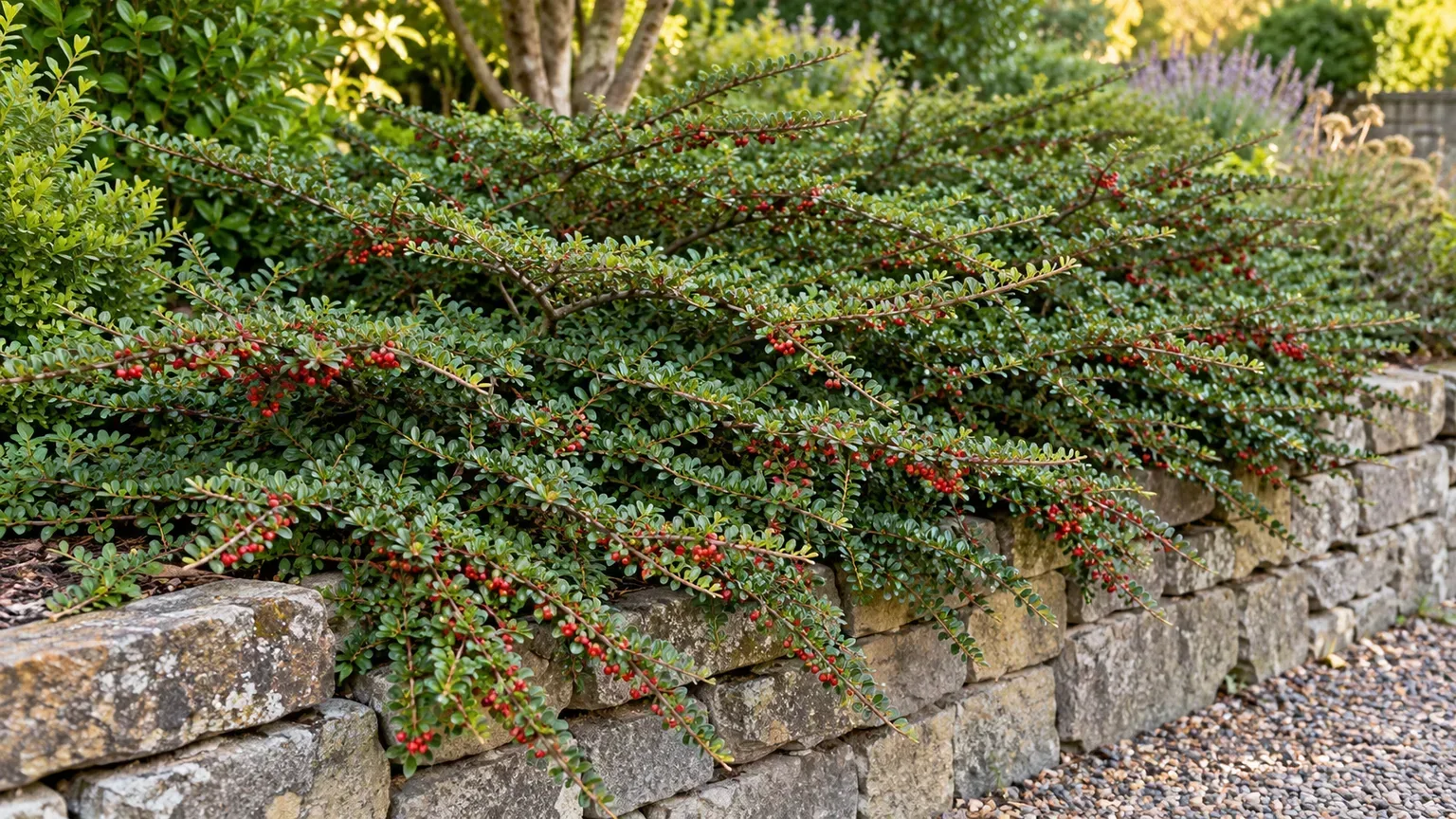
Control Seedlings and Check Local Invasive Status
There are two different kinds of spread to manage. Branches may extend across the ground and sometimes root where they touch it; fruit can also produce seedlings after birds carry seed. Pruning controls the first, while pulling or digging young seedlings controls the second. Inspect nearby paths, wall crevices, gutters, and neighboring beds in spring and early autumn, when small volunteers are easiest to spot.
Local legal status varies. The Royal Horticultural Society lists C. horizontalis as an invasive non-native species in Great Britain (RHS plant profile), while plant status in North America depends on the state, region, and the specific species considered. The Invasive Plant Atlas of the United States has a genus-level cotoneaster entry, which should not be mistaken for a species-specific legal determination everywhere. Check your state and county invasive-plant lists before purchasing, especially if your garden is near open land or a natural area.
If you already grow the shrub in a place where it is permitted, avoid dumping fruiting branches or garden waste in a wild area. Bag or compost prunings only where the local waste facility accepts them and where fruiting material will not be spread. Pull volunteer seedlings while they are small and remove their roots; mowing the top alone may leave a seedling to regrow. If your local authority asks residents to remove a listed plant, follow that guidance and ask about disposal before moving fruiting branches.
Understand Its Flowers, Berries, and Safety
Small pink to pink-white flowers open in spring, often partly hidden by the leaves. They are not the kind of large display that makes the shrub a focal point from a distance; the ornamental effect comes from the sequence of flowers, foliage, layered branches, red fruit, and—in deciduous climates—autumn leaf color. Full sun usually improves fruiting, while shade may produce a looser plant with fewer berries.
The red fruits can persist into colder weather and are eaten by birds. That wildlife value also helps explain why seedlings may appear some distance from the original shrub. If you want fruit for birds but want to limit seedlings, keep fruiting branches away from natural edges and remove volunteers promptly rather than cutting off every berry-bearing stem.
Do not treat the berries as edible. NC State Extension warns that ingestion can cause stomach upset. Keep children and pets from eating the fruit, and contact a medical professional, poison-control service, or veterinarian for case-specific advice if a person or animal eats a significant amount or develops symptoms. The exact risk depends on the amount and the individual, so avoid home remedies or claims that a small taste is always harmless.
Propagate from Cuttings or Seed
Softwood or greenwood cuttings are the most predictable way to reproduce a plant when you want a copy of a particular selection. Fine Gardening’s profile lists greenwood cuttings in early summer. Choose a healthy, nonflowering shoot, cut a section with several leaf nodes, and remove leaves from the portion that will sit below the surface. Keep the cutting in a free-draining propagation mix that stays lightly moist, not waterlogged.
Place the pot in bright shade, out of drying wind, and cover it loosely with a clear propagation cover if your air is dry. Vent it periodically and check for mold or rotting stems. New leaves alone do not prove that roots have formed, so resist tugging repeatedly; wait until the cutting resists a gentle pull or roots show at the drainage holes, then pot it on. Keep the young plant protected while it develops a root system, and harden it off gradually before planting outside.
Seed propagation takes longer and is less predictable. Clean seeds from fully ripe fruit, sow them in a labeled potting mix, and keep the container outdoors or provide a cool, moist period because many woody-shrub seeds have dormancy that is not broken by immediate warm sowing. Germination may be uneven, and seedlings can differ from a named cultivar. Do not sow seed outdoors if local rules prohibit the species or if you cannot manage volunteer plants later.
A branch that roots where it touches soil can also be separated from the parent and replanted, but only if the plant is allowed in your region. This is essentially a form of natural layering. Confirm that the rooted section has its own roots before severing it, then keep it watered while it adjusts to its new site.
Diagnose Common Pest and Disease Problems
Established plants are usually resilient, but a sudden change in foliage or branch condition deserves inspection before treatment. Check whether damage is limited to one stem, appears on new growth, or affects the whole shrub. Look under leaves and along branch junctions for insects, webbing, cankers, or mechanical injury; then compare symptoms with recent heat, drought, and rainfall.
Avoid spraying a broad-spectrum pesticide at the first sign of damage. Many insects are temporary or can be removed by hand, while a spray will not correct water stress or a fungal or bacterial disease. Identify the likely cause, prune only what needs removal, and use any pesticide only if a local extension service recommends it for the diagnosed pest and the product label allows that use.
Recognize and Respond to Fire Blight
Fire blight can make blossoms, leaves, and shoot tips turn brown or black as if scorched. Young shoots may bend into a hook, and cankers can form on older branches. Several problems can cause dieback, so black color alone is not enough to diagnose it; look for the pattern of affected blossoms and shoots and whether the damage follows branch tips.
Cotoneaster is a host in the rose family. The University of Illinois Extension fire-blight guide describes the disease and notes cotoneaster among susceptible plants. If fire blight is likely, remove affected branches well into healthy wood during suitable dry conditions, sanitize tools between cuts, and dispose of infected material according to local guidance. Do not compost visibly diseased material at home. Severe or recurring damage warrants advice from a local extension office because climate, disease pressure, and pruning timing matter.
Check for Webworms, Mites, and Leaf Spots
Cotoneaster webworms or webber moth caterpillars may create silk over branch tips and skeletonize leaves inside the webbing. On a small shrub, remove and discard the webbed tips early, then monitor for new webs. Spider mites are more likely during hot, dry weather; fine stippling, bronzing, or delicate webbing can prompt a closer look under leaves. A strong stream of water can dislodge some mites, but avoid soaking a plant late in the day if fungal disease is already active.
Leaf spots can develop in humid, wet conditions, especially where foliage is crowded and air movement is poor. Remove badly affected fallen leaves, thin crossing stems where appropriate, and water the soil rather than repeatedly wetting foliage. Scale insects may appear as small, fixed bumps on stems; confirm that they are insects before applying oil or soap, and check label restrictions and weather conditions first. A few damaged leaves rarely justify treating the entire shrub.
Prepare for Winter and Seasonal Changes
A healthy, established shrub generally needs little winter protection in a suitable climate. In a cold region, a light mulch over the root zone can reduce soil heaving, but keep it away from the stem base. Do not wrap the whole shrub tightly; its natural branch structure can be damaged by constriction, and covering the plant may trap moisture.
Expect seasonal appearance to change. In colder climates, leaves may turn red and drop; in milder areas, some foliage may remain through winter. Red fruit can linger, though birds may remove it earlier in some gardens. If snow bends branches, brush off heavy accumulation gently rather than pulling frozen stems, and wait until thaw to assess any breakage.
The first winter is different from later years because the roots have not yet explored a large soil volume. Water well before the ground freezes if autumn has been unusually dry, and maintain mulch without piling it against the crown. In wet-winter climates, drainage is more important than adding extra winter cover. A plant that repeatedly dies back after winter may be poorly sited, overly exposed, or unsuited to local summer conditions as well as winter temperatures.
Choose a Cultivar or a Less Spreading Substitute
The standard species is the right choice when you want a broad, layered shrub and have room to let it spread. ‘Variegatus’ has pale margins on its leaves and can offer a different foliage effect; the University of Connecticut Plant Database describes this cultivar as a slow-growing form. Cultivar dimensions can differ from the species, so check the label for mature height, width, and local hardiness before buying.
If you like the look but want a smaller plant, investigate a compact selection such as a dwarf C. horizontalis form, but do not assume that a smaller top remains confined without occasional attention. If your priority is a plant that will not seed into surrounding areas, first check local native-plant recommendations and invasive lists; choosing a native or non-spreading alternative may be the simpler long-term decision.
Other cotoneasters are not interchangeable. Some are upright shrubs, some evergreen groundcovers, and some grow taller or more vigorously than C. horizontalis. Compare the botanical name, not just a nursery tag that says “cotoneaster.” Match the plant to the exact job—wall cover, low slope, evergreen mat, or wildlife planting—and verify whether that species is suitable where you live.
Conclusion
Rockspray cotoneaster is easiest to care for when its mature width is part of the plan. Give it sun or light shade, drainage, and enough room for its horizontal branches; water consistently while it establishes, then scale back. Feed sparingly, prune selectively around its flowering and fruiting cycle, and remove rooted shoots or seedlings before they become a second shrub.
Its red fruit and resilient habit are assets in the right garden, but seed dispersal and regional invasive status are real constraints. Check local guidance before planting, keep fruiting prunings out of wild areas, and choose a compact or native substitute if ongoing spread control is not a job you want. With those decisions made up front, the plant can provide a distinctive low structure without requiring constant reshaping.



