How to Grow and Care for Scindapsus Pictus 'Exotica'
Learn Scindapsus pictus 'Exotica' care: light, watering, airy soil, humidity, climbing, pruning, propagation, pests, problems, and pet safety.
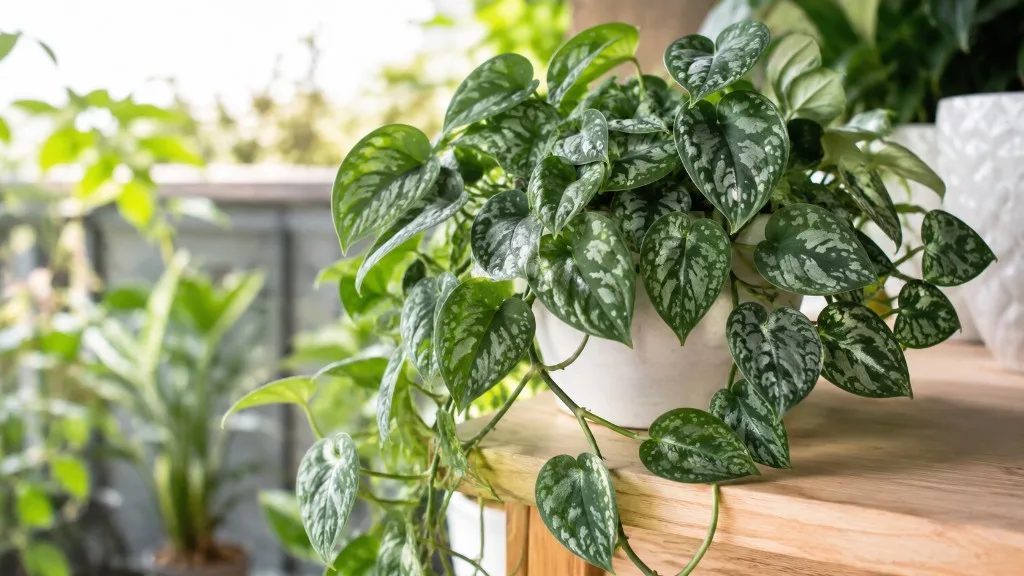
Scindapsus pictus ‘Exotica’ is the large-leaf satin pothos: a tropical vine with heart-shaped leaves marked by broad, metallic-looking silver splashes. It is forgiving about ordinary indoor conditions, but the best-looking plants do not come from a fixed weekly schedule. They come from matching light, pot size, soil moisture, and support to the way the vine is actually growing.
Give Exotica bright filtered light, an airy mix in a pot with drainage, and water only after the upper root zone has dried. Then choose whether you want a graceful trailing basket or a climbing plant with the potential for larger mature foliage. The sections below cover the routine, propagation, recovery decisions, and safety details that keep this cultivar useful rather than merely alive.
Exotica Care at a Glance
Use this table as a starting point, not a substitute for checking the plant. A small nursery pot beside a bright window can dry in a week, while a large plastic pot in a dim room may remain wet for much longer.
| Care factor | Practical starting point | First thing to watch |
|---|---|---|
| Light | Bright, indirect or filtered light | Faded silver in dim light; crisp scorch from hot direct sun |
| Water | Water when the upper 1–2 inches of mix are dry and the pot feels lighter | Wet, heavy soil with yellow leaves means investigate roots |
| Soil | Moisture-retentive but airy and fast draining | Slow dry-down, sour odor, or fungus gnats suggest a dense or oversized setup |
| Temperature | About 65–85°F (18–29°C) for steady indoor growth | Cold glass, drafts, and vents can stall or curl foliage |
| Humidity | Average home humidity is usually workable; moderate humidity keeps edges cleaner | Crispy tips with correctly watered soil point to dry air or salts |
| Fertilizer | Half-strength balanced liquid feed during active growth | White crust or burned tips means the dose or frequency is too high |
| Growth form | Trail from a shelf or climb a moss pole or trellis | Climbing can support larger foliage; trailing is simpler |
| Safety | Keep leaves and cuttings away from chewing pets and children | ASPCA lists satin pothos as toxic because of insoluble calcium oxalates |
Identify Exotica Before You Copy Pothos Advice
The word “pothos” on a plant tag is a common-name shortcut, not a botanical identity. Exotica is a cultivar of Scindapsus pictus in the arum family, Araceae; the NC State Extension plant profile describes the species as a tropical evergreen climbing vine with green foliage marked by silvery blotches.
Exotica is valued for larger, heart-shaped leaves with broad silver splashes across the blade. Young plants may still have smaller leaves, and a shop’s lighting can make the pattern look either bright and frosted or mostly green. Judge the newest healthy growth after the plant has settled into your home rather than deciding that one stressed leaf represents the cultivar.
This vine uses rootlets along its stems to climb in its natural habitat. Indoors, those aerial roots can help it attach to a support, but they do not mean the potting mix should be kept wet. Aerial-root support and root-zone watering are two separate parts of the care routine.
Exotica vs. Argyraeus vs. True Pothos
The classic Scindapsus pictus ‘Argyraeus’ generally has smaller, darker leaves with neater silver edges or speckles. Exotica has a more expansive, irregular silver pattern and a broader leaf presence. The RHS Scindapsus pictus profile confirms the species’ trailing and climbing habit, slow growth, stem-cutting propagation, and preference for moist but well-drained conditions.
True pothos usually refers to Epipremnum aureum, a different genus even though it is also in Araceae and shares similar houseplant care. That difference matters when you compare photos, mature leaf shape, and cultivar names; a care tip for golden pothos can be a useful starting point, but it should not override what your Exotica’s pot and leaves are telling you.
Choose Light That Preserves Silver Variegation
Place Exotica near a bright east-facing window, or a few feet back from a south- or west-facing window with a sheer curtain. The goal is strong, diffuse light for much of the day, not a beam of hot afternoon sun resting on the foliage. The RHS cultivation guidance recommends bright filtered light with protection from hot sun.
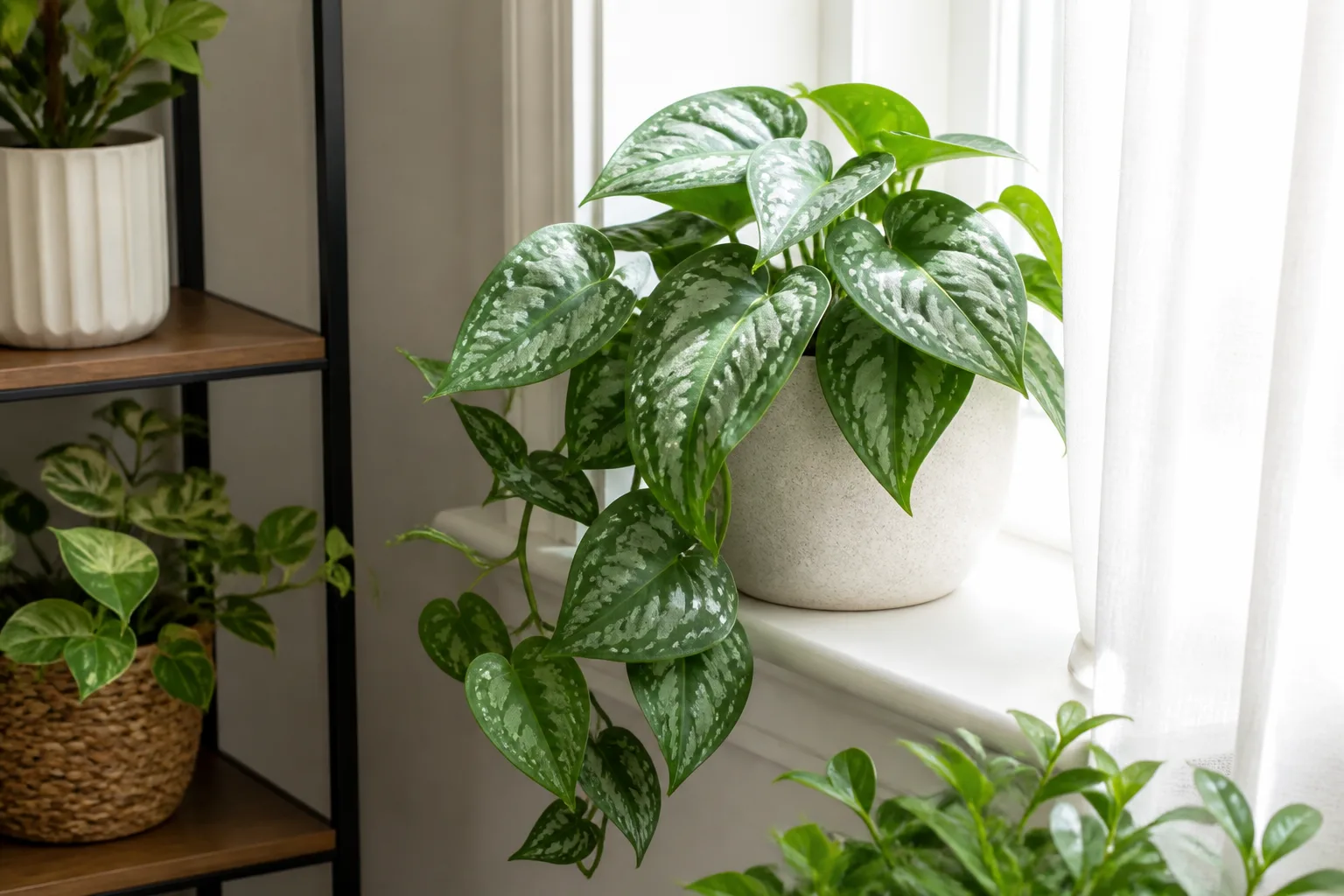
Too little light usually shows up first in new growth. Leaves may emerge smaller, the gaps between leaves may lengthen, and the silver pattern can look duller or more green. Low light also slows water use, so keeping the same watering rhythm can turn a placement problem into a root problem.
Direct sun creates a different pattern: pale, tan, or crispy patches on the window-facing surface. Move the plant back gradually if it has been in a dim room; a sudden jump from shade to intense glass-filtered sun can damage leaves before the plant acclimates. Rotate the pot every week or two so the vine does not lean hard toward one window.
Use the next leaf as your light meter. Old scorch will not disappear and faded silver on a mature leaf will not be repainted, but a firm new leaf with strong contrast tells you whether the new position is working.
Use an Airy Mix and the Right Pot
Exotica needs moisture around its roots without the root ball becoming a sealed, airless mass. A practical starting blend is two parts quality indoor potting mix to one part perlite, with a small amount of orchid bark if the mix collapses or stays wet. The NC State Extension profile describes satin pothos as preferring fertile, moist, acidic, well-drained soil, so the target is not a dry cactus mix.
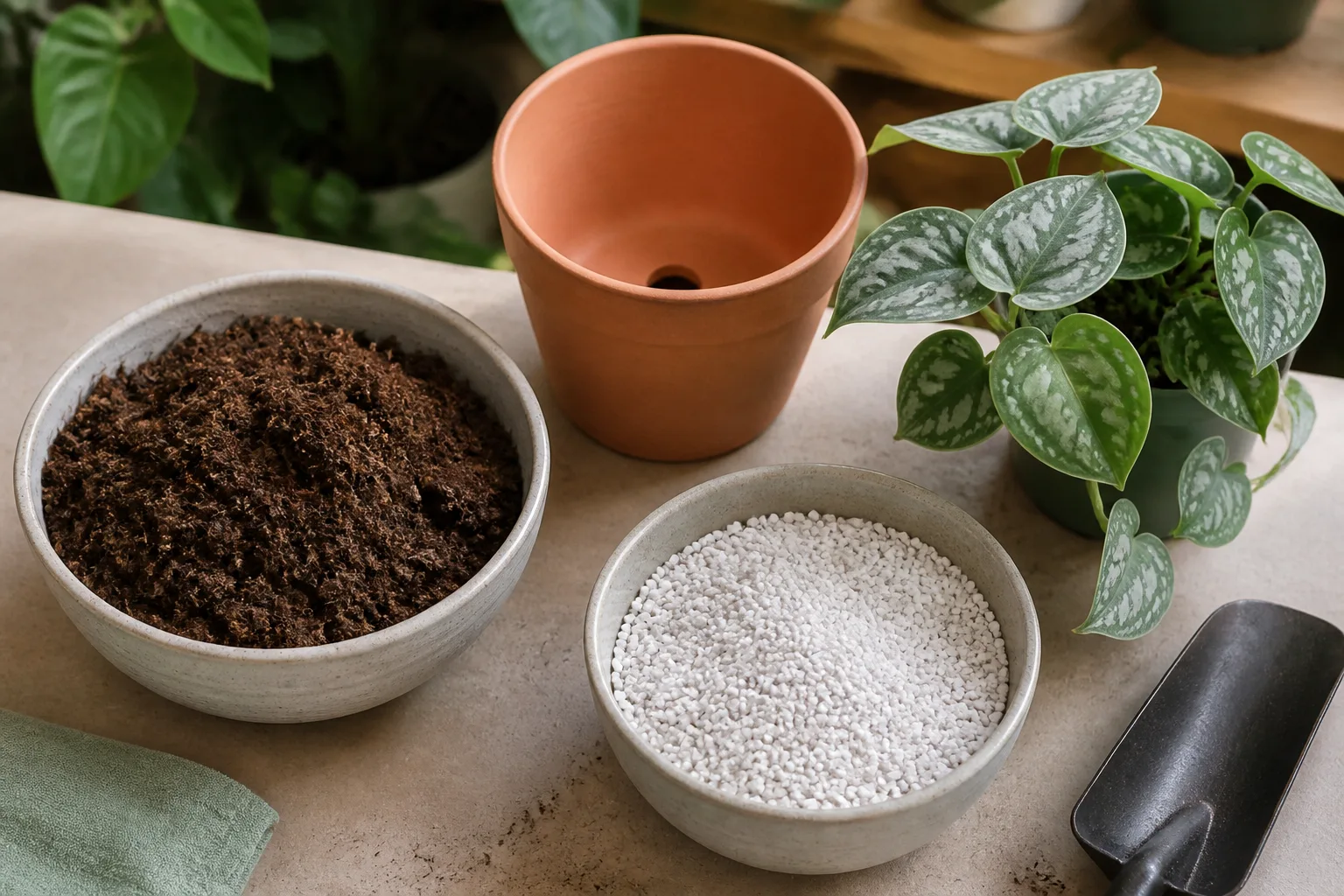
The container must have an open drainage hole. A decorative cachepot is fine around a nursery pot, but empty water that collects in the outer pot after irrigation. Do not add a gravel layer to the bottom as a drainage cure; it reduces usable root space and does not correct a dense mix or an oversized container.
Choose a pot only one size larger when repotting. Terracotta dries faster and can help a grower who routinely keeps the mix wet, while plastic holds moisture longer and may suit a bright, warm plant that dries quickly. The right material is the one that makes your actual dry-down predictable, not the one that sounds best in a recipe.
Water After a Measured Dry-Down
Check the top 1–2 inches of mix with a finger or wooden skewer, then lift the pot if you can. When that upper layer is dry and the container feels noticeably lighter, water slowly across the surface until a little runs from the drainage hole. Empty the saucer or cachepot instead of letting the pot stand in runoff.
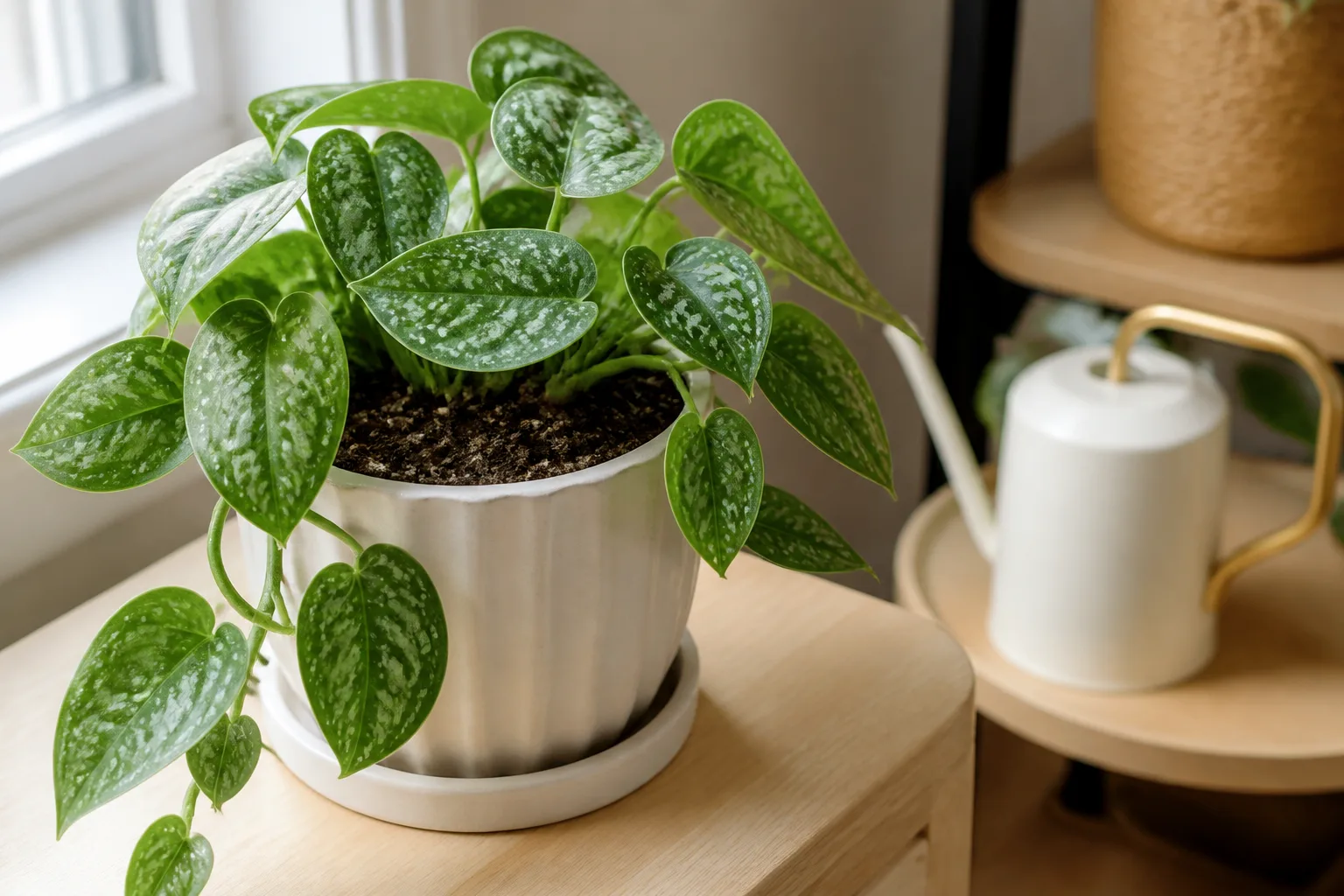
The RHS growing guide advises waiting until the compost is approaching dryness and warns that repeated wetness or standing water can cause root rot. For a hard-water home, it also suggests rainwater or filtered room-temperature water when possible to help preserve the acidity of the growing medium. That is a useful refinement, not a reason to let a thirsty plant go dry for weeks.
Do not water by the calendar. In bright, warm active growth, a small Exotica may need a drink every 7–10 days; in cool, dim winter conditions, the interval can stretch to two weeks or more. Pot size, material, airflow, root density, and the mix recipe all matter more than the month printed on a care card.
If the surface is dry but the center of the pot is still heavy, wait. If water runs down the gap between the mix and the pot wall, the root ball may have become hydrophobic; use several slow passes to rehydrate it instead of flooding it once and assuming the middle is wet. Gardening Know How describes the same inward “taco curl” as a useful thirst cue, but a genuinely light, dry pot should confirm it before you water. Yellow leaves beside a heavy, wet pot point toward root stress.
Balance Warmth, Humidity, and Airflow
Keep Exotica in a stable room around 65–85°F (18–29°C), away from cold window glass, air-conditioning blasts, heating vents, and doors that open directly to cold air. NC State Extension lists 65–85°F as the range best suited to satin pothos and notes that cooler air is not tolerated well. A brief cool spell may slow a leaf; repeated temperature swings can trigger curl, drop, or a long pause in growth.
Average household humidity is usually enough to keep this plant growing, which is one reason satin pothos is more adaptable than its tropical appearance suggests. If a hygrometer shows very dry air and the tips crisp even though the mix is drying normally, group plants or use a small humidifier nearby. Keep airflow moving gently so damp leaves can dry.
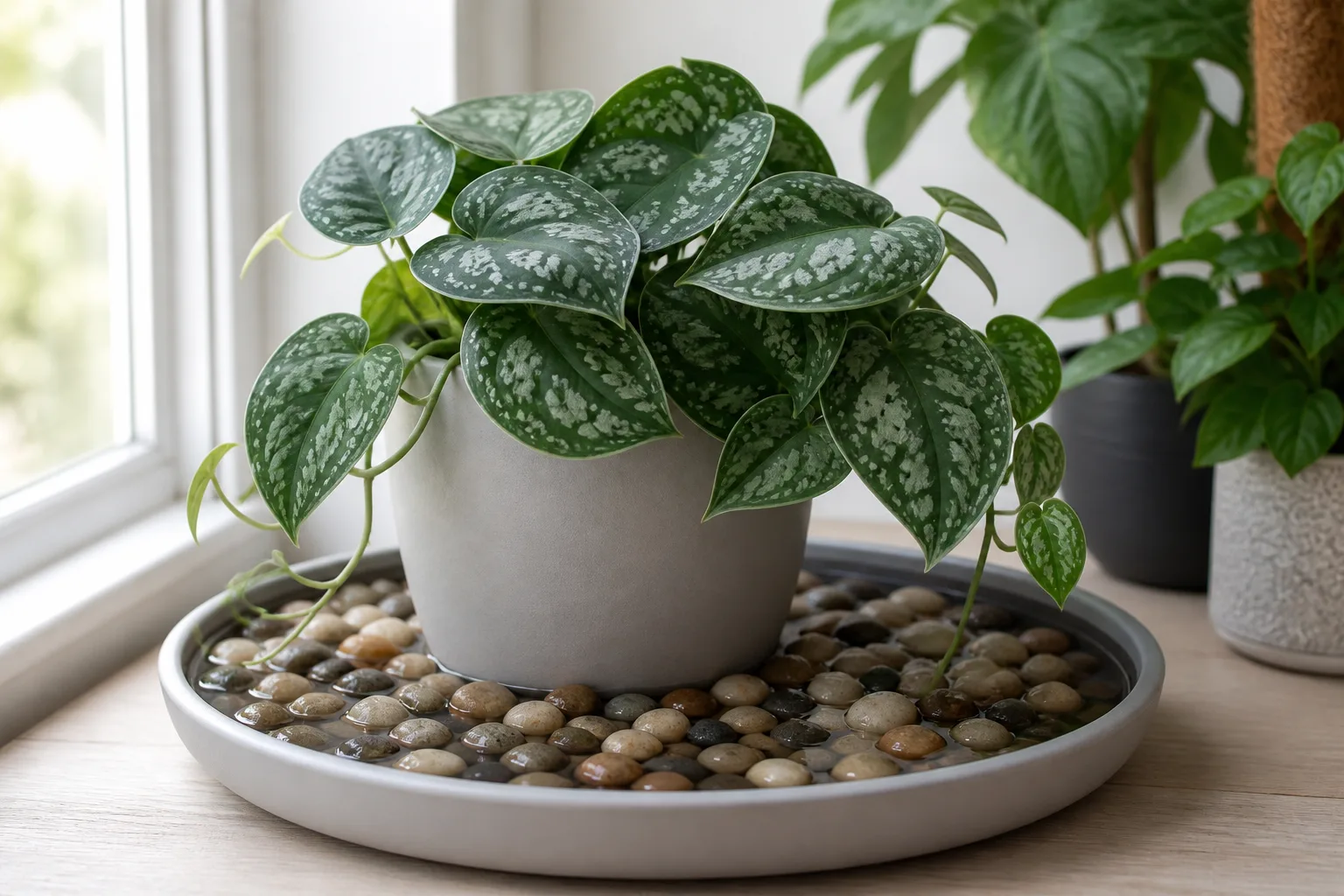
Misting is not a dependable room-humidity strategy. It wets the leaf for a short time and can create a damp, stagnant surface without changing the room’s average humidity. Fix dry air at the room level, fix dry soil at the root ball, and do not use one as a substitute for the other.
Trail or Climb? Choose the Growth Form
A hanging basket or high shelf lets Exotica make a relaxed cascade with little training. This is the lower-maintenance choice: guide stems away from traffic, keep them off hot vents, and prune them when the ends become thin or bare.
A moss pole, coir pole, trellis, or stable narrow stake gives the vine a vertical route. Climbing can encourage larger, more mature-looking foliage when the plant also has enough light, warmth, and root health. It is not a magic leaf-size switch; a support cannot compensate for dim light or a waterlogged pot.
Choose the direction early. A trailing stem that has already tangled around furniture is harder to redirect without kinking it, while a climbing plant needs a support anchored in the pot before the upper growth becomes heavy. The RHS growing guide describes the related climbing habit well: aerial roots grip supports, and stems may need tying where they wander.
Train Vines and Keep Leaves Clean
Place the support close to the stem and use soft ties, loose clips, or plant tape. Leave room for the stem to thicken, keep ties off delicate leaf petioles, and guide the vine around a support rather than forcing a sharp bend at a node. If the support is moss-covered, keep it lightly damp during active growth so aerial roots have a chance to attach.
Do not keep the potting mix wet just because the moss pole is dry. The pole can be damp while the root ball dries, or the root ball can be wet while the pole is dry; check each separately. Wipe broad leaves with a soft damp cloth every few weeks so dust does not hide pests or dull the silver pattern.
Fertilize Only Active Growth
Feed once every four weeks during active growth with a balanced liquid houseplant fertilizer diluted to half the label strength. Start only after a new purchase has settled and after fresh potting mix has had time to supply its initial nutrients. A plant with damaged roots cannot use fertilizer well, so feeding a yellowing, waterlogged, cold-stressed, or heavily infested plant often adds salt stress instead of vigor.
The active-growth window depends on light and temperature rather than a universal date. A plant pushing leaves under bright artificial light may keep growing beyond summer, while one in a dark winter room may need no fertilizer at all. The RHS profile recommends balanced liquid feeding monthly while in growth and sparse watering outside that period.
If a white crust builds on the mix or leaf tips turn brown soon after feeding, flush the pot with plain water and let it drain fully. Resume at a lower frequency only after the plant is growing normally. Fertilizer can support a good setup; it cannot manufacture light or replace healthy roots.
Prune for Fullness and Propagation Material
Pruning is optional for health but useful for shape. In spring or another active-growth period, shorten long bare stems by cutting just above a healthy node. The node can push a side shoot, while the removed section becomes propagation material.
For a fuller pot, root several cuttings and plant them back together once they are established. Do not remove most of the live foliage in one session; Exotica is not a fast rebuilder, and the remaining leaves need to make energy. Remove dead or heavily damaged leaves at any time, but save major reshaping for when the plant is actively growing.
Use clean, sharp scissors and wash them before moving from a suspect plant to a healthy one. Wear gloves if your skin reacts to plant sap, keep cuttings away from pets and children, and wash your hands when the pruning session is finished.
Propagate from Stem Cuttings
The reliable rule is simple: every viable cutting needs a node. A node is the small joint where a leaf and bud meet the stem; a leaf or petiole without that joint may stay green briefly but cannot become a complete new vine. NC State Extension lists stem cuttings as the recommended propagation strategy, and the RHS guide also describes stem cuttings and layering for related climbing plants.
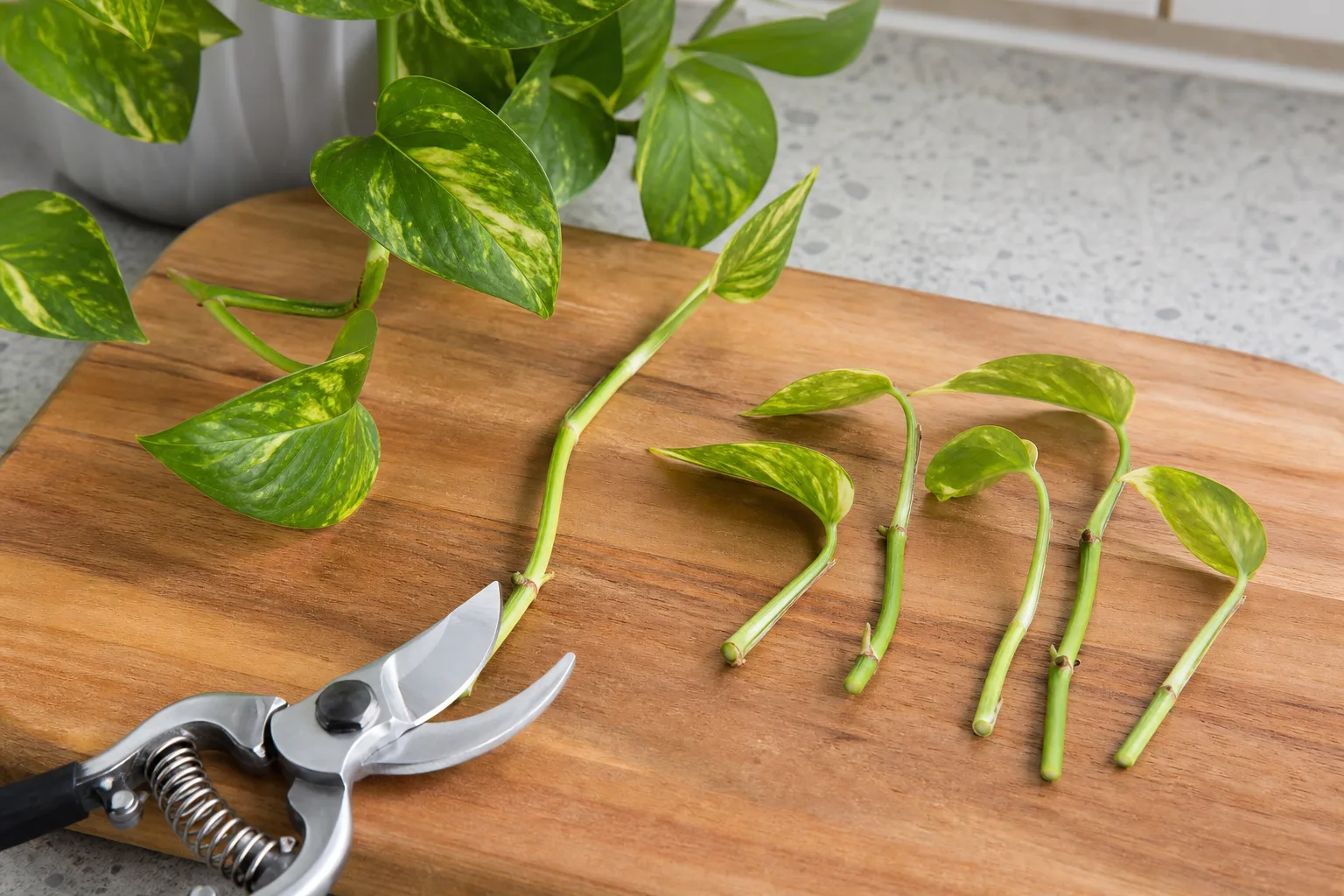
For water propagation, choose a firm, healthy vine and take a 4–6-inch section with at least one node, preferably two. Cut just below a node, remove any lower leaf that would sit underwater, and keep the remaining leaves above the waterline. Use a clean jar and room-temperature water in bright indirect light, away from hot sun.
Refresh the water about weekly or sooner if it becomes cloudy. Wait for several roots to branch before potting; a root system around 2–3 inches long gives the cutting more margin than a single white nub. Rooting speed depends on warmth, light, cutting health, and season, so “no roots after a few days” is not a diagnosis.
If the base turns brown and soft, remove the cutting from the jar and trim back to firm tissue with clean scissors. Refresh the container and improve light and warmth. If the piece never included a node, discard the unproductive section and take a better cutting rather than waiting for a leaf to grow roots on its own.
Layering is a gentler option for a long trailing plant. Pin a node against moist, airy mix while the stem remains attached to the parent, then separate it only after roots have formed. This reduces the risk of a cutting drying out before it has a root system.
Move Water Roots into Soil
Water roots are adapted to constant moisture, so the transition to potting mix deserves a calm first two weeks. Put the rooted cutting in a small drainage pot, cover the roots and node lightly with moist airy mix, and water once to settle it. Do not move a single cutting into a huge pot; extra mix stays wet around a small root system.
Keep the mix evenly moist but never saturated while the cutting acclimates, then return to the established-plant dry-down test. Mild droop after transplanting is less important than a firm stem and eventual new growth. Hold fertilizer until the cutting is visibly growing in soil.
Repot When Roots Need Space
Repot in spring or another period of active growth when roots circle densely around the pot, emerge from drainage holes, or the mix dries unusually fast after a thorough watering. A plant that is simply slow in low light does not automatically need a larger container. The RHS growing guide recommends repotting once roots become crowded and cautions against overpotting because extra compost remains wet too long.
Slide the plant out carefully and inspect the root ball. Firm, light-colored roots and a mix that dries predictably are reasons to wait; brown, soft, collapsing roots, a sour odor, or a pot that stays heavy for many days are reasons to correct the root environment. Choose a pot only one size larger, set the plant at its previous depth, and water once to settle fresh mix.
If root rot is the reason for repotting, cut away only roots that are brown and mushy, keep every firm root you can, and use a clean pot with fresh airy mix. Give the recovering plant bright indirect light and a conservative dry-down cycle. Do not add fertilizer as a recovery shortcut.
Diagnose Yellow Leaves, Curling, and Slow Growth
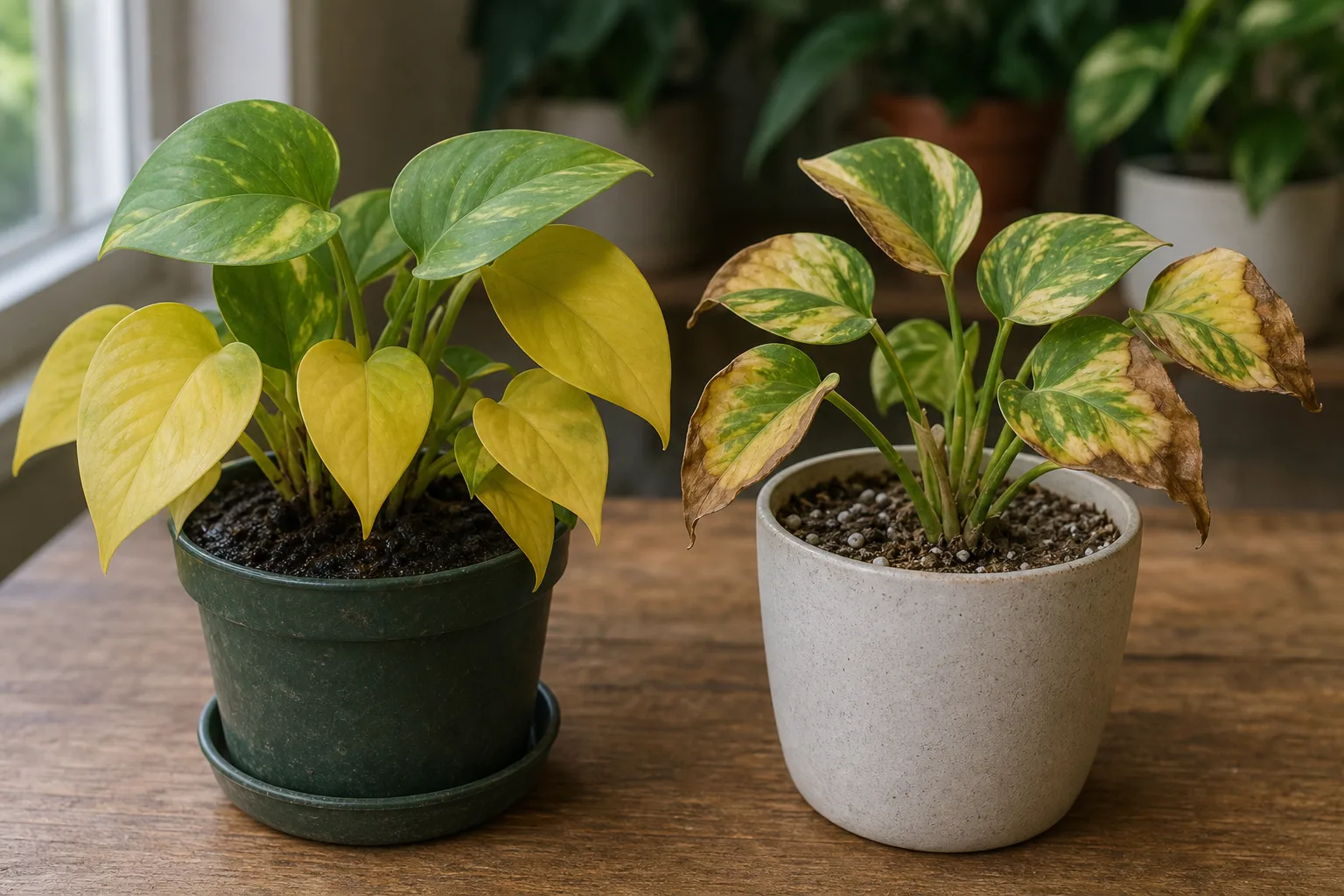
One oldest lower leaf fading slowly can be normal turnover. Several leaves yellowing together, yellowing that reaches new growth, a soft stem base, or a plant that wilts while the mix is wet deserves a root-zone check before you change every care factor at once.
| Symptom pattern | Check first | Most useful next move |
|---|---|---|
| One old lower leaf yellow; new growth is firm | Whether the mix dries normally | Remove the leaf after it is mostly yellow and keep observing |
| Several soft yellow leaves; pot remains heavy | Drainage, mix texture, and roots | Stop routine watering and inspect for root stress |
| Tight curl; pot is unusually light and dry below the surface | Moisture several inches down | Rehydrate slowly and make sure water reaches the center |
| Pale leaves, long gaps, and little new growth | Window distance and season | Move brighter gradually or add a grow light |
| Tan crispy patches on the window-facing side | Direct sun and heat | Filter the light or move the plant back |
| Brown tips with a normal dry-down | Humidity, salts, and fertilizer history | Measure humidity, flush salts if needed, and avoid stronger feeding |
The NC State Extension profile specifically associates yellow leaves with overwatering and curled leaves with underwatering, but those clues become useful only when paired with the soil. A curled leaf in wet soil may reflect damaged roots, and a yellow leaf in a bone-dry pot may reflect drought; the same visual can point in opposite directions.
Do not expect damaged tissue to turn green again. Correct the condition, then judge the change by the next leaf. If the pot is wet for many days, the plant wilts despite damp soil, the base softens, or the mix smells sour, slide the root ball out and look for brown, mushy roots rather than adding more water.
Slow growth by itself is not a crisis. Exotica is naturally slower than some true pothos, and a recently moved plant may pause while it acclimates. If there is no growth at all, combine the clues: dim light, cold drafts, root damage, a dense mix, and feeding during dormancy are more likely explanations than a lack of “growth booster.”
Manage Pests and Root Rot
Inspect the undersides of leaves, stem joints, and the support every few weeks. NC State Extension lists scale, mites, mealybugs, thrips, fungal leaf spot, and botrytis among problems to monitor, while poorly drained or wet soil can lead to root rot. New plants deserve a short quarantine before they sit beside an established collection.
Mealybugs look cottony and often gather at nodes. Scale looks like fixed tan or brown bumps, spider mites can create fine webbing and pale stippling in dry conditions, and thrips may scar soft new leaves. Isolate a suspect plant, remove what you can see, rinse only when the plant and room can dry quickly, and use a product labeled for the pest and indoor plant exactly as directed.
One treatment is rarely the whole solution because eggs and hidden insects can survive the first pass. Recheck at the interval required by the product label, wipe the shelf and support, and correct the stress that made the plant vulnerable. Avoid homemade pesticide concentrations and avoid coating a heat-stressed plant in direct sun.
Root rot is a root-environment problem, not a disease you cure with more fertilizer. Drainage, appropriate pot size, enough light for water use, and a measured dry-down are the preventive system; if the roots are already soft, trim damaged tissue and repot rather than repeating the old watering pattern.
Keep Exotica Safe Around Pets and Children
Scindapsus pictus is not pet safe. The ASPCA Satin Pothos entry lists the plant as toxic to cats, dogs, and horses because it contains insoluble calcium oxalates. The clinical signs listed include oral irritation, pain and swelling of the mouth, tongue, and lips, excessive drooling, vomiting, and difficulty swallowing.
Keep the pot, fallen leaves, pruning waste, and water-propagation jars out of reach. A high shelf or hanging basket can work only if a pet cannot climb to the foliage or pull down the vines; otherwise choose a genuinely pet-safe plant for a floor pot or low shelf.
If a pet may have chewed Exotica, contact a veterinarian or ASPCA Animal Poison Control promptly and do not wait for symptoms to worsen. Wear gloves if the plant irritates your skin, keep sap away from eyes and mouth, and wash tools and hands after pruning.
Conclusion
Scindapsus pictus ‘Exotica’ is easiest when you manage the root zone rather than obeying a calendar. Give it bright filtered light, a drainage pot with airy mix, and water only after the upper mix dries; then choose trailing or climbing support according to the foliage and space you want.
For a fuller plant, prune above nodes and root healthy cuttings in water, soil, or by layering. When leaves change, read the combination of pattern, pot weight, soil moisture, light, temperature, and roots before treating the symptom. That routine keeps Exotica’s silver foliage attractive, makes propagation predictable, and gives you a clear next step when the room or season changes.