Sugar Maple Tree Care: Planting, Watering, and Pruning
Sugar maple tree care starts with the right site. Get planting steps, establishment watering, pruning timing, pest notes, and realistic fall-color advice.
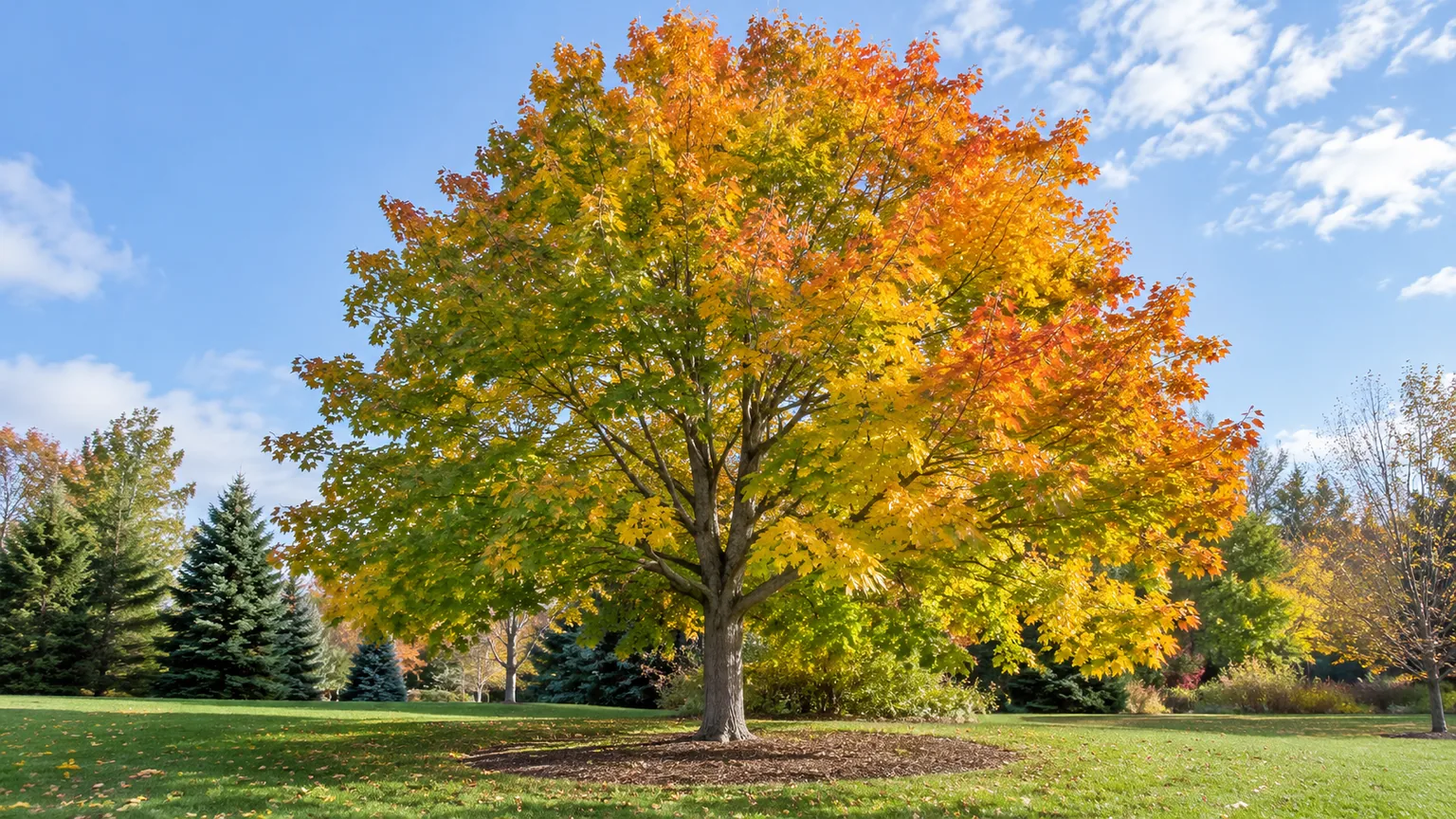
A sugar maple can become the defining tree of a large, cool-climate yard: a broad summer canopy, strong autumn color, and a lifespan that can outlast the house around it. But Acer saccharum is not a universal “plant it anywhere” shade tree. It struggles where heat, road salt, compacted soil, or restricted rooting space are built into the site, so the most important part of sugar maple care happens before you buy one.
Think about the mature tree rather than the sapling in the pot. A young maple may look modest for years, but its future canopy and roots need generous space. If your property can offer moist, draining soil and a broad unpaved root zone, establishment is manageable; if it cannot, choose a tree better suited to the site instead of trying to correct a poor match with fertilizer or constant pruning.
Sugar Maple at a Glance
| Feature | What to expect |
|---|---|
| Botanical name | Acer saccharum |
| Mature size | Often 50–80 feet tall and 40–60 feet wide; some references report larger trees |
| Growth rate | Slow to moderate overall; young open-grown trees may grow faster |
| Light | Full sun to partial shade; it can persist in deeper shade but grows more slowly |
| Soil | Deep, fertile, moist but well-drained soil; slightly acidic is ideal, though some regional references note tolerance of clay or alkaline soil |
| Hardiness | Commonly listed in Zones 3–8; exact performance depends on provenance, cultivar, heat, and local conditions |
| Main strengths | Long-lived shade, native wildlife value, spring flowers, and variable yellow-orange-red fall color |
| Main limitations | Poor tolerance of road salt, compaction, urban heat, and prolonged drought; needs room for a large crown and root system |
Published size ranges differ because sugar maple varies across its broad native range and because references use different specimens. North Carolina State Extension lists a potential height of 50 to 120 feet, while The Morton Arboretum describes a typical mature specimen around 60 to 75 feet tall and 40 to 50 feet wide. Use the larger end of local nursery or extension estimates when checking clearance; choosing a planting spot for a 40-foot tree and hoping it stays small can create years of unnecessary conflict. NC State Extension’s sugar maple profile and The Morton Arboretum’s profile provide useful regional reference points.
Sugar maple is native to eastern and central North America.
Is a Sugar Maple the Right Tree for Your Site?
Sugar maple suits a large lawn, park-like planting, or cool woodland edge where roots can spread through open soil. It is a poor choice for a narrow curb strip, a small island surrounded by pavement, a driveway edge salted each winter, or a hot courtyard that reflects afternoon heat back onto the crown. Its shade tolerance does not cancel its need for moisture, soil volume, and room to mature.
Measure the site in two directions. First, estimate the mature crown width and leave room for branches to grow without repeatedly striking a roof, blocking a required sightline, or crowding overhead lines. Then look below ground: wide stretches of pavement, a compacted construction zone, and buried infrastructure all limit the soil volume available to a large tree. Roots can extend beyond the visible canopy, so do not treat the trunk circle as the whole root zone.
Roots may lift paving or exploit existing cracks and leaks, so check utility maps and local planting rules before digging. An arborist or municipal forester can assess a site with major infrastructure constraints.
Use this site-fit check
Before buying, confirm the site has open root space, draining soil, little salt or reflected heat, and room below wires and buildings. If a key condition is missing, compare a more compact or urban-tolerant species.
Local climate matters as much as the hardiness-zone number on a plant tag. A tree may survive winter minimums in a zone yet decline in a region where hot summers, drought, or long warm autumns are common. In the South or in a dry western site, check nearby extension and arboretum recommendations for locally adapted maples before planting; a species native somewhere in North America is not automatically suited to every North American yard.
How to Plant a Sugar Maple Correctly
Plant a container-grown or balled-and-burlapped tree when you can water it reliably and the ground is workable. Fall can be a useful window in many temperate climates because cooler air reduces heat stress while soil remains warm enough for root activity, but spring is often the safer choice in places with severe winters, very dry autumns, or frozen ground arriving quickly. A recent field planting documented by Martha Stewart’s farm blog shows sugar maples installed in autumn; treat it as an example of one favorable site and crew, not a universal calendar rule.
The visible root flare—the point where the trunk widens and the main roots begin—is your depth marker. If the tree arrives with soil or burlap covering the flare, remove enough material to find it before digging. Set the flare at or just above finished grade; a tree planted too deep can lose access to oxygen around the trunk base and may develop decay or girdling roots over time.
A practical planting sequence is:
- Find underground utilities and choose the final location based on mature size, sun, and soil drainage.
- Dig a broad hole, generally two to three times wider than the root ball, but no deeper than the root ball’s height at the root flare.
- Remove the container and inspect the roots. Loosen circling outer roots gently; cut only clearly damaged or girdling roots with clean tools.
- For balled-and-burlapped stock, keep the root ball supported while positioning it. Remove twine from the trunk and pull back material covering the top of the root ball; handle wire baskets carefully and avoid collapsing a heavy ball.
- Backfill with the soil you removed unless a soil test or local extension recommendation gives a specific reason to amend it. Water partway through backfilling to settle soil, then finish filling without stomping or compacting the root zone.
- Water slowly and deeply, then spread a shallow mulch ring over the root zone while keeping mulch several inches away from the trunk.
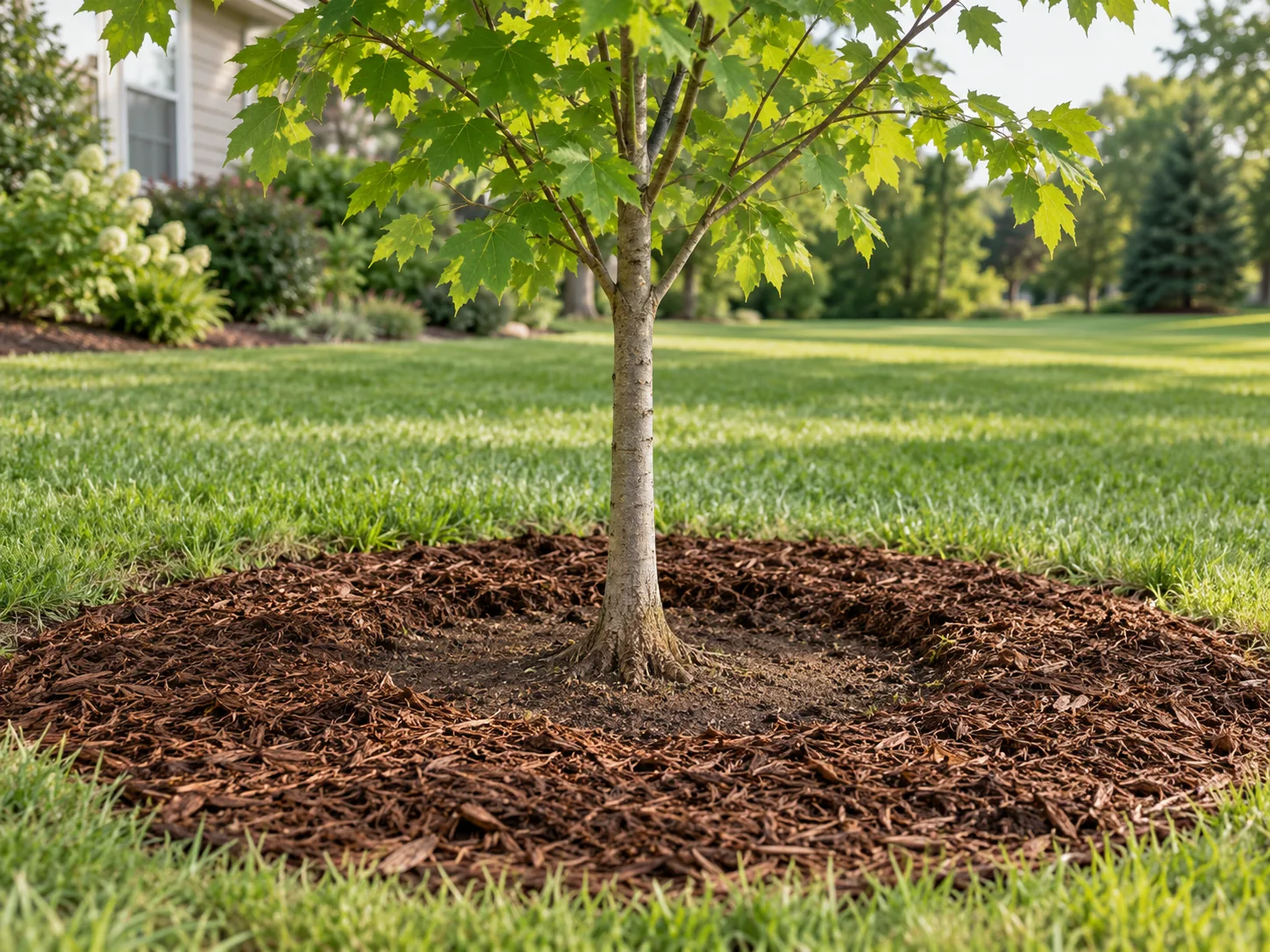
The planting basics apply across tree species, but packaging changes the details. Fine Gardening’s tree-planting guide separates container, bare-root, and balled-and-burlapped stock and emphasizes root-flare depth, a wide hole, careful watering, and a mulch layer that does not touch the trunk. Do not add a large amount of compost or fertilizer to the hole by habit; a sharply different pocket of amended soil can discourage roots from moving into the surrounding ground. Use a soil test when fertility or pH is genuinely in question.
Light, Soil, and Climate: Match Its Natural Preferences
Give a sugar maple open sun to partial shade. It can tolerate shade better than many large landscape trees, particularly when young in a woodland understory, but an understory seedling will not develop the same fast, broad crown as an open-grown specimen. Aim for a site with several hours of direct light and enough air circulation; in a hot-edge climate, afternoon shade may help, but it cannot compensate for an undersized, baked root zone.
The best soil is deep, fertile, and consistently moist without staying saturated. A slightly acidic soil is often ideal, but tolerance varies: The Morton Arboretum lists clay and alkaline-soil tolerance for its regional landscape conditions, whereas NC State emphasizes moist, well-drained, slightly acidic soil and warns about heat, compaction, and salt. That is not a contradiction you can solve with a pH target alone. Drainage, soil structure, climate, and root volume interact, so test the soil and read regional guidance before making adjustments.
Do not add lime or acidify soil without a test and regional guidance. Nutrient uptake can suffer in alkaline conditions, but pH is only one factor; drainage, climate, and salt exposure may matter more.
For a new property or an unfamiliar bed, the USDA NRCS Web Soil Survey can help you understand mapped soil types and drainage limitations. It does not replace a small-area soil test or on-site observation, especially where construction has disturbed the original soil. Dig a test hole after rain and note whether water drains, and avoid sites that remain waterlogged or bake hard and cracked through summer.
Water by Root-Zone Conditions, Not a Calendar
A newly planted sugar maple needs attentive water while its roots expand beyond the nursery root ball. The key is to keep the root ball and nearby backfill from repeatedly drying out, not to follow a fixed number of gallons or watering days that ignores soil and weather. Check moisture under the mulch with a finger or trowel; if the soil at root depth is still cool and damp, wait, and if it is dry, apply water slowly enough to soak the root zone rather than run off the surface.
During the first growing season, check more often during hot, windy stretches and after extended periods without rain. Clay soils may hold water for longer and need less frequent irrigation; sandy soils drain faster and may need more frequent checks. Water deeply and pause to let it infiltrate. A daily splash wets the surface without encouraging a broad, deep root system, while constantly saturated soil deprives roots of oxygen and can promote decline.
Keep checking through at least the first two growing seasons, and continue during drought until the tree is established. A tree may leaf out successfully and still experience stress later when summer heat raises demand. Watch for a combination of signs: wilting that persists into cooler hours, scorched leaf margins, early fall color, unusually sparse growth, or dead twig tips. Any one sign has multiple possible causes, so use soil moisture and recent weather to guide the first response rather than adding fertilizer or pesticide immediately.
Established trees tolerate short dry spells, but prolonged drought can still scorch leaves and weaken the crown. A wide, thin mulch layer conserves moisture; sprinkling only the trunk does not replace deep watering across the root zone. If drought is routine where you live, choose a better-adapted tree.
Mulch and Fertilizer: Protect the Root Zone
Mulch helps by moderating soil temperature, slowing evaporation, and reducing grass competition. Spread about 2 to 4 inches of organic mulch over as much of the young tree’s root zone as practical, then keep it pulled back from the trunk so the bark stays dry and visible. A low, wide ring is more useful than a small volcano piled against the trunk; thick mulch against bark encourages moisture problems and can hide damage.
Avoid digging or cultivating beneath an established maple. Many of its fine absorbing roots lie close to the surface, and aggressive tilling can sever them. If you want to plant shade-tolerant perennials below a mature tree, use small plants, make minimal holes, and do not build a deep raised bed over the roots. Let fallen maple leaves remain where they do not create a safety or drainage problem, or shred them lightly into the lawn so they do not form a dense mat.
Routine fertilizer is usually unnecessary when a sugar maple grows normally and the soil is not deficient. Fertilizer cannot make a hot, salty, compacted site suitable, and excess nitrogen may push top growth when a newly planted tree needs to establish roots. If leaves are unusually pale, growth has slowed, or the tree is declining, first rule out water stress, root damage, planting depth, and salt exposure; then use a soil test and local extension advice before applying nutrients. Fine Gardening’s planting guidance also cautions against fertilizing a newly installed woody plant without a specific soil need.
Prune for Structure and Safety
Sugar maples have sap flow that can make late-winter or spring pruning cuts look as though the tree is bleeding. This visible sap loss is usually more alarming than harmful, but it is easy to avoid: schedule routine pruning after the leaves have fully expanded, in summer or late summer, when cuts are less likely to bleed heavily. The Morton Arboretum specifically advises avoiding spring pruning for maples.
For a young tree, focus on structure rather than size reduction. Keep one well-positioned central leader when the tree naturally has one, remove crossing or rubbing branches, and correct narrow competing leaders while the cuts are small. Preserve a balanced crown and avoid stripping lower branches simply to expose a trunk; excessive early removal reduces leaf area the tree needs to grow and can create a weak, top-heavy form.
Remove dead, broken, or hazardous branches when needed, but pruning large limbs is not a casual homeowner job. If the cut is near power lines, above a safe reach, larger than you can handle with a hand pruner, or involves a heavy limb over a roof, hire a qualified arborist. Do not top a sugar maple to keep it below wires: topping creates large wounds and weak regrowth, and it does not turn a large tree into a small one.
Why Fall Color and Growth Vary
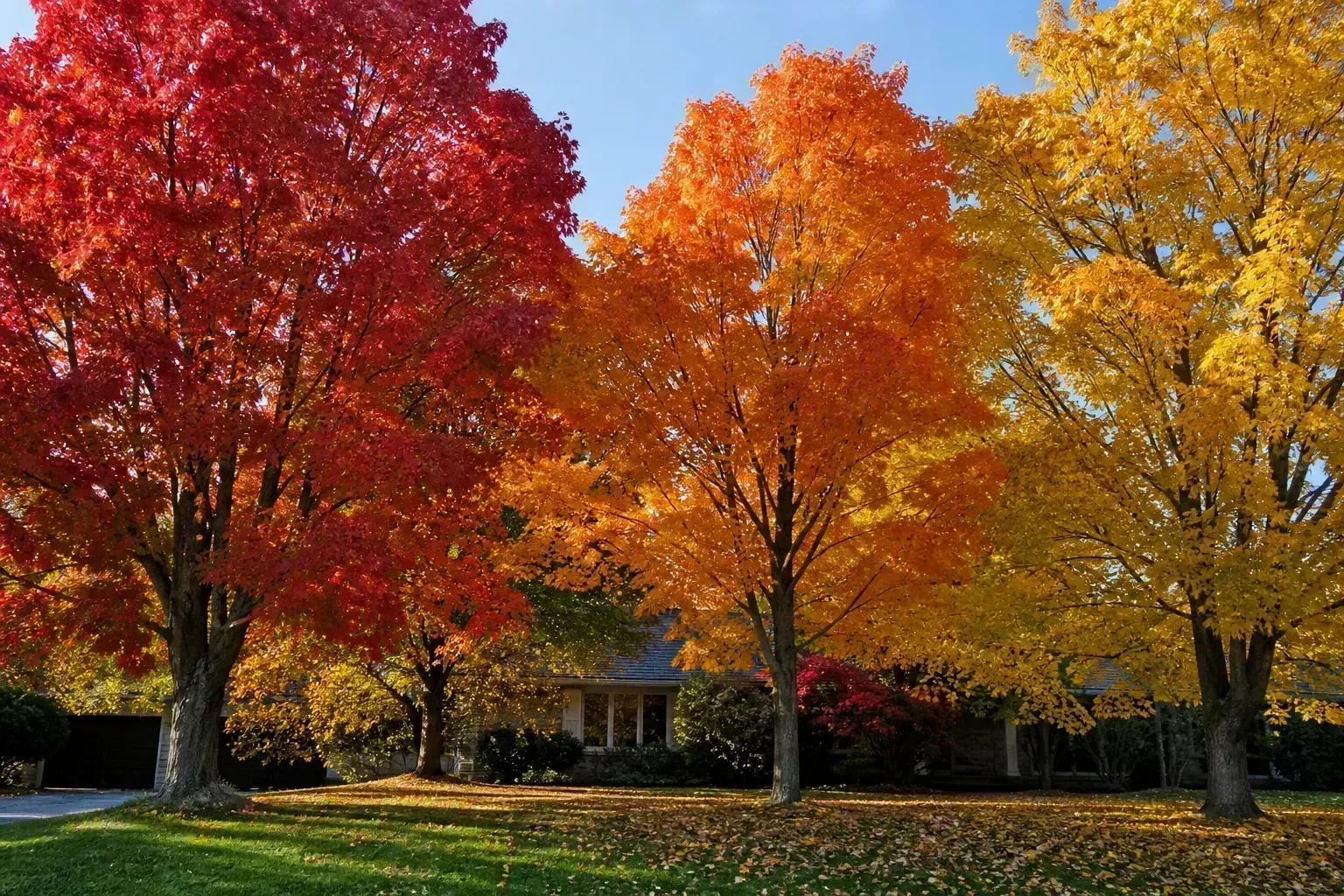
Sugar maple fall color can range from yellow through orange to red, sometimes with more than one shade visible in the same canopy. It will not necessarily match the photograph on a plant label every year. Temperature patterns, sunlight, moisture, tree health, and genetic differences all affect when color develops and how long it lasts; a warm autumn or a drought-stressed tree may produce a weaker or earlier display.
A single subdued fall is not enough reason to diagnose disease or replace a healthy tree. Look at the whole season: Did the canopy fill out normally in spring? Did the leaves stay mostly healthy through summer? Did the tree experience construction damage, drought, salt splash, or premature leaf loss? A pattern of repeated sparse growth, dieback, or browning that begins in summer deserves closer attention than a one-year difference in autumn hue.
Sugar maple grows slowly to moderately, but open-grown trees may put on more growth than shaded forest trees. Do not use a promised number of inches per year as a success test; the nursery size, climate, water, soil, and root disturbance all change the first years’ growth. A tree that invests in roots before extending its crown is not necessarily failing. Fine Gardening’s fall-tree coverage likewise treats autumn color as a feature of a tree’s growing conditions and seasonal behavior, not a guaranteed, identical display.
Flowers, Seeds, and Responsible Sap Tapping
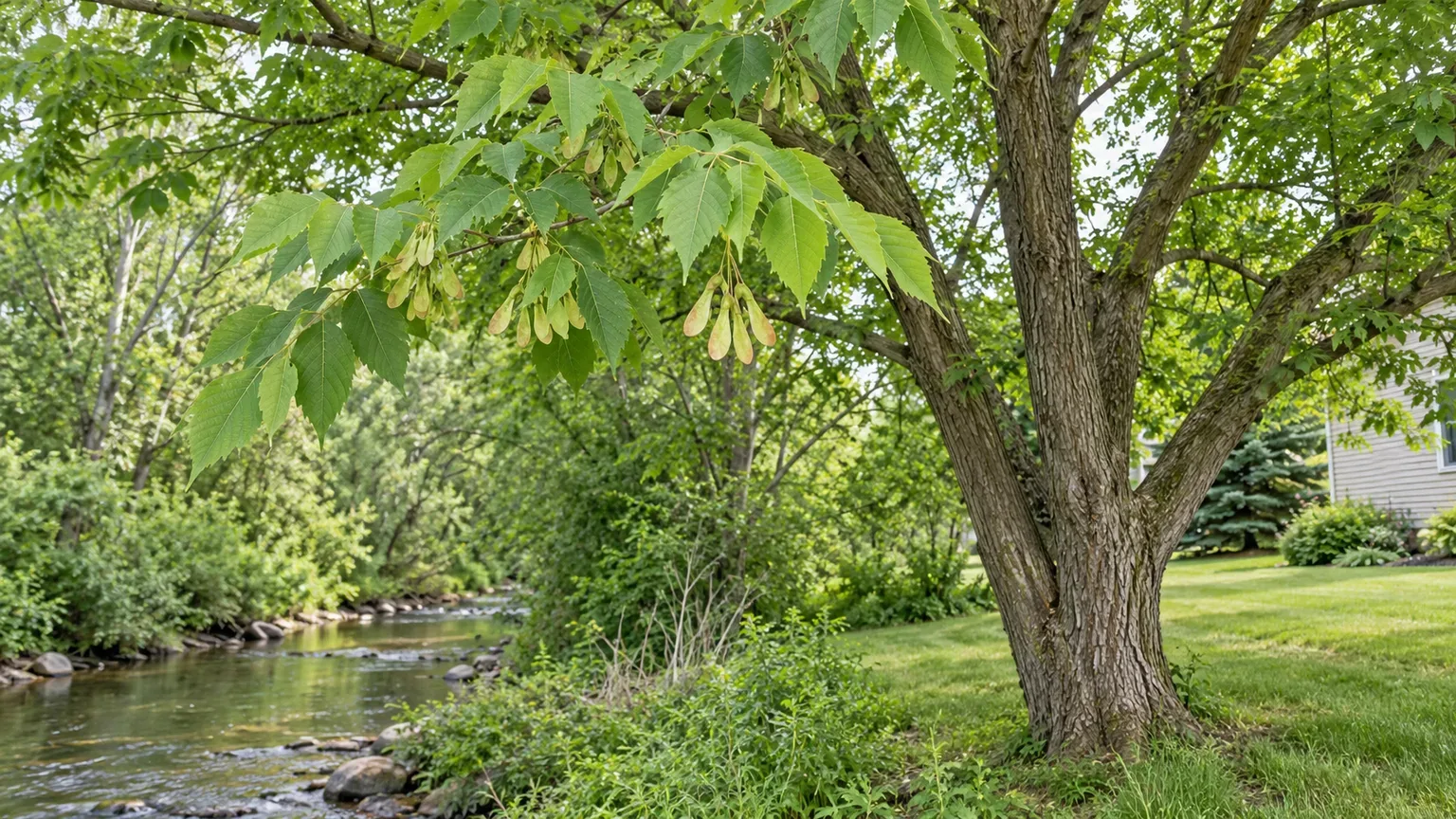
Small yellow-green flowers appear in spring, followed by paired winged samaras that mature and fall later in the season. The seeds can germinate in favorable soil, so a mature tree may produce seedlings in garden beds or lawn edges. Pull young seedlings while the soil is moist; waiting until their roots are larger makes removal more difficult, but seed drop alone is not a defect that should rule out an otherwise suitable tree.
Sugar maple is the principal commercial species for maple syrup because its sap has a relatively high sugar concentration. NC State Extension notes that trees are commonly not tapped until they are around 40 years old and gives an approximate 32 gallons of sap for one gallon of syrup. Those are broad reference figures, not a promise for a backyard tree: sap sugar content, tree health, weather, and equipment all affect the amount, and a healthy shade tree may never be worth tapping.
Do not tap a young, stressed, or small-diameter tree simply because it is a sugar maple. A wound can expose living tissue, and tapping technique and local recommendations matter. If sap collection is your goal, learn the current guidance from a regional maple extension program before drilling; if shade, autumn color, and longevity are your main reasons for planting, leave the trunk intact and enjoy the tree as an ornamental.
Common Pests, Diseases, and Tree Stress
A healthy sugar maple does not usually need routine pest treatment. Aphids, scale insects, and borers may occur, while leaf spots, tar spot, anthracnose, verticillium wilt, and drought-related leaf scorch are among the problems listed by NC State Extension and The Morton Arboretum. The useful first question is not “Which spray should I use?” but “What changed in this tree’s site, water, or canopy, and what does the damage look like?”
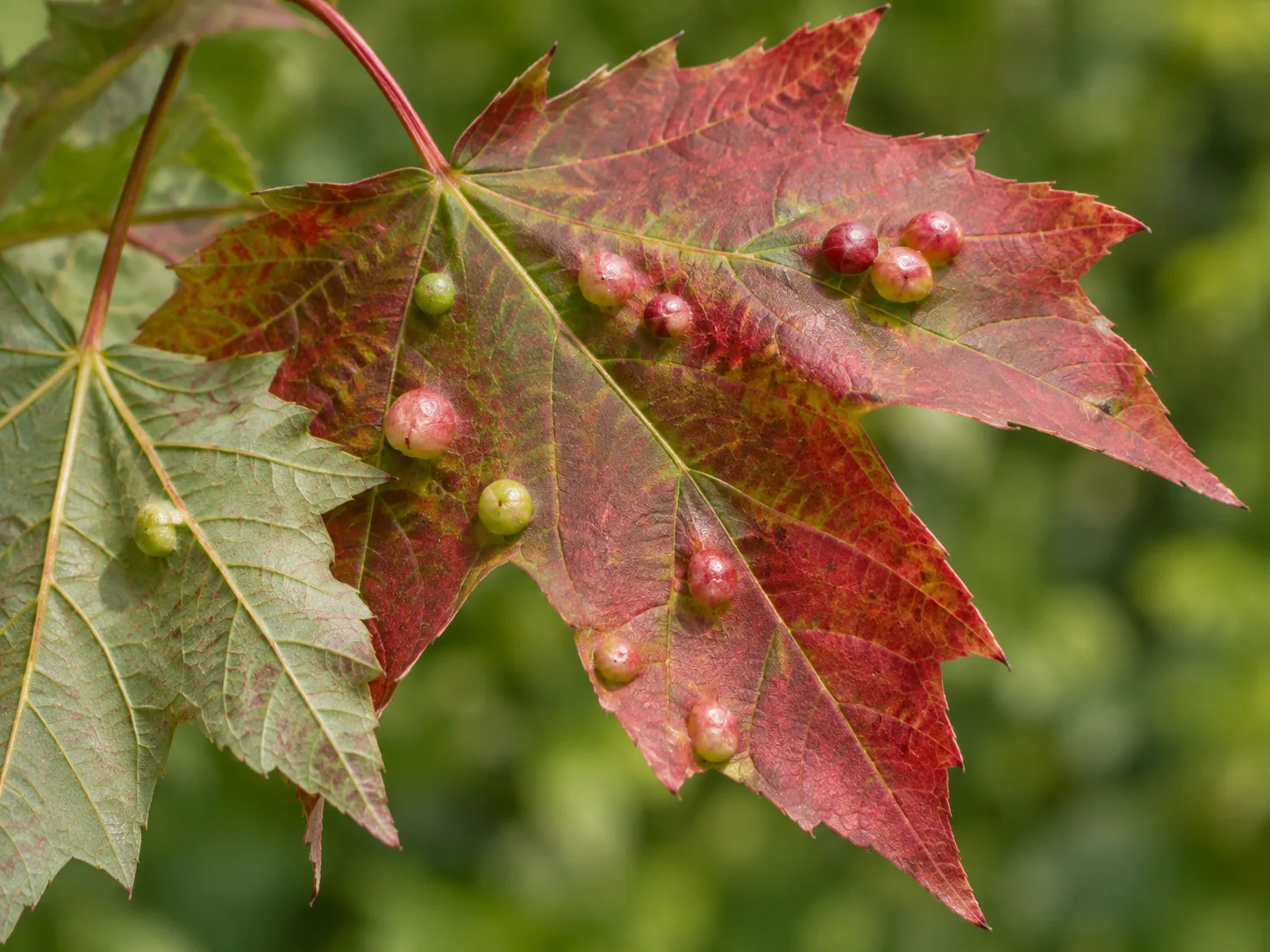
Tar-like dark spots and small leaf galls often look dramatic but may be mostly cosmetic when the rest of the tree is vigorous. Leaf scorch can follow drought, root disturbance, heat, or limited root volume; it is a symptom, not a diagnosis. Browning that starts at the edges during a dry spell points you toward moisture and exposure checks, while one-sided dieback, wounds at the base, or progressive canopy thinning deserves a more careful inspection.
Read leaf symptoms before treating
Start by noting which leaves are affected, when symptoms began, and whether they occur across the whole canopy or on one branch. Check soil moisture several inches below the surface, inspect for salt or construction damage, and compare new growth with older foliage. If you find insects, identify whether they are causing meaningful damage before treating; many minor populations do not justify broad-spectrum pesticides, which can also harm beneficial insects.
Call a certified arborist when large limbs are dead, the canopy is declining year after year, the trunk has significant cracks or cavities, fungal growth appears near the base, or the problem began after excavation or grading. Tree diseases can resemble drought, root injury, or nutrient problems, and applying fertilizer or a pesticide before identifying the cause may waste money or make stress worse. Extension diagnostic services can help with leaf or soil samples where available.
Sugar Maple Cultivars: Verify Regional Fit
Named sugar maple selections can vary in crown form, mature size, fall color, and tolerance of heat or drought. North Carolina State Extension lists options such as ‘Bonfire,’ which it describes as faster-growing with better heat tolerance, and ‘Morton,’ a more compact selection in that profile with improved heat and drought tolerance. Those descriptions are useful starting points, not a guarantee that a cultivar will thrive outside the region where it was evaluated.
Before buying, ask the nursery for the cultivar’s full name, expected height and spread in your climate, and evidence that it performs locally. A label that says “heat tolerant” does not mean “drought proof” or “suitable for a parking strip”; root volume, irrigation during establishment, and soil compaction still matter. If the site is too hot, salty, dry, or tight for the species, switching to a better-adapted tree is more reliable than searching for a sugar maple selection that can overcome every constraint.
Seasonal Care Calendar
| Season | What to do |
|---|---|
| Late winter to early spring | Inspect for broken limbs and winter injury. Avoid optional pruning while sap flow is active; do not fertilize automatically. |
| Spring | Plant when soil is workable and you can water consistently. Check that mulch is not touching the trunk and watch new transplants as leaves emerge. |
| Summer | Check root-zone moisture during dry spells, water slowly when the root ball and surrounding soil are drying, and prune small structural issues after leaves expand. |
| Late summer to fall | Plant in regions where the ground remains workable and winter is not imminent. Keep watering if autumn is dry; monitor fall color as a seasonal response rather than a pass/fail test. |
| Winter | Keep equipment and snow piles from damaging the trunk. In salted areas, reduce salt splash and avoid piling salty plowed snow over the root zone. |
For an established tree, seasonal care is mainly observation and protecting the soil, not a list of monthly treatments. Keep vehicles and heavy equipment off the rooting area, maintain the mulch ring without burying the trunk, and check the canopy after severe weather. For more fall planting options and conditions, see the existing guide to trees to plant in fall.
Common Planting Mistakes to Avoid
Planting too deeply is one of the most preventable problems. If the trunk enters the soil like a straight pole with no visible flare, the tree may be buried. Correct the depth before backfilling; after planting, do not cover the trunk with extra soil or a deep mulch mound.
Planting in the wrong place often shows up years later as pavement lifting, branches hitting a building, salt injury, or a crown that competes with utility lines. Read the mature dimensions, locate utilities, and account for the whole root zone before choosing a spot. A small nursery pot says nothing about the space an adult tree needs.
Watering by habit rather than soil can lead to both drought stress and waterlogged roots. A sprinkler running on a lawn schedule may barely reach the root ball—or it may keep heavy soil wet for too long. Check below the mulch and adapt frequency to rainfall and drainage.
Using fertilizer as a rescue treatment can mask the real issue without fixing it. Compaction, heat, salt, a buried root flare, girdling roots, and drought do not respond to more nitrogen. Find the cause first, and make nutrient changes only when a soil test or qualified diagnosis supports them.
Pruning to control height is also a mistake. Repeatedly shortening a large canopy creates wounds, weak shoots, and a tree that still wants to become large. If the site cannot accommodate the natural size, select a smaller species before planting.
Alternatives for Hot, Dry, or Tight Sites
If a sugar maple fails the site-fit check, replace the wish with a tree suited to the actual conditions. For a smaller ornamental space, compare compact native or regionally adapted maples and other small trees through a local extension or arboretum list. For a broad yard in warmer summers, a locally recommended red maple cultivar, black gum, or another drought- and heat-tolerant native may be a more dependable choice, depending on region and soil.
Do not treat another maple as an automatic substitute. Red maples can still become large, and silver maples have different structural liabilities. Compare maple forms in the maple fall-color guide, then verify mature size, hardiness, water needs, and invasive status regionally.
A useful replacement rule is simple: select for site first, then for fall color. Match mature width to the available open soil, choose a species proven in your climate, and avoid trees that will need constant pruning to stay away from wires or buildings. A tree that fits the yard can become a lasting shade canopy; a tree that only fits the photo can become a costly removal.
Conclusion
Sugar maple rewards the gardener who can give it cool-climate conditions, moist but well-drained soil, and room to develop a broad root system and crown. The main care steps are straightforward: plant with the root flare visible, water by checking the root zone while the tree establishes, protect the soil with a shallow mulch ring, and prune for structure after leaves expand rather than trying to control mature size.
Before purchasing, measure the mature footprint and look honestly at summer heat, road salt, compaction, drainage, and nearby infrastructure. If those conditions suit the site, a sugar maple can deliver generations of shade and changeable fall color; if they do not, choose a better-adapted tree now instead of asking fertilizer or pruning to solve the wrong problem.