13 Fruiting Olive Tree Varieties to Grow
Choose an olive tree for table fruit or oil. Compare 13 cultivars, learn why winter chill and summer heat matter, and plan for its mature size.
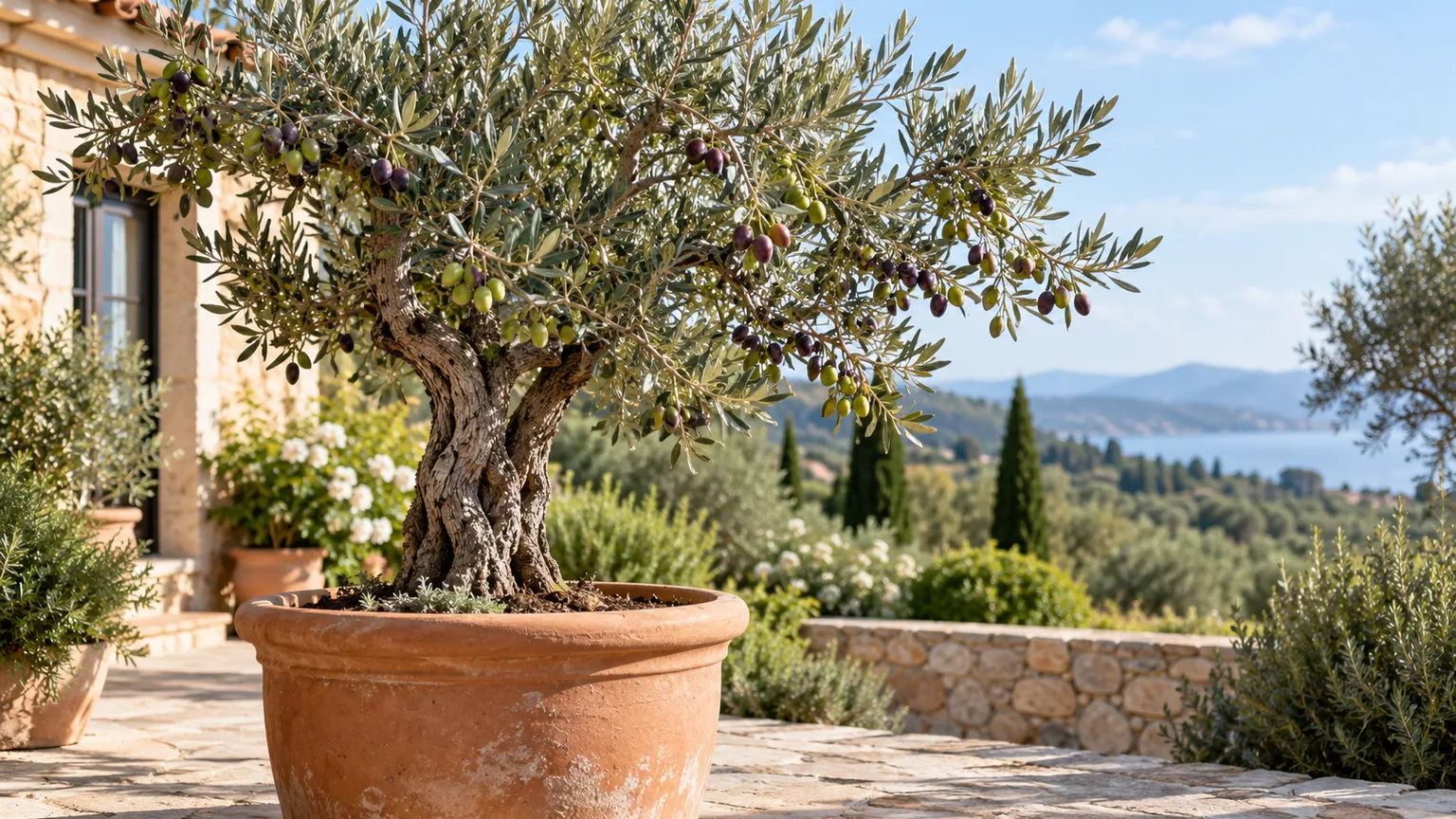
A fruiting olive tree is a named cultivar of Olea europaea selected to produce edible drupes, rather than a sterile ornamental such as ‘Swan Hill.’ The right choice depends less on a famous olive name than on whether your winters, summers, available space, and harvest plans suit that cultivar.
Before ordering, answer four questions: Will the tree spend winter outdoors? Does your winter provide enough cool weather for flowering without repeated damaging freezes? Do you want olives for curing, oil, or both?
Can you give a mature tree full sun and room for its canopy—or protect a container tree when temperatures fall? These questions narrow the options more reliably than a generic hardiness-zone label.
Olives are evergreen Mediterranean trees, but “Mediterranean” does not mean every warm place is suitable. Flowering responds to winter temperature patterns, the fruit crop can vary from year to year, and heat or humidity around bloom can disrupt pollen. A tree can stay alive and attractive while producing little or no fruit.
How to Choose Based on Site and Harvest
Start with the conditions that determine whether a tree can flower and set fruit, then compare the olives themselves. A plant tag may name a cultivar and a USDA zone, but it rarely tells the whole story about winter chill, heat during bloom, local pollination, or the size of a mature tree.
Climate has two separate tests: winter low and winter cool
First assess the coldest temperatures your site actually reaches. Olive foliage, shoots, trunk, and developing fruit do not all respond to a freeze in the same way.
Damage depends on the cultivar, duration of cold, how gradually the tree acclimated, its age and condition, and whether it is exposed to drying wind or sits in a low frost pocket. A cold-hardy label is a relative comparison, not a promise that a tree can withstand every freeze at that temperature.
NC State Extension describes common olive as best suited to hot, dry summers and mild winters, and lists outdoor growing broadly for USDA Zones 8 through 10. It notes that some cultivars may grow in Zones 7a and 7b, which is not a guarantee of regular crops there.
A hardiness zone tracks average annual extreme minimum temperature; it does not describe winter chill, summer humidity, frost duration, or the tree’s exposure on your property. Read NC State Extension’s olive profile as a broad species reference, then ask a local extension service or experienced olive nursery about cultivars that have actually fruited near you.
Texas A&M AgriLife Extension’s Texas olive-production guide discusses cultivar attributes alongside regional climate, soil, irrigation, pollination, and freeze protection. That regional scope is a useful reminder that a variety recommendation has to fit local growing conditions.
The second test is winter chill for flowering. Olive trees need a period of cool weather to induce flower buds, but “chilling requirement” is not one universal number of hours that works for every cultivar and climate. NC State gives a broad guideline of about two months in the 40 to 50°F range.
A multi-year study of five cultivars found that flower induction varies with winter temperature patterns, cultivar, and the previous fruit load; its authors caution that a simple chilling threshold does not predict flowering reliably in every setting. See the peer-reviewed study of winter chilling and olive flower induction.
This distinction explains an apparent contradiction: an olive can be hardy enough to survive a mild winter yet receive too little cool weather for a strong bloom. Conversely, a cultivar may need more cool exposure to flower but suffer damage during a severe freeze.
In the Wikifarmer discussion of cold-hardy olive varieties, cultivar rankings and chilling needs vary, and the authors caution that results can change with site and method. Use such rankings to form a shortlist, not to ignore your own winter records.
Summer warmth helps, but hot bloom weather has limits
Olives generally need abundant sun and a long, warm growing season to ripen fruit. Yet high heat is not automatically helpful at every stage. Flowering and early fruit set are sensitive periods: a study of 12 cultivars found that exposure to 36°C combined with very high humidity reduced pollen viability.
That is a controlled research result, not a universal temperature cutoff, but it helps explain why a tree may flower heavily and still set few olives during a hot, humid spring. See the study of temperature and humidity effects on olive pollen.
A dry Mediterranean summer and a humid subtropical summer may share similar daytime highs while posing different challenges. In a hot inland garden, reliable moisture during flowering and early fruit growth matters; in a humid region, stagnant air and wet weather around bloom or ripening can also increase disease pressure. Do not assume that the cultivar with the greatest cold tolerance will also be the best match for your summer.
The practical test is local performance. Look for nearby trees that flower and bear fruit regularly, then ask what cultivars they are and whether they have a pollinizer nearby. If local growers have success with one cultivar but a similar-looking tree in a neighboring town does not fruit, compare winter temperatures, bloom timing, and exposure before blaming care alone.
Decide how you will use the fruit before you buy
Some cultivars are chosen primarily for oil, others for large table fruit, and some are used for both. An oil cultivar can still produce olives that a homeowner might cure, but small fruit and a high pit-to-flesh ratio may make hand processing tedious. A large table olive is satisfying to pick and stuff, but it is not automatically the best option for oil production.
Fruit color is a ripeness cue, not a reliable cultivar identifier. Many olives progress from green through red or purple to dark brown or black as they ripen.
The same cultivar can be harvested at different stages for different textures and flavors, and curing changes the final eating experience. A name on a jar may identify an olive style or region rather than a unique tree variety.
Make the decision around the crop you will actually use. If you want to cure olives for snacks, prioritize cultivars with suitable fruit size and a flavor style you enjoy.
If you want to press oil, ask a local mill which cultivars it accepts, its minimum batch size, and whether your harvest volume is practical. A single patio tree may be an enjoyable fruit project, but pressing a useful quantity of oil often requires several productive trees or a community mill.
Fruiting Olive Cultivars at a Glance
The table compares the 13 cultivars below by their familiar fruit use and likely growing fit. Mature size varies with climate, pruning, training, rootstock, and whether the tree is planted in a container; do not treat the relative space notes as guaranteed height specifications.
| Cultivar | Common fruit use | Relative space and climate fit |
|---|---|---|
| Arbequina | Mild table olive; especially valued for oil | Lower-vigor candidate for a large container or managed planting; needs a locally suitable winter |
| Arbosana | Oil, especially commercial high-density plantings | Lower-vigor than many traditional trees; container pruning is possible, but fruiting is not guaranteed |
| Koroneiki | Small fruit used chiefly for oil | Often selected for warm-winter olive regions; avoid exposed frost-prone sites |
| Mission | Table olives and oil | Traditional California choice; reserve full sun and substantial in-ground room |
| Picholine | Crisp green table olive; also used for oil | Medium to large evergreen tree; can be trained in a large pot |
| Manzanilla | Large green table olives | Best where summers ripen fruit and winters avoid repeated hard freezes |
| Nocellara del Belice | Green, mild, meaty table olives sold as Castelvetrano | Plan for an in-ground-sized tree unless you can prune and repot consistently |
| Gordal Sevillano | Very large table olives | Better suited to a sunny yard or a large, manageable patio container |
| Amfissa | Greek table olive | Check local winter chill and cold records; cultivar reports on tolerance vary |
| Kalamata | Dark, almond-shaped table olives | Better in a warm, sunny growing season with a locally suitable winter |
| Cailletier | Small dark olives; the Niçoise style | A full-size olive tree in ground; source a compatible local pollinizer if advised |
| Frantoio | Primarily oil; also used for table fruit | Medium to large canopy; choose a sheltered site and verify pollination locally |
| Leccino | Oil and table uses | Plan on an in-ground-sized tree; research reports self-incompatibility in some regions |
These are orientation notes, not cultivar guarantees. For example, a recent two-season field comparison in Egypt found Arbequina and Arbosana had lower canopy volumes than the Coratina and Maraqi cultivars studied; that supports their relative lower-vigor reputation in that trial, not a fixed backyard height. The cultivar comparison in Scientific Reports also demonstrates why a result from one production site should not be transferred uncritically to a different climate.
13 Fruit-Bearing Olive Cultivars
The profiles below focus on what each cultivar is known for and the trade-off to consider before planting. Olive fruit is bitter straight from the tree. Whether you choose an oil cultivar or a table olive, harvested fruit must be processed before it is pleasant to eat.
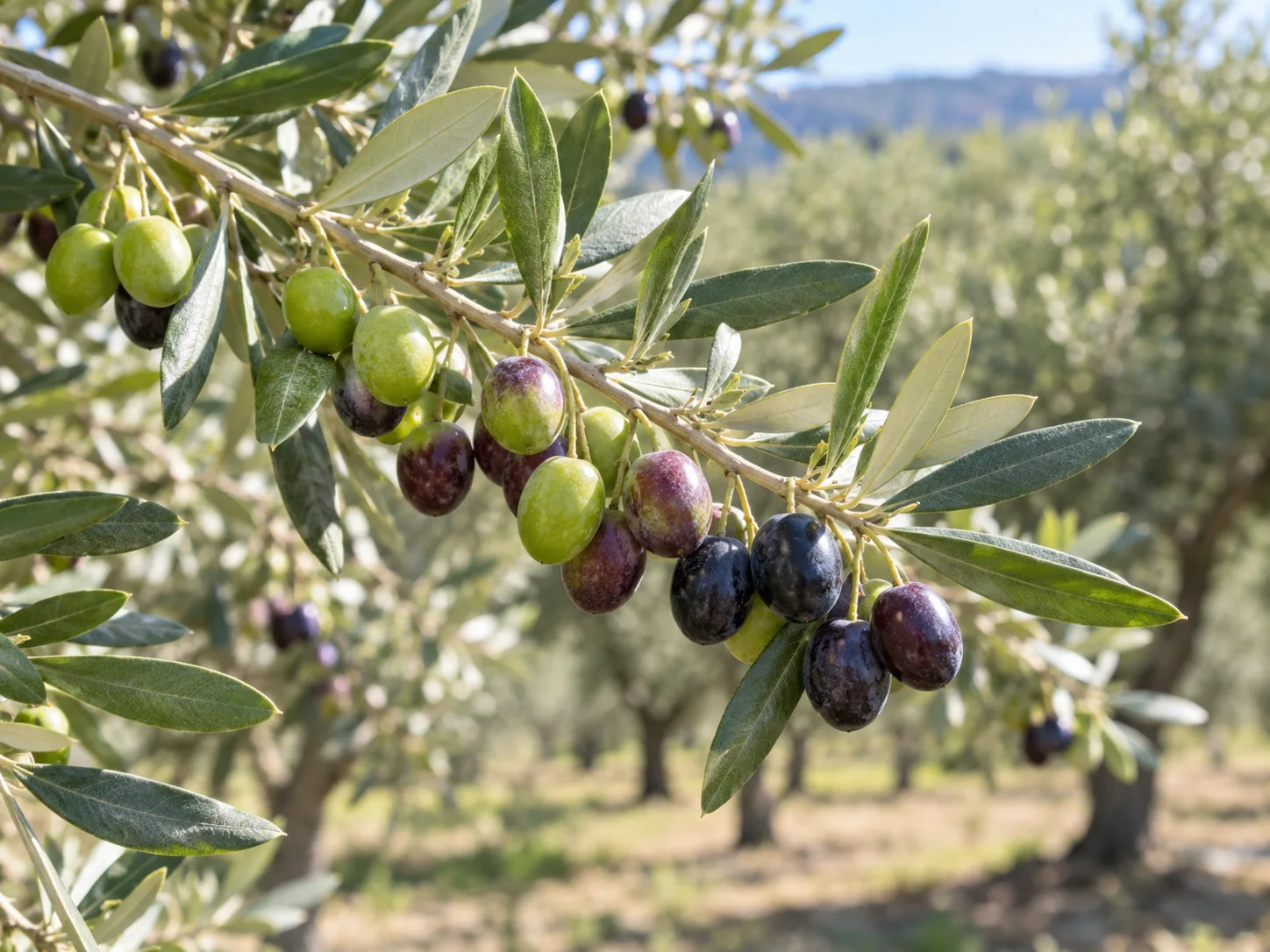
Lower-vigor and oil choices: Arbequina, Arbosana, Koroneiki
Arbequina originated in Catalonia and became widely planted for its mild, fruity oil and early productivity in commercial systems. Its lower vigor can make it easier to maintain than a large landscape olive, and it is often grown in high-density orchards. That does not make it a genetically dwarf tree: without pruning, time, and a suitably large root zone, it still develops into a woody evergreen with a substantial canopy.
Grow Organic includes Arbequina among choices for both colder and warmer olive-growing areas, which is a useful shortlist signal rather than proof it will fruit reliably in every Zone 7 or Zone 10 garden. See Grow Organic’s climate-based olive selection guide.
Arbosana is another Spanish cultivar valued in high-density oil production. Its relatively low vigor is useful where trees are trained as a compact hedgerow, but a commercial hedgerow system is not the same as a small patio tree: it depends on regular pruning and a site that supplies enough sun, winter conditions, and compatible pollen for a crop. Consider Arbosana if a nearby nursery can confirm that it fruits in your climate and you are willing to keep its structure open and controlled.
Koroneiki is a Greek oil cultivar known for small fruit and a high oil content. Wikifarmer describes it as needing relatively little winter chill compared with some Greek varieties, an advantage in mild-winter olive regions. That same source reports it as frost-sensitive relative to hardier cultivars.
It is therefore a poor choice for a garden that often receives sharp freezes simply because the cultivar performs well in a warm olive district. See the cultivar-specific discussion in Wikifarmer’s comparison of cold tolerance and chill needs.
Arbequina, Arbosana, and Koroneiki make the most sense when oil is the main goal and the local climate can support regular flowering. In a warm but humid region, ask a local grower about fruit set and disease pressure. If your winter rarely cools, a lower-chill cultivar may be a better starting point, but it still needs suitable bloom weather, pollination, and enough sun to finish the crop.
Versatile and green-table choices: Mission, Picholine, Manzanilla
Mission is a historic California olive associated with Spanish missions. Growers use it for both table olives and oil, so it suits someone who wants flexibility rather than a single specialized harvest.
Its history in California makes it a recognizable dual-purpose choice, but cultivar name alone does not establish freeze tolerance. Choose it only after checking how mature Mission trees perform in your region.
Picholine is a French olive commonly picked green for its crisp texture and tart, nutty flavor. It is also used for oil.
That dual use is useful if you plan to experiment with harvest timing, although the best stage for table processing is not necessarily the same stage a mill prefers. Serious Eats’ guide to olive varieties describes Picholine as a firm green olive, a useful reminder to pick a cultivar for both growing conditions and the way you want to eat the crop.
Manzanilla, often sold as Manzanillo, is a familiar Spanish green table olive. Its relatively large fruit makes it a better fit for curing and stuffing than tiny oil olives, but it still requires a long enough season for its crop to develop.
A young tree can look healthy for years before it produces a useful harvest. If your summers are short or your winters are marginal, prioritize a locally proven cultivar rather than assuming a supermarket name predicts garden performance.
Large and mild Greek or Sicilian table olives: Nocellara, Gordal, Amfissa, Kalamata
Nocellara del Belice is the cultivar behind the bright green Sicilian olive marketed as Castelvetrano. The fruit is meaty and mild, which helps explain its popularity as a snack olive. Castelvetrano is not a separate tree cultivar; it generally refers to the prepared olive style associated with Nocellara del Belice.
Serious Eats also notes that regional names and cultivar names can overlap in the foods we buy. A tree label should name the cultivar, not only a jar or menu style.
Gordal Sevillano is prized for unusually large, fleshy fruit used as a table olive. Its size makes it appealing for home curing, but table-quality olives need careful harvest and handling so the fruit is not bruised. Gordal is a more sensible choice for a sunny yard with room to train a tree than for a grower who wants a low-maintenance, indoor winter houseplant.
Amfissa, also written Amfissis and sometimes grouped with the Greek name Konservolia, is associated with Greek table olives. Reports on its cold tolerance and chill needs are not fully consistent: Wikifarmer notes that published cultivar rankings differ, and that some sources place Amfissis among varieties needing more winter chilling.
This makes it a particularly poor cultivar to buy from a generic “cold hardy” tag alone. Ask the seller which regional selection they carry and whether it has fruited in a climate like yours.
Kalamata is the familiar deep-purple Greek table olive with an almond-like shape and rich, fruity flavor. The cultivar is also called Kalamon in some growing and marketing contexts.
A controlled pollen study tested Kalamata along with Frantoio and Koroneiki and found self-incompatibility in the tested material; that is a reason to check a compatible pollinizer, not proof that every tree sold under the name will fail alone in every climate. See the published pollen-compatibility study.
These table cultivars reward a grower who wants to cure and share the harvest. Their fruit does not become a ready-to-eat snack when it turns purple; raw olives remain sharply bitter. Before planting, confirm that you are buying an edible-fruit cultivar rather than an ornamental fruitless olive, then decide whether you can process the crop soon after harvest.
Tuscan and Riviera choices: Cailletier, Frantoio, Leccino
Cailletier is the cultivar behind olives often sold or served as Niçoise. The name Niçoise describes a regional style and product, not a second cultivar to count separately from Cailletier.
These smaller olives are harvested dark and are associated with the cuisine of the French Riviera. If you want olives for salads or tapenade, Cailletier offers a specific culinary identity; its fruit and tree still need a climate that supports flowering and ripening.
Frantoio is a Tuscan cultivar primarily prized for olive oil, though its fruit can also be used for eating. The International Society for Horticultural Science’s study in Central Italy found that Frantoio could set fruit under self-pollination in that trial but produced better fruit set with cross-pollination. A separate study of Frantoio, Koroneiki, and Kalamata detected self-incompatibility with its pollen-tube method.
The different results are a useful warning: cultivar behavior can depend on place and test method. If a reliable crop matters, plant with a locally recommended compatible pollinizer that blooms at the same time.
Leccino is another Italian cultivar grown for oil and sometimes table use. A Central Italian study detected self-incompatibility in Leccino, so an appropriate overlapping pollinizer may be important.
The study named Carolea, Dolce Agogia, and Maurino as compatible pollinizers for Leccino in that region; do not transfer that list to every place without checking local bloom dates and recommendations. Read the Acta Horticulturae cultivar trial.
Wikifarmer lists Leccino among cultivars considered relatively cold-tolerant, but even that is a relative rating, not a fixed temperature guarantee. Frantoio, by contrast, appears among cultivars sensitive to frost in its comparison. If you like the flavor profile of Tuscan oils but live in a cold pocket, compare the actual cultivar and site rather than shopping by country of origin.
Olive Trees in Pots Versus In-Ground Planting
A pot can make an olive tree movable, but it cannot create a Mediterranean winter or guarantee fruit. Container growing works best where summer light is strong and the owner can move or shelter the plant during severe cold. It is also a practical option if your yard has heavy soil, poor drainage, or less than the space an unrestricted tree needs.
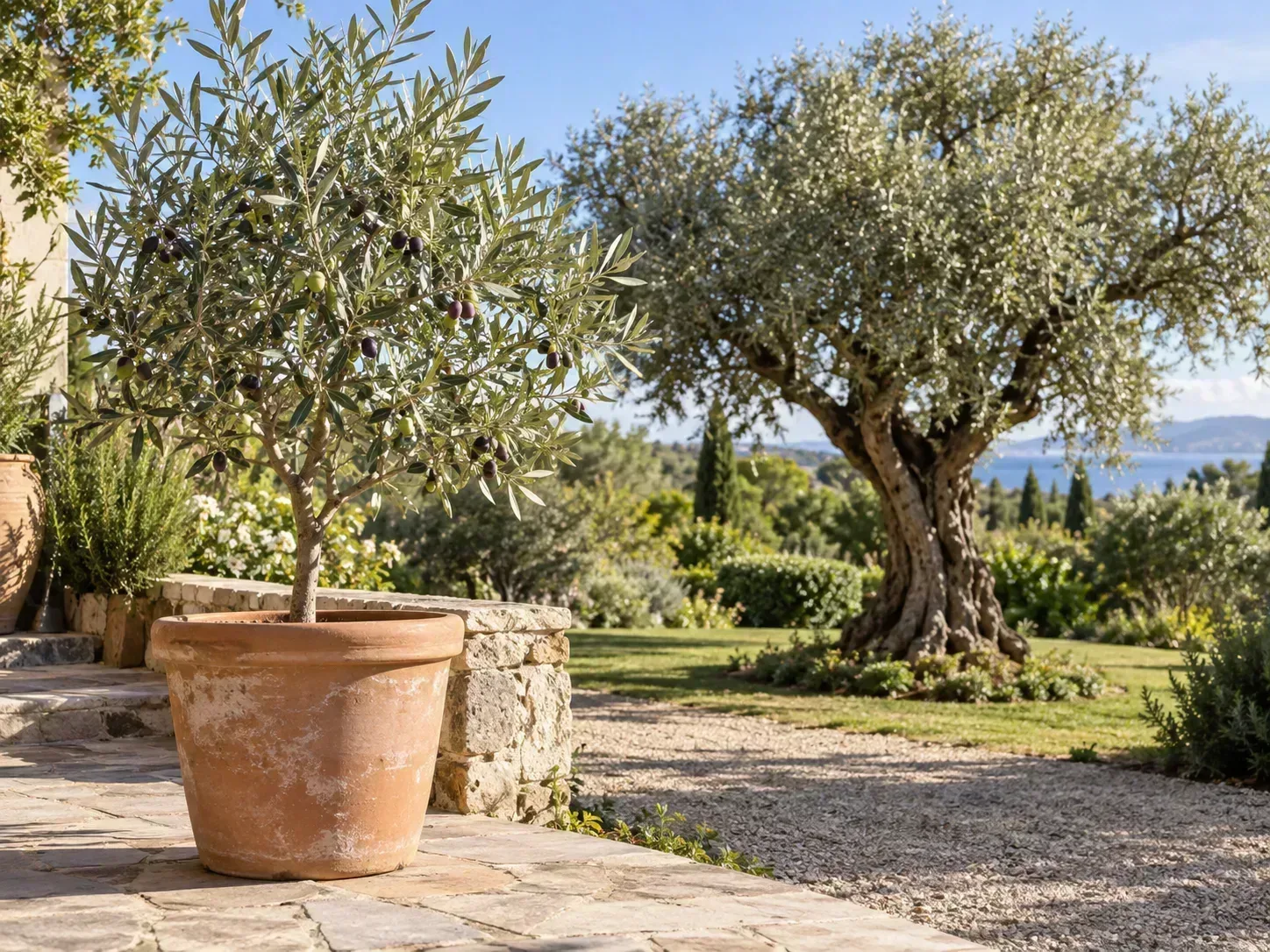
In the ground, common olive can reach roughly 20 to 30 feet tall and 15 to 25 feet wide, according to NC State Extension. The tree can be held smaller with pruning, but the root system and eventual crown deserve space.
Plant where mature branches will not block paths, crowd a wall, shade a vegetable bed, or drop fruit onto a paved surface. Allow airflow around the canopy and avoid planting in the coldest hollow of a sloped yard.
Lower-vigor Arbequina and Arbosana are more manageable than many traditional oil cultivars, and both are used in high-density orchard systems. Even so, “lower vigor” does not equal “naturally miniature.”
A tree in a pot will need a container large enough for stable root growth, sharp drainage, and enough soil volume to buffer heat and missed watering. Epic Gardening’s container-tree guide includes olive as a pot candidate and emphasizes full sun and fast drainage; in a fruiting container, add the need for winter protection and a realistic pollination plan.
Choose a heavy pot with drainage holes, then use a coarse, free-draining growing medium rather than garden soil that compacts in a container. Place it where the leaves receive several hours of direct sun. Water deeply when the mix is drying, but do not let water stand in a saucer or decorative cachepot.
In hot weather a container can dry faster than an in-ground root zone, while in winter a wet, cold mix can stress roots. Check the root ball and soil before watering instead of following a fixed weekly schedule.
When a container tree outgrows its pot, repot in stages and prune conservatively. Repeatedly cutting roots or keeping a tree severely root-bound may suppress growth, but it can also lower flowering and fruiting.
An indoor room is usually a winter shelter, not the best permanent place to grow a fruiting olive: light levels may be too low, warmth can interfere with its seasonal rest, and pollen transfer may be limited. A cool, bright, frost-protected location is often more useful than a warm, dim living room.
For a permanently in-ground tree, choose the cultivar from local experience first. For a pot, prioritize lower vigor, mobility, good drainage, and your ability to supply sun and winter shelter. If your primary goal is edible fruit, do not buy a fruitless ornamental olive just because the nursery display looks identical.
Pollination and Winter Chill Decide Whether Flowers Set Fruit
Olive trees have both male and perfect flowers, but that does not mean every cultivar reliably pollinates itself. Compatibility is cultivar-specific, and research findings can vary by site, conditions, and method. A 2023 flowering study also explains that prior fruit load can suppress the following season’s flower induction, contributing to alternate bearing—a heavy crop one year followed by a lighter one.
The most useful rule for a home grower is to confirm pollination before buying. Ask the nursery: Is this exact cultivar reliably self-fertile in my region? If not, which compatible pollinizer blooms at the same time?
Will bees and wind reach both trees? A second olive tree of any name is not automatically a compatible mate, and two cultivars that flower on different dates cannot exchange pollen effectively.
Some cultivar-specific evidence supports caution. A Central Italian trial found Leccino self-incompatible and Frantoio more productive with cross-pollination; another controlled study found Frantoio, Koroneiki, and Kalamata self-incompatible.
Because the Frantoio findings differ, do not treat a single label such as “self-pollinating” as a sure crop plan. For those cultivars, a locally proven, overlapping pollinizer is prudent if you have room.
Pollination does not solve every fruiting problem. If a tree receives too little winter chill, a spring bloom may be weak. If the weather is hot and humid around flowering, pollen viability can drop.
A young tree may not yet flower heavily; an older tree can alternate between high and low crops; water stress or poor drainage can further reduce its performance. Diagnose in this order: did the tree flower, did pollen overlap, did fruit set, and did the small olives remain on the tree?
Harvest, Cure, and Use the Crop
Olives are harvested at different maturity stages, and the right timing depends on cultivar and intended use. Green fruit is generally less ripe and firmer; as it colors through purple and dark shades, flesh softens and flavor changes. The exact calendar varies across hemispheres, elevations, cultivars, and weather, so follow fruit color and firmness rather than a fixed month.
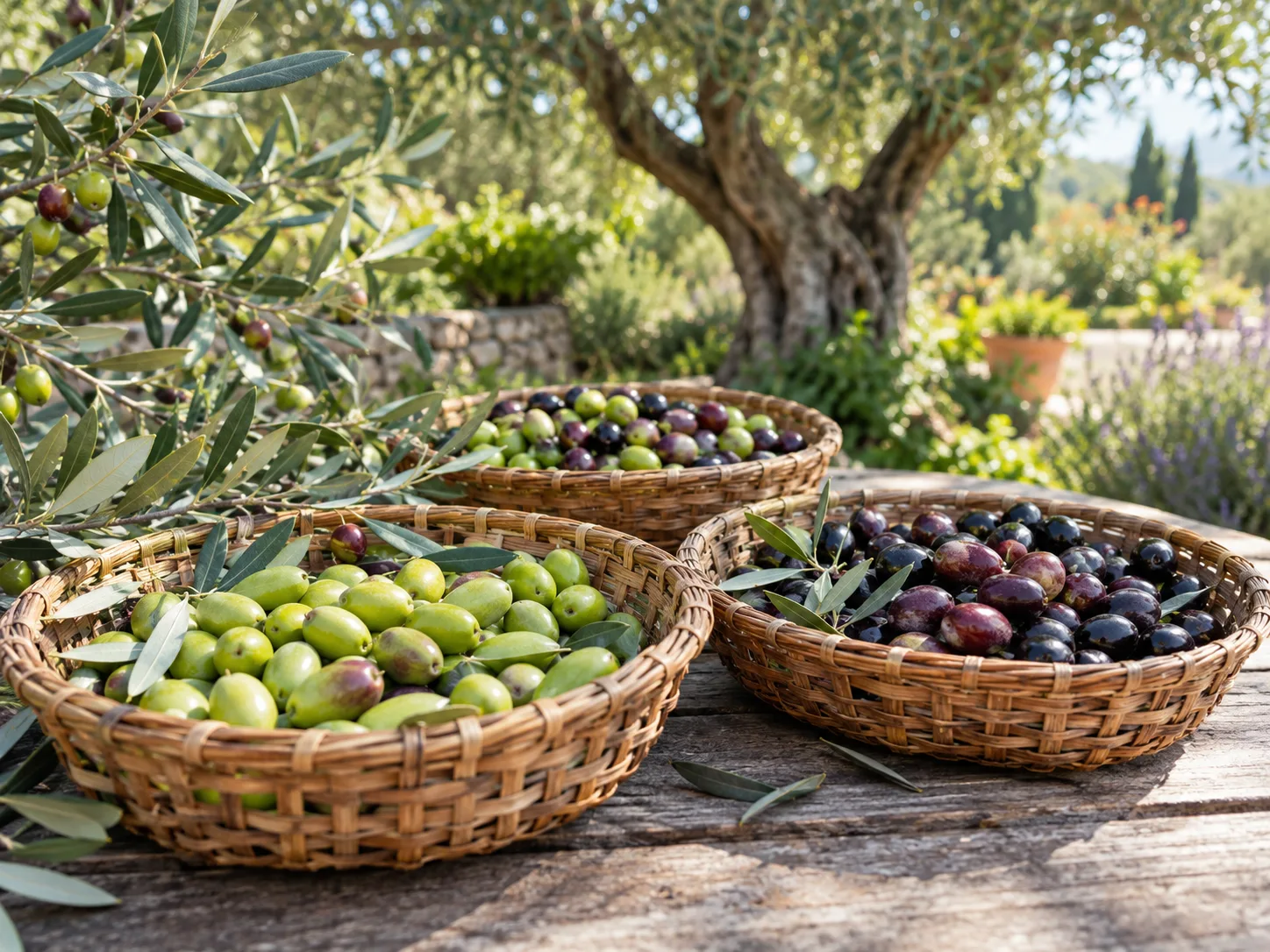
The tree does not ripen every fruit at once. For a small crop, hand-pick selected fruit and avoid shaking branches onto hard paving.
Bruising and punctures can reduce table quality, while fallen fruit may carry dirt and decay. The food-oriented editorial guide from Serious Eats explains the relationship among ripeness, color, flavor, and curing in its overview of olive varieties.
Harvest for the job: table olives versus oil
For table olives, harvest according to the style you want and the cultivar’s customary use. Green table olives are picked while firm; darker styles are picked later when the fruit has colored. Large-fruited cultivars such as Manzanilla and Gordal are convenient for hand preparation, but curing can take time and requires a reliable recipe.
Do not taste raw fruit as a readiness test: natural oleuropein makes fresh olives intensely bitter. Use a tested method for curing and follow its salt, water, time, and storage instructions.
For oil, the harvest window balances quantity with the flavor and quality you want. Earlier-picked fruit is greener and can yield less oil; later-picked fruit is riper, but leaving olives too long can change the oil’s sensory profile and expose the crop to weather or pests.
Ask your intended mill about its minimum batch size and delivery window before planting. Wikifarmer’s practical guide to olive harvest timing and handling explains why cultivar, fruit maturity, weather, and time from picking to milling all matter.
If your tree gives only a small handful of fruit, curing for table use is more realistic than pressing oil at home. If you want an oil harvest, grow enough fruit to make milling practical or join a local grower group. Whichever path you choose, harvest into clean shallow containers, process the fruit promptly, and avoid storing a warm, bruised crop in sealed bags.
Common Mistakes That Delay or Erase a Crop
Choosing by zone alone. A hardiness zone does not say whether the tree gets enough winter chill, whether a late frost hits during bloom, or whether the summer is too humid. Use zone information as a first filter, then check nearby fruiting trees and local nursery records.
Mistaking survival for production. An olive can survive a winter and still fail to flower after an overly warm season. It can flower and fail to set fruit after poor pollination or hot, humid bloom weather. Track these steps separately rather than responding to every empty branch with more fertilizer.
Planting a sterile ornamental. Fruitless olive cultivars such as ‘Swan Hill’ are sold for foliage and reduced mess. Read the cultivar name and ask explicitly whether the tree is known to make edible fruit. “Olive tree” on a tag alone is not enough.
Assuming a second tree always fixes pollination. Choose a pollenizer that is compatible and flowers at the same time. If space only permits one tree, select a cultivar with locally documented self-fruitfulness and accept that a one-tree crop may still be inconsistent.
Putting a large tree in a small pot indefinitely. A restricted root ball, fast-drying mix, winter exposure, and inadequate light can all reduce growth and fruit set. Select lower-vigor stock, use a substantial draining container, and be prepared to repot or prune.
Expecting raw fruit to be edible. Fresh olives are bitter and need proper curing. Do not improvise food-preservation steps from a nursery label or treat oil, brine, or salt as interchangeable instructions; use a method designed for the cultivar and process.
Planning around a seller’s first-crop date. A young nursery tree may flower in a few years under good conditions, but the first fruit is not the same as a dependable harvest. Weather, tree age, prior crop load, water management, and pollination all influence timing and yield.
Conclusion
The best fruiting olive tree is the cultivar that matches your winter and summer pattern, your available space, and what you will do with the crop. Arbequina or Arbosana may suit a lower-vigor oil project; Mission gives a flexible table-and-oil option; Nocellara, Gordal, Manzanilla, Kalamata, and Cailletier have recognizable table-olive uses; Koroneiki, Frantoio, and Leccino are common oil choices. Each still needs a suitable site.
Before buying, confirm the cultivar is fruiting rather than fruitless, ask how it performs in your local climate, check mature size and pollination needs, and find out whether you can protect a pot or process a harvest. That short conversation can prevent years of growing a handsome olive tree that never gives the crop you expected.



