What Does Crabgrass Look Like? Identification Guide
Learn what crabgrass looks like at every growth stage—seedling, spreading clump, and seed head—plus how to tell it from fescue, quackgrass, and goosegrass.
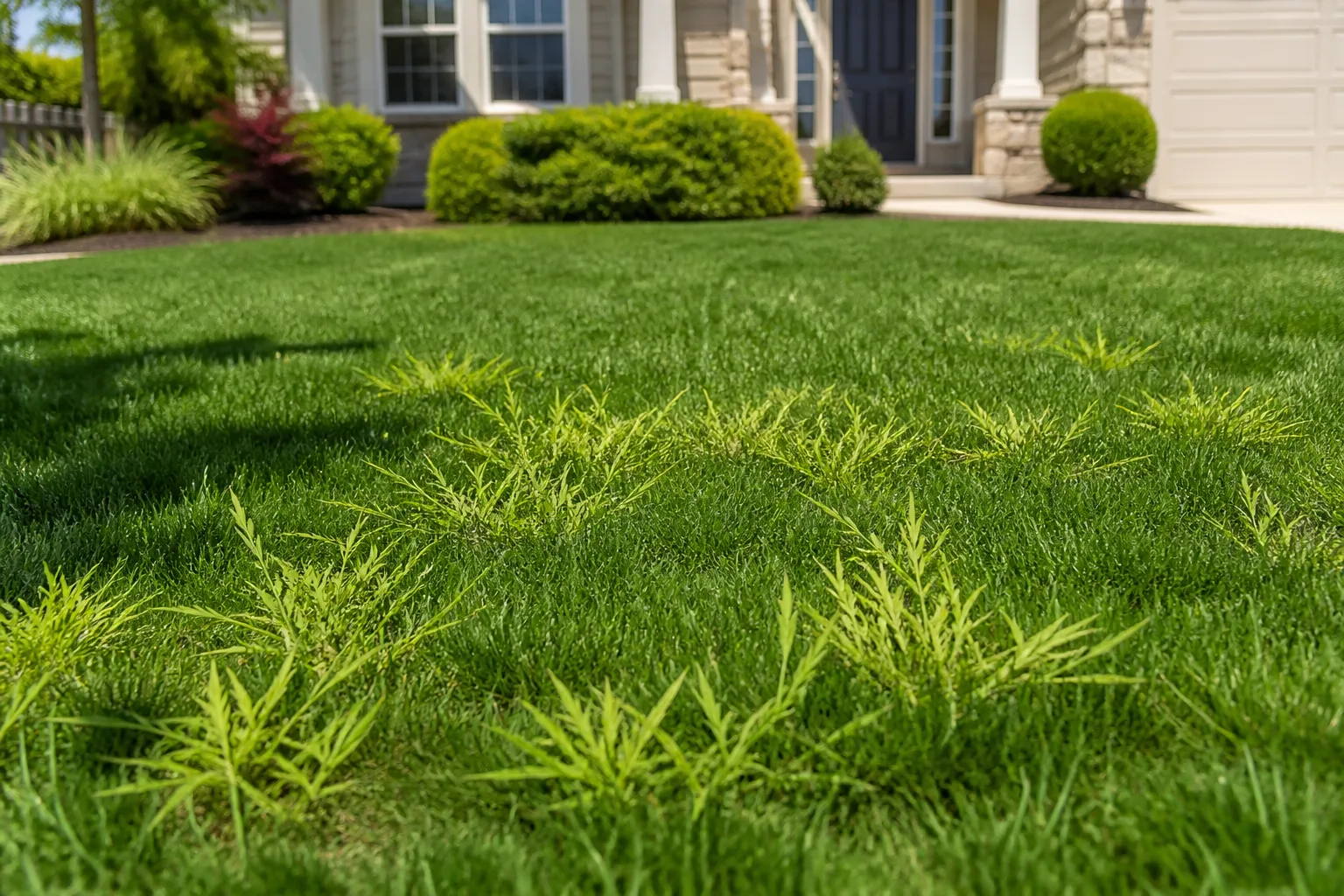
That pale, wide-bladed patch spreading low across your lawn in July is probably crabgrass—but “probably” is not good enough when you are deciding whether to hand-pull, spot-spray, or wait for frost. Crabgrass belongs to the genus Digitaria, a group of warm-season annual grasses that germinate from seed each spring, spread flat across the soil surface, set enormous seed crops by late summer, then die at the first hard frost. Correct identification matters because crabgrass is controlled differently than perennial grassy weeds like quackgrass, and differently than goosegrass, which germinates weeks later and often survives a normal crabgrass pre-emergent window.
The good news: crabgrass has a consistent visual signature once you know what to scan for. This guide walks through three fast field checks, what the plant looks like at every growth stage, how to separate smooth vs large crabgrass, and how to avoid the look-alikes that send homeowners down the wrong control path.
Start Here: Three Field Checks to Confirm Crabgrass
You do not need a magnifying glass to make a working ID in the field, but you do need to look at more than color from the driveway. Run these three checks in order. If all three match, you are almost certainly looking at crabgrass.
Check 1 — Pale Color and Low, Sprawling Habit
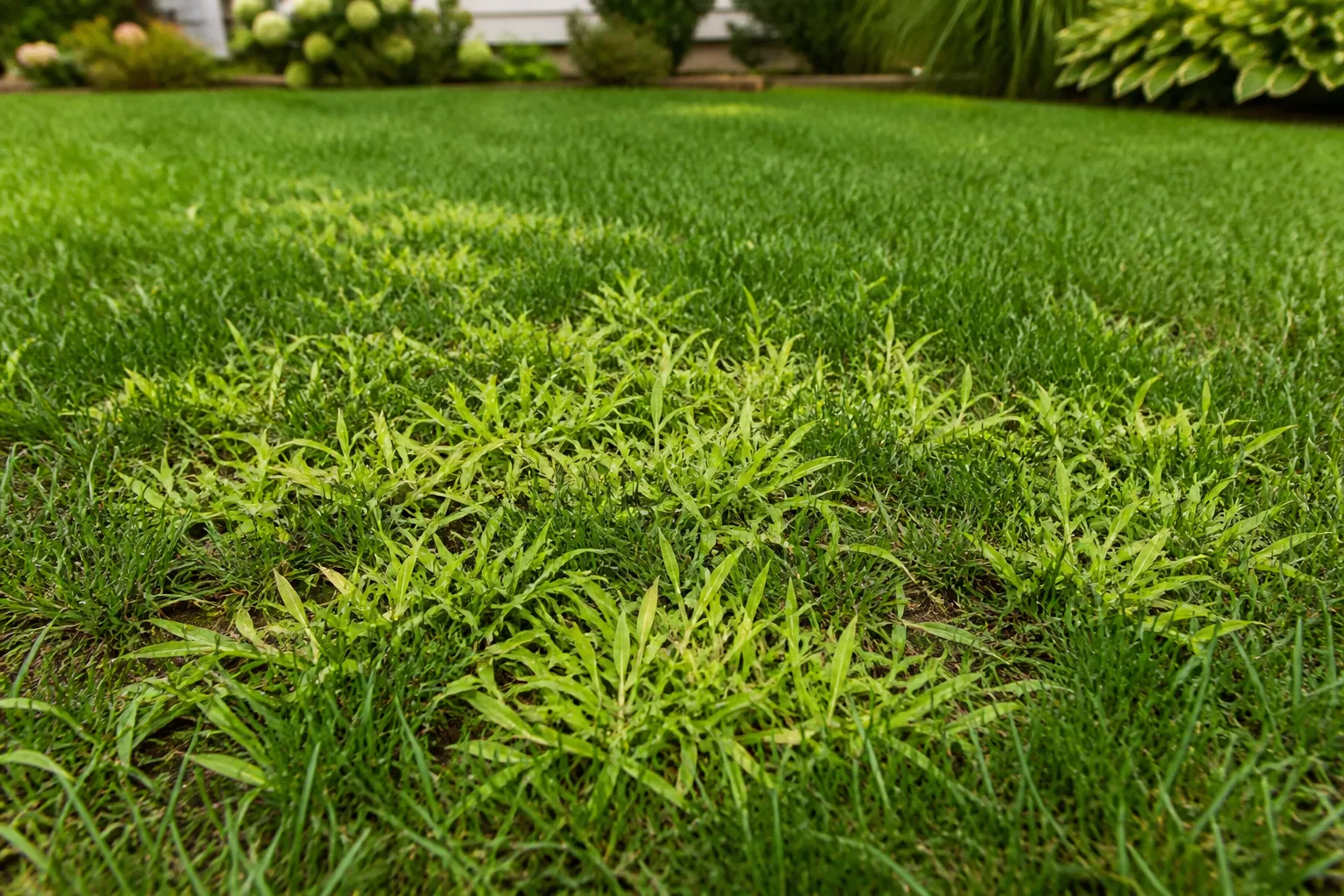
Healthy cool-season lawn grasses—Kentucky bluegrass, perennial ryegrass, tall fescue—usually read as a deeper, more uniform green in summer. Crabgrass clumps look noticeably lighter, often a yellow-green or lime-green compared to the turf around them. The growth habit is the bigger tell: crabgrass does not grow upright like turf. Stems sprawl horizontally from a central crown, hugging the ground like crab legs—hence the name.
Mature plants form star-shaped rosettes when viewed from above, with stems radiating outward and rooting at nodes where they touch soil. Purdue Turfgrass Science describes both common lawn species as spreading summer annuals that form clumps once tillering begins, often filling thin turf or bare soil (Purdue crabgrass overview). If the patch stands tall and vase-shaped like turf, suspect something else first.
Check 2 — Wide Blades, Membranous Ligule, and Stem Hairs
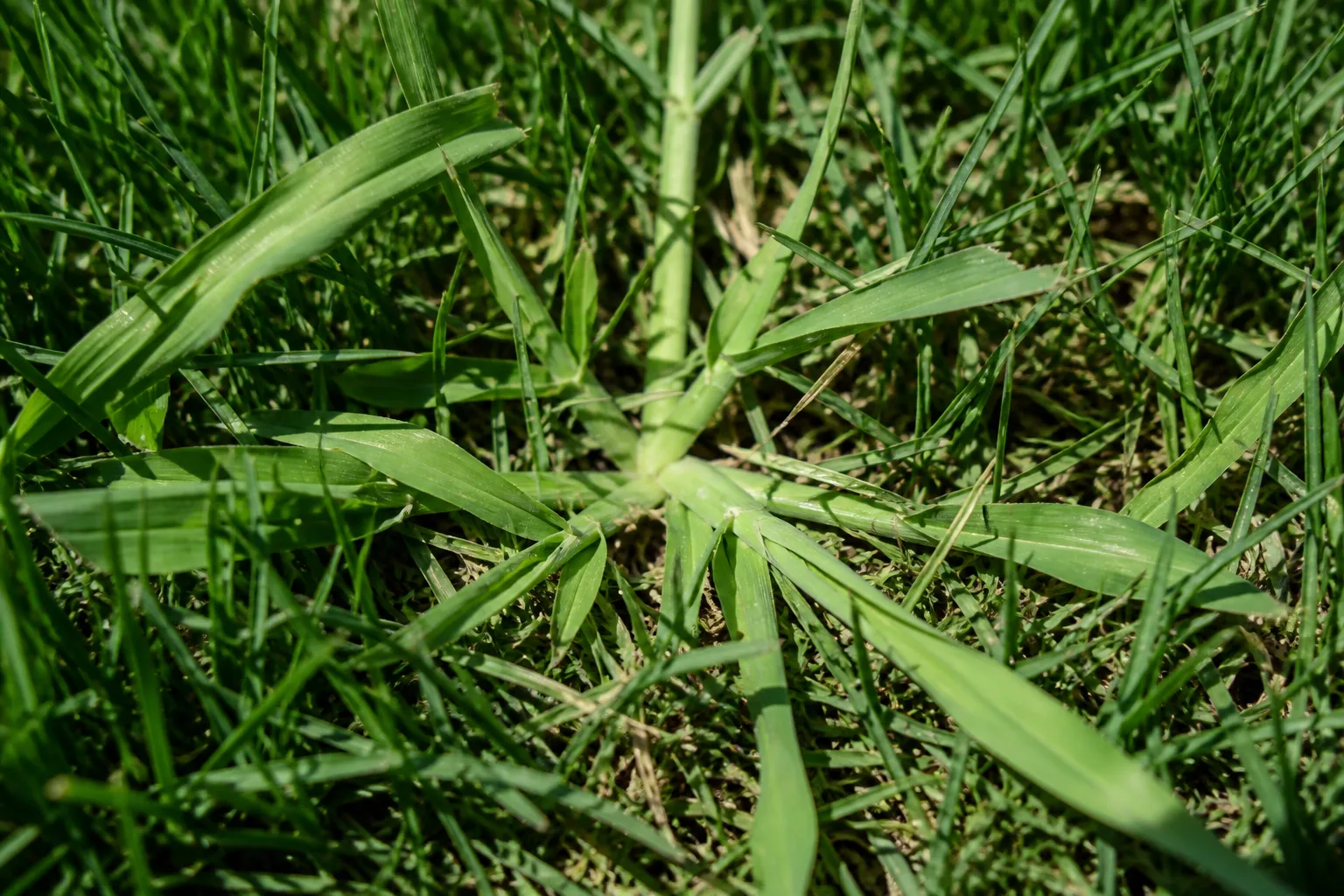
Crabgrass blades are wider and coarser than most fine turfgrass leaves—often compared to a pencil width in young plants, widening as the plant matures. Pull one stem and examine the collar where the leaf meets the stem. Crabgrass has a membranous ligule (a thin papery flap) at that junction. Whether the plant is hairy determines the species:
Large or hairy crabgrass (Digitaria sanguinalis) has hairs on stems and leaves—you can feel them. Smooth crabgrass (Digitaria ischaemum) is mostly hairless except for a few hairs at the collar near the ligule. Smooth crabgrass blades are slimmer (about ¼ inch wide) and sometimes show a pinkish-red tint at the base where stems meet soil.
Both species have rolled vernation—new leaves emerge rolled, not folded flat like some turf grasses. This is a botanist’s detail, but it explains why crabgrass blades look tubular when young.
Check 3 — Finger-Like Seed Heads in Late Summer
If it is August or September and your mystery grass has produced seed, identification gets easy. Crabgrass seed heads are digitate—several narrow spikes (usually three to seven) extend from a single point on the stem like fingers on a hand. They appear at multiple nodes along sprawling stems, not as a single tidy seed stalk.
Each mature plant can produce tens of thousands of seeds; UMass Extension notes that a single large crabgrass plant may yield on the order of 150,000 seeds under favorable conditions (UMass Biology and Management of Crabgrass). Once seed heads are present, treat identification as confirmed—even if color seemed ambiguous earlier in the season.
Crabgrass at Every Growth Stage
Crabgrass looks different in April than it does in August. Matching the plant to its stage prevents the most common ID mistake: calling a fescue seedling “crabgrass” in spring, or calling August crabgrass “just stressed turf” because you missed the seed heads.
Seedling Stage (Late Spring)
Crabgrass seeds germinate when soil in the upper 1–2 inches holds 55–58°F at daybreak for several consecutive days—typically late spring, though timing shifts by region and year. Penn State Extension emphasizes soil temperature over calendar dates for summer annual grass weeds (Penn State summer annual grass control).
At emergence, seedlings are easy to miss. They look like tiny corn plants—thin, upright, pale green shoots with narrow first leaves. Within a week or two, leaves widen and the plant begins its low spread. Seedlings along driveways, sidewalks, and pavement edges appear first because concrete and asphalt warm the soil faster. This is the hardest stage for ID and the best stage for prevention—once you see sprawling clumps, the easy window has narrowed.
Vegetative Spread (Early to Mid-Summer)
By June and July, crabgrass becomes obvious. Stems lengthen, branch, and fall outward, forming the crab-leg pattern. Blades widen and lie flatter than turfgrass. Clumps often appear in circles or patches where last year’s plants dropped seed or where turf is thin from compaction, dog traffic, or summer heat stress.
Mowers struggle here: wide, prostrate stems dodge the blade and spring back. Foot traffic does not kill it—crabgrass tolerates heat and drought better than stressed cool-season turf, which is why it looks like the last green thing in a browned-out August lawn. Nodes that contact soil can root and produce secondary stems, so one crown can cover a surprisingly large area by midsummer.
Mature and Seeding Stage (Late Summer)
From late July through September, crabgrass shifts energy to reproduction. Seed heads emerge at stem tips and nodes—those finger-like spikes are the definitive ID feature. Stems may turn reddish near the base, especially on smooth crabgrass. Plants that were mowed repeatedly stay lower but still seed; mowing after seed set can spread seed across the lawn, which is why bagging clippings in heavily infested areas matters.
The first hard frost kills all crabgrass plants—they are true annuals. Brown, dead mats may linger into fall, but the living threat is the seed bank left behind, not the dead foliage. Do not confuse winter-killed crabgrass skeletons with dormant perennial grasses that will resprout from crowns in spring.
Large (Hairy) Crabgrass vs Smooth Crabgrass
Two species dominate North American lawns: large crabgrass (Digitaria sanguinalis, also called hairy crabgrass) and smooth crabgrass (Digitaria ischaemum). Control tactics are similar, but knowing which you have helps with scouting and tracking whether your prevention program is working.
Digitaria sanguinalis — Large or Hairy Crabgrass
Large crabgrass is the more aggressive spreader in many thin, sunny lawns. It can reach 3½ feet across if unmowed, with leaf blades up to ½ inch wide and 6 inches long. Stems and leaves are distinctly hairy—run your fingers along a stem and you will feel rough pubescence. Seed spikes are slightly coarser than smooth crabgrass. In disturbed soil, garden edges, and bare patches, large crabgrass often wins the race.
Digitaria ischaemum — Smooth Crabgrass
Smooth crabgrass is typically smaller—often under 6 inches tall in mowed turf, spreading roughly 2½ feet. Blades are narrower (about ¼ inch), tapering to a point, with a smoother texture. Hairs appear only at the leaf collar near the ligule, not along the full stem. Stems may bend at nodes and develop a pink-to-red base where they meet soil—a useful field mark when seed heads are not yet present.
If you are not botanizing at species level, treat both as crabgrass for management purposes. The ID still matters for record-keeping: if smooth crabgrass dominates your edges year after year, compaction and heat stress are likely drivers worth fixing alongside herbicide timing.
Where Crabgrass Shows Up First on Your Property
Crabgrass is an opportunist, not a random invader. It wins where cool-season turf is weakest and soil is warmest. Scout these zones first every late spring:
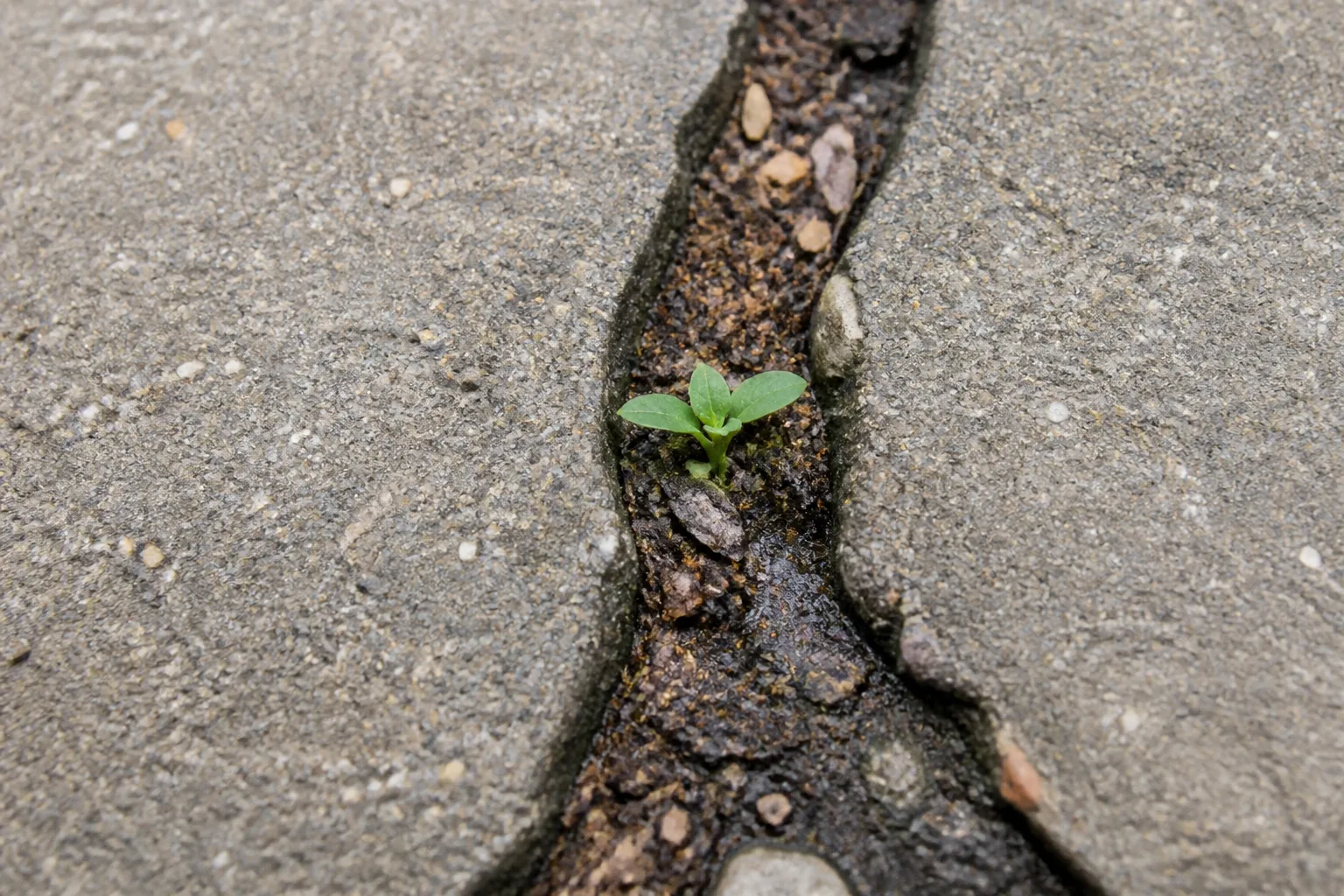
Pavement edges and heat islands: Driveways, sidewalks, curb lines, and patio seams warm soil early and stay hot. Crabgrass seedlings here can be two to three weeks ahead of the open lawn. The same microclimate that grows weeds in cracks produces your earliest crabgrass warnings.
Thin or scalped turf: Lawns mowed below 3 inches, drought-stressed yards, and areas damaged by disease or insects leave bare soil and light that seeds need. Purdue Turfgrass Science lists low mowing, underfertilization, and summer thinning as primary drivers of crabgrass invasion (Purdue crabgrass overview).
Compaction zones: Play paths, gate entrances, and parking-adjacent lawn strips hold heat and limit turf root depth. Crabgrass does not need deep soil—it needs warmth and an opening.
Last year’s crabgrass cemeteries: Where mature plants seeded heavily, the soil seed bank is loaded. Expect concentric regrowth in the same arcs unless pre-emergent timing and fall overseeding reduced the seed load.
Crabgrass Look-Alikes That Fool Homeowners
Misidentification wastes money and seasons. These grasses are confused with crabgrass most often—and each needs a different strategy.
Tall Fescue Clumps and Other Upright Turf Grasses
Tall fescue is a common cool-season turfgrass, not a weed, but clumpy tall fescue in a bluegrass lawn can look like a pale invader. Key differences: fescue clumps grow upright and bunch-forming, with darker green, thicker blades and no digitate seed heads. Fescue is perennial—the same clump returns next spring from a crown, whereas crabgrass dies in winter.
Orchard grass and other coarse pasture grasses occasionally appear in rural lawns with similar upright habits. Check whether the plant survived winter unchanged; crabgrass will not.
Quackgrass and Perennial Grassy Weeds
Quackgrass (Elymus repens) is a cool-season perennial with rhizomes—horizontal underground stems that make hand-pulling feel like you are unraveling a network. Quackgrass grows more upright, often with clasping auricles (ear-like projections) at the leaf base that crabgrass lacks. When you tug quackgrass, neighboring turf may lift with it; crabgrass fibrous roots usually release more cleanly.
Quackgrass survives winter; crabgrass does not. If the same plant is green in early spring before soil hits 55°F, it is not crabgrass. Pre-emergent herbicides do not touch quackgrass rhizomes—another reason ID matters.
Goosegrass, Dallisgrass, and Other Summer Annuals
Goosegrass (Eleusine indica) is the classic crabgrass confusion in midsummer. It germinates three to four weeks later than crabgrass and loves compacted soil. Look for flattened, silvery leaf sheaths and a zipper-like seed head—not digitate fingers. If your “crabgrass” returns after a well-timed pre-emergent, suspect goosegrass.
Dallisgrass (Paspalum dilatatum) is a perennial clumping grass with tall, V-shaped seed heads on long stalks—not low, finger-like spikes. It is common in the South and in irrigated lawns.
Bermudagrass spreads by stolons and rhizomes as a perennial warm-season turf or weed, with finer texture and a different growth architecture than annual crabgrass. In transition zones, homeowners sometimes mistake bermuda patches for crabgrass in summer.
Field Tests When You Are Still Not Sure
When the three field checks leave you on the fence—common with young spring seedlings—use these low-tech confirmations before buying herbicide.
The winter survival test: Did this exact patch die completely over winter and reappear from bare soil in late spring? Crabgrass yes; quackgrass, dallisgrass, and fescue no.
The pull test: Moist soil after rain, grip at the crown, and pull upward. Crabgrass fibrous roots often release as a single shallow clump. Quackgrass resists and pulls connected white rhizomes.
The hair test: Feel the stem. Widespread hairs point to large crabgrass; mostly smooth stem with collar hairs only points to smooth crabgrass; no hairs and silvery flattened sheaths suggest goosegrass.
The seed-head wait: If it is early summer and you are stuck, mark the patch and revisit in six weeks. Crabgrass seed heads will resolve the question. Do not broadcast post-emergent on a guess.
The mow-line test: After mowing, crabgrass often remains visibly prostrate with wide blades below the turf canopy height. Upright grasses cut evenly with the lawn.
What to Do Once You Have Confirmed Crabgrass
Identification is step one; management depends on season and plant size. You do not need to solve the entire lawn today, but you should prevent seed set on plants you have confirmed.
If seedlings are young and few (spring): Hand-pull after rain, or use a weeding tool that lifts the shallow crown. This is also pre-emergent season—see our guide on when to apply pre-emergent herbicide for soil-temperature timing.
If plants are spreading but not yet seeding (early summer): Hand-pull manageable patches; for larger areas, selective post-emergent herbicides labeled for crabgrass in turf work best on younger tillers. Our ways to get rid of crabgrass guide matches methods to growth stage.
If seed heads are present (late summer): Prioritize preventing more seed drop—bag mowing clippings in infested zones, hand-remove plants before they shatter seed, and plan fall turf repair. Pre-emergent applied now will not kill established plants.
For organic-first lawns: Cultural prevention—tall mowing, fall fertilization, overseeding thin areas—pairs with corn gluten timing detailed in natural ways to prevent crabgrass.
For pavement and crack growth: Low crabgrass in seams is the same species with an earlier start. Removal and sealing gaps is covered in grass in driveway and sidewalk cracks.
Crabgrass in a neighbor’s untreated lawn will reseed yours regardless of your ID skills. Focus on what you can control: accurate identification, stopping seed on your property, and thickening turf so next year’s seedlings lack light and space.
Conclusion
Crabgrass looks like a pale, low, sprawling annual grass with wide blades, a membranous ligule, and—by late summer—finger-like seed heads at multiple stem nodes. Large crabgrass feels hairy; smooth crabgrass is mostly smooth with possible pink stem bases. It is not tall fescue (upright, perennial, darker), not quackgrass (rhizomatous, auricles, winter-hardy), and not goosegrass (later germination, silvery sheaths, different seed head).
Confirm with the three field checks, watch pavement edges for the earliest seedlings, and separate species only if you are tracking a multi-year control plan. Once you are sure, match your response to the calendar—prevention in spring, removal or selective post-emergent in summer, turf repair in fall. Get the ID right and the control choices become straightforward instead of expensive guesswork.