Compost Tea: What It Is and How to Use It Safely
What is compost tea? Learn the difference between tea, extract, and leachate, plus a safer brew method, application rules, and honest limits.
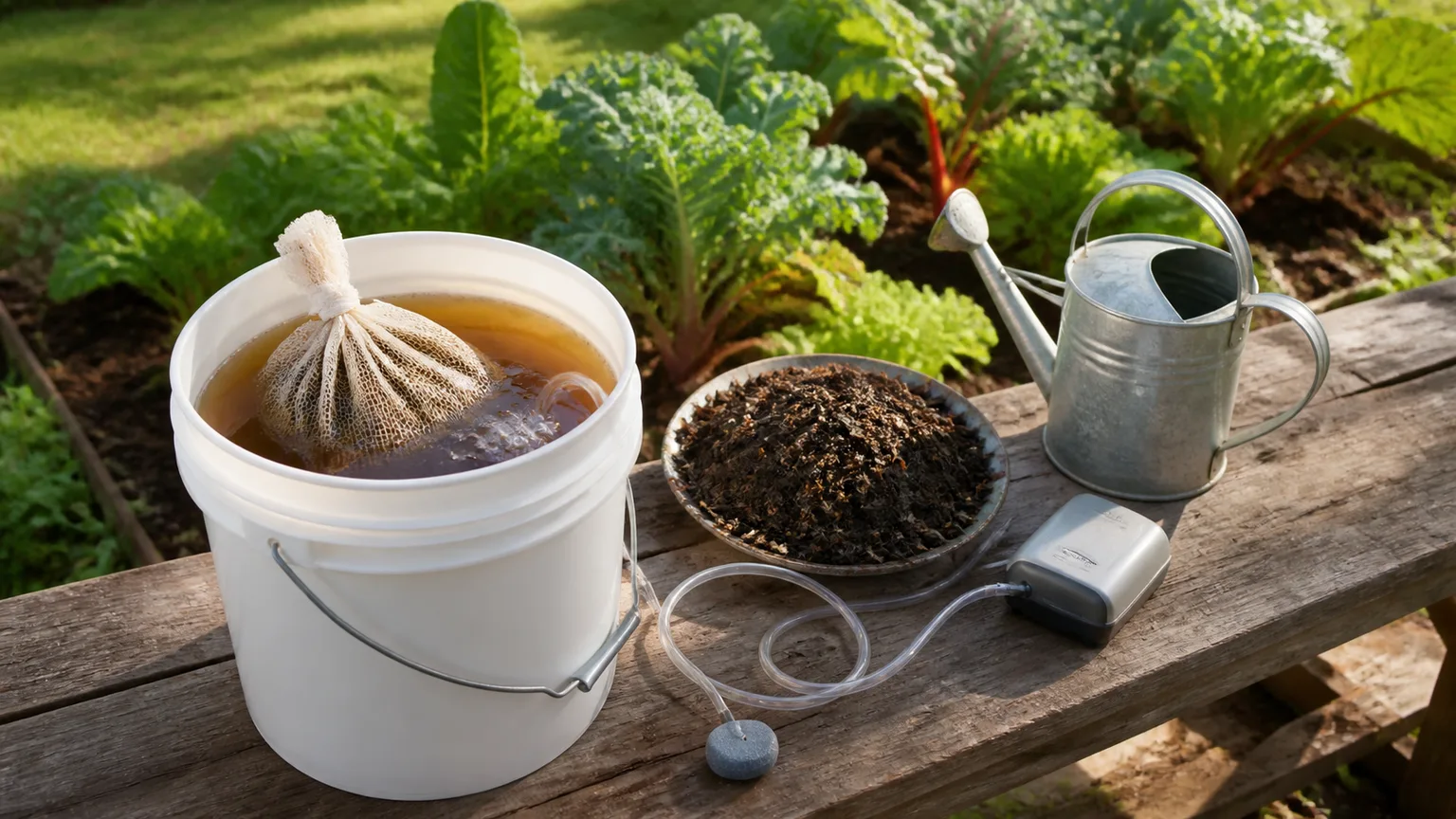
Compost tea is one of those gardening ideas that sounds both obvious and slightly mysterious: put finished compost in water, let the mixture sit or bubble, and use the brown liquid on plants. The appeal is easy to understand. You can turn a small amount of compost into something pourable, make use of materials you already have, and experiment with the living organisms that make healthy soil work.
The catch is that compost tea is not a standardized fertilizer. Its nutrient content and microbial community change with the starting compost, water, oxygen, temperature, brewing time, and any additives you use. A careful batch may be a useful soil drench or a modest biological supplement; a poorly managed batch can become an oxygen-depleted, contaminated mixture that is not worth putting on edible crops.
The most useful way to think about compost tea is as a fresh liquid extract from mature compost, not as a miracle cure. If you make it, keep the recipe simple, use clean materials, apply it promptly, and let finished compost, mulch, correct watering, and sound disease management do the heavy lifting.
The Short Answer: Compost Tea Is Useful, but Not Magic
Compost tea is water that has extracted some soluble nutrients, organic compounds, and microorganisms from finished compost. Gardeners use it as a soil drench around roots or, with more caution, as a foliar spray. The “tea” may be made by steeping compost without aeration or by actively bubbling the mixture with an aquarium pump.
There are plausible reasons it can help. Compost-derived organisms may compete with some pathogens, and dissolved organic material can support soil biology. But a tea does not automatically contain the right microbes for your plant, does not reliably replace fertilizer, and should not be sold as a universal disease treatment. Even university extension guidance has described disease suppression as promising but too inconsistent for routine recommendations.
If your goal is simply to improve soil structure, moisture retention, and long-term fertility, finished compost spread on the soil is more predictable. Brew tea when the liquid format solves a real problem—such as reaching a dense planting, applying a mild root-zone drench, or learning how your compost behaves—not because every plant needs a weekly microbial drink.
What Compost Tea Actually Is
In its simplest form, compost tea is an aqueous extract of mature compost. The compost is suspended in water, stirred or aerated, and then removed or filtered before the liquid is applied. The result is usually brown, earthy-smelling, and variable from batch to batch.
The liquid can carry some soluble nitrogen, phosphorus, potassium, micronutrients, humic compounds, and organisms that were present in the compost. That does not mean the liquid contains a complete, balanced fertilizer analysis. Most of the carbon and nutrients in finished compost remain in the solid material, which is why compost itself remains the more substantial soil amendment.
Tea, Extract, Leachate, and Manure Tea Are Not Interchangeable
The names matter because the risks and expected uses differ.
| Material | What it is | Practical takeaway |
|---|---|---|
| Compost extract | Mature compost briefly mixed or steeped in water, usually without trying to grow a large microbial population | The simplest home-garden option; use fresh and keep expectations modest |
| Aerated compost tea | Compost and water brewed while air is pumped through the mixture | Faster and more equipment-dependent; oxygen and hygiene still matter |
| Non-aerated compost tea | Compost and water held with little or no active aeration for a longer period | Easy to make, but the oxygen level and microbial balance are harder to control |
| Compost leachate | Liquid that drains through a compost pile or bin | Not the same as tea; it may carry contaminants and is a poor choice for spraying food crops |
| Manure tea | Water extract made from manure rather than plant-based finished compost | Higher food-safety concern; do not substitute it for compost tea casually |
The University of Vermont Extension explanation of compost tea makes the leachate distinction clearly: dark liquid leaking from the bottom of a pile is not automatically a clean plant supplement. Leachate can contain organisms that cause illness, especially when the composting process and source materials are unknown.
What the Liquid Can—and Cannot—Deliver
Think of compost tea as a delivery format, not a new category of plant food. It makes some compost-derived material easier to pour around roots or filter into a sprayer, but it does not concentrate all the benefits of a wheelbarrow of compost into a watering can.
It also cannot guarantee a stable inoculation of beneficial microbes. Some organisms may survive the brew, while others may be outcompeted, die as oxygen is consumed, or fail to establish in a different soil environment. The tea’s effect is therefore more conditional than the phrase “beneficial microbes” suggests.
Why Compost Tea Is Suddenly Popular Again
Compost tea fits several gardening habits that are having a moment: turning household and yard waste into inputs, reducing reliance on purchased products, and paying closer attention to the soil food web. It is also visually satisfying. A bucket, a mesh bag, and an air stone make an invisible soil process feel tangible.
There is a practical economic reason too. A gardener who already has mature compost can make a small batch with inexpensive equipment instead of buying another liquid product. The renewed interest also reflects real horticultural research into microbial communities and biostimulants, although research interest is not the same thing as a guarantee for a backyard recipe.
Social-media recipes often flatten the distinction between a short extract, a long fermentation, and a carefully monitored aerated brew. They may also encourage sugar, molasses, fish hydrolysate, or kelp as “food” for microbes. Those additions can make a batch biologically more active, but they can also feed organisms you do not want and make food-safety management much harder.
Does Compost Tea Actually Work?
The honest answer is sometimes, under specific conditions, with variable results. Compost tea has plausible mechanisms and a body of research behind it, but the research does not support treating every home brew as a dependable fertilizer or fungicide.
The Washington State University compost-tea literature reference catalogs studies on disease suppression, compost extracts, aerated teas, non-aerated teas, and the problems associated with leachates. The range of methods and outcomes is itself important evidence: compost type, brewing conditions, crop, pathogen, and application method all change the result.
There are encouraging newer findings. A 2025 study in Frontiers in Plant Science tested a characterized aerated tea made from plant residues, straw, and mature cow manure on lettuce, onion, and chard in protected Mediterranean conditions. Yield increases were reported in that specific system, but the researchers also stressed the need for controlled feedstock and brewing conditions, immediate use, and further work on pathogen risk. That is a useful signal—not a universal home-garden recipe.
For a home gardener, the realistic potential benefits are modest:
- A mild supply of soluble nutrients and organic compounds around the root zone.
- A temporary addition of organisms from a mature compost source.
- A convenient liquid format for beds where spreading solid compost is awkward.
- Possible support for plant vigor when the soil, water, light, and roots are already in good shape.
The unrealistic promises are just as important to name. Compost tea will not correct compacted soil overnight, cure an active fungal disease on its own, replace a soil test, or make a chronically dry plant thrive. If a plant is yellow because its roots are waterlogged, more liquid—microbial or otherwise—is the wrong first step.
Why Results Vary From One Batch to the Next
Finished compost is not a laboratory culture. Two piles made from different leaves, kitchen scraps, manures, temperatures, and moisture levels can contain different nutrients and microbial communities even when both look dark and crumbly.
The brew adds more variables: water chemistry, temperature, compost-to-water ratio, oxygen, agitation, container cleanliness, brewing time, filtration, and the delay before application. A tea brewed in a cool shed with mature plant compost is not equivalent to one brewed in warm weather with manure, molasses, and an air pump.
This is why a neighbor’s success is useful as an observation but not proof that your batch will do the same thing. Judge tea by modest, repeatable outcomes—soil moisture, new growth, root-zone response—not by claims that it will prevent every disease or eliminate fertilizer needs.
Choose the Right Starting Material Before You Brew
The safest ingredient is finished, mature compost with a clean history. It should be dark and crumbly, have an earthy smell rather than an ammonia or rotten-egg odor, and show no obvious undecomposed food scraps, fresh manure, or diseased plant material.
For food gardens, the source matters even more. Compost made from unknown municipal inputs, pet waste, raw manure, or a pile that never heated evenly is not a good candidate for a foliar spray. The USDA Agricultural Research Service’s compost-tea safety research found that additives used in brewing could encourage the growth of E. coli and Salmonella even when the starting tea contained very low numbers of those organisms.
Use potable water and clean, non-reactive equipment. If your tap water is treated, do not assume that letting it sit removes every disinfectant or contaminant; follow local water guidance or use a known-safe source. Rinse buckets, mesh bags, tubing, strainers, and watering cans before and after each batch.
A Safer Beginner Method for Making Compost Tea
For a first attempt, make an unamended compost extract rather than a heavily fed microbial brew. This keeps the number of variables down and avoids the most questionable part of internet recipes: adding sugar or other nutrients to encourage rapid microbial growth without testing the final liquid.
This method is best for ornamental beds and general soil application. If you grow food for sale, manage a certified organic operation, or plan to spray edible leaves, consult your extension service and follow the rules that apply to your crop and location.
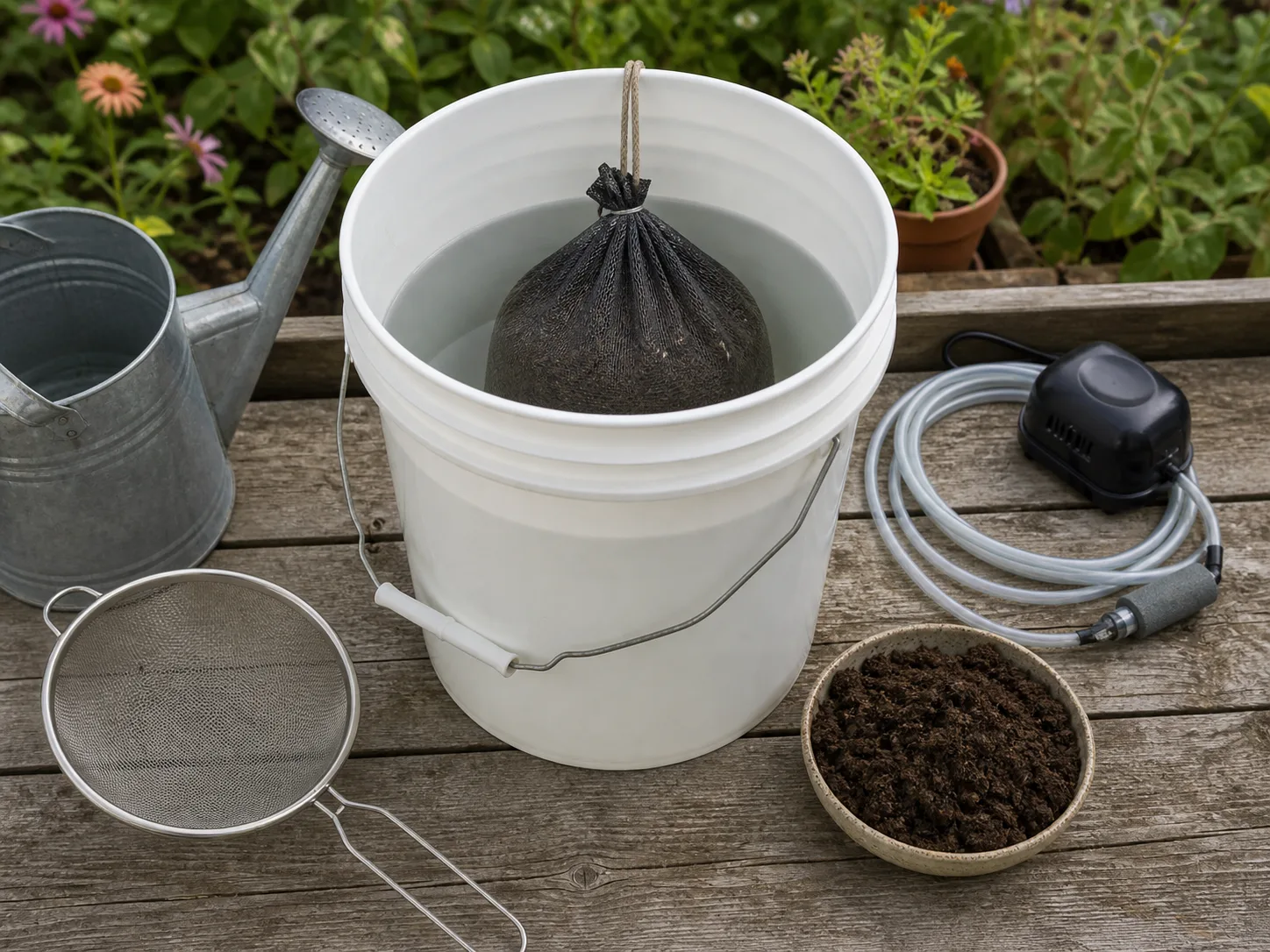
Materials for a Small Batch
- A clean 5-gallon food-safe bucket or similar container.
- One to two gallons of potable water.
- About two cups of mature, finished compost.
- A clean mesh bag, old piece of tightly woven cloth, or strainer.
- A clean stirring tool and a second container for the filtered liquid.
- A watering can for soil application.
Do not add molasses, sugar, fruit juice, fish hydrolysate, kelp, or other microbial foods to this beginner batch. Additives can change oxygen demand and microbial growth in ways you cannot see, and USDA research specifically raises concern about pathogen multiplication when nutrient additives are present.
Step-by-Step Brewing and Filtering
- Clean the equipment. Wash the bucket, mesh bag, stirring tool, and watering can, then rinse them well so soap residue does not enter the brew.
- Add the water first. Fill the bucket with potable water, leaving room for the compost and stirring. Use water at a moderate outdoor temperature rather than very hot or icy water.
- Contain the compost. Put mature compost in the mesh bag and secure it, or add it loose if you are prepared to filter carefully later.
- Steep and stir. Suspend the bag in the water and stir gently several times during the first day. For a simple extract, use the liquid the same day or after a short steep rather than letting an unmonitored bucket ferment for weeks.
- Inspect before use. An earthy smell is expected. A strong sewage, sulfur, solvent, or ammonia odor is a discard signal, not a troubleshooting challenge.
- Filter the liquid. Remove the bag or strain the mixture through clean cloth so solids do not clog a watering can or sprayer. Return the spent compost to the compost pile.
- Apply promptly. Use the finished liquid the same day when possible. Do not store a bucket in the sun and hope the brew improves with age.
The Gardener’s Supply practical brewing guide describes the familiar bucket-and-stir approach, while Gardener’s Path’s compost-tea guide shows why filtering and a clean receiving container matter. Those practical steps are more useful than copying a recipe’s exact ratio as though every compost pile behaved identically.
Aerated vs. Non-Aerated Compost Tea
Aerated compost tea (ACT) uses an aquarium pump, tubing, and air stone to keep oxygen moving through the liquid. It can be ready more quickly—university extension guidance commonly discusses roughly 24 to 48 hours for aerated brewing—but it is not automatically safer or more effective. The pump must provide enough circulation, the equipment must be clean, and the tea still needs to be used promptly.
Non-aerated compost tea (NCT) is simpler: compost and water steep with occasional stirring or no active bubbling. Longer fermentation times are common, but a bucket that is left unattended can lose oxygen and become anaerobic. The University of Vermont Extension notes that both methods have variables, that aeration can speed production, and that short shelf life is a practical limitation.
If you are curious about ACT, buy or build a small setup only after you can make a clean, unamended extract consistently. A more complicated machine does not rescue questionable compost, contaminated water, or a recipe built around sugar. The quality of the inputs and the discipline of the process matter more than the number of bubbles.
How to Apply Compost Tea Without Creating Problems
Apply compost tea to actively growing plants in moist soil, preferably in the morning or on a cool, cloudy day. Avoid pouring an unfamiliar batch onto drought-stressed roots, saturated soil, seedlings, or freshly transplanted plants; the liquid is not a substitute for correcting those conditions.
Make a Soil Drench Your Default
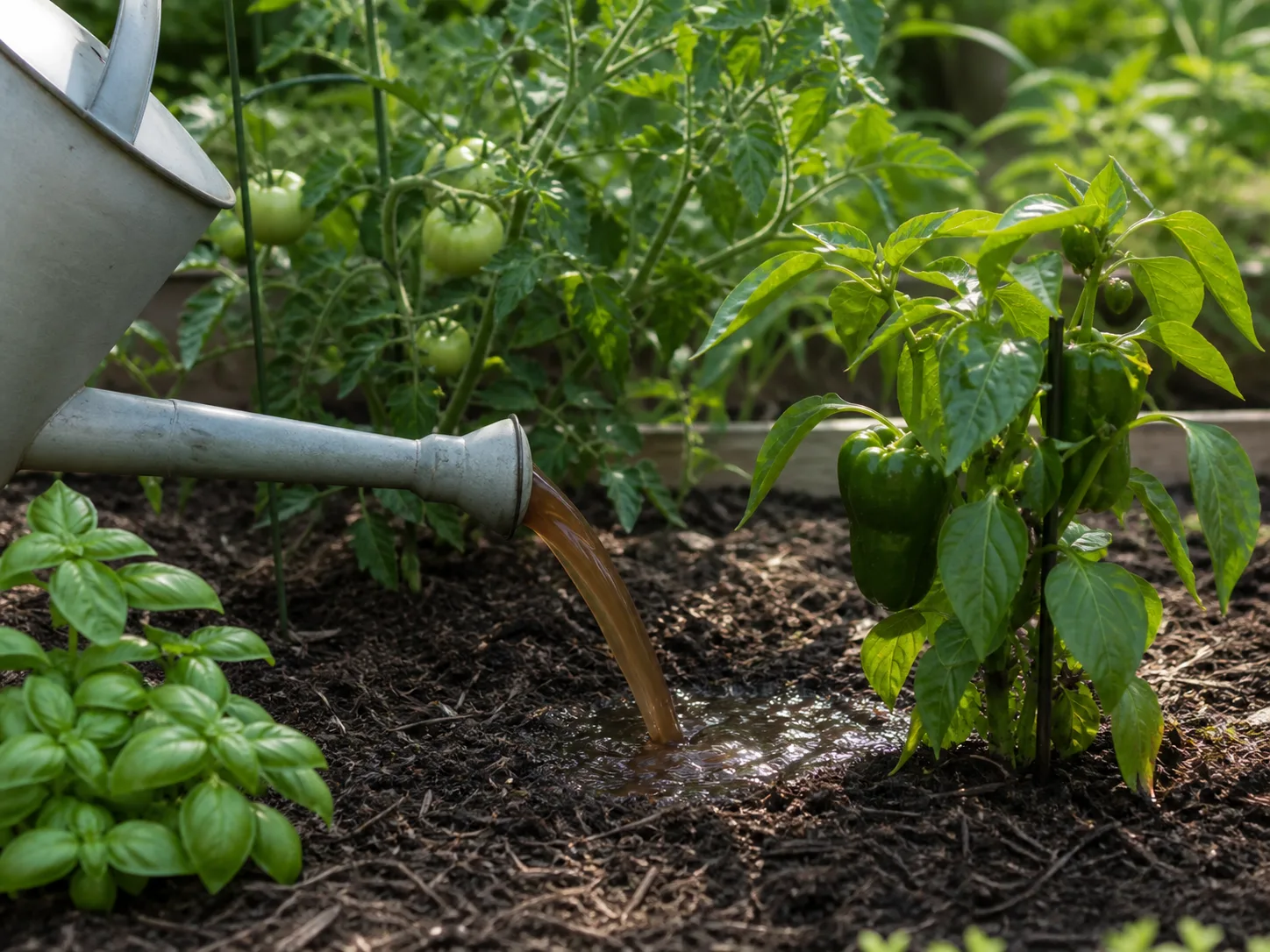
A soil drench is the most sensible starting use because it keeps the tea in the root zone and avoids coating edible leaves. Pour the filtered liquid around the soil surface, keeping it off the plant crown and stem, then water normally if the soil is dry.
There is no universal home-garden dilution that makes every compost tea equivalent. Start conservatively, follow the method’s directions if you are using a tested commercial product, and observe the plant and soil rather than repeatedly applying more because the tea looks weak. A light application is easier to evaluate—and easier to stop—than saturating a container with an unknown brew.
Do not route homemade tea through drip lines, fine sprayers, or irrigation emitters until it has been filtered extremely well. Small particles can clog the system, and the interior of tubing is difficult to clean once organic material settles inside.
Treat Foliar Sprays and Edible Crops With Extra Caution
Foliar spraying is where the safety standard should rise. A leaf spray places the liquid directly on the surface that people may eat, and a homemade brew is not routinely tested for human pathogens. Avoid spraying edible leaves, harvestable fruit, or herbs with an untested home tea.
For ornamentals, a carefully made, filtered, fresh tea may be used as an experimental foliar application, but it still should not be treated as a fungicide. Keep spray off flowers that attract pollinators, avoid hot sun that can spot wet foliage, and stop if the plant shows spotting or a sour odor develops in the tank.
The USDA ARS found that commercial-style additives could support pathogen growth in compost tea. That is why “add more molasses for more microbes” is not a harmless default for a backyard food garden. If your intended use involves edible crops, commercial production, certification, or a disease-control claim, use extension or regulatory guidance rather than an internet recipe.
Mistakes That Turn a Useful Extract Into a Risky Brew
Starting with immature compost. Fresh scraps and incompletely composted manure can contain pathogens, weed seeds, or compounds that irritate roots. Mature compost is the minimum starting point.
Using compost leachate by accident. Liquid draining from the bottom of a bin is not a controlled extract. Treat it as a waste stream unless you have a specific, trusted process for the material.
Adding sugar without understanding oxygen demand. Molasses, fruit juice, and similar ingredients can produce a burst of microbial activity, consume oxygen, and favor organisms you did not intend to grow. The USDA research is the reason this guide leaves them out.
Brewing by calendar alone. “Two weeks” or “36 hours” cannot guarantee that a batch is ready. Temperature, oxygen, feedstock, and equipment change the process. Smell, cleanliness, source material, and prompt use matter more than a magic timer.
Keeping the tea for later. Once active microbes consume available oxygen, the liquid changes. A fresh batch used promptly is a more defensible choice than a sealed jug left in a warm shed.
Applying it to every stressed plant. Wilting, chlorosis, root rot, and disease have different causes. Diagnose first; do not use compost tea as a universal rescue treatment.
Assuming organic means risk-free. “Organic” describes a production approach, not a guarantee that every brew is pathogen-free, correctly diluted, or appropriate for a particular crop.
Compost Tea vs. Finished Compost: Which Should You Choose?
Choose finished compost when your main goal is long-term soil improvement. A top-dressing or shallow incorporation adds organic matter, improves aggregation over time, buffers moisture swings, and releases nutrients gradually. It also avoids the extra equipment, filtration, storage, and microbial uncertainty of a brew.
Choose a simple compost extract when you want a low-cost liquid for a root-zone application and already have clean, mature compost. It may be convenient for densely planted beds, starts a useful observation, and can be applied without moving much solid material.
Choose aerated compost tea only when you are willing to control the process: consistent inputs, clean equipment, a working air system, oxygen-aware timing, and immediate use. The 2025 research study that found crop benefits used a characterized feedstock, measured conditions, and fresh application. That level of control explains why its results should not be copied into a casual bucket recipe without qualification.
If your garden soil is poor, spend your first effort on compost, mulch, drainage, irrigation, and a soil test. Tea is an optional side experiment, not the foundation of soil fertility.
When You Should Skip Compost Tea
Skip a homemade brew when you cannot identify the compost source, the water is questionable, the equipment is dirty, or the mixture smells foul. Discard a batch that develops a sewage-like odor, visible contamination, unexplained mold, or a greasy surface rather than trying to “fix” it with more air or dilution.
Skip foliar use on edible crops unless you have a process and testing standard appropriate for that use. Do not use tea as a substitute for a labeled treatment when a plant has a serious disease, and do not apply it to soil that is already saturated or to roots damaged by overwatering.
Finally, skip brewing when you are only looking for fertilizer. A measured commercial fertilizer or a layer of finished compost gives you more predictable information about what you applied. Compost tea is worth making when you want to explore a fresh, low-cost biological extract with realistic expectations and careful handling.
Conclusion
Compost tea is a liquid extract made from mature compost and clean water. It can supply some soluble nutrients and compost-derived organisms, and research suggests that certain carefully produced teas may support crop growth or disease suppression in specific systems. The same research also shows why results vary and why a home brew should not be treated as a guaranteed fertilizer, fungicide, or soil cure.
For the safest first experiment, use mature compost, potable water, clean equipment, no sugar additives, thorough filtering, and prompt soil-drench application. If finished compost already solves the problem, use it; if food-crop foliar spraying or disease control is the goal, get crop-specific guidance before you brew. The point is not to make the strongest-smelling bucket in the neighborhood—it is to make a small, controlled choice that helps your garden without adding an avoidable risk.



