Tomato Leaves Turning Yellow: Causes and Fixes
Tomato leaves turning yellow? Match symptoms to 13 common causes—from nitrogen loss to Septoria—and get step-by-step fixes that work in your garden.
Yellow tomato leaves are one of the most common mid-season alarms in the vegetable garden, and they are also one of the most misread. A few pale lower leaves during fruit set can be harmless senescence, while a sudden yellow band climbing the stem in wet weather can signal a wilt you cannot spray away. The fix depends less on the color itself and more on which leaves yellow first, what pattern surrounds the yellow, and what the rest of the plant is doing.
Before you reach for fertilizer, fungicide, or the pruning shears, spend five minutes classifying the symptom. That small pause keeps you from drowning an already soggy plant, dumping nitrogen onto a virus, or tearing off leaves that were doing useful work.
Start by reading which leaves turn yellow
Tomato foliage problems follow patterns. Extension diagnosticians at the Missouri Botanical Garden organize many of the serious issues by where symptoms begin and how they move through the plant. Use their logic at home.
Lower, older leaves first usually point toward natural aging, nitrogen shortage, Septoria leaf spot, early blight, or the beginning of soil-borne wilts. Upper, youngest leaves first more often suggest iron chlorosis, some potassium problems, herbicide injury, or certain viruses. Whole-plant yellowing with wilt raises the stakes for root rot, bacterial wilt, Fusarium, or severe overwatering. Yellow with distinct spots, halos, or rings steers you toward fungal or bacterial leaf diseases rather than simple hunger.
Run your hand along the stem while you look. Soft, mushy stems and sour-smelling soil suggest rot. One-sided wilt with otherwise firm tissue suggests Fusarium. A sudden collapse in hot, wet weather with green leaves still attached makes bacterial wilt more likely. None of those checks replaces a lab diagnosis, but they tell you whether your next move is a soil moisture adjustment or an isolation-and-removal decision.
Lower leaves vs upper leaves vs whole-plant yellowing
If only the bottom skirt is fading while new growth stays deep green, ask whether the plant is carrying a heavy fruit load. Tomatoes often shed older leaves to redirect energy upward. If yellow lower leaves also carry brown spots with dark margins or tan centers, shift your attention to leaf-spot fungi. If the yellowing climbs steadily and the plant wilts despite moist soil, stop fertilizing and inspect for vascular wilts described later in this guide.
When the top of the plant turns pale while veins stay dark green, think iron availability before you add more nitrogen. Iron chlorosis is frequently a pH problem, not an iron shortage in the soil. Whole-plant yellowing after a cold rain or transplant usually sits in the environmental bucket until proven otherwise.
When yellow leaves are normal aging
Not every yellow leaf is an emergency. Once tomatoes begin flowering and setting fruit, the plant routinely sacrifices the oldest leaves near the base. They may fade evenly to yellow, then tan, without spots, curling, or wilting on the rest of the plant. New leaves at the growing tip should still look vigorous, and stems should feel firm.
This kind of senescence is especially common on indeterminate varieties that keep producing new growth all season. Removing a few fully yellowed bottom leaves can improve airflow, but you do not need to strip the plant bare. Leave leaves that are only partly yellow unless they show disease signs. They are still photosynthesizing.
The line between normal aging and trouble is movement. Benign yellowing stays low and slow. Pathology climbs, spreads sideways, or arrives with spots, halos, cupping, or wilt. If you are unsure, mark a suspect leaf with a twist tie and check it in three days. Stable, dry, bottom-only yellowing is rarely urgent. Rapid spread is.
Watering problems—too much or too little
Water stress is the fastest way to yellow a tomato, and both extremes do it. Tomatoes need consistent moisture in the root zone, not constant sogginess on the surface. A widely used baseline is about 1 inch of water per week from rain and irrigation combined, but sandy soil, containers, and heat waves can demand more. The number matters less than what your soil actually holds.
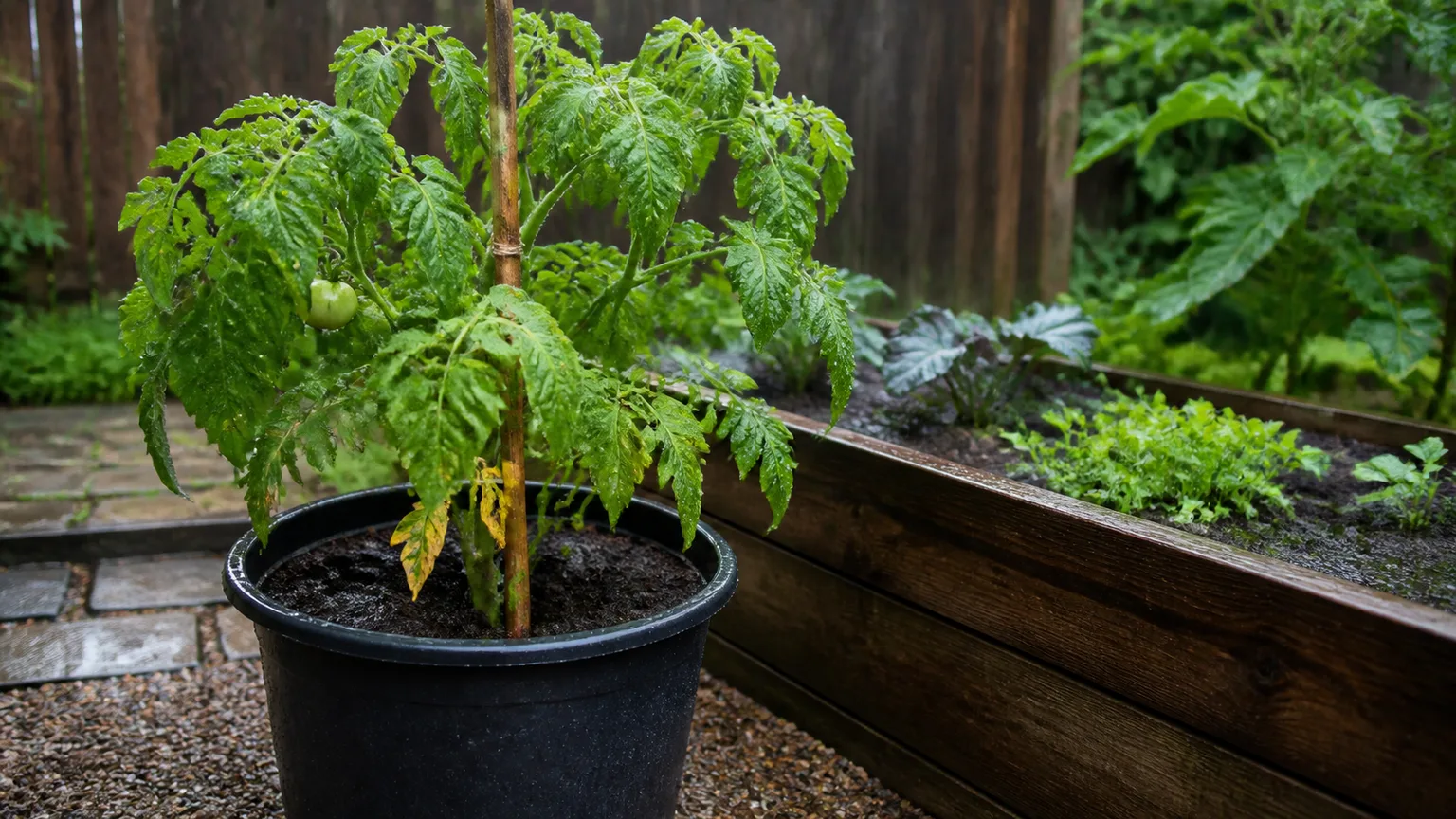
Overwatered plants often look paradoxical: leaves droop and yellow even though the soil is wet. Roots in saturated soil cannot take up oxygen or nutrients efficiently, so the foliage starves while standing in water. Underwatered plants may yellow from the bottom up, feel crispy at the edges, and recover overnight after a deep soak—until the next hot afternoon.
Water at the base, early in the day, so foliage dries before night. Overhead sprinklers that soak leaves every evening invite the leaf-spot fungi covered below. For a deeper look at frequency and container vs in-ground needs, see our guide on how often to water tomato plants.
Signs your tomato is overwatered vs underwatered
Push your finger into the soil 2 to 3 inches below the surface. If it is dry and the plant wilts in the afternoon but perks up by morning, underwatering is plausible. Water slowly until the root zone is moist, then mulch to even out swings. If the soil is wet, the pot feels heavy, or you smell sourness near the roots, hold off on water. Improve drainage, elevate containers, and remove mulch temporarily so the surface can dry. Our overwatered tomato plant guide walks through recovery steps when saturation has already damaged roots.
Nitrogen deficiency
Nitrogen drives leafy growth. When it runs short, the oldest leaves yellow first, often starting at the tips and moving inward, while younger leaves may still look green for a while. Heavy-feeding tomatoes in lean soil, raised beds that leach quickly, or containers that were not refreshed with compost can all show this pattern mid-season.
Fix it with a balanced vegetable fertilizer or a tomato-specific product applied according to the label—commonly something in the range of 5-10-5 or a labeled tomato formula. Side-dress along the drip line rather than against the stem. Avoid dumping extra nitrogen on a plant that is yellowing with spots or wilt; starvation and disease can look similar from a distance, but only one benefits from more feed.
If lower leaves yellow while the top stays dark green and the plant sets fruit normally, nitrogen may not be the whole story. Pair fertility with a soil test so you are not guessing among nitrogen, potassium, and magnesium at once.
Potassium deficiency
Potassium helps tomatoes regulate water and build strong cell walls. Shortage often appears on newer leaves first, with yellowing at the margins that can progress to brown, leathery edges while veins stay greener. Sandy soil, heavy rain that leaches nutrients, drought stress, and very acidic soil can all make potassium harder for roots to access.
Tomato fertilizers are typically higher in potassium (the last number in an N-P-K ratio). A liquid feed can act faster than slow-release granules on a plant that is already showing edge burn. Again, confirm with soil testing when possible. Potassium problems and magnesium problems can overlap; fixing one without data sometimes worsens the other.
Iron chlorosis and high soil pH
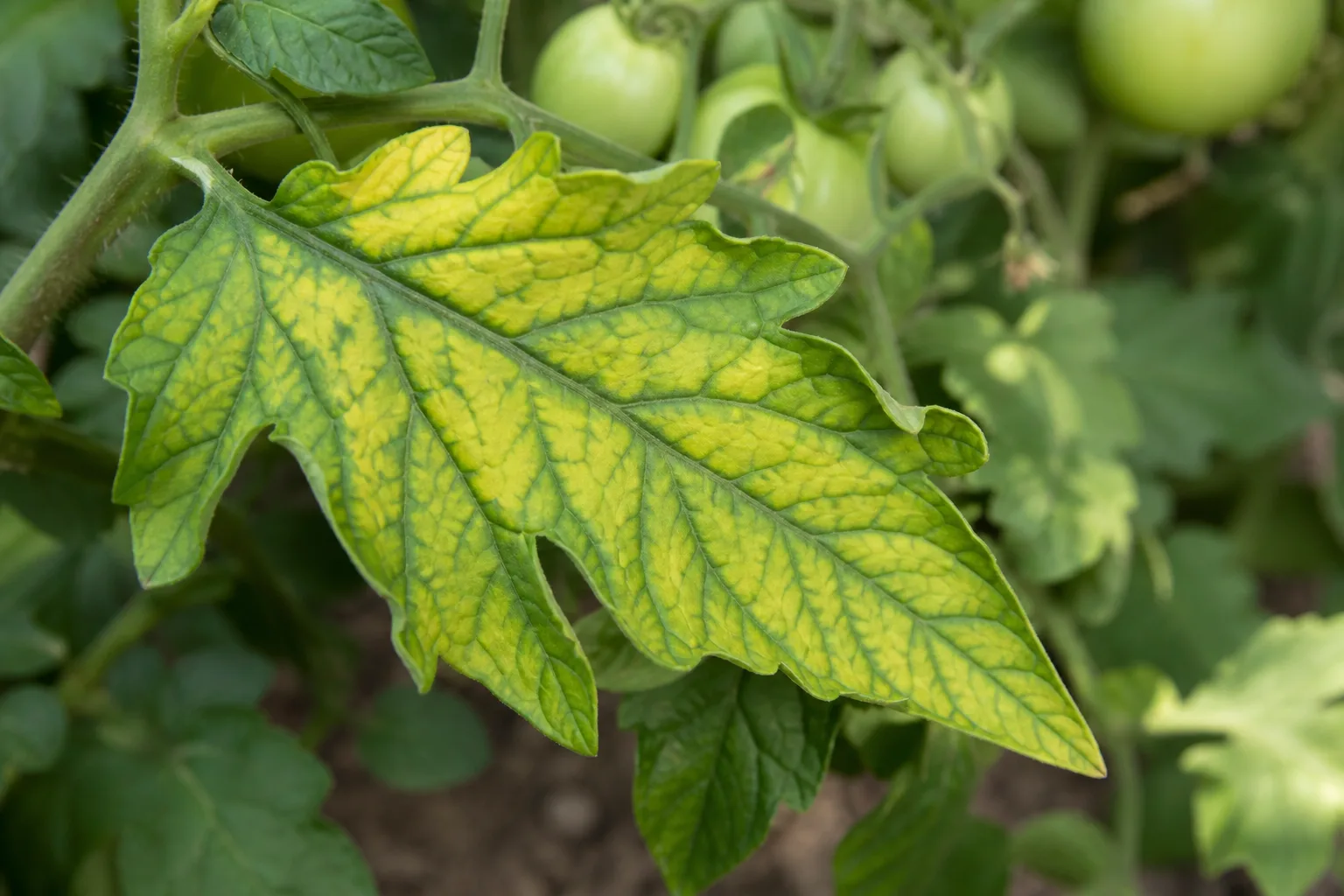
Iron chlorosis shows up on the youngest leaves at the top of the plant. The blades turn pale yellow or lime green while the veins remain darker, producing a sharp contrast. Tomatoes prefer slightly acidic soil, roughly pH 6.2 to 6.8, according to Missouri Botanical Garden guidance on iron chlorosis. In alkaline or poorly drained soils, iron may be present but unavailable.
Lowering pH is a multi-month project, not a single spray. Elemental sulfur, acidifying fertilizers with micronutrients, and consistent organic matter can help over time. Foliar iron chelate sprays can green up new growth temporarily, but they do not fix alkaline soil by themselves. A soil test tells you whether you are fighting pH, true iron shortage, or both.
Do not confuse iron chlorosis with nitrogen deficiency: nitrogen usually hits older leaves first; iron hits the top first.
Magnesium deficiency
Magnesium sits at the center of the chlorophyll molecule, so low magnesium produces interveinal yellowing on older leaves—green veins with yellow or whitish tissue between them. Some gardeners describe it as a marbled or speckled look. Heavy potassium or calcium applications without balanced magnesium can aggravate the problem.
Epsom salt (magnesium sulfate) is a popular home remedy, but Clemson Extension and other university guides stress testing first. If magnesium is already adequate, extra Epsom salt will not help and can throw off nutrient balance. When a test confirms low magnesium, labeled rates mixed into water or soil can improve color on new growth. Old yellow tissue rarely re-greens; you are protecting leaves that have not yellowed yet.
Not enough sunlight
Tomatoes are sun plants. Most varieties need at least six to eight hours of direct sun daily to stay deep green and productive. Shade from neighboring trees, fences, or overcrowded planting can cause pale, yellowish foliage, leggy stems, and poor fruit set.
Container tomatoes are the easiest to relocate. In-ground beds may need pruning back encroaching branches or moving next year’s planting to a brighter row. Reflective heat and light stress are different problems—see the sunscald section—but chronic dull yellowing in dim sites is almost always a light issue before it is a disease.
Transplant shock and cold soil
Freshly transplanted seedlings commonly drop a few lower leaves or turn them yellow while roots establish. Transplant shock usually resolves within one to two weeks if you keep soil evenly moist, protect plants from temperatures below about 45°F, and avoid letting new transplants sit in cold, waterlogged soil.
Planting into cold ground creates a related problem: roots cannot take up potassium well, and leaves may look purplish or yellow until the soil warms. Missouri Botanical Garden notes that tomatoes planted too early may stay stunted all season. Harden off seedlings gradually, plant after your last frost window, and bury heat-loving transplants only when the soil temperature is consistently warm.
Fertilizer burn
Too much fertilizer—especially in containers—loads the root zone with salts and nitrogen that damage fine roots. Burned plants may yellow, brown at leaf margins, and wilt even when soil feels moist. Flushing containers with clean water until it runs freely from drainage holes can leach excess salts. In-ground plants benefit from heavy soaking and a pause on feeding.
Prevention beats rescue. Soil test before the season, follow label rates, and feed smaller amounts more often rather than one heavy dose. If you are unsure, under-fertilize until you see steady new growth. Our guide to fertilizing tomatoes covers timing without the guesswork.
Fungal leaf diseases that start with yellowing
Many tomato leaf diseases begin as yellow halos, pale patches, or general yellowing around lesions on lower leaves after fruit set. Humid weather, overhead irrigation, and tight spacing accelerate all of them. Fungicides such as chlorothalonil, mancozeb, or copper products can prevent spread but do not cure infected tissue; Missouri Botanical Garden is explicit that sprays halt movement, not history.
Cultural control is your first line: stake plants, prune the lowest leaves to the first flower cluster, mulch to block soil splash, rotate tomatoes on a three-year cycle, and water in the morning. Remove infected leaves into the trash, not the compost pile, when lesions are limited.
Septoria leaf spot and early blight
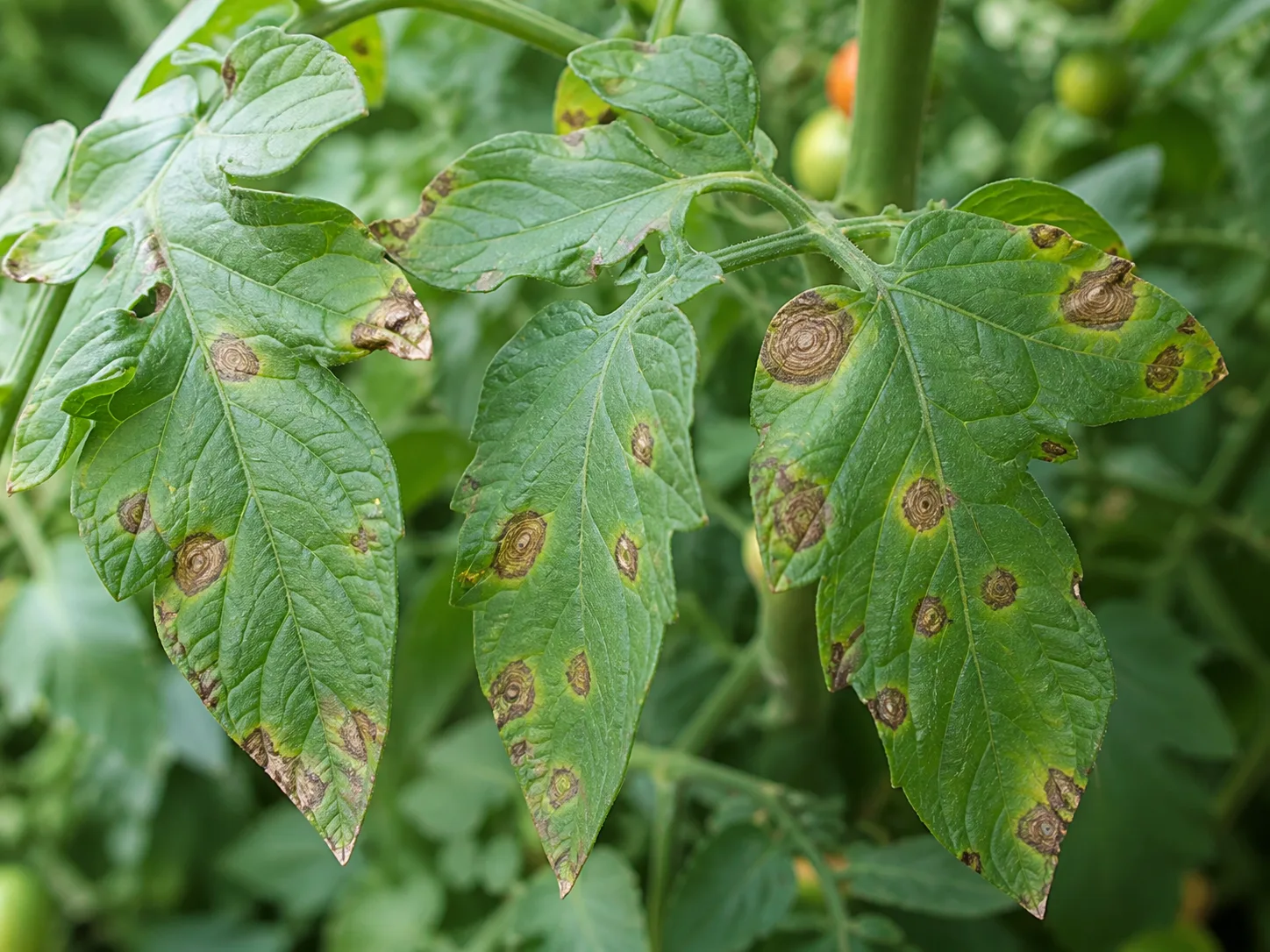
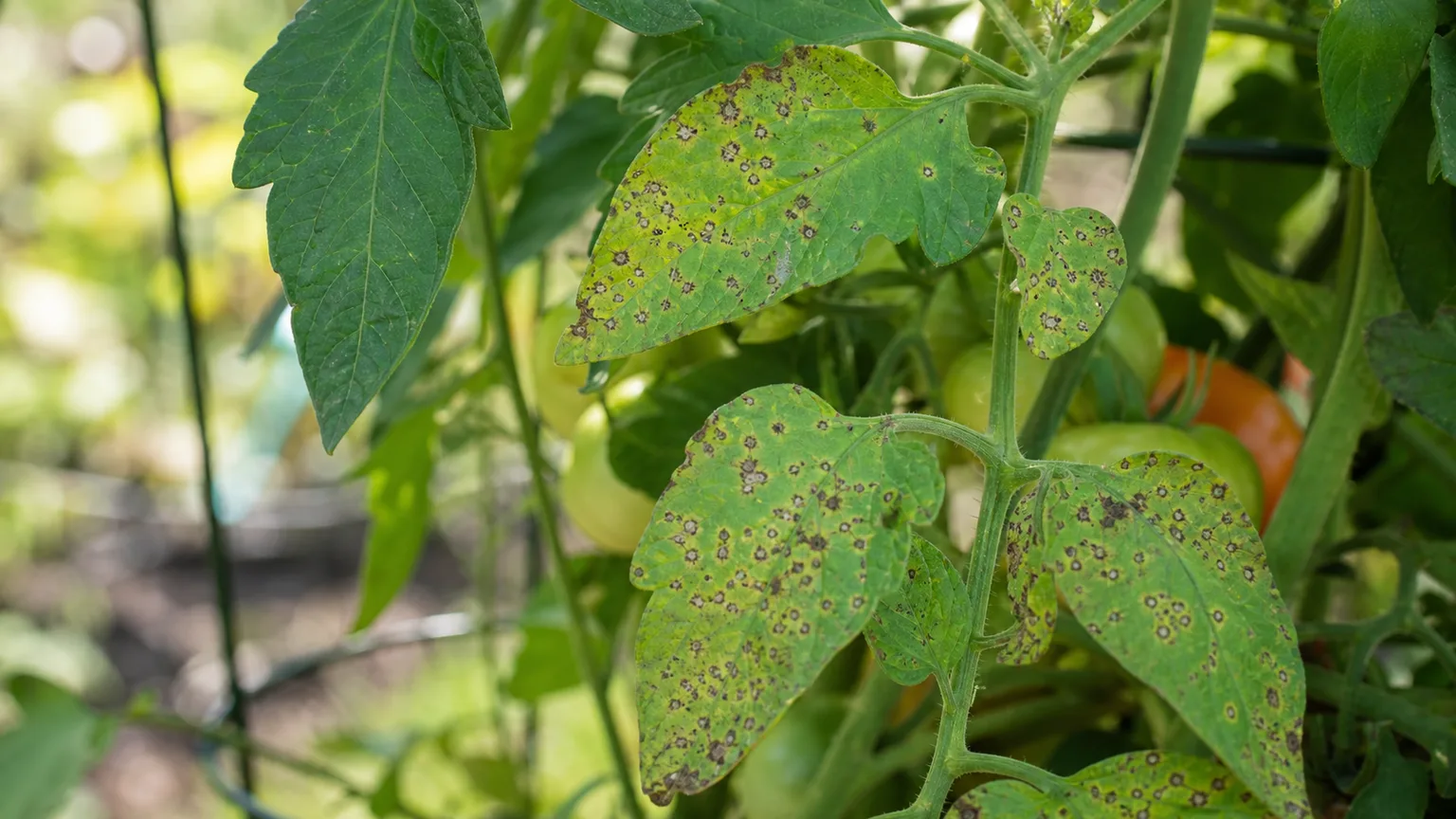
Septoria leaf spot, caused by Septoria lycopersici, produces many small circular spots with dark margins and tan or gray centers; tiny black fruiting bodies may appear in the centers (Clemson HGIC). Infection usually starts on the lowest leaves after the first fruits form and works upward. Leaves yellow around the spots, then brown and drop.
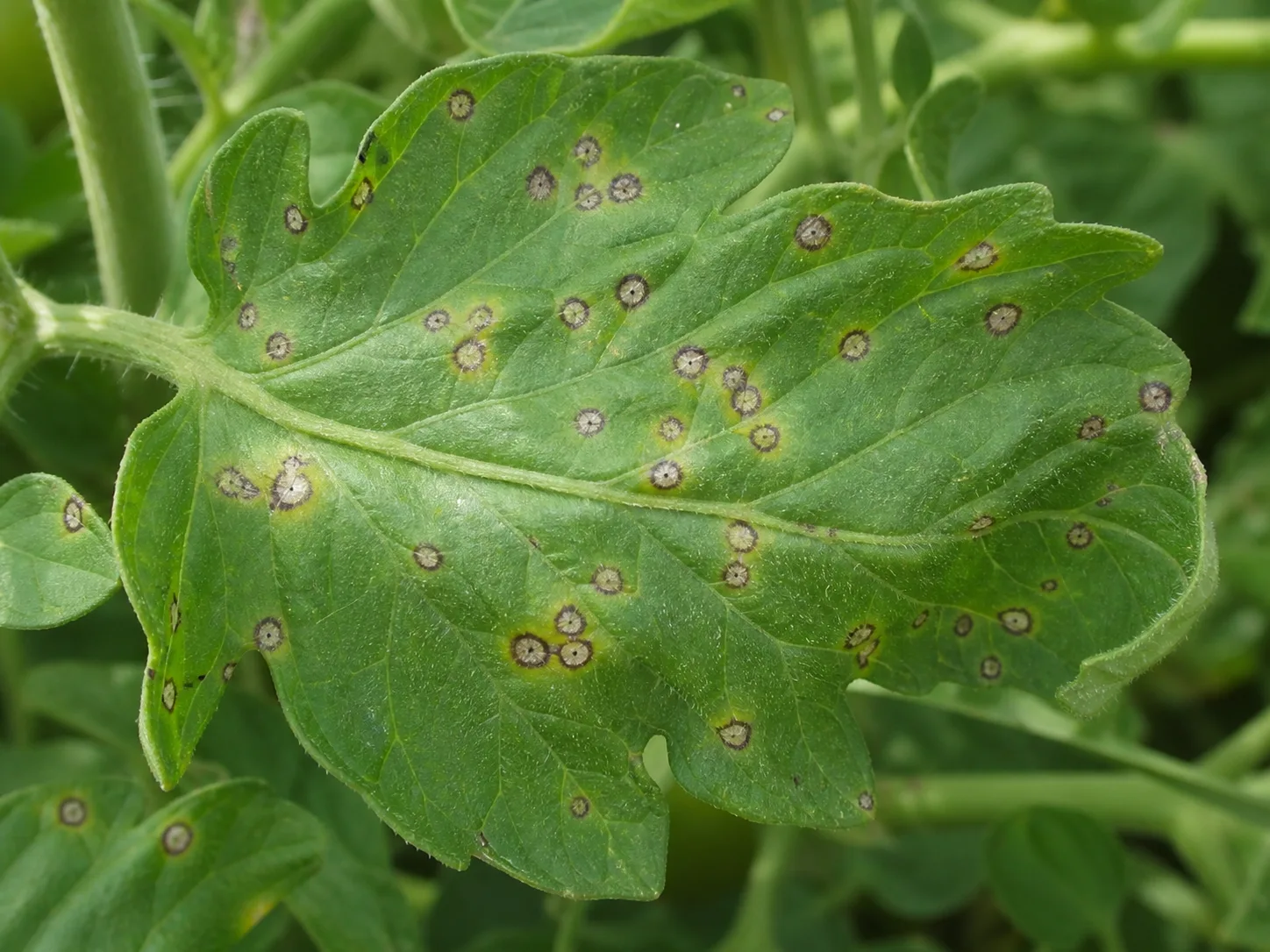
Early blight, caused by Alternaria linariae, shows larger brown lesions that often develop concentric rings— a target-like pattern—with yellow tissue surrounding them. It also tends to start low and climb. Both diseases overwinter on debris and splash upward during rain.
Because the treatments overlap, distinguishing them matters mainly for monitoring: Septoria spots are smaller and more numerous; early blight lesions are larger and more ringed. See our dedicated Septoria leaf spot guide for close-up identification.
Trim affected lower leaves, improve airflow, and begin a protective fungicide program if wet weather continues. For a wider disease field guide, visit 22 tomato diseases.
Fusarium and Verticillium wilt
Soil-borne wilts block water movement inside the stem. Fusarium wilt (Fusarium oxysporum) favors warm soil and often yellows one side of the plant or one branch before the rest (Clemson HGIC). Lower leaves may turn golden yellow, then brown, while the stem looks fine outside but shows brown vascular streaks when cut near the base.
Verticillium wilt is less common in hot regions and may appear later in cooler soil. Lower leaves develop yellowing between veins in V-shaped patches that turn brown. Vascular discoloration is usually confined to the lower foot of stem tissue.
There is no reliable home-garden cure once these fungi colonize the vascular system. Remove affected plants, do not compost them, and rotate away from tomatoes, peppers, eggplants, and potatoes for several years. Next season, choose cultivars labeled with V and F resistance; many tags also list N (nematodes) and T (tobacco mosaic virus). Heirlooms often lack wilt resistance, so site selection and rotation matter more for them.
If wilting is your main symptom rather than static yellowing, read why tomato plants wilt for heat and bacterial wilt lookalikes.
Viral diseases and tomato yellow leaf curl
Viruses yellow, curl, stunt, and distort leaves in ways fertilizers cannot fix. Tomato yellow leaf curl virus (TYLCV), spread by whiteflies, causes upward leaf curl, yellow margins, stunted new growth, flower drop, and poor fruit set (UC IPM). Reflective mulches, whitefly management, and removing infected plants early are the practical tools; there is no spray that clears the virus from tissue.
Other viruses—tobacco mosaic, tomato spotted wilt, cucumber mosaic—produce mottling, mosaic patterns, threadlike foliage, or bronze streaks. Because symptoms overlap with herbicide drift and drought stress, look for spread pattern: viruses often hit scattered plants or branches; drift frequently follows prevailing wind or lawn spray timing.
Control focuses on resistant varieties where available, insect vector management, sanitized tools, and prompt removal. Do not try to “feed away” viral yellowing.
Herbicide drift and contaminated soil amendments
Tomatoes are famously sensitive to synthetic auxin herbicides such as 2,4-D and dicamba. Drift from lawn treatments causes cupping, strapping parallel veins, twisted growth, and yellow or pale distorted leaves. Symptoms may appear on multiple species in the same drift path.
Manure and hay mulch can carry herbicide residues from treated pastures. If several plants show bizarre leaf deformation after a new mulch application, suspect contamination before disease. There is no corrective spray; mild cases may outgrow damage on new growth, severe cases warrant removal.
Hand-weeding near tomatoes beats blanket herbicide sprays. On windy days, assume tomato beds are downwind of trouble.
Sunscald and heat stress on foliage
Tomatoes depend on foliage to shade fruit. When intense sun hits exposed leaves—especially after aggressive pruning or disease defoliation—yellow or pale bleached patches can appear on the sun-facing side. This is often temporary cosmetic damage if the plant still has enough cover for developing fruit.
Heat waves plus dry soil produce a different picture: general dulling, wilting, and yellowing that eases when moisture returns. Shade cloth during extreme heat, consistent watering, and avoiding wholesale leaf removal protect both leaves and fruit. For pruning that preserves cover, see how to prune a tomato plant.
Your 48-hour troubleshooting sequence
When yellow leaves appear, work this list in order instead of jumping to the most frightening diagnosis.
Day 1 morning: Note which leaves are affected and whether spots, curl, or wilt accompany the yellow. Check soil moisture 2 to 3 inches down. Look under leaves for stippling or fine webbing that suggests spider mites—an issue the Missouri Botanical Garden tomato foliage guide lists among common yellowing lookalikes many general articles skip.
Day 1 afternoon: Adjust water only if soil data supports it. Remove clearly diseased leaves with clean shears; disinfect tools between plants with a 1:9 bleach solution as Missouri Botanical Garden recommends for disease prevention.
Day 2: If yellowing is lower-only without spots and the plant is fruiting, monitor rather than fertilize heavily. If spots are present, mulch, prune for airflow, and consider a protective fungicide per label. If wilt with vascular streaks or virus-like curl appears, isolate the plant and prepare to remove it.
After 48 hours: Submit photos to your county extension office if the plant worsens or you need confirmation before ripping out a whole row. Bring notes on watering, products sprayed nearby, and variety resistance codes.
Conclusion
Yellow tomato leaves are a symptom, not a diagnosis. Lower, spotless fading during fruit set is often normal; lower leaves with tan-centered spots point to fungi; pale top leaves with green veins scream iron and pH; sudden one-sided wilt with brown stem streaks means wilt, not hunger. Water correctly before you fertilize, test soil before you dump Epsom salt, and remove diseased tissue before you reach for sprays that cannot resurrect dead leaf cells.
Keep records: variety, planting date, mulch type, and weather. Tomatoes reward observers who notice patterns early. The plant that yellows quietly at the base in July needs a different response than the one that collapses overnight in August—and now you can tell them apart.