Perlite for Plants: Benefits, Uses, and Mix Ratios
Learn what perlite does in potting soil, how much to mix in, which grade to choose, and when vermiculite or pumice is a better fit.
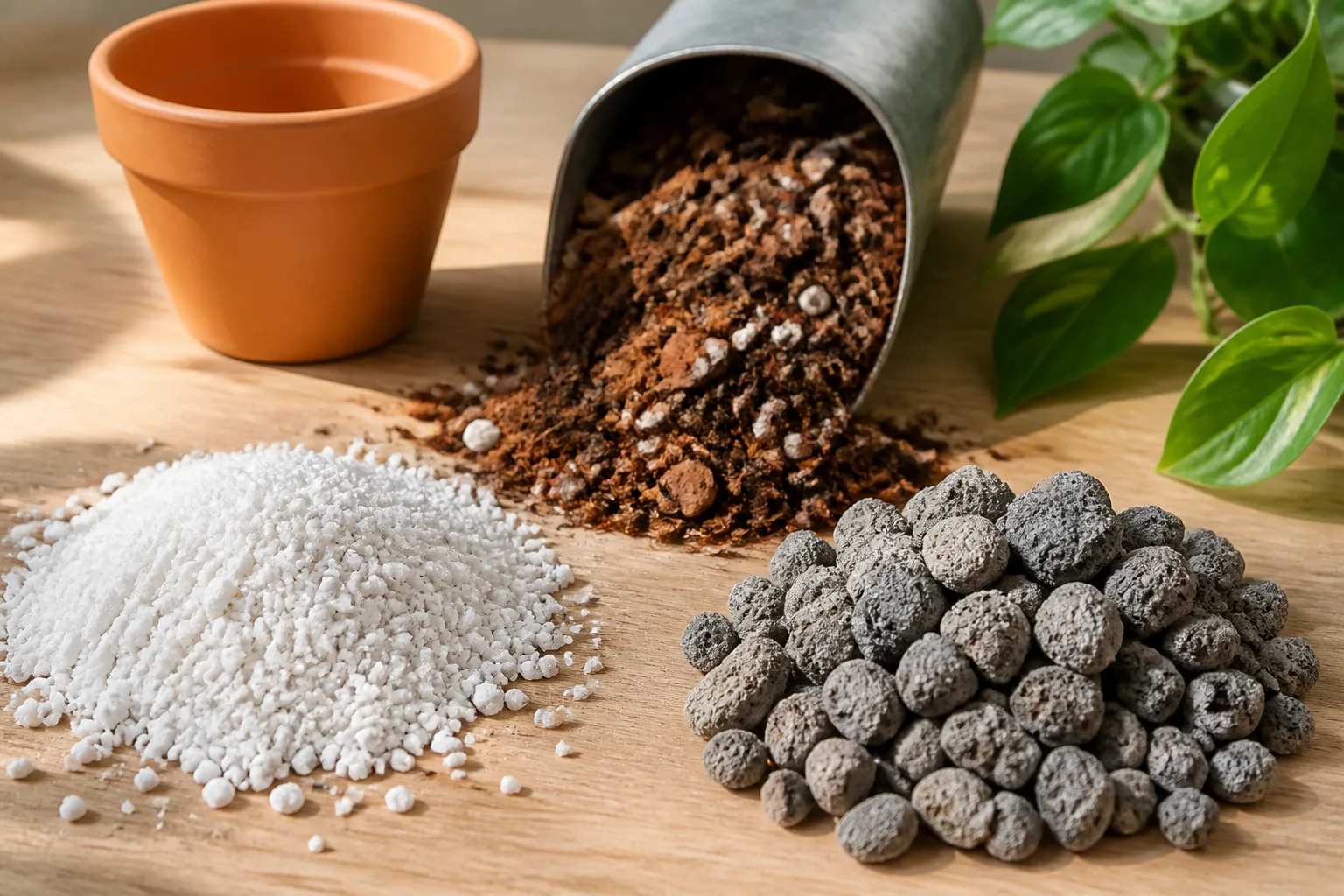
Those small white pieces in potting mix are usually perlite: a lightweight mineral added to make the root zone airier and help excess water move through the mix. It can improve a container medium that stays dense or wet, but it is not fertilizer, it does not replace a drainage hole, and it cannot rescue a plant that is being watered too often.
The useful decision is not simply whether perlite is “good for plants.” It is whether your mix needs more open pore space, and how much you can add without making the root ball dry faster than you can manage. Here is how to choose a grade, use a measured starting ratio, and tell whether perlite is actually solving the problem.
Perlite at a Glance
Perlite is expanded volcanic glass. In horticultural mixes it is used as a lightweight, mineral ingredient that adds air space and improves drainage. It may hold a little moisture on its porous surfaces, but it is not a substitute for peat, coir, or vermiculite when the goal is to keep a mix evenly moist.
| Question | Practical answer |
|---|---|
| What does it look like? | White or pale gray, irregular, lightweight granules that can resemble foam. |
| What does it do? | Adds pore space, helping roots get air and excess water leave the mix. |
| Does it feed plants? | No. It contributes structure, not a complete supply of plant nutrients. |
| How much should I start with? | For a small trial in a dense container mix, use about 1 part perlite to 4 parts base mix by loose volume, then watch a full wet-to-dry cycle. |
| When might another material be better? | Choose vermiculite for more moisture retention, or pumice when you want a heavier mineral that is less likely to float. |
The Penn State Extension guide to potting media and plant propagation describes perlite as a naturally occurring siliceous rock that expands substantially when heated, and lists it among common ingredients in seedling and soilless mixes. The UConn Home & Garden Education Center likewise describes horticultural perlite as crushed, heated volcanic rock used to improve drainage and aeration.
What Perlite Is and How It Is Made
Perlite begins as a naturally occurring volcanic glass that contains water within its structure. Processors crush and heat the ore; as trapped water vapor expands, the material puffs into a low-density, porous particle. The white kernels sold for gardening are this expanded product, not a synthetic foam or a fertilizer bead.
Horticultural perlite is sold in different particle sizes. Some bags contain a fairly even grade, while others include a broad mix of sizes and fines. The grade names are not perfectly consistent across manufacturers, so look at the particles and label rather than assuming every “coarse” or “medium” bag is identical. A material sold for construction or insulation may have a different grade or intended use; choose a product clearly labeled for horticulture.
The mineral itself is relatively stable in a pot, but that does not mean the whole mix stays unchanged forever. Organic ingredients such as peat, coir, and bark settle or break down; handling and root pressure can also crush some perlite particles into finer material. Over time, the balance of air space and moisture in an old pot can shift even though the mineral pieces do not rot like bark or compost.
How Perlite Changes the Root Zone
Roots need both water and oxygen. A potting medium that stays saturated has fewer air-filled pores, while a mix that drains too quickly may leave fine roots without enough available moisture. Perlite helps by adding rigid particles and gaps through a mix, improving aeration and giving excess water more paths downward and out of a pot with open drainage holes.
That effect depends on the material around it. A peat-heavy or coir-heavy base can still hold substantial water after perlite is added; the amendment changes the balance rather than overriding the base mix. A well-formulated potting medium has to provide support, air exchange, water flow, and some water and nutrient storage, as UF/IFAS explains in its potting-mix guidance.
Perlite is sometimes described as both a drainage aid and a moisture-retaining ingredient. The distinction is that water can cling to its irregular, porous surfaces, but perlite does not behave like a sponge that absorbs and releases a large reserve. If a seed tray dries at the surface between checks, a finer moisture-holding material may help more. If a houseplant pot stays heavy and wet for days, a coarser, more open structure may be the priority.
What Perlite Can and Cannot Do
Perlite can make a container mix lighter and more open. It can be one component in a seed-starting or propagation medium, and it may help a dense potting mix drain more freely. UF/IFAS describes it as a lightweight volcanic material that increases air space and improves water drainage; it also notes that perlite is pH-neutral in the context of potting-mix ingredients.
Perlite does not add meaningful fertility, correct a pH problem, or tell you when to water. It cannot make a pot without drainage holes safe, and adding it to the surface of a pot does not change the structure around most of the roots. Nor does it guarantee protection from root rot: watering frequency, the plant’s needs, the pot size, the base mix, and the drainage path still matter.
If a plant wilts while the soil remains wet, do not respond by automatically adding more perlite to the top. Check whether water can leave the container, whether the root ball is compacted or decaying, and whether the mix is much larger than the roots can use. Perlite is an ingredient for changing the medium; it is not a treatment for damaged roots or a blocked pot.
When Perlite Is Useful
Houseplants and Container Mixes
Perlite is most straightforward to use when you are blending a container medium and want more air space without adding much weight. It can be useful in a bagged mix that feels dense, compresses after watering, or remains wet longer than the plant and your conditions can tolerate. Mix it throughout the root zone rather than scattering it on top, and keep the container’s drainage holes open.
The same amendment is not automatically right for every indoor plant. A coarse, high-perlite mix may be inconvenient for a moisture-loving plant in a warm, bright room where the pot already dries quickly. A small percentage may be enough for a plant whose roots dislike prolonged saturation, while a plant that needs consistent moisture may do better with a modest amount or a different blend.
For an aroid or other chunky-root-zone mix, perlite can be combined with bark and a moisture-holding base rather than used alone. If the pot is top-heavy, remember that perlite’s low weight is a trade-off: it makes the mix lighter but does not add much ballast. A heavier mineral such as pumice may suit a tall plant in a lightweight pot better.
Seed Starting and Cuttings
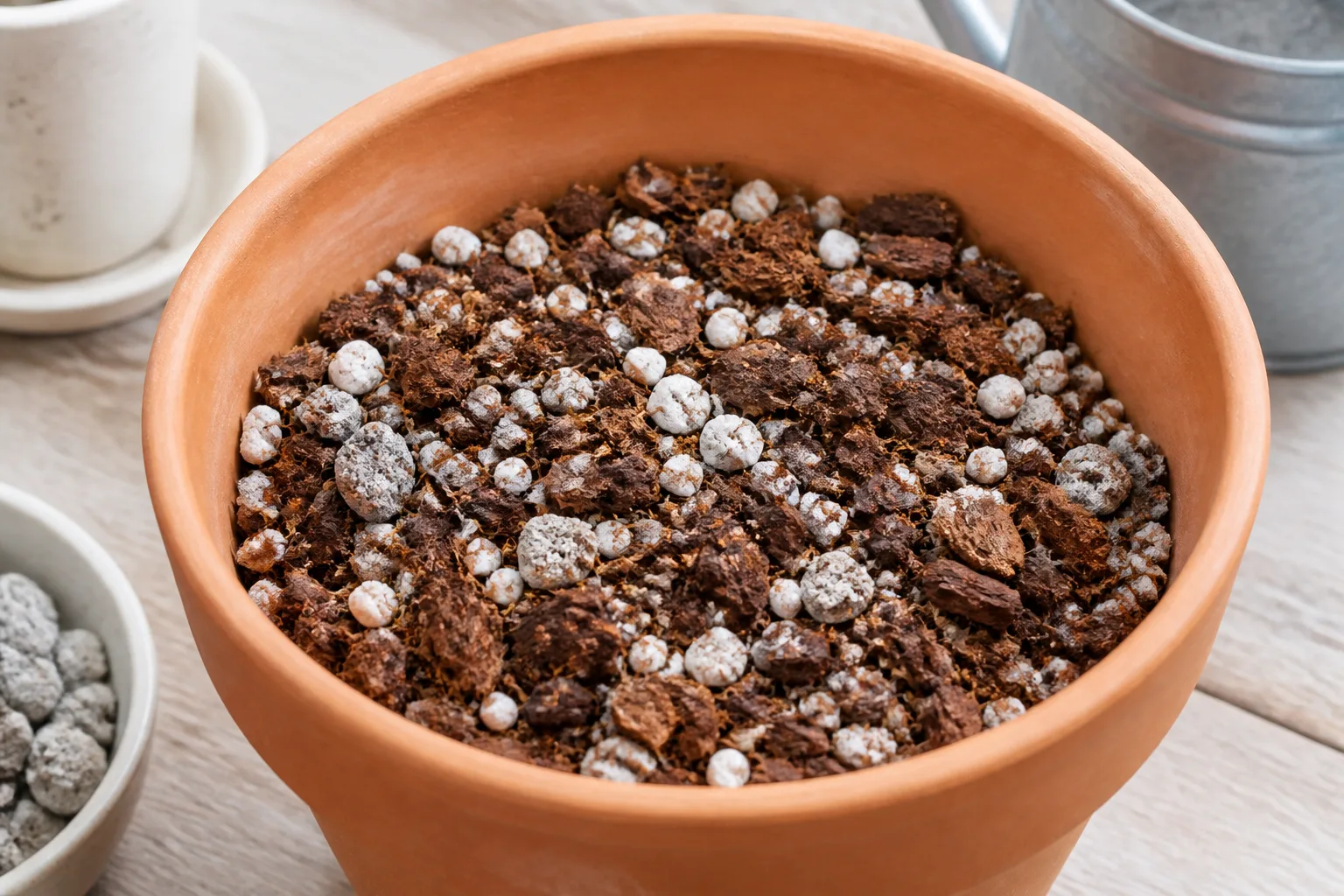
Seedlings need a fine, even medium that holds enough moisture for germination while still allowing air around new roots. Penn State Extension describes seedling media that combine peat with perlite or vermiculite and a nutrient source such as compost or organic fertilizer. That is a reminder that perlite can be part of a seed mix, but it is not the entire recipe and does not feed seedlings.
For most home sowing, start with a reputable seed-starting mix rather than trying to make a tray out of straight perlite. If you are adjusting a homemade blend, use a small batch, keep the particles appropriate for the seed size, and make sure the mix can be moistened evenly. Very coarse pieces can leave tiny seeds with poor contact; a mix that is too open may dry before germination if the tray is warm, uncovered, or exposed to moving air.
Perlite can also provide a lightweight, airy medium for rooting some cuttings, but moisture management is still essential. The cutting needs contact with a damp medium, not a dry pocket between granules or standing water at the bottom. Use a clean container, check it frequently, and transfer rooted cuttings before they become difficult to handle in a loose medium.
Hydroponics and Outdoor Beds
Some soilless growing systems use perlite as a physical substrate around roots. In that role it is support, not plant food: the grower must provide a complete nutrient solution and manage irrigation for that system. Penn State’s discussion of soilless media and the perlite applications summarized in the peer-reviewed perlite toxicology and epidemiology review include horticultural uses, but a hydroponic setup still has to be designed for the crop and the particle grade.
For an ordinary garden bed, perlite is usually more useful in a defined potting or propagation mix than as a broad soil conditioner. A small amount mixed into the top few inches will not solve a drainage problem caused by a compacted layer, low site, or water running toward the bed. Diagnose the site first; at bed scale, correcting grade, improving soil structure with appropriate organic matter, or using a raised bed may be more practical than trying to amend the entire soil volume with a lightweight mineral.
How Much Perlite to Use
Measure perlite by loose volume, not by weight. The same weight of fine and coarse grades occupies a different amount of space, and the practical goal is to change the texture of the finished mix. Start small if you do not know how the plant or pot behaves, because it is easy to add more to the next batch and harder to undo an overly fast-drying blend.
For a dense houseplant mix, a useful first trial is 1 part perlite to 4 parts base mix. That makes perlite about one-fifth of the finished blend. Make only enough for one small pot or test container, then note how quickly it drains, how heavy the pot feels after watering, and how long it takes for the root zone to approach the plant’s normal watering point.
Extension recipes show why there is no universal ratio. In its homemade potting-mix recipes, UF/IFAS includes a foliage blend with two parts peat, one part perlite, and one part coarse sand, so perlite is one-quarter of that full recipe. Its succulent formula contains one part perlite among five total parts, along with soil, peat, and coarse sand. Those are complete blends with several ingredients, not instructions to pour that percentage of perlite into any bag of potting soil.
Use the ratio as a trial rather than a rule. If the original mix already contains visible perlite or drains freely, you may need little or none. If you are growing a plant that needs a consistently moist root zone, reduce the amount and watch dry-down. For a plant that needs a much faster-drying mix, first check whether coarse bark, pumice, a smaller pot, or a different base medium is also needed; simply pouring in more white particles is not always the best adjustment.
How to Mix Perlite With Less Dust
Choose horticultural perlite and a container that drains. If you are using a dry bag, work outside or where air can move through the space. The 2014 review of perlite toxicology notes that mineral composition varies among sources and that commercial safety data sheets report variable crystalline-silica content; it also distinguishes perlite from the crystalline silica component. This is a reason to limit dust, not a reason to treat a brief home potting task as equivalent to sustained occupational exposure.
Lightly dampen the perlite before pouring or blending it. Do not turn it into a wet clump; just reduce the dry powder that can lift into the air and make the particles easier to incorporate. The BBC Gardeners’ World guide to perlite also flags dust and describes perlite as an ingredient for airy seed compost and free-draining mixes.
Measure each ingredient with the same scoop, then fold the perlite through a pre-moistened base mix until the white particles are distributed rather than sitting in one layer. Avoid grinding or crushing it, and do not pack the blend tightly into the pot; the open structure is the point. Water the finished mix once and observe how it drains before committing a valuable plant to a large batch.
Perlite vs. Vermiculite, Pumice, and Sand
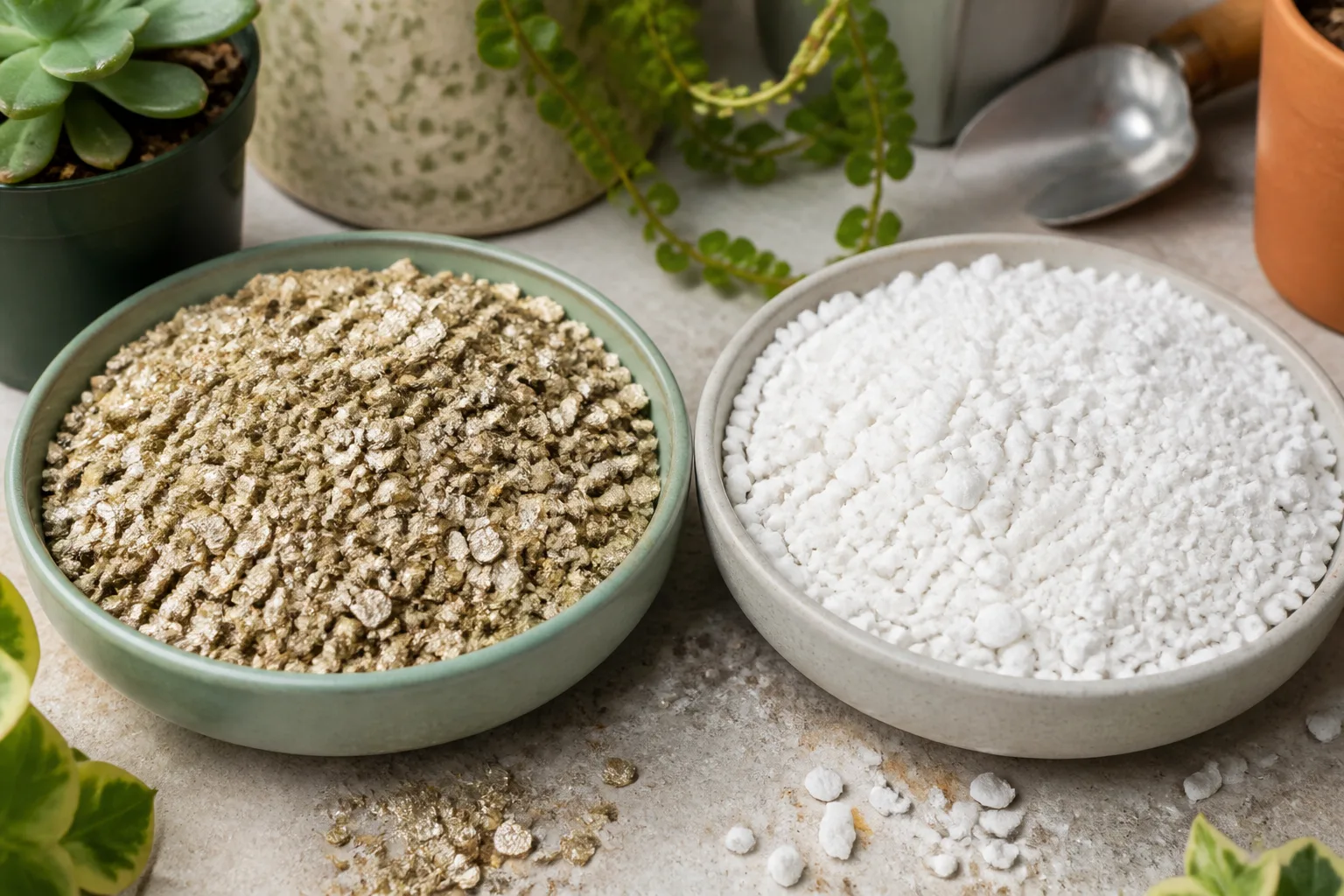
Perlite and vermiculite are both lightweight expanded minerals, but they solve different problems. Perlite is the more common choice when you want additional aeration and water to move through a mix. Vermiculite is better known for holding moisture and nutrients, so it can be helpful in seed media or a mix that dries too quickly; the Cornell Cooperative Extension overview of potting soils lists both among the ingredients used to shape a growing medium.
Pumice is also a porous volcanic material used to open a mix, but it is heavier and tends to stay distributed more reliably when watered. Perlite is often easier to find and keeps a pot light, but individual particles can rise to the surface or spill from drainage holes. The right choice depends as much on pot stability and how much surface migration bothers you as on the plant itself. See the perlite-versus-pumice comparison for a closer look at that trade-off.
Coarse sand adds weight and can help create a stable mix, while fine sand can make a medium dense. Sand is not a one-for-one replacement for perlite by scoop because it changes the weight and pore structure differently. The UConn potting-media guide also separates these jobs: it describes coarse sand as a drainage ingredient in some mixes, perlite as an aerator, and vermiculite as a moisture- and nutrient-retentive ingredient.
Choosing a Perlite Grade
For most established houseplants, choose a coarse horticultural grade if you want visible, durable air pockets through the mix. Medium grade can work in a general-purpose blend when you want the particles less prominent. Fine perlite is more appropriate for seed trays or fine-textured propagation media, where a very large particle could interrupt seed contact or make a small cell uneven.
Check the bag rather than buying by grade name alone. Particle-size labels vary by supplier, and very dusty or powdery bags are not a good choice for a chunky houseplant mix. If a bag contains a lot of fine material, moisten it before handling and consider screening it outdoors; do not breathe across a dry pile to separate it.
Common Perlite Problems and How to Fix Them
The Pot Stays Wet or Dries Too Fast
If the pot is still heavy and wet well after watering, adding perlite may help only if the mix is dense and the water can leave through the bottom. First check that the drainage holes are not blocked, that the pot is not much larger than the root ball, and that the mix has not broken down into a compacted mass. Also account for light, temperature, and plant growth: a healthy plant in a cool dim corner uses water more slowly than the same plant in warmth and bright light.
If a revised mix still dries too quickly, use less perlite or blend it with a more moisture-holding base such as peat or coir. Confirm that water is wetting the whole root ball rather than slipping down a gap between the soil and pot wall. The UConn guidance recommends moistening growing media before use, since dry organic ingredients can resist water; a damp, evenly mixed starting medium makes it easier to judge what the mineral amendment is doing.
Perlite Floats to the Surface
Perlite is light, so some particles may move upward as water drains or float out of a container. This is usually a cosmetic and handling issue rather than proof that the plant is being harmed. Blend it through the mix, water gently, and avoid filling the pot so loosely that the first watering washes particles out of the drainage holes.
If a white surface crust keeps returning, use a coarser grade, lower the perlite fraction, or choose pumice for the part of the mix that needs to stay put. Do not solve the problem by adding a layer of stones under the potting mix; a separate layer does not make a dense root zone drain properly. If a light mix makes a tall plant unstable, add weight with a suitable heavier ingredient or switch to a more stable container rather than relying on a high-perlite blend.
Can You Reuse Perlite?
Perlite does not decompose like peat or bark, so particles from a healthy, pest-free mix may remain useful when you repot the same plant. In practice, separating clean perlite from old roots and fine organic material can be tedious, and broken particles may no longer create the same open spaces. For a fresh seed tray or a plant with a history of root disease, use clean new media rather than assuming that rinsed old mix is sterile.
If you do reuse it, remove old roots and debris, rinse away loose fines, and combine it with fresh base mix. Do not reuse potting medium from plants with persistent pests, root rot, or unexplained decline. A used mineral particle may look clean while the organic material around it still carries the problem, and perlite alone does not sanitize a contaminated mix.
Conclusion
Perlite is a lightweight, expanded volcanic mineral that adds air space and helps water move through container media. It is useful when a mix is too dense or stays wetter than a plant can tolerate, but it is not food, a moisture-control guarantee, or a cure for poor watering and drainage.
Start with horticultural grade, measure a small batch by volume, and use roughly one part perlite to four parts dense base mix as a first trial. Then judge the result by the root-zone moisture and the pot’s wet-to-dry rhythm. If you need more moisture retention, consider vermiculite or a different base; if you need a heavier mineral that stays mixed, compare pumice before adding more perlite.