What Not to Plant Near Bee Balm: Spacing and Shade
Bee balm has few true plant enemies. See which neighbors compete for light, water, and space, plus a practical layout and spacing plan.
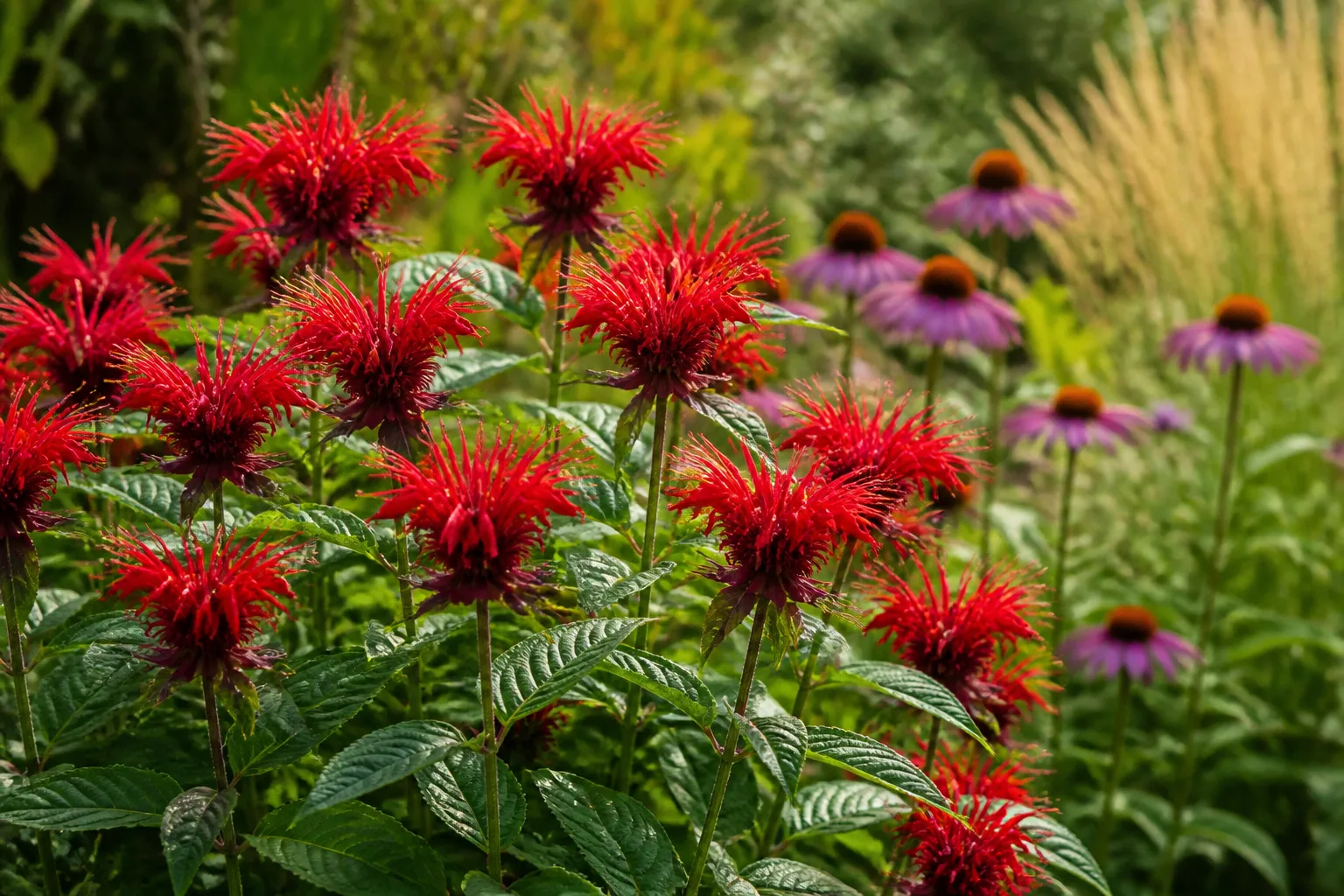
Bee balm is not a plant with a long list of botanical enemies. The neighbors to reconsider are the ones that shade it, compete with its expanding roots, demand very different soil moisture, or pack its stems so tightly that air cannot move through the bed. Those problems depend on the site and the cultivar; they do not make a particular flower or vegetable universally incompatible with every bee balm.
That distinction matters because “companion planting” lists often turn ordinary competition into a claim that one plant harms another. A more reliable way to plan a Monarda border is to check the mature size and water needs of each plant, leave space for air, and give bee balm an edge or barrier if you do not want its clump to wander.
Quick answer: give bee balm room from four kinds of neighbors
Keep bee balm away from fast-spreading perennials that are difficult to separate, large plants that cast persistent shade, plants that need a much drier bed, and dense combinations that close up around its stems. Bee balm grows from underground spreading stems, flowers best in sun or light shade, and prefers soil that holds some moisture while draining well. A location that frustrates those habits can make it compete, lean, flower less, or become harder to maintain.
There is no evidence-based universal blacklist of vegetables or flowers that must never share soil with Monarda. For example, a tomato does not automatically weaken bee balm just because tomatoes use nutrients; in a fertile, well-managed bed, their roots may coexist. What matters is whether both plants have enough room, light, water, and airflow in that particular layout.
Why “bad companion” is usually the wrong diagnosis
Plants growing close together can compete for light, water, nutrients, and physical space, but that is a general garden effect rather than a special incompatibility. A vigorous plant can dominate a smaller one; a tree can intercept sun and rainfall; two plants with opposite moisture needs can force the gardener into a watering compromise. These are observable design problems, and they can be solved by distance, pruning, division, or moving one plant.
Bee balm also varies. The genus includes species and named cultivars with different heights, widths, moisture tolerances, and rates of spread. North Carolina State Extension describes scarlet bee balm as a plant that prefers moist, well-drained soil and full sun, tolerates some shade, and spreads rapidly by underground stolons; the same page notes its susceptibility to powdery mildew and rust North Carolina Extension Gardener Plant Toolbox. Use the plant label or a regional extension profile for your exact variety rather than assuming every plant sold as “bee balm” behaves identically.
Fast spreaders can tangle with bee balm’s underground growth
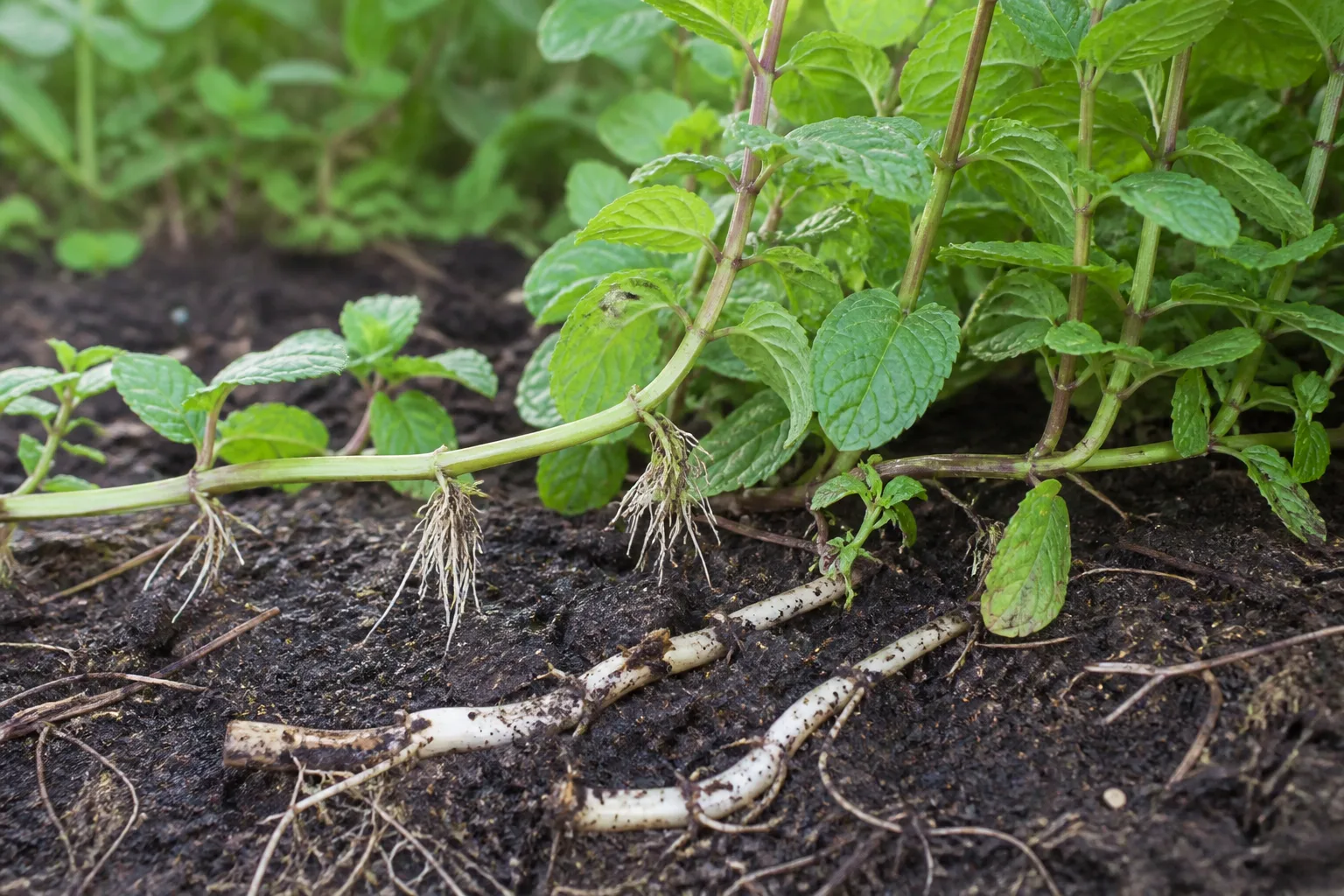
The strongest reason to separate a neighbor is often not chemistry but root-system management. Scarlet bee balm can expand by underground stems, so a clump may push into open soil over time. Put it beside another perennial that also spreads beyond its planting footprint, and the two can weave together until thinning one disturbs the roots of the other.
That does not mean bee balm will instantly smother every plant nearby. It means you should avoid putting it in the center of a collection of aggressive spreaders if you want a neat, species-by-species border. The harder the neighboring plant is to remove, the more useful a physical boundary or a separate container becomes.
Mint and other vigorous groundcovers
Mint is a practical neighbor to manage carefully because many culinary mints spread into nearby soil and are easy to confuse with bee balm once their foliage overlaps. Both belong to the mint family, but family membership is not the problem; competing runners and mixed root mats are. The same caution applies to any groundcover or perennial that continually moves beyond its allotted space, whether or not it is botanically related.
If you want mint and bee balm in the same garden, give them separate footprints. Grow mint in a pot with drainage, set that pot where its stems cannot root into surrounding soil, and keep the bee balm in a bed with a clear edge. A pot sunk into the ground can still allow roots or stems to escape through drainage holes, so inspect it and lift it periodically rather than treating it as a permanent sealed boundary.
Contain aggressive neighbors before planting
Before adding either plant, look at how it expands, not just how wide its nursery pot is. If a label says “spreads,” “naturalizes,” or “forms colonies,” ask whether you are comfortable dividing it, edging it, or allowing it to mingle with the Monarda. A small, contained groundcover can work at the front of a large bed; the same plant can be a nuisance in a narrow border where roots meet immediately.
Shade-casting trees and shrubs can reduce flowering
Bee balm tolerates some shade, so a little afternoon relief in a hot climate is not automatically harmful. The mismatch appears under deep or persistent shade, especially from a mature tree, a dense hedge, or a large shrub that has grown over the bed. Plants may stretch toward light, produce fewer flowers, or lean into neighboring stems, changing what was once a workable planting into a crowded one.
The Royal Horticultural Society recommends sun or light, dappled shade for Monarda and notes that it will not flower much in deep shade RHS Monarda guide. Before planting, observe the site during the season when nearby trees are fully leafed out. A spot that receives morning sun in early spring can become a nearly shaded patch by midsummer, precisely when bee balm is making most of its growth.
Large neighbors also change moisture. Tree roots may draw water from the upper soil, while a roof or dense evergreen canopy can reduce rainfall reaching the bed. If the bee balm wilts during dry weather even though the surrounding soil is shaded, the cause may be root competition and rain interception rather than an “incompatible” species. Place Monarda beyond the densest root zone or choose a smaller, open-canopy companion that will not overtake its light.
Dry-soil plants may need the opposite watering routine
Monarda usually does best in soil that stays evenly moist but drains readily; it does not want a permanently saturated planting hole. The RHS says bergamots grow in moisture-retentive, fertile soil and warns that dry summer spells can contribute to powdery mildew, while waterlogged winter soil can cause rot RHS Monarda guide. That middle ground can conflict with drought-adapted plants that need soil to dry thoroughly between waterings.
The problem is not that bee balm inevitably makes a dry-garden plant sick. It is that one irrigation schedule may not suit both. If you water a shared bed often enough to keep the Monarda from drying out, a plant adapted to lean, dry soil may stay too wet; if you hold water back for the drought-tolerant neighbor, bee balm can suffer in a hot, dry spell. Match plants by their actual water requirements and drainage needs, not by the broad labels “perennial” or “pollinator plant.”
Species and climate shift the balance. Some Monarda tolerate occasional dryness once established, while species native to moist habitats appreciate more consistent moisture; a cultivar grown in a hot inland garden may need more irrigation than one in a cooler, humid region. If your bee balm regularly wilts, check soil several inches down before watering, and distinguish temporary afternoon droop from dry root-zone soil. Avoid solving every wilt by soaking the bed if it drains poorly.
Dense mildew-prone beds can restrict airflow
Bee balm has a well-known susceptibility to powdery mildew, but the best prevention is not to ban every nearby plant that can also develop mildew. The Connecticut Agricultural Experiment Station advises minimizing Monarda disease by avoiding overcrowded spacing and removing affected leaves when symptoms appear Connecticut Agricultural Experiment Station: Beebalm. North Carolina State Extension likewise identifies powdery mildew and rust as issues for Monarda and advises against overhead watering North Carolina Extension Gardener Plant Toolbox.
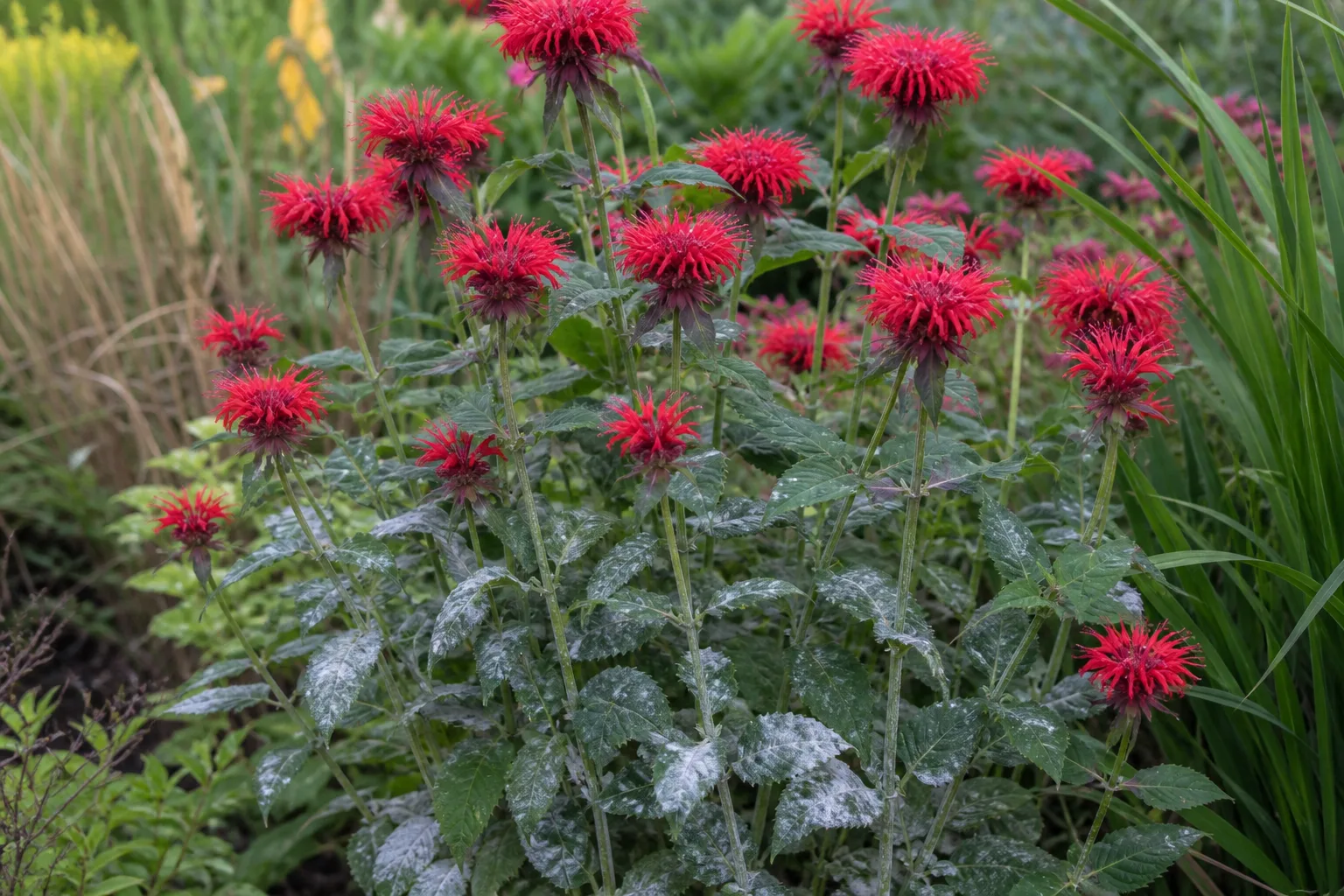
The risk comes from a dense, stagnant canopy and stressed growing conditions, not a simple rule that two susceptible species cannot share a bed. Tall phlox, roses, zinnias, squash, and other plants may develop powdery mildew under suitable conditions, but they have different pathogens and different growing habits. Planting phlox near bee balm does not, by itself, prove that the bee balm will catch the phlox’s disease.
Another mildew host is not automatically a transmitter
Powdery mildew is a group of fungi, and the fungi often have relatively narrow host ranges. The RHS explains that the mildew affecting one kind of plant may be a different species from the one affecting another; for instance, the pathogen on peas differs from the one on apples RHS powdery mildew guide. So the blanket advice to avoid every mildew-prone flower or vegetable beside Monarda oversimplifies how these diseases work.
Still, dense planting can make it harder for air and light to reach lower leaves, and interwoven foliage is more difficult to inspect or prune. Give bee balm enough room to grow to its mature width, avoid watering over the foliage late in the day, and remove badly affected plant debris. The University of Minnesota Extension’s Monarda diagnostic guide identifies the familiar white, powdery patches and notes that symptoms can spread across leaves; use it to distinguish a mildew problem from leaf spots or rust University of Minnesota Extension: Monarda leaf spots and mildew.
Do heavy-feeding vegetables really weaken bee balm?
You may see corn, tomatoes, cucumbers, melons, or squash labeled as plants to keep away because they are “heavy feeders.” That label does not establish a special incompatibility with bee balm. A large vegetable can compete for light or water if the bed is small, and a productive crop may need soil fertility managed separately, but the conclusion that it will necessarily steal enough nutrients to weaken Monarda is too broad without knowing the soil, plant sizes, and fertilizer plan.
Treat the bed as a finite space rather than a companion-planting puzzle. If a tall crop will shade a low bee balm cultivar, put the taller crop on the north side in the Northern Hemisphere or simply use a separate row. If irrigation for a thirsty vegetable keeps the perennial bed waterlogged, separate the watering zones. In a large, sunny garden with fertile, well-drained soil, there may be no meaningful problem beyond ordinary spacing and maintenance.
The same principle applies to shrubs and flowers: a plant becomes a poor neighbor when its size, roots, or care needs create a predictable conflict. There is no need to avoid a species solely because an online list calls it a heavy feeder. Test the soil if nutrient deficiency is suspected, and fertilize according to the crop’s needs rather than adding extra fertilizer to “protect” bee balm.
Choose spacing from mature width, not the nursery pot
For many common garden bee balms, 18 to 24 inches between plants is a useful starting point. HGTV gives that spacing for Monarda and also emphasizes that good air circulation helps limit powdery mildew HGTV bee balm growing guide. It is not a universal measurement for every cultivar: compact forms may stay smaller, while vigorous plants can spread well beyond their initial position.
Use the mature width on the label as your first measure, then consider airflow and access. If a variety is expected to reach 24 inches wide, give it about that much center-to-center room as a baseline; add more if the bed is humid, sheltered, or difficult to reach for deadheading and division. A small gap between foliage today is not a reliable spacing guide because the plant’s roots and stems will keep growing after it settles in.
How to measure an actual planting gap
Measure from the center of each plant, not from the outside edge of the starter pot. When the bed is narrow, leave a walkable strip or put bee balm where you can reach it from one side, so you can thin stems without stepping on neighboring plants. If the plant tag gives only height, look up the named cultivar or ask the nursery for expected width; a species-level listing may not reflect a compact selection.
When mixing plants, allow each one to reach its mature footprint without forcing leaves into a permanent overlap. Some visual interweaving is normal in a naturalistic border, but you should still be able to see the plant bases and move through the bed to water or divide. If a cultivar naturally forms a broad clump, let it be the anchor and use modestly sized companions outside its expansion zone.
Better companions share light, moisture, and manageable size
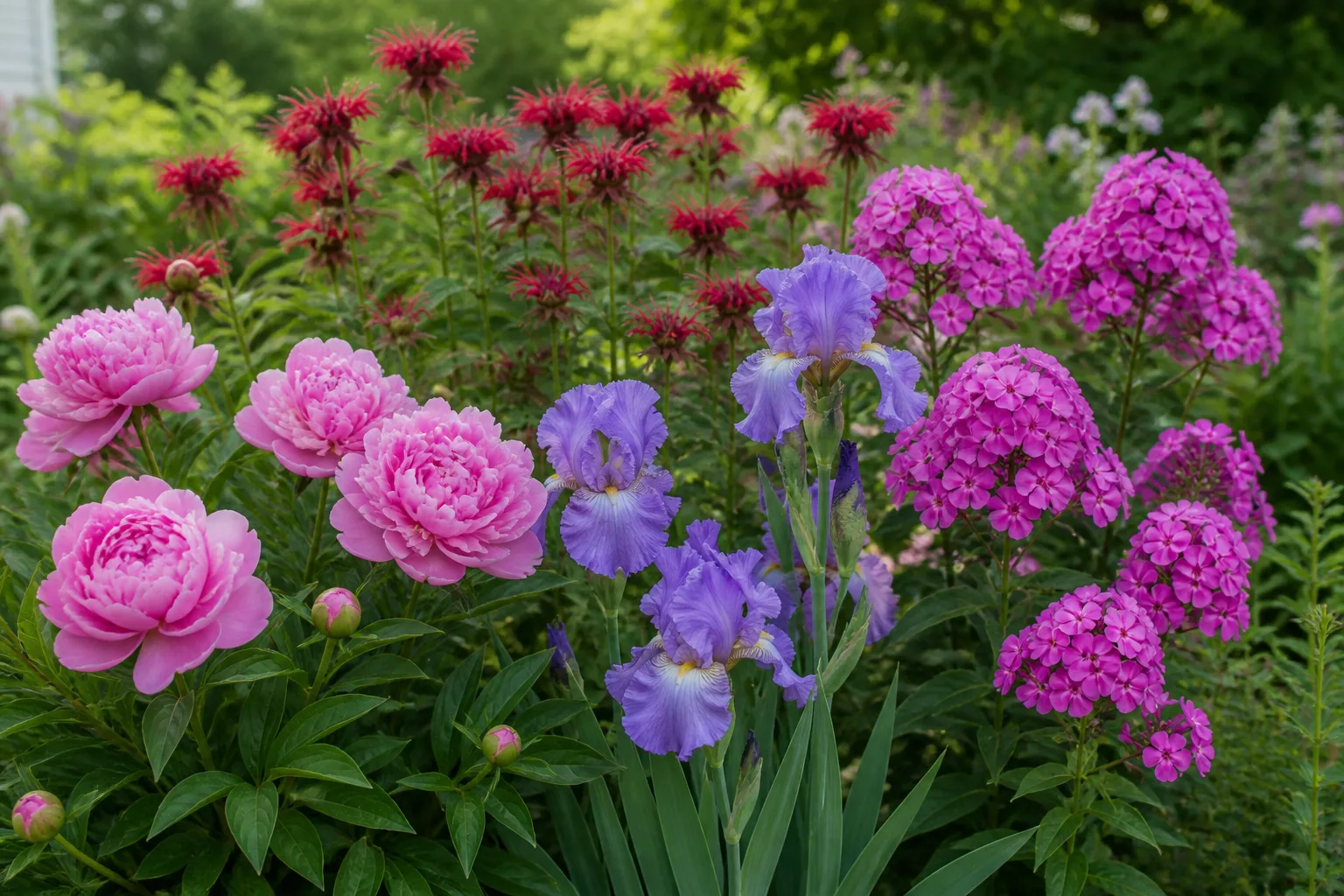
Good companions are plants that can use the same sun-to-light-shade exposure, tolerate similar soil moisture, and stay within a size you can manage. The Royal Horticultural Society notes that Monarda combines well with perennials and grasses in mixed borders and prairie-style planting RHS Monarda guide. HGTV suggests companions such as Shasta daisy, daylily, Echinacea, phlox, Achillea, Agastache, chives, and basil when their sunlight and water needs align HGTV bee balm growing guide.
These are candidate plants, not a formula. Before adding one, compare the cultivar’s mature height and spread with the bee balm’s, check whether it tolerates the same drainage and watering, and decide which plant should be the focal point. If a companion needs substantially drier soil, keep it in a raised or separate bed rather than repeatedly compromising the whole planting.
Tall flowers and prairie-border companions
Coneflowers, black-eyed Susans, and other sturdy flowering perennials can make a layered pollinator border with bee balm when each has enough room. Epic Gardening describes bee balm with black-eyed Susans and Echinacea for similar-height color, while HGTV names Echinacea, daylilies, Achillea, and Agastache among possibilities Epic Gardening bee balm guide. Choose spacing by the actual cultivar: a tall, broad Monarda should not be placed directly in front of a shorter plant that needs uninterrupted sun.
Put the tallest plants toward the back or north side of a border if the bed has a clear viewing direction. In a circular island, distribute height so bee balm does not shade smaller companions from every angle. Keep a buffer between stems where you expect strong spread, then fill the remaining spaces with plants that are easy to divide or move.
Low herbs and front-of-border plants
Low herbs can soften the edge of a sunny bee balm bed if they tolerate the same moisture. Chives or basil may work in a productive, watered garden; thyme and other herbs that prefer sharply drained, drier soil can be a less convenient match in a consistently moist patch. Epic Gardening and HGTV both mention herbs as companions, but the site requirements still determine whether the combination is practical.
Keep low fillers several inches back from the bee balm’s crown instead of carpeting right up to each stem. That small open ring makes it easier to spot new shoots, pull seedlings, and remove leaves with mildew. If you want groundcover, choose one with restrained growth and plan to trim it when it starts entering the Monarda’s footprint.
A simple layout that keeps bee balm in its lane
Start by marking the bee balm’s expected mature circle with a garden hose or a few stakes. Set that circle in sun or light shade, where the soil drains after rain but does not dry out immediately; then note where shade falls at midday and late afternoon. This simple map reveals whether a planned shrub, tree, or vegetable row will eventually shade it or make watering awkward.
Next, place the bee balm at the back or middle of the border according to its height, leaving the spacing recommended for the cultivar. Put vigorous or unrelated spreaders in containers or behind a root barrier designed for that plant, and keep low companions outside the crown area. The barrier should extend continuously through the soil to a depth appropriate for the species being contained; shallow edging can redirect surface growth but may not stop deeper or more persistent roots.
Finally, plan how you will reach the bed. Leave enough room to remove diseased stems, water at soil level, and divide the clump every few years if it becomes congested. Epic Gardening notes that Monarda can form dense root balls and that division is one way to manage an overgrown plant Epic Gardening bee balm guide. A layout you can maintain is more dependable than a dense planting that looks full only in its first season.
How to fix a crowded bee balm bed
If bee balm has swallowed a neighbor, first identify what you want to keep and when each plant is best moved. In early spring, before rapid growth, dig around the Monarda clump and lift it with as much root mass as practical. Separate healthy outer sections from old, woody or dead material, replant a manageable division at the cultivar’s recommended spacing, and move the other plant beyond the clump’s expansion path.
You do not have to remove every companion to restore airflow. Thin the densest stems at the base, clear dead debris, and take out weeds or groundcovers that have rooted through the clump. If a plant is declining only on the shaded side, test whether a shrub or tree has grown over it before treating the symptoms as a nutrient problem. Better light and spacing often solve the underlying competition more effectively than fertilizer.
For persistent spread, install a dependable border or grow the bee balm in a large container with drainage holes. Check the container each season because roots can reach the surrounding soil through an open bottom, and divide a pot-bound plant when the root mass fills the available space. HGTV recommends dividing crowded Monarda every two or three years to keep the clump vigorous; use that as a practical interval to inspect rather than a calendar rule for every cultivar HGTV bee balm growing guide.
If powdery mildew returns each year despite open spacing, consider replacing the plant with a cultivar noted for better resistance or moving it to a sunnier, airier position. North Carolina State Extension lists compact and mildew-resistant selections in its Monarda profile, though resistance is not immunity and performance varies by site North Carolina Extension Gardener Plant Toolbox. Keep the useful companion plants that fit the improved conditions; redesign only the parts of the bed that create a measurable conflict.
Conclusion
The plants to avoid beside bee balm are the ones that make its real needs hard to meet: persistent spreaders that tangle with its stolons, tall neighbors that block light, dry-soil plants that need the opposite watering schedule, and tightly packed growth that restricts airflow. Most flowers and vegetables are not inherently incompatible with Monarda. Match mature size and site conditions, leave room for movement and maintenance, and bee balm can share a border without taking it over.