10 Common Rose Problems and How to Fix Them
Identify 10 common rose problems, from aphids and black spot to thrips and crown gall, with practical first steps and prevention advice.
Start with a 2-minute rose problem triage
Before you reach for a spray, decide whether the damage is caused by a sucking insect, a chewing insect, a fungus, a bacterium, a virus, or growing conditions. Inspect one affected shoot and one healthy shoot, comparing the newest leaves, older-leaf undersides, flower buds, and the stem at the soil line.
The two-minute check below prevents a common mistake: treating a symptom instead of the cause. A rose with yellow leaves and black spots needs a different response from a rose with plain yellow leaves, and translucent “windowpane” leaves point to sawfly larvae rather than Japanese beetles.
| What you see | Most likely starting point | First action |
|---|---|---|
| Clusters of tiny insects on soft tips or buds, sticky leaves, or ants | Aphids | Spray the colony off with water and look for predators before using a pesticide |
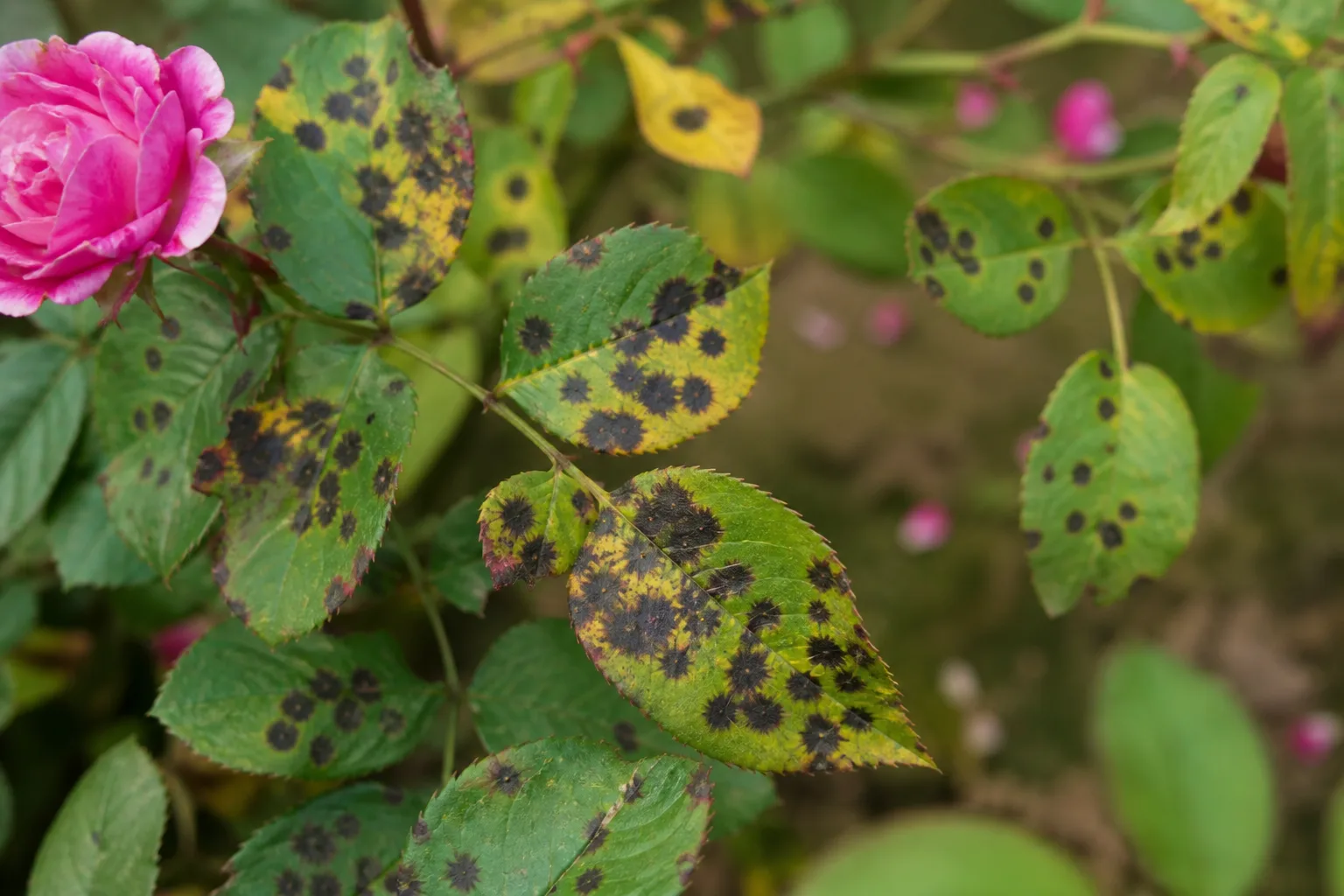
| Feathery black spots with yellowing and lower-leaf drop | Black spot | Remove fallen leaves, keep new foliage dry overnight, and improve airflow |
| White powder on young leaves, buds, or shoots | Powdery mildew | Reduce crowding and drought stress; prune heavily affected shoots |
| Many small maroon-purple spots with tan or gray centers | Cercospora leaf spot | Remove affected leaves and reduce splash from rain or irrigation |
| Rough, enlarging growth at the crown or on roots | Crown gall | Do not try to spray it away; isolate the plant and seek a diagnosis |
| Metallic beetles and lace-like leaf or petal damage | Japanese beetles | Hand-pick in the morning and remove beetles before they attract more |
| Rings, wavy lines, or mottled yellow-green foliage across otherwise unexplained growth | Rose mosaic virus | Do not propagate the plant; confirm before removing it |
| Snout-nosed beetles or ragged holes in unopened buds | Rose curculios | Hand-pick adults and destroy infested buds |
| Papery, translucent leaf surfaces with veins left intact | Rose or pear slug larvae | Look on leaf undersides and wash larvae off with water |
| Brown petal streaks, distorted buds, or flowers that fail to open | Thrips | Remove damaged buds and inspect inside unopened buds |
Check new growth, leaf undersides, buds, and the soil line
New growth is where aphids and thrips concentrate, while mites and sawfly larvae are easy to miss on leaf undersides. Turn a leaf over rather than relying on the damage pattern alone. A hand lens helps with thrips, mites, and tiny larvae, but you should still be able to find some physical evidence before treating.
Then inspect the base of the plant. A swollen graft union is not automatically crown gall, but a rough growth that keeps enlarging is different from a stable graft union or normal callus. Also check whether the soil is dry several inches down, waterlogged, or repeatedly splashed onto the foliage; stress and leaf wetness change which problems are likely.
Match the damage pattern before choosing a spray
Use the least disruptive response that fits the evidence. UC Integrated Pest Management guidance emphasizes cultivar selection, appropriate cultural practices, hand-picking, water sprays, regular monitoring, and conserving natural enemies for rose insects; its rose disease guidance likewise puts irrigation, spacing, pruning, and sanitation ahead of routine fungicide use. UC IPM’s rose insect guidance and disease guidance are useful references when a symptom does not fit neatly into one category.
1. Aphids on buds and new growth
Aphids are small, soft-bodied insects that gather on tender shoot tips, flower buds, and the undersides of new leaves. They may be green, pink, yellow, or nearly black. Look for curled or puckered growth, white cast skins, sticky honeydew, and sometimes black sooty mold growing on that honeydew. Ants may be present because they harvest the sugary secretion and can interfere with aphid predators.
Do not confuse “many” with “damaging.” A small colony on an established rose often causes little lasting harm and may be reduced by lady beetles, hoverfly larvae, lacewings, and parasitoid wasps. RHS guidance on rose aphids recommends regular checks and tolerating low populations where the plant is growing well; UC IPM also notes that natural enemies can rapidly reduce aphids.
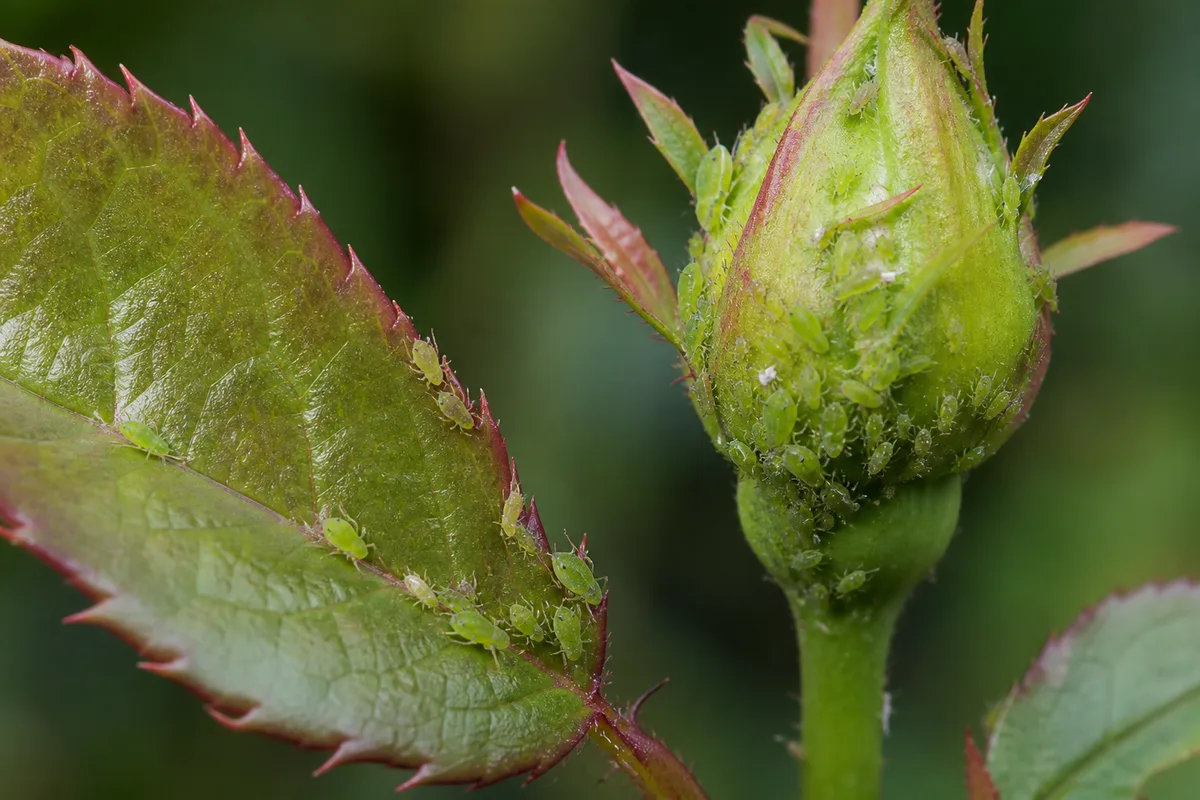
Aphids cluster on tender rose growth and buds; check for sticky honeydew and natural enemies before treating.
Start by directing a firm stream of water at the new growth, buds, and leaf undersides early in the day. Repeat every few days while checking whether the colony is shrinking. For a small plant or a hose-restricted garden, a damp cloth or soft paintbrush can remove aphids from long stems, but work from the top down so you do not push them onto clean buds. Prune only the most heavily infested tips if they are already distorted; cutting the whole flowering shoot can remove more future blooms than the aphids would have.
If water is not enough, use a product specifically labeled as insecticidal soap or horticultural oil for roses and follow that label. These products work by contact, so coverage matters and repeat applications are often necessary. Do not apply oil or soap to drought-stressed foliage, in high heat, or over open flowers without checking the label; a broad-spectrum systemic insecticide is rarely justified for a normal garden aphid colony and can harm beneficial insects.
2. Black spot and premature leaf drop
Black spot is caused by the fungus Diplocarpon rosae. It starts as dark purple-black spots, often with feathery edges, on upper leaf surfaces. Yellowing around the spots and premature leaf drop separate a serious cycle from harmless dark marks; defoliation commonly begins low and moves upward.
The trigger is not simply “humidity.” Black spot needs free water on the plant to reproduce, and UC IPM notes that leaves remaining wet for more than about seven hours favor disease development. RHS black-spot guidance also explains why wet conditions and overwintering debris matter. This is why evening sprinkling, dense foliage, and a rose planted where air cannot move create more trouble than a brief morning shower.
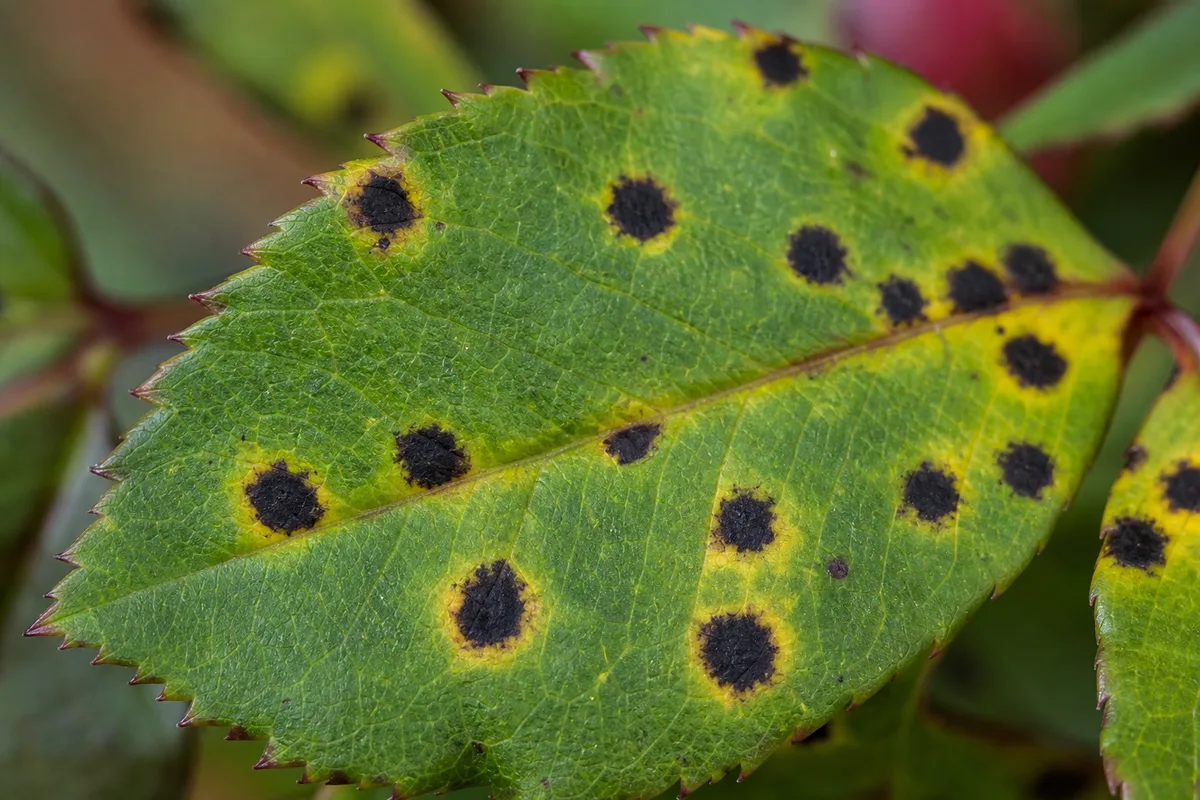
Black spot typically produces dark lesions with yellowing around them; the upper leaf surface is the place to inspect first.
Remove badly affected leaves that detach easily and pick up fallen leaves from around the plant. Bag diseased debris rather than adding it to home compost, and prune congested or infected canes during the dormant season. Water at the base in the morning when possible, leave enough space between roses for foliage to dry, and add a mulch layer that reduces soil splash without touching the canes.
Fungicides are protectants more often than erasers: they help shield new foliage but do not turn spotted leaves green again. If cultural measures are not enough, choose a product labeled for black spot on roses, follow the local label, and begin before the disease is widespread. Rotate active ingredients when the label and local guidance call for it, and do not assume that neem, copper, sulfur, or any homemade mixture is automatically safe for every rose cultivar or weather condition.
3. Powdery mildew on leaves and buds
Powdery mildew looks like a white or gray dusting on the upper or lower leaf surface, young shoots, sepals, buds, and sometimes petals. New leaves may pucker, curl, or become distorted. Unlike black spot, powdery mildew does not need a film of water on the leaf to germinate; it often becomes severe when days are warm, nights are cool and humid, and the root zone is dry or the air is still.
The RHS rose powdery mildew guide and UC IPM both recommend treating the growing conditions as part of the disease. Give the roots consistent moisture without leaving the soil saturated, open up crowded growth, and avoid planting a rose against a wall or hedge where air movement is poor. If the plant is mildly affected, remove the worst leaves and shoots rather than stripping every leaf from the bush.
Powdery mildew and black spot need opposite watering instincts, so do not apply one generic “keep leaves dry” rule to every fungal problem. For powdery mildew, midday overhead water in dry weather may disrupt spore release and allow leaves to dry before evening, according to UC IPM; frequent late-day wetting can create a black-spot problem at the same time. A disease-resistant cultivar can reduce future pressure, but resistance is not immunity and may vary by climate.
When infection is established, a labeled fungicide or horticultural oil may suppress new growth, but timing matters. Oils should not be used on water-stressed plants or close to sulfur applications, and no treatment will repair already distorted tissue. If mildew returns every year, solve the site problem—crowding, drought cycles, shade, or a highly susceptible cultivar—rather than relying on a permanent spray schedule.
4. Cercospora leaf spot
Cercospora leaf spot can look like black spot from across the garden, but the lesions are usually numerous, small, and maroon to purple, with tan or gray centers and a darker margin. Heavily spotted leaves yellow and fall, often starting near the canes. It is more likely where susceptible roses grow in rainy conditions or irrigation repeatedly splashes foliage.
The Pacific Northwest Plant Disease Management Handbooks identify Rosisphaerella rosicola (formerly Cercospora rosicola) as a cause of rose Cercospora leaf spot and note that spores move by rain splash. That distinction matters because a black-spot spray chosen without confirming the disease may be poorly timed or mislabeled for the actual problem. Anthracnose, chemical injury, and other leaf spots can overlap visually, too.
Start with sanitation and water management: remove infected leaves and fallen debris, thin dense growth, and use drip or soaker irrigation where practical. Do not pull off every leaf in a panic; severe defoliation can stress the plant further. If the same rose develops the problem repeatedly, photograph both sides of a fresh lesion and take a sample to a county extension office or plant clinic before committing to repeated fungicide applications.
If a product is needed, use only one whose label includes the disease and rose as a site, and follow the label exactly. The handbook notes that tactics used for black spot, powdery mildew, and rust can help with several rose leaf-spot fungi, but it also warns that some sprays can themselves cause spots or discoloration. That is one reason a confirmed diagnosis is more useful than a bigger spray list.
5. Crown gall
Crown gall produces rough, rounded, irregular growths at the soil line, on roots, or sometimes higher on the canes. Young galls may be pale and smooth; older ones become hard, corky, and woody. The bacterial pathogen Agrobacterium tumefaciens enters through wounds caused by pruning, transplanting, mechanical injury, or chewing insects, then redirects plant growth into the gall.
The key decision is whether the growth is stable or enlarging. A graft union and ordinary callus can be lumpy but should not steadily expand into a rough mass. A rose that declines despite adequate water and nutrition, especially when the gall is partly below the soil surface, deserves a close inspection rather than another feeding.
There is no spray that cures crown gall inside an established rose. The safest response to a confirmed infection is to remove the plant and as much of the affected root system as practical, dispose of it outside the compost pile, and avoid planting another susceptible rose in the same contaminated spot. Clean soil from tools and footwear, and avoid moving soil or water from the area to other roses. The Missouri Botanical Garden rose-problem guide is useful for comparing crown gall with the graft union and other rose symptoms.
Prevention is less dramatic but more effective: buy healthy, reputable nursery stock, handle roots gently, make clean cuts with sharp pruners, and protect the crown from mower, string-trimmer, and digging injuries. If the diagnosis is uncertain, get an expert opinion before removing a valuable old rose.
6. Japanese beetles
Japanese beetles are metallic green beetles with copper-brown wing covers that gather on flowers and foliage in summer. They chew between leaf veins, leaving a lace-like skeleton, and may shred petals and buds. Their feeding and floral odors can attract more beetles, so early hand-picking is worthwhile.
Look for the beetle itself before blaming every skeletonized leaf on Japanese beetles. Rose slugs can leave a similar result, but they are soft-bodied larvae hiding on leaf undersides. The Missouri Botanical Garden’s rose-problem visual guide describes Japanese beetles as active for roughly six weeks in summer and distinguishes their adult leaf, flower, and bud feeding from sawfly damage.
Hand-pick beetles in the cool morning and drop them into soapy water. Remove badly damaged flowers and leaves if the plant can spare them, and keep the rose watered during the feeding period so it can replace foliage. A beetle trap placed beside the rose can draw more adults toward the garden, so do not place one next to the plant you are trying to protect.
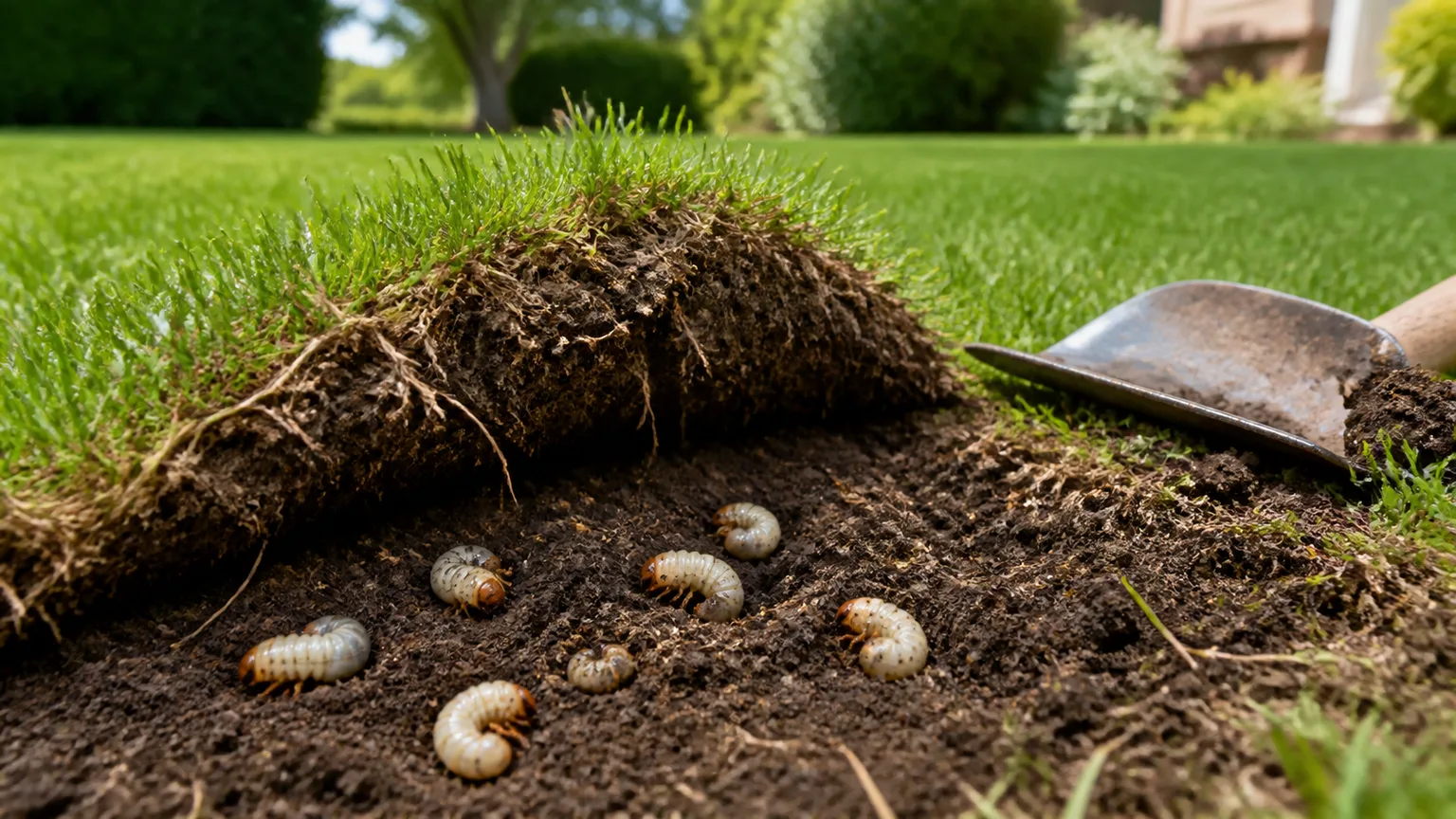
Treating the lawn for grubs is not a guaranteed fix for the adults on your roses, because beetles can fly in from beyond your property and grub-control products affect other soil organisms. If you use an insecticide, choose one labeled for Japanese beetles and roses, protect pollinators by following application timing and restrictions, and avoid spraying open flowers. A resistant rose cultivar or a temporarily covered plant can be more practical than repeated broad-spectrum applications.
7. Rose mosaic virus
Rose mosaic disease can produce yellow rings, wavy lines, mottled foliage, vein clearing, puckering, or irregular chlorotic patches. Symptoms may be strongest on one cane, change with the season, or disappear in hot, bright weather even though infection remains. Plants may show reduced vigor and fewer or smaller flowers, but herbicide injury, nutrient stress, and other viruses can look similar.
In the United States, UC IPM identifies Prunus necrotic ringspot virus, Apple mosaic virus, or both as common causes of rose mosaic disease. Its rose disease guidance explains that transmission most often occurs through infected propagative material such as grafting, and that pruning tools do not spread rose mosaic viruses. That is an important distinction from diseases spread by insects or contaminated plant debris.
There is no home treatment that removes rose mosaic virus. Do not take cuttings, budwood, or rootstock from a suspect plant, and do not keep cutting one symptomatic cane in the hope that the virus will be contained; the plant can remain infected even when the newest growth looks normal. If the rose is valuable, confirm the diagnosis with a plant clinic or virus-testing service before removal. Replace confirmed infected plants with tested, reputable stock rather than an unverified cutting.
Do not confuse rose mosaic with rose rosette disease. Excessive thorniness, tight clusters of distorted red shoots, witches’-broom growth, and progressively abnormal canes are warning signs of rose rosette, a different and highly destructive disease associated with an eriophyid mite. Contact local extension before moving or propagating a rose with that pattern.
8. Rose curculios
Rose curculios are small snout-nosed weevils, often reddish to black, that drill into flower buds. The buds may die before opening, or the opened flowers may be riddled with ragged holes. Yellow and white roses are often more attractive to these beetles, but color preference is not a reliable reason to remove a healthy cultivar.
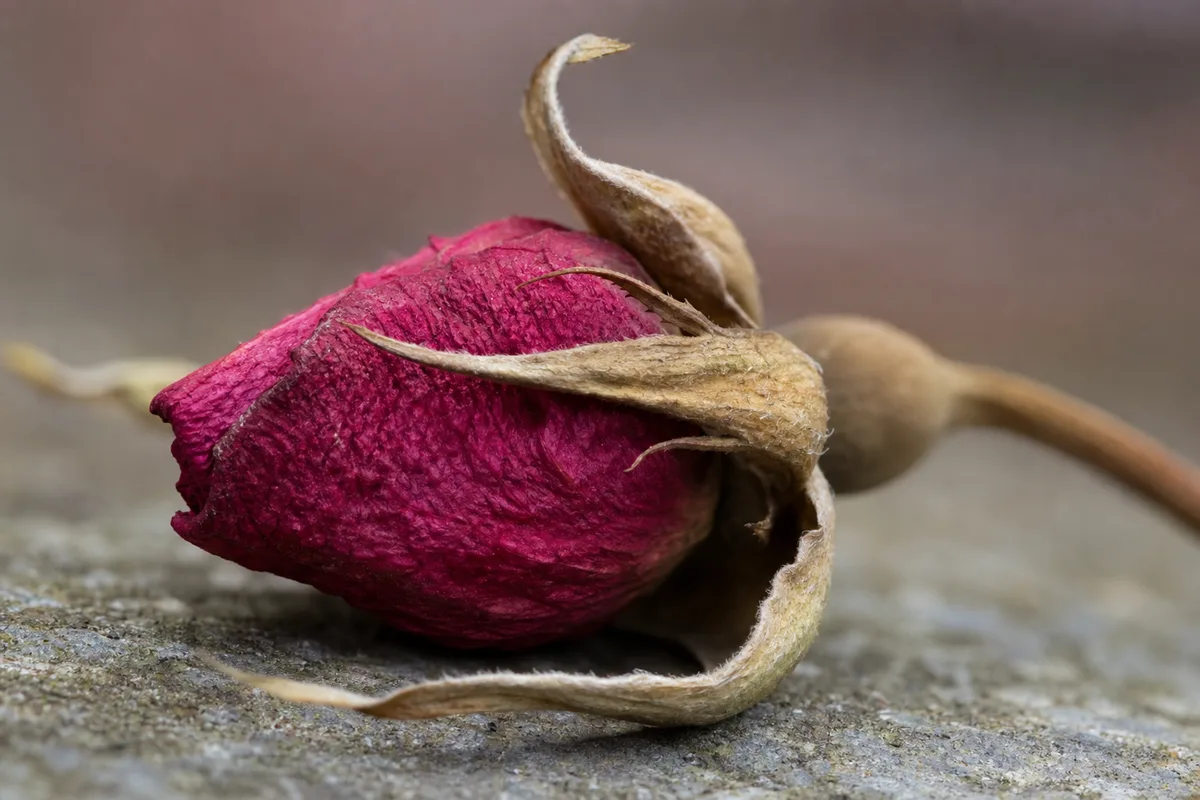
Dropped or failed buds are a symptom, not a diagnosis; inspect the bud and plant for the insect before choosing a control.
Inspect unopened buds closely in spring, especially when new damage appears in a short burst. Hand-pick adults and drop them into soapy water, or gently shake the plant over a bucket in the cool part of the day. Remove buds that contain eggs or larvae and dispose of them rather than leaving them under the plant, because the larvae eventually drop to the soil to pupate.
Curculios have one generation a year in the UC IPM account, which makes early scouting more useful than an all-season spray routine. A broad-spectrum insecticide may be labeled for severe infestations, but adults and larvae are protected by the bud, and a spray can kill predators without reaching the insect. Start with removal and sanitation; if the problem returns, record when adults first appear and ask a local extension office about the species and timing in your region.
9. Rose and pear slugs (sawfly larvae)
Rose slugs and pear slugs are not true slugs. They are sawfly larvae that can look slimy or caterpillar-like but are actually the plant-feeding young of wasplike insects. Young larvae scrape the lower leaf surface, leaving a translucent papery “window” with veins intact; older larvae chew larger holes. Heavy damage can make a rose look scorched even when the stems and buds are still healthy.
Look on both sides of leaves in mid-spring for rose sawfly larvae and in early summer for pear sawfly larvae. The Missouri Botanical Garden guide notes that timing and the translucent leaf damage help separate sawflies from Japanese beetles. Natural enemies, including birds, predatory beetles, and parasitic wasps, often keep light infestations below a damaging threshold.
Wash larvae off with a firm stream of water, prune the worst leaves if the plant is small, and repeat the inspection after several days. Insecticidal soap or horticultural oil may work when the larvae are present and fully contacted; Bacillus thuringiensis products intended for caterpillars do not work on sawfly larvae. Use any pesticide only when the label includes roses and the pest, and avoid spraying when beneficial insects are active.
Do not treat every hole as a crisis. Roses can replace a moderate amount of leaf tissue, and cosmetic damage is often less harmful than a spray that removes the predators that would control the next generation. If the plant is repeatedly defoliated, combine cultivar selection, spring scouting, sanitation, and targeted treatment rather than applying a blanket insecticide.
10. Thrips in buds and flowers
Thrips are tiny, slender insects that hide inside flower buds and open blooms. Their feeding can leave brown petal streaks, distorted flowers, brittle buds, and flowers that fail to open. Chilli thrips can also deform leaves, while western flower thrips are more concentrated in flowers. A hand lens or tap over white paper may reveal them.
Thrips are difficult to control because the most vulnerable stages are often protected inside the bud. UC IPM notes that damage can be more severe when many roses bloom close together and that insecticides may not reach thrips feeding deep in flowers. Some western flower thrips also prey on spider mites, so the presence of a few thrips is not automatically a reason to spray.
Remove badly distorted buds and spent flowers promptly, bagging the debris if thrips are abundant. Thin crowded growth and avoid a continuous tangle of overlapping blooms. Check new buds several times during the flowering flush instead of waiting for every flower to show damage. A labeled insecticidal soap or horticultural oil can suppress exposed stages when coverage is thorough, but repeat timing and flower-safety directions matter.
Do not spray open flowers in a way that exposes pollinators, and do not expect one application to end a hidden-bud infestation. If thrips repeatedly ruin an otherwise vigorous rose, note the rose cultivar, bloom timing, and whether nearby roses are acting as a reservoir. A local extension office can help distinguish flower thrips from chilli thrips and recommend regionally appropriate management.
A season-long prevention plan
Healthy roses still get pests and diseases, but site and maintenance decisions determine whether a small problem stays small. Choose a cultivar with documented disease resistance for your climate, give it sun and room for airflow, and water deeply at the soil rather than alternating between bone-dry and saturated roots.
A practical rose-growing guide from Gardener’s Path makes the same useful baseline point: site selection, drainage, soil preparation, and airflow do more long-term work than a calendar of emergency sprays. Treat those conditions as prevention, not as a cure for a confirmed disease.
Walk the roses once a week during active growth. Check the newest tips for aphids and thrips, turn over a few leaves for larvae or mites, scan buds for holes and distortion, and look at the soil line for galls or cane injury. This takes less time than treating a whole hedge after the first generation has spread, and it lets you tolerate small aphid or sawfly populations while their predators catch up.
Keep fallen leaves, spent flowers, and diseased pruning out of the canopy and dispose of them according to local guidance. Clean soil from pruners after working on a suspect plant, and avoid carrying wet foliage or debris from one rose to the next. Mulch helps reduce splash and conserve soil moisture, but it should not be piled against the canes.
What to do after a problem appears
Use a simple sequence: identify, isolate the evidence, remove what is clearly affected, correct the growing condition, monitor the new growth, and escalate only if the problem persists. “Isolate the evidence” can mean taking a close photograph, marking the affected cane, or placing a white sheet under a branch so you can see what falls when the plant is tapped.
Do not combine several products in one tank or alternate homemade recipes without a reason. Oils, soaps, sulfur, copper, and synthetic fungicides each have label restrictions, temperature limits, and possible interactions. A product that is acceptable for one rose disease may be ineffective or damaging for another, and a broad-spectrum insecticide can turn a manageable mite or aphid problem into a larger one by killing natural enemies.
When to replace a rose or call for diagnosis
Replace or remove a rose when a qualified diagnosis confirms a systemic problem with no practical home cure, such as crown gall in the crown or a destructive virus-associated disease. Remove a plant suspected of rose rosette with care and seek local guidance before handling nearby roses, because leaving a confirmed source in place can put other plants at risk. Do not remove a rose solely because a few leaves have black spot, a small aphid colony, or cosmetic sawfly damage.
Ask a county extension office, plant clinic, or experienced rosarian for help when the symptom does not match the insect or disease, when several problems appear at once, or when a valuable rose continues to decline after watering, drainage, spacing, and sanitation are corrected. Bring clear photographs of the whole plant, the leaf upper and lower surfaces, the buds, the cane base, and the surrounding soil. A dated sequence of images is often more useful than one close-up.
Conclusion
Most rose problems become easier once you stop treating “yellow,” “spotted,” or “eaten” as a diagnosis. Check where damage begins, look for the cause, and let timing and moisture guide your next step.
Begin with water, hand removal, sanitation, spacing, and consistent root moisture. Reserve pesticides for a confirmed problem that justifies them, protect beneficial insects and pollinators, and accept some cosmetic damage when the plant is still vigorous. That approach will not make every rose spotless, but it will produce healthier growth with fewer repeat crises and a much better chance of knowing when a real intervention is needed.