Low Humidity on African Milk Tree: Causes, Checks & Fixes
Quick answer
African milk tree (Euphorbia trigona) prefers normal to dry indoor air and rarely needs a humidifier. Crispy ridge leaves or brown tips usually trace to underwatering, heating-vent placement, or spider mites in hot dry spots—not room humidity alone. First step: read humidity with a hygrometer near the pot; if you are already in the 30–50% range, check stem firmness and ridge-leaf drop before raising humidity.
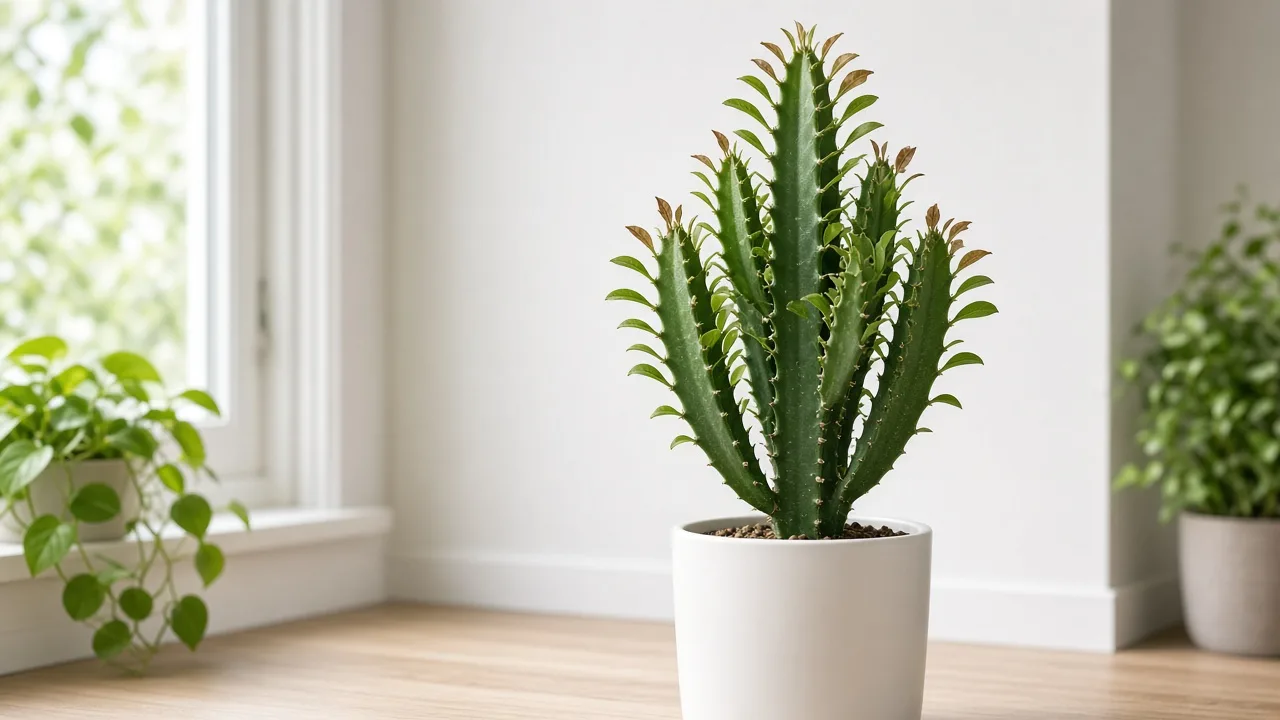
Low Humidity on African Milk Tree: Causes, Checks & Fixes
This guide covers low humidity on African Milk Tree. See also the general Low Humidity guide, watering, and light pages for this plant.
Low Humidity on African Milk Tree: Causes, Checks & Fixes
Quick answer
African milk tree (Euphorbia trigona) is a succulent euphorb from dry tropical forests that stores water in upright triangular stems. It is tagged as dry-soil tolerant and fits ordinary indoor humidity far better than ferns or calatheas.
For how dry winter air crisp leaf edges on houseplants in general, see our low humidity hub. On African milk tree, low humidity is usually a misdiagnosis—ridge-leaf drop, crispy tips, and slow growth more often trace to underwatering, heating-vent placement, or spider mites in hot dry micro-climates.
First step: place a hygrometer near the pot for two to three days. If readings sit in the 30–50% range most homes already provide, move the plant away from heating vents and check stem firmness plus ridge-leaf drop before buying a humidifier.
When to use this page vs other African milk tree guides
- Underwatering — use when stems wrinkle, ridge leaves drop in clusters, and the pot feels light
- Brown tips — use when tan crispy margins are the main symptom after heat or hard water
- Spider mites — use when dry air coincides with stippling and fine webbing on stem ridges
- Wilting or drooping leaves — use when whole branches soften, not just dry ridge leaves
- Not enough light — use when columns stretch and lower ridge leaves drop from weak light, not dry air
- Watering guide — use for soak-and-dry rhythm before assuming humidity is the issue
What low humidity looks like on African milk tree
African milk tree does not show the classic “crispy fern tips” pattern. Symptoms appear on small ridge leaves and thin stem edges while the main columns stay firm.
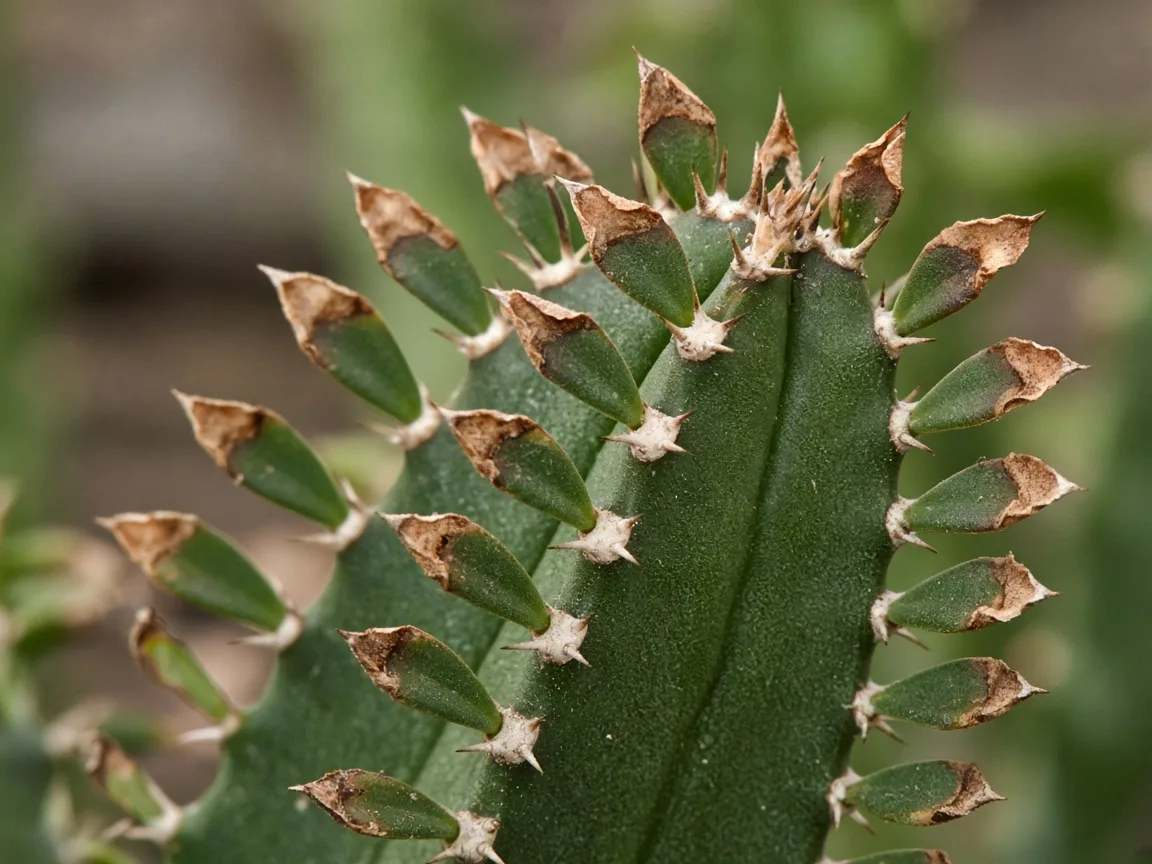
Low humidity on African milk tree—papery brown ridge leaves along a triangular stem; firm green columns may still look healthy.
Typical signs when dry air is actually involved:
- Papery brown tips on tiny teardrop ridge leaves along triangular stems
- Dry, crisp leaf edges on the newest ridge leaves facing a heating vent or fireplace
- Localized damage on one side of a tall column while the opposite face stays green
- Slow spread over weeks—not overnight stem collapse
- Fine stippling or webbing on ridges in the same hot dry spot—mite overlap, not humidity tolerance limits
Usually not low humidity:
- Ridge leaves yellowing and falling on lower branches in dim corners — not enough light
- Wrinkled, soft stems with a very light pot — underwatering
- Mushy black bases at the soil line — overwatering or root rot
Ridge leaves vs drought: a pattern only Euphorbia trigona shows
This distinction is mandatory for African milk tree and wrong for most leafy houseplants.
Euphorbia trigona produces short-lived teardrop leaves in pairs along the ridges of three-sided stems. Those leaves naturally yellow and drop even on healthy plants—growers often mistake normal shedding for humidity stress.
| What you see | More likely cause |
|---|---|
| One or two old ridge leaves yellow and fall; stems firm | Normal leaf turnover |
| Many ridge leaves drop at once + wrinkled stems + light pot | Drought — see underwatering |
| Crisp brown tips only on leaves beside a heat vent | Localized dry air, not whole-room humidity |
| Stippling + webbing on ridges | Spider mites in hot dry conditions |
NC State Extension notes that African milk tree leaves are small, short-lived, and produced along ridged stems. Judge health by firm vertical stems and new ridge leaves on upper growth, not by every lower leaf staying attached.
Why African milk tree rarely struggles with low humidity
Native dry-forest adaptation. African milk tree is found in dry tropical forests across Central Africa. Its succulent stems hold water between infrequent drinks—the same architecture that makes it drought and dry-soil tolerant indoors.
Prefers drier air over steamy rooms. Retail growers report that Euphorbia trigona does well in normal home humidity but prefers drier air and should avoid steamy bathrooms. Misting ridge leaves or running a humidifier beside a slow-draining pot keeps soil wet longer—a bigger risk than dry winter air.
Winter heating is usually still adequate. Penn State Extension notes ASHRAE recommends 30–60% indoor relative humidity for human comfort, with some cacti and succulents among the exceptions that tolerate drier air. African milk tree falls in that tolerant group.
Spider mites, not humidity limits. Colorado State Extension reports dry weather greatly favors spider mites on houseplants. Tall African milk tree columns beside sunny windows and heating vents create exactly that hot, dry micro-habitat—NC State lists spider mites among pests to monitor on this species.
Royal Red and variegated clones. Variegated and reddish forms need brighter light than plain green stems. In dim rooms with dry winter air, lower ridge leaves drop from light stress while owners blame humidity—check the light guide before humidifying.
The stem firmness check (succulent columns, not leaf turgor)
On ferns you watch frond tips. On African milk tree you watch triangular stem ridges.
- Pinch a mid-stem ridge between gloved fingers (latex sap irritates skin). Firm, plump angles mean the column is hydrated.
- Look for vertical wrinkles or slight stem shrink between spines—drought stress, not dry air alone.
- Check the pot weight when mix is dry. A light pot plus wrinkled stems overrides any humidity reading.
- Inspect upper growth. New ridge leaves along the top few inches confirm the plant is actively replacing tissue.
Soft, mushy bases or black patches at the soil line are never humidity issues—switch to root rot diagnosis immediately.
How to confirm the cause
Work through checks in this order:
- Measure humidity with a hygrometer at plant height for two to three days. Readings between 30% and 50% mean normal home air is adequate.
- Map placement — note heating vents, radiators, fireplaces, and sunny glass that amplify dry air on one face of a tall column.
- Stem firmness and pot weight — wrinkled stems plus a light pot point to underwatering, not humidity.
- Ridge-leaf pattern — scattered old-leaf drop on firm stems is normal; cluster drop on new growth is not.
- Pest check — magnify stem ridges and leaf axils for stippling, webbing, or cottony clusters.
- Water and salt history — white crust on soil plus brown tips may be fertilizer salts, not dry air. Flush per the fertilizer guide if needed.
If humidity is normal, watering rhythm is steady, and stems stay firm, low humidity is unlikely to be the main driver.
First fix for African milk tree
If humidity readings stay below about 30% near the plant: move the pot away from heating vents and draft paths, then group it with other plants or run a small room humidifier until readings stabilize around 30–50%. Do not mist African milk tree—water on ridge leaves in tight columns invites fungal issues, and dripping latex sap can irritate skin.
If humidity is already 30–50%: skip the humidifier. Move the pot off radiator ledges, confirm the soak-and-dry watering rhythm, and rinse stem ridges with a strong water jet if spider mites are suspected—before any oil spray on a latex-bearing euphorb.
Make one correction at a time. Do not repot, fertilize, and humidify on the same day.
Step-by-step recovery
If ridge-leaf crisping continues after placement is fixed:
- Deep soak when dry — water only after the top 2–3 inches of gritty mix are dry, per the watering guide
- Treat spider mites if stippling is confirmed — see spider mites on African milk tree
- Increase light gradually if columns are stretching—variegated forms especially need brighter exposure per the light guide
- Hold fertilizer until new ridge leaves emerge clean
- Trim only fully dead ridge leaves — snapped leaves will not regreen; wait for new pairs along upper ridges
Wear gloves when handling cut stems or fallen leaves—euphorbia latex is irritating and this plant is not pet safe.
Recovery timeline
- 1–2 weeks: Localized tip crisping from a heat vent often stops once the pot is moved
- 2–4 weeks: New ridge leaves along upper stems confirm watering and placement fixes are working
- Months: Lower stem sections may stay bare between natural leaf cycles—that is normal columnar growth, not failed recovery
Dropped ridge leaves do not reattach. Judge success by firm stems and clean new leaves on vertical extension, not by old nodes refoliating.
Lookalike symptoms
| What you see | More likely cause than low humidity |
|---|---|
| Wrinkled stems, light pot, dry mix | Underwatering |
| Soft black base, sour soil | Overwatering / root rot |
| Stretching columns, pale growth | Low light |
| Stippling + fine webbing on ridges | Spider mites in hot dry air |
| White soil crust + brown tips | Salt buildup from fertilizer |
| Single old ridge leaf yellowing | Normal short-lived leaf turnover |
Low humidity vs. spider mites: Mites leave stippling, dusty surfaces, and webbing on ridges—common in hot dry spots but a pest issue. Humidifying without treating mites lets populations explode while soil stays damp.
Low humidity vs. curling leaves: Curling leaves on this species more often follow drought or cold drafts than room-wide dry air.
What not to do
- Do not mist ridge leaves to raise humidity—this euphorb prefers drier air and wet foliage adds rot risk.
- Do not place African milk tree in a steamy bathroom for humidity—it tolerates dry air better than saturated rooms.
- Do not overwater because ridge leaves look dry. Mushy euphorb stems fail faster than dry winter air.
- Do not fertilize a stressed plant to speed recovery—salt burn worsens tip browning.
- Do not handle damaged stems bare-handed—latex sap from snapped ridges can irritate skin and eyes.
How to prevent low-humidity stress next time
Keep African milk tree in ordinary room humidity without special equipment:
- Run a hygrometer once each heating season near tall columns.
- Pull pots back from radiator ledges and heat registers.
- Maintain bright light and fast-draining soil so the plant is not drought-stressed while air is dry.
- Wipe dust from stem ridges occasionally; do not leave them dripping wet.
- Inspect ridges for mites each winter when indoor air is driest.
Penn State Extension suggests that if humidity is comfortable for you, most houseplants tolerate winter levels, with succulents needing less intervention.
African milk tree care cross-check
Align humidity work with this species’ baseline needs:
- Light: Bright indirect to direct sun after acclimation; weak light causes leaf drop misread as humidity stress
- Water: Soak when top 2–3 inches are dry; stems store moisture between drinks
- Soil: Gritty cactus mix in a heavy stable pot—tall columns tip easily
- Temperature: Warm rooms suit active growth; avoid cold drafts below about 45°F (7°C) per NC State guidance
When air is dry and soil stays wet too long, fix drainage and watering before humidifying.
Practical checks
Urgency check
Low humidity alone is a slow-moving, medium-severity issue on African milk tree. Escalate immediately if stems soften at the base, black patches spread at the soil line, or columns collapse—that is root-zone failure, not dry air.
Best inspection order
For African milk tree, check hygrometer readings, stem firmness and pot weight, heating-vent placement, ridge-leaf drop pattern, then stem ridges for pests—in that order—before adding humidity.
When the first fix fails
If ridge-leaf crisping continues after four to six weeks with humidity in range and steady watering, flush the pot to remove salt buildup and revisit light levels for variegated clones. Persistent problems with wet soil point to repotting into grittier mix—not higher humidity.
Related African milk tree guides
- African milk tree overview
- African milk tree watering
- African milk tree light
- African milk tree soil
- Brown tips on African milk tree
- African milk tree problems hub
Related tool
Use the Humidity Calculator to narrow causes for low humidity on this plant before changing multiple variables at once.