Curling Leaves on Barrel Cactus: Rib Checks & Dry-Down Fixes
Quick answer
Curling leaves on barrel cactus almost always means rib contraction from long drought, dried spine clusters at areoles, or distorted crown tissue from pests—not foliage rolling like a houseplant. First step: push a dry skewer through the pot and feel whether ribs are firm but shrunken; if the mix is bone-dry throughout, soak once and drain—if the base is soft on damp soil, stop watering and check for rot instead.
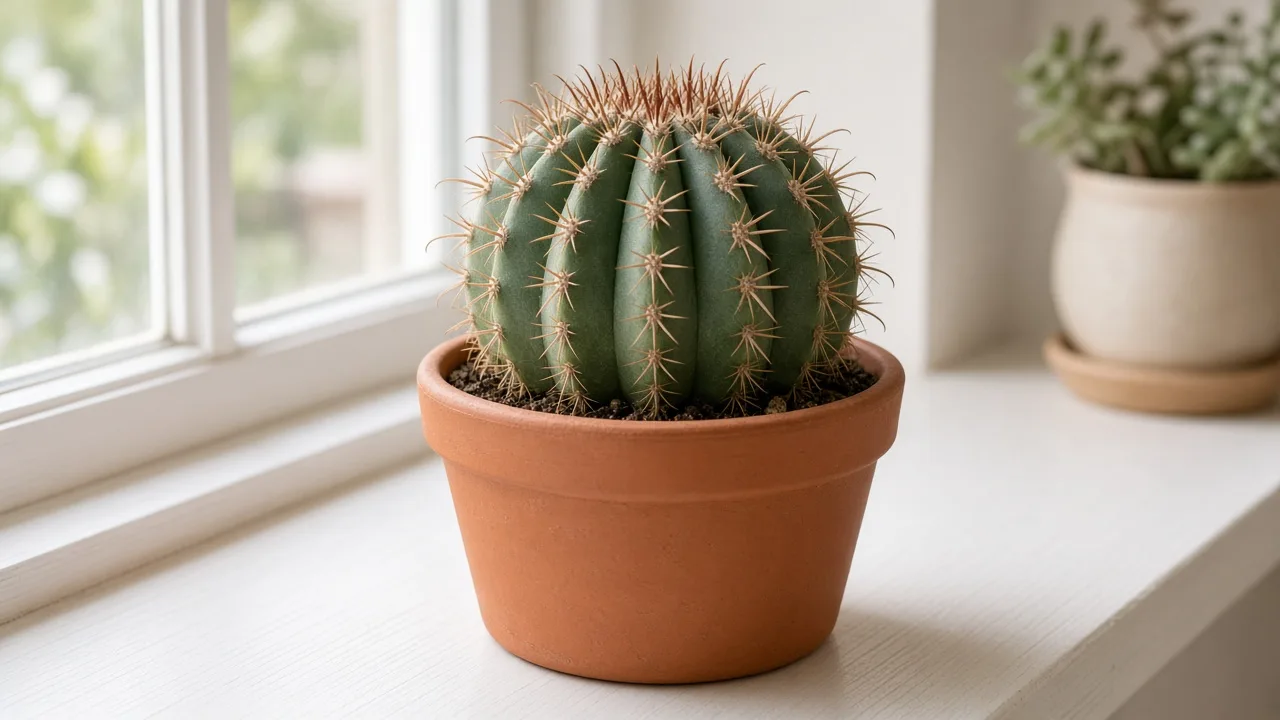
Curling Leaves on Barrel Cactus: Causes, Checks & Fixes
This guide covers curling leaves on Barrel Cactus. See also the general Curling Leaves guide, watering, and light pages for this plant.
Curling Leaves on Barrel Cactus: Causes, Checks & Fixes
Quick answer
“Curling leaves” on barrel cactus (Ferocactus) is almost never flat foliage rolling inward like on a pothos. On this ribbed desert cactus, the visible curl is usually rib contraction—vertical grooves pulling tighter as the stem loses water—or dried spine clusters at areoles twisting back, or distorted crown tissue where the only soft growth meets pests or heat.
For how leaf curl works as a general protective stress response, see our curling leaves symptom guide. On Ferocactus, the pattern usually shows up as shrunken ribs on a still-firm barrel, a feather-light pot, and dull matte skin—not limp translucent tissue unless roots are failing on wet mix.
First step: push a dry wooden skewer through the drainage hole to the pot base and press the lower ribs with tongs or a folded towel—before you soak, repot, or spray anything.
- Firm ribs that feel shrunken inward + bone-dry mix throughout → one deep soak, drain fully, then resume dry-down per the watering guide.
- Soft or mushy base + damp soil for days → stop watering; see overwatering and root rot before you treat drought.
- Fine webbing on rib grooves + dull stippling, firm base → spider mites at rib surfaces, not thirst.
- Sticky crown with soft insects between new spines → aphids or mealybugs distorting the growing tip.
Make one correction at a time so you can read rib firmness over the next two weeks. Contracted ribs may stay slightly shallower even after recovery—watch new crown spines and stable base color for proof the fix worked.
When to use this page vs other Barrel Cactus guides
This page is the curl-and-shrink entry when ribs, spine tufts, or crown tissue look twisted or pulled inward.
| Pattern | Read next |
|---|---|
| Ribs shrunken inward, dull skin, very light pot | This page → then underwatering |
| Soft base, yellow lower tissue, wet mix | Overwatering or root rot |
| Bleached papery patches on sun-exposed ribs | Sunburn |
| Fine webbing and yellow stippling on ribs | Spider mites |
| White cottony masses in areole crevices | Mealybugs |
| Whole barrel leaning, stretched pale growth | Not enough light or leggy growth |
| Uniform yellowing without rib shrinkage | Yellow leaves |
What curling looks like on Barrel Cactus
Healthy Ferocactus has a stout tubular stem with well-defined ribs covered in curved spines from areoles. Stress “curl” breaks that geometry in ways leafless cacti show differently from ferns or aloe:
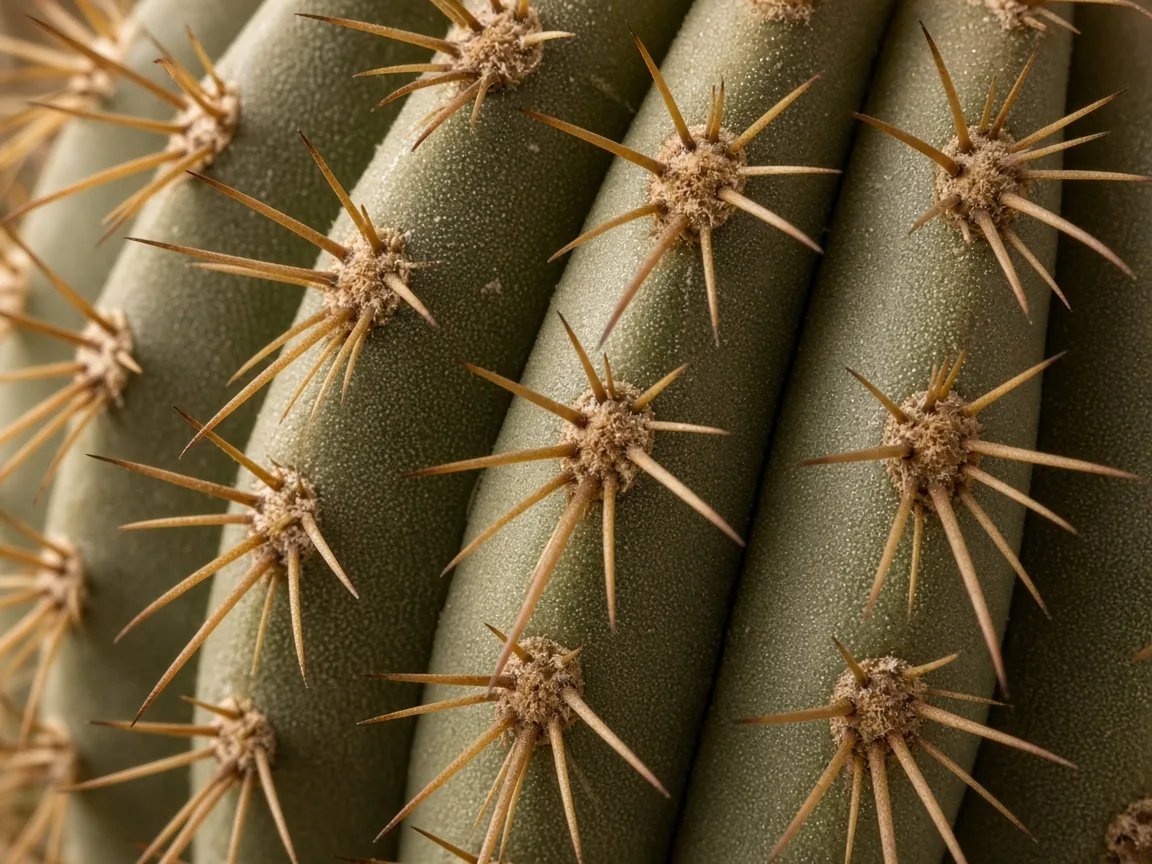
Shallow rib valleys pulled tighter on a firm barrel—compare contracted grooves with stable spine clusters above.
Drought rib contraction (most common indoors):
- Ribs pull inward so vertical grooves look deeper and the barrel appears slightly narrower
- Skin turns dull or matte instead of plump and glossy
- Pot feels very light when lifted; skewer comes out dusty dry at the base
- Spines may look slightly limp or dried at the tips without falling off
- Base stays firm when pressed through a towel—no mush
Overwatering / root-failure shrinkage (different emergency):
- Lower ribs may look translucent yellow-brown or feel soft while upper ribs still seem normal
- Pot stays heavy; mix damp at depth for more than a week
- Sometimes mistaken for drought because the barrel looks “wrinkled,” but tissue is mushy not rigid
- Overwatering or poor drainage can cause rot or brown mushy areas on the stem—see root rot
Heat and sun-stress curl at the crown:
- Newest areoles at the growing tip may twist or dry after a sudden move to intense afternoon sun
- Follows relocation to a south sill without acclimation—pairs with sunburn patches on exposed ribs
- Soil may be correctly dry while crown tissue curls from rapid water loss in heat
Pest-related crown distortion:
- Soft growth at the crown-like flower formation twists when aphids, mealybugs, or thrips feed on expanding tissue
- Mealybugs, spider mites, fungus gnats, or scale are occasional pests—check areoles before you soak for drought
- Firm ribs below with damage only at the top points to insects, not whole-barrel thirst
One season of slight rib shallowing on an otherwise firm plant after a dry winter rest may be normal. Concern rises when the base softens, contraction spreads while soil stays wet, or crown tissue collapses inward.
Rib contraction vs soft-base rot on a leafless barrel
Direction and firmness matter because Ferocactus stores water in the stem ribs, not in separate leaves.
| Signal | Drought rib contraction | Soft-base rot / overwatering |
|---|---|---|
| Rib feel | Firm but shrunken; grooves deeper | Soft, translucent, or mushy at base |
| Pot weight | Very light | Heavy for days after watering |
| Skewer test | Dusty dry throughout | Damp or sour-smelling at base |
| Skin color | Dull matte green/blue-green | Yellow-brown translucent lower ribs |
| First fix | One deep soak, full drain | Stop water; inspect roots |
| Recovery sign | Ribs slowly plump; new crown spines | Firm base returns; no spreading mush |
Thirsty barrel cactus conserves water by pulling ribs together—the cactus equivalent of leaf cupping. If you soaked recently but ribs still shrink while the base goes soft, trust the base and soil probe over the calendar.
Reading the skewer test through a heavy mineral mix
Barrel cactus in mineral-dominated cactus mix with pumice and grit dries unevenly in thick ceramic or terracotta pots. Surface dust does not prove the base is dry—and a dry surface with wet core can rot roots while ribs still contract from inability to absorb water.
Spine-safe dry-down check
- Skewer to base — Push a dry bamboo skewer through the drainage hole until it hits the pot bottom; pull out and check moisture at the tip, not just the top inch.
- Pot weight — Lift with both hands on the rim (gloves on). A mature barrel in a heavy clay pot should feel noticeably lighter when truly dry.
- Base press — Use kitchen tongs wrapped in paper towel to press lower ribs. Firm resistance = intact tissue. Give-way softness = rot risk first.
- Crown scan — Inspect the growing tip and upper areoles for webbing, cottony wax, or sticky shine before assuming drought.
- Season check — During cool winter dormancy, reduce water sharply; ribs may contract slightly on a long dry rest without needing a mid-winter soak.
Let the soil mix dry out completely between waterings is the extension baseline—on indoor Ferocactus that often means four to six weeks in warm bright growth and eight to twelve weeks or longer in a cool room, not a weekly calendar.
Why barrel cactus ribs curl
Long drought is the default indoor cause. Ferocactus evolved for rocky, sandy desert soils with full sun. Indoors, low winter light plus fear of rot leads many growers to underwater for months. Ribs contract as the stem dehydrates—slight rib contraction and dull skin after long drought are the plant-detail warning signs for this species.
Wet roots that cannot drink mimic drought curl. When mix stays damp in a dim corner, roots suffocate and stop moving water even though you watered on schedule. The barrel shrinks while soil feels wet—classic succulent overwatering trap. Curl plus heavy pot means stop water, not another soak.
Heat spikes near glass accelerate crown curl. A south-facing window can bake the pot while ribs lose water faster than roots replace it—especially right after repotting when roots are disturbed. Pair with gradual acclimation per the light guide.
Pests target the only soft tissue. Aphids and mealybugs colonize crown buds and new areoles during warm active growth, twisting slow crown expansion. Spider mites favor dry air and rib grooves. A firm shrunken barrel without insects at the crown is almost always water stress, not pests.
Nitrogen push softens crown tissue. Heavy feeding during long bright days produces succulent crown growth that curls and attracts pests faster than firm slow ribs. Match feeding to the fertilizer guide instead of forcing soft tips.
Confirm drought curl vs overwatering, pests, sunburn, and low light
Work through checks in order so you do not soak a rotting base or spray mites on a thirsty plant:
- Base firmness first — Soft mushy tissue on damp mix overrides every other symptom.
- Skewer at depth — Dry throughout confirms drought; wet core with shrinking ribs suggests root failure.
- Pest scan at crown and rib grooves — Webbing, cottony wax, or sticky residue before watering.
- Light history — Recent move to harsh sun? Check for bleached patches on exposed ribs.
- Growth direction — Leaned pale stretch points to not enough light, not classic rib contraction.
Symptom lookalike comparison
| What you see | Likely cause | Key check |
|---|---|---|
| Firm shrunken ribs, light pot, dry skewer | Drought rib contraction | Base firm; dull skin |
| Soft base, translucent lower ribs, wet mix | Overwatering / rot | Sour soil possible; no soak |
| Bleached papery rib patches | Sunburn | Follows sun move; tissue dry not shrunken |
| Fine webbing, stippling on ribs | Spider mites | Dry indoor air; firm base |
| White cotton in areoles | Mealybugs | Stationary wax masses |
| Sticky crown, soft insects | Aphids | Honeydew on upper ribs |
| Pale stretched lean, slow dry-down | Low light | Not classic inward rib pull |
Confirmed drought diagnosis — Firm ribs, dull skin, very light pot, and bone-dry mix at the skewer tip. Suspected — Slight contraction after winter rest in a cool room may need only patience until spring growth resumes—do not mid-winter soak a cold dormant plant.
First fix: skewer, then one deep soak (drought path only)
Only when the base is firm and the skewer is dry at the bottom: water once thoroughly until excess runs from the drainage hole, then empty the saucer immediately.
That single soak is the lowest-risk first fix for contracted ribs—no repot, no fertilizer, no crown rinse that pools water at the growing tip. Water the plant well and ensure good drainage, then let the mix dry completely before the next drink.
Soak technique for a spiny barrel
- Use a narrow-spout watering can aimed at the soil line—not overhead spray on the stem
- Terra cotta and porous clay help the pot dry; if yours is glazed with no hole, repot is urgent before soaking
- Soak in morning so the plant sits in full sun and warmth during uptake
- Skip mid-winter soaks in rooms below 50°F (10°C) unless the plant is actively growing and fully dry
- Wait two to three weeks before judging rib plumpness—Ferocactus rehydrates slowly
If the base was soft or soil was wet, do not soak. Move to dry-down and root inspection per root rot guidance instead.
Recovery timeline and what improvement looks like
Barrel cactus recovers on stem time, not leaf time—there are no blades to unfurl overnight.
| Phase | What to expect |
|---|---|
| Days 1–3 after soak | Pot weight increases slightly; skin may look marginally less dull |
| Weeks 1–3 | Ribs gradually deepen outward; crown spines push normally |
| Month 2+ | Stable firm barrel; contraction stops spreading |
| Old contracted tissue | May keep slightly shallow grooves permanently—normal |
Judge success by firm base, stable rib color, and new spine growth at the crown—not by perfect spherical roundness. Wear protective gloves when handling during checks; fishhook spines puncture fabric.
Worsening signs — Base softens further, lower ribs turn translucent, crown collapses inward, or contraction spreads while soil stays damp. Those mean escalate to rot or pest paths, not repeat soaks.
Mistakes to avoid
- Soaking on a wet-tissue base — Adds water to rotting roots; ribs may still look shrunken.
- Misting ribs — Surface moisture does not rehydrate stem tissue and raises rot risk at the crown.
- Weekly calendar watering — Indoor Ferocactus in cool dim winters needs months between drinks, not a houseplant schedule.
- Fertilizing contracted ribs — Stressed cactus does not need feed until firm growth resumes.
- Repotting and soaking same day — Disturbed roots plus full soak invite rot; pick one stressor.
- Scrubbing spines to “uncurl” — Mechanical damage; fix the water balance instead.
How to prevent rib contraction next time
Align care with desert biology:
- Dry-down discipline — Skewer to base before every soak per watering
- High light — South or west window or supplemental grow light so the plant uses water actively
- Gritty fast-draining mix — Mineral cactus blend in a pot with drainage; terracotta speeds drying
- Cool dry winter — Water even less during dormant seasons of fall and winter
- Crown pest patrol — Weekly crown glance during warm months catches pests before crown twist
- Stable heavy pot — Prevents tipping that cracks contracted ribs against furniture
Start at the Barrel Cactus hub for the full care cluster when you reset after a drought scare.
Related Barrel Cactus guides
- Underwatering on Barrel Cactus — Use when rib contraction pairs with long drought and a light pot; overlaps heavily with this page.
- Overwatering on Barrel Cactus — Use when ribs look shrunken but the base is soft on damp mix—opposite first fix.
- Root rot on Barrel Cactus — Use when lower tissue is mushy, translucent, or smells sour.
- Spider mites on Barrel Cactus — Use when rib surfaces show webbing and stippling without drought dry-down.
- Sunburn on Barrel Cactus — Use when bleached papery patches follow a sudden sun move, not inward rib pull alone.
Related tool
Use the Plant Problem Diagnosis Tool to narrow causes for curling leaves on this plant before changing multiple variables at once.