Calathea Zebrina Care Guide: Complete Overview
Goeppertia zebrina
Zebra calathea care: bright indirect light, at least 60% humidity, filtered water, evenly moist soil, and division at repotting. Non-toxic to pets.
Calathea Zebrina Care Guide: Complete Overview
Start with wateringThe most common care mistake for Calathea ZebrinaWatering guide →Calathea Zebrina care essentials
Light
medium to bright indirect light, low indirect light
Water
Every 5–7 days spring and summer (top 2 cm beginning to dry). 7–10 days winter. filtered or rainwater recommended.
Soil
Well-draining but moisture-retentive mix. pH 6.0–7.5. Peat or coco coir base with perlite.
Humidity
above 60% RH; zebra bands stay crisp when humidity stays high
Temperature
18–24°C (65–75°F)
Fertilizer
Feed lightly during active growth.
About Calathea Zebrina
Calathea Zebrina has a upright growth habit.
| Detail | Information |
|---|---|
| Growth habit | Upright |
| Scientific name | Goeppertia zebrina |
Calathea Zebrina Care Guide: Complete Overview
Calathea Zebrina Care: Quick Answer
Calathea Zebrina — the zebra plant — is worth bringing home when its newest leaves show crisp light-and-dark green bands on velvety oblong foliage with clean purple undersides. Give it bright indirect light (see the dedicated light guide), evenly moist well-draining soil (watering and soil pages), humidity above 60%, stable room temperatures around 65–75°F (18–24°C), and rainwater or distilled water when tap water leaves parallel brown streaks along the pale bands. Divide the rhizome in spring to propagate. The ASPCA lists Calathea species as non-toxic to cats and dogs — a genuine advantage for pet owners who still need to discourage chewing.
Among popular prayer plants, zebrina is often described as more forgiving than pinstripe or white-variegated calatheas, but it is still a true Marantaceae humidity plant, not a set-and-forget pothos. Success means matching light, moisture, air moisture, and water chemistry together.
What Is Calathea Zebrina? Identification and Striped Foliage
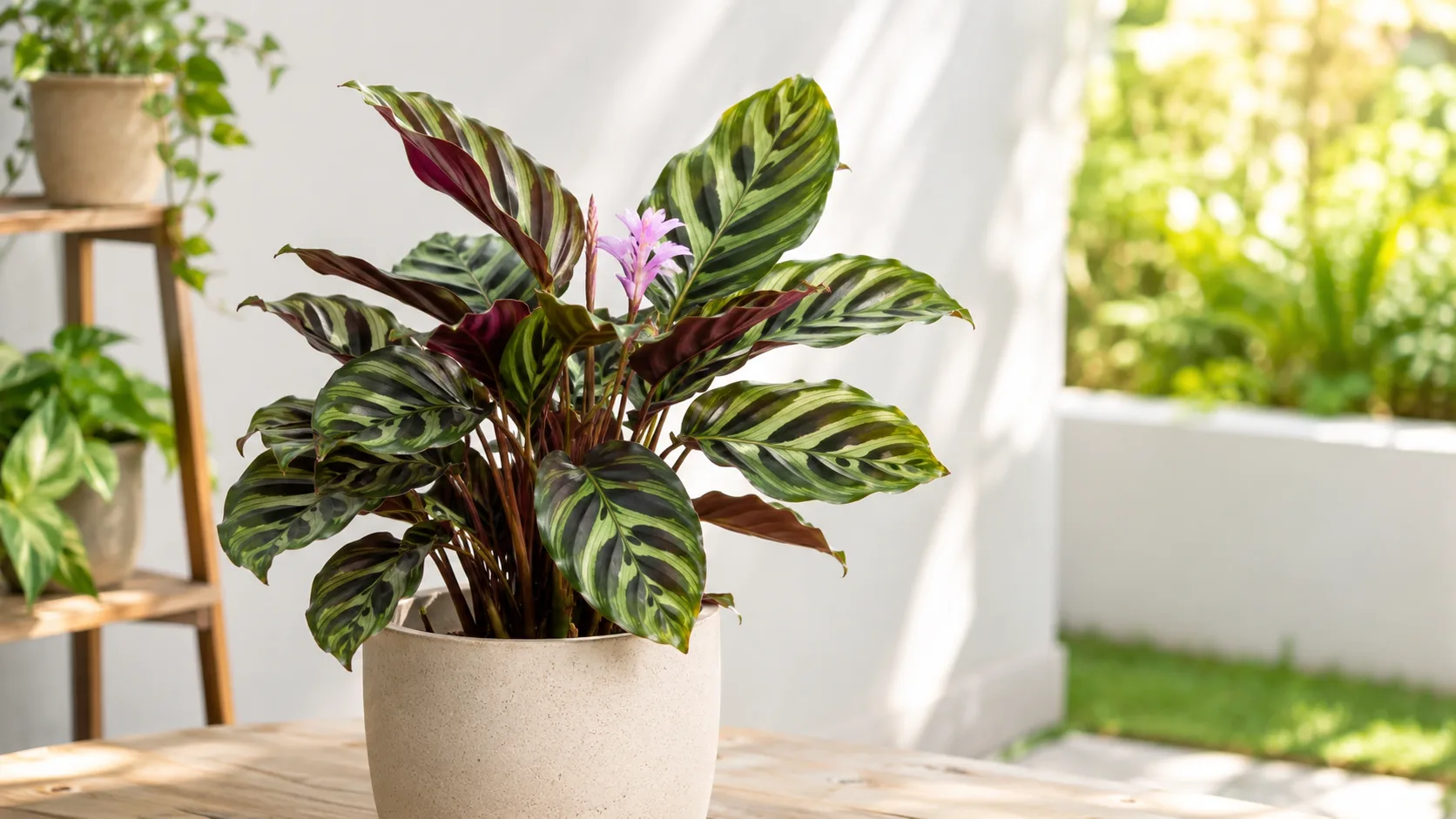
Calathea Zebrina is an evergreen tropical perennial in the Marantaceae (prayer plant) family, valued for large velvety oblong leaves with dramatic zebra-like striping. Indoors it typically forms an upright clumping plant up to about 3 feet (90 cm) tall and wide, with individual leaves reaching 15 to 20 inches (38–50 cm) long and 6 to 8 inches (15–20 cm) wide on long petioles, per NC State Extension. The upper surface is dark green with lime-green bands along the veins; undersides are reddish-purple. Flowers are inconspicuous and rare on houseplants.
The Royal Horticultural Society describes an evergreen perennial forming a clump of long-stalked light green leaves regularly marked with dark green on each side of the midrib, with red-purple beneath — the pattern that makes zebrina one of the most recognizable calatheas at retail.
Like other Marantaceae members, zebrina displays nyctinasty: leaves fold upward in the evening and reopen in the morning, driven by light and temperature changes at the leaf base. Nighttime folding is healthy. Daytime curl or droop usually signals dry air, incorrect watering, or cold stress — a distinction that prevents you from drowning a plant that actually needs humidity.
Botanical Names on the Nursery Tag
Botanists now place this species in Goeppertia, so the accepted scientific name is Goeppertia zebrina. Retail tags often still read Calathea zebrina or occasionally Maranta zebrina. All refer to the same plant. The specific epithet zebrina is Latin for “with stripes like a zebra” and describes the banded foliage, per NC State Extension. Search both genus names when researching pests or propagation to find complete results.
NC State Extension notes zebrina is often confused with Ctenanthe lubbersiana, which has a similar striped look but different growth habit and care tolerances. At the nursery bench, compare leaf shape, velvety texture, and upright clumping form before you buy.
How Zebrina Differs From Other Prayer Plants
Maranta leuconeura, the trailing herringbone prayer plant, roots easily from stem cuttings and tolerates slightly more watering lapses. Goeppertia zebrina grows upright from rhizomes, forms a taller clump of larger leaves, and propagates almost exclusively by division — not by rooting a single leaf in water.
Compared with other popular calatheas, zebrina sits in the moderate difficulty range. UF/IFAS lists C. zebrina among commonly produced interiorscape calatheas with oblong light green leaves and wide dark stripes from midrib to margin. It is often cited as more forgiving than Goeppertia ornata (pinstripe) or highly variegated cultivars, but more humidity-sensitive than Goeppertia lancifolia (rattlesnake). The bold pale bands mean parallel brown streaks from hard tap water show up immediately — a zebrina-specific warning sign that rattlesnake owners may not see as quickly.
Native Habitat and Why It Matters Indoors
Zebra plant is native to the tropical rainforests of Brazil (northeast, south, and southeast regions per NC State), where it grows as an understory plant beneath a closed canopy. That origin explains nearly every indoor requirement: warm temperatures, high humidity, filtered light, and evenly moist but never waterlogged soil.
Your home is not a rainforest floor. Winter heating drops humidity to 30–40% in many rooms. Municipal tap water adds fluoride that NC State Extension links to browning leaf edges and tips. South windows throw heat and direct beams that fade band contrast before the whole leaf scorches. Treat zebrina as a system — light, water, soil, humidity, and water quality together — rather than a checklist you can satisfy halfway.
When to choose zebrina over siblings: Pick zebrina if you want large velvety striped foliage for a floor or side-table display and can supply humidifier-level air plus filtered water. Choose rattlesnake calathea if your air runs dry and you want a more forgiving prayer plant. Choose pinstripe or white fusion only when you are ready for stricter humidity and water-quality discipline.
Should You Buy This Plant? Honest Fit Check
Calathea Zebrina is not a beginner “set and forget” plant like pothos or snake plant. It rewards growers who can supply stable humidity above 60%, filtered or rainwater, and bright indirect light without afternoon sun on the leaves. It is a strong fit if you enjoy watching large new leaves unfurl, you already own or will buy a humidifier, and you want pet-safe foliage without calcium oxalate toxicity.
Skip it or wait if your only bright spot is a hot south window without a sheer curtain, you plan to water weekly on autopilot without checking soil, or your winter bedroom humidity stays below 40% with no plan to raise it. Cosmetic old-leaf damage at the nursery will not repair — if the newest leaves already show brown streaks along the pale bands or washed-out striping, walk away.
Nursery Buying Checklist for Zebra Stripes
- Inspect the newest leaves first — crisp zebra banding on fresh growth tells you current light, water, and humidity at the shop were adequate.
- Confirm species identity — verify velvety oblong leaves and upright clump, not a mislabeled Ctenanthe with similar striping.
- Check undersides for fine pale stippling (early spider mites) or white cottony clusters (mealybugs).
- Lift the pot — it should feel moderately heavy, not waterlogged-soggy or feather-light.
- Reject pots with parallel brown streaks on new pale bands — that pattern often traces to fluoride-heavy tap water at the grower, not random edge burn.
- Confirm drainage holes — zebrina in sealed cachepots at the shop often arrives already stressed.
Best Light for Bold Zebra Banding
Calathea Zebrina needs bright, indirect light — strong ambient daylight without harsh direct sun on the leaves for extended periods. NC State Extension lists bright, indirect light and partial shade (direct sun only part of the day, roughly two to six hours). Indoors that usually means an east-facing window, a bright north exposure, or a filtered south or west window with a sheer curtain.
Direct midday or afternoon sun bleaches stripe contrast and causes leaf scorch on velvety tissue. Too little light produces smaller new leaves, weaker banding, and slower drying, which increases overwatering risk if you keep a summer watering rhythm year-round. For window placement detail, grow-light distance, and faded-pattern troubleshooting, see the full Calathea Zebrina light guide.
The RHS calathea growing guide recommends a bright spot out of direct sunlight, with a north- or east-facing window ideal in summer and a brighter position in low winter light — the same seasonal shift zebrina owners should apply when bands dull in December.
Temperature and Humidity Targets
Calathea Zebrina prefers stable indoor temperatures between 65 and 75°F (18–24°C). NC State Extension gives the same range and warns against sudden temperature changes and cold drafts. The RHS species page recommends draught-free conditions and a constant temperature of at least 16°C (61°F). Avoid winter glass chill, air-conditioning blasts, and hot dry air from heating vents. Bring outdoor summer plants inside before temperatures drop below about 60°F (15°C).
Humidity above 60% is the threshold NC State Extension recommends for good foliage quality. Ideal active-growth range is 60–80%. Below about 50%, expect crispy margins, daytime leaf roll, and spider mite pressure even when watering is correct. Zebra bands stay crisp when humidity stays high; pale stripes are the first place dryness shows.
Raising Humidity Without Wasting Effort
A small humidifier near the plant is the most reliable fix. Secondary help includes grouping humidity-loving plants, a pebble tray with the pot elevated above water (not sitting in it), or a bright bathroom — provided light is still adequate.
Misting leaves adds only minutes of elevated humidity and can encourage leaf spot if water sits overnight — treat misting as cosmetic, not structural. The goal is changing the air volume around the plant, not wetting foliage on a schedule.
Soil Mix and Drainage
Use a moisture-retentive but well-draining potting mix with high organic matter and added perlite or bark. NC State Extension describes moist, well-drained peat-based or African violet potting mix with good drainage and soil pH from acid to neutral (6.0–8.0). A workable home recipe is roughly two parts quality houseplant mix, one part perlite, and one part orchid bark or coco chips — adjust toward more perlite in warm bright rooms.
Always use a pot with a drainage hole. For mix ratios, pH notes, and compaction troubleshooting, see the Calathea Zebrina soil guide.
Watering Rhythm and Water Quality
The general rule: keep soil evenly moist during active growth — never bone dry and never soggy. Water when the top 2 cm (about an inch) of mix is beginning to dry and the pot still feels slightly heavy — roughly every 5–7 days in spring and summer and every 7–10 days in winter for many homes, but always check first. Water thoroughly until a little runs from the drainage hole, then empty the saucer.
NC State Extension recommends distilled or rain water and warns that fluoride in tap water causes edges and tips to brown — on zebrina, that damage often appears as parallel brown streaks along the pale bands, not random tip crisp alone. The RHS growing guide notes calatheas prefer rainwater; tap water left to stand 24 hours can reduce chlorine, but fluoride remains a problem in many regions.
Do not treat daytime curl as an automatic signal to water — curl from low humidity will not fix itself with extra soil moisture and may worsen rot risk. Pair symptoms with a moisture check and humidity reading. Full seasonal rhythm, saucer discipline, and mistake patterns live in the watering guide.
Feeding During Active Growth
Calathea Zebrina does not need heavy feeding. NC State Extension recommends monthly balanced liquid fertilizer during the growing season. The RHS species page advises a balanced liquid fertiliser monthly under glass during growth. Use one-quarter to one-half label strength on already-moist soil. Hold feed in winter, after repotting until new growth appears, and during pest or root recovery. Salt buildup mimics fluoride streaking — flush and pause feeding if bands brown despite good humidity and filtered water. See the fertilizer guide for NPK choices and pause triggers.
Repotting and Root Health
Repot roughly every two years, or when roots circle drainage holes, mix breaks down and stays wet too long, or water runs straight through without soaking in. NC State Extension lists repotting on that interval. Best timing is early to mid-spring as active growth resumes. Choose a pot only one size larger — typically 1–2 inches (2.5–5 cm) wider — because oversized pots hold excess wet mix and trigger post-repot rot on shallow rhizomes.
Tease circling roots gently, remove only mushy tissue, and replant at the same depth. Keep humidity high after repotting. Do not repot a plant wilting from overwatering until roots are inspected. Step-by-step timing and rescue logic are in the repotting guide.
Propagation by Rhizome Division
The standard home method is rhizome division in spring, not leaf cuttings or water propagation. Each division needs its own rhizome section, several healthy leaves, and roots. NC State Extension lists division as the propagation method; the RHS recommends division in late spring. Unpot, identify natural crowns connected by thick horizontal rhizomes, cut with a sterilized knife, and pot into the same moist mix as the parent. Place in bright indirect light with humidity above 60%. Expect minor transplant shock; new growth confirms success. Full division walkthrough: propagation guide.
Common Problems: Brown Tips, Yellow Leaves, and Pests
Most zebrina problems are environmental, not mysterious diseases. Read moisture, humidity, light, and water quality before reaching for pesticide or extra fertilizer.
Brown tips and parallel streaks on pale bands usually point to low humidity, fluoride or chlorine in tap water, salt buildup, or slight chronic underwatering. Fix humidity first, switch to filtered or rainwater, and judge success by new leaves emerging without streaking — old brown tissue will not green up. See brown tips for the full decision tree.
Yellow leaves often mean overwatering, underwatering, low light, natural aging, or recent repotting. Soft yellow leaves with wet mix suggest chronic soggy roots; crisp yellow with a light pot suggests drought stress. One yellow lower leaf on an otherwise healthy plant is often normal — remove it and watch new growth. See yellow leaves when the pattern spreads.
Daytime curl suggests dry air, cold, or root stress; night folding alone is healthy nyctinasty. Faded zebra bands mean light is wrong before fertilizer will help.
Watch for spider mites (fine webbing, stippling), mealybugs (white cotton in axils), scale (immobile bumps), and aphids on new growth — all listed by NC State Extension for this species. Dry winter air favors mites; catch infestations early with weekly underside checks.
For cosmetic trimming of damaged foliage after conditions stabilize, see pruning.
Pet Safety and Household Placement
The ASPCA lists Calathea spp. as non-toxic to dogs, cats, and horses. That makes zebrina a strong choice for pet-aware homes compared with calcium oxalate-heavy tropicals. Non-toxic does not mean edible — chewing leaves can still cause mild stomach upset from plant fiber. Keep pots out of reach of heavy chewers, and treat zebrina as a display plant on a stand or shelf rather than a floor snack bar.
When to Use This Page vs Other Calathea Zebrina Guides
This overview is your starting map — identification, habitat logic, buying checklist, and a compressed care summary across light, water, soil, humidity, feeding, repotting, and propagation. Open a sibling guide when one variable needs depth:
- Light — window placement, grow lights, sunburn vs low-light fade on zebra bands
- Watering — seasonal rhythm, saucer discipline, bottom watering, drought vs rot signals
- Soil — mix recipes, drainage tests, when to refresh compacted mix
- Fertilizer — dilution, pause triggers, salt flush after tip streaking
- Repotting — pot sizing, root inspection, post-repot humidity recovery
- Propagation — division timing, crown selection, aftercare for new divisions
- Pruning — when to trim damaged leaves after environment fixes
Related Calathea Zebrina Guides
- Calathea Zebrina Light Requirements — keep stripe contrast sharp without scorching velvety leaves
- Calathea Zebrina Watering Guide — moisture band, fluoride streak prevention, winter slow-down
- Calathea Zebrina Soil Mix — peat-coco base with perlite for even moisture
- Brown Tips on Calathea Zebrina — parallel band streaks vs random edge burn
- Yellow Leaves on Calathea Zebrina — overwatering, light, and natural senescence patterns
Conclusion
Calathea Zebrina rewards growers who treat it as a humidity-and-water-quality plant first and a watering-calendar plant second. Give it bright indirect light, evenly moist well-drained soil, stable warmth, humidity above 60%, and filtered water when tap causes streaking on the pale bands — then judge health by new leaf quality, not old cosmetic damage. Use this overview to set up the environment, then open the sibling guides above when one care variable needs a deeper fix.
How to care for Calathea Zebrina?
How much light does Calathea Zebrina need?
medium to bright indirect light, low indirect light
- medium to bright indirect light, low indirect light - medium to bright indirect light, low indirect light.
When should you water Calathea Zebrina?
Every 5–7 days spring and summer (top 2 cm beginning to dry). 7–10 days winter. filtered or rainwater recommended.
- Check top 2 inches - Every 5–7 days spring and summer (top 2 cm beginning to dry).
- Drain excess water - filtered or rainwater recommended.
What soil works best for Calathea Zebrina?
Well-draining but moisture-retentive mix. pH 6.0–7.5. Peat or coco coir base with perlite.
- Well-draining mix - Well-draining but moisture-retentive mix.
Grower notes for Calathea Zebrina
What matters most with Calathea Zebrina
Calathea Zebrina is part of the fussy foliage group where leaf movement, crisping, and humidity stress can look dramatic before the plant is truly lost. Judge the newest rolled leaves and root moisture before reacting to every old edge mark. In practice, the care checkpoint is simple: medium to bright indirect light, low indirect light. Pair that with well-draining but moisture-retentive mix; pH 6.0–7.5. Peat or coco coir base with perlite, and avoid changing water, pot size, and placement all at once.
Best placement in a real home
Calathea Zebrina belongs where medium to bright indirect light, low indirect light is realistic for most of the day, not only where the pot looks good. Every 5–7 days spring and summer (top 2 cm beginning to dry). 7–10 days winter. filtered or rainwater recommended. If the pot stays wet longer than expected, move the plant into better light or reassess the mix before watering again. Humidity target: above 60% RH; zebra bands stay crisp when humidity stays high. Temperature comfort zone: 18–24°C (65–75°F).
Before you buy this plant
Choose Calathea Zebrina with firm new growth, clean leaf undersides, and soil that does not smell sour or feel compacted. Be cautious if you see brown-tips, sticky residue, collapsed crowns, or a pot that is wet in poor light. Cosmetic old-leaf damage is less worrying than weak roots or active pests.
First month after bringing it home
Do not repot Calathea Zebrina on day one unless the mix is failing or pests are obvious. Quarantine it, learn how fast the pot dries, and keep care boring while it adjusts. Watch especially for brown-tips and yellow-leaves. If problems appear, correct the condition first rather than stacking fertilizer, repotting, and pruning together.
Safety note for Calathea Zebrina
Calathea Zebrina is not a plant to keep within reach of pets or children. Treat it as an inaccessible display plant. Use gloves if sap or plant tissue is irritating, and pick a pet-safe alternative for floor pots or low shelves.
How to tell Calathea Zebrina is settling in
If you plan to multiply it later, common methods include Division. If yellow-leaves shows up early, inspect light, watering, and roots before assuming the plant is permanently weak.
Is it pet safe?
Calathea Zebrina is generally considered pet safe.
Watering Calathea Zebrina
Every 5–7 days spring and summer (top 2 cm beginning to dry). 7–10 days winter. filtered or rainwater recommended.
Soil & potting for Calathea Zebrina
Well-draining but moisture-retentive mix. pH 6.0–7.5. Peat or coco coir base with perlite.
Humidity & temperature for Calathea Zebrina
Calathea Zebrina prefers above 60% RH; zebra bands stay crisp when humidity stays high, though normal home humidity is usually fine. Keep temperatures around 18–24°C (65–75°F).
| Detail | Information |
|---|---|
| Humidity | above 60% RH; zebra bands stay crisp when humidity stays high - normal home humidity is fine. |
| Ideal temperature | 18–24°C (65–75°F) |
Fertilizer & pruning for Calathea Zebrina
Use feed lightly during active growth. for Calathea Zebrina.
| Detail | Information |
|---|---|
| Fertilizer type | Feed lightly during active growth. |
Common problems on Calathea Zebrina
Yellow Leaves
MediumLikely cause: Common on this plant type; confirm with recent watering, light, and root checks.
Quick fix: Inspect the plant and correct the most likely care stressor before stacking treatments.
Full fix guide →Brown Tips
MediumLikely cause: Common on this plant type; confirm with recent watering, light, and root checks.
Quick fix: Inspect the plant and correct the most likely care stressor before stacking treatments.
Full fix guide →Root Rot
MediumLikely cause: Common on this plant type; confirm with recent watering, light, and root checks.
Quick fix: Inspect the plant and correct the most likely care stressor before stacking treatments.
Full fix guide →Overwatering
MediumLikely cause: Common on this plant type; confirm with recent watering, light, and root checks.
Quick fix: Inspect the plant and correct the most likely care stressor before stacking treatments.
Full fix guide →Underwatering
MediumLikely cause: Common on this plant type; confirm with recent watering, light, and root checks.
Quick fix: Inspect the plant and correct the most likely care stressor before stacking treatments.
Full fix guide →Spider Mites
MediumLikely cause: Common on this plant type; confirm with recent watering, light, and root checks.
Quick fix: Inspect the plant and correct the most likely care stressor before stacking treatments.
Full fix guide →Mealybugs
MediumLikely cause: Common on this plant type; confirm with recent watering, light, and root checks.
Quick fix: Inspect the plant and correct the most likely care stressor before stacking treatments.
Full fix guide →Aphids
MediumLikely cause: Common on this plant type; confirm with recent watering, light, and root checks.
Quick fix: Inspect the plant and correct the most likely care stressor before stacking treatments.
Full fix guide →Leggy Growth
MediumLikely cause: Common on this plant type; confirm with recent watering, light, and root checks.
Quick fix: Inspect the plant and correct the most likely care stressor before stacking treatments.
Full fix guide →Slow Growth
MediumLikely cause: Common on this plant type; confirm with recent watering, light, and root checks.
Quick fix: Inspect the plant and correct the most likely care stressor before stacking treatments.
Full fix guide →Wilting
MediumLikely cause: Common on this plant type; confirm with recent watering, light, and root checks.
Quick fix: Inspect the plant and correct the most likely care stressor before stacking treatments.
Full fix guide →Drooping Leaves
MediumLikely cause: Common on this plant type; confirm with recent watering, light, and root checks.
Quick fix: Inspect the plant and correct the most likely care stressor before stacking treatments.
Full fix guide →Low Humidity
MediumLikely cause: Common on this plant type; confirm with recent watering, light, and root checks.
Quick fix: Inspect the plant and correct the most likely care stressor before stacking treatments.
Full fix guide →Not Enough Light
MediumLikely cause: Common on this plant type; confirm with recent watering, light, and root checks.
Quick fix: Inspect the plant and correct the most likely care stressor before stacking treatments.
Full fix guide →Fungus Gnats
MediumLikely cause: Common on this plant type; confirm with recent watering, light, and root checks.
Quick fix: Inspect the plant and correct the most likely care stressor before stacking treatments.
Full fix guide →Mold on Soil
MediumLikely cause: Common on this plant type; confirm with recent watering, light, and root checks.
Quick fix: Inspect the plant and correct the most likely care stressor before stacking treatments.
Full fix guide →