Chives Light Requirements: Sun, Shade and Windowsills
Chives Light Requirements: Sun, Shade and Windowsills
Chives Light Requirements: Sun, Shade and Windowsills
Quick answer
Grow common chives (Allium schoenoprasum) in full sun for the strongest leaf growth and flowering, or in light partial shade where afternoons are hot. In a garden, choose a spot with several hours of direct sun and bright light for the rest of the day. In a pot, keep the clump close to an unobstructed bright window or outdoors where nearby walls do not block most of the sky. NC State Extension lists full sun to partial shade and notes that chives can also grow in a sunny indoor window (NC State Extension). Start by watching how many hours of direct sunlight reach the leaves, then compare new growth over a few weeks.
Why light matters for chives
Chives grow as a dense perennial clump of narrow, hollow leaves. Light fuels new leaf production and supports the flower stalks that rise above the foliage in spring or early summer. A sunny location generally produces a denser, more harvestable clump; moderate shade can still suit the plant, but may reduce flowering. Wisconsin Extension specifically notes that chives tolerate light shade while flowering may be reduced (Wisconsin Horticulture). Light is only one part of vigor, however. A crowded centre, waterlogged soil, or a recently divided root system can also slow leaves even in a bright position.
Full sun is the productive default
For an outdoor bed or balcony, begin with the sunniest location that does not leave the soil constantly dry. Better Homes & Gardens describes chives as thriving in full sun and gives six hours of bright direct light as a useful daily benchmark (BHG). The Royal Horticultural Society also recommends sun or partial shade, so a little shade does not disqualify a site (RHS). Think of six hours as a practical target for a productive clump, not a pass-or-fail threshold: bright open conditions can still support foliage when the direct-sun window is shorter.
When partial shade works
A site with morning sun and afternoon shade is a sensible choice in a hot-summer climate, especially for a small container that heats and dries quickly. Chives tolerate partial shade, and the softer exposure can make watering easier to manage during hot weather. Expect fewer flowers and possibly slower leaf growth than in a sunny bed. Harvest to Table advises providing shade from direct sun in hot climates, while still describing full sun as the standard exposure (Harvest to Table). In cooler climates, shade that lasts most of the day is more likely to leave a clump thin than to protect it from stress.
Choose a site for your climate
Do not decide from a compass direction alone. A south- or west-facing balcony in a hot region may receive intense reflected heat, while a north-facing garden under open sky can still be bright without direct sun. Notice whether the wall, roof, tree canopy, or balcony above cuts off morning and midday light. A location that receives morning sun and stays bright in the afternoon often balances steady growth with manageable moisture. Savvy Gardening recommends full sun for the best container harvest, while its container guidance also highlights that pots dry faster and need close attention (Savvy Gardening).
Read the sun across the day
Before moving a mature clump, check the spot at morning, midday, and afternoon. The sun may shift behind a building or tree, and the hours of direct light can change substantially between seasons. Mark the hours when sunlight actually reaches the foliage for two clear days, then use the observation rather than guessing from a window or balcony label. Also check the plant’s crown: leaves at the edge may be bright while the centre sits in shade from surrounding herbs. If only the outer side leans toward a bright opening, rotate a pot gradually or move it a short distance rather than making several large changes at once.
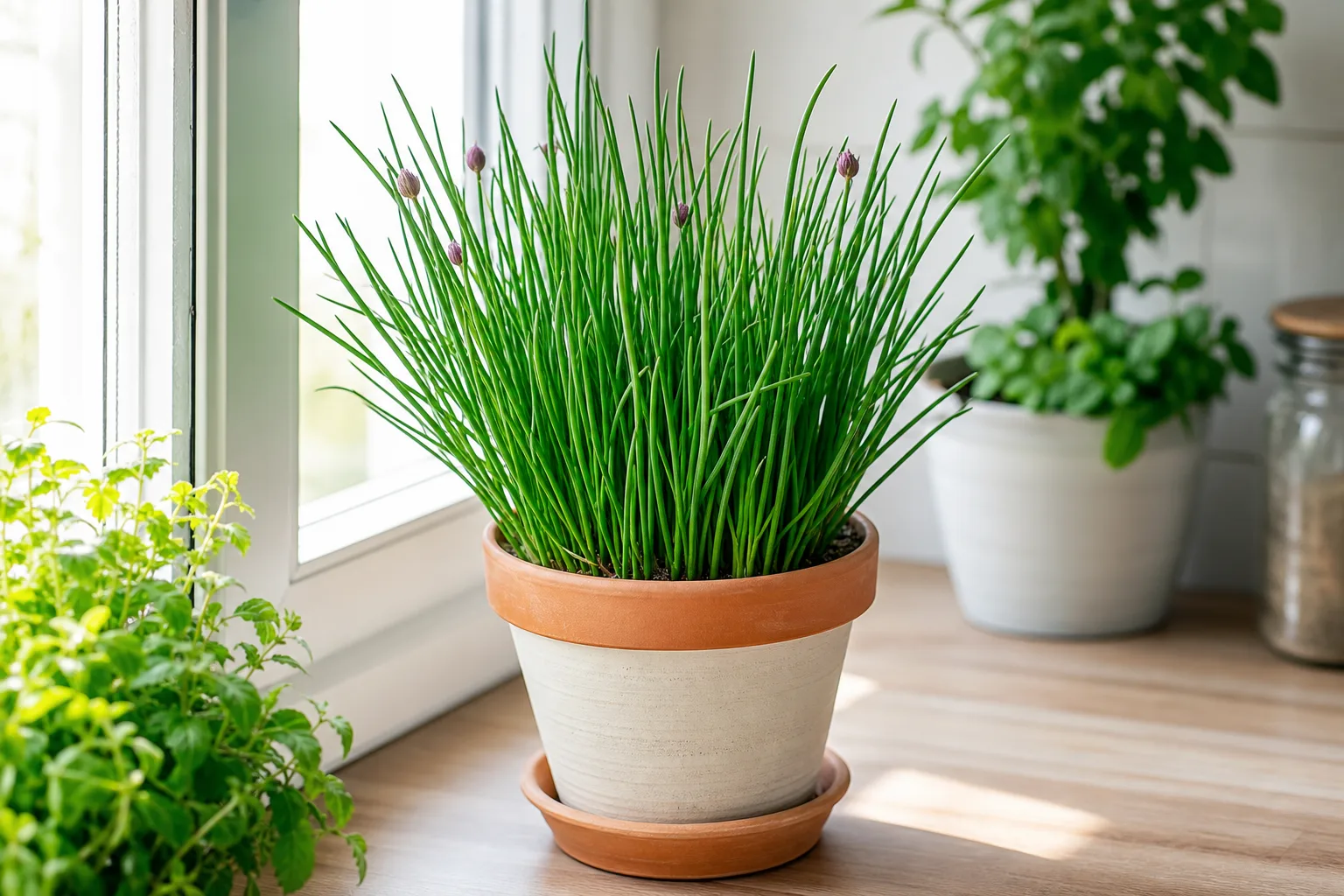
Grow chives indoors by a bright window
Chives can grow indoors, but a kitchen window is not automatically bright enough for reliable leaf production. Put the pot as close to the glass as practical while avoiding contact with very hot or cold glass. A bright sill with an open view of the sky is generally better than a shelf several feet into the room. Wisconsin Extension notes that small chive clumps can be moved indoors to a bright windowsill during winter (Wisconsin Horticulture); NC State also lists a sunny indoor window as an option. Indoor growth may still slow in the darker part of the year, so harvest modestly and let the plant keep enough leaves to recover.
Compare window direction and season
Window direction helps estimate brightness, but the view outside matters as much. A clear east window gives gentler morning sun; a clear south or west window may give longer direct exposure in the northern hemisphere, while nearby buildings, deep eaves, or curtains can greatly reduce it. In the southern hemisphere, the sun-facing orientations reverse. Observe the leaves and the soil together: if the pot dries much more quickly near glass, increase moisture checks rather than assuming the plant needs less light. Wisconsin Extension’s indoor-lighting guidance explains that light reaching a plant depends on window orientation, distance from the window, and obstructions (Wisconsin Extension indoor-lighting guide). GrowVeg also suggests moving a pot of chives to a sunny windowsill when bringing a division indoors for winter (GrowVeg).
Use a grow light only when needed
If an indoor chive clump repeatedly produces pale, stretched leaves despite sitting directly at a bright window, a grow light can supplement the available daylight. Choose a light intended for plants and follow its manufacturer’s distance and duration guidance; fixtures differ, so there is no single universal number of hours to prescribe. Keep the light close enough to reach the leaves evenly without heating or bleaching them. If growth is naturally slowing in winter, first reduce harvest and check the plant’s moisture and roots before buying equipment. Outdoor chives do not need special lighting when their garden or container position receives adequate natural light.
Set container chives where light reaches the crown
A pot can be bright on one side and shaded on the other. Leave enough space around it for sunlight to reach the full clump, and rotate it a quarter turn every week or two if one side consistently leans toward the window. Savvy Gardening recommends a sunny position for the best container harvest, and NC State confirms that chives suit patios and sunny windows. Do not place the container behind a tall herb or railing where only the flower stalks rise into the light. Because pots warm and dry quickly in sun, pair a brighter location with a drainage hole and regular moisture checks rather than moving the plant into deep shade to solve dry soil.
Tell dim light from other growth problems
Low light can leave chives sparse or leaning toward the brightest opening, and it may reduce flowering. But yellow or limp leaves alone do not prove that the site is too dim. Wet soil, drought, root crowding, seasonal dieback, and a recently divided clump can all produce weak foliage. Look at the pattern: stretched growth toward a window suggests light direction; a soggy mix suggests drainage or watering; a tightly crowded centre suggests division may be due. The Chives watering guide and soil guide help separate moisture and drainage issues before you relocate the pot.
Respond to harsh heat and midday exposure
Chives tolerate sun, but a pot on a dark balcony floor or against masonry can heat more than a garden bed. If leaves wilt during the hottest hours and recover in the evening, check the mix and container temperature before concluding that direct light is damaging the foliage. Water deeply when the mix begins to dry, let excess drain, and use morning sun with light afternoon shade if the pot repeatedly dries or overheats. Do not suddenly move a shade-grown clump into all-day intense sun. Harvest to Table suggests shading plants from direct sun in hot climates; that is a climate adjustment, not a reason to keep chives in darkness year-round (Harvest to Table).
Adjust light without stressing the clump
When a site is clearly too dim, move a container in stages over several days toward brighter conditions. For an in-ground plant, transplant during mild weather and water it in; avoid lifting it during extreme heat or when the soil is saturated. Do not change light, watering, and fertilizer all at once, because then it becomes difficult to see what helped. Take a quick photo of the clump before adjusting, then compare new leaf growth after two to four weeks. Existing thin leaves may not thicken; judge the change by the fresh growth and whether the plant keeps producing upright leaves.
Match light to flowering and harvest
If you mainly want leaves, a bright site is still useful even if you choose light afternoon shade to reduce heat. If you also want rounded purple blooms, aim for a sunnier position because shade can reduce flowering. RHS confirms that chives grow in sun or partial shade and treats their flowers as a valued seasonal feature (RHS). Do not cut back the entire clump repeatedly to compensate for a dim site; regular cutting cannot replace the energy supplied by light. For harvest technique, cut leaves low with clean scissors and leave the clump enough time and foliage to regrow; see the Chives pruning guide for timing after bloom.
Avoid common placement mistakes
A bright-looking room may still have a dim corner, and the label “full sun” on a balcony does not tell you how many hours the pot is actually exposed. Avoid placing chives behind tinted glass, several feet from a window, or under dense tree shade if the leaves are already sparse. Do not keep a pot in harsh afternoon heat simply to meet an hour target, especially if it becomes difficult to keep the mix lightly moist. Move the plant based on observed new growth, not a one-day droop. If a plant is otherwise healthy and producing leaves, a partial-shade site may be entirely adequate even when it does not match an idealized six-hour target.
When to use this page vs other Chives guides
Use this guide to select and adjust the location. The Chives overview explains the full seasonal routine; the watering guide helps when a sunnier site dries faster. Use the soil guide to improve drainage, the fertilizer guide if growth remains weak after light and roots are checked, and the repotting guide when a container becomes congested. If leaf color or shape is the main concern, check the matching plant-problem page once available rather than diagnosing every symptom as low light.
Related Chives guides
For pruning, flowering, and a measured harvest, see the Chives pruning guide. To start new clumps or divide old ones, read the propagation guide. These pages cover the decisions that follow placement: moisture, nutrition, soil, and what to do when a pot outgrows its space. Start at the Chives plant hub for the plant profile and its wider care information.
Conclusion
Chives prefer a sunny position but grow in light partial shade, especially where hot afternoon exposure makes a small pot hard to keep evenly moist. Outdoors, assess direct sun and the open-sky brightness across the day; indoors, keep the pot near a clear, bright window and expect slower winter growth. Change one condition at a time and judge the result from new leaves, not old foliage. If the clump stays weak, check its water, drainage, and crowding before adding fertilizer.