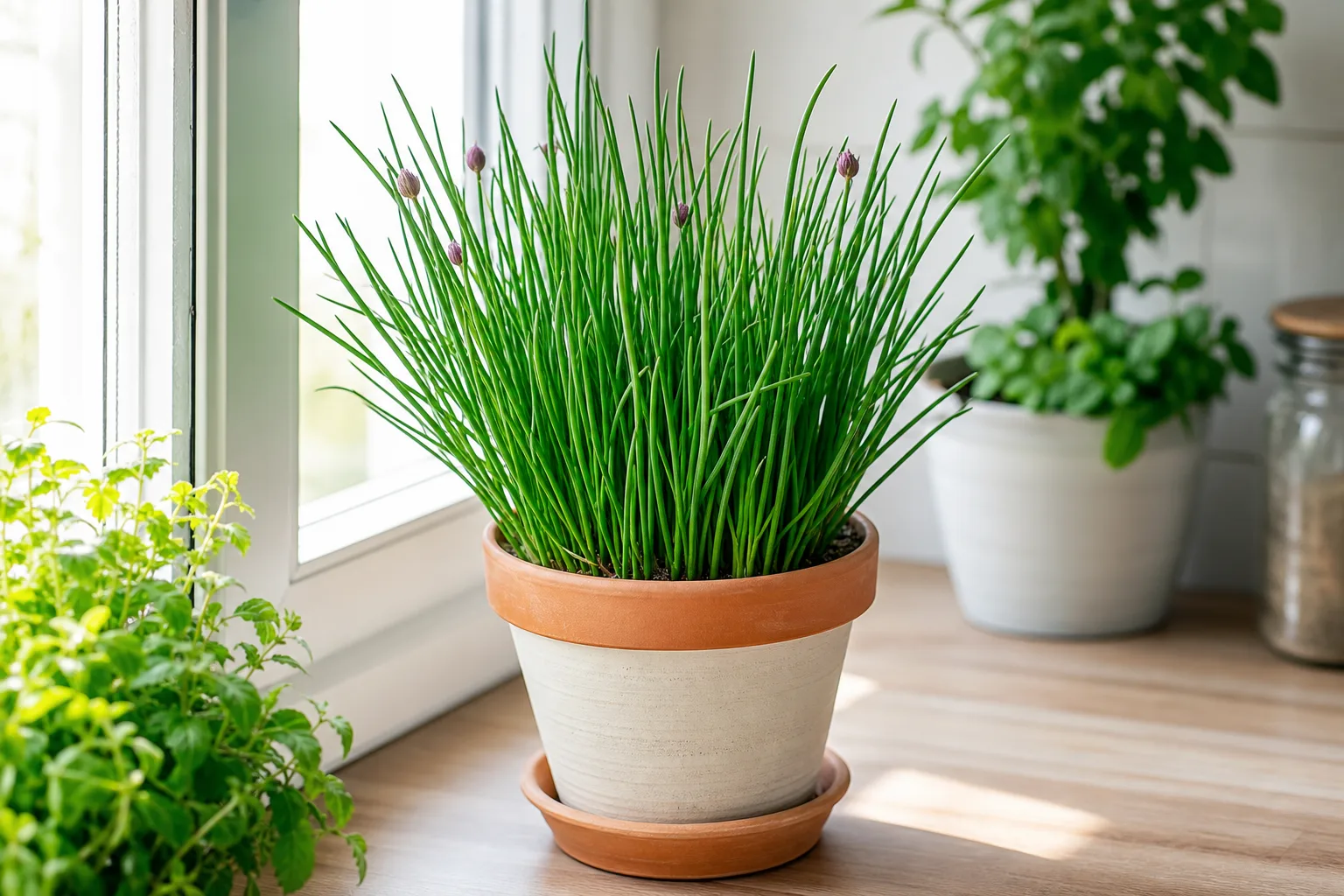
Keep chives evenly moist but well-drained while they establish. Established garden clumps usually need extra water only during prolonged dry spells; container plants dry faster and need more regular checks. In practice, water water newly planted chives during dry spells in their first summer. For a pot, check the mix every few days in warm weather and water when it begins to dry. Check the upper 2–3 cm of potting mix. Water when it is starting to dry, then let excess drain freely from the container. In-ground clumps need little extra water once established, except during extended drought. Containers dry more quickly in warm weather; reduce watering in cool or rainy periods while keeping the mix from staying saturated.
What light does Chives need?
Chives needs bright, indirect light for steady indoor growth.
Is Chives toxic to pets?
Chives is toxic to cats, dogs, and horses. Keep out of reach of curious pets and choose pet-safe alternatives for accessible spots.
How do I propagate Chives?
Propagate Chives from healthy stem or root divisions during active growth.
What soil is best for Chives?
Use moderately fertile soil with organic matter that stays lightly moist while draining freely; a container mix around pH 6.0–7.0 suits chives. A good mix includes Peat-free multipurpose potting mix with some added compost, Add perlite or horticultural grit if the mix holds too much water, Use a container with an open drainage hole and empty its saucer after watering. Use well-drained soil and a pot with a drainage hole. Chives tolerate some dryness, but persistently wet soil can cause root rot.
When should I repot Chives?
Repot Chives divide or repot a crowded clump about every three to four years, or sooner if the roots fill the container., ideally in spring, as new growth begins; established garden clumps can also be divided in autumn. Signs it needs a bigger pot: roots fill the pot or emerge from its drainage hole, the clump becomes congested or weak in the centre, a crowded pot dries very quickly after watering.
Written by Sai AnanthLead content writer at LeafyPixels. B.Pharmacy graduate from Andhra University with a background in pharmacognosy, turned indoor gardening writer after a long-time plant hobby became a research-led resource for home growers.View Sai Ananth's profile · Reviewed by LeafyPixels Review Board
This Chives problems problem guide was researched and written by Sai AnanthLead content writer at LeafyPixels. B.Pharmacy graduate from Andhra University with a background in pharmacognosy, turned indoor gardening writer after a long-time plant hobby became a research-led resource for home growers.View Sai Ananth's profile. Problems symptoms on Chives, lookalike causes, and step-by-step fixes are cross-checked against extension pest, disease, and care references before publication.
We prioritize sources that hold up under scrutiny:
University cooperative extension bulletins and fact sheets (Penn State, Clemson, UMD, NC State, and similar programs)
Botanical garden and horticultural society publications
Peer-reviewed plant science and veterinary toxicology references where pet safety matters (including ASPCA Animal Poison Control)
Established reference works on indoor plant culture
The LeafyPixels editorial team then reviews the draft for clarity, step-by-step usefulness, and fit with real apartment and home conditions-not ideal greenhouse setups. When guidance changes materially, we update the page and note the revision date.
NC State Extension Plant Toolbox — Chives (n.d.) Scientific identity, family, native range, growth habit, mature size, light, soil, container suitability, and propagation. [Online]. Available at: https://plants.ces.ncsu.edu/plants/allium-schoenoprasum/ (Accessed: 1 March 2024).
Royal Horticultural Society — Chives: Grow Your Own (n.d.) Moisture and drainage, care of established plants and containers, harvest, flowering, deadheading, and division. [Online]. Available at: https://www.rhs.org.uk/herbs/chives/grow-your-own (Accessed: 1 March 2024).
Savvy Gardening — Growing Chives in Pots (n.d.) Container drainage, potting mix, light, moisture, and winter care. [Online]. Available at: https://savvygardening.com/growing-chives-in-pots/ (Accessed: 1 March 2024).
Savvy Gardening — How to Harvest Chives (n.d.) Harvest height, cutting technique, and repeat harvests. [Online]. Available at: https://savvygardening.com/how-to-harvest-chives/ (Accessed: 1 March 2024).