Low Humidity on Kalanchoe: Causes, Checks & Fixes
Quick answer
Low humidity rarely harms Kalanchoe: its thick succulent leaves store water and it prefers average to dry indoor air. Crisp edges usually mean underwatering, fertilizer salts, sun scorch, or spider mites instead. First step: move the pot out of direct vent or heater airflow and confirm the soil is truly dry with a skewer before adding any water or humidity.
Low Humidity on Kalanchoe: Causes, Checks & Fixes
This guide covers low humidity on Kalanchoe. See also the general Low Humidity guide, watering, and light pages for this plant.
Low Humidity on Kalanchoe: Causes, Checks & Fixes
Quick answer
Low humidity is rarely the real problem on Kalanchoe. This is a succulent from Madagascar with thick, waxy, water-storing leaves — it is built for dry air, and growers note that low indoor humidity is rarely a problem for this succulent since it actually prefers drier air than tropical houseplants. Typical heated and air-conditioned homes already sit in a safe range. For the general mechanics of dry-air stress, see our low humidity guide. On Kalanchoe, the pattern usually shows up as something else: underwatering, fertilizer salt burn, sun scorch, or spider mites riding along with dry heated air.
First step: move the pot out of the direct path of any vent, radiator, or hot window glass, then skewer-test the soil to the bottom of the pot. Add no water and no humidity hardware until that check tells you the root zone is truly dry. For full species context, see the Kalanchoe overview.
What dry-air stress looks like on Kalanchoe
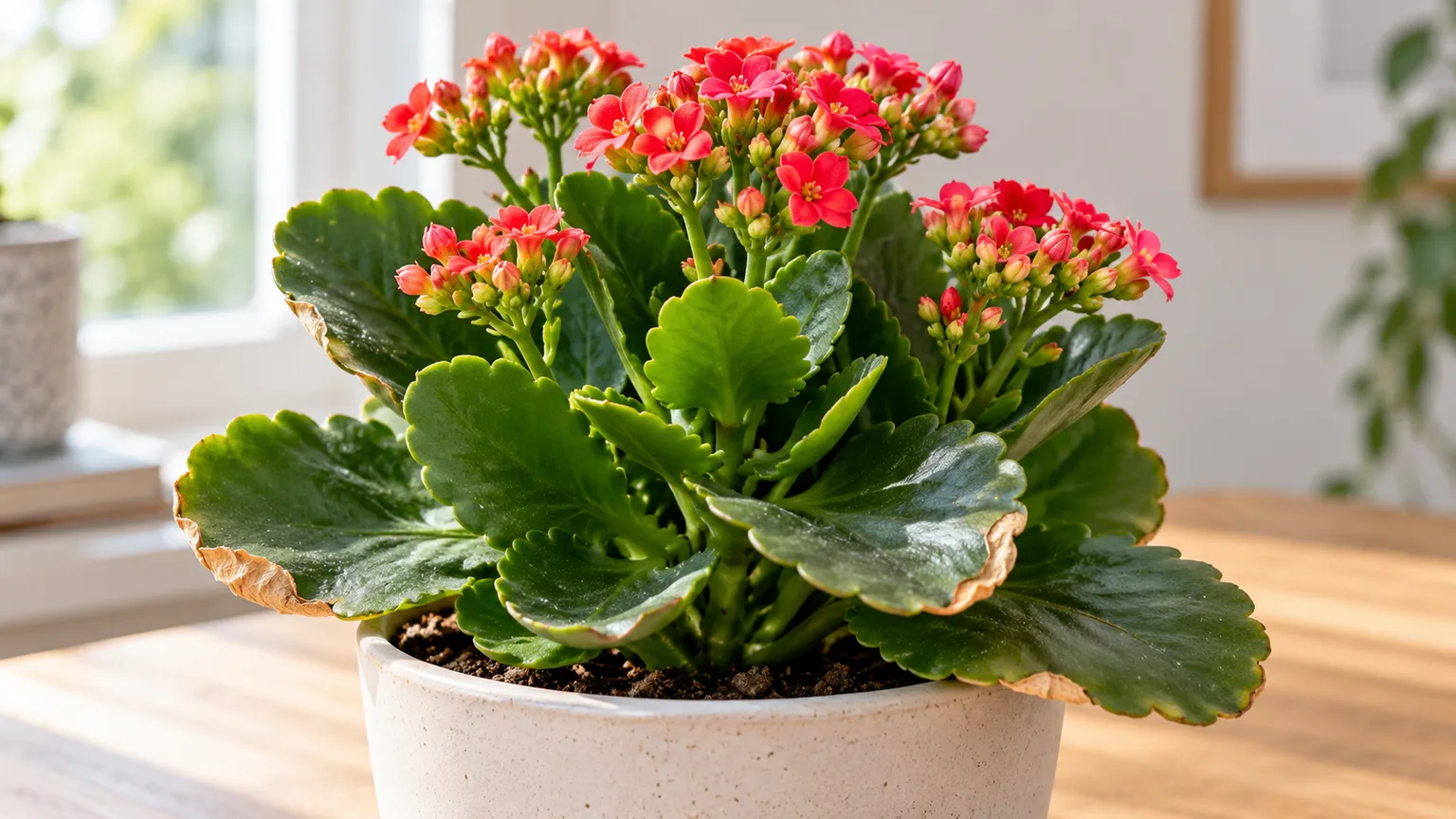
Because Kalanchoe leaves are thick and scalloped rather than thin and papery, dry air alone seldom marks them the way it marks ferns or calatheas. When moving air does matter, the signs cluster on the most exposed tissue: outer leaf margins facing a vent turn tan and papery, older lower leaves wrinkle slightly while staying attached, and buds nearest a heat source may stall or blast while the rest of the cluster opens. Growth otherwise continues — new center leaves still emerge firm and glossy.
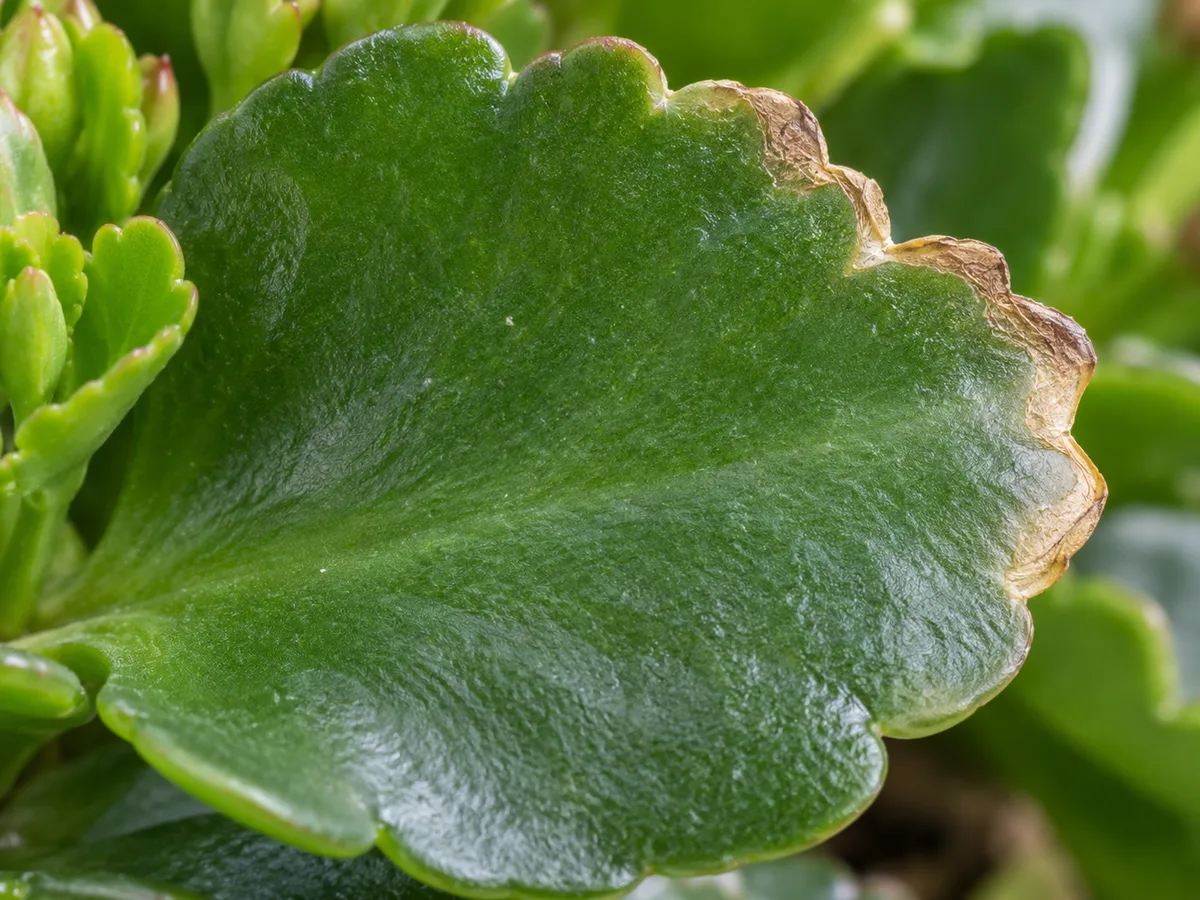
Tan papery margins on thick scalloped Kalanchoe foliage — compare edge damage with soil moisture and pest signs before blaming room humidity.
Uniform crisping across the whole plant, soft or translucent leaves, or black stem bases point away from dry air entirely — those belong to watering and rot problems covered in overwatering on Kalanchoe and underwatering on Kalanchoe.
Why Kalanchoe tolerates dry air so well
Kalanchoe (Kalanchoe blossfeldiana) is native to Madagascar and a member of the stonecrop family built around seasonal rain and long dry spells. Its fleshy leaves act as a water bank, transpiring far less than thin tropical foliage, so normal indoor relative humidity around 30–50% is comfortable without misting or humidifiers.
High humidity is the direction that actually hurts this plant. Growers warn that too much humidity increases the danger of decay, with fungal root, leaf, and crown rots all traced to overwatering or excess moisture, and extension guidance notes that root rot usually results from a soil mix that does not drain quickly or from watering too often. A humidifier or pebble tray that keeps the pot damp longer trades a non-problem for the plant’s biggest killer. Prevention guidance agrees: provide good air circulation around the plant to hold off powdery mildew. See the Kalanchoe soil guide for the gritty mix that makes dry-down predictable.
The florist-peat root zone: why new plants crisp first
Most Kalanchoe arrive as florist-forced plants grown fast in heavy peat to hold blooms for sale. That peat behaves nothing like the gritty succulent mix Kalanchoe needs long-term: it either stays soggy for weeks or dries into a hard brick that water runs around. In both cases the leaf symptoms mimic humidity stress — crisp margins, dropped lower leaves, stalled buds — while the real fault sits in the root zone.
Check before you blame the air. Lift the pot: heavy and cool means the peat is still wet and the plant needs drying, not misting. Light with shrunken, gap-showing mix means water is bypassing the roots and a slow deep soak (or repotting into cactus blend with perlite and grit after bloom) is the fix. Extension guidance for this species is to allow the soil to dry out between waterings and then water deeply, which only works when the mix can actually dry evenly — see watering Kalanchoe.
Winter heating, short days, and bud blast
Kalanchoe’s bloom cycle collides with heating season, and that collision causes most “low humidity” complaints. Like poinsettias, kalanchoes need about six weeks of 14- to 16-hour nights to set buds, and temperatures above 80°F during the long night period can inhibit flower development. A plant parked beside a heat vent gets the worst of both worlds: warm dry blasts on its foliage plus night temperatures too high for bud set.
The species itself prefers 60°F at night and 70°F during the day and must come indoors before temperatures drop toward 45°F — cool nights actually prolong open flowers. So the winter fix is placement, not humidity: keep the plant in bright light a few feet from the vent, in a room that cools at night, and let short winter days do their work. Buds that blast near a radiator while lower buds open normally are telling you about heat and airflow, not room-wide dryness. Compare with not enough light on Kalanchoe if buds stall plant-wide.
Dry air’s real accomplice: spider mites and mealybugs
Hot, dry, still air near winter heating favors spider mites on houseplants, and Kalanchoe is on their menu — extension lists aphids, mealybugs, and spider mites among its most common pests, and growers observe these pests hit especially when humidity is too low or the plant is stressed. Mites show as fine stippling, dusty yellowing, and delicate webbing on leaf undersides — not uniform crispy tips alone. Confirm with the white-paper test: tap a suspect leaf over paper and watch for moving specks.
Mealybugs hide separately in Kalanchoe’s scalloped leaf axils and stem joints as white cottony clusters; wipe small outbreaks with an alcohol-dipped swab and isolate the plant. Treat active pests directly rather than humidifying the room — misting Kalanchoe foliage to deter mites wets the crown and invites the mildew and rot problems this species fears most. See spider mites on Kalanchoe and mealybugs on Kalanchoe for the full routines.
How to confirm the cause
Work in this order; stop at the first match:
- Placement. Is the pot within a few feet of a vent, radiator, fireplace, or sun-baked glass? Margin damage on the vent-facing side only is an airflow diagnosis. Move it and reassess over two weeks.
- Soil moisture. Skewer to the pot bottom. Bone-dry plus a light pot means underwatering — see underwatering on Kalanchoe. Still damp days after watering means the mix is failing — see overwatering on Kalanchoe.
- Salts and light. White crust on the soil plus recent feeding points to fertilizer burn; bleached patches on the sunniest leaves point to scorch after a sudden move outdoors. Compare with brown tips on Kalanchoe.
- Pests. Stippling with webbing means mites; cottony axil clusters mean mealybugs. Either overrides humidity as the diagnosis.
Judge everything by the newest growth: clean firm center leaves mean the plant has already turned the corner.
The first fix to try
Move the plant out of direct vent or heater airflow and confirm soil moisture with a skewer — change nothing else for two weeks. This single relocation removes the only dry-air mechanism that genuinely affects Kalanchoe (forced moving air desiccating exposed margins) while the skewer check stops you from watering a plant that is actually wet or humidifying one that is actually thirsty.
After the move, water only when the skewer comes up fully dry, keep foliage dry, and hold fertilizer until new growth looks healthy. Do not mist, tent, or run a humidifier for this plant.
Mistakes to avoid
- Misting the foliage daily. Water sitting in scalloped leaf cups and the crown invites powdery mildew and rot on a plant that never needed the moisture.
- Buying a humidifier for crisp tips. On Kalanchoe this treats a symptom whose cause is almost always water, salts, light, or pests — and the slower dry-down can rot roots.
- Repotting or heavily pruning on day one. Dry-air suspects are rarely root emergencies; repotting a stressed, blooming plant compounds the shock. Stabilize placement and watering first.
- Feeding a stressed plant. Fertilizer cannot fix crisp margins and salts can cause them; hold feed until clean new growth resumes.
Recovery timeline
Once placement and watering are corrected, existing brown margins stay brown — trim them only for appearance after growth resumes. Expect firm new center leaves within 2–4 weeks in the growing season; winter-rest plants may simply hold steady until spring, which is normal. Bud blast stops with the next bud cycle if nights stay cool and long. Escalate if stems soften, black spreads from the soil line, or several leaves fail at once — that is rot, not dryness; see root rot and wilting on Kalanchoe.
How to prevent it next time
Keep Kalanchoe a few feet from vents and radiators year-round, in bright light with the gritty drainage described in the soil guide. Water by skewer, not calendar, reducing sharply in winter; see watering Kalanchoe. Give fall plants their long nights for rebloom, deadhead spent clusters, and inspect axils and leaf undersides monthly through heating season so mites never build. Kalanchoe is toxic to dogs and cats — bufodienolides can cause vomiting, diarrhea, and abnormal heart rhythm — so keep every placement, including the away-from-vent spot, out of pet reach.
Related Kalanchoe guides
- Kalanchoe overview — full care baseline: light, watering rhythm, and rebloom.
- Brown tips on Kalanchoe — use when margins crisp plant-wide and you suspect salts, thirst, or scorch rather than airflow.
- Underwatering on Kalanchoe — use when the skewer runs dry and leaves wrinkle while staying firm.
- Spider mites on Kalanchoe — use when stippling plus fine webbing accompanies dry heated air.
- Mealybugs on Kalanchoe — use for cottony clusters in leaf axils and stem joints.
- Mold on soil — use if humidifying attempts or wet peat left the surface fuzzy; a sign of too much moisture, not too little.
- Drooping leaves on Kalanchoe and yellow leaves on Kalanchoe — use when softness or color change joins the crisping, pointing to root-zone trouble.
Related tool
Use the Humidity Calculator to check whether your room readings actually warrant action for low humidity on this plant before changing watering or placement.