Mango Fertilizer Guide for Pots and Warm Climates
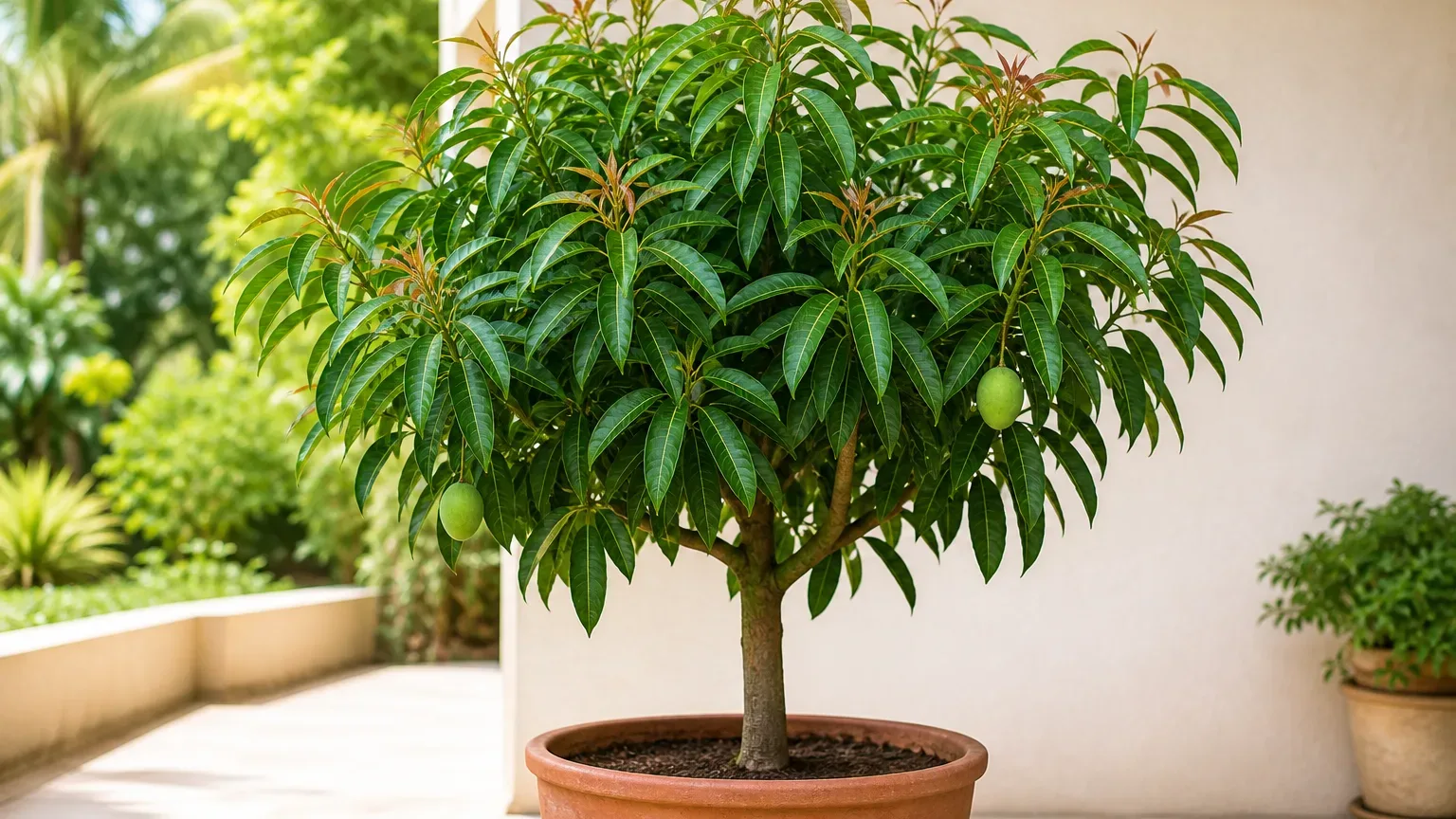
Mango Fertilizer Guide for Pots and Warm Climates
Mango Fertilizer Guide for Pots and Warm Climates
A mango that looks pale or stalled is not always hungry. Mangifera indica may be limited by shade, waterlogged roots, cool weather, a cramped pot, or recent transplant stress before it is short of nutrients. Feed only after Mango light, Mango watering, and drainage are sound, because extra fertilizer cannot correct those problems and can make fruit quality worse.
That distinction matters most on Indian terraces and in other warm climates where field orchard rates are easy to find and dangerous to copy into a pot. A landscape tree explores a large soil volume; a container mango holds every added salt in a confined root zone. The same species benefits from measured, age-aware feeding in both settings, but the safe dose changes with root volume, tree age, and whether the tree is still vegetative or already bearing.
The quick answer: what to feed mango
Use a complete fertilizer that supplies nitrogen, phosphorus, potassium, and magnesium, then adjust the nitrogen emphasis as the tree matures. For young trees, UF/IFAS reports that mixes with roughly 2–6% nitrogen, 6–10% available phosphoric acid, 6–12% potash, and 4–6% magnesium give satisfactory results, with examples such as 6-6-6-2. For bearing trees, the same UF/IFAS mango guidance advises drastically reducing or eliminating nitrogen while increasing potash and attending to minor-element nutrition.
For a container on a terrace or balcony, prefer a complete liquid fruit-tree or general-purpose fertilizer that is labeled for pots. Start at one-quarter to one-half of the label’s container rate, apply to already-moist mix, and increase only if growth stays strong without tip burn or crusting. Never pour an orchard kilogram rate into a tub.
Why mango fertilizer needs change with tree age
Young mango trees are building framework wood and leaf area, so they use a steadier supply of nitrogen along with phosphorus, potassium, and magnesium. Once the tree is bearing, excess nitrogen can push soft vegetative flushes at the expense of fruit quality. UF/IFAS notes that the fruit disorder known as internal breakdown (jelly seed / soft nose) is aggravated by overfertilization with nitrogen, and that reducing nitrogen is the practical response when that problem appears.
Treat fertilizer as support for the growth stage you actually have. A newly grafted container tree and a mature garden specimen are not on the same nutrient program, even when both are Mangifera indica.
Best fertilizer type for mango
Choose a product with a full guaranteed analysis rather than a single-nutrient “bloom booster.” Equal N-P-K numbers are not a biological requirement. A young-tree formula with moderate nitrogen plus magnesium, or a fruit-tree mix that later shifts toward higher potash, is closer to how extension schedules treat mango than a high-middle-number bloom product used every week.
Clemson Extension advises choosing nutrients according to actual need and reminds growers that plants in otherwise favorable soil may require less fertilizer than expected in its fertilizer selection guide. For mango, that means reading tree age, soil or mix condition, and recent growth before reaching for a stronger bag.
How to read the NPK and magnesium label
The three large numbers are percentages by weight of nitrogen, phosphate (P2O5), and potash (K2O)—not a feeding schedule. Clemson’s fertilizer-label explanation notes that soilless container mixes benefit from all three major nutrients, though not necessarily in equal proportions. Check whether the product lists magnesium and micronutrients such as iron, zinc, manganese, and boron, then follow the container directions if the tree is potted.
Boron deserves special caution. UF/IFAS states that boron should be applied only at very low rates because it is toxic at moderate to high rates. Do not improvise micronutrient “cocktails” on a balcony when pale leaves may actually be a drainage or pH problem.
Compost, FYM, and organic feeds
Finished compost or well-rotted farmyard manure can improve structure and supply background nutrition, but release rates are hard to calculate in a pot. Keep organic matter as a modest part of an airy Mango soil mix rather than packing a thick, water-holding collar against the trunk. Never use fresh manure in a container; it can be salty, chemically hot, and physically dense.
Indian orchard guidance from Tamil Nadu Agricultural University combines FYM with scheduled N, P, and K, applied in September–October away from the trunk out to the peripheral leaf drip. Those kilogram-per-tree rates assume open soil and orchard spacing. They confirm that organic matter and mineral nutrition can work together; they should not be scaled by guesswork into a terrace pot.
A warm-climate mango fertilizer schedule
In frost-free tropical and subtropical climates, follow visible flushes and fruiting stage more than a temperate four-season calendar. Feed when the tree is producing healthy new leaves or supporting fruit and the root zone is using water normally. Pause when growth stalls, the mix stays saturated, or the tree is recovering from root disturbance.
UF/IFAS describes a home-landscape pattern of more frequent applications while trees are young, then fewer, size-proportionate applications as trees mature—roughly every two to three months in the first year, then about two to three times per year later. Gardening Solutions / UF/IFAS also notes that mango should be fertilized periodically through life, but that excess fertilizer can reduce fruit quality or quantity.
Young and newly planted trees
Do not fertilize into the planting hole as a concentrated band under the root ball. UF/IFAS advises that it is not necessary to add fertilizer, topsoil, or compost into the hole first, and that mixing amendments into excavated soil should stay modest if used at all. After the tree is established and showing new growth, begin light, complete feeds rather than a heavy first dose.
In the ground, young-tree schedules increase amount gradually with canopy size. In a pot, keep the dose tied to the product’s container rate and the current pot volume. If the plant wilted after transplant, the stem base darkened, or the mix stayed wet, troubleshoot establishment through the Mango repotting guide before feeding.
Bearing and mature trees
Shift emphasis away from high nitrogen once the tree is cropping reliably. UF/IFAS recommends little to no nitrogen for mature healthy trees, with more attention to potash and minor elements, and gives examples such as 6-3-16 or 0-0-22 among materials used in that stage. Micronutrient sprays or soil applications of iron, zinc, manganese, magnesium, and boron may be needed depending on soil pH; calcareous soils often need chelated iron drenches, while acid sandy soils may use different iron forms.
Do not heavily fertilize lawn next to a mature mango. Roots extend beyond the drip line, and UF/IFAS warns that heavy lawn fertilization beside mango trees may reduce fruiting or fruit quality.
Monsoon, cool spells, and drought stress
Skip a planned feed when the root zone is already saturated or when heavy rain will immediately leach the pot or bed. Clemson Extension’s 4R nutrient guidance recommends applying fertilizer when plants can absorb it and postponing before heavy rain to reduce leaching and runoff. During extreme dry heat, water first and delay feeding until the tree is no longer wilted. During cool or cloudy spells with little new growth, lengthen the interval or pause.
A warm-climate mango does not need a rigid “winter ban” everywhere, but fertilizer must match actual uptake. Monsoon waterlogging plus salts is a common way to injure terrace trees.
How to fertilize mango in containers
Container fertilizer should be measured, diluted, and recorded. Check whether the potting mix already includes controlled-release granules; stacking those with frequent liquid feeding is a common source of excess. Use a dedicated measuring spoon or syringe, follow that product’s container units, and discard saucer runoff so salts do not wick back into the root ball.
Large pots need enough solution to wet the root zone evenly, not a stronger solution. Apply around the mix rather than dumping concentrate against the trunk flare. University of Georgia Extension explains that smaller soil volumes require less fertilizer and that active growth and light level should guide feeding in its container nutrition guidance.
A safe dose-and-water method
- Confirm that the mango is in active growth or carrying fruit normally, and is not wilted, waterlogged, chilled, or newly root-pruned.
- Feel the mix; if it is dry, water normally first and feed at a later watering.
- Mix a complete liquid fertilizer at one-quarter of the label’s container rate for the first application on a new product or a newly acquired tree.
- Distribute it across the already-moist root zone until a small amount drains.
- Empty the saucer, note the date and dose, and watch newest leaves and margins for two to three weeks before any increase.
Keep fertilizer, measuring tools, and runoff inaccessible to children and pets. If you later raise the dose, stay within the label and stop at the first sign of tip burn or white crust.
After repotting or refreshing the mix
Fresh commercial mix may contain starter fertilizer or controlled-release pellets. Check the bag before adding anything else, then wait for resumed growth. Root disturbance and concentrated salts are a poor combination on mango.
If you moved the tree into an unamended, inert mix, feeding may resume sooner once a new flush confirms establishment. If the mix already holds a fertilizer charge, wait longer. The Mango propagation guide covers establishment of young plants; this page resumes once roots are functioning and the tree is ready for routine nutrition.
Diagnose the plant before adding fertilizer
Assess the newest leaves, older leaves, soil moisture, trunk base, drainage, recent weather, and feeding history together. Yellow lower leaves in wet mix point first to root stress. Small leaves in shade point to light. Uniform pale growth after those factors are corrected can suggest inadequate nitrogen on a young tree, but one yellow leaf is not a diagnosis.
For an in-ground mango, a local soil test is more useful than repeatedly adding a broad mix. Container media may need a specialist media or irrigation-water test rather than a standard garden-soil test. UF/IFAS also links mango decline symptoms in some situations to manganese and iron deficiency, which is another reason not to answer every chlorosis pattern with more nitrogen.
Possible nutrient and salt-stress patterns
- Uniformly pale older growth and smaller successive leaves on a young tree can suggest inadequate nitrogen after light and roots are corrected.
- Interveinal yellowing on newest leaves can suggest iron or manganese availability problems, especially at high pH.
- Brown tips or margins soon after feeding, white crust on the mix or pot rim, or wilting while the mix is still moist suggest soluble-salt stress rather than hunger.
- Soft, poor-quality fruit with internal breakdown symptoms after heavy nitrogen use is a cue to reduce nitrogen, not to feed harder.
Suspect excess when symptoms appear soon after a strong application. Stop feeding, remove visible granules, and leach only if the pot drains freely. Run plain water through the mix, discard every bit of runoff, then return to the normal moisture cycle. If the mix smells sour or the pot has no open drainage, inspect roots instead of repeatedly flushing a waterlogged plant.
Handling sap, peel, and fertilizer safely
Mango belongs to the Anacardiaceae family. Sap, peel, stems, and leaves can trigger allergic contact dermatitis in sensitive people, especially those previously reacting to poison ivy or poison oak; related alk(en)yl catechols and resorcinols are discussed in the dermatology literature summarized on PubMed. Fertilizer days often overlap with pruning, staking, or harvesting, so wear gloves and long sleeves when mixing products and when handling sap-wet stems or peel. Avoid touching your face, wash tools and exposed skin afterward, and let someone else peel fruit if mango or poison ivy has caused a rash before.
Do not give medical advice from a care page: if a rash, swelling, or breathing difficulty develops after contact, seek appropriate clinical care. Keep fertilizer concentrates, granules, and treated mix away from pets and children.
Common mango fertilizer mistakes
The most damaging errors are copying TNAU or other orchard kilogram rates into pots, pushing high nitrogen on bearing trees, feeding bone-dry or waterlogged roots, stacking liquid and controlled-release products, treating every yellow leaf as hunger, and fertilizing into standing monsoon water. Another mistake is heavy lawn feeding under the canopy, which can reduce fruiting even when the tree itself looks leafy.
Avoid letting fertilizer-rich runoff enter storm drains or neighboring balconies. Measured application protects both the tree and water quality. If you spill granules on paving, sweep them up rather than washing them away.
When to use this page vs other Mango guides
- Use the Mango overview for whole-plant requirements, size expectations, and sap/peel cautions in context.
- Use Mango watering when wilting, wet mix, or monsoon timing makes moisture the first concern.
- Use Mango soil when drainage, pH, compaction, or the potting blend may be limiting nutrient uptake.
- Use Mango light when leaves are small, growth is weak, or the site lacks full sun.
- Use Mango repotting for root-bound trees, unstable pots, or damaged container media before changing the fertilizer program.
- Use Mango pruning when canopy size or timing of tip cuts is the issue rather than nutrition.
Related Mango guides
- Mango plant care overview
- Mango light guide
- Mango watering guide
- Mango soil guide
- Mango repotting guide
- Mango propagation guide
- Mango pruning guide
Conclusion
Mango responds best to complete nutrition matched to tree age, with steadier nitrogen while the canopy is forming and much more caution once fruiting begins. In warm Indian and tropical conditions, feed during active growth, pause for monsoon saturation or stress, and keep container doses far below orchard tables. Start pots with a complete liquid fertilizer at a conservative fraction of the label rate, apply to moist mix, discard runoff, and adjust from the tree’s response rather than from a calendar alone.
Keep the priorities in order: sun, warmth, drainage, sensible watering, functioning roots, then fertilizer. That sequence builds stronger flushes and better fruit prospects than chasing every pale leaf with another scoop of nitrogen.