Spider Mites on Mango: Causes, Checks & Fixes
Quick answer
Dusty stippling plus fine webbing on mango leaf undersides usually means spider mites, especially after hot dry weather. First step: isolate the tree and blast the undersides of every leaf with a strong stream of water before reaching for any spray.
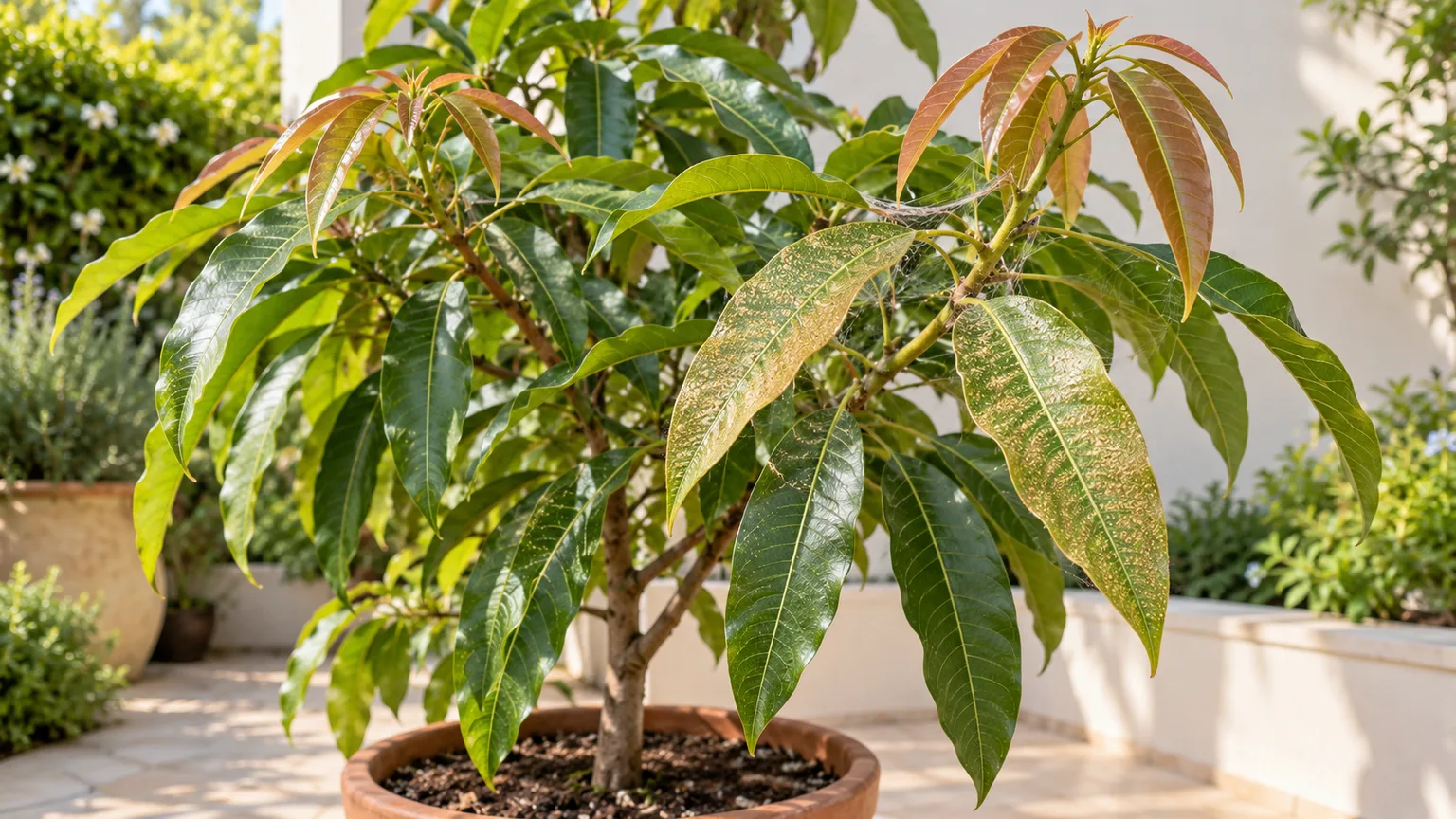
Spider Mites on Mango: Causes, Checks & Fixes
This guide covers spider mites on Mango. See also the general Spider Mites guide, watering, and light pages for this plant.
Spider Mites on Mango: Causes, Checks & Fixes
Quick answer
If your mango’s leaves look dusty and pale-stippled with fine silk webbing tucked where leaves meet stems, spider mites are the leading suspect — especially after a spell of hot, dry, dusty weather. These pests are eight-legged arachnids, not insects, and on mango they feed on sap from the undersides of the tree’s big evergreen leaves until the foliage looks drained of color.
First step: isolate the tree and blast the undersides of every leaf with a strong stream of water. Missouri Botanical Garden lists knocking mites off with water, aimed at leaf undersides, as the opening move, and on mango this matters more than on most houseplants: one large leaf has more underside hiding space than a whole pothos vine, so a casual shower that only wets leaf tops changes nothing. For the general mechanics of how chronic mite feeding weakens plants, see our spider mites hub. On mango, the pattern usually shows up as stippling concentrated on older leaves or on the softest new flush, with webbing anchoring colonies at leaf-stem joints.
What spider mites look like on mango
On mango’s broad, leathery leaves, early mite feeding reads as thousands of pinprick pale dots — stippling — over a leaf that otherwise keeps its shape. The Spruce describes this signature precisely: white dots appear as the chlorophyll is sucked out, and leaves progress through yellowed, dry, and dropping as colonies grow. On mango, hold the leaf to the light: stippled zones look sandblasted and translucent compared with the deep gloss of healthy tissue.
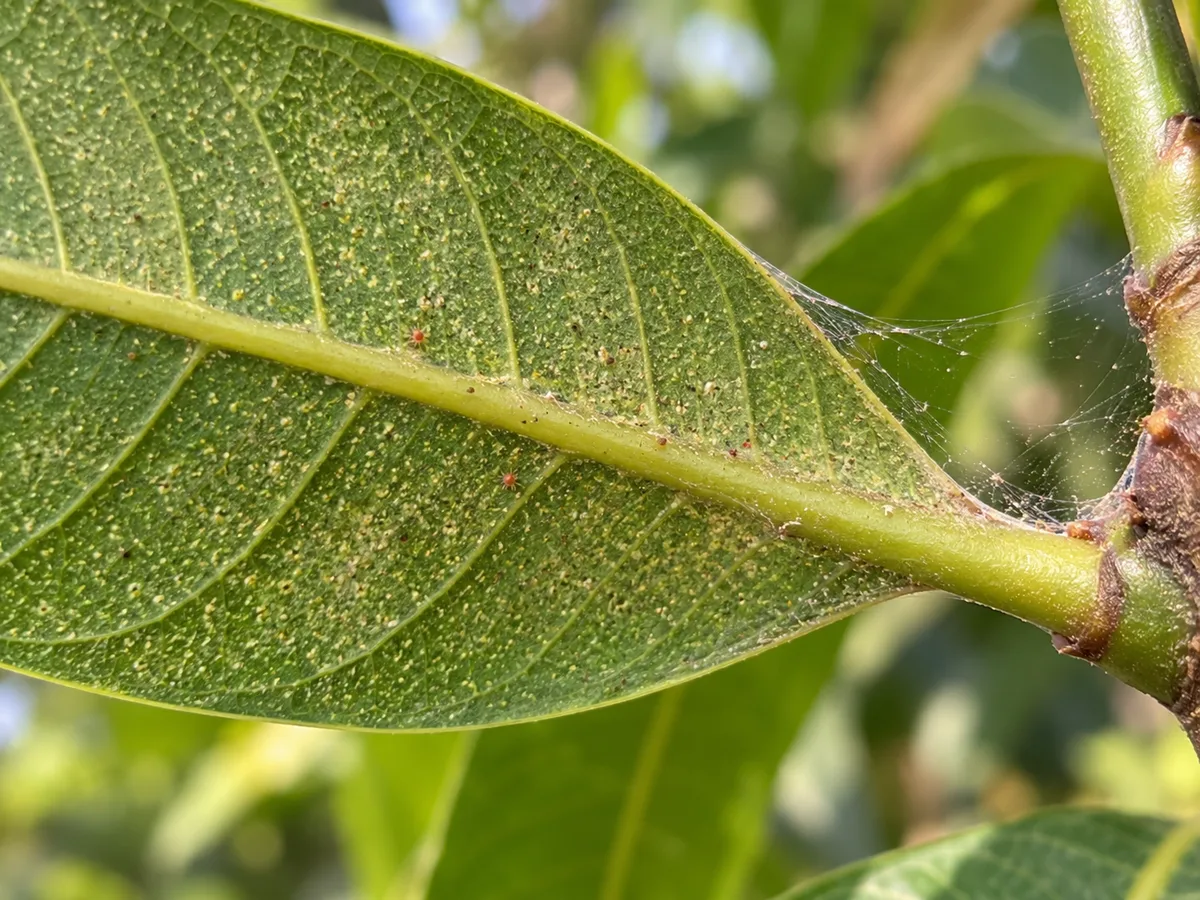
Close-up of stippled mango leaf tissue with fine webbing — compare with the glossy green of an unaffected leaf on the same tree.
As numbers build, the classic fine silky webbing spider mites spin appears first in sheltered spots: the angle where the leaf blade meets its stalk, along the midrib underside, and between touching leaves. Mites themselves are nearly invisible — around 1/50 of an inch long — so look for the dull, dusty cast over the foliage rather than the animals. Heavily fed leaves turn bronzy-tan, crisp at the edges, and drop; a flush that emerges already pale and undersized means the infestation was active while buds were expanding.
Why mango draws spider mites
Hot, dry air is the accelerant. Reproduction of spider mites is favored by hot, dry conditions, and a container mango on a sun-baked terrace or a landscape tree in a rainless stretch sits squarely in that zone. Mango wants full sun and sustained warmth, so you cannot fix mites by shading the tree — but you should recognize that the same July-to-September heat that pushes growth also lets mite generations cycle in under two weeks.
Big leaves collect the dust mites love. Mango’s large leaf blades near roads, construction, patios, or dusty courtyards accumulate a film that shelters mites and hides early stippling. Trees whose foliage is never hosed off in the dry season are consistently the first to show webbing. Indoor or balcony specimens are worse off: no rain, no predatory mites, and still air let a small colony explode unnoticed.
Soft flush growth is premium food. Mango grows in flushes — bursts of tender, often bronze-red new leaves — and mites colonize this soft tissue readily, stunting the flush. Because mango flowers and fruits on terminal growth, a flush ruined by mites costs more than aesthetics: repeated tip damage from mealybugs or mites during the flowering season can erase the structures that would have carried panicles.
Dry-culture habits backfire. Growers who hear that established mango trees need irrigation only during prolonged drought sometimes extend that logic to young container trees and underwater them through heat waves. A drought-stressed mango with dusty leaves in stagnant air is the ideal mite host — keep the mango watering rhythm matched to the pot and weather, not to a slogan.
How to confirm the cause
Work in this order before any spray touches the tree:
- Tap test. Hold white paper under a stippled leaf and tap the leaf sharply. Specks that move like dust or pepper confirm live mites. No movement after tapping several leaves means the stippling may be old, resolved damage — or a lookalike below.
- Webbing check. Inspect leaf-stem joints, midrib undersides, and the tightest new flush with a hand lens or phone macro. Fine silk strands confirm an active colony; stippling without any silk points toward past feeding, thrips scarring, or spray burn.
- Damage map. Mites usually start on older, dustier leaves or the softest flush and spread inward. Uniform browning of every leaf margin at once suggests salt, fertilizer, or drought stress instead — cross-check with brown tips on mango.
- Exclude lookalikes. Sticky honeydew plus visible insects means aphids or mealybugs, not mites — mites produce silk, never honeydew. Rapid whole-canopy yellowing after a watering change points to overwatering or yellow leaves on mango.
Wear gloves and long sleeves for close inspection work. Mango sap, peel, stems, and leaves carry contact allergens related to the poison-ivy family, so avoid touching your face while handling flush growth and wash tools and skin afterward.
The first fix for mango
Isolate the tree and rinse the undersides of all leaves with a strong stream of water. Do this outdoors or in a wash area, angling the spray upward so it hits the midrib and joints where colonies anchor. Repeat every three to four days for two weeks — Missouri Botanical Garden advises spraying plants frequently to control future buildups, because a single rinse never catches every egg.
Do not start with fertilizer, repotting, or hard pruning on the same day. A mite-stressed mango needs its leaf area intact for recovery, and stacking treatments hides which action worked.
Step-by-step recovery
Follow this sequence only if rinsing alone is not holding the line after a week:
- Prune the worst leaves. Remove heavily bronzed, web-covered leaves that will never photosynthesize well again. Bag and discard them — never compost mite-infested foliage near the tree.
- Apply insecticidal soap or horticultural oil to leaf undersides. Many insecticidal soaps check mite populations when the label covers mites, and highly refined horticultural oils suffocate mites on foliage. Neem oil and insecticidal soap are both effective modes of controlling spider mites when coverage reaches the colony.
- Spray at the cool edges of the day. Apply just before the sun rises or sets so oils and soaps do not scorch foliage — critical on mango, whose huge sun-facing leaves burn readily under midday oil films. Coat leaf undersides fully and let foliage dry before intense sun returns.
- Repeat on the egg cycle. Eggs hatch within days, so re-treat every five to seven days for at least three rounds, rinsing between sprays. One application followed by silence is how infestations rebound.
- Protect the predators. Broad-spectrum insecticides kill the beneficial insects that feed on spider mites, and mite populations surge afterward. Never reach for a general garden insecticide against mites on mango — it reliably makes the problem worse.
Recovery timeline
Mite-drained stippling is permanent on affected leaves; recovery is measured in new growth. Expect webbing to vanish within days of effective treatment, stippling spread to halt within one to two weeks, and the next flush to expand clean and glossy. A container mango pushing new flushes in warm weather can look fully recovered in four to six weeks. If new flush leaves still emerge pale and stippled after three full treatment rounds, reassess: you may be fighting reinfestation from a neighboring plant, or the real problem is a lookalike such as thrips or nutrient burn.
Lookalike symptoms
| What you see | More likely | How to tell apart |
|---|---|---|
| Silvery rasped patches, black specks, no silk | Thrips | Thrips scar the surface and leave dark frass dots but never spin webbing; tap test shows elongated insects, not round specks |
| Sticky leaves with visible cottony or clustered insects | Mealybugs or aphids | Honeydew stickiness proves sap-feeding insects, not mites; follow the stickiness to the colony |
| Brown dry margins on otherwise green leaves | Brown tips from salt, fertilizer, or drought | Margin-first scorch with no stippling or silk; check feeding history and the mango fertilizer schedule |
| Whole-canopy yellowing and leaf drop after watering changes | Yellow leaves or root-zone trouble | Pattern follows irrigation events, not hot dry spells; test the top 3–5 cm and pot weight per the mango watering guide |
| Limp, inward-curling leaves with dry mix | Underwatering | Leaves recover turgor after a deep drink; mite-stippled leaves never un-stipple |
Mistakes to avoid
- Showering only the leaf tops. Colonies live underneath; a top-down rinse is theater.
- Spraying oil or soap in midday sun. Mango’s sun-facing leaves scorch under oil films in heat — treat near dawn or dusk.
- Using a broad-spectrum insecticide. It kills mite predators and triggers a worse rebound.
- Fertilizing a mite-stressed tree to “help it recover.” Forcing soft growth during an active infestation feeds the mites; hold feed until new growth emerges clean.
- Stripping every damaged leaf at once. A mango that loses most of its canopy to pruning has no energy to push the replacement flush — remove only the worst leaves.
Mango care cross-check
Mites exploit weak culture, so verify the basics while treating: full sun with moving air per the mango light guide, deep but free-draining water per mango watering, and the airy container blend from mango soil — mango performs poorly in flooded or persistently saturated ground, and a soggy, airless root zone stalls the replacement flush this tree needs. Keep feeding matched to active growth via the mango fertilizer guide, and review size-control pruning in the mango pruning guide rather than shearing the canopy during an outbreak. If the pot dries within a day or roots circle the drainage holes, schedule work from the mango repotting guide after mites are controlled — never combine repotting with spray day.
How to prevent it next time
Hose dust off the big leaves whenever hot, dry weather settles in — clean foliage reveals stippling early and removes mite habitat. Space containers for airflow, quarantine every new plant for two weeks with weekly underside inspections, and check leaf undersides with the tap test at the first sign of dull foliage. Favor targeted soaps and oils over broad-spectrum products so predatory mites survive, and keep a steady mango watering rhythm through heat waves so drought stress never invites the next outbreak.
When to use this page vs other mango guides
- Mango overview — Start here for whole-tree identity, sun needs, and whether a container cultivar suits your space.
- Mango problems hub — Browse every mango problem when symptoms overlap or the tap test is negative.
- Yellow leaves on mango — Use when yellowing dominates and webbing plus stippling are absent.
- Brown tips on mango — Use for margin-first scorch without silk or specks.
- Low humidity on mango — Use when dry air causes crisping but no stippling pattern or webbing.
- Not enough light on mango — Use when pale, stretched flush growth suggests light deficit rather than mite feeding.