Underwatered Mango: Drooping Leaves, Dropped Fruit &
Quick answer
Underwatering on Mango shows as limp inward-curling leaves, dry brown margins, aborted new flushes, and premature flower or fruit drop on light dry mix. First step: water deeply until runoff drains freely, then wait until the top 3–5 cm dries before watering again.
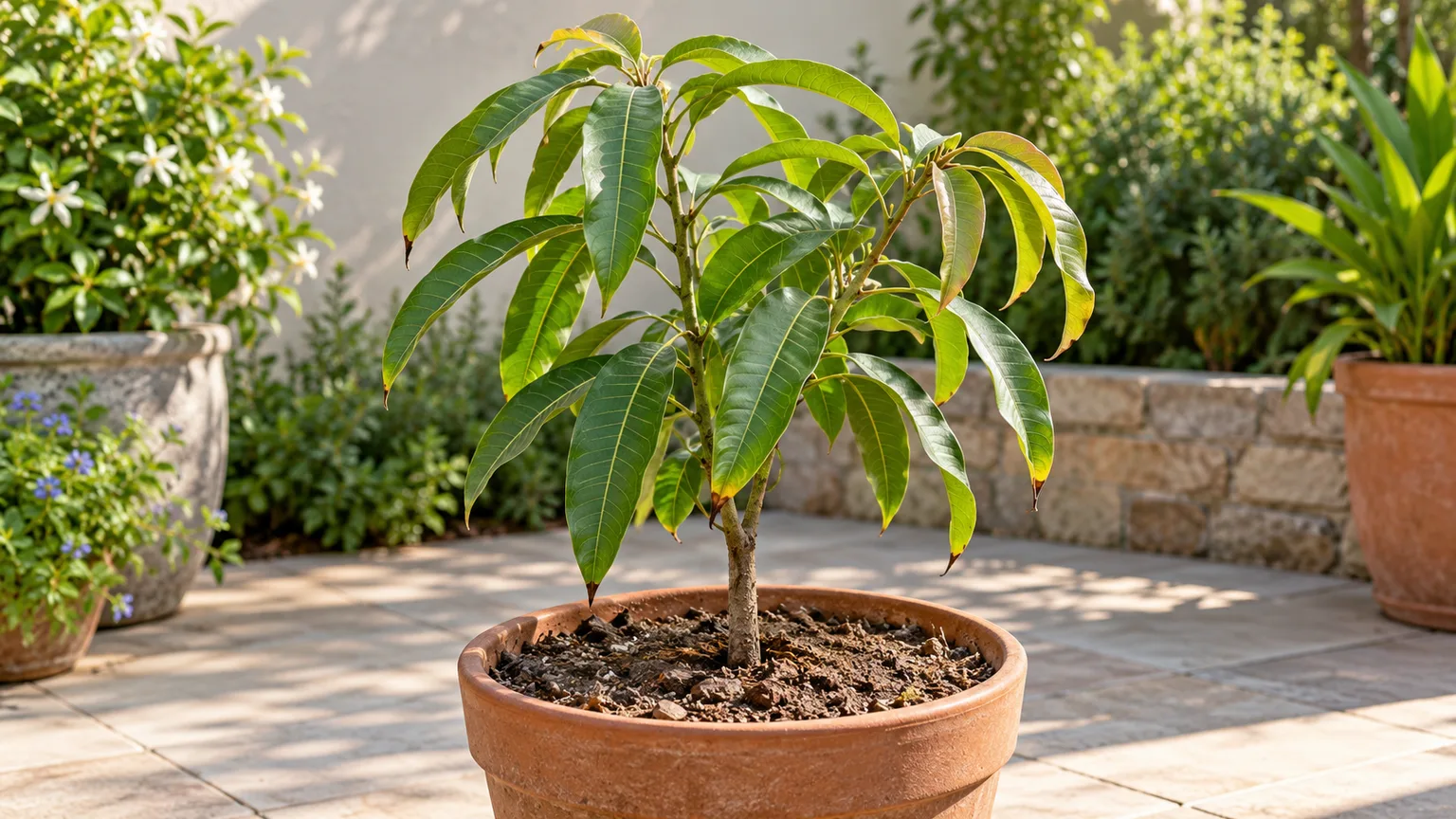
Underwatering on Mango: Causes, Checks & Fixes
This guide covers underwatering on Mango. See also the general Underwatering guide, watering, and light pages for this plant.
Underwatering on Mango: Causes, Checks & Fixes
Quick answer
Underwatering on Mango (Mangifera indica, Mango overview) is too little water during warm active growth—not the deliberate dry rest mature landscape trees tolerate in cool months. Because Mango evolved in the Indo-Burma region as a full-sun fruit tree, a thirsty Mango keeps transpiring hard in heat while its roots run dry: leaves go limp and curl inward, margins turn papery brown, tender new flushes abort, and flowers or young fruitlets drop early.
First step: give one deep, slow watering until excess flows freely from the drain holes (or soaks deep into the landscape root zone), then stop. Do not fertilize, repot, or prune the same day. After that soak, resume the dry-down rhythm in the Mango watering guide—water again only when the top 3–5 cm of mix is dry.
For how chronic dry-down injures roots in general, see our underwatering guide. On Mango, the pattern usually shows up as flush abortion and fruitlet drop long before the whole canopy collapses—which is why this page focuses on Mango’s growth rhythm rather than generic wilt advice.
| What you find | What it usually means | Read next |
|---|---|---|
| Limp curling leaves, dry margins, dusty dry mix, light pot | Underwatering during active growth | Stay on this page; deep soak below |
| Wilting on wet heavy mix, sour smell, stalled flushes | Overwatering or root damage, not thirst | Overwatering on Mango and root rot on Mango |
| Flower or fruitlet drop on dry mix in heat | Thirst during bloom and set | Panicle section below, then Mango watering |
| Single older leaves yellowing while new flushes hold | Normal aging, not drought | Yellow leaves on Mango |
| Pale stretched shoots, tiny leaves, no sun | Light hunger, not water | Not enough light on Mango |
When to use this page vs other Mango guides
- Mango watering guide — routine dry-down checks and seasonal rhythm; use before assuming thirst is the main issue.
- Mango problems hub — browse every Mango issue when symptoms overlap.
- Wilting on Mango — start here instead when wilt is the main symptom and the cause is still open.
- Drooping leaves on Mango — start here instead when droop could be water, light, or root related.
- Brown tips on Mango — start here instead when margin burn dominates and watering seems correct.
What underwatering looks like on Mango
Mango signals thirst from the newest growth inward: tender flushes and leaf margins suffer first, then flowers and fruitlets, and only later the hardened canopy. Learn that order and you water before the crop is lost.
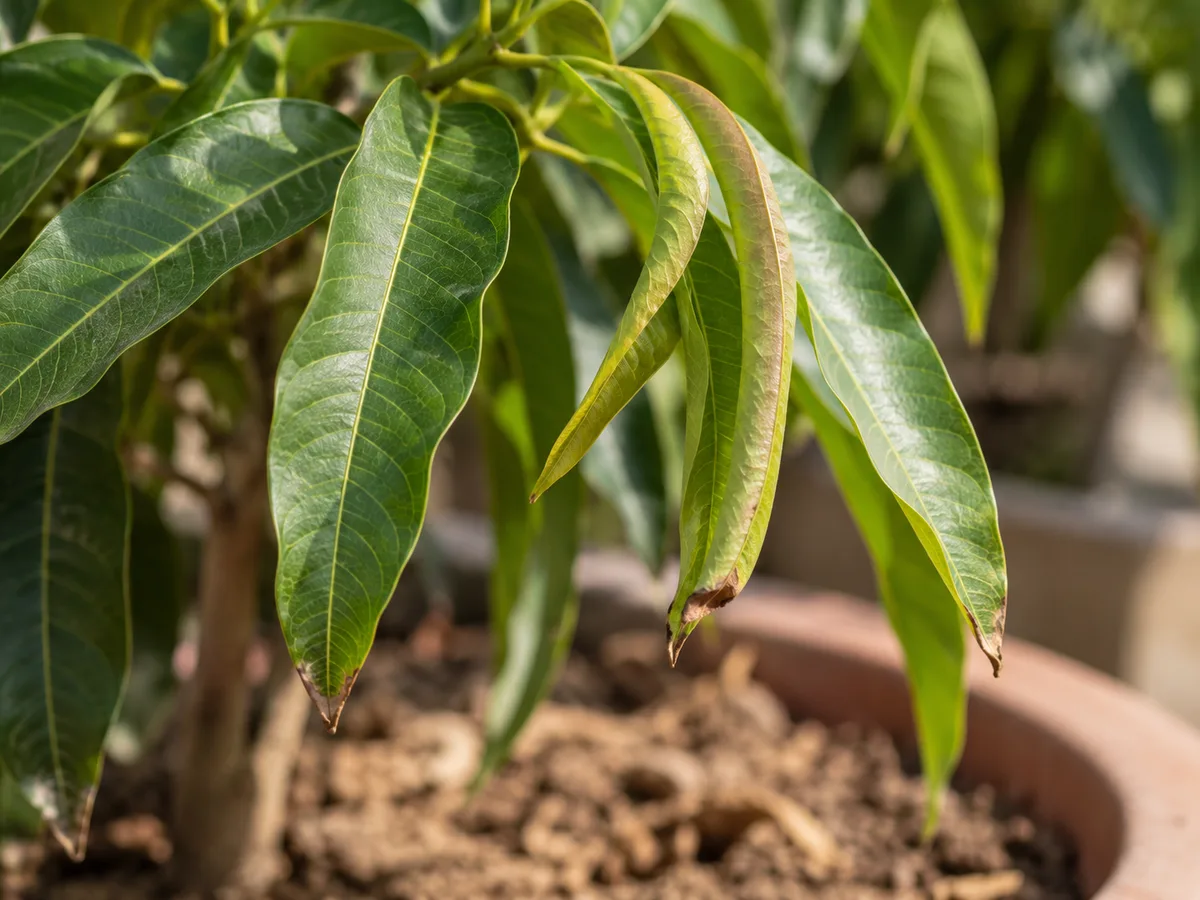
Underwatering symptoms on Mango—limp curling leaf with papery brown margin on dry mix; compare with firm glossy tissue on well-watered flushes.
Leaves:
- Limp, inward-curling leaves that feel soft and papery rather than crisp-snapping—classic drought wilt, which starts with wilt, folding, and rolling before scorch and drop set in
- Dry brown margins and tips, often on the softest newest leaves first
- Dull, greyish-green cast on flushes that should look glossy
- Premature shedding of older leaves during hot dry spells to cut water loss
Flushes, flowers, and fruit:
- Aborted new flushes—tender pinkish-amber shoots stall, crisp, and fail to expand
- Premature flower or fruitlet drop from terminal panicles during bloom and set
- Undersized or shriveled fruitlets that drop instead of sizing up
Soil and pot:
- Mix dusty dry 3–5 cm down, sometimes pulling slightly from the pot wall
- Pot feels very light when lifted
- On the first re-watering, moisture may run straight through—dried organic mix turns water-repellent so water slips down the gap between the shrunken root ball and the pot wall instead of soaking in
What underwatering does not look like:
- Yellow leaves on wet, heavy mix with a sour smell—that is overwatering
- Blackened panicles after overhead watering in humid weather—that is fungal pressure, not thirst
- Stippled leaves with fine webbing—that is spider mites on Mango, a separate pest check
New flushes abort first: reading Mango’s flush cycle
This section would be nonsense on a fern or a snake plant, because Mango grows in episodic flushes—bursts of tender pinkish-amber shoots that harden to dark green—rather than continuous leaf production. Each flush is mostly water, so it is the first tissue sacrificed when roots run dry.
A healthy flush sequence runs: bud swell, rapid soft extension, then gradual hardening over several weeks. Underwatering interrupts that sequence mid-extension—the soft shoot stalls, leaflets stay small and cupped, margins crisp, and the whole flush may abort while older hardened leaves still look acceptable. If your Mango drops tender new shoots but keeps last season’s canopy, you caught drought at the flush stage, which is the cheapest moment to fix it.
Check flush tips every few days in warm growth. When a flush is actively extending in heat, that is the week to probe soil depth rather than trusting last week’s schedule—and the Mango fertilizer guide matters here too, because pushing nitrogen into a thirsty flush grows soft tissue the roots cannot support.
Panicles and fruitlets drop: thirst during bloom and fruit set
Mango flowers and fruits on terminal panicles at branch tips, so repeated tip pruning during bloom removes the crop—and drought during bloom aborts it. When water runs short as panicles emerge or fruitlets size up, the tree sheds flowers and drops young fruit to match the crop load to available moisture. A carpet of fallen fruitlets under a dry container tree in early summer is drought triage, not mysterious disease.
Watering technique matters as much as volume here. Do not apply irrigation water to the foliage, flowers, and fruit—wet blooms invite powdery mildew and anthracnose, the two major Mango flower and fruit diseases. Soak the root zone slowly and keep the canopy dry: basin watering or a slow hose at the dripline for landscape trees, staged pot watering for containers. If panicles blacken while foliage stays wet from sprinklers, switch to soil-level watering and read the bloom failure as disease pressure rather than thirst.
After harvest, Mango shifts back to vegetative flushes—prune then, not during bloom—and restore the normal dry-down rhythm instead of keeping emergency daily soaks running into the wet season.
Container root-ball vs landscape taproot: why potted Mangoes dry out in days
A landscape Mango drives a deep root system into a large soil volume and, once four or more years old, needs irrigation only during very prolonged dry periods. A container Mango lives in a few liters of fast-draining mix—potted plants dry out much faster than plants in the ground—so the same tree that shrugs off a dry fortnight in soil can wilt in days on a hot terrace.
Grafted container trees compound this: the nursery root ball is dense and fibrous, and a pot that dries within a day during warm weather is signaling root crowding as much as thirst—one of the classic repotting signs. Until you up-pot, check that pot every 3–5 days in heat (weekly in cool weather) per the Mango soil guide blend of potting mix, perlite, and pine bark, which drains fast by design and therefore demands faster checks.
Young landscape trees sit between these extremes: newly planted trees need water at planting and every other day for the first week, then 1 to 2 times a week for the first couple of months, plus weekly drinks through any stretch of five or more rainless days in their first three years. Treat “mature trees rarely need water” as a year-four privilege, not a year-one rule.
Why Mango gets underwatering
Mango is planted in full sun for best growth and fruit production—and full sun plus free-draining mix is exactly the combination that empties a pot fastest. Most Mango underwatering traces to one of these mismatches:
Fear of rot after one wet mistake — A grower who once saw yellow leaves on soggy mix swings to permanent drought. The gritty Mango soil dries correctly in two or three hot days, but the owner waits for a calendar date instead of probing depth.
Season mismatch — Watering like it is still the cool rest period when flushes and heat have returned. Little to no irrigation is needed through fall and winter for established trees—but spring flushes and summer fruit sizing are the thirstiest weeks of the year.
Container drying in heat waves — Small pots on reflective terraces in full afternoon sun can need checks far more often than the standard weekly rhythm. Temporary shade during extreme heat slows moisture loss while flushes harden.
Hydrophobic dry-out — Bark-heavy mix that stayed dry too long repels water; the surface looks briefly damp while the root ball stays dry inside. Staged watering, not a bigger single pour, fixes this.
New-transplant gaps — Recently planted trees whose original root ball never integrated with surrounding soil dry out inside the ball while the surrounding ground looks moist. Probe the ball itself, not just the adjacent bed.
The pattern is almost always: dry depth + light pot + warm active growth + curling flushes or dropping fruitlets.
How to confirm the cause
Work through these checks in order so you do not soak a rotting tree or ignore true drought.
- Season and stage — Are flushes extending, panicles blooming, or fruitlets sizing? Warm active growth raises water need sharply. A quiet cool-season tree with dry mix may simply be resting.
- Soil at depth — Push a finger or skewer a full 3–5 cm down, not just the surface. Check deeper than a fingertip reaches—two inches down tells you more than the surface ever does. Dusty and dry confirms thirst; clammy or wet rules simple underwatering out.
- Pot weight and drainage — Lift the container and confirm holes run freely. Very light plus dusty depth means drought; heavy plus wilt means roots.
- Leaf pattern — Inward curl with dry margins on dry mix is thirst. Uniform yellowing on wet mix, or stippling with webbing, sends you to yellow leaves or spider mites instead.
- Flush and fruit check — Aborted tender flushes or dropped fruitlets on dry mix corroborate drought. Blackened blooms on wet foliage point to fungal pressure—keep water off the canopy.
- Morning response test — Leaves that recover overnight but wilt again by afternoon are warning you early; wilt that persists through a cool morning after a deep soak means look beyond simple thirst.
Confirmed diagnosis: dry mix through the root zone, light pot, limp curling leaves or aborted flushes during warm growth, and visible improvement within a day or two of one deep soak.
First fix for Mango
Water deeply once, slowly, at soil level—until water runs freely from the pot’s drain holes or soaks well into the landscape root zone.
- Use room-temperature water kept off leaves, panicles, and fruitlets to avoid inviting flower and fruit disease.
- If water channels straight through dried mix, water in two or three slow passes ten minutes apart so moisture absorbs instead of running off—water slowly with low pressure so hydration soaks in rather than displacing soil.
- For severely dried pots, bottom-water 30–45 minutes, then drain fully and empty the saucer so roots are not left sitting in runoff.
- For landscape trees, soak the dripline area deeply rather than sprinkling the trunk or canopy.
That single thorough soak is the entire first fix. Do not fertilize, repot, hard-prune, or move the tree to harsher sun the same day. Wear gloves when handling prunings or damaged growth—Mango sap and peel carry contact allergens for sensitive people.
Step-by-step recovery
- Confirm dry depth and light pot—not wet-mix root damage.
- Deep soak at soil level until runoff; repeat in slow passes if mix repelled the first pass.
- Drain fully and return the tree to its accustomed full-sun position—recovery is fastest in the light it already holds.
- Wait and re-probe before the next drink: top 3–5 cm dry for containers, deeper for landscape trees.
- Leave living leaves even if margins crisped; trim only fully dead tissue once the cause is fixed.
- Repot or up-pot only if the root ball dries within a day in warm weather or water always channels through—otherwise one fix at a time per the Mango repotting guide.
- Resume feeding only after flushes extend normally again, following the Mango fertilizer schedule—never fertilize drought-stressed roots.
Recovery timeline
Mild dehydration (afternoon limpness, slight curl, few crisp margins): leaves usually firm up within 24–48 hours of one deep soak; flushes resume extending within days.
Moderate stress (aborted flushes, heavy margin burn, early fruitlet drop): expect one to two weeks of corrected dry-down cycling before new growth looks normal. Dropped fruitlets for this bloom are gone—success is measured on the flushes and fruit that remain.
Worsening signs after watering on already-moist mix—spreading black stems, sour smell, continued drop—shift to the root rot workflow, not more water.
Crisp brown margins do not re-green. Judge recovery by relaxed turgid leaves, held flushes, and clean new growth—not by old damage reversing.
Lookalike symptoms
| What you see | Often confused with | How to tell apart |
|---|---|---|
| Curl + crisp margins on dry mix | Brown tips from salts or burn | Salt burn: white crust, wet mix, no wilt cycle. Thirst: dusty depth, light pot, afternoon wilt. |
| Wilt on wet heavy mix | Simple underwatering | Damaged roots cannot drink; see overwatering and root rot. |
| Whole-canopy dullness, tiny pale shoots | Low light or slow growth | Light hunger: stretched stems, no sun hours, soil still moist. Thirst: dry depth, curling flushes. |
| Shedding with sticky residue or webbing | Mealybugs or spider mites | Pests: visible insects, honeydew, stippling. Thirst: clean dry mix, no pests on leaf undersides. |
| Leaf drop with gnats over damp mix | Fungus gnats or mold on soil | Those ride on chronic wetness—the opposite moisture error. |
What not to do
Do not panic-soak daily after one dry spell—saturated mix with no dry-down invites the root decline Mango hates. Do not mist leaves instead of soaking the root zone; Mango needs moisture at depth, and wet foliage invites bloom disease. Do not fertilize drought-stressed roots before hydration stabilizes—salts on dry roots burn. Do not overhead-sprinkle a blooming tree to “cool it down.” Do not assume every wilted Mango needs water; wilt on wet mix means roots, and more water deepens the damage. Do not keep a fast-drying container tree in a tiny pot thinking extra attention fixes it—see the soil and repotting guides and fix volume first. Do not ignore a pot that dries daily all summer because mature landscape trees tolerate drought—containers play by different rules.
How to prevent underwatering on Mango
Prevention is reading the root zone, not memorizing a weekday.
- Free-draining airy mix per the soil guide so water penetrates deeply without stagnating—then replace it on an observable rhythm.
- Full sun with airflow per the light guide so flushes and fruit develop strongly—and so you notice pots drying quickly in the position where they dry fastest.
- Dry-down habit from the watering guide: deep drinks when the top 3–5 cm is dry; less frequent deep watering within the root zone beats frequent shallow sprinkling that never penetrates.
- Lift the pot on every check during warm growth; weight change beats a calendar.
- Mulch landscape trees and keep competing grass back from the dripline so irrigation reaches Mango roots.
- Size containers generously for grafted trees and up-pot when daily drying starts; pair with pruning after harvest to keep canopy and root volume in balance.
Healthy Mango care pairs sharp drainage with generous drinks when dry—the same pairing that prevents both underwatering and rot.
Related Mango guides
- Mango overview
- Mango watering
- Mango light
- Mango soil
- Mango fertilizer
- Mango repotting
- Wilting on Mango
- Drooping leaves on Mango
- Brown tips on Mango
- Yellow leaves on Mango
- Overwatering on Mango
- Mango problems
Conclusion
Underwatering on Mango announces itself early—curling flushes, crisping margins, then dropped flowers and fruitlets—if you probe depth and lift the pot instead of watering by calendar. One slow deep soak at soil level, a return to the 3–5 cm dry-down rhythm, and patience through one or two flush cycles will steady most trees. Keep young and container trees on a faster check schedule than mature landscape specimens, keep water off blooms and fruit, and judge success by held flushes and clean new growth.
How we wrote and verified this guide: Recommendations were checked against UF/IFAS Extension mango culture, Utah State University Extension drought guidance, Gardening Know How, and Fast Growing Trees references cited inline. Author: sai-ananth. Reviewer: LeafyPixels Review Board. Methodology: plant problem guidance is reviewed against botanical references, extension resources, and LeafyPixels plant-care data before publication. Last reviewed: 2026-08-30.