Mealybugs on Mango: Causes, Checks & Fixes
Quick answer
Mealybugs on mango show up as white cottony clusters on new flushes, leaf axils, and flower panicles, often with sticky honeydew, black sooty mold, and ants marching up the trunk. First step: band the trunk with a sticky barrier to stop soil-climbing nymphs, then dab visible clusters with rubbing alcohol before considering soap or oil sprays.
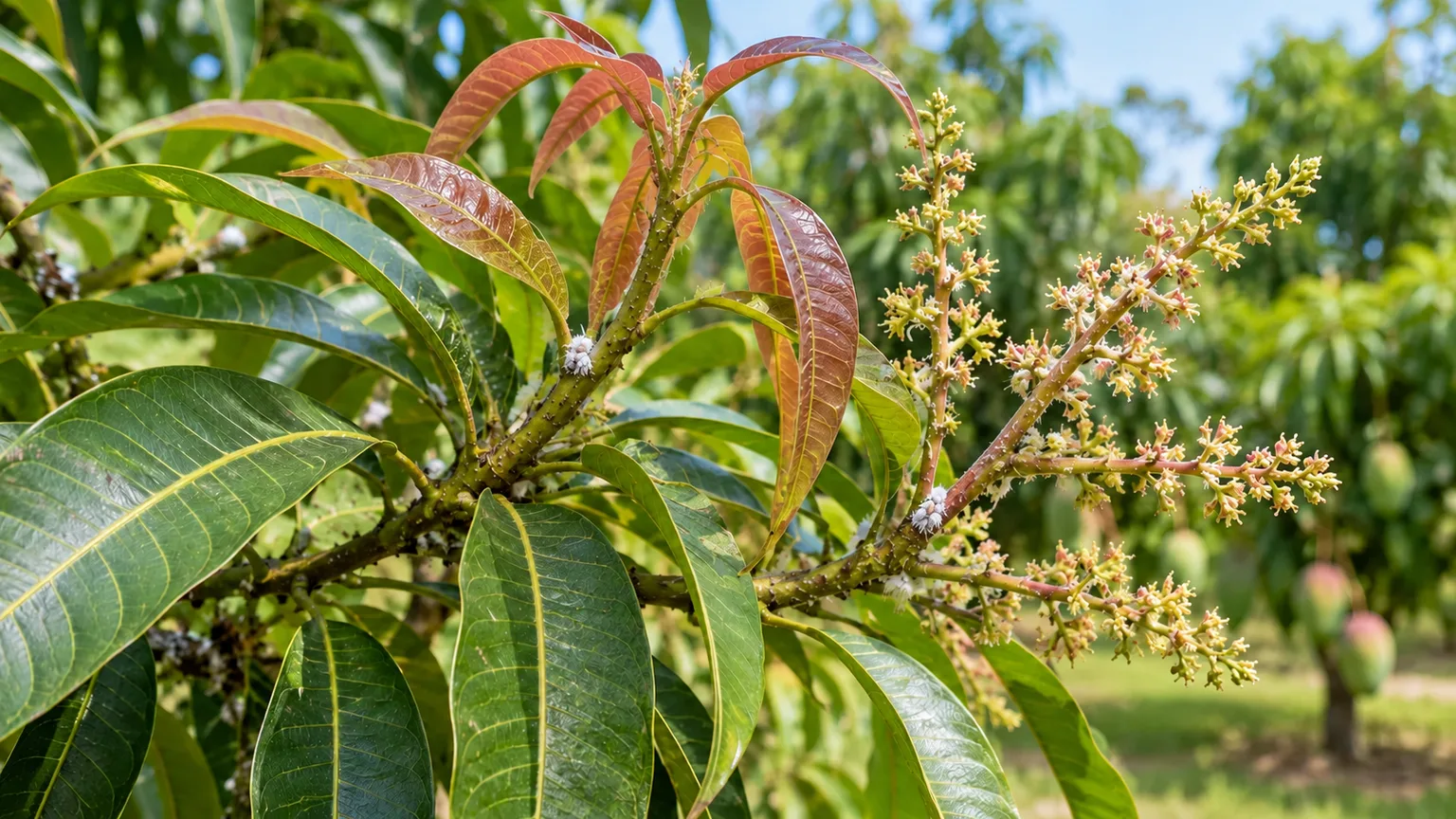
Mealybugs on Mango: Causes, Checks & Fixes
This guide covers mealybugs on Mango. See also the general Mealybugs guide, watering, and light pages for this plant.
Mealybugs on Mango: Causes, Checks & Fixes
Quick answer
Your mango tree (Mangifera indica) has white cottony clumps tucked into shoot tips, leaf joints, or flower panicles, and the leaves below feel sticky or look blackened. That combination is classic mealybug: sap-sucking insects that drain tender mango growth and coat it in sticky honeydew that grows black sooty mold.
First step: band the trunk, then clean the clusters. Wrap a smooth polythene band around the trunk with a sticky coating so the nymphs climbing up from the soil cannot reach the panicles, then dab visible cottony masses with a rubbing-alcohol cotton swab. Mango mealybug nymphs migrate up the trunk from the soil around flowering time, so blocking that climb is the highest-leverage move on this tree. For the general mechanics of how mealybugs feed and spread, see our mealybugs guide — on mango, the pattern almost always centers on panicles, new flushes, and ant activity.
What mealybugs look like on mango
On mango, mealybugs do not scatter evenly across the canopy. They pack into the tree’s most tender real estate: unfolding leaf flushes, the joints where leaf stalks meet stems, shoot tips, and — most distinctively — the branching flower panicles. Adult females are oval, soft-bodied, and dusted in white powdery wax, roughly 2–5 mm long; males are tiny, winged, and rarely noticed. The giant mango mealybug Drosicha mangiferae is one of the key species on this host in Asia.
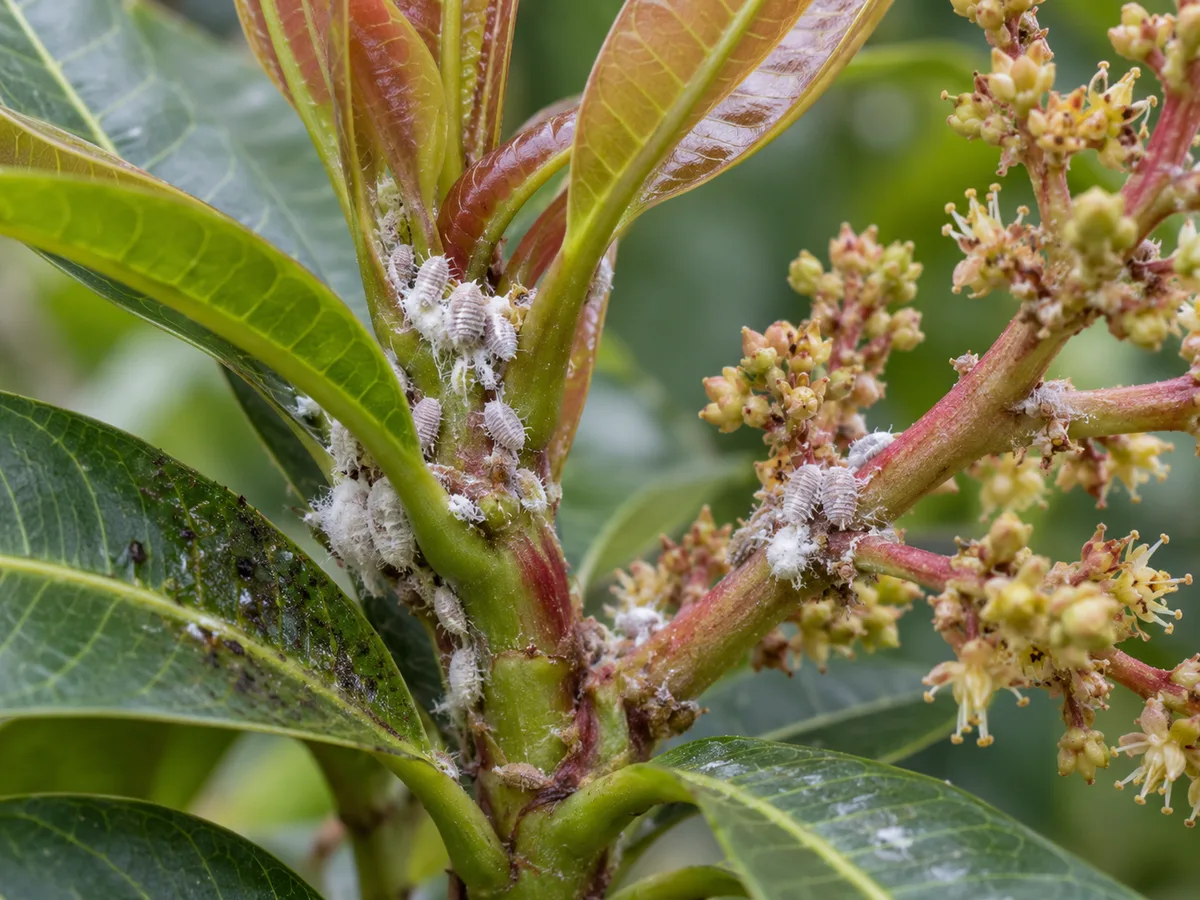
Close-up of cottony mealybug masses in mango leaf axils — look for the waxy white coating, sticky honeydew, and dark sooty mold on leaves below.
Secondary signs often appear before you spot the insects themselves. Leaves and fruitlets under a colony feel tacky with honeydew, then develop a black powdery film of sooty mold growing on that sugary residue. Infested panicles shrivel, distort, or shed flowers and young fruitlets. A line of ants streaming up the trunk and along branches is mango’s loudest early alarm — ants farm mealybugs for honeydew and will defend the colony from predators.
Container-grown mangoes show the same pattern compressed: check the tight leaf axils of a recent flush, the graft union, and the soil-line stem base, where humidity lingers and colonies establish first.
Why mango gets mealybugs
Mango’s growth habit hands mealybugs exactly what they want. Each new flush pushes a burst of soft, sap-rich tissue at the shoot tips, and flowering covers the canopy in tender panicles that feed colonies for weeks. Dense, unpruned canopies trap humidity and shade the interior, sheltering colonies from sun and predators — the same crowded-canopy problem behind many mango airflow and light issues.
Three mango-specific drivers matter most:
Flowering-season exposure. Nymphs overwinter in the soil and climb the trunk as the tree pushes panicles, so bloom time is peak vulnerability. A tree that looked clean in autumn can be colonized within weeks of flowering.
Ant partnerships. Mango bark highways carry ants straight to panicle colonies. Where ants are active, mealybug populations grow faster because their natural predators get harassed away — controlling ants is part of controlling mealybugs on this tree.
Soft growth from excess nitrogen. Heavy feeding pushes the succulent flushes mealybugs prefer. Mango needs only modest nutrition on the schedule in our mango fertilizer guide, and overfed trees reliably attract heavier infestations.
New nursery trees are the other classic entry route: females crawl poorly, so colonies usually arrive on an already-infested plant. Quarantine newcomers away from the collection for several weeks and inspect leaf joints before planting out, a precaution the RHS recommends for mealybugs generally.
How to confirm the diagnosis
Work through these checks in order before spraying anything:
- Find the cotton. Part new flushes and panicles gently and look deep into axils and flower branch junctions. Mealybug masses look like tiny tufts of wet cotton with a waxy sheen and do not fly or jump when disturbed — aphids on mango scatter and drop when touched (see aphids on mango).
- Test the stickiness. Rub a leaf below the suspect colony. Honeydew feels tacky like dilute syrup; black powder that smudges is sooty mold feeding on it. Sticky-plus-black under a white colony is near-certain mealybug.
- Follow the ants. Watch the trunk for 5 minutes in warm daylight. A steady ant column heading to one branch section points straight at a tended colony.
- Check the trunk base at dawn or dusk. During flowering season, tiny pale nymphs may be visible migrating upward from the soil — the crawler stage that trunk bands are designed to intercept.
- Rule out scale. Press a suspect bump: mealybugs smear waxy and soft with visible segmentation, while armored scale feels like a hard, dry shell fused to the bark.
Skip the magnifier-guessing: if you see white cottony masses plus honeydew plus ants on mango panicles or flushes, you have enough confirmation to act.
First fix for mango
Band the trunk this week. On a landscape tree, wrap a 20–25 cm smooth polythene or alkathene sheet snugly around the trunk below the lowest branches and coat it with grease or a sticky barrier, following the banding approach used in mango orchards. On a container tree, the equivalent is a sticky band around the main stem plus isolating the pot from neighboring plants. This single action cuts off the soil-to-canopy reinforcement that makes mango infestations explode at bloom.
Then, in the same session, dab every visible cottony cluster with a cotton swab dipped in rubbing alcohol and rinse honeydew-coated leaves with a firm water spray. Alcohol dissolves the waxy armor on contact, and water removes the mold substrate without chemicals. Repeat the swab-and-rinse weekly until two consecutive checks find no new cotton.
Reserve insecticidal soap or horticultural oil for colonies that survive two weeks of banding plus manual removal. These sprays work best on exposed crawlers, so thorough coverage of leaf undersides and panicle junctions matters more than product strength — spray thoroughly and repeat per the label. Always follow label directions, keep sprays off open mango bloom where possible to protect pollinators, and observe any pre-harvest interval on fruiting trees. Avoid broad-spectrum insecticides that wipe out the ladybirds and parasitic wasps already hunting mealybugs in your canopy.
For severe landscape infestations, biological reinforcement helps: the predatory ladybird Cryptolaemus montrouzieri (the mealybug destroyer) is commercially available and established on mango in several regions, and neem oil sprays plus predator releases are a documented combination on this crop.
Step-by-step recovery
- Band the trunk and isolate container trees from neighbors.
- Alcohol-swab all visible cottony masses; prune out only the most encrusted panicle tips if the colony is impenetrable (never strip a flowering canopy bare — see our mango pruning guide for timing).
- Blast honeydew off with water so sooty mold loses its food source; mold usually weathers off over subsequent weeks.
- Suppress the ant column with a sticky trunk barrier or ant bait stations at the tree base so predators can reach the colony.
- Re-check every 5–7 days through the end of flowering and the following flush. Treat only fresh cotton, not old scars.
- Escalate once, not constantly: if crawlers persist after two manual rounds, apply one thorough round of insecticidal soap or horticultural oil, then return to monitoring.
Recovery timeline
Expect sticky honeydew to stop accumulating within 1–2 weeks of effective banding and cleanup; existing sooty mold fades gradually and may take a month or more to weather off mature leaves. New flushes should emerge clean and expand without distortion — that is your success signal. Panicles hit hard during bloom will not re-flower this season; recovery means the tree holds its remaining fruitlets and pushes healthy vegetative growth afterward. If fresh cotton reappears on the next flush, the soil reservoir or a neighboring host is still feeding the problem — re-check bands and nearby plants rather than assuming the spray failed.
Lookalikes: rule these out on mango
| What you see | More likely | Where to go |
|---|---|---|
| Small soft insects that scatter when touched, no cotton | Aphids on tender flushes | Aphids on mango |
| Fine webbing plus stippled, bronzed leaves | Spider mites in hot, dusty weather | Spider mites on mango |
| Yellowing leaves but no insects, cotton, or stickiness | Watering or nutrient issue | Yellow leaves on mango and mango watering |
| Wilting flushes with no visible pests | Root or water stress | Wilting on mango |
| Hard shell-like bumps fused to bark | Scale insects, not mealybugs | Mango problems hub |
Sooty mold alone, without any live colony above it, usually means the pests have already left or were washed off — clean the mold and monitor rather than spraying blindly.
Mistakes to avoid
- Spraying the whole canopy on day one before banding and manual removal. On mango, the trunk-climbing cycle re-infests sprayed canopies within days.
- Drenching open panicles with insecticide during bloom. You will kill the pollinators the fruit set depends on; use targeted swabbing and bands while flowers are open.
- Feeding a stressed, infested tree to “help it recover.” Extra nitrogen pushes exactly the soft growth mealybugs want — hold fertilizer until flushes emerge clean, per our mango fertilizer guide.
- Pruning every infested shoot at once. Removing panicles removes the crop; prune lightly for airflow after harvest instead, as outlined in mango pruning.
- Ignoring the ants. Killing mealybugs while ants remain means the next crawlers get escorted straight back up.
- Handling sap carelessly while treating. Mango shares allergenic compounds with its Anacardiaceae relatives — wear gloves and long sleeves when banding trunks and handling prunings, as noted in our mango overview.
Mango care cross-check
Mealybug pressure rises when the tree’s basics slip, so verify the foundation while you treat:
- Sun and airflow: Mango needs at least 6–8 hours of direct sun and an open canopy (mango light); shaded, tangled interiors stay humid and hide colonies.
- Watering: Deep but infrequent watering with full drainage beats chronic dampness — soggy root zones stress the tree and favor pests (mango watering).
- Soil: A deep, freely draining mix keeps roots vigorous enough to outgrow minor feeding damage (mango soil).
- Container size: Root-bound trees in small pots dry unevenly and flush weakly; refresh the mix on schedule (mango repotting).
How to prevent it next time
Prune for an open, sunlit canopy soon after harvest so interior wood dries fast and colonies have nowhere to hide. Feed modestly — mango on a lean schedule produces tougher flushes that mealybugs colonize slowly. Re-fit trunk bands before every flowering season and hoe or rake the soil ring under the canopy to disturb overwintering stages, a standard orchard sanitation step. Quarantine every new plant for several weeks, inspect weekly while flushes and panicles are tender, and keep a small bottle of rubbing alcohol with your garden tools so the first cottony tuft gets swabbed the day it appears.
When to use this page vs other mango guides
Use this page when you find white cottony masses plus stickiness, sooty mold, or ant columns on flushes or panicles. If leaves yellow with no insects or honeydew, start with yellow leaves on mango instead. If the whole canopy wilts despite wet soil, the roots — not pests — are the prime suspect (see root rot on mango and overwatering on mango). Anything affecting shoots generally traces back to the foundations in mango watering, mango light, and mango soil.
Related mango guides
- Mango overview — growth habit, size control, and sap-handling precautions.
- Mango problems hub — every diagnosed mango issue in one place when symptoms overlap.
- Mango watering — deep, infrequent watering that keeps trees vigorous without chronic dampness.
- Mango light — full-sun and airflow needs that keep canopies hostile to mealybugs.
- Mango soil — freely draining mixes that support strong flushes.
- Mango fertilizer — lean feeding so flushes stay tough, not succulent.
- Mango pruning — post-harvest canopy opening without sacrificing panicles.
- Aphids on mango — when the sap-suckers scatter instead of forming cotton.
- Spider mites on mango — stippling and webbing in hot, dusty conditions.
Related tool
Use the Pest Identifier Tool to narrow causes for mealybugs on this plant before changing multiple variables at once.