Wilting on Mango: Causes, Checks & Fixes
Quick answer
On mango, wilting most often means the root ball swung too dry between waterings or sat too wet in poorly draining mix. Probe the top 3-5 cm and lift the pot: water deeply once if dry, hold water and improve drainage if soggy. One-sided wilt with dieback or gum on the trunk points to vascular disease instead of watering.

Wilting on Mango: Causes, Checks & Fixes
This guide covers wilting on Mango. See also the general Wilting guide, watering, and light pages for this plant.
Wilting on Mango: Causes, Checks & Fixes
First, probe the top 3-5 cm of mix and lift the pot before you touch the hose. If the mix is dry and the pot feels light, give one deep watering until water runs freely from the drainage holes. If the mix is wet and heavy, do not water — move the tree to brighter airflow and let the root zone dry. For whole-tree background, start with the Mango overview.
Reviewed by LeafyPixels Review Board · Author: sai-ananth
Quick answer
Mango wilting is a plumbing problem first and a disease problem second. Mangifera indica originated in the Indo-Burma region as a large full-sun evergreen tree, so a grafted container tree wilts whenever its small root ball cannot keep up with a big tropical canopy — either because the mix dried out or because soggy mix rotted the fine roots. Young trees in dry weather do best watered deeply about once a week during prolonged dry spells rather than sprinkled daily. How chronic wet mix damages roots in general is covered in our wilting guide; on mango the pattern usually shows up as limp mature leaflets plus stalled flushes in a heavy pot.
What wilting looks like on mango
On mango, true wilting starts with the mature dark-green leaflets losing their stiff, slightly upward stance and hanging down along the midrib like wet paper. The long lance-shaped leaves (15-40 cm) curl inward at the margins, feel soft and cool rather than leathery, and the newest flush stops extending. If dryness is the cause, leaflet edges brown and crisp within a few days; if soggy mix is the cause, leaves stay limp and dull, may yellow between the veins, and drop while still soft.
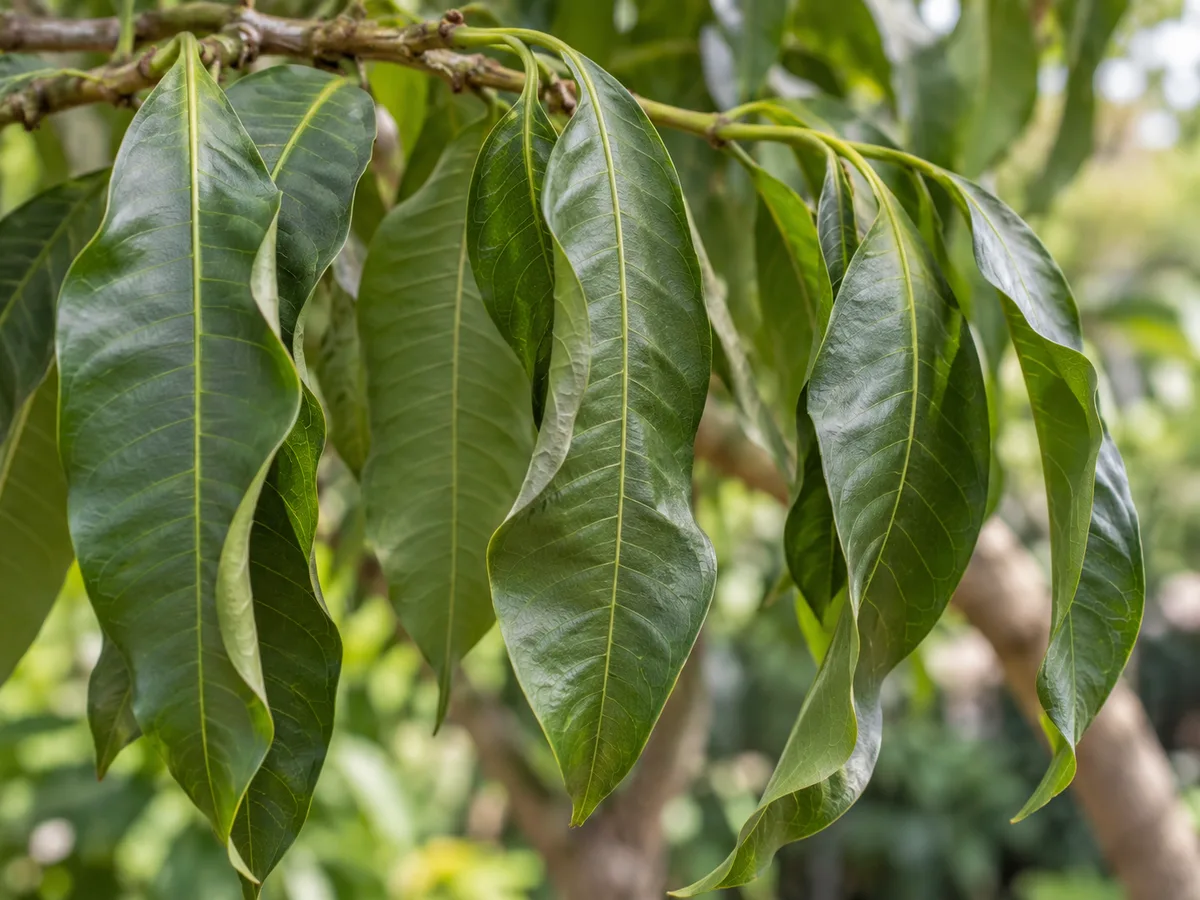
Close-up: mature mango leaflets hanging limp along the midrib with inward-curling margins — the classic loss-of-turgor look before browning sets in.
Container trees often wilt first on the sunniest side of the canopy in afternoon heat, then recover slightly overnight. That daily rhythm matters: wilt that eases by morning points to the root ball running dry each afternoon, while wilt that never eases points to root damage or vascular blockage.
New flushes that only look wilted
Mango has a built-in false alarm every growth flush. New leaves emerge pinkish, amber, or pale green and hang soft and floppy for days before they stiffen and turn dark green — young mango leaves start off pinkish or pale and darken at maturity. A first-time grower often mistakes this normal floppy flush for wilting and overcorrects with extra water.
Tell them apart in ten seconds: normal flush limpness affects only the colored new growth at shoot tips while every mature dark leaf stays firm and angled upward. True wilting drags the mature leaves down too, and the whole canopy looks tired rather than just the tips. If only the pink tips are soft, leave the hose alone and let the flush harden off.
The two common container causes: too dry, then too wet
Most potted mango wilting comes down to a root ball that is wrong-sized for a tree species. An ungrafted mango wants to become a 9-30 m tree, and even a grafted compact cultivar fills its pot with roots fast. A root-bound pot can go from soaked to bone-dry in a single hot day, so the canopy wilts every afternoon no matter how faithfully you watered that morning.
At the other extreme sits the drowned root ball. Mango tolerates an occasional soaking but performs poorly in badly drained soils, and landscape guidance recommends planting on a raised mound where flooding threatens. In pots the equivalent mistake is dense compost-heavy mix with no perlite or bark, a saucer that never gets emptied, or daily lawn sprinklers hitting the trunk — a routine extension guidance links directly to overwatering and root rot decline in mango trees. Soggy roots cannot take up water, so the canopy wilts exactly like a thirsty tree while the mix stays wet. Compare your pattern with overwatering on mango and underwatering on mango before deciding which side you are on, and check your mix against the mango soil guide.
Vascular wilts: Verticillium and mango sudden decline
When watering checks do not explain the wilt, mango has two named vascular suspects worth knowing. Verticillium wilt is documented on mango in limestone soils and in ground previously used for vegetables such as tomatoes: the fungus invades the roots and water-conducting vessels, blocking flow so leaves wilt, desiccate, and brown while stems and limbs die back. It can occasionally kill young trees outright, and the recommended response is pruning out affected limbs rather than watering harder.
The signature that separates vascular wilt from thirst is asymmetry. One branch or one side of the canopy wilts while the rest looks normal, and cutting into a declining branch reveals dark streaking in the wood where vessels are blocked. A related orchard-scale problem, mango sudden decline linked to Ceratocystis fungi, shows the same one-sided collapse plus trunk gum oozing and sudden wilt with reddish-brown vascular staining. That disease mainly threatens orchard trees, so container growers should treat it as a differential to rule out, not the default diagnosis — but gum on the trunk plus branch drying means stop guessing and get a local extension diagnosis.
Be honest about the odds: simple dry-or-wet root stress explains the large majority of container mango wilting, Verticillium is uncommon but real in susceptible ground, and Ceratocystis is rare outside production regions. Match the pattern before borrowing orchard-level fear.
How to confirm the cause
Work through these checks in order on a dry morning, and write down what you find:
- Finger and weight test. Push a finger 3-5 cm into the mix and lift the pot. Dry and light means thirst; wet and heavy days after watering means drainage failure. The mango watering guide sets the baseline rhythm to compare against.
- Drainage audit. Water once and watch: free flow from the holes within seconds is healthy, ponding on the surface or a full saucer an hour later is not. Tip the saucer out.
- Root peek. Slide the root ball out of a plastic nursery pot and look. White-tipped firm roots mean the plumbing works; brown mushy roots or a sour smell confirm rot — escalate to root rot on mango.
- Flush test. Are only pink tip flushes soft (normal), or are mature dark leaves limp too (true wilt)? Note whether the canopy recovers overnight.
- One-side scan. Stand back and compare halves of the canopy. Uniform wilt suggests water; one-sided wilt with tip dieback suggests a vascular problem.
- Trunk and graft check. Look for gum oozing, sunken bark, cracks, or a buried graft union. Plant with the top of the root ball at or slightly above the surface, never deep.
- Site history. Was the tree planted where tomatoes or other vegetables recently grew, or where sprinklers run daily? Both raise the odds of soil-borne trouble.
The first fix to try
Do the finger-and-weight check first, then apply exactly one correction: if the mix is dry, water the whole root ball deeply once until excess flows freely and empty the saucer. That single deep soaking — not a week of extra sprinkles — is the correct first response to a dried-out mango, because it re-wets the full root zone without training roots to expect daily sips.
If the mix is already wet, the first fix is the opposite single action: move the pot into full sun and airflow, empty all standing water, and let the top centimetres dry before the next watering. Either way, change one variable and watch the canopy for 24-48 hours before adding fertilizer, repotting, or spraying anything.
Step-by-step recovery
- Confirm dry versus wet with the finger-and-weight test.
- Dry: deep-water once, empty the saucer, and shade only during extreme heatwave afternoons — mango needs full sun, so return it promptly.
- Wet: hold all water, clear the saucer, improve airflow, and tilt a waterlogged plastic pot to drain. Do not fertilize yet.
- Remove only fully crisped leaflets; leave limp-but-green ones, which may re-inflate.
- If roots were mushy, trim only the clearly rotted portions with clean shears (wear gloves — mango sap and peel carry contact allergens), repot into the airy mix from the mango soil guide, and water in once.
- If wilt is one-sided with dieback, prune the affected branch back to healthy wood, disinfecting between cuts, and dispose of the material rather than composting it. Pruning away dead and dying branches is the core home response to Verticillium-type wilt.
- Resume the weekly-deep rhythm from the mango watering guide once new growth holds firm.
Note that Verticillium has no cure once established inside the plant, so recovery here means the tree walls off damage and pushes healthy flushes — not that old wilted wood heals. Where infected soil is suspected in a bed, solarizing moist soil under clear plastic for several hot weeks can reduce the fungal load before replanting with clean stock.
Recovery timeline
Honest expectations keep growers from over-treating. Thirst-only wilt on an otherwise healthy container tree usually firms up within 12-24 hours of one deep watering, with flush growth resuming in one to three weeks. Soggy-mix wilt recovers slower: expect one to three weeks of stable, non-spreading symptoms as new fine roots form, and a full canopy refill only on the next flush cycle.
Vascular wilt plays out over months, not days. A tree that keeps pushing clean new flushes while old affected limbs stay pruned away is winning; a young tree that collapses branch by branch through a season may not be saveable, and replanting elsewhere with fresh mix is the rational call. Judge everything by incoming growth, not by whether damaged leaflets turn pretty again — they will not.
Lookalike symptoms
| What you see | More likely | Where to go |
|---|---|---|
| Leaves droop but stay green and soft, whole canopy evenly | Simple underwatering or heat load | Underwatering on mango |
| Limp leaves plus yellowing in constantly wet mix | Overwatering and early root failure | Overwatering on mango |
| Mushy brown roots, sour mix, stalled flushes | Active root rot | Root rot on mango |
| Whole canopy sags without crisping, stems soft | Classic droop pattern, check water first | Drooping leaves on mango |
| Older leaves yellow while new growth looks fine | Natural aging or nutrient shortfall, not wilt | Yellow leaves on mango |
| One-sided wilt with dieback or trunk gum | Vascular wilt or decline — diagnose, do not just water | Extension clinic plus sections above |
Heat wilt deserves a special note for mango because the species demands 6-8 hours of direct sun: a container tree in full sun on a 38°C afternoon may flag temporarily even with moist mix. If it stands back up by morning, that is transpiration outrunning roots, and the answer is a larger pot and mulch rather than shade — confirm placement with the mango light guide.
Mistakes to avoid
- Watering on a fixed daily schedule instead of checking the top centimetres first.
- “Rescuing” a soggy tree with extra water because the leaves look thirsty.
- Fertilizing a wilted tree to force recovery — salts stress damaged roots further.
- Repotting, hard-pruning, and spraying on the same weekend, then not knowing which intervention did what.
- Cutting into trunk cankers or oozing limbs bare-handed; wear gloves and keep sap off skin.
- Replanting a new mango into the same suspect bed soil without addressing drainage or disease history.
How to prevent it next time
Prevention is mostly pot physics plus sun. Keep container mango in a heavy, stable pot with large drainage holes, filled with the airy perlite-and-bark blend from the mango soil guide, and refresh it every one to two years as the tree bulks up. Water young trees deeply about once a week through prolonged dry spells, easing off when monsoon-style rain does the job, and never let lawn sprinklers run the show. Hold the tree in genuine full sun per the mango light guide with open airflow around the canopy so foliage dries fast after rain — dry foliage plus a fast-draining root zone is the cheapest disease insurance available. Check the Mango overview each season for size-control pruning, since a canopy the roots cannot support will wilt on schedule every summer.
When to use this page vs other mango guides
Use this page when mature leaves go limp and you need to separate thirst, drowning, and vascular disease. If the mix is clearly the issue, hand off to underwatering on mango or overwatering on mango for the full fix routines. If roots smell or test mushy, root rot on mango takes over. For the broad symptom index, the Mango problems hub routes every sibling guide.
Related mango guides
- Mango overview — whole-tree context: sun, size control, and container reality.
- Mango problems hub — symptom index when wilt is not the whole story.
- Mango watering — the weekly-deep rhythm this page diagnoses against.
- Mango soil — fast-draining blends and repotting intervals.
- Mango light — full-sun placement and heat-flag versus true wilt.
- Underwatering on mango — when the finger test says dry.
- Overwatering on mango — when the finger test says soggy.
- Root rot on mango — when roots test mushy or sour.
- Drooping leaves on mango — the closest lookalike pattern.
- Yellow leaves on mango — yellowing without true limpness.
Conclusion
Mango wilting rewards a calm sequence: confirm dry versus wet at 3-5 cm, apply one correction, and read the canopy for a day or two before escalating. Most cases end at the hose or the drainage hole. Reserve the disease playbook — asymmetric wilt, dieback, gum, vascular streaking — for patterns that truly match it, and lean on the cluster guides above for the routine fixes that keep a sun-loving tree upright.
Related tool
Use the Plant Watering Calculator to narrow causes of wilting on this plant before changing multiple variables at once.
FAQs
My young mango flush hangs limp and pale. Is that wilting?
Usually not. Fresh mango flushes emerge pinkish, amber, or pale green and hang soft until they stiffen and darken, so floppy colored tips with firm mature leaves underneath are normal growth. Suspect true wilting only when mature dark-green leaves go limp too and stay down overnight.
Should I water a wilting mango right away?
Check before watering. Probe the top 3-5 cm and lift the pot: a dry, light pot earns one deep watering until drainage flows, while a wet, heavy pot means holding water and improving drainage instead. Watering a drowning root ball because the leaves look thirsty is the fastest way to turn wilt into rot.
Will wilted mango leaves recover?
Limp-but-green leaflets from a single dry spell often firm up within a day of deep watering. Leaflets that browned, crisped, or dropped are finished — mango does not repair dead tissue. Judge recovery by whether the next flush extends cleanly and holds its posture through hot afternoons.
When is mango wilting an emergency?
Act fast when wilt hits one side while the other stays healthy, branch tips die back, gum oozes from the trunk, or a young tree collapses after wet weather in ground once used for vegetables. Verticillium can occasionally kill young mango trees, so prune affected limbs, avoid replanting susceptible stock in the same spot, and get a local extension diagnosis for gum-and-dieback cases.
How do I stop my potted mango wilting every summer?
Match the pot to a tree-scale root system with fast-draining mix, water young trees deeply about once a week during prolonged dry spells, and keep the tree in full sun with open airflow. Keep daily sprinklers off the trunk, empty saucers after watering, and up-pot or root-refresh when the pot dries out within a day — chronic afternoon flagging means the roots have outgrown their home.