Drooping Leaves on Mango: Causes, Checks & Fixes
Quick answer
Drooping leaves on Mango most often mean a dry container root ball, waterlogged mix after heavy rain, midday heat, transplant shock, or cold nights on a young graft — and sometimes just a soft new flush that has not hardened yet. First step: check moisture 3–5 cm deep and lift the pot in the morning before adding any water.
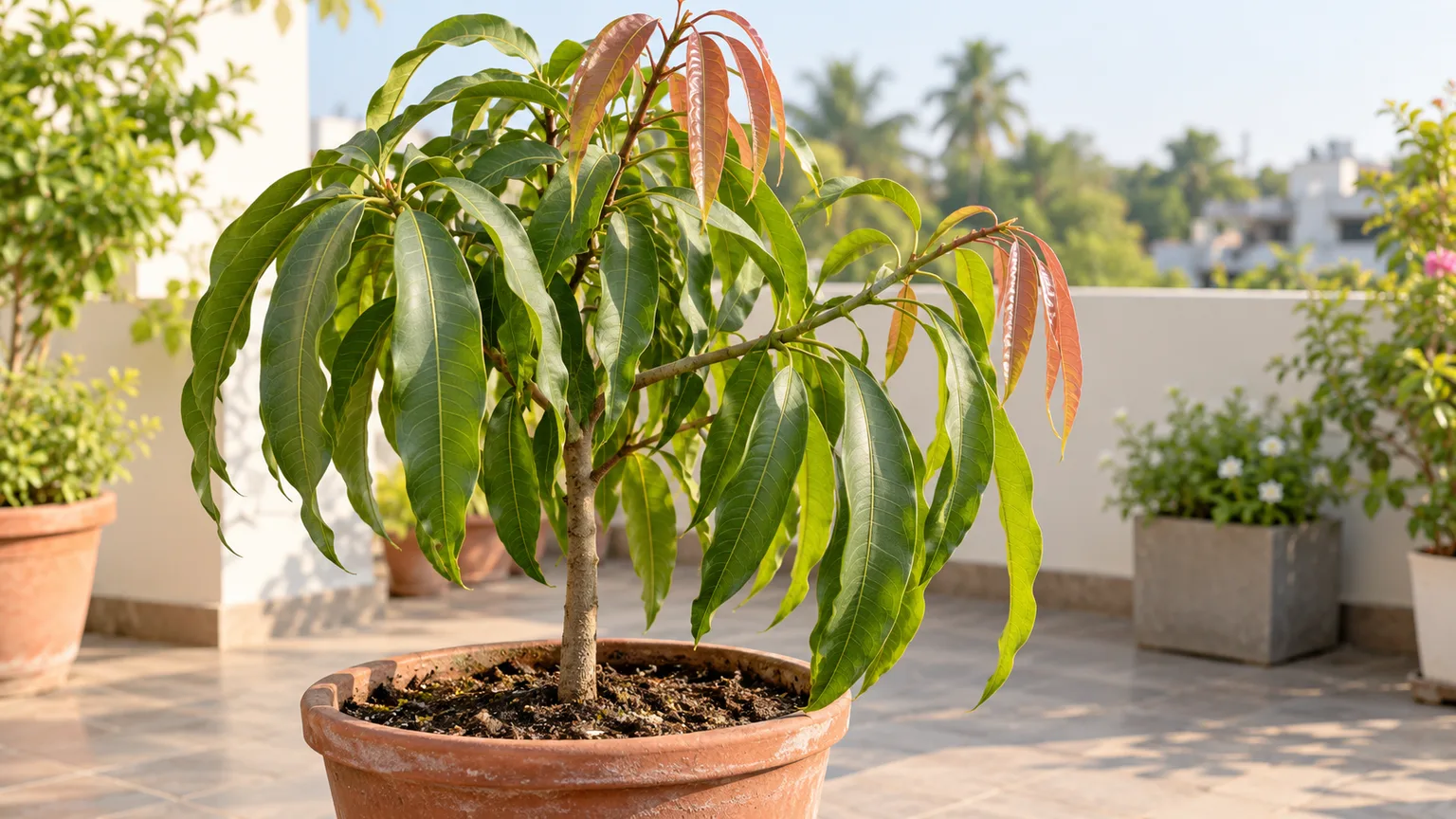
Drooping Leaves on Mango: Causes, Checks & Fixes
This guide covers drooping leaves on Mango. See also the general Drooping Leaves guide, watering, and light pages for this plant.
Drooping Leaves on Mango: Causes, Checks & Fixes
Quick answer
Drooping leaves on Mango (Mangifera indica, see the Mango overview) most often trace to a dry container root ball, a waterlogged mix after heavy rain, fierce midday heat, shock after planting, or cold nights on a young graft. Before those, rule out the harmless one: Mango pushes growth in soft flushes that hang limp and often reddish for several days before hardening.
Your first move is a morning moisture test, not the hose. Push a finger 3–5 cm into the mix and lift the pot. Water deeply only if that layer is dry and the pot feels light; if it is wet, hold water back and fix drainage instead. For how limp leaves lose rigidity in general, see drooping leaves — on Mango, the pattern usually shows up as whole-canopy wilt after a missed watering, persistent wilt in soggy monsoon soil, or a soft new flush mistaken for sickness.
What drooping looks like on Mango
True droop on Mango is a loss of stiffness across whole leaves or whole shoots: leaf blades hang downward from the petiole, young shoot tips nod, and the canopy looks tired rather than crispy. Early on, leaf color often stays green, which separates simple wilt from scorch or advanced disease.
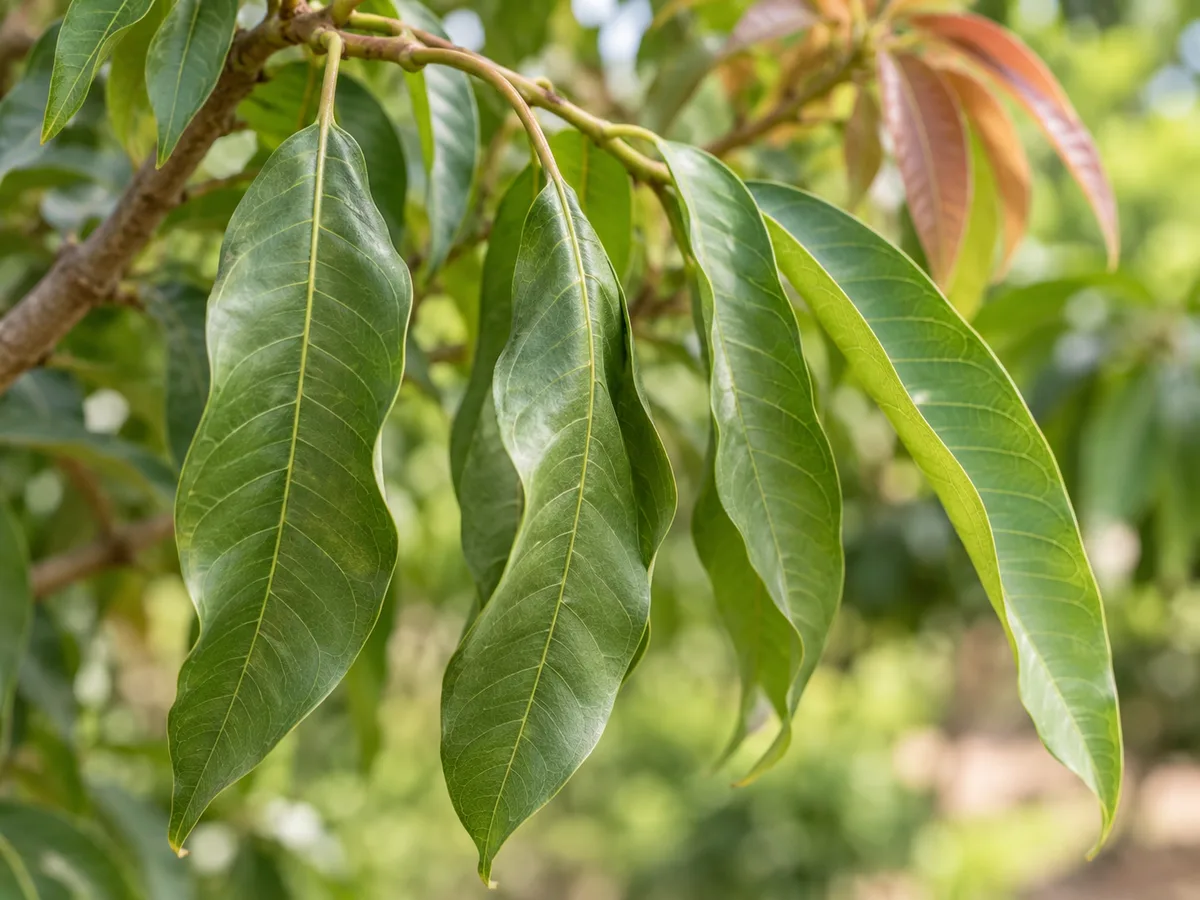
Close-up of limp Mango blades and a nodding shoot tip — compare stiffness with the nearest hardened flush on the same tree.
The locus matters. Droop confined to the softest newest flush while older hardened leaves stay firm is usually normal growth. Droop across hardened older leaves, especially with yellowing, brown margins, or stalled flushes, points to roots, water, or cold. Droop on one side after a windstorm or a move points to exposure stress.
Normal flush flop vs true droop
This is the most Mango-specific call on this page, and it prevents the commonest overreaction: watering a healthy flushing tree into root trouble.
Mango grows in episodic flushes rather than one leaf at a time. Each new flush emerges soft, pale or bronze-red, and distinctly pendulous — it hangs down under its own weight because the tissue has not lignified yet. Over one to three weeks the leaves expand, stiffen, and turn deep green. During that window the tree can look dramatically “droopy” while being perfectly healthy.
Confirm it in seconds: only the newest growth at shoot tips is limp, older leaves below are firm and flat, the mix moisture matches your normal rhythm, and there is no yellowing, spotting, sour smell, or shoot blackening. If all four hold, do nothing except keep your normal checks. If hardened leaves are also hanging, or the flush stays soft and discolored beyond two weeks, work through the causes below instead.
Why Mango leaves droop
A dry root ball, especially in terrace pots
Container Mango dries far faster than ground-planted trees because the whole root volume sits in sun-baked mix with no deeper reserves. Pre-monsoon heat radiating off terrace walls can dry a pot within a day. Early signs are limp or inward-curling leaves, dry brown margins, and aborted new flushes — the classic underwatering signature for this species. Tamil Nadu Agricultural University guidance centers young-tree care on regular watering until establishment, which is exactly the stage where a missed check shows up as droop.
Waterlogged mix and monsoon drainage failure
The mirror image is more dangerous. Mango demands free drainage, and saturated mix suffocates feeder roots so the canopy wilts while the soil is wet. Leaf yellowing while the mix stays wet, soft dark roots, a sour smell, and stalled flushes are the overwatering markers on this tree. UF/IFAS specifically warns that timer-run lawn sprinklers can overwater home-landscape mangoes into decline, and the same logic applies to a pot sitting in a full saucer through monsoon weeks. If you grow in the ground, suspect low spots where runoff collects after storms.
Midday heat and hot dry wind
A healthy Mango can flag in extreme afternoon heat and recover by morning. Leaves go limp around midday, then firm up overnight without any intervention. Young container trees on reflective terraces and recent transplants with small root balls show this first. Wind compounds it by stripping moisture from broad leaves faster than small root systems can replace it. Morning recovery is the diagnosis — true root or disease wilt does not reset overnight.
Transplant and repotting shock in new grafts
A recently planted graft, a seedling moved from nursery bag to ground, or a container Mango that was root-pruned and repotted often droops for days to weeks. Damaged or disturbed roots temporarily cannot meet canopy demand even in moist mix. The standard prevention is to disturb the roots as little as possible and keep the rootball evenly moist — not soaked — while it knits into surrounding soil. Mango-specific roundups of seedling droop likewise put handling stress and poor drainage at the top of the suspect list, noting that overwatering and poorly draining soil lead the list of reasons young leaves collapse.
Cold nights on young trees
Mango does not acclimate to cold the way temperate fruit trees do. UF/IFAS notes mature trees can take brief dips near 25°F with leaf and twig injury, but young trees can be killed around 29–30°F, and flowers and fruitlets suffer below about 40°F. On a young graft, a cold night can show up as sudden widespread droop followed by browning — distinct from drought because the mix may be normally moist. Northern growers overwintering seedlings indoors see the same pattern after a cold windowsill or a drafty move.
Vascular wilt and root disease (the rare escalation)
When droop persists in adequately moist soil with no heat or cold explanation, consider the vascular system. UF/IFAS describes Verticillium wilt on Mango as a fungus attacking roots and the water-conducting system that blocks water movement into the canopy, producing leaf wilting, desiccation, browning, and limb dieback. It is most reported in new trees on ground previously used for vegetables, and control centers on pruning out affected limbs. This is uncommon in containers with fresh mix, which is itself diagnostic: container droop is almost always water, drainage, or exposure.
How to confirm the cause
Work in this order on a calm morning, before the sun is high:
- Separate flush flop from canopy wilt. Only newest tips limp with firm older leaves means normal growth — stop here and keep routine checks.
- Check time-of-day behavior. Limp at 3 p.m. but firm at 7 a.m. means heat or wind load, not disease.
- Test moisture at depth. Push a finger or skewer 3–5 cm into a pot (10–15 cm in the ground near the root ball) and lift the pot for weight. Dry plus light means thirst; wet plus heavy means drainage trouble.
- Inspect drainage, not just soil. Saucer full, blocked holes, pot sitting in a puddle, or a ground basin that ponds after rain all confirm waterlogging even if you “did not overwater.”
- Review recent changes. Planted, repotted, root-pruned, or moved in the last month points to transplant shock. A cold night, a new windy terrace spot, or a shift into harsh sun points to exposure.
- Smell and feel the root zone. Sour odor, black soft roots, or a trunk base that feels soft indicate rot or vascular failure — stop watering and move to recovery inspection. Compare with root rot on Mango and overwatering on Mango before treating.
- Check the newest growth direction. A fresh flush emerging clean and upright while older leaves droop means the tree is already stabilizing; no new growth for weeks with spreading dieback means escalation.
First fix for Mango
Give the tree one matched correction based on your morning test: if the root zone is dry, water slowly at soil level until runoff appears, empty the saucer, and recheck the next morning; if it is wet, stop all irrigation, clear drainage, and shelter the pot from further rain. Direct the water at the soil above the root zone rather than the foliage, and keep panicles and fruit dry where present.
Do not combine this first correction with feeding, hard pruning, or repotting on the same day — a stressed Mango reads one change at a time.
Step-by-step recovery
After a dry root ball. Soak in two or three slow passes a few minutes apart so water penetrates instead of running down the pot sides. Confirm moisture reached depth with a skewer. Resume the check-first rhythm in the Mango watering guide: dry 3–5 cm down plus light pot means water; anything else means wait.
After waterlogging. Empty saucers, lift pots onto feet, clear holes, and divert roof runoff away from ground-planted trees. Let the mix dry to the threshold before the next irrigation. If the pot stays wet for many days in warm weather despite no watering, review the mix against the Mango soil guide — a dense mix needs replacing, not smaller sips. Foul-smelling mix with black roots means unpotting, trimming dead roots, and repotting into airy mix per the Mango repotting guide.
After transplant shock. Keep the root ball evenly moist, shade the tree from the harshest afternoon sun for one to two weeks, and stake only if wind rocks the graft. Hold fertilizer until a new flush emerges.
After cold exposure. Move pots to the warmest sheltered spot, stop feeding, and wait — do not prune blackened tips until stable warm weather shows where living tissue resumes. Protect the next cold night rather than treating the current leaves.
After suspected vascular wilt. Prune clearly dead limbs back to healthy wood, disinfect tools between cuts, and get a local extension or plant-disease clinic diagnosis before replanting Mango in the same ground. Do not keep watering a tree whose canopy cannot receive it.
Recovery timeline
Drought or heat droop usually resolves fast: leaves firm within hours of a proper morning soak, and the canopy looks normal by the next day. Transplant shock takes longer — one to three weeks of even moisture before new growth resumes. Waterlogging recovery is measured in weeks: no further yellowing, then a clean new flush. Cold-damaged young trees may take a full warm season to replace lost canopy.
Drooped leaves that stayed green generally recover their posture; leaves that yellowed, crisped at the margins, or blackened do not. Judge success by the next flush coming in firm and upright, not by old leaves re-greening. If wilt spreads to hardened leaves, shoots die back, or the trunk base softens, treat it as escalation rather than slow recovery — compare wilting on Mango for the urgent path.
Lookalike symptoms to rule out
| Pattern | More likely | First step |
|---|---|---|
| Only newest flush limp, older leaves firm | Normal Mango flush growth | No treatment; keep routine checks |
| Limp at midday, firm by morning | Heat or wind load | Morning watering check; shade the pot, not the canopy |
| Limp plus light pot, dry 3–5 cm down, crisping margins | Underwatering on Mango | Deep slow soak; then check-first rhythm |
| Limp plus heavy wet pot, yellowing, sour mix | Overwatering on Mango or root rot on Mango | Stop water; drain and inspect roots |
| Wilt in moist soil with branch dieback | Vascular wilt (see confirmation steps) | Prune dead wood; seek disease diagnosis |
| Droop plus uniform yellowing of older leaves | Yellow leaves on Mango — nutrition or chronic wetness | Check feeding history and drainage together |
| Pale stretched growth leaning toward light | Not enough light on Mango | Move to full sun gradually, not in one jump |
What not to do
Do not water on sight alone — midday limpness in a wet pot is a drainage problem, and more water deepens it. Do not feed a drooping tree to “pep it up”; fertilizer on damaged or dry roots worsens injury, and flushing a waterlogged pot with feed solution is not a flush. Do not repot, hard-prune, and spray on the same day unless rot forces root work. And do not mistake a soft new flush for sickness and prune it off — those shoots carry the recovery.
Wear gloves and long sleeves for any pruning or debris handling: Mango sap, peel, and leaves carry contact allergens related to poison ivy, so avoid touching your face and wash tools and skin afterward.
How to prevent droop next time
Keep Mango in full sun with airflow, in a deep freely draining mix, and size the container to a compact grafted cultivar you can manage. Water by testing, not by weekday: check depth and pot weight, soak thoroughly, and empty the tray. Pause timer irrigation through dependable monsoon rain and watch drainage instead. Shelter young grafts from cold nights and hard wind, acclimate nursery stock to terrace sun over several days, and keep mulch a few centimeters off the trunk. The seasonal detail lives in the Mango watering guide and the Mango light guide.
When to use this page vs other Mango guides
Use this page when leaves or shoot tips hang limp and the question is water, drainage, heat, shock, cold, or normal flush growth. Use the Mango problems hub to browse the full issue list when you are unsure of the symptom. Use the Mango overview for placement, mature size, and safety context before redesigning the planting spot.
Related Mango guides
- Mango overview — full-sun placement, size control, and sap safety for the whole tree.
- Mango watering — check-first irrigation by season, container vs ground, and flowering stage.
- Mango soil — airy container blend and ground drainage when pots stay wet too long.
- Mango light — sun needs and acclimation when droop follows a move.
- Mango repotting — root crowding and exhausted mix behind pots that dry overnight or never dry.
- Underwatering on Mango — dry-root-zone confirmation when the pot is light and margins crisp.
- Overwatering on Mango — wet-root-zone recovery when droop comes with yellowing and stall.
- Root rot on Mango — root inspection and triage when the mix smells sour or the base softens.
- Wilting on Mango — urgent path when wilt persists in moist soil or spreads with dieback.
- Mango problems — hub for all 16 Mango issues when symptoms overlap.
Conclusion
Most drooping on Mango is a water-timing or exposure story, not a mystery disease: a dry terrace pot, a drowned monsoon root zone, a hot afternoon, a recent move, a cold night — or a healthy new flush doing what Mango flushes do. Test the root zone on a calm morning, make one matched correction, and let the next flush confirm it. Reserve the disease pathway for the stubborn case: wilt that ignores both water and weather and keeps spreading deserves inspection and a professional diagnosis, not another round from the can.