Yellow Leaves on Mango: Causes, Checks & Fixes
Quick answer
Yellow leaves on Mango most often mean the root zone stayed too wet, the tree caught a cold snap, or alkaline soil is locking out iron - not a random deficiency. First: push a finger 3-5 cm into the mix and confirm drainage before watering, feeding, or spraying anything.
Yellow Leaves on Mango: Causes, Checks & Fixes
This guide covers yellow leaves on Mango. See also the general Yellow Leaves guide, watering, and light pages for this plant.
Yellow Leaves on Mango: Causes, Checks & Fixes
Quick answer
Yellow leaves on Mango (Mangifera indica) most often mean the roots stayed too wet, the tree took cold it cannot acclimate to, or alkaline soil is locking out iron. For how wet mix damages roots in general, see our yellow leaves guide. On Mango, the pattern usually shows up as older interior leaves paling first while new flushes stall — and the fix starts in the root zone, not the fertilizer bottle.
First fix: push a finger 3–5 cm into the mix, lift the pot for weight, and confirm water drains freely from the bottom. If that layer is still damp, hold all water and clear the drainage path — drainage holes, saucer, soggy mulch — before you feed, spray, or move the tree. One dry-down correction first, so you can read the response.
What yellow leaves look like on Mango
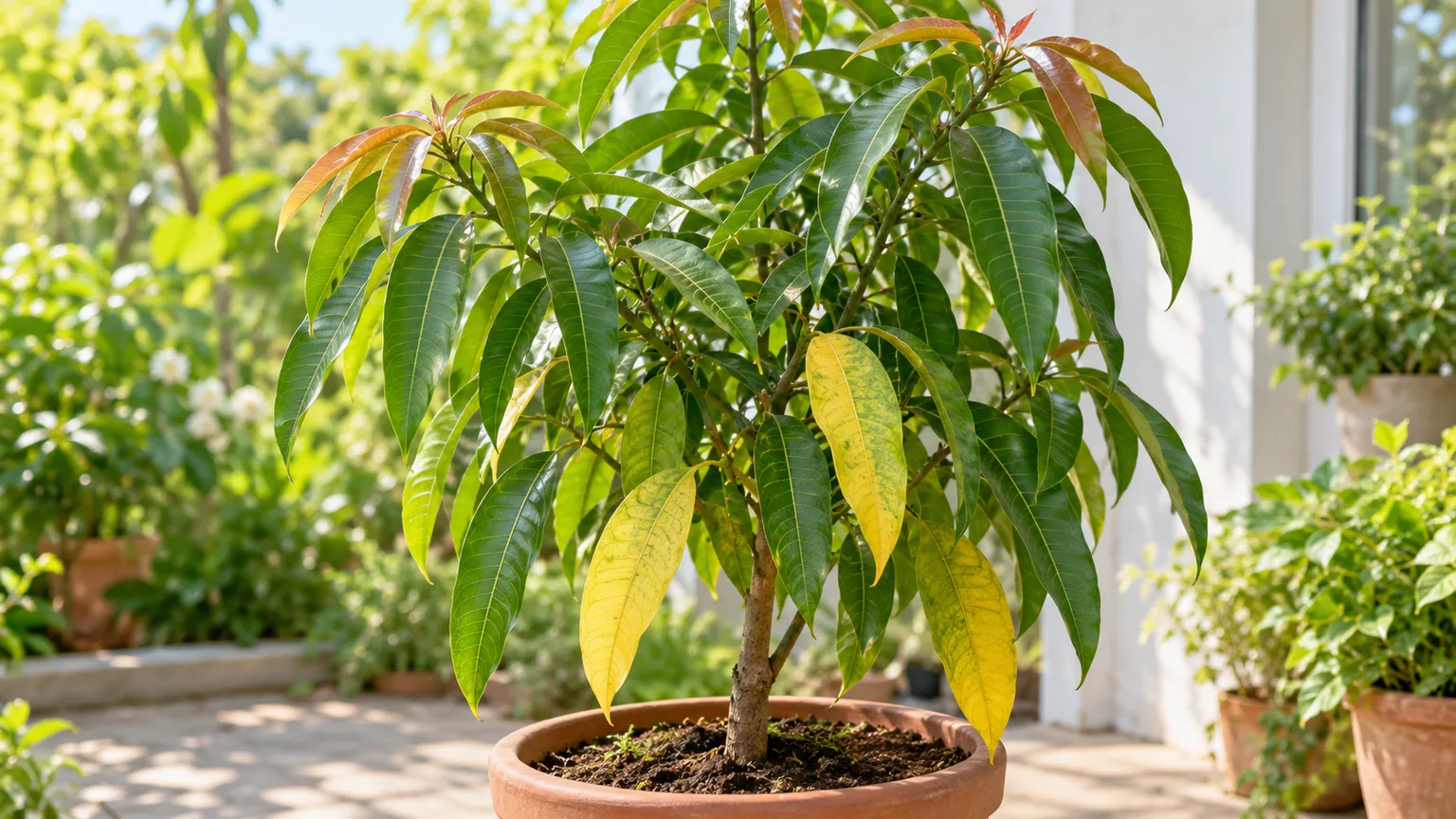
Mango is an evergreen fruit tree, not a deciduous houseplant, so it holds foliage year-round and replaces leaves in waves. New flushes often emerge bronze, coppery-red, or pinkish before hardening to deep green — that color is normal growth, not sickness. True yellowing is different: older interior or lower leaves fade to pale green, then uniform yellow, then drop, while the canopy thins from the inside out.
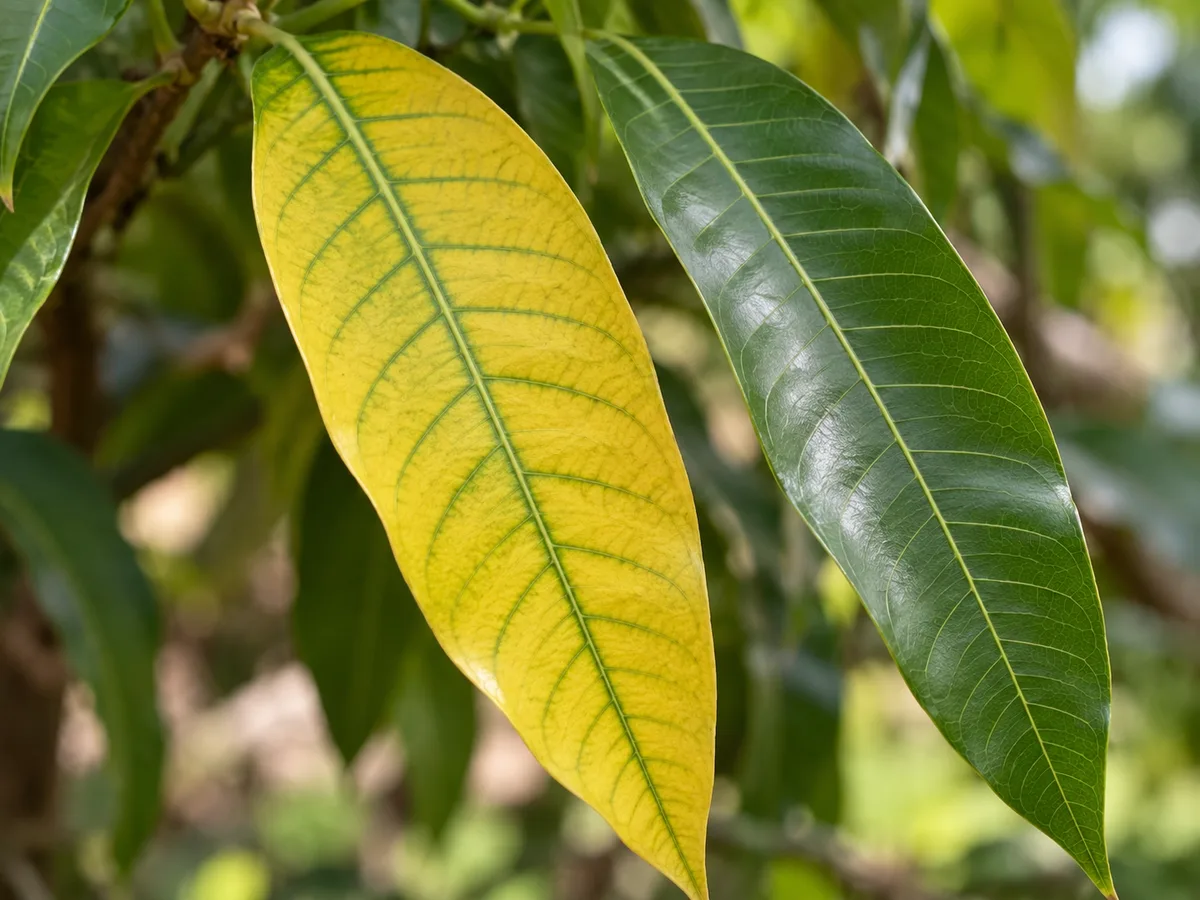
Yellowing Mango foliage with green veins points toward iron lockout; uniform pale older leaves point toward water or nitrogen issues.
Watch where the yellow sits. Uniform yellowing of the oldest leaves with a wet, heavy pot points at water. Yellowing between still-green veins on young leaves points at iron or manganese lockout in high-pH soil. Yellow spots or blotches with dark centers that spread after rain point at fungal leaf disease rather than nutrition. Sudden yellowing across the whole canopy right after a cold night points at chill injury on a species that does not harden off.
Why Mango leaves turn yellow
Wet roots and poor drainage
Container Mango is usually overwatered before it is underwatered. Mango tolerates brief flooding but will not perform well in poorly drained soils, and a gritty mix that stays soggy suffocates the fine roots that feed each flush. The classic picture is pale older leaves on a pot that never lightens between waterings, sometimes with stalled flushes or early leaf drop. Landscape trees planted in low spots that pond after summer rain fail the same way — UF/IFAS recommends a 2–3 ft mound of native soil where flooding is likely.
Cold the tree cannot acclimate to
Mango does not appear to acclimate to cold, and no variety tested in Florida showed meaningful extra hardiness, per UF/IFAS Extension. A single chilly night in the low 40s °F (single digits °C) can yellow tender new flushes on a young tree that looked perfect the week before. Potted trees on exposed terraces and trees moved outdoors too early in spring are the usual victims. Cold-yellowing hits new growth first — the opposite of the old-leaf pattern of water and nutrient problems.
Nutrient gaps, especially iron in alkaline soil
Hungry Mango pales from the bottom up when nitrogen runs short after heavy flushing or fruiting, since young trees in containers leach nutrients fast. The more Mango-specific trap is lime-induced chlorosis: in calcareous or high-pH soil, iron, zinc, and manganese are present but unavailable, so young leaves yellow between green veins. UF/IFAS advises annual foliar sprays of copper, zinc, manganese, and boron on calcareous soils, with iron applied in chelated form as a soil drench — and warns boron turns toxic quickly, so label rates matter. Bearing trees need the opposite caution: cut nitrogen back and emphasize potash, because pushing leafy growth with nitrogen at the wrong time weakens the tree.
Normal evergreen turnover after a flush
A healthy Mango sheds its oldest interior leaves as each new flush hardens. One or two fully yellow leaves deep in the canopy, dropping while shoot tips push firm bronze-red growth, is housekeeping — not disease. Worry only when yellowing outpaces flushing: several leaves yellowing at once, new flushes emerging pale or undersized, or bare interior branches with tufted tips.
Sap-sucking pests and fungal leaf spots
Scale, mealybugs, and mites cluster on Mango flushes and leaf undersides, draining sap until leaves yellow, sticky honeydew coats blades, and black sooty mold follows. Always inspect nursery trees for insect pests and diseases before planting, since a pest load arrives with the pot. Fungal pressure looks different: dark lesions on leaves and fruit signal anthracnose, often with yellowing halos, spreading fastest in wet weather on susceptible cultivars. White powdery coating on young leaves and shoots is powdery mildew, which distorts and yellows flushes if left unchecked.
How to confirm the cause
Work this order — root zone, weather, light, then nutrition and pests:
- Probe and lift. Push a finger 3–5 cm into the mix and lift the pot. Damp at depth plus a heavy pot days after watering means excess water, even if the surface looks dry.
- Check the drain path. Water the pot and watch: flow should exit within seconds. Standing water in a saucer or cachepot, or a pot sitting in a flooded bed, confirms the drainage diagnosis.
- Replay the weather. Any night below about 50 °F (10 °C) in the past two weeks, a cold wind on a terrace, or a sudden move outdoors? New-flush yellowing after cold is chill injury.
- Read the light. Mango must be planted in full sun for best growth — at least 6–8 hours of direct sun. A tree dragged into shade yellows while its pot stays wet longer, compounding the problem. See the Mango light guide for placement checks.
- Read the vein pattern. Green veins with yellow tissue between them on young leaves is textbook iron chlorosis; uniform pale older leaves suggest nitrogen or chronic wetness instead.
- Flip leaves and check spots. Sticky residue, bumps along midribs, fine webbing, or dark spots with yellow halos separate pest and disease cases — and regular monitoring for dark lesions or white powdery growth catches fungal problems while still treatable.
The first fix to try
If the 3–5 cm probe comes up damp: stop watering and restore drainage today — empty the saucer, clear blocked holes, pull soggy mulch back from the trunk, and move the pot where air circulates. Do not fertilize, repot, or spray on the same day. Then wait until the top 3–5 cm dries before the next deep watering, following the Mango watering guide. If the probe comes up dry and leaves are limp with brown margins, give one thorough soak until water runs freely instead — then resume the same dry-down rhythm.
Step-by-step recovery
- Stabilize the root zone. Correct the confirmed extreme — wet or dry — and keep the tree in full sun with free airflow. Most mild cases stop spreading here.
- Drop the spent leaves. Let fully yellow leaves fall on their own or snip them at the petiole; they will not re-green and they cost the tree nothing once detached.
- Feed only on confirmation. If older leaves are uniformly pale and drainage is already correct, apply a balanced mango fertilizer at label rate during warm active growth. If young leaves show green-vein chlorosis on alkaline soil, use chelated iron as a soil drench — not extra nitrogen. Details live in the Mango fertilizer guide.
- Treat pests and spots separately. Wipe or prune isolated scale and mealybugs; for spreading dark lesions or powdery coating, improve air circulation, avoid overhead irrigation that wets foliage, and escalate to the disease-specific steps in root rot on Mango if roots are involved.
- Shelter from the next cold night. Move container trees under cover or wrap young trees when frost or near-freezing nights threaten; landscape position is permanent, so choose the warmest frost-free pocket at planting time.
Recovery timeline
Mango recovers on flush time, not leaf time. Yellowed leaves never re-green — judge progress by what emerges next. With watering corrected, spread usually halts within one to two weeks and the next flush pushes out in normal bronze-to-green color within three to six weeks of warm weather. Iron correction is slower: new leaves green up over four to eight weeks while old chlorotic leaves stay pale. Cold-damaged tips may die back to firm wood; prune to live tissue only after new buds show where the living wood starts.
Yellow leaves lookalikes on Mango
| What you see | More likely | Go here |
|---|---|---|
| Pale older leaves, heavy wet pot, sour mix | Overwatering | Full dry-down ladder and saucer routine |
| Black soft roots, dieback, collapse | Root rot | Unpot inspection and trim protocol |
| Limp leaves, dry mix, brown margins, aborted flushes | Underwatering | Deep-soak recovery steps |
| Whole canopy wilts while mix is moist | Wilting | Wilt triage: roots vs heat vs cold |
| Drooping foliage after a move or repot | Drooping leaves | Transplant and placement settling |
| Yellowing plus no new growth for months | Slow growth | Light, pot size, and feeding audit |
| Pale stretched flushes in shade | Not enough light | Sun-hour checks and acclimation |
| Sticky leaves, bumps, cottony clusters | Scale, mealybugs, or aphids | Pest ID and removal steps |
| Fine stippling plus webbing in dry heat | Spider mites | Mite confirmation and rinse protocol |
When to use this page vs other Mango guides
Use this page when yellow color is the main symptom and you need to sort water, cold, nutrition, and normal turnover. Move to overwatering on Mango when the pot stays heavy and wet — it carries the full dry-down routine. Move to root rot on Mango when stems soften or roots smell. For routine rhythms rather than triage, the Mango overview, watering, soil, and fertilizer guides set the baseline this page assumes.
Mistakes to avoid
- Feeding a stressed tree. Fertilizer on wet roots or cold-damaged flushes burns fine roots and deepens yellowing. Fix water, drainage, and shelter first; feed only during warm growth on a confirmed nutrition gap.
- Repotting on diagnosis day. Unpotting a yellowed Mango before checking drainage destroys the evidence and adds shock. Only unpot when rot signs — soft stems, sour smell — demand it.
- Treating bronze flushes as sickness. New Mango flushes are supposed to emerge reddish-bronze. Spraying or feeding a flushing tree for “discoloration” wastes product and risks burn.
- Chasing pH with kitchen chemistry. Vinegar drenches and unmeasured sulfur swings damage roots. If chlorosis is confirmed on alkaline soil, use labeled chelated-iron products and keep boron at trace rates.
- Overhead watering in humid weather. Wet foliage invites the anthracnose and mildew that yellow young leaves. Water the base with drip or a hose, and mulch to cut soil splash.
Mango care cross-check
Cross-check the three Mango non-negotiables before blaming the variety: sun (6–8+ hours direct, per the light guide), drainage (gritty free-draining mix that dries 3–5 cm down between drinks, per the soil guide), and warmth (sustained tropical warmth, frost protection for young trees). Container growers add a fourth: pot size matched to the root ball with annual size control, since an oversized pot stays wet long after the surface dries — review timing in the Mango repotting guide. Prune for shape soon after harvest, never by shearing flowering tips mid-season (see the pruning guide), and handle sap and peel with gloves — Mango shares contact allergens with its Anacardiaceae relatives.
How to prevent it next time
Match water to how fast the pot actually dries in full sun — check containers every few days in heat, weekly in cool spells, and irrigate landscape trees only through prolonged drought. Top-dress mulch without piling it against the trunk, keep sprinklers off the foliage, and give each flush room in open airflow. Feed young trees lightly every two to three months in the first year, then two to three times yearly, shifting bearing trees toward potash and micronutrients rather than nitrogen. New to fruit trees? The Mango propagation guide notes why grafted cultivars establish more predictably than seedlings — a clean start prevents inherited pest and vigor problems that show up as yellowing later.
When to worry
Inspect roots the same day if yellowing races through new flushes, shoot tips blacken, bark softens, or several leaves fail at once on sour-smelling mix — follow root rot on Mango and wilting on Mango before any other step. Call a local extension clinic if dark sunken lesions spread across leaves and fruit despite airflow and dry foliage, or if a young tree defoliates after a freeze with no budding within a month of warm weather.
Related Mango guides
- Mango overview — species baseline, sun and warmth needs, container size reality
- Mango problems hub — all diagnosed Mango issues in one place
- Mango watering — 3–5 cm dry-down rhythm and seasonal intervals
- Mango soil — gritty free-draining container blend and mound planting
- Mango light — full-sun placement and indoor acclimation limits
- Mango fertilizer — young-tree schedule, potash shift, micronutrient sprays
- Overwatering on Mango — wet-pot diagnosis and dry-down ladder
- Root rot on Mango — root inspection and salvage protocol
- Underwatering on Mango — dry wilt vs rot confusion
- Yellow leaves diagnosis tool — narrow causes before changing variables
Yellow leaves on Mango almost always trace to a wet root zone, a cold night the tree could not harden to, or iron locked out by alkaline soil — with normal flush turnover mistaken for sickness in between. Confirm with the probe-lift-drain check, apply one matched fix, and judge recovery by the color of the next flush. When wet soil and sour mix align, move to the overwatering and root rot guides before touching fertilizer.
How we wrote and verified this guide: Recommendations were checked against UF/IFAS Extension mango production guidance, UF/IFAS disease-management publications, and Gardening Know How chlorosis references cited inline. Author: sai-ananth. Reviewer: LeafyPixels Review Board. Methodology: plant problem guidance is reviewed against botanical references, extension resources, and LeafyPixels plant-care data before publication. Last reviewed: 2026-09-05.