Root Rot on Mango: Causes, Checks & Fixes
Quick answer
Root rot on mango usually means the taproot and feeder roots are suffocating in saturated mix: leaves wilt or yellow while the soil stays wet. First step: stop watering, drain the pot fully, and check roots before you prune or fertilize.
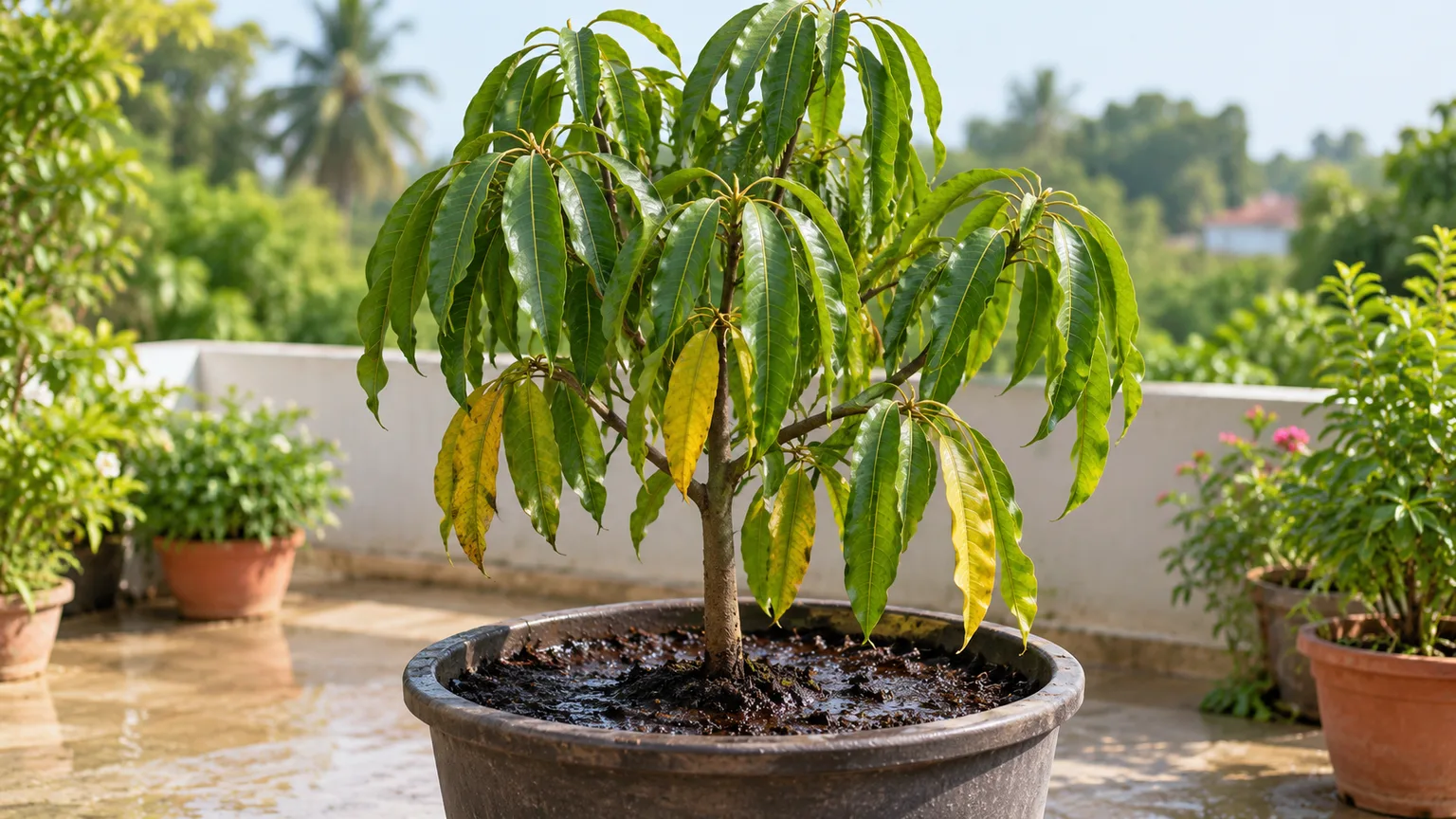
Root Rot on Mango: Causes, Checks & Fixes
This guide covers root rot on Mango. See also the general Root Rot guide, watering, and light pages for this plant.
Root Rot on Mango: Causes, Checks & Fixes
Quick answer
A mango with root rot looks thirsty while standing in wet soil: new flushes stall, leaves turn dull then yellow, and the canopy wilts even days after watering. The cause is almost always too little air around the roots — a dense mix, blocked drainage, an oversized pot, monsoon pooling, or watering before the upper mix dries.
First step: stop watering and restore air. Empty the saucer, clear drainage holes, move the pot out of rain, and let excess water leave. Then check one edge of the root ball before you cut, repot, fertilize, or spray anything. For how wet-soil damage works in general, see our root rot guide; on mango, the pattern usually shows up first as wet-soil wilt on a young graft or terrace pot, followed by stalled flushes and a sour root ball.
What root rot looks like on mango
Mango is a vigorous full-sun tree (Mangifera indica), so early root trouble hides behind a big canopy. Watch for this sequence rather than one yellow leaf:
- Canopy wilts or looks limp in the morning despite wet mix — damaged roots cannot supply water even though water is present
- New flushes emerge small, pale, or abort; older leaves yellow and drop while the soil is still heavy
- Growth stalls in warm weather when a mango should be pushing strongly
- Pot stays heavy for many days; surface may grow algae or attract fungus gnats
- In advanced cases the trunk base darkens, softens, or oozes near the soil line, and branches die back from the tips
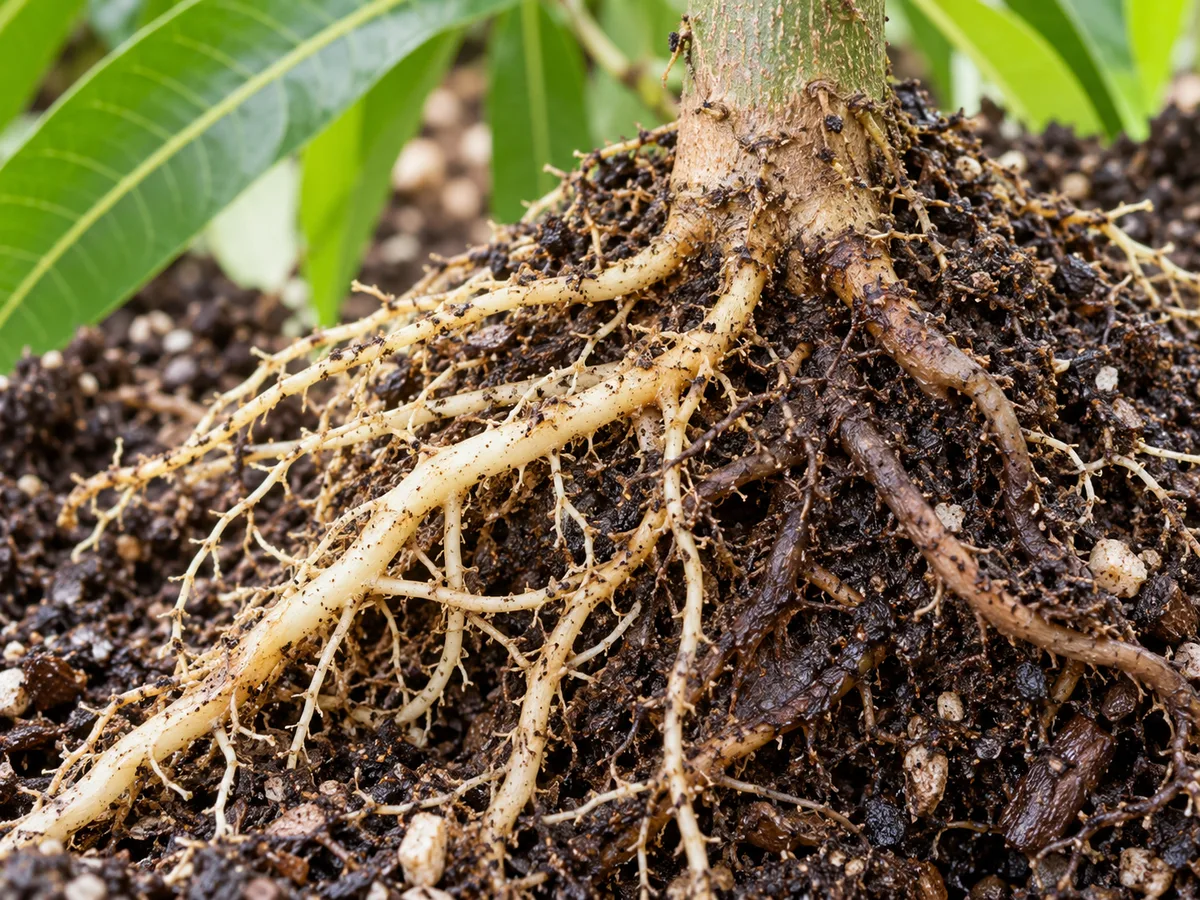
Macro detail: pale firm mango feeder roots compared with brown, soft, sour-smelling rotted sections in saturated mix.
Roots tell the truth. Healthy mango feeder roots are pale and firm; rotting roots are soft and brown to mushy black, often with a sour or swampy smell. If you only see yellowing without checking the root zone, you will confuse rot with underwatering, overwatering, or heat stress.
Why mango gets root rot
Mango tolerates many mineral soils but not standing water. UF/IFAS notes that mango trees are moderately tolerant of occasional flooding yet will not perform well in poorly drained soils. Three mango-specific setups create that airless zone:
1. Terrace pots that trap monsoon water
A grafted mango in a large tub has no deep soil to escape into. One blocked hole, a saucer left full after rain, or a pot sitting flat on tile keeps the bottom third saturated while the top looks merely damp. Decorative stones on the surface hide the problem longer. This is why terrace mangoes rot most often in July–September, not in summer.
2. Dense or oversized mix around a taproot system
Mango builds a strong taproot with spreading feeders. Fine garden soil, unfinished compost, or pure cocopeat collapses into a mass where the larger pores that normally refill with air disappear. An oversized pot makes it worse: a small root system cannot drink a large volume of mix, so the unused zone stays wet for a week. See the Mango soil guide for the open 50/25/25 blend.
3. Planting depth and site pooling in the ground
Trees planted too deep, with soil or mulch piled against the trunk, keep the crown constantly damp. Low garden spots, roof runoff aimed at the trunk, and black-cotton or compacted clay that holds monsoon water all saturate the feeder zone. UF/IFAS recommends planting on a broad mound where flooding is possible — flat planting in a flood pocket is the in-ground equivalent of a pot without holes.
Overwatering starts the cycle, but the pathogen finishes it. Phytophthora and related water molds prefer warm, wet conditions where moisture remains high and spread fastest when soil stays saturated. That is why a mango watered daily “a little bit” in humid weather rots faster than one soaked thoroughly then allowed to drain.
How to confirm the cause
Do these checks in order, before cutting roots:
- Pot weight and skewer test — Lift the pot and push a wooden skewer deep near the edge. If the pot is heavy and the skewer comes out dark and damp days after watering, the lower root ball is saturated. Compare with the Mango watering guide 3–5 cm rule: a dry surface over a wet core still means do not water.
- Drainage audit — Pour a little water and watch the outlets. No prompt flow means blocked holes, roots matting over the outlet, or a saucer sealing the base. Check for roof runoff entering the pot and standing water in the planting basin outside.
- Smell and edge-root check — Ease one side of the root ball up. Earthy smell with pale firm roots points to simple overwatering caught early. Sour or rotten smell with brown mushy roots points to active decay.
- Trunk base and graft union — The graft union must stay above the soil and mulch. Dark, soft, or oozing bark at the soil line, or a trunk that feels spongy, signals crown involvement and higher urgency. UC IPM describes darkened areas in bark around the crown and upper roots, sometimes with gumming, as typical of Phytophthora damage.
- Canopy-versus-soil mismatch — The classic confirmation is wilt in a well-watered plant that does not recover after irrigation. If leaves stay limp in the morning while the mix is wet, roots — not the hose — are the problem. Rule out wilting from heat alone by checking morning turgor.
If roots are pale and firm with no smell, treat it as overwatering and dry the pot without surgery. If roots are brown and soft with a sour smell, continue to the rescue below.
First fix for mango
Drain the root zone and keep it drained — today.
Empty the saucer, clear every outlet, lift the pot onto feet, and move it out of rain while keeping the canopy in full sun and airflow. Do not fertilize, do not spray fungicide on leaves, and do not repot in the same hour. One correction first lets you read whether the canopy firms up overnight.
This matters because mango leaves cannot be used as a watering meter once roots are damaged. Adding more water to a wilted-but-wet mango only deepens oxygen loss. Avoiding prolonged saturation around the base is the single most important rot control, ahead of any product.
Step-by-step recovery
Mild case: wet and heavy, but roots still pale
- Stop all watering until a skewer to the bottom reads dry and the pot feels clearly lighter.
- Shelter the pot from further rain but keep the canopy in bright sun and moving air.
- Remove fallen leaves and surface debris so the top can breathe.
- Resume deep, infrequent watering per the Mango watering guide: soak fully, then allow the surface to dry before watering again.
Moderate case: some brown soft roots, sour smell, stalled flushes
- Slide the tree out of the pot in warm, dry weather. Shake and rinse only enough mix to see root color.
- Trim only clearly mushy, dark roots with clean scissors. Keep every firm pale root — mango needs them to re-establish. Epic Gardening notes that smaller plants can sometimes be salvaged by trimming away damaged roots and repotting into fresh media with excellent drainage.
- Air-dry the trimmed root ball in shade for 30–60 minutes; do not leave it in harsh sun.
- Repot into fresh open mix from the Mango soil guide in a pot only one size up from the remaining healthy roots. Keep the root flare and graft union above the finished surface.
- Water once lightly to settle, drain fully, then wait for the proper dry-down before watering again. Follow pot-size and root-handling timing in the Mango repotting guide.
Severe case: soft trunk base, oozing crown, collapsing canopy
When the trunk base is soft, bark slips easily, or major limbs wilt together on a wet root ball, feeder-root trimming rarely saves a young graft. For in-ground trees with crown gumming and dieback, get a local plant-disease diagnosis before applying fungicides — soil-applied products have label, rate, and resistance limits and are not a home remedy to guess at. Protect neighboring trees by correcting drainage and avoiding movement of contaminated soil and water.
Mistakes to avoid
- Watering a wilted mango without checking soil — wet-soil wilt needs drainage, not more water.
- Heavy fertilizer on damaged roots — salts stress injured feeders; feed only after new flushes prove recovery, per the Mango fertilizer guide.
- Repotting into a much bigger pot “for room” — extra unused mix stays wet and restarts rot.
- Burying the graft union or mounding wet soil against the trunk — keeps the crown damp and invites decay.
- Sealing the surface with plastic after rain — traps moisture and slows gas exchange.
- Stacking root surgery, hard pruning, and full sun shock on the same day — a trimmed mango needs stable warmth and bright but not scorching recovery conditions. Size control comes later via the Mango pruning guide.
Recovery timeline
Mango does not repair mushy roots or yellowed leaves back to perfect — it replaces them. Judge by new growth and pot behavior:
- Week 1–2: Pot begins drying on a normal rhythm; no new wilting; sour smell fades. Old yellow leaves may still drop — that alone is not failure.
- Week 3–6: A new flush emerges firm and green in warm weather; skewer tests show the profile wetting then drying. Stalled buds breaking is the best early sign.
- Beyond 6 weeks: Flushes expand normally and hold color; watering intervals stabilize. If flushes keep aborting, the pot stays heavy, or trunk-base softness spreads, reassess drainage, mix, and disease diagnosis.
Young container grafts in hot growth can rebound in one warm month when firm roots remain. Trees with crown softness or repeated monsoon saturation take a full season or may not be saveable — honest triage beats another round of repotting.
How to prevent it next time
Build the root zone so monsoon rain can pass through:
- Use the open container blend and confirm every outlet flows before planting; raise tubs on broad feet so holes never seal against tile.
- Water by test, not calendar: soak the whole ball, empty the tray, then wait until the top 3–5 cm dries and the pot lightens.
- Keep the graft union and root flare above soil and mulch; keep mulch several centimetres off the trunk.
- In the ground, grade water away from the trunk or use a broad mound in flood-prone sites; divert roof runoff.
- Pause timer irrigation during dependable monsoon rain; check pots under eaves and wall shadows separately.
- Feed and prune only a draining, actively growing tree — see the Mango overview for placement and size reality before blaming water alone.
When to use this page vs other mango guides
- Overwatering — use when the mix is chronically wet but roots are still pale and the trunk base is hard; the fix is dry-down rhythm without surgery.
- Wilting — use when leaves droop but you have not yet matched it to wet versus dry soil; this page takes over once wet-soil wilt plus sour roots confirm rot.
- Mold on soil — use for surface fuzz and gnats on damp mix; come here when probing finds mushy roots underneath.
- Yellow leaves — use for nutrient, light, and natural aging yellowing; come here when yellowing pairs with heavy pots and stalled flushes.
- Watering, soil, repotting — use after rescue for long-term moisture, mix, and pot sizing.
FAQs
How do I know my mango has root rot and not just overwatering?
Overwatering is the saturated condition; root rot is the tissue damage that follows it. Probe one edge: pale firm roots with an earthy smell mean overwatering caught early — dry the pot per the watering guide. Brown soft roots with a sour smell, plus wilt that persists while wet, mean rot is underway and needs trim-and-repot steps above.
Should I unpot a mango at the first sign of wilt?
No — check drainage, pot weight, and morning turgor first. Unpot only when the mix stays wet for days, growth stalls, or you smell sour decay. Unnecessary unpotting injures the taproot and feeders a young graft cannot spare.
Will yellow mango leaves turn green again after treatment?
No — damaged leaves rarely regain full color. Success looks like the spread stopping and the next flush emerging firm and green. Leave functioning leaves in place to fuel recovery and remove only fully dead tissue.
Do I need fungicide for mango root rot?
Most home rescues succeed through drainage, airy mix, and careful watering rather than chemicals. Soil fungicides have strict labels and do not fix a sealed pot or flood pocket. If crown gumming and dieback persist despite drainage, seek local extension or clinic diagnosis before buying any product.
Why did my potted mango rot during monsoon even though I stopped watering?
Rain alone saturates a poorly draining tub: blocked holes, a full saucer, roof runoff, and dense mix keep the core wet for days. Shelter the pot from additional rain, raise it on feet, clear outlets, and confirm the whole profile dries between storms — stopping the hose is not enough when the sky keeps watering.
Related mango guides
- Mango care overview — full-sun placement, tree size, and the complete care framework.
- Mango watering — root-zone checks and seasonal irrigation.
- Mango soil — open mix, drainage design, and pH range.
- Mango repotting — pot sizing and safe root work timing.
- Mango fertilizer — feeding only after drainage and roots recover.
- Mango light — sun levels that drive healthy water use.
- Overwatering on mango — early wet-soil stage before tissue rots.
- Wilting on mango — sorting wet-soil wilt from dry-soil wilt.
- Mold on soil on mango — surface moisture warning signs.
- All mango problems
Related tool
Use the Root Rot Risk Checker with mango pre-selected to narrow causes for root rot on this plant before changing multiple variables at once.