Brown Tips on Mango: Tipburn Causes, Checks & Fixes
Quick answer
Brown tips on mango are usually tipburn, a physiological response to salt accumulation or sporadic watering rather than infection. First step: check for white crust on the soil, confirm the pot drains freely, then leach once with plain low-salt water and stabilize the watering rhythm before feeding or repotting.
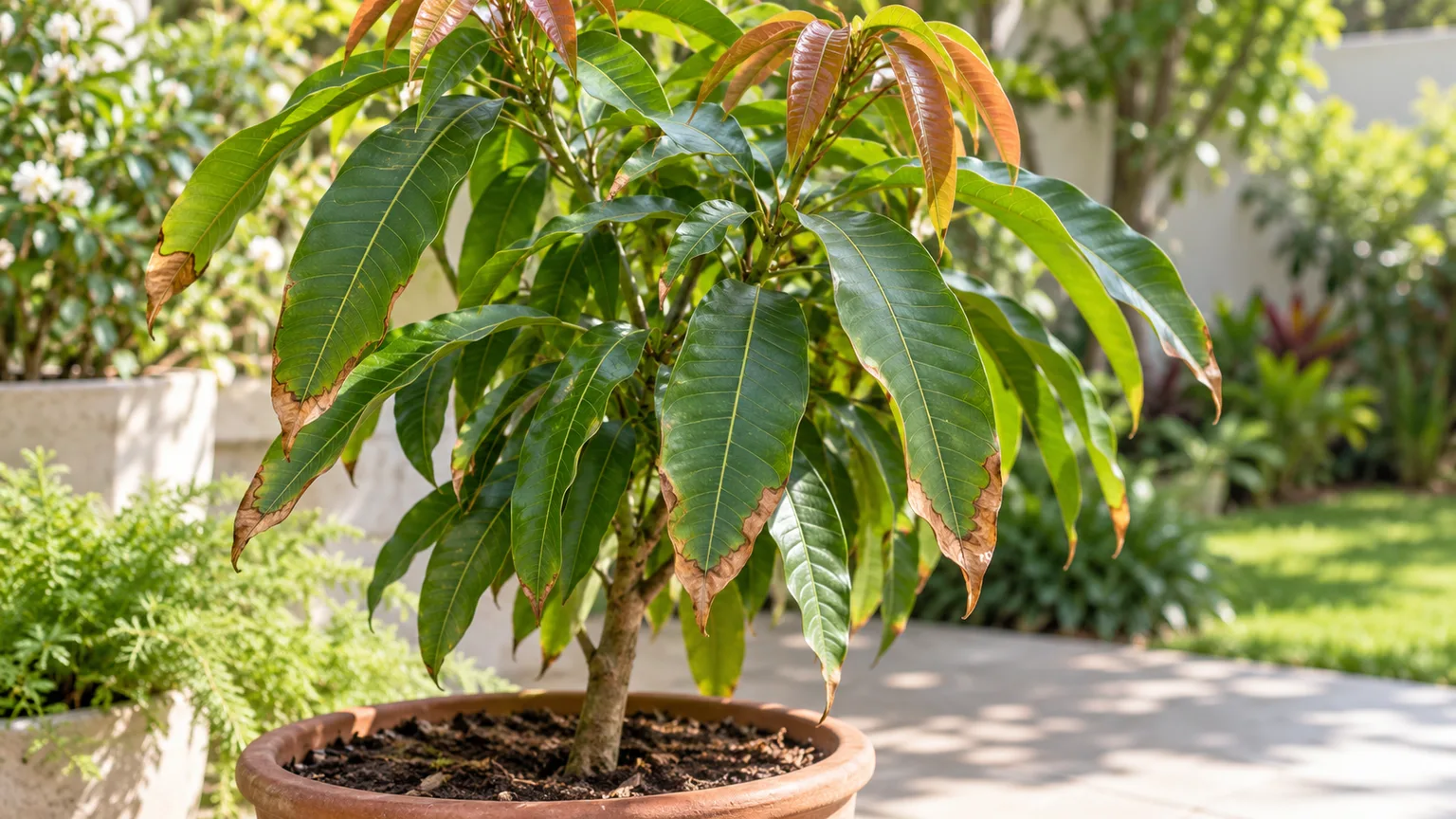
Brown Tips on Mango: Causes, Checks & Fixes
This guide covers brown tips on Mango. See also the general Brown Tips guide, watering, and light pages for this plant.
Brown Tips on Mango: Causes, Checks & Fixes
Quick answer
Brown tips on mango (Mangifera indica, Mango overview) are almost always tipburn, a physiological condition rather than an infection. The primary symptom is necrotic sections around the leaf edges, starting at the drip tip of mango’s long lance-shaped leaves and creeping along the margins. For how tip burn works on houseplants in general, see our brown tips guide. On mango, the two leading triggers are salt accumulated in the root zone and sporadic, feast-or-famine watering — often both at once.
First step: look for white crust on the soil surface or pot rim and confirm the pot drains freely. Crust plus recent feeding or hard irrigation water points to salts — leach once with plain low-salt water and steady the watering rhythm. No crust plus a light pot and dry mix several centimeters down points to drought fluctuation — soak deeply, drain fully, and keep the schedule consistent. Do not feed, repot, or prune until you know which pattern matched.
What brown tips look like on mango
Healthy mango holds stiff, glossy, lance-shaped evergreen leaves on a sun-loving framework, with new flushes often emerging copper-red before hardening green. Tipburn breaks that pattern in a recognizable sequence: the very tip of the leaf turns tan, then papery brown, and the necrosis advances along one or both margins while the midrib and leaf base stay green longest.
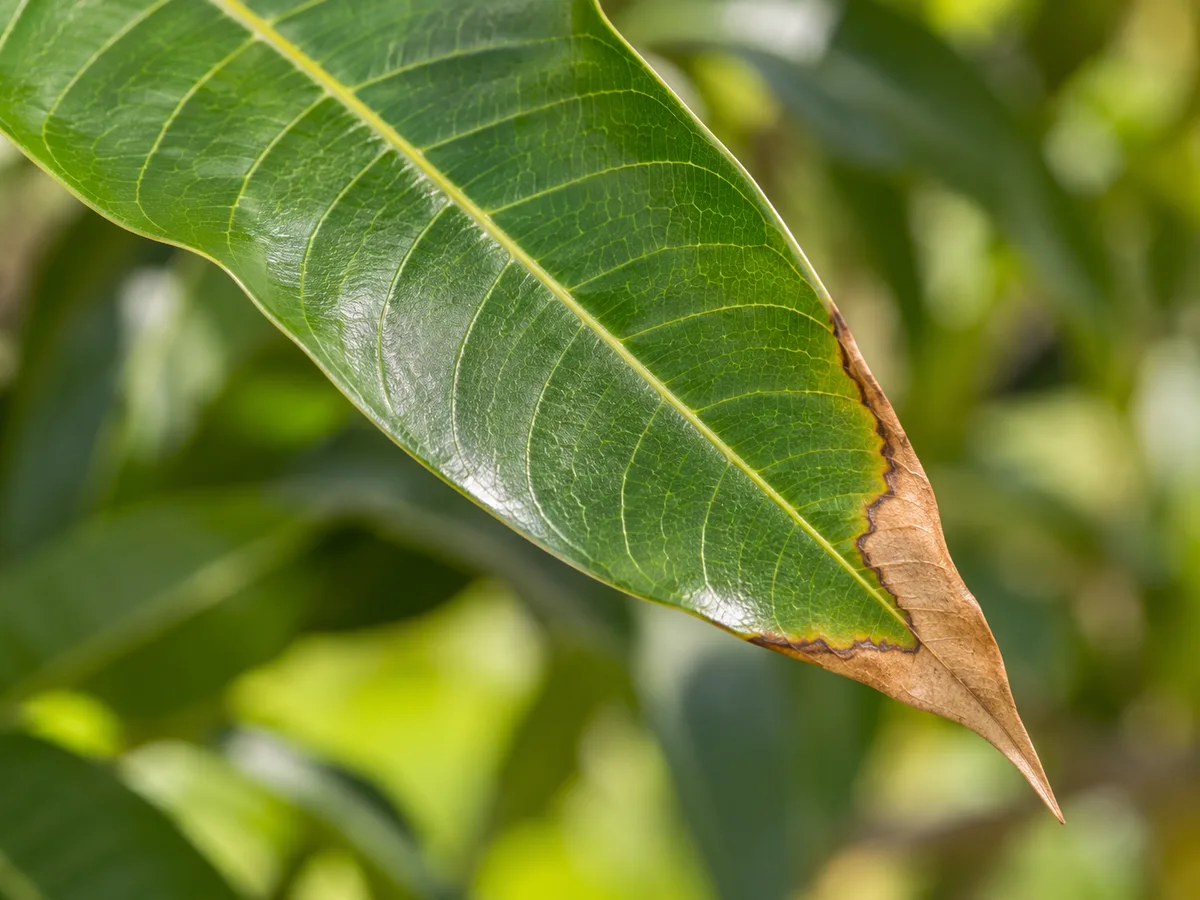
Tipburn on mango starts at the drip tip with dry tan-to-brown necrosis along the margins while the leaf base stays green.
Severity tells you how long the stress has run. Light tipburn affects scattered older leaves after a hot dry spell or a heavy feed. Advancing tipburn browns most leaves including the newest flush, which means salts or water stress are ongoing and each new flush is being damaged as it expands. Uniform browning across the whole blade, blackened soft patches, or spots with yellow halos are different problems — check the lookalike table before treating.
Container trees show tipburn earlier and harder than landscape trees. A small pot concentrates fertilizer salts and hard-water minerals with every watering, and it swings between soaked and bone-dry far faster than open ground. If your potted mango browns every summer despite regular watering, the pot’s salt load — not the watering frequency alone — is the prime suspect.
Why salt hits mango first
Commercial mango cultivars are genuinely salt-sensitive. Research on mango rootstocks notes that commercial mango cultivars are salinity sensitive, which is why salt-affected soils need tolerant rootstocks in orchards. Your tree has the same biology: when soluble salts — chiefly sodium and chloride from salt-based fertilizers or mineral-heavy irrigation water — exceed what the roots tolerate, water uptake stalls even though the soil feels moist. Salt damage hinders water uptake and nutrient absorption, so leaves wilt or scorch in a way that resembles drought stress while the real problem is osmotic.
Three salt pathways matter for home growers:
Fertilizer salts in containers. UF/IFAS recommends only 2 to 3 fertilizer applications per year once a mango is established, with nitrogen drastically reduced for bearing trees. Weekly liquid feeding, lawn fertilizer washing into the root zone, or dry granules scattered on a dry root ball all pile salts where feeder roots live. Mango in Miami-Dade limestone soils also gets routine micronutrient sprays — and boron is toxic to plants at moderate to high rates, so more is not better.
Saline or hard irrigation water. Repeated watering with mineral-heavy water leaves deposits that concentrate as water evaporates from the mix surface. In pots without generous drainage, every watering adds more salt than it removes.
Poor drainage trapping everything. Salt buildup is most likely when drainage is poor, because salts never wash below the root zone. A pot with one small hole, a saucer that is never emptied, or heavy moisture-retentive compost keeps the salt bath in permanent contact with the roots.
Erratic watering: the second half of tipburn
Even with clean water, mango leaves burn when irrigation swings wildly. Sporadic irrigation or extreme fluctuations in soil moisture is the classic cultural trigger: roots alternate between drowning and desiccation, feeder roots die, and leaf tips — the last stop on the water route — necrose first. Container mango in full sun can swing through this cycle within days in summer heat.
Landscape trees have the opposite risk. Established mango trees need irrigation only during prolonged drought, and chronic overwatering makes trees decline rather than thrive. The common suburban setup — a mango inside a lawn zone hit daily by sprinklers on a timer — keeps roots wet, and timer-driven lawn sprinklers can overwater mango into decline and root rot. Those trees brown from damaged roots, not from thirst, so adding more water deepens the injury. Young trees in their first three years do need steady weekly water during dry spells; mature trees need restraint.
Nutrient deficiencies that mimic tipburn
Two deficiencies deserve a direct check because their fix differs from leaching:
Magnesium deficiency produces marginal browning that overlaps tipburn, and it is explicitly listed as another possible cause of mango tipburn alongside water and salts. Suspect it when browning follows a long season of high-nitrogen, low-magnesium feeding, or when older leaves yellow between the veins before edges brown. UF/IFAS fertilizer mixes for young trees include 4 to 6 percent magnesium precisely because mango needs it.
Potassium shortage shows as browning and curling of leaf tips and margins, while general overfertilization with nitrogen aggravates fruit disorders and can push soft, salt-loaded growth. A soil test settles deficiency questions faster than guessing — testing is also the recommended first move for diagnosing salt load through soil and water testing.
Mango decline is the serious lookalike. IFAS describes decline leaf symptoms as interveinal chlorosis, stunting, and terminal and marginal necrosis with dead leaves retained on the tree, linked to manganese and iron deficiency predisposing shoots to fungal attack. Tipburn that comes with dieback of young stems, retained dead leaves, and stalled flushes is not cosmetic — it needs the worry-section response below, not a cosmetic trim.
How to confirm the cause (mango tipburn checklist)
Work through this order before changing anything:
- Read the flush. Damage only on older leaves after a dry or heavy-feed spell favors tipburn. Damage worst on the newest expanding flush points to ongoing salts or active root trouble.
- Check for crust. White or pale deposits on the mix surface, pot rim, or saucer mean salts regardless of when you last fed — hard water counts.
- Test drainage. Water slowly and watch: it should run freely from multiple holes within seconds. Ponding, seepage from one hole only, or a saucer you never empty means salts are trapped.
- Probe moisture at depth. Push a finger or skewer 5–8 cm into the mix (deeper for large pots). Surface dust means nothing; roots live deeper. Light pot plus deep dryness equals drought fluctuation; heavy pot plus persistent dampness equals root-zone excess.
- Audit the last month. Any lawn fertilizer near the root zone? Sprinklers hitting the tree daily? A move into stronger sun? A skipped-then-soaked watering pattern during heat?
- Look at the whole tree. Firm stems, normal flush rhythm, and green leaf bases mean cosmetic tipburn. Soft stems, sour mix smell, wilting despite wet soil, or retained dead leaves shift the diagnosis to overwatering or root rot — follow those guides instead.
Write down which pattern matched. Salt tipburn, drought fluctuation, and deficiency each need a different first fix.
First fix for mango
Match one action to what you confirmed:
- Salt crust with free drainage: Leach once with plain low-salt water at roughly two to three pot volumes, poured slowly so it percolates rather than channels. Heavy watering flushes salts out from the root zone, and regular leaching with low-salt water is the primary way to manage soil salinity. Empty the saucer, then resume normal watering only when the top layer dries.
- Salt signs with poor drainage: Do not flush a pot that cannot drain — repot into airy fast-draining mix first, using the mango soil blend as the baseline, with generous drainage holes. Flushing a sealed pot just redistributes salts.
- Drought fluctuation, no crust: Soak deeply until excess runs out, empty the saucer, and lock in a steady rhythm per the mango watering guide instead of alternating neglect and rescue soakings.
- Suspected magnesium deficiency: Correct only after salts are ruled out or leached, since adding minerals to a salty pot worsens burn. Then feed per label at a measured dose rather than guessing.
Make one correction first. Do not feed, repot, prune, and spray in the same week — stacked stresses hide which fix worked and can finish a weakened tree.
Step-by-step recovery by cause
After salt leaching
- Pause all fertilizer until the next flush emerges with clean margins.
- Water with the lowest-salt water available (rainwater or filtered if your tap is very hard) and always empty saucers.
- When growth resumes, feed at the seasonal mango fertilizer rate — a few measured applications a year, not weekly drenches.
- Keep lawn fertilizer and reclaimed softener water away from the root zone permanently.
After drought fluctuation
- Mulch landscape trees with 5–15 cm of bark or wood chips, kept 20–30 cm from the trunk, to even out soil moisture.
- Move container trees out of reflected-heat corners during heat waves and check weight every few days until you learn the dry-down rhythm.
- Trim fully brown tips for appearance if you wish, leaving a thin brown edge so you do not wound green tissue.
After suspected deficiency
- Get a soil test before supplementing — guessing between magnesium, potassium, and salts wastes a season.
- Apply only the missing nutrient at label rate on a healthy, well-watered tree, never on dry or stressed roots.
- Recheck the next flush; clean new margins confirm the call, spreading necrosis rejects it.
Recovery timeline — what success looks like
Dead brown tip tissue never turns green again, so judge everything by new growth, not old leaves. After a correct leach or watering correction, spread should stop within one to two watering cycles, and the next flush — usually within three to six weeks in warm active growth — should expand with clean green tips. Salt recovery can lag one flush behind the fix if the load was heavy; that is normal, not failure.
Success on mango specifically means firm stems, flushes that harden from copper-red to green without marginal necrosis, and no returning crust. If new flushes keep emerging with burned tips despite leaching, the salt source is still active — recheck irrigation water, drainage, and lawn-fertilizer drift rather than leaching harder.
Lookalike symptoms to rule out
| Pattern | Likely cause | Urgency | First step |
|---|---|---|---|
| Dry tips, white crust, recent feed or hard water | Salt tipburn (this page) | Medium | Leach once if drainage is good; stop feeding |
| Crispy tips, light pot, deep-dry mix, no crust | Underwatering | Medium | Deep soak; steady the rhythm |
| Brown tips plus yellow limp leaves in wet mix | Overwatering / root rot | High | Stop water; inspect roots |
| Uniform yellowing before browning, oldest leaves first | Yellow leaves / natural aging | Low | Check feeding and season |
| Pale stunted flushes, weak growth, no crust | Slow growth / underfeeding | Low | Review light and fertilizer |
| Thin dry air, crispy edges on indoor-proximate leaves | Low humidity / not enough light | Low | Correct placement, not flushing |
| Retained dead leaves, stem dieback, stalled flushes | Mango decline (Mn/Fe + pathogens) | High | Soil test; micronutrients; arborist |
Anthracnose and other leaf spots make circular or irregular lesions with distinct borders rather than uniform tip-first necrosis — fungicide-style treatment does nothing for tipburn, which is physiological.
What not to do
Do not feed a mango to “green up” browned tips. Fertilizer on salty or stressed roots deepens the burn, and excess nitrogen pushes the exact soft growth that tipburn punishes.
Do not flush a pot that drains poorly. Waterlogging rotting roots while trying to wash salts trades one injury for a worse one — fix drainage first.
Do not repot, hard-prune, and relocate the tree in the same week unless rot forces it. Mango answers one correction at a time; stacked interventions hide the signal.
Do not mistake every brown leaf for a watering problem. Handle sap, peel, and pruning debris with gloves and long sleeves — mango is in the cashew–poison-ivy family and its resinous sap can sensitize skin — and keep irrigation off foliage where fungal pressure is high.
Do not apply boron or micronutrient mixes above label rate. IFAS singles boron out because the gap between helpful and toxic is narrow.
How to prevent brown tips next time
Align care with how mango actually grows:
- Light: Full sun, at least 6–8 hours of direct sun, where leaves dry quickly after rain. Review placement with the mango light guide.
- Water: Deep, steady, seasonal — regular for young trees in dry spells, restrained for established trees. Never park a mango in a daily lawn-sprinkler zone.
- Soil: Deep, airy, freely draining mix in containers; open ground that never ponds. Refresh depleted mix at repotting per the repotting rhythm for mango.
- Feed: A few measured applications a year matched to tree size and bearing stage, with magnesium in the mix for young trees. Skip feeding dormant or stressed trees.
- Watch: Inspect flush tips and the soil surface monthly in the growing season. Crust or tip-flecking caught early needs one leach; caught late it costs a season of flushes.
Related Mango problems
Brown tips overlap with several sibling guides — use these when your checklist points past simple tipburn:
- Overwatering — wet mix, limp yellow leaves, sour soil; root damage browns margins from the inside out.
- Root rot — soft stems and declining flushes on persistently wet mix; leaching makes this worse.
- Underwatering — light pot, deep-dry mix, inward-curling leaves with no salt crust.
- Yellow leaves — widespread yellowing where deficiency or natural aging, not edge necrosis, leads the pattern.
- Mango overview — full-sun placement, mature size, and why mango is a poor permanent indoor plant.
When to worry
Escalate immediately if browning spreads from tips across entire leaves while dead leaves cling to the canopy, young stems die back, or flushes stall altogether — that combination fits mango decline or advancing root disease, not cosmetic tipburn. Get a soil test, correct iron, manganese, and zinc per results, and bring in local extension or an arborist if dieback continues.
Also act promptly when a container tree sits in a saucer of standing water with a foul smell, or when browning follows a heavy lawn-fertilizer application near the root zone. Cosmetic tipburn on firm stems with normal flush rhythm can wait for the next scheduled leach — no emergency repot required.
When to use this page vs other Mango guides
- Mango watering guide — use for routine moisture rhythm before assuming salts are the issue.
- Mango problems hub — browse all mango issues when the pattern does not fit tipburn.
- Underwatering on mango — different entry point when the pot is light and the mix is deep-dry with no crust.
- Overwatering on mango — different entry point when the mix stays wet and leaves go limp and yellow.
- Yellow leaves on mango — different entry point when whole-leaf yellowing leads and edge necrosis follows.