Low Humidity on Mango: Causes, Checks & Fixes
Quick answer
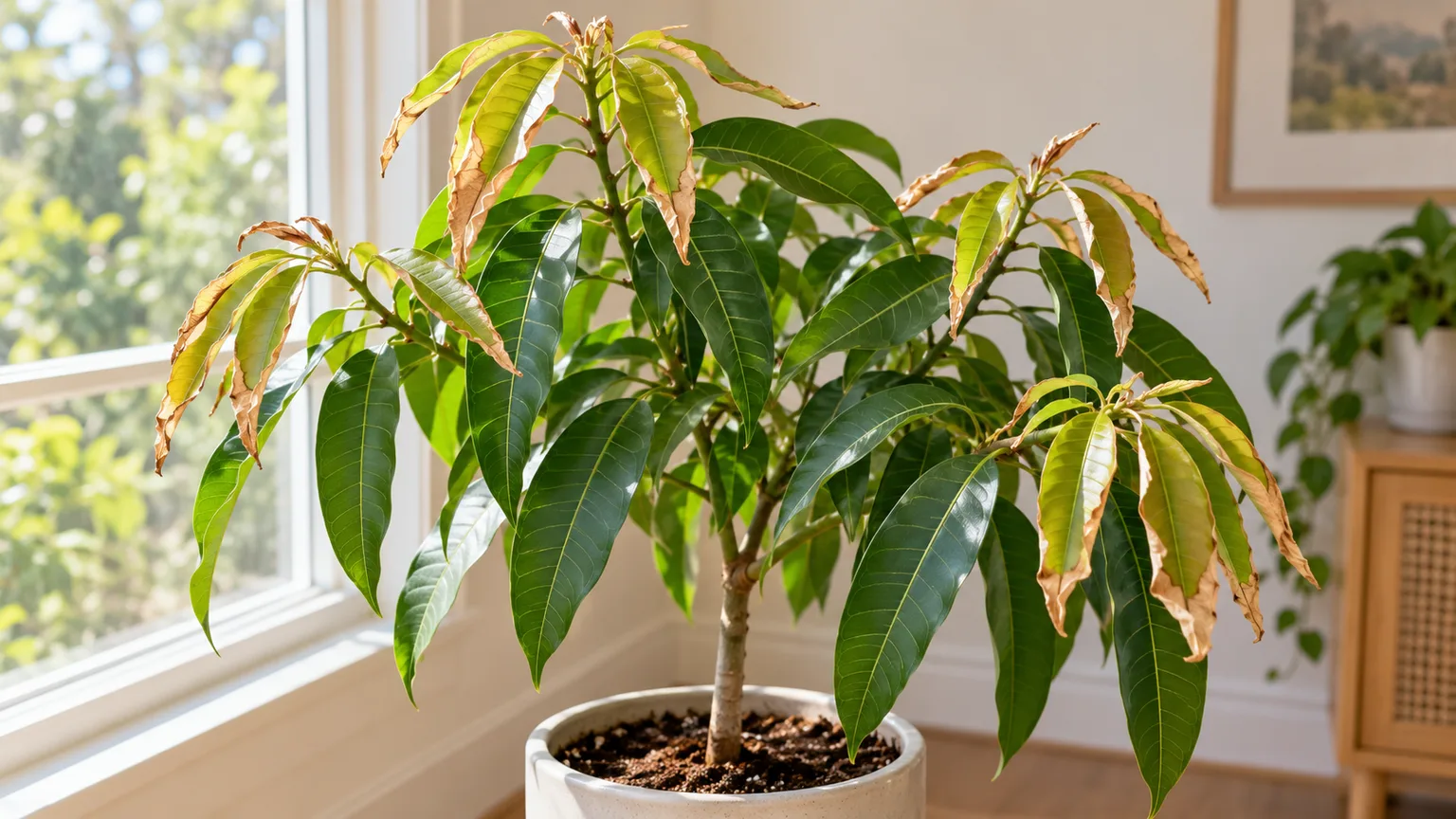
Dry heated air browns the edges of Mango's newest flush leaves even when the soil is fine. First, move the pot out of direct vent or radiator airflow and confirm the top 3-5 cm of mix is drying normally. Then raise ambient humidity with a humidifier or pebble tray without misting the leaves.
Low Humidity on Mango: Causes, Checks & Fixes
This guide covers low humidity on Mango. See also the general Low Humidity guide, watering, and light pages for this plant.
Low Humidity on Mango: Causes, Checks & Fixes
Quick answer
Mango evolved in the warm monsoon climates of the Indo-Burma region, so a potted tree spending winter in heated indoor air often shows the stress on its youngest leaves first: papery tan margins on the current flush while the older, leathery foliage still looks fine. For how dry air damages foliage in general, see our low-humidity guide. On Mango, the fastest read is the newest flush, not the whole canopy.
First, move the pot out of direct airflow from heating vents, radiators, fireplaces, and cold window glass, then confirm the top 3–5 cm of mix is drying on its normal rhythm. If the soil check passes and only new growth is crisping, raise the humidity around the plant with a humidifier, pebble tray, or grouping — without misting the leaves themselves.
What low humidity looks like on Mango
Dry air on Mango is a flush-first problem. The current growth flush — the soft, reddish-purple to pale-green young leaves at the branch tips — develops dry tan or brown edges and tips while the leaf centers stay green. As those leaves expand, the crisped margins never fill back in, so a stressed tree carries a visible record of each dry spell until those leaves eventually age out.
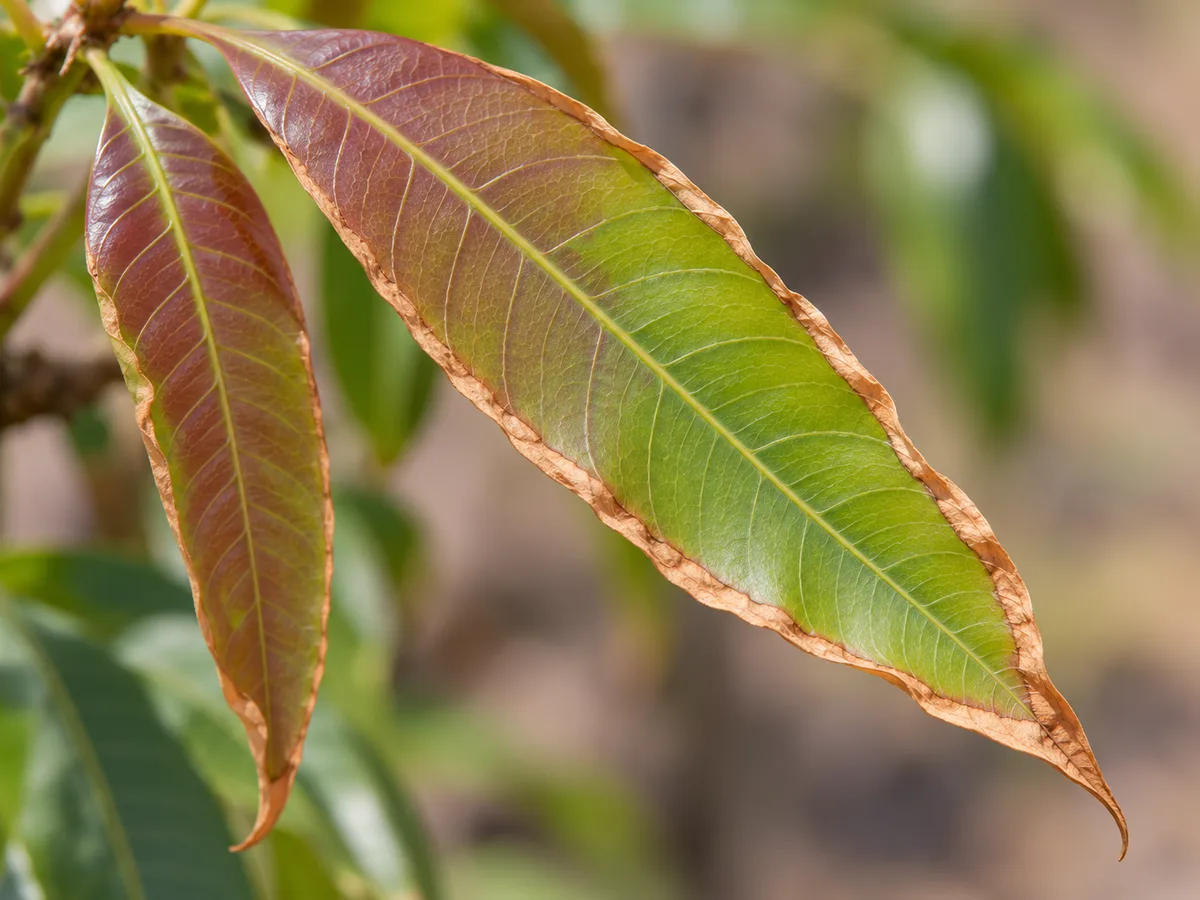
Close-up: papery tan margins on a young Mango flush leaf with the leaf center still green — classic dry-air damage, not a spreading leaf spot.
Older, fully hardened leaves resist dry air far better because Mango blades are thick and leathery, reaching 6 to 16 inches long at maturity, and healthy leaves can persist on the tree for years. So when the big lower leaves look fine but every new flush emerges with scorched edges, dry air plus winter indoor conditions is the leading suspect. A secondary clue is fine pale stippling on leaf undersides, sometimes with faint webbing where the leaf meets the stem — dry, warm air is exactly when indoor-plant spider mite pressure climbs.
Why a tropical tree still suffers in dry rooms
Mangoes grow best with humidity above 50% and sustained warmth, thriving outdoors in summer temperatures of 80–100°F. A container Mango on a sunny terrace in July rarely complains about the air. The trouble starts when that same tree must overwinter indoors: heated rooms in cold climates can drop well below the humidity a monsoon-climate evergreen expects, while the tree simultaneously gets far less than the full sun it needs for best growth.
That combination — dry air, warm room, weak winter light — hits the flush cycle hardest. Mango grows in waves, pushing soft new shoots that harden off over weeks. Soft expanding tissue loses water far faster than leathery mature blades, so each indoor flush can emerge pre-crisped at the margins even when you watered correctly. The low relative humidity of heated winter homes causes exactly this kind of tip and margin browning, and it gets worse when plants sit in drafts of hot or cold air.
Mango’s humidity dilemma: moister air, drier leaves
Here is the part that makes Mango different from a calathea or fern: you must raise ambient humidity without wetting the foliage. Mango’s two most important diseases both punish wet leaves. Anthracnose development is encouraged by rains or heavy dews, and UF/IFAS advises planting where flowers, leaves, and fruit dry off quickly and never aiming irrigation water at the foliage. Powdery mildew is most prevalent in warm, humid environments and spreads fastest where airflow is poor — and good sun plus air movement keeps canopy humidity lower and less conducive to disease development.
So the standard houseplant advice of “mist the leaves daily” backfires on Mango: it adds exactly the leaf wetness that invites black sunken anthracnose lesions. Use a room humidifier, a pebble tray under the pot, or group the Mango with other plants instead. Keep gentle air moving around the canopy and let the foliage stay dry while the surrounding air stays kinder.
How to confirm dry air is the cause
Work through these checks in order before changing anything:
- Soil rhythm first. Push a finger 3–5 cm into the mix and lift the pot. Mango wants a wet-dry watering cycle — saturated, then allowed to dry down — and mature trees need irrigation only during prolonged drought. If the soil is drying normally and stems are firm, the brown margins are probably atmospheric, not root trouble. Compare with overwatering on Mango if the mix stays soggy.
- Find the airflow. Is the crisping worst on the side facing a vent, radiator, fireplace, or leaky cold window? Drafts of hot or cold air striking the foliage are a classic trigger, and damage that maps to a heat source is nearly diagnostic.
- Read the flush pattern. Dry air browns the softest, newest leaves first. If instead the oldest lower leaves are yellowing while new growth looks clean, look at yellow leaves on Mango rather than humidity.
- Check the undersides. Hold flush leaves to the light and inspect for stippling, tiny moving specks, or fine webbing. Dry indoor conditions are very favorable for rapid spider mite population increases, and mites need direct treatment — see spider mites on Mango.
- Rule out cold. Mango does not acclimate to cold, flowers and small fruit suffer below about 40°F, and young trees may be killed at 29–30°F. Cold damage blackens tissue quickly after a chill night; humidity crisping builds gradually through the heating season.
- Rule out underwatering. Truly thirsty Mango goes limp and inward-curling with dry mix throughout the pot, and may abort flushes and drop buds — compare with underwatering on Mango and wilting on Mango.
The first fix to try
Move the pot out of the dry-air blast zone. Pull it back from heating vents and radiators, off the top of a heat source, and away from direct contact with cold glass — one relocation, done today. Confirm the soil is on its normal wet-dry rhythm while you are at it, and water only if the top layer is actually dry.
Do not stack a humidifier purchase, a pruning session, fertilizer, and repotting onto the same day. Mango reads one change at a time, and a stressed tree pushed through four interventions tells you nothing about which one worked. Relocate first, watch the next flush, then add humidity support if the margins keep crisping.
Step-by-step recovery
- Relocate away from forced air. Brightest frost-free spot you have, out of vent streams and off cold sills. This alone stops the active damage in many winter cases.
- Raise ambient humidity, not leaf wetness. Run a small humidifier near the tree, set the pot on a pebble tray with water below the pot base, or group plants together. Do not mist the canopy — wet Mango foliage invites the anthracnose and mildew problems described above.
- Steady the watering rhythm. Keep the saturate-then-dry-down cycle: water deeply, let the top 3–5 cm dry, drain fully, never let the pot sit in water. Dry air never justifies soggy roots — review Mango watering if the schedule drifted over winter.
- Trim only dead tissue. Snip fully brown margins back to healthy green with clean scissors if appearance bothers you. Partially green leaf area still photosynthesizes, so do not strip whole leaves for cosmetic crisping.
- Hold fertilizer and repotting. A Mango pushing through dry-air stress does not need feeding or root disturbance. Resume normal care once a full flush expands clean.
- Judge by the next flush. Recovery means the newest reddish-purple leaves expand without tan edges and harden to glossy deep green. Old crisped margins will not heal — the flush, not the old damage, is your scoreboard.
Lookalike symptoms on Mango
| What you see | More likely | Where to go |
|---|---|---|
| Crispy margins only on the newest flush, soil normal, near a vent | Low humidity | This page — relocate, then humidify without misting |
| Limp, inward-curling leaves with dry mix and aborted flushes | Underwatering | Underwatering on Mango |
| Brown tips plus white crust on mix or pot rim, heavy feeder history | Salt or fertilizer burn | Brown tips on Mango — leach and ease off feeding |
| Fine stippling, bronzing, and webbing spreading leaf to leaf | Spider mites | Spider mites on Mango — treat the pests, humidity alone will not stop them |
| Black, slightly sunken spots on leaves, twigs, or flowers after wet weather | Anthracnose | Opposite error: too much leaf wetness — improve drying and airflow, stop misting |
| Sudden blackening after a cold night near glass or outdoors | Cold damage | Protect from frost; young trees die near 29–30°F |
| Whole-canopy droop with wet, heavy mix | Overwatering or root trouble | Overwatering on Mango and root rot on Mango |
| Pale, stretched indoor growth with small leaves | Too little light | Not enough light on Mango |
Mistakes to avoid
- Misting the canopy. It feels helpful and it wets exactly the tissue anthracnose and powdery mildew attack. Humidify the air, keep the leaves dry.
- Watering extra to “replace” humidity. Soggy mix on a tropical fruit tree causes decline and poor fruit quality; Mango roots need air between waterings.
- Sealing the tree in a plastic tent. Still, saturated air around Mango foliage with no airflow is a fungal invitation. If you tent young grafts, ventilate daily.
- Fertilizing a stressed tree. Salts accumulate fastest when growth is stalled, and excess fertilizer is itself a cause of brown tips and margins.
- Hard-pruning flush tips mid-recovery. Mango blooms on terminal growth, and repeated tip removal costs future flowering wood. Let the flush finish, then shape after harvest season.
- Ignoring mites while chasing humidity. If stippling and webbing are spreading, a humidifier alone loses — treat the infestation directly.
Mango care cross-check
Dry-air stress rarely travels alone indoors. Cross-check the three foundations: water on the Mango watering rhythm, maximum light per the Mango light guide, and the free-draining mix described in Mango soil. The Mango overview keeps the full-sun, frost-free picture in one place, and the Mango problems hub lists every diagnosed issue on this tree. If lower leaves are yellowing rather than new flushes crisping, start with yellow leaves on Mango; if the canopy is slumping, check drooping leaves on Mango.
How to prevent it next time
Plan the winter before the heat comes on. Site container Mango in the brightest room with a humidifier already running, away from the vents that will blast it all January. Group it with other humidity-loving plants so the cluster buffers dry spells, and keep a pebble tray topped up under the pot. Water on the wet-dry cycle through winter without letting the root ball stay cold and wet, and hold repotting for early spring at the start of active growth. When frost danger passes, acclimate the tree back to full sun over several days rather than throwing a soft indoor flush straight into harsh sun and wind.
When to worry
Simple humidity crisping is cosmetic and reversible in the next flush. Escalate when black sunken lesions spread across leaves and twigs (likely anthracnose, not dry air), when flushes repeatedly abort or die back, when stems soften, or when the whole canopy declines despite correct water and placement. Those patterns point to disease, root failure, or cold injury rather than the room air — inspect roots, review drainage, and consider a local extension clinic if dieback keeps advancing.
Related Mango guides
- Mango watering guide — Use when the soil rhythm is uncertain; dry air and watering errors overlap constantly on this tree.
- Mango light guide — Use when winter growth is pale and stretched alongside the crisping; weak light compounds humidity stress.
- Mango soil guide — Use when the mix stays wet or dries oddly; drainage fixes come before humidity gadgets.
- Brown tips on Mango — Use when crust, heavy feeding, or water quality suggests salt burn rather than room air.
- Spider mites on Mango — Use when stippling and webbing spread; mites ride the same dry conditions but need direct treatment.
- Underwatering on Mango — Use when leaves go limp with dry mix; thirst and dry air look alike until you check the soil.
- Mango problems hub — Browse when the diagnosis still does not fit; compare all 16 documented issues on Mango.
Related tool
Use the Humidity Calculator to narrow causes for low humidity on this plant before changing multiple variables at once.