Slow Growth on Mango: Causes, Checks & Fixes
Quick answer
Slow growth on Mango is most often too little sun, cool weather, a pot-bound container, or missed feeding — not a mystery disease. First step: move the tree to its sunniest warm spot with at least 6 hours of direct sun and confirm night temperatures stay well above 40°F before feeding, repotting, or spraying anything.
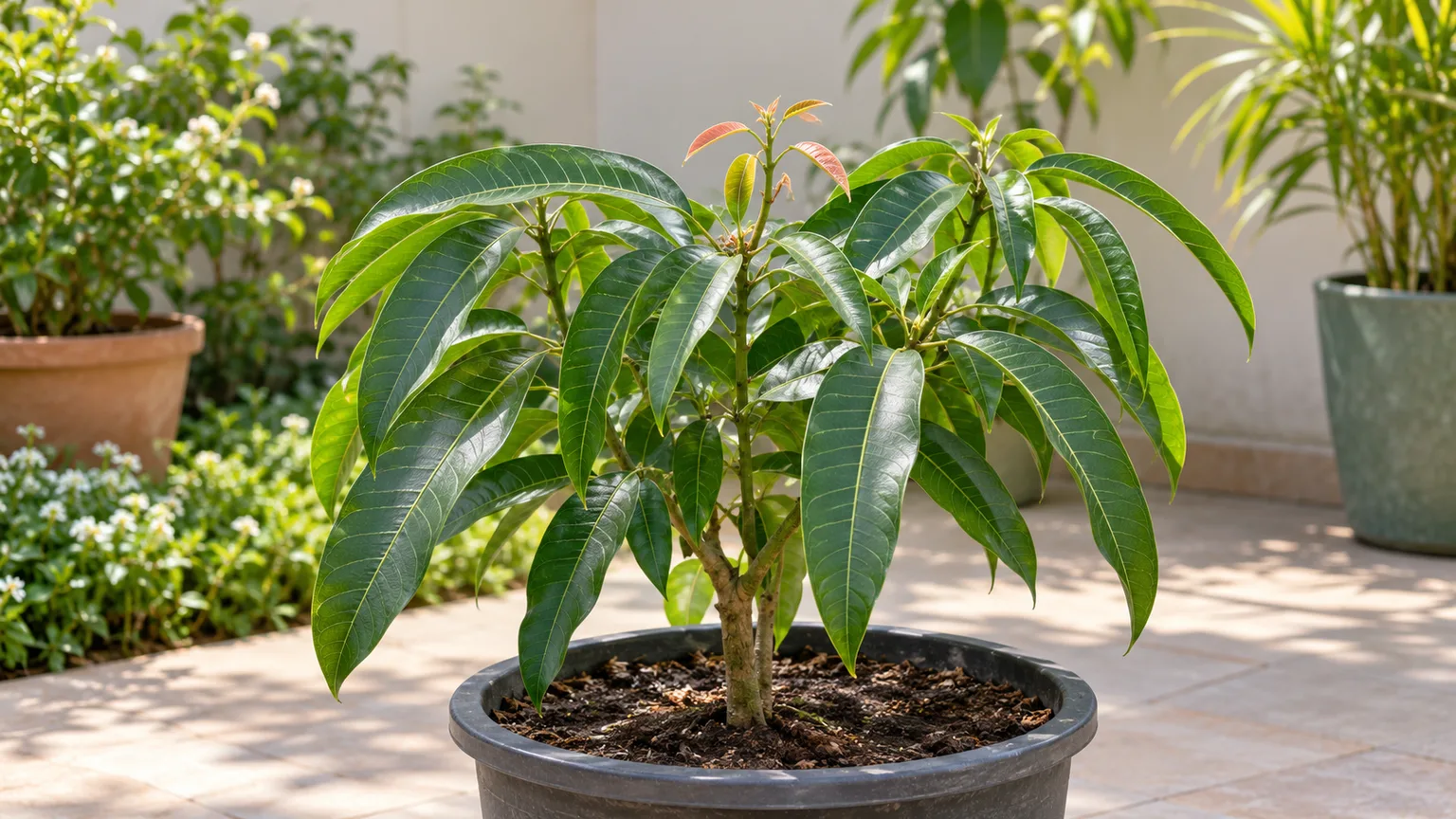
Slow Growth on Mango: Causes, Checks & Fixes
This guide covers slow growth on Mango. See also the general Slow Growth guide, watering, and light pages for this plant.
Slow Growth on Mango: Causes, Checks & Fixes
Quick answer
Slow growth on Mango (Mangifera indica) is most often too little sun, cool weather, a pot-bound container, or missed feeding — not a mystery disease. A healthy young Mango in sustained warmth and full sun pushes episodic flushes of new leaves; a tree that sits static through warm sunny weeks is telling you one of those inputs is missing.
First step: move the tree to its sunniest warm spot with at least 6 hours of direct sun and confirm nights stay well above 40°F. Do this before feeding, repotting, or spraying. If light and warmth were the bottleneck, the next flush tells you within weeks — and you will have avoided stressing an already stalled tree with chemicals it did not need.
For how stalled growth works in plants generally, see our slow growth guide. The rest of this page covers what is different about Mango, because a tropical fruit tree stalls for tropical-tree reasons.
What slow growth looks like on Mango
Mango does not grow leaf-by-leaf all year. It grows in flushes: a terminal bud breaks, pushes a cohort of soft pinkish or pale-green leaves, and those harden to dark green over several weeks. Learning this rhythm is half the diagnosis — a quiet tree between flushes is normal, while a tree that skips flushes through an entire warm season is stalled.
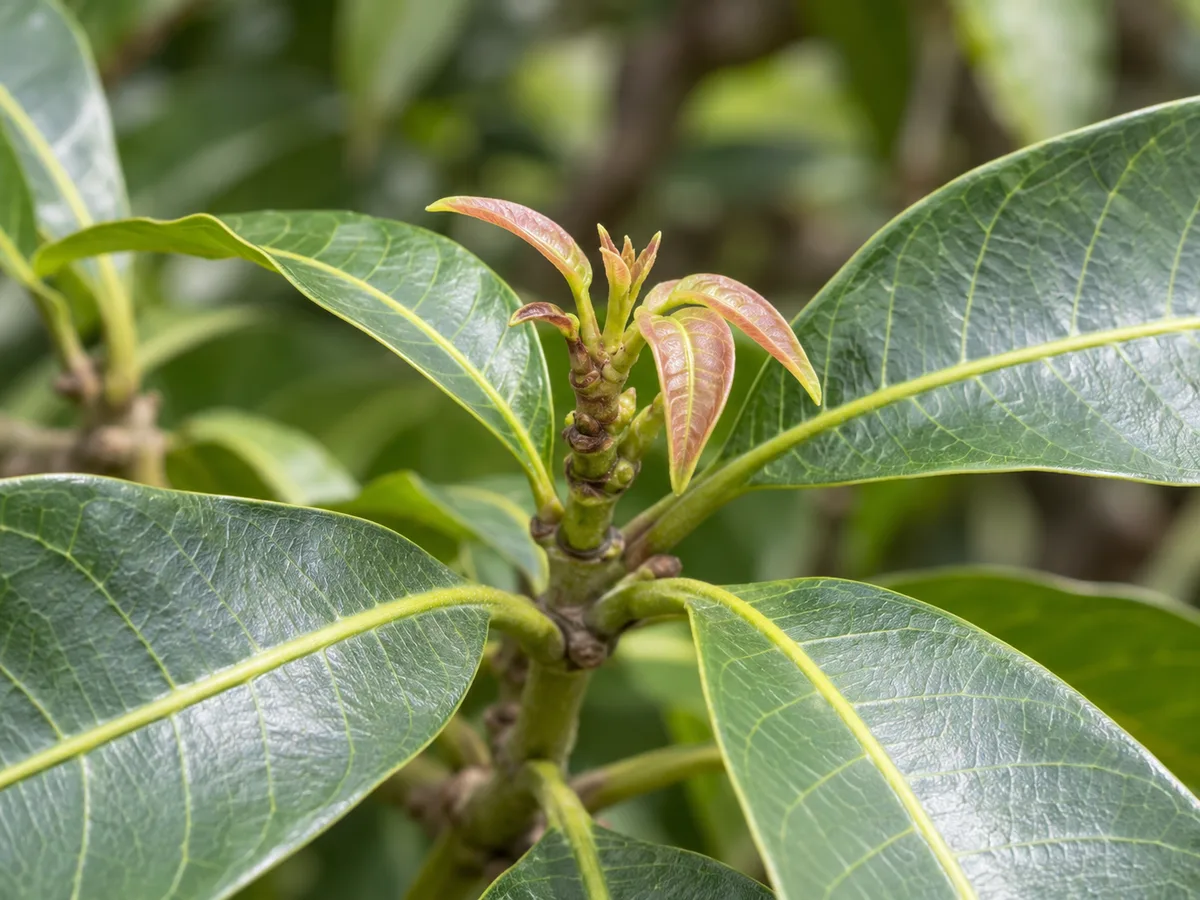
Close-up: a stalled terminal flush with undersized, pale new leaves — compare against healthy tissue on the same tree.
The signature stall pattern:
- No new terminal flush for months during warm, bright weather
- New leaves emerging much smaller than the older hardened leaves below them
- Flushes that start, then abort — tiny shoots blacken or drop before expanding
- Pale new growth with thin, weak stems instead of sturdy shoots
- A grafted tree that refuses to extend scion shoots, or a seedling that adds almost nothing in a full year
- Otherwise healthy-looking older leaves, which is why owners often wait too long
Seedlings deserve special context: a seed-grown Mango is genetically variable and commonly takes several years longer to size up and fruit than a grafted cultivar, with young trees typically needing 3 to 6 years to bear. A slow seedling in good conditions may simply be juvenile, while a grafted tree stalling in the same conditions has a fixable problem.
Why Mango stalls: the Mango-specific causes
1. Too little sun
Mango is a full-sun fruit tree, not a shade-tolerant houseplant. It wants 6 to 8 hours of direct sun daily to fuel photosynthesis and flush production, and it performs best in USDA zones 10–11. A Mango kept indoors behind glass, on a shaded balcony, or under a larger tree’s canopy will photosynthesize just enough to survive and never enough to flush. Container guides stress at least 6 hours of sun even for dwarf potted trees. If your tree lives somewhere you would not ripen fruit, it will not grow fruit wood either.
2. Cold checked the growth
Mangoes love warm, humid weather and sulk through cold spells — one of the three classic reasons Mango trees grow slowly, alongside poor soil and lack of water (Eco Family Life mango guide). UF/IFAS notes that flowers and small fruit are damaged below 40°F and young trees can be killed around 29–30°F. Even non-lethal cold pauses flushing for weeks, and a tree repeatedly chilled never strings together enough warm days to complete a flush. Mediterranean-winter growers see this every year: the tree idles through cool months no matter how it is fed.
3. Pot-bound roots or a seedling’s patience test
Mango makes a strong taproot and resents small permanent pots. A grafted tree squeezed into an undersized container circles its roots, exhausts its mix, and stalls — the classic container failure of a tree that wants to become 30 to 100 feet tall unpruned (UF/IFAS Mango guide). Container growing works, but it demands dwarf cultivars such as Carrie or Cogshall and a pot at least 20 inches across with real drainage. Seed-grown trees add a second trap: juvenility. They are slower by nature, so compare a seedling only against its own past flushes, never against a grafted neighbor.
4. Hunger — nitrogen for flushes, potassium for bearing trees
Each flush is built from stored and freshly absorbed nutrients, and shortfalls of nitrogen, phosphorus, or potassium stunt growth and flowering. UF/IFAS advises feeding young trees every two to three months in the first year, then 2–3 applications yearly scaled to tree size, with low-nitrogen, higher-potash mixes once trees bear. Container trees exhaust their mix fastest. A separate trap: heavy lawn fertilization nearby floods the Mango root zone with nitrogen, pushing soft leafy growth at the expense of sturdy flushes and fruit. Pale small new leaves point to hunger; rank soft growth with no fruiting points to excess nitrogen instead.
5. Water extremes in a drainage-demanding root zone
Mango wants deep, airy, freely draining mix around pH 5.5–7.5 and declines in waterlogged ground. Chronic wetness rots fine roots, so the canopy stalls while older leaves yellow on wet mix — see overwatering on Mango and root rot on Mango. At the other extreme, drought aborts new flushes and drops young fruit. Newly planted trees need watering 1–2 times weekly for the first months, while established landscape trees need irrigation mainly during prolonged drought. A container that swings between soggy and bone-dry spends its energy surviving instead of flushing.
6. Sap-suckers and flush diseases draining momentum
New Mango shoots are prime sap-sucker habitat. Scale insects suck juice from leaves, branches, and young fruit and can set young plants growing backward; mealybugs, aphids, and thrips similarly drain flushes — check shoot tips before assuming nutrition is at fault (see aphids on Mango, mealybugs on Mango, and spider mites on Mango). Fungal pressure finishes what pests start: powdery mildew coats young flush tissue, and anthracnose blackens shoots and panicles in wet weather. Two Mango-special distortions deserve mention: shoot gall midge larvae cause crumpled, stunted shoots that never elongate, and malformation disease produces bunchy, compressed shoot growth. Flushes that emerge already twisted or galled are a pest-or-pathogen problem, not a feeding problem.
How to confirm the cause
Work through these checks in order — each one rules out a cause before you spend money or stress the tree:
- Count sun hours. Track direct sun on the canopy for two days. Under 6 hours means light is the prime suspect — review placement against the Mango light guide.
- Read the temperature history. Any nights near or below 40°F in recent weeks, or a cool winter just passed, explains a pause. Blackened shoot tips after cold confirm it.
- Inspect the flush points. Healthy dormant buds are firm and pointed; aborted black tips, galled crumpled shoots, or sticky honeydew with insects mean pests or disease, not hunger.
- Check the pot and roots. Roots circling densely or emerging from drainage holes, a pot drying within a day in warm weather, or a wobbly top-heavy tree means the container is the ceiling — compare with the Mango repotting cues and soil guide.
- Read soil moisture at depth. Push a finger 3–5 cm into the mix per the Mango watering guide: cool and damp days after watering suggests excess; powder-dry with aborted flushes suggests drought.
- Read leaf color. Uniformly pale small new leaves point to nitrogen hunger; yellowing with green veins points to iron lockout in alkaline soil; scorched margins point to salt or drought (see brown tips on Mango and yellow leaves on Mango).
Match the pattern before treating. Feeding a cold-stalled tree, or repotting a light-starved one, wastes the one intervention that matters.
The first fix to try
Move the tree to its sunniest, warmest available spot — at least 6 hours of direct sun — and leave every other variable alone for now.
For a potted tree, that means the brightest frost-free terrace, courtyard, or south-facing position you have; for a landscape tree, it means clearing the competing shade you can control. This single correction addresses the most common true stall: a tropical tree running an energy deficit. Do not pile on fertilizer, repotting, and sprays the same day — you need to read the tree’s response to light and warmth first. If cold is in the forecast, add frost protection rather than feeding.
Step-by-step recovery
- Lock in light and warmth as above. Indoor trees that cannot get 6 hours of real sun need a greenhouse or grow-light setup, not hope — Mango is a poor fit for dim rooms.
- Stabilize water. Return to the check-the-top-3–5-cm routine: water deeply, then let that layer dry before watering again. Empty saucers so containers never sit wet.
- Feed only in warm active growth. Resume the young-tree rhythm of light applications through spring and summer, shifting toward lower-nitrogen, higher-potash mixes as the tree bears — full schedules are in the Mango fertilizer guide. Container growers can use fish emulsion through the warm months per label rates.
- Repot if root-bound. Move up one sensible pot size (or root-prune and refresh mix in the final container) in early spring as active growth starts, using the airy Mango soil mix of potting mix cut with perlite or grit and bark. Never bury the graft union.
- Clear pests on new shoots. Wash small aphid or mealybug clusters off flush tips with a strong water rinse first; escalate only for scale armor or repeating infestations, and treat in the cool of the day.
- Prune for size only after harvest. Mango bears on terminal growth, so repeated tip-pruning during the flowering season removes the crop. Train a low branched framework on young trees, then prune soon after harvest — see the Mango pruning guide.
- Snip first-year flowers on tiny container trees to redirect energy into vegetative growth, as container guides recommend, then let the tree set crop once it has real canopy.
- Track flushes, not days. Log each new flush’s date and leaf size. One normal-sized flush in warm weather means recovery; continued tiny or aborted flushes mean re-diagnose roots, pests, or cold exposure.
Recovery timeline
Mango answers in flushes, not days, so patience is calibrated in weeks. In warm sunny weather after a correct fix, expect a new flush attempt within 3–6 weeks. Full-sized hardened leaves follow over the next 6–10 weeks. Old undersized leaves will not enlarge — judge everything by new shoots. A tree that flushes normally but slowly (one modest flush per warm season) may simply be a young seedling or a dwarf cultivar at its natural pace. If two full warm months pass with no flush response, suspect root damage, chronic cold exposure, or gall damage, and inspect below the soil line and inside shoot tips before feeding again.
Lookalike symptoms
| What you see | More likely page | How to tell apart |
|---|---|---|
| Older leaves yellowing along with the stall | Yellow leaves on Mango | Confirmed nutrient or water issue; the stall is secondary |
| Tall, stretched shoots reaching for light | Leggy growth on Mango | Light shortage stretches internodes; true slow growth stays compact |
| Overall dim placement, pale stretched seedlings | Not enough light on Mango | Light-placement problem specifically; fix position first |
| Wilting in dry soil or aborted flushes | Underwatering on Mango | Water delivery failure; soil reads dry at depth |
| Wilting while mix stays wet, sour smell | Root rot on Mango | Root failure, not hunger; roots darken and soften |
| Visible insects on shoot tips and undersides | Aphids on Mango | Pests drain new growth directly |
| Drooping foliage with wet or dry extremes | Wilting / drooping leaves | Acute water stress rather than a chronic stall |
When to use this page vs other Mango guides
Use this page when the tree is alive but static: no meaningful flush for weeks of warm weather, undersized new leaves, or a season-long failure to size up. Go to not enough light on Mango when dim placement clearly leads; to overwatering or root rot when the pot stays wet and roots smell sour; to yellow leaves when discoloration dominates; and to the Mango problems hub when you are unsure which symptom dominates. For routine schedules rather than a stall rescue, the Mango watering guide, Mango fertilizer guide, and Mango overview are the right stops.
Mistakes to avoid
- Feeding a cold- or dark-stalled tree heavily. Extra fertilizer cannot restart flushes without sun and warmth, and it burns stressed roots. Match feeding to the season.
- Stacking repot, spray, prune, and feed on one day. A stalled Mango is already stressed; one targeted fix, then observe.
- Tip-pruning through the flowering season. Terminal buds carry panicles — repeated snipping removes the crop you are growing the tree for.
- Keeping a Mango as a permanent dim-room plant. No feeding schedule compensates for missing sun on a full-sun fruit tree.
- Judging recovery by old leaves. Old tissue will not size up or re-green; only new flushes count.
- Planting a standard-vigor cultivar in a small forever-pot. Match cultivar and container: grafted dwarfs for pots, full-size trees for open ground.
How to prevent it next time
Site the tree where it gets full-day sun in a frost-free position with airflow, and give roots the drainage Mango insists on — deep, airy mix that never stays saturated. Choose a grafted dwarf cultivar for containers and a pot you can still upsize, refreshing the mix every 1–2 years while young. Feed young trees on schedule through the warm months and shift bearing trees toward potash, guided by a soil test rather than guesswork. Mulch containers and beds with a few inches of organic mulch to steady moisture, inspect shoot tips weekly so sap-suckers never reach colony size, and prune only after harvest. Full tree-keeping rhythm is covered in the Mango overview.
When to worry
Treat the stall as urgent when:
- Shoot tips blacken after cold, or young bark splits — frost injury needs prompt sanitation pruning back to live wood
- The pot smells sour and roots are dark and soft — advancing rot per the root rot guide
- Scale armor or mealybug masses coat flush after flush despite rinsing
- New shoots emerge bunchy and compressed and never elongate — suspect malformation or gall damage
- Multiple flushes abort in a row during warm, bright weather despite correct water and feeding
A plain pause through cool or dim months with firm buds and healthy older leaves is low urgency. Fix light and warmth, then wait for the season to do its work.
Related Mango guides
- Mango growing overview — sun, warmth, cultivar choice, and size control; start here for planning.
- Mango problems hub — every diagnosed Mango issue in one place; use when symptoms overlap.
- Mango watering guide — the 3–5 cm check routine that prevents water-swing stalls.
- Mango light guide — sun hours and placement; use when growth is compact but static.
- Mango soil guide — airy pH 5.5–7.5 mixes and drainage; use at planting and repotting time.
- Mango fertilizer guide — feeding schedules and bearing-tree potash shift; use for routine nutrition.
- Leggy growth on Mango — when shoots stretch instead of stalling compactly.
- Not enough light on Mango — when dim placement is the confirmed ceiling.
Related tool
Use the Plant Problem Diagnosis Tool to narrow causes for slow growth on this plant before changing multiple variables at once.