Aphids on Mango: Causes, Checks & Fixes
Quick answer
Sticky, curling new mango flushes with visible insect clusters mean aphids are feeding on sap. First, isolate the plant and blast colonies off young leaves, buds, and panicles with a firm stream of water before using any spray.
Aphids on Mango: Causes, Checks & Fixes
This guide covers aphids on Mango. See also the general Aphids guide, watering, and light pages for this plant.
Aphids on Mango: Causes, Checks & Fixes
Quick answer
If your mango’s newest flush is sticky, curling, or stunted while older hardened leaves look normal, aphids are the likely cause-not a watering problem. These sap feeders cluster on tender tissue: young flush leaves, shoot tips, buds, and flower panicles.
First step: isolate the plant and blast the colonies off with a firm stream of water, covering leaf undersides, shoot tips, and panicles. For how aphids feed and spread in general, see our aphids guide. On mango, the pattern usually shows up as distorted new flushes with honeydew dribbling onto the broad evergreen leaves below, where black sooty mold follows if colonies stay.
Why mango flushes and panicles attract aphids
Tender flush growth is the target. Mango grows in flushes of soft new leaves, and aphids feed on exactly that tissue. Colonies settle on the undersides of young leaves, petioles, and shoot tips, drawing sap until the expanding leaves twist and stall. Because hardened older mango leaves resist feeding, damage concentrated on one flush while the rest of the canopy looks fine points to insects, not a root or watering issue-compare with overwatering on mango if older leaves yellow while the mix stays wet.
Flowering panicles are high-value feeding sites. Mango blooms on many-branched terminal panicles carrying hundreds of small flowers, and UF/IFAS notes most Florida varieties set less than one fruit per panicle. Heavy aphid feeding on buds and young panicles, compounded by honeydew and sooty mold shading the tissue, can weaken a bloom flush a home grower cannot afford to lose.
Mango hosts documented aphid pests. Aphids that colonize mango include highly polyphagous species: UF/IFAS documented Sinomegoura citricola on mango fruit in Florida, a pest recorded on more than 80 host species and the only aphid currently recorded infesting mango fruit in North America. Winged aphids arrive on air currents from nearby citrus, hibiscus, or weeds, so an outdoor mango can gain colonies without any new plant introduction.
Soft over-fed growth invites outbreaks. Excess nitrogen during warm active growth produces the succulent shoots aphids prefer. Match feeding to the mango fertilizer guide instead of pushing flushes, and keep trees in the full sun and open airflow mango needs-stagnant, shaded interior canopy holds the humidity colonies favor.
What aphids look like on mango
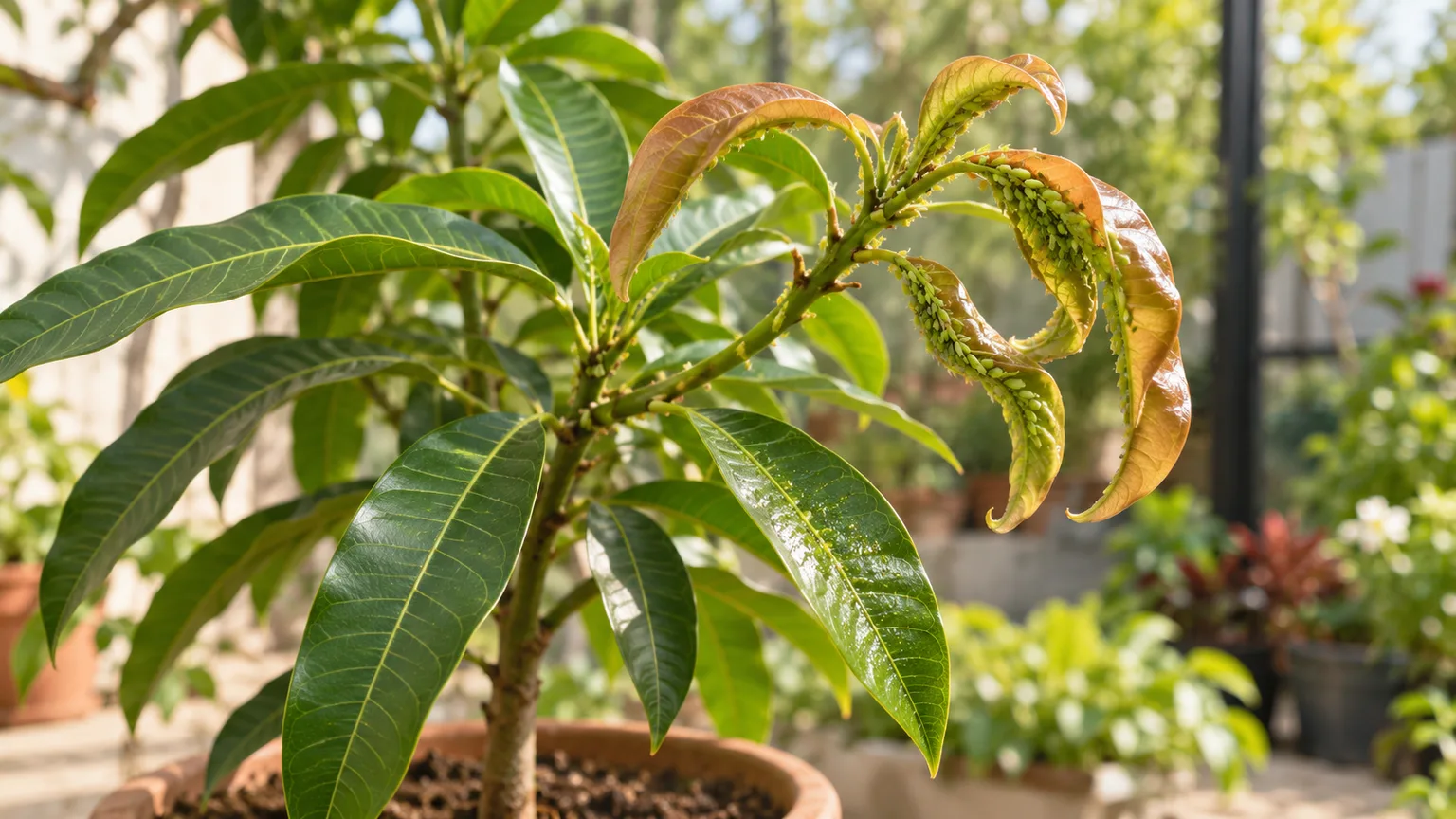
- Small soft-bodied insects-green, brown, reddish, or black-clustered on new flush leaves, shoot tips, buds, or panicles
- Colonies tucked along main veins on leaf undersides
- Sticky, shiny honeydew on flush leaves and on the hardened leaves below the colony
- Ants traveling up stems to tend the colonies, collecting honeydew and guarding aphids from predators
- New flush leaves curling, twisting, or stalling while older foliage stays normal
- Black powdery sooty mold growing on uneaten honeydew, dulling the broad evergreen leaves
- White cast skins shed on leaf undersides as nymphs molt

Clustered aphids and sticky honeydew on a young mango flush - compare with clean hardened leaves on the same tree.
Run a fingertip along a flush leaf: tacky residue that returns within a day means sap feeders are still active above that leaf.
Confirm aphids vs. lookalikes on mango
Work in order so you treat insects, not a care problem wearing a similar disguise:
- Flush-locus check - Damage only on the newest flush with hardened leaves untouched points to sap feeders on tender tissue. Whole-canopy yellowing on wet mix points to roots instead.
- Underside scan - Part each young flush leaf and look along the veins underneath, then check buds and panicle branches.
- Honeydew test - Wipe a leaf below the suspect flush; returning stickiness confirms active feeding overhead.
- Ant-trail follow - Ants streaming up the trunk toward one flush usually lead to an aphid colony, not a separate ant infestation.
- Distortion check - Aphid sucking feeding distorts young leaves and shoots, while mite or sun damage leaves different signatures (see table).
Symptom lookalike comparison
| What you see | Likely cause | Key check |
|---|---|---|
| Soft insects clustered on flush tips or panicles plus honeydew | Aphids | Colonies move when disturbed; ants tending them |
| White cottony wax in leaf axils and stem joints | Mealybugs | Stationary waxy masses, not fast-moving clusters |
| Fine stippling and webbing on older leaves in dry air | Spider mites | Webs plus tiny mites; damage starts on hardened leaves |
| Older leaves yellowing while mix stays wet | Overwatering | No insect clusters; check drainage per the mango soil guide |
| Pale new growth from chronic shade | Not enough light | Leggy pale flushes with no honeydew, insects, or ants |
| Uniform pale young leaves with green veins | Nutrient issue, not pests | No colonies, honeydew, or cast skins on undersides |
Confirmed diagnosis - Visible soft-bodied colonies plus honeydew, ants, or sooty mold on flushes or panicles. Suspected - Sticky flushes with no insects seen yet; recheck undersides with a hand lens, since early colonies hide along veins.
First fix: isolate and blast colonies off with water
Isolate container trees away from citrus, hibiscus, and other aphid hosts until no new aphids appear for at least two weeks after treatment. Landscape trees cannot move, so treat them where they stand and inspect neighboring hosts the same day.
Blast colonies off with a firm stream of water first. A strong stream of water dislodges aphids from leaves and stems-aim up into leaf undersides, along shoot tips, and through panicle branches. This is the lowest-risk first fix on mango: no residue near developing fruit, no chemical exposure around pollinators visiting the bloom, and no phytotoxicity risk on sun-exposed foliage.
Practical notes for mango:
- Rinse early morning so flushes and panicles dry in sun and airflow;promotion of lingering wetness on bloom invites fungal trouble, and mango panicles already face pressure from powdery mildew and anthracnose.
- Repeat every two to three days for at least two cycles to knock down nymphs hatching between rinses.
- On a large landscape tree, work one scaffold section per session with a hose nozzle rather than attempting the whole canopy at once.
- Wear gloves and long sleeves when handling infested shoots-mango sap, peel, and pruning debris carry contact allergens for sensitive people in the same plant family as poison ivy.
Follow-up sprays and biological backup
If colonies persist after two or three rinses, step up in this order:
- Insecticidal soap on contact points. Apply insecticidal soap to leaves and stems with thorough coverage, focusing on leaf undersides, and repeat every few days until the infestation is under control. Coat tops and undersides of flush leaves-contact sprays only kill insects they touch. Spray early morning or late evening, never on heat-stressed foliage in midday sun, and patch-test one flush first.
- Neem oil for lingering colonies. Use a labeled horticultural neem product per label directions, again in cooler hours with full underside coverage. Do not drench open panicles in full bee activity if you can time sprays for evening instead.
- Recruit natural enemies. Ladybirds, hoverflies, parasitoid wasps, and earwigs all prey on aphids, and outdoor mango trees benefit most when broad-spectrum insecticides are withheld so predators establish. If ants are guarding colonies, breaking ant access (sticky trunk barriers on container trees, removing nearby nest shelter) lets predators work.
- Wipe honeydew off. Clean sticky residue from broad leaves with a damp cloth so sooty mold loses its food base and you can tell whether fresh honeydew is still appearing.
Do not stack a hard prune, repot, and spray program on the same day-make one correction, then read the flush response before adding another.
What not to do on mango
- Do not prune off terminal tips during flowering season to remove aphids. Mango fruits on terminal panicles, so cutting tips removes the crop along with the colony-rinse and spot-treat instead, and save structural pruning for after harvest per the mango pruning guide.
- Do not push nitrogen to outgrow the damage. Extra fertilizer grows softer flushes that attract the next wave; hold feed until new growth emerges clean.
- Do not water more because flushes look stressed. Distorted, sticky flushes on a properly drying root zone need pest treatment, not extra drinks-check the top 3-5 cm and pot weight per the mango watering guide before changing irrigation.
- Do not spray at midday on sun-exposed trees. Wet foliage plus oil or soap films in harsh sun risks leaf burn on flush tissue.
- Do not ignore ants. Colonies guarded by ants rebound after rinses; address ant access or the same flush gets recolonized.
Recovery timeline
Visible colonies should collapse within one to two weeks of consistent rinsing or soap treatment. Judge recovery by the next flush: clean, flat, undistorted new leaves with no returning honeydew mean the colony is broken. Already-twisted flush leaves will not fully straighten once hardened, and buds or fruitlets shed during heavy feeding will not return that cycle.
Established landscape mango trees need irrigation mainly during prolonged drought, so keep the normal deep-but-infrequent rhythm through recovery rather than pampering the tree with extra water. Young container trees keep their regular check-every-few-days routine from the mango watering guide.
How to prevent aphids next season
Inspect every new flush weekly from spring warmth through summer, especially the first two weeks after leaves emerge. Quarantine new nursery plants for two weeks before placing them near an existing mango. Rinse flushes occasionally when watering during peak aphid months, and prune for an open framework after harvest so interior canopy dries fast and predators can reach colonies.
Keep baseline care aligned with the mango overview-full direct sun, freely draining mix, and measured feeding-so growth emerges firm rather than overly succulent. Browse the full mango problems hub when symptoms overlap, since yellow leaves, wilting, and pest issues can look similar at first glance.
When to escalate
Get local extension or IPM advice if panicles stay coated through three full treatment cycles, if sooty mold blackens most of the flush canopy, or if colonies rebound within days because of heavy ant tending. Systemic insecticides move through sap and carry pollinator and label restrictions-never apply them to a blooming mango without expert guidance for your area, and always follow the product label exactly.
Aphids rarely kill an established mango, but a neglected colony on bloom wood can cost a season of fruit and leave honeydew-fouled foliage photosynthesizing poorly for months.
When to use this page vs other mango guides
- Mango watering guide - Use for routine moisture checks before assuming aphids is the main issue.
- Mango problems hub - Browse all 16 common issues on this species.
- Mealybugs on Mango - Use when waxy stationary masses, not mobile soft colonies, dominate axils and joints.
- Spider Mites on Mango - Use when fine webbing and stippling on hardened leaves point to mites rather than flush-feeding aphids.
- Yellow Leaves on Mango - Use when whole-canopy yellowing suggests watering, light, or nutrition rather than flush-localized insects.