Drooping Monstera Siltepecana Leaves: What to Check First
Quick answer
Before adding water, feel the top 3–5 cm of mix and lift the pot. If the mix is dry and the pot feels light, water thoroughly and let it drain; if it is wet and heavy, hold water and check drainage and root condition.
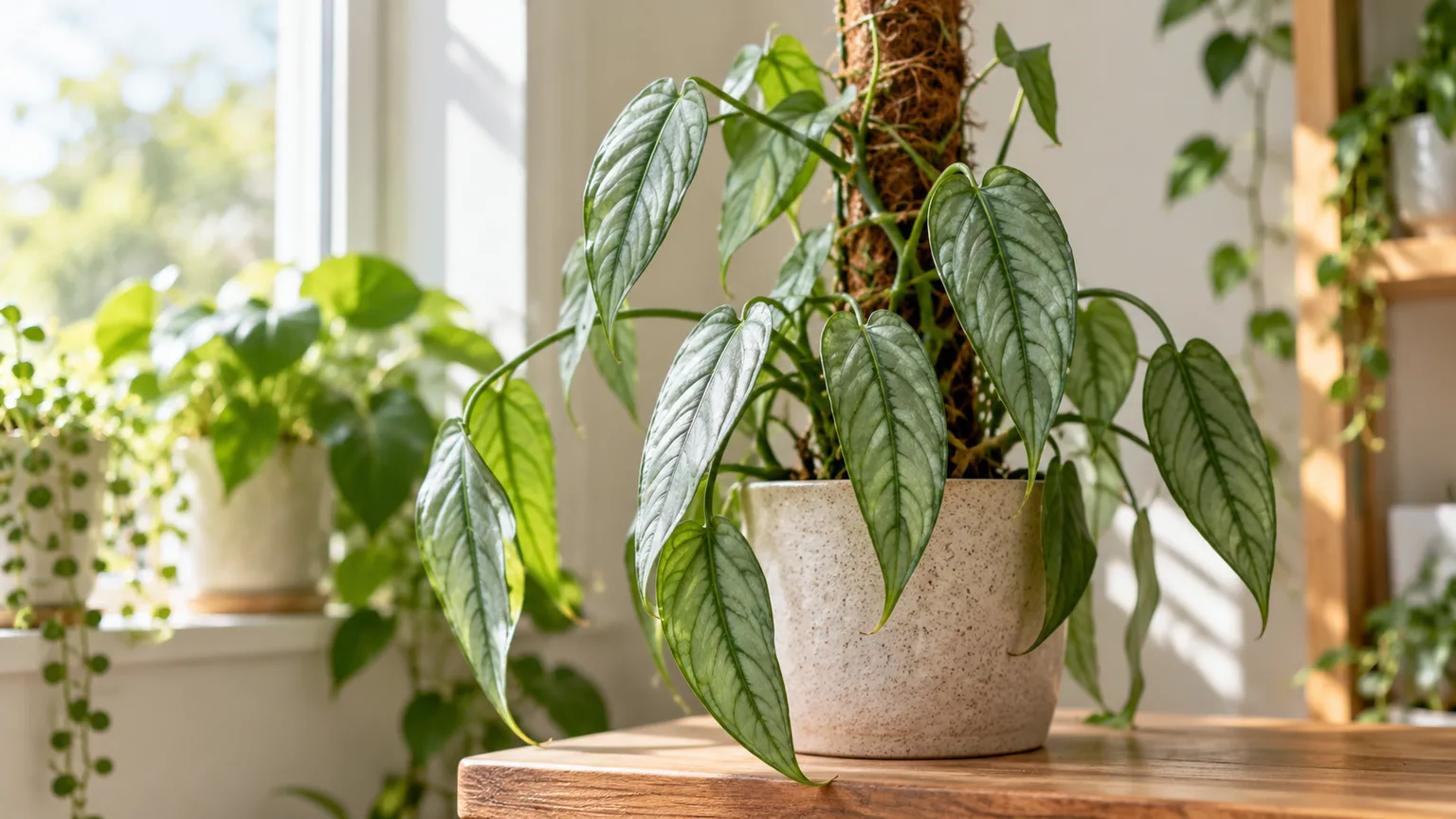
Drooping Leaves on Monstera Siltepecana: Causes, Checks & Fixes
This guide covers drooping leaves on Monstera Siltepecana. See also the general Drooping Leaves guide, watering, and light pages for this plant.
Drooping Leaves on Monstera Siltepecana: Causes, Checks & Fixes
Quick answer
Before adding water, feel the top 3–5 cm of mix and lift the pot. If the mix is dry and the pot feels light, water Monstera siltepecana thoroughly until excess drains, then empty the saucer. If the mix is still wet and the pot feels heavy, do not water again: check whether the pot drains and whether the stem base or roots show damage.
Drooping is a sign that the leaves are not being supplied or held as usual; it does not identify the cause by itself. On this climbing aroid, a vine can hang naturally while its leaves remain firm. First separate a trailing stem from a wilted leaf, then use the moisture and root-zone evidence to choose one correction.
What drooping looks like on Monstera siltepecana
A genuinely drooping siltepecana has leaf blades that hang lower than their normal angle, petioles that feel limp, or several leaves that lose firmness together. The change may be gradual, or a whole section of vine may soften after a missed watering, a long period in wet mix, or an abrupt move to a hot or cold location. NC State describes the species’ narrow silver-green juvenile leaves with dark veins; that recognizable pattern should stay visible even when a leaf is sagging.
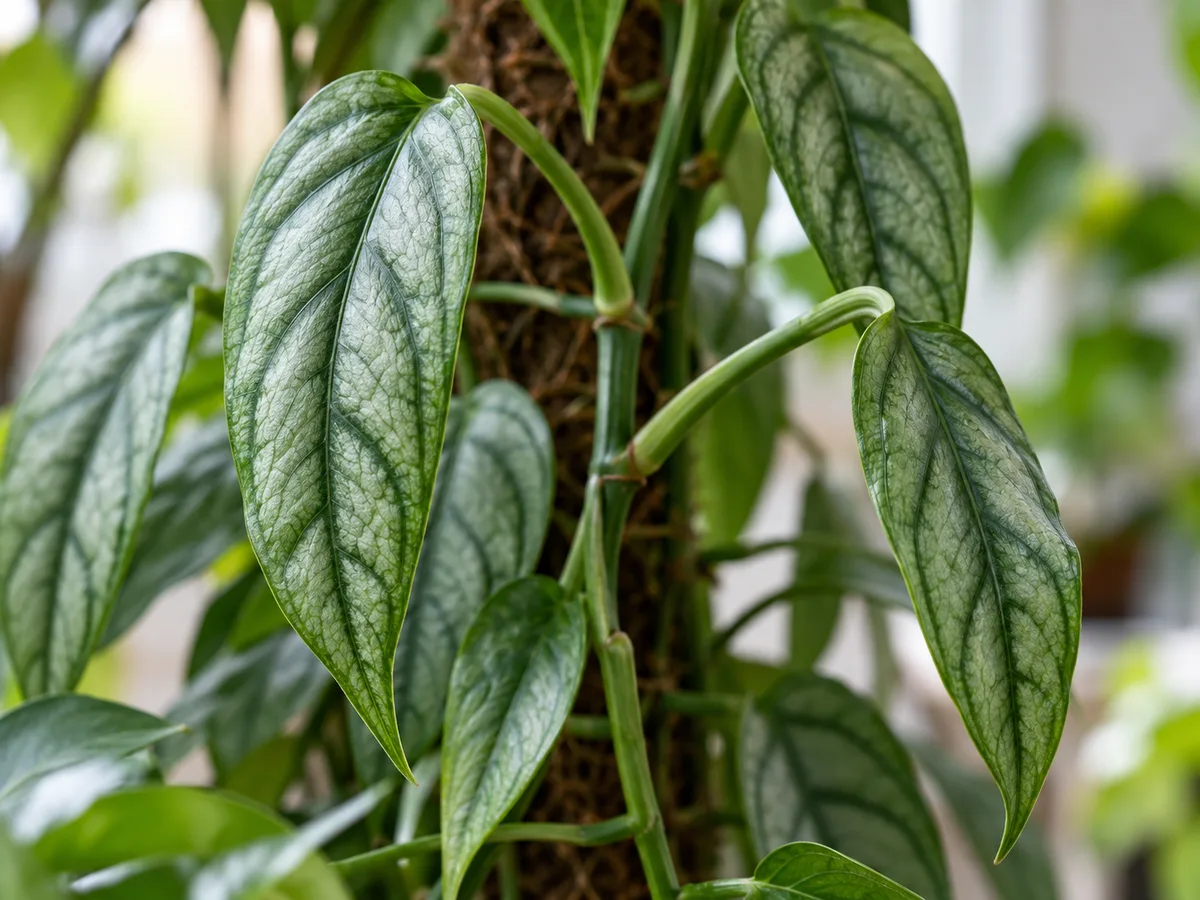
Several siltepecana leaves hang below their usual angle; compare the petioles and leaf firmness with the rest of the vine before changing care.
Look at more than one leaf. A single older leaf can gradually yellow and decline while the vine continues to grow; that alone does not show that the whole root system is failing. More concerning is a repeated pattern across several leaves, especially when the newest leaf or growing tip also loses firmness. Note whether the leaf blades remain flat, curl inward, develop dry margins, or turn yellow, because those details help distinguish a short dry spell from roots that are staying too wet.
A trailing siltepecana vine can hang normally
Monstera siltepecana is a climbing or trailing vine. A basket-grown stem may drape over the rim, while a supported stem can climb; the Spruce’s species guide likewise recommends a trellis or moss pole for climbing growth. A long stem that points down is not automatically wilted. Follow it back to its nodes and check the leaves individually: if the blades are firm and their petioles hold their usual position relative to the stem, the plant may simply be trailing.
This distinction matters because adding water will not make a healthy trailing vine climb, and adding a support will not repair water-stressed leaves. If you want a more upright display, attach the vine loosely to a support without constricting it. The support changes the plant’s form; it is not a treatment for drooping. Avoid pulling a limp stem upright before you know whether it has softened at the base or is just bending under its own length.
Why a siltepecana’s leaves may droop
Dry mix and a light pot
If the mix has become dry well below the surface, the pot feels noticeably lighter than after watering, and the leaves are limp or beginning to curl, underwatering is plausible. A missed watering, a warm bright spell, a small pot packed with roots, or a porous container can make the root ball dry faster than it did last month; Clemson lists pot and mix conditions among the factors that change watering needs. The plant’s own watering trigger is more useful than a fixed calendar: NC State recommends watering when the top 1–2 inches dry, and the plant detail data likewise calls for checking roughly the top 3–5 cm.
Drying is not the only explanation for a light pot, but it is useful evidence when the mix is also dry at depth. If only the surface is dry while the lower mix is cool and damp, wait and recheck rather than watering based on the top alone. In a hanging basket, lift or support the pot safely before judging its weight; a large vine can make the container awkward to move.
Wet mix and injured roots
A siltepecana can also droop while its pot remains wet. Roots damaged by prolonged saturation may fail to take up water well, so the leaves can look thirsty even as the mix stays heavy. Clemson Extension cautions that wilting can follow root injury, and the University of Wisconsin Extension describes wilting despite wet soil as a common sign that root rot may be present.
Wet mix by itself does not prove root rot. Look for a combination: the pot stays heavy for an unusually long time, water drains slowly or pools in a cachepot, lower leaves yellow, the stem near the mix softens, or the potting mix smells sour. Root rot becomes more likely when the plant keeps declining in persistently wet conditions and a root check finds soft, dark tissue. If the pot is wet but the leaves are firm and the plant is stable, first correct standing water and observe; do not unpot it solely because the surface has not dried.
Dense mix, blocked drainage, or a change in the room
Siltepecana needs a mix that holds some moisture while still draining and leaving air around the roots. A dense, compacted potting mix, a container without drainage holes, or a nursery pot left standing in runoff can keep its root zone wet for too long. The Spruce recommends well-drained soil for this species, while Plantophiles discusses a chunky, aerated aroid mix with coarse ingredients such as bark and perlite. The exact proportions can vary; what matters in this diagnosis is whether the pot releases excess water and then dries at a reasonable pace for your room.
Think about recent changes if the mix is neither clearly dry nor persistently wet. A move beside hot glass, an air-conditioning vent, a cold draft, or direct midday sun may coincide with drooping or leaf damage. NC State recommends bright indirect light for the species and warns that direct sunlight can scorch its leaves. Sudden change is a clue, not proof: check the root zone before treating a location change as the only cause.
Support, leaf age, and normal growth
A vine may droop at a weak point if it is long and unsupported, but that posture differs from leaves losing turgor throughout the plant. A snapped or sharply creased stem can also leave only the growth beyond that point limp. Inspect the stem at each node for a crease, split, or soft section. If the stem remains firm and the leaves are evenly supported, try a loose tie to a stake or moss pole only if you want the vine to climb.
Older leaves at the lower part of the vine may decline as the plant grows, while newer leaves remain firm. That pattern is less urgent than drooping that starts at the newest growth and spreads down the vine. Do not remove a leaf just because it hangs: wait until it is mostly yellow, dry, or damaged beyond recovery, and keep healthy green tissue while you correct the cause.
Confirm the cause before watering
Use the evidence in this order so you do not mistake damaged roots for thirst.
- Review the last few days. Note the last watering, whether water ran out of the drainage holes, whether the pot sat in a saucer or cachepot, and any recent change in room temperature, window exposure, or support. Also check whether the plant was repotted or moved recently.
- Feel the mix below the surface. Push a finger into the top 3–5 cm. If the mix is dry there and the pot is light, a thorough watering is reasonable. If it is cool, wet, or muddy and the pot remains heavy, do not add more.
- Check the container. Make sure the inner pot has open drainage holes and that water can leave it. Empty runoff rather than letting the plant sit in it. A decorative outer pot can hide standing water even when the nursery pot itself has holes.
- Inspect the stem and leaves. Follow the vine from its base to the newest growth. Firm stems with leaves that remain patterned and unmarked suggest that a naturally trailing posture or support issue may be more likely than a whole-plant root problem. A soft, darkened base or a section that collapses at one node needs closer attention.
- Look for other visible damage if the pattern does not fit water stress. If leaves also have unusual marks, sticky residue, or distortion, inspect the foliage closely and treat that as a separate diagnosis rather than repeatedly changing the watering routine. Drooping alone is not evidence to start a pesticide or soap treatment.
If the soil is wet and the plant is worsening, gently slide the root ball out only far enough to inspect it. Healthy roots should feel firm; decayed roots are often dark and soft. Gardening Know How notes that dark, mushy roots, sometimes with an unpleasant smell, are a stronger confirmation than drooping leaves alone. Do not pull apart a healthy root ball to search for a diagnosis that the visible evidence does not justify.
First fix: match the moisture check
The first action is to check the root-zone moisture and pot weight before adding water. That single check prevents the most common wrong turn: giving more water to a siltepecana whose roots are already short of oxygen.
If the mix is dry through the upper root zone and the pot is light, water slowly and evenly until excess comes through the drainage holes. Let the pot finish draining, then return it to its normal bright, indirect position. Avoid giving only a small splash that wets one edge while leaving the center of the root ball dry. If water beads on top or runs straight down the pot wall without wetting the mix, the soil may have become hard to rewet; soak the root ball gradually in stages, let it drain fully, and then observe before the next watering.
If the mix is wet and heavy, skip watering and remove any standing runoff. Keep the pot in a stable, bright indirect location with ordinary airflow while the mix begins to dry; do not move it into harsh sun to force evaporation. If the pot has no drainage or the mix is severely compacted, address that physical problem rather than waiting through repeated wet cycles. A repot is justified when drainage or soil structure is failing, or when root rot is confirmed—not simply because the leaves are limp.
When roots are visibly decayed, remove only roots that are soft and collapsing with clean tools, then move the plant into a clean pot with drainage and fresh, airy mix. Gardening Know How recommends trimming decayed roots and replacing the affected mix when rot is confirmed; keep as much firm root tissue as possible. If most roots are dark and deteriorated or the lower stem is soft through several nodes, recovery may be limited. A healthy section of vine that still has a firm node may be worth keeping as a cutting; The Spruce outlines node-bearing stem cuttings for this species. Do not apply fertilizer to compensate for weak roots.
If the mix is appropriately moist and the roots appear sound, do not keep changing water. Return the vine to a stable bright-indirect position, move it away from direct hot sun or a cold draft if that is the recent change, and give the stem support if its own weight is pulling it down. Make one correction at a time so the plant’s response remains interpretable.
Recovery: watch the next growth, not the old leaf alone
A mildly thirsty plant with functional roots may regain some firmness after a correct watering, but a damaged leaf may stay creased, curled, or slack. If the mix was wet and roots were injured, recovery is slower because the root system must resume taking up water. There is no dependable fixed number of days for every pot and room. Recheck the plant over the next several days without watering again unless the mix reaches its normal dry-down point.
The useful signs are that drooping stops spreading, the lower stem remains firm, and the growing tip produces a leaf that opens and holds itself normally. An older leaf that was already yellow or crispy may not return to its former condition. Remove it only when it is mostly spent or easily detached; pruning green leaves does not repair a root problem and reduces the foliage still available to the plant.
Escalate your inspection if new leaves continue to soften, yellowing spreads, the stem base turns dark or mushy, or the pot remains wet for many days despite adequate drainage and normal room conditions. A sour smell supports checking the roots, but smell alone is not a diagnosis. If the roots are firm and the plant stabilizes, leave them undisturbed and track the next watering cycle.
Lookalikes: droop is not the whole diagnosis
| What you notice | More likely explanation | What to do next |
|---|---|---|
| Firm leaves on a long vine that hangs over the pot | Normal trailing growth | Decide whether to let the vine trail or loosely attach it to support; use the Monstera siltepecana overview to compare the plant’s normal climbing and juvenile form. |
| Limp leaves with dry mix and a light pot | Underwatering is plausible | Water thoroughly, let the pot drain, then use the Monstera siltepecana watering guide to set a moisture-based check rather than a fixed schedule. |
| Limp leaves while the mix stays wet and the pot is heavy | Root stress; root rot is possible | Stop adding water, empty runoff, and inspect drainage; use the plant problems hub to compare other symptoms if wet-mix evidence is absent. |
| Droop after a sharp change in sun or temperature | Environmental stress is possible | Restore bright indirect light and a stable location; use the Monstera siltepecana light guide if you need to adjust placement gradually. |
| One section droops below a crease or soft node | Stem injury | Support the sound portion and inspect the damaged node; do not treat the whole root zone unless its moisture evidence also points there. |
The global overwatering guide explains how prolonged wet mix can injure roots across houseplants. For siltepecana, the useful question is whether the pot actually remains wet and the vine has root-zone signs—not whether the leaves happen to hang.
Prevent the next episode on a climbing Monstera
Keep a simple record of the pot’s dry-down rather than watering every set number of days. Check the mix and lift the pot at the same point in your routine; once you learn how quickly this particular container dries in your light, use that observation as a cue. Expect the interval to change with season, pot size, mix, and room conditions. In winter, the plant detail guidance calls for slower watering because the pot can dry more slowly; continue checking instead of automatically following its summer rhythm.
Use a pot with drainage and a mix that stays open rather than densely packed. If water drains very slowly or the mix stays saturated, review the Monstera siltepecana soil guide before making a drastic change. Keep runoff out of the saucer or outer pot so the drainage holes are not left sitting in water.
Choose a bright, indirect position and keep the plant away from cold drafts, heating vents, and hot direct sun. If the vine is long, use a stable support and soft ties that do not pinch the stem. Support can reduce the visual impression of a hanging vine and help guide new growth, but it should be paired with root-zone checks rather than used to conceal ongoing wilt.
Related Monstera Siltepecana guides
Use this page when the leaves themselves have lost firmness or several leaves are sagging. For the plant’s normal leaf form and climbing habit, start with the Monstera siltepecana overview. Use its watering guide for a closer dry-down routine, its light guide for placement changes, and its soil guide when the mix stays wet or drains poorly. The repotting guide is for confirmed root crowding or a failing mix, not for an unexplained droop that has not been checked.