Overwatering on Monstera Siltepecana: Signs, Soil Checks &
Quick answer
Overwatering on Monstera siltepecana causes limp, yellowing lower leaves while the pot remains waterlogged and heavy. Immediately pause watering, empty decorative saucers, and verify that the top 3–5 cm of mix dries before adding moisture. Aerate dense potting mix to restore root oxygen, and transition to a chunky aroid bark blend if drainage fails.
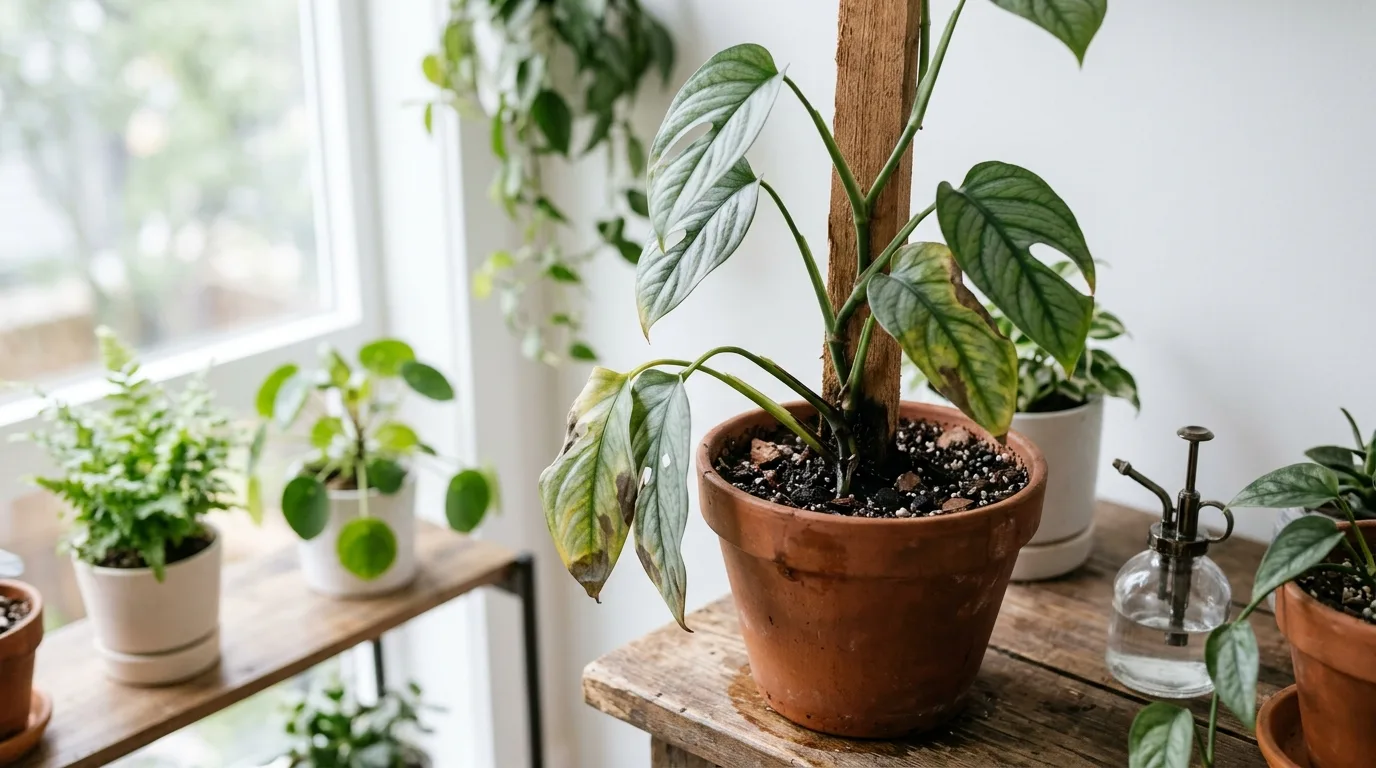
Overwatering on Monstera Siltepecana: Signs, Soil Checks & Fixes
This guide covers overwatering on Monstera Siltepecana. See also the general Overwatering guide, watering, and light pages for this plant.
Overwatering on Monstera Siltepecana: Signs, Soil Checks & Fixes
Quick answer
Overwatering on Monstera siltepecana causes limp, pale yellowing lower foliage while the container remains wet, cold, and noticeably heavy. Because this species is an epiphytic climber adapted to breathable jungle canopies, its underground and aerial root systems suffocate rapidly when confined in dense, waterlogged media. The immediate first action is simple: pause all watering, pour away stagnant water from catch trays or decorative cachepots, and relocate the plant to a spot with bright, indirect light.
Never water a Monstera siltepecana on a rigid weekly routine. Before adding water, test the potting substrate with your finger or a wood dowel to confirm that the top 3–5 cm (1–2 inches) has dried out completely. If the plant continues to droop despite saturated soil, check for root decay, aerate the surface mix, and prepare to transition the vine into an open, chunky aroid blend containing coarse orchid bark and perlite.
What overwatering looks like on Monstera siltepecana
Recognizing overwatering on Monstera siltepecana begins with understanding its distinctive foliage. In its juvenile form, this plant produces lance-shaped, iridescent silver-green leaves mapped with delicate, deep green veins. When roots are deprived of oxygen, that vibrant metallic luster fades into a dull, watery chartreuse, starting on the oldest leaves closest to the soil line. Unlike the crisp, brittle edges caused by underwatering, overwatered leaves feel strangely limp, soft, and cool to the touch.
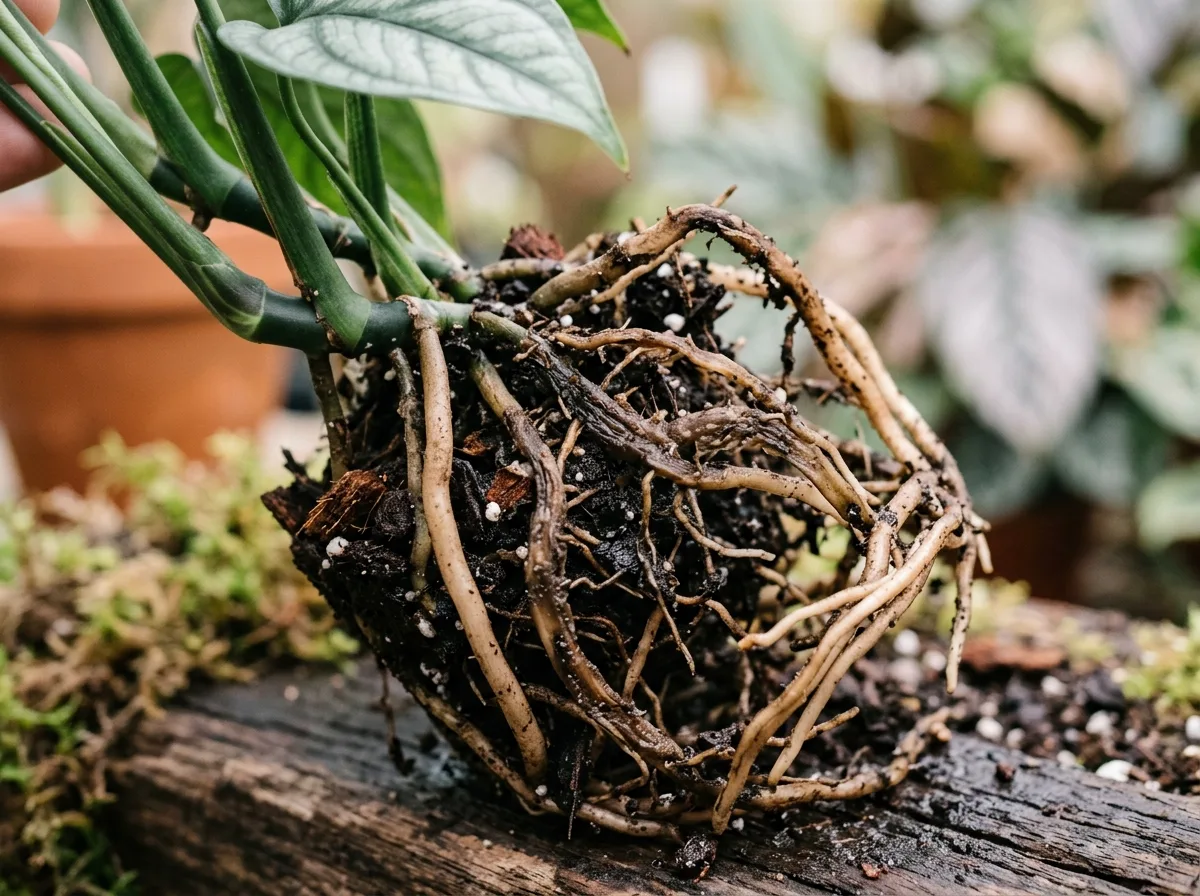
Overwatered Monstera siltepecana foliage develops translucent chlorosis and limp petioles as root hypoxia halts nutrient and water uptake.
As moisture saturation continues, several progressive symptoms appear across the vine:
- Lower leaf chlorosis: The oldest leaves at the base of trailing runners or climbing stems lose their dark green venation, turning an even butter-yellow before collapsing.
- Persistent guttation: Heavy morning water droplets collect at leaf margins and tips. While minor guttation is normal transpiration pressure, chronic weeping leaves mineral spots and indicates the root system is forced to absorb excess moisture under saturated soil conditions.
- Leaf edema: Small water-soaked blisters develop on the abaxial (underside) surfaces of juvenile leaves, which eventually rupture and form brown, corky scars.
- Soft, blackened petiolar sheaths: The delicate sheath at the node where new leaves unfurl becomes waterlogged, turning dark brown or slimy black, often causing unopened leaves to rot before emerging.
- Foul soil odor and surface fungus: The potting mix emits a sour, swampy smell as anaerobic bacteria proliferate, accompanied by surface mold or swarming fungus gnats.
For broader background on how waterlogged soils compromise plant cellular function across houseplant families, consult our comprehensive overwatering guide. On Monstera siltepecana, however, the damage is uniquely shaped by its epiphytic anatomy and dimorphic vining habit.
How overwatering attacks Monstera siltepecana’s epiphytic root network
In the tropical forests of southern Mexico and Central America, Monstera siltepecana lives as a nomadic epiphyte. It begins life on the forest floor before climbing tree trunks toward the canopy, utilizing specialized adventitious roots to clasp rough bark. According to NC State Extension, this climbing aroid demands a moist but well-drained, porous growing medium that replicates its native sub-tropical environment.
The root system of Monstera siltepecana is anatomically adapted for rapid gas exchange. Its roots possess wide cortical air spaces that require atmospheric oxygen (O2) to fuel cellular respiration and synthesize adenosine triphosphate (ATP). When a container is saturated with water, pore spaces fill completely, driving out air. As explained by the Royal Horticultural Society (RHS), oxygen diffusion through water is thousands of times slower than through ambient air pores. Within 24 to 48 hours of soil saturation, the root zone enters anoxia (total oxygen depletion).
Without oxygen, the root hairs cannot generate the energy needed to power active nutrient transport. Starved of essential ions—especially mobile nitrogen, iron, and magnesium—the plant mobilizes stored nutrients from its lower juvenile leaves, causing the characteristic bottom-up yellowing. Paradoxically, as root cells die from oxygen starvation, the plant loses its hydraulic absorption capacity. Even though the root ball sits in wet mud, the vine wilts from lack of water reaching the upper foliage. If saturation continues unchecked, opportunistic water molds such as Pythium and Phytophthora invade the collapsed root tissue, transitioning simple overwatering into destructive root rot on Monstera siltepecana.
Petiolar sheath collapse vs leaf blade yellowing
One of the most critical plant-specific diagnostic indicators on Monstera siltepecana is what occurs at the petiolar node. In juvenile siltepecana, each new leaf emerges from a protective petiolar sheath (the sheathing base of the preceding petiole) that clasps the slender vine. When grown in overly wet conditions with poor air movement, water droplets and guttation fluid accumulate inside these narrow nodal crevices.
This creates a localized microclimate of high moisture and stagnant air. While the main leaf blade may initially appear green, the basal sheath turns soggy, dark brown, and black. If you gently pull on the petiole of an overwatered leaf, it will frequently detach cleanly from the main stem with a wet, soft click, leaving behind a small, discolored scar.
In contrast, if a leaf is yellowing purely due to natural senescence or insufficient light, the petiole remains firm, fibrous, and resilient until the blade has dried out completely. Observing black, mushy tissue at the leaf attachment point is an urgent signal that soil moisture has overwhelmed the plant’s vascular defenses.
Moss pole moisture traps and trailing basket drainage risks
How you train your Monstera siltepecana significantly alters its overwatering vulnerability:
Trailing hanging baskets
When grown as a trailing specimen in a hanging basket, siltepecana stays in its juvenile silver state. Hanging baskets, however, are frequently suspended near ceilings where warm air collects, causing the top centimeter of soil to dry quickly while the bottom remains waterlogged. Growers touch the surface, assume the plant is thirsty, and add more water. Because hanging baskets often have integrated drip trays that trap runoff, the lower 40% of the root ball sits continuously submerged in an anaerobic perched water table.
Climbing moss poles and wood boards
If you train the vine upward on a sphagnum moss pole or cedar plank to encourage mature, fenestrated foliage, a different moisture trap emerges. Growers mist or drench the moss pole daily to encourage aerial roots to embed. That excess moisture trickles down the support core directly into the base of the container. While you may only “water” the pot once every two weeks, the moss pole runoff keeps the central root crown perpetually saturated. To prevent this, aerial roots should be hydrated with targeted spray, while the pot substrate is managed independently based on depth moisture.
Diagnostic inspection: Confirming wet-soil stress step-by-step
Before making drastic care changes or pruning foliage, execute this five-step physical diagnostic routine:
- Perform the 3–5 cm finger and dowel check: Insert a wooden skewer or clean finger 3 to 5 cm (1 to 2 inches) deep into the root zone. If the skewer emerges dark, damp, and clinging with heavy potting peat, the soil is saturated. Clemson Cooperative Extension emphasizes that watering schedules must vary based on container size and light levels, making direct root-zone moisture checks far superior to a calendar routine.
- Weigh the container by lifting: Lift the pot. A waterlogged pot feels dense, heavy, and cold at the base. A pot that has reached the proper dry-down threshold feels surprisingly light and balanced.
- Inspect the drainage holes and saucer: Remove any decorative cachepot or saucer cover. Check whether stagnant water is pooling beneath the nursery container. Water standing for more than 30 minutes after watering suffocates lower root tips.
- Sniff the drainage holes: Healthy aroid soil smells fresh and earthy. An overwatered container with active root hypoxia produces a distinctive sour, marshy, or sulfurous odor caused by anaerobic microbial breakdown.
- Examine stem firmness at the soil line: Gently pinch the main climbing runner or trailing stems right where they meet the substrate. Healthy siltepecana stems feel tough, wiry, and fibrous. Stems suffering from waterlogged rot feel spongy, hollow, or slippery.
Lookalike symptoms and differential diagnosis
Do not assume every yellow or limp leaf is caused by overwatering. Compare your plant’s symptoms against this differential diagnosis table to rule out lookalikes:
| Problem / Stressor | Key Visual Symptoms | Soil Moisture & Pot Weight | How to Tell Apart from Overwatering | Sibling Guide |
|---|---|---|---|---|
| Overwatering | Lower leaves turn translucent yellow and limp; petioles soften; persistent guttation; edema blisters. | Mix is saturated, cool, and soggy 3–5 cm down; pot feels noticeably heavy. | Foliage droops while soil is wet; base of petioles shows dark water-soaking. | Current Guide |
| Underwatering | Entire vine wilts; leaves curl inward along central vein; leaf tips become paper-crisp and brown. | Mix is dry throughout; soil shrinks away from container rim; pot feels feather-light. | Plant perks up rapidly within 4–8 hours after a thorough drench; no yellowing mush. | Underwatering |
| Root Rot | Widespread leaf yellowing, rapid leaf drop, vine collapse, blackened stems near the soil surface. | Persistently wet; sour or rotting odor; roots are dark brown/black, hollow, and slimy. | Root rot is the fungal consequence of chronic overwatering; roots pull apart easily when tugged. | Root Rot |
| Low Light | Vine stretches with elongated internodes; leaves become small, sparse, and pale green; soil dries very slowly. | Pot takes 2–3 weeks to dry out; surface may develop white salt crust or algae. | Stems are leggy; foliage lacks silver contrast but does not exhibit soft waterlogged rot. | Not Enough Light |
| Natural Aging | A single oldest leaf at the very base of the stem yellows slowly over 2–3 weeks while upper growth thrives. | Normal dry-down cycle (top 3–5 cm dries every 7–10 days in active season). | Isolated to one leaf at a time; stem is firm; new climbing leaves emerge vigorously. | Yellow Leaves |
| Spider Mites | Fine yellow stippling across silver leaf surfaces; dusty webbing beneath leaves; leaves look faded. | Variable; often coincides with warm, dry indoor air. | Tiny moving specks on leaf undersides; leaf texture is dusty rather than limp and waterlogged. | Spider Mites |
First fix for an overwatered Monstera siltepecana
When you confirm that your Monstera siltepecana is overwatered, apply this single, critical first fix immediately:
The First Fix: Immediately withhold all water, extract the plant from any decorative outer cachepot, and empty all standing water from the saucer. Place the nursery pot on an elevated wire rack or folded paper towels in a warm location with bright, indirect sunlight to maximize air contact around the drainage holes.
Do not fertilize, do not prune healthy vines, and do not drench the plant with chemical fungicides on day one. Adding fertilizer salts to hypoxic, damaged roots causes severe chemical burning, while aggressive pruning removes the foliage the plant needs to drive transpiration and pull moisture out of the soggy soil.
Allow the pot to breathe undisturbed until the top 3–5 cm of substrate has dried out and the pot feels noticeably lighter. This resting period allows air to re-enter soil macropores, halting cell death and giving surviving root hairs an opportunity to stabilize.
Secondary recovery steps: Root inspection, aeration, and mix overhaul
Once the first fix has halted immediate waterlogging, determine whether passive recovery or active intervention is needed based on how the plant responds over 48 to 72 hours.
Step 1: Gentle surface aeration
If the potting soil is dense and compacted, use a sanitized wooden chopstick to poke 8 to 12 vertical ventilation holes 5–8 cm deep into the upper root zone, taking care not to impale major central root branches. This creates direct air chimneys that accelerate evaporation and deliver oxygen to suffocating roots without disturbing the delicate root ball.
Step 2: Elevate indirect light and airflow
Transpiration is the primary engine that removes water from potting mix. Relocate the plant to a position receiving strong, bright indirect light—such as near an unobstructed east-facing window or 1 to 2 meters back from a south/west window protected by sheer curtains. According to Penn State Extension, environmental adjustments that stimulate natural metabolic activity help houseplants process soil moisture efficiently. A gentle ceiling fan or oscillating room fan set to low speed increases boundary-layer air exchange, further speeding soil drying.
Step 3: Unpotting and root inspection (for severe cases)
If the potting mix remains soggy after 5 days, if a foul odor is noticeable, or if stems continue to soften, you must inspect the underground root system:
- Support the vine stems gently, turn the pot slightly sideways, and ease the root ball out of the container.
- Carefully brush away loose, waterlogged peat to reveal the root architecture.
- Healthy Monstera siltepecana roots are firm, flexible, and creamy white or light tan. As described by the University of Wisconsin Horticulture Division, rotted roots appear dark brown or black, feel mushy and hollow, and easily slough off when lightly pulled, leaving a thin wire-like vascular core.
- Using bypass pruners sterilized with 70% isopropyl alcohol, snip away all diseased, discolored roots back to clean, firm tissue.
       ┌────────────────────────────────────────────────────────┐
       │     Overwatered Monstera siltepecana Root Decision     │
       └──────────────────────────┬─────────────────────────────┘
                                  │
                    Unpot & Inspect Root System
                                  │
         ┌────────────────────────┼────────────────────────┐
         ▼                        ▼                        ▼
     >50% Healthy              30%–50% Healthy          <30% Healthy
  (Firm creamy-white)       (Moderate rot present)   (Extensive collapse)
         │                        │                        │
    Trim rotted tips         Prune dead roots         Execute Node Salvage
    Repot same size pot      Downsize pot 2–3 cm      Take 2-node cuttings
    Chunky aroid mix         Reduce vine mass 25%     Dust cuts with sulfur
    Bright indirect light    Sterile chunky mix       Root in damp perlite
Step 4: Repot into an airy, chunky aroid substrate
Never return an overwatered aroid to standard dense peat-based houseplant soil. The University of Florida IFAS Extension highlights the necessity of using highly porous, well-aerated growing media for tropical indoor plants to avoid moisture saturation.
Prepare a custom chunky aroid blend that guarantees rapid drainage while retaining adequate humidity around root surfaces:
- 40% Chunky Orchid Bark (Medium grade): Provides structural pore spaces, structural anchorage, and mimics canopy tree bark.
- 25% Coarse Perlite or Horticultural Pumice: Resists soil compaction, maintains long-term macropores, and allows immediate drainage.
- 20% High-quality Peat Moss or Coco Coir: Supplies baseline moisture retention and maintains an optimal acidic-to-neutral pH between 5.5 and 7.0.
- 15% Horticultural Charcoal or Extra Pumice: Improves aeration, sweetens the mix, and absorbs organic impurities from decomposing matter.
Grower Rule: Do not add worm castings, compost, or fertilizer to the triage mix. Recovering root wounds must not sit in organic manures or fertilizer salts until the vine has produced two consecutive healthy leaves.
Select a container with multiple functional bottom drainage holes—preferably an unglazed terracotta pot or a clear plastic nursery pot. Terracotta is porous, allowing moisture to wick outward through the pot walls, while clear plastic allows you to monitor root growth and moisture distribution visually without disturbing the plant. For complete potting procedures, read our Monstera siltepecana soil guide and repotting guide.
Emergency propagation: Rescuing vines via stem node cuttings
If root rot has consumed more than 70% of the subterranean root system, attempting to rehabilitate the remaining root ball often fails as the rotting tissue spreads into the crown. In this scenario, your most reliable path forward is vegetative propagation to start a vigorous new plant:
- Identify healthy climbing or trailing runners: Look for firm green vine segments that have intact nodes and firm, undamaged silver leaves.
- Sever single- or double-node cuttings: Using a sterilized razor blade, make clean horizontal cuts approximately 1.5 cm below each node. Ensure each cutting includes at least one healthy leaf and a visible root nodule or aerial root nub.
- Antiseptic treatment & callusing: Dust cut ends lightly with micronized sulfur powder or powdered activated charcoal. Place the cuttings on a clean paper towel in a shaded room for 2 to 3 hours so the cut wounds form a protective dry callus.
- Root in high-oxygen media: Avoid rooting overwatered vine cuttings in stagnant standing water, which can trigger stem rot. Instead, insert the node into moist, well-aerated sphagnum moss or coarse horticultural perlite kept lightly humid under a clear humidity dome or plastic bag.
- Establish roots: Keep the cuttings in warm conditions (21–27°C / 70–80°F) under bright indirect light. Within 3 to 4 weeks, fresh, white adventitious roots will emerge from the node, ready for potting into chunky aroid mix.
Recovery timeline and realistic expectations
Rebuilding a healthy root network after overwatering requires patience. Track your plant’s recovery against these realistic milestones:
- Days 1 to 5 (Stabilization phase): Soil moisture recedes toward the top 3–5 cm dry line. Guttation droplets stop forming on leaf tips each morning. Irreversibly damaged lower leaves will turn fully yellow and should be pruned off at the stem margin.
- Weeks 2 to 3 (Root regeneration phase): The remaining healthy foliage stops drooping and regains firm turgor pressure. Leaf petioles hold themselves upright at their normal angles. The vine produces no new leaves during this period because metabolic energy is directed underground toward growing fresh lateral root hairs.
- Weeks 4 to 6 (New vegetative growth): Once the root system re-establishes capillary balance, a fresh, tightly rolled silver leaf shoot will emerge from the terminal climbing tip or active auxiliary nodes. Inspect this first new leaf: it should unfurl clean, glossy silver-green, with crisp edges and no brown tips or edema blisters.
- Months 2 to 3 (Full recovery): The vine resumes vigorous seasonal climbing or trailing. Pot dry-down returns to a predictable 7–10 day cadence in active growing conditions.
Critical mistakes to avoid during recovery
Well-intentioned plant owners often compound overwatering damage by making these preventable errors:
- Applying chemical fertilizer to “boost” the plant: Stressed, oxygen-starved roots cannot absorb nutrient salts. Applying liquid fertilizer coats fragile root tissue with chemical salts, causing severe dehydration and fertilizer burn. Withhold all fertilizer until the plant has produced two consecutive healthy new leaves.
- Repotting into an oversized container: Up-potting an overwatered plant into a larger pot adds excess uncolonized soil mass that stays wet for weeks, creating a persistent perched water table that accelerates rot. If repotting, use a container that matches the current root ball volume with no more than 2–3 cm of space around the roots.
- Misting yellowing leaves: Spraying water onto foliage that is already struggling with root hypoxia raises humidity around saturated tissues, inviting fungal leaf spot pathogens like Colletotrichum into soft petiolar sheaths.
- Sticking to a rigid calendar schedule: Watering every Saturday regardless of weather or season is the single most common cause of overwatering. Environmental variables such as seasonal light shifts, humidity, and room temperature constantly alter water uptake.
- Relying solely on surface moisture: Peat-heavy mixes can feel dry and dusty on the top half-centimeter while remaining saturated mud at the bottom. Always check the top 3–5 cm.
How to prevent overwatering long-term
Long-term success with Monstera siltepecana relies on establishing care habits that respect its native epiphytic physiology:
- Observe the top 3–5 cm dry-down rule: Only water when the upper substrate has dried out and the pot feels light to lift. During summer active growth, this typically occurs every 7 to 10 days in bright light; during cooler winter months, dry-down may take 14 to 20 days.
- Drench thoroughly, then drain completely: When watering is needed, water the mix evenly until moisture flows freely from the bottom drainage holes, flushing out accumulated salts. Allow the pot to drain completely for 15 minutes, then immediately discard all water collected in the saucer or cachepot. Consult our detailed Monstera siltepecana watering guide for seasonal watering strategies.
- Provide bright, filtered sunlight: Give your siltepecana plenty of bright, indirect sunlight near an east or filtered south window. As noted by NC State Extension, direct harsh sun can scorch the silver leaves, but sufficient indirect light is essential to drive steady photosynthesis and healthy water transpiration. Check our Monstera siltepecana light guide for lux and placement targets.
- Use breathable pots and porous mix: Always grow this species in containers with unimpeded drainage holes filled with an open, bark-rich aroid blend.
- Adjust for seasonal shifts: In late autumn and winter, indoor temperatures drop and daylight hours shorten. The plant enters semi-dormancy, drastically slowing water consumption. Reduce watering frequency accordingly and keep the vine away from cold window drafts or blasting heating vents.
Related tool
To determine the ideal watering cadence for your specific pot size, mix porosity, light exposure, and ambient home humidity, calculate your plant’s custom moisture schedule with our interactive tool:
Calculate your plant’s custom watering schedule with the Plant Watering Calculator.
When to use this page vs other Monstera siltepecana guides
Understanding where your plant’s symptoms fit within our care library ensures you apply the correct remedy:
- Use this Overwatering guide when lower silver leaves turn soft yellow, the potting container feels heavy and wet, and the top 3–5 cm has not dried out.
- Use the Root Rot guide when the soil emits a sour, swampy odor, stems collapse into dark mush at the soil line, or an unpotted inspection reveals blackened, decaying roots.
- Use the Yellow Leaves guide if you are uncertain whether leaf yellowing is caused by natural leaf senescence, nitrogen deficiency, light stress, or improper hydration.
- Use the Drooping Leaves guide when the vine loses turgor pressure but you need to distinguish between underwatering, root injury, and normal trailing runner growth.
- Use the Mold on Soil guide if a fuzzy white or yellowish harmless saprophytic fungal film appears on the substrate surface without deep root decay.
- Use the Underwatering guide when the pot is feather-light, the mix has pulled away from the container edges, and leaf margins are dry, curled, and crispy.
Related Monstera siltepecana guides
Deepen your cultivation knowledge with our comprehensive per-plant guides:
- Monstera siltepecana Plant Overview: Explore complete species morphology, natural habitat, and juvenile versus adult growth characteristics.
- Monstera siltepecana Watering Guide: Master seasonal dry-down cycles, water quality considerations, and bottom-watering techniques.
- Monstera siltepecana Soil Guide: Step-by-step recipes for blending chunky, high-oxygen epiphytic aroid substrates.
- Monstera siltepecana Repotting Guide: How to up-pot root-bound vines without damaging fragile aerial roots or triggering transplant shock.
- Monstera siltepecana Problems Hub: A complete visual directory diagnosing common pests, fungal pathogens, and environmental disorders.