Not Enough Light for Monstera Siltepecana: Signs &
Quick answer
When Monstera siltepecana receives insufficient light, its juvenile leaves lose their distinctive silvery sheen and turn a dull dark green, internodes stretch into sparse vines, and new growth slows or stops. Because low light drastically reduces transpiration, potting soil stays dangerously wet for weeks, increasing the risk of root rot. Move the plant immediately closer to an east-facing window or filtered south-facing exposure providing 10,000–20,000 lux (200–800 foot-candles) of bright indirect light.
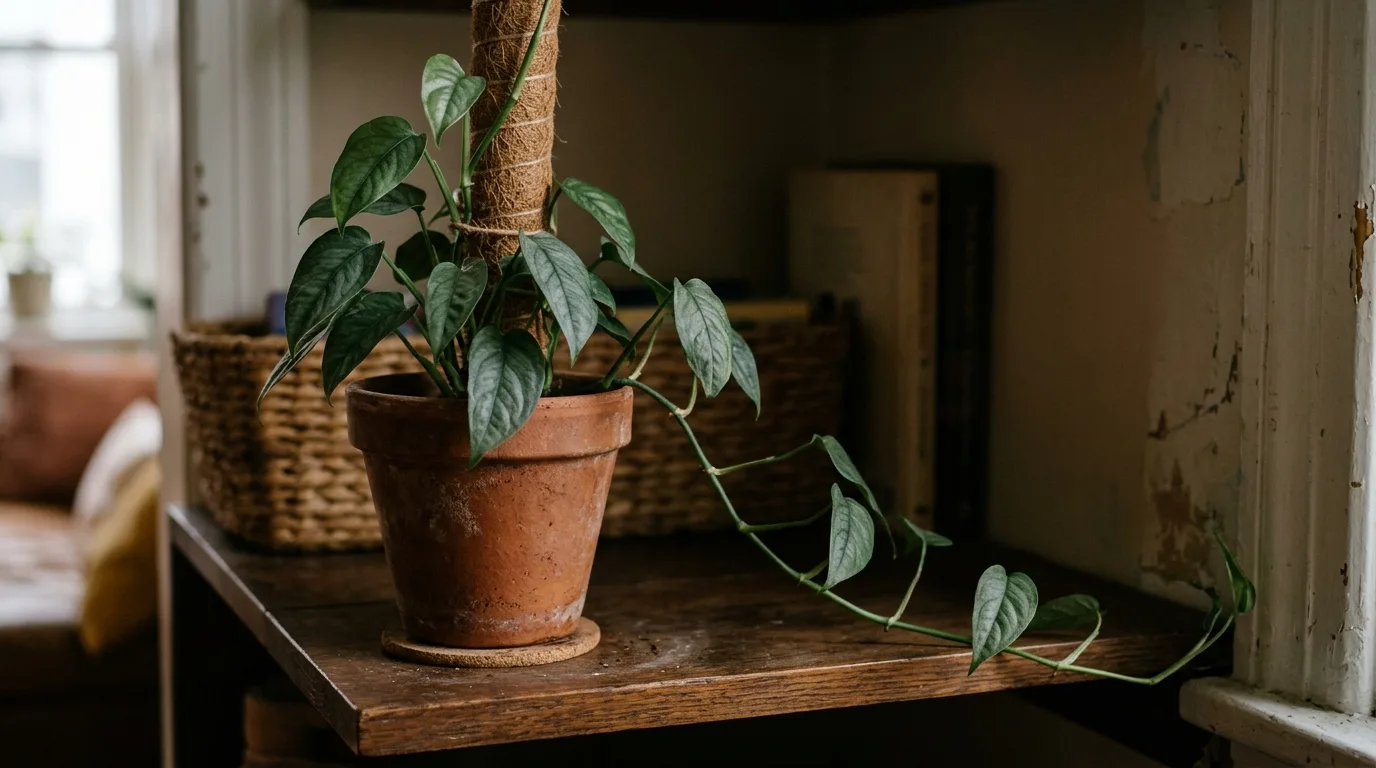
Not Enough Light for Monstera Siltepecana: Signs & Corrections
This guide covers not enough light on Monstera Siltepecana. See also the general Not Enough Light guide, watering, and light pages for this plant.
Not Enough Light for Monstera Siltepecana: Signs & Corrections
Quick answer
When Monstera siltepecana suffers from insufficient light, it exhibits a distinct combination of leaf fading, vine stretching, and sluggish root uptake. The plant’s standout juvenile hallmark—a shimmering silvery-gray pattern woven between deep green veins—gradually vanishes, leaving the foliage looking flat, dull, and uniformly dark green. Simultaneously, stem internodes stretch into spindly, bare runners as the vine expends valuable carbohydrates searching for a photon source, and new leaf blades emerge progressively smaller or stall completely.
Because reduced solar radiation causes plant stomata to close and slashes transpiration rates, the potting mix stays waterlogged far longer than normal, transforming light starvation into an acute root-suffocation hazard. The first step is to gently transition the plant to a location receiving 10,000–20,000 lux (200–800 foot-candles) of bright indirect daylight—such as directly beside an east-facing window or two to four feet back from a sheer-filtered south window. Do not prune, fertilize, or repot on day one; stabilizing energy intake and confirming root health must come first.
For general houseplant lighting dynamics and foot-candle requirements, consult our not enough light symptom guide. On Monstera siltepecana, however, the diagnostic clues are intimately bound to its dimorphic climbing habit and unique foliar anatomy.
What not enough light looks like on Monstera siltepecana
Recognizing light deficiency on Monstera siltepecana requires looking beyond simple stem elongation. As an epiphytic climbing aroid native to the tropical forests of southern Mexico and Central America, this species possesses specialized cellular adaptations that react rapidly when illumination falls below metabolic maintenance thresholds.
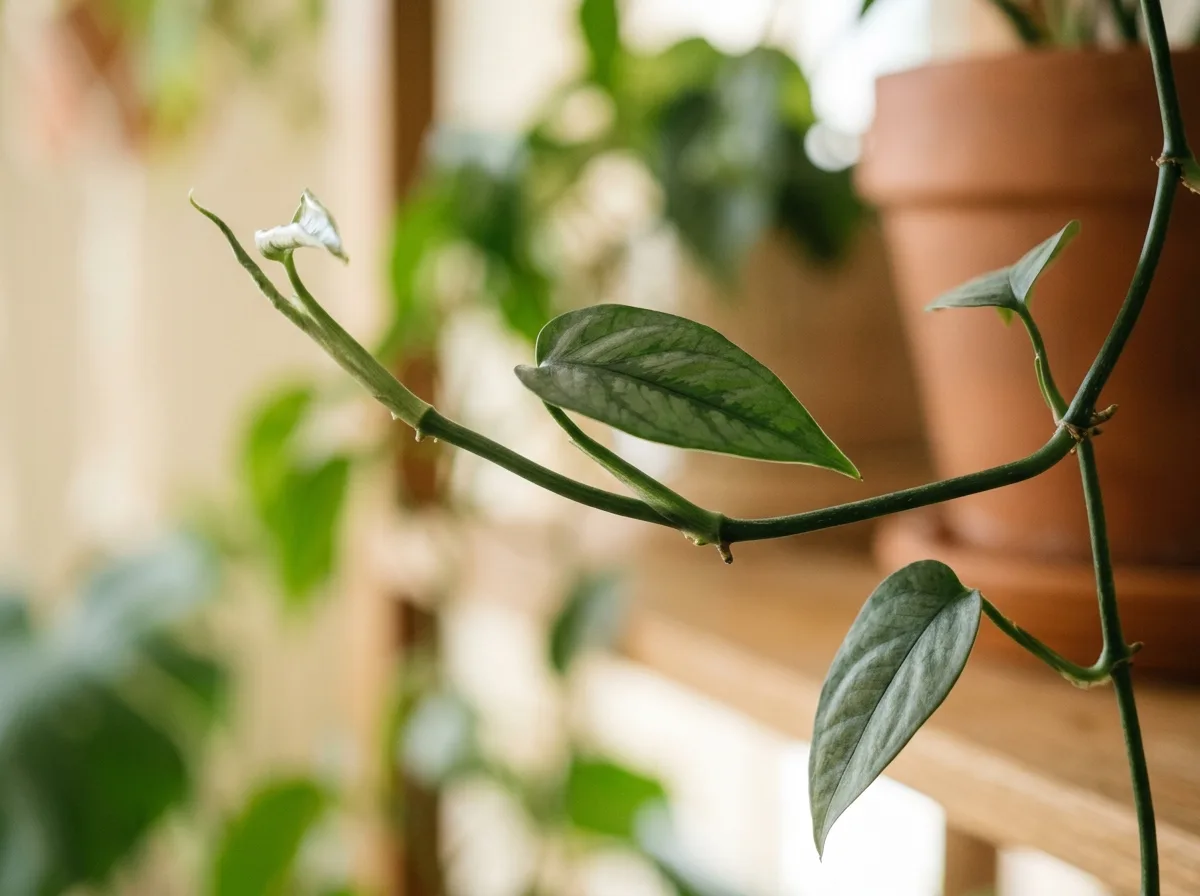
In low light, Monstera siltepecana internodes stretch into spindly bare stems while emerging juvenile leaves lose their reflective silver sheen, turning flat and dull dark green.
The visible signs typically unfold across three distinct morphological changes:
Faded silver sheen and dull dark green foliage
In its healthy juvenile phase, Monstera siltepecana displays striking silver-green lanceolate leaves highlighted by dark green primary veins. NC State Extension indicates that this silvery juvenile foliage is characteristic of the species before it climbs. This silvery sheen is an optical effect known as epidermal blister variegation, created by tiny, reflective intercellular air pockets located directly beneath the upper cuticle.
When the vine is positioned in deep shade or several feet away from usable daylight, the plant compensates by maximizing photosynthetic capture. Chloroplast density increases within the palisade mesophyll, and cells rearrange to absorb every available photon. As green chlorophyll saturates the leaf tissue, the optical contrast created by the air blisters is drowned out. The leaf surface loses its metallic luminescence and shifts into a muddy, dull, dark green. If newer leaves appear flat and matte rather than bright and silvery, the plant is signaling that its current position is far too dark.
Etiolation and stretched internodal spacing
Under adequate light, a young Monstera siltepecana produces compact internodes—typically 2 to 4 centimeters apart on a trailing or shingling vine. When light levels plunge below 1,000 lux (roughly 100 foot-candles), the plant initiates an etiolation response driven by the accumulation of the plant growth hormone auxin on the shaded side of the stem.
Instead of developing sturdy, compact nodes capable of anchoring aerial roots, the vine throws out long, thin, rubbery runners with internodes stretching 8 to 15 centimeters apart. These bare stem lengths often bear only tiny, vestigial leaves or rudimentary leaf scales. In a hanging basket, the vine looks straggly and defoliated; on a moss pole, the vine races vertically upward without properly adhering, hunting for canopy light that does not exist. The Spruce notes in its siltepecana care guide that long, sparse stems with widely spaced nodes serve as a primary warning that light levels are inadequate.
Stunted leaf size and halted vine progression
A healthy Monstera siltepecana produces sequentially larger juvenile leaves—usually reaching 8 to 15 centimeters long before climbing maturity. Under prolonged light deficiency, each successive leaf unfurling from the apical shoot is noticeably smaller than the one before it. Eventually, leaf production stops entirely, leaving an inactive terminal bud or an aborted shoot tip that turns brown and dry.
Why Monstera siltepecana suffers in low light
Understanding why Monstera siltepecana fails in low light requires examining its natural forest ecology and internal hydraulic physiology. Unlike terrestrial floor dwellers such as Aspidistra or Aglaonema that have evolved dense photosynthetic structures to thrive on the dim rainforest floor, Monstera siltepecana is an opportunistic hemiepiphyte programmed to climb rapidly toward the canopy.
The collapse of transpiration and the waterlogged soil trap
The most dangerous consequence of low light is not aesthetic—it is hydraulic. Light is the physical engine of transpiration. When photosynthetically active radiation (PAR) strikes the leaf surface, stomatal guard cells take up potassium ions, swelling open to intake carbon dioxide. Water vapor exits through these open stomata, generating negative hydrostatic pressure (transpiration pull) that draws moisture and dissolved nutrients up through the roots.
In a dark room or north-facing alcove, stomata remain largely closed. Photosynthesis drops to near zero, and transpiration slows to a fraction of normal velocity. University of Florida IFAS notes that indoor lighting levels directly govern water consumption, and plants kept in dim spots dry down at a drastically slower pace.
If a grower continues following a standard 7- to 10-day watering schedule, the potting medium stays saturated. The air voids in the mix collapse under stagnant water, driving out dissolved oxygen and creating an anaerobic environment. Deprived of oxygen, fine root hairs die off, allowing opportunistic water molds like Pythium to invade. Consequently, low light frequently manifests as yellowing lower leaves and blackened stem bases—classic symptoms of secondary root rot triggered by light starvation.
Blister variegation mechanics under low photon flux
The silver coloration of Monstera siltepecana is structural rather than chemical. Unlike chimeral variegation (where cells lack chlorophyll entirely, as in Monstera deliciosa ‘Albo’), Monstera siltepecana has chlorophyll throughout its leaf blade, but an upper epidermal separation refracts ambient light to generate a silver shimmer.
In full shade, the plant cannot afford to refract or reflect light away from its light-harvesting complexes. It downregulates structural air spaces and concentrates light-capturing chlorophyll b pigments near the upper leaf layers. While this survival response helps the plant stay alive on minimal light, it completely eliminates the silver patterning that plant parents prize. Restoring sufficient photon density is the only mechanism that triggers the plant to rebuild those reflective epidermal layers in subsequent growth.
Disrupted dimorphic transition and fenestration stall
Monstera siltepecana is a dimorphic species with two distinct morphological phases. NC State’s profile notes that juvenile leaves are small, lance-shaped, and silver-green, while adult leaves become significantly larger, solid green, and develop natural perforations (fenestrations) after the plant climbs a sturdy vertical host.
Growers often wonder why their climbing Monstera siltepecana never develops fenestrations. While a vertical cedar board or moist moss pole provides the structural signal, light provides the energetic fuel. Wisconsin Horticulture Extension explains that climbing Monstera species require abundant light alongside structural support to make the metabolic transition into mature, fenestrated foliage. In low light, the vine remains trapped in an etiolated juvenile state, incapable of producing the carbohydrate reserves needed to synthesize broad, perforated adult leaf blades.
How to confirm insufficient light on your plant
Before altering care routines, systematically confirm that light—rather than a root pathogen, nutrient deficit, or pest infestation—is the genuine root cause. Follow this diagnostic checklist:
- Inspect Internodal Progression: Trace the longest vine from the base to the growing tip. If the older nodes produced leaves every 3–4 cm, but the newest four or five nodes span 8–12 cm with shrinking leaves, you have confirmed classical etiolation.
- Evaluate Foliar Color Contrast: Compare mature leaves formed under nursery conditions with the newest leaves. If the older leaves exhibit sharp silver sheen around distinct green veins, while the newest leaves are uniformly dull, murky green, light starvation is active.
- Measure Usable Foot-Candles or Lux: Human eyes adjust automatically to dim environments, making visual room assessment unreliable. Use a calibrated digital lux meter or smartphone sensor at leaf height:
- Deep Shade (<1,000 lux / <100 fc): Severe light deficit. Plant will decline within 4–8 weeks.
- Low Light (1,000–5,000 lux / 100–250 fc): Bare maintenance level; causes fading, slow growth, and wet-soil risk.
- Bright Indirect (10,000–20,000 lux / 200–800 fc): The target zone for vigorous growth, silver sheen, and sturdy nodes.
- Weigh the Pot and Probe Soil Moisture: Lift the container. If the pot feels heavy and the mix remains saturated 14 days after watering, low transpiration caused by inadequate light is the prime suspect. Confirm the top 3–5 cm dry-down status as detailed in our Monstera siltepecana watering guide.
- Check Stem and Root Firmness: Gently squeeze the vine at the soil line. If the green tissue is firm and wire-like, the vascular system is intact. If the base feels soft, brown, or smells sour, unpot immediately to inspect for root decay before adjusting light.
The first fix: reposition into bright indirect daylight
The first and most critical action is to increase usable photosynthetically active radiation without causing solar shock. Do not fertilize, do not repot, and do not prune heavily on day one.
Select the ideal window exposure
Move your Monstera siltepecana into a position that receives generous indirect light throughout the morning or filtered ambient light all day:
- East-Facing Windows (Ideal): An unobstructed east sill provides gentle morning sun and bright ambient sky light for the rest of the day. The cool morning rays provide high photosynthetic value without the intense infrared heat that burns thin juvenile foliage.
- South- or West-Facing Windows (With Diffusion): These windows offer exceptional photon flux, but direct midday sun through window glass can heat leaf surfaces beyond 35°C (95°F), scorching the cuticle. Set the pot 2 to 4 feet back from the glass or install a sheer white curtain to diffuse direct beams into a soft, glowing 15,000 lux field.
- North-Facing Windows (Supplemental Only): A north window rarely delivers more than 1,500–3,000 lux in temperate climates—insufficient to maintain rich silver variegation or dense climbing nodes.
UF/IFAS houseplant guidelines categorize light levels for interior plants and highlight that medium to bright indirect light typically ranges between 200 and 800 foot-candles for vigorous foliage tropicals. For species-specific placement nuances, review our dedicated Monstera siltepecana light guide.
Acclimate to prevent photo-bleaching
A plant kept in a dark location produces leaves with thin cuticles and high concentrations of shade-adapted shade pigments. If you thrust a light-starved Monstera siltepecana directly into intense afternoon sun, the chloroplasts become overloaded with energy they cannot process—a phenomenon called photo-inhibition. The leaves develop unsightly yellow-white scorched patches within hours.
Acclimate the vine incrementally over 7 to 10 days. Move it two feet closer to the window every few days, or begin with morning-only exposure before settling it into its permanent bright spot. The Royal Horticultural Society highlights that houseplants need gradual seasonal positioning to avoid tissue scorch when moving from low winter illumination into brighter summer exposures.
Secondary corrections: watering cadence, pruning, and support
Once the vine is settled in its new light footprint, calibrate the rest of your care routine to support its metabolic revival.
Align watering with active transpiration
Because brighter light stimulates transpiration and accelerates nutrient cycling, monitor how fast the soil dries. However, do not immediately pour more water into a pot that is already damp from its time in the shade. Wait until the top 3–5 cm (1–2 inches) of soil is completely dry to the touch before providing a thorough, drenching soak. Ensure excess water drains freely from the pot’s drainage holes, and never allow the container to sit in standing saucer water. For optimal mix formulation, consult our Monstera siltepecana soil guide.
Prune bare etiolated runners selectively
One common disappointment for growers is discovering that previously stretched internodes cannot contract. Once a stem section elongates in darkness, those wide gaps remain permanently bare.
Wait 2 to 3 weeks until the plant produces its first compact, silvery leaf in the new location. Once active growth is confirmed, use sterilized bypass pruners to cut back the bare, stringy runners just above a healthy leaf node. The Spruce advises that pruning stretched stems should be carried out during active growth and that healthy cuttings containing at least one node can be rooted in water or moist sphagnum moss. For detailed pruning protocols, read our Monstera siltepecana pruning guide.
Decide between trailing and vertical climbing support
Light correction provides an opportunity to evaluate your structural setup. If you keep the plant trailing in a hanging basket, bright indirect light will maintain tight, bushy silver juvenile foliage cascading over the rim.
If your ambition is to cultivate mature adult leaves, introduce a moist sphagnum moss pole or cedar plank. Secure the vine flat against the pole with plant velcro at each node. As the aerial roots penetrate the moist support under 15,000+ lux of light, the vine will sense vertical orientation, stimulating progressively broader foliage and eventual fenestration.
Lookalikes and when to use another guide
Because low light often causes symptoms that overlap with watering errors and nutritional issues, use this differential diagnosis table to pinpoint the exact condition:
| Visible Symptom | Most Likely Cause | Diagnostic Check | Next Step |
|---|---|---|---|
| Dull dark green leaves, long bare stems, small new leaves | Insufficient light (etiolation) | Internodes >6 cm; silver sheen vanished; pot dries slowly | Follow the light repositioning steps above; see our leggy growth guide. |
| Lower leaves turn uniform yellow; soil wet 14+ days; soft stems | Overwatering / secondary root rot | Probe roots; check for brown, slimy root tips and sour smell | Unpot, trim necrotic roots, repot in airy mix; refer to watering guide. |
| Crispy brown leaf tips, paper-thin margins, normal internodes | Low ambient humidity / draft stress | Node spacing normal; hygrometer reads <40% RH | Raise humidity to 50–70%; check our Monstera siltepecana problems hub. |
| Pale yellow or bleached patches on leaves directly facing glass | Direct sun scorch (excess light) | Damage localized only to south/west leaf surfaces | Move plant 2–3 feet back from window or install sheer curtain. |
| Stunted growth, short internodes, pale green veins, dry pot | Underwatering or severe root-bound pot | Roots circling tightly; water runs straight through pot | Water thoroughly by bottom soaking; see repotting guide. |
If you are dealing with multiple confounding symptoms across the foliage and root zone, browse the comprehensive Monstera siltepecana problems hub to triage care stressors systematically.
What not to do: common low-light mistakes
When growers realize their Monstera siltepecana is languishing in low light, instinct often leads to well-intentioned interventions that make the problem significantly worse. Avoid these four frequent traps:
- Do Not Apply Fertilizer to Stimulate Growth: Fertilizer is not plant food; light is. Applying synthetic fertilizers to a light-starved vine introduces mineral salts into soil that roots cannot utilize. The unused salts accumulate in the root zone, causing fertilizer burn and root necrosis. Hold all feeding until the vine produces healthy new leaves in bright light, then follow our Monstera siltepecana fertilizer guide.
- Do Not Move Straight into Scorching Midday Sun: Panicking and placing a shade-adapted plant directly onto an unshaded west-facing patio or hot sill will blister the delicate epidermal tissues, causing irreversible sun scorch. Always acclimate gradually.
- Do Not Mist Foliage to Compensate for Slow Growth: Misting leaves does not increase light absorption or raise ambient humidity meaningfully. On a plant struggling in dim conditions with stagnant airflow, wet foliage creates an open invitation for bacterial leaf spot and fungal blights.
- Do Not Repot into a Much Larger Container: A struggling vine in low light has a compromised, inactive root system. Placing it into a larger pot with extra volume of wet soil increases the dry-down window to several weeks, almost guaranteeing fatal root rot.
Recovery timeline and expectations
Recovery on Monstera siltepecana requires realistic botanical expectations. Stems that have already stretched will not shrink, and leaves that turned dull dark green will not regain their silver contrast. Progress is measured strictly by the health of new growth produced after relocation:
- Days 1–7 (Stabilization): The vine stops leaning aggressively toward distant light. Transpiration rates begin to recover, and the potting mix begins drying at a healthier pace.
- Weeks 2–4 (Bud Awakening): The apical shoot or dormant axillary nodes swell. The first new leaf unfolds. Inspect this new leaf carefully: under proper light, it should emerge with crisp, reflective silver markings and a noticeably shorter petiole.
- Weeks 6–10 (Vigorous Extension): Internodal distance normalizes to a tight 2–4 cm. Aerial roots at each node become plump and active, ready to anchor onto a support pole or trail cleanly.
- Months 3+ (Structural Renovation): Once the plant possesses several nodes of vigorous, compact growth, you can safely prune off the older, bare leggy sections formed during its low-light period.
If new leaves continue emerging smaller and dimmer after 4 weeks in a new spot, your window placement may still be insufficient. Measure light levels directly or consider adding an artificial light source.
How to prevent light stress year-round
Maintaining prime illumination for Monstera siltepecana requires proactive seasonal management, especially in homes located in northern latitudes:
Track seasonal sun angles
Indoor light dynamics change dramatically between summer and winter. In summer, the sun is high in the sky, and trees outside windows cast heavy shade. In winter, the sun sits low, days are much shorter, and cloud cover reduces ambient lux. RHS guidelines note that plants positioned safely back from summer windows often need to be moved directly onto windowsills during winter to capture sufficient daylight.
Keep foliar surfaces clean
Indoor dust, aerosolized cooking oils, and mineral residue settle on broad Monstera siltepecana leaves over time. A thin layer of household dust can block 10% to 30% of incident photons from reaching chlorophyll molecules. Wipe the juvenile leaves monthly with a soft, damp microfiber cloth moistened with tepid distilled or filtered water. Do not use commercial chemical leaf shine products, which clog stomata and impede gas exchange.
Supplement with LED grow lights
If your indoor living space lacks bright east- or filtered south-facing windows, artificial lighting offers a predictable, highly controllable solution. Standard household incandescent or warm fluorescent bulbs emit insufficient PAR spectrum and excessive heat.
Opt for a dedicated full-spectrum LED grow light with a high Color Rendering Index (CRI >90) and a color temperature of 4000K–5000K. Position the light source 12 to 18 inches above the vine’s top leaves, providing a Photosynthetic Photon Flux Density (PPFD) of 100–200 µmol/m²/s for 10 to 12 hours daily on an automated timer. This consistent photon flux will maintain vivid silver blister variegation even in windowless interior rooms.
Related Monstera Siltepecana guides
Explore our species-specific care resources to maintain balanced health across all growth factors:
- Monstera Siltepecana Care Overview: Complete botanical profile, juvenile versus adult foliage traits, and native Central American habitat notes.
- Light Guide: Detailed seasonal lux recommendations, window exposure charts, and grow-light distance setups.
- Watering Guide: How to master the top 3–5 cm dry-down test and prevent anaerobic root conditions.
- Problems Hub: Master diagnostic index covering leaf yellowing, brown tips, pests, and root disorders.
- Fertilizer Guide: Balanced NPK feeding schedules tailored to active growth cycles without root burn risk.
- Soil Guide: Aerated aroid potting mix recommendations to avoid compaction and waterlogging.
Related tool
Not sure whether your window setup delivers sufficient foot-candles for Monstera siltepecana? Use our interactive Light Requirement Calculator to calculate exact daylight levels based on your window orientation, glass distance, and season.