Underwatering on Monstera Siltepecana: Signs, Soil
Quick answer
An underwatered Monstera siltepecana displays limp, downward-curling silver leaves, crisp margins, and a feather-light pot pulled away from dry substrate edges. Chunky aroid bark becomes hydrophobic when parched, causing top-poured water to channel out without soaking roots. Bottom-soak the container in lukewarm water for 20–30 minutes to evenly rehydrate the root ball and restore cellular turgor.
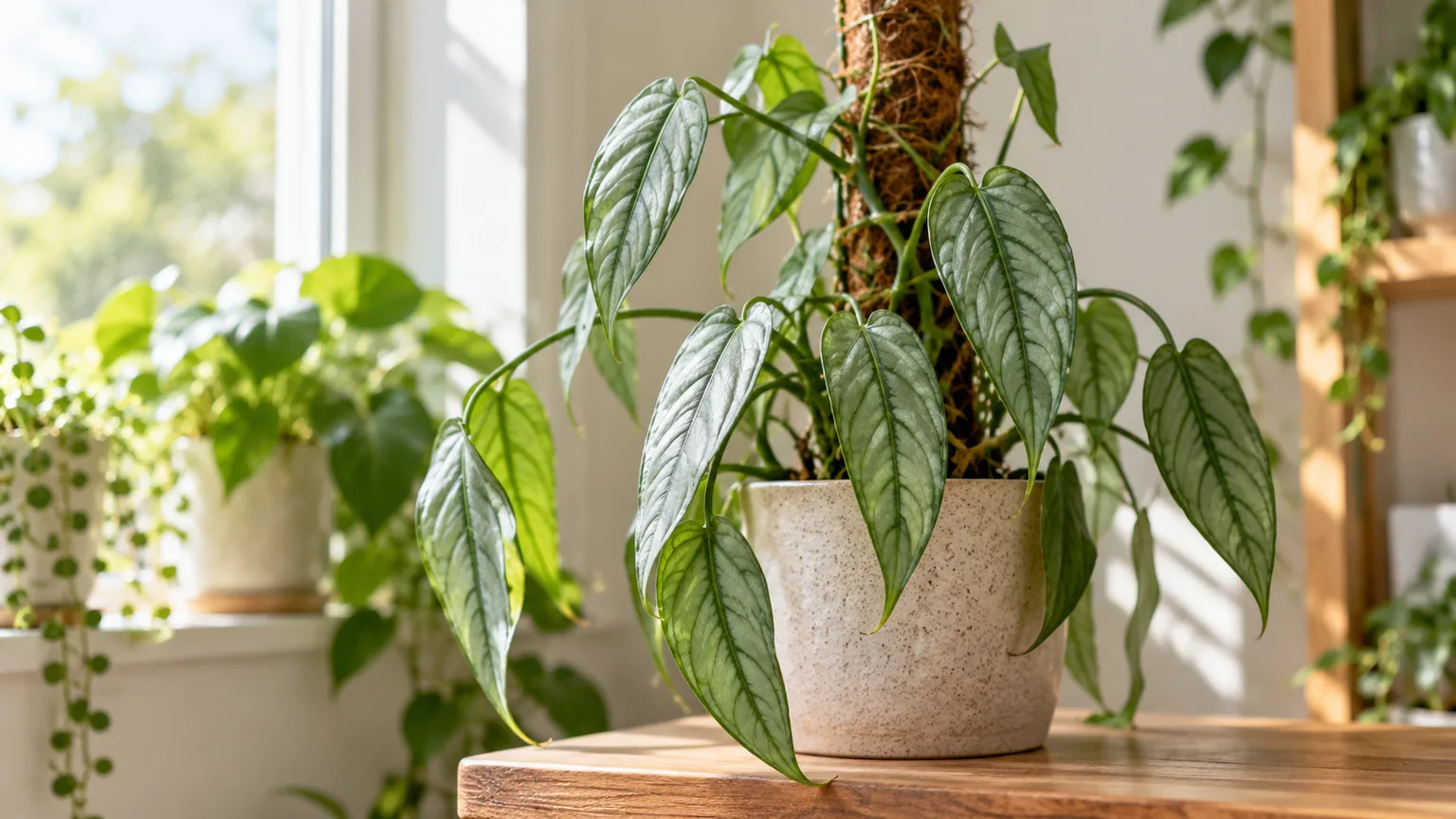
Underwatering on Monstera Siltepecana: Signs, Soil Rehydration & Fixes
This guide covers underwatering on Monstera Siltepecana. See also the general Underwatering guide, watering, and light pages for this plant.
Underwatering on Monstera Siltepecana: Signs, Soil Rehydration & Fixes
By sai-ananth · Reviewed by LeafyPixels Review Board · Methodology: extension cross-check and LeafyPixels cluster validation · Last reviewed August 2026
Quick answer
When a Monstera siltepecana runs short on water, the container weight tells you the truth long before the vine collapses into systemic leaf drop. An underwatered Silver Monstera exhibits limp, soft, inward-curling silver blades, drooping vine petioles, and a feather-light container filled with pale, shrunken substrate that pulls visibly away from the inside pot walls. Because the juvenile leaves of this Central American hemiepiphyte have relatively thin tissue compared to thick succulents or leathery adult monsteras, prolonged water deficit quickly deflates cell vacuoles, causing the plant to lose turgor and assume a deflated, dull appearance.
First step: bottom-soak the nursery pot in a basin of lukewarm water for 20 to 30 minutes. Pouring a small cup of water from the top of bone-dry aroid mix will fail because parched fir bark and peat turn hydrophobic; the water simply races down the gap between the root ball and container side, exiting into the saucer while the inner root core stays completely dry. Submerging the bottom half of the pot allows capillary action to draw moisture up through the entire root zone without dislodging chunky bark chips. Once the top surface feels damp and the pot regains noticeable heft, drain the excess water thoroughly. For the universal mechanics of root desiccation and cellular collapse across houseplants, consult our underwatering symptom guide; on Monstera siltepecana, follow the species-specific diagnosis, rehydration, and prevention steps detailed below.
What underwatering looks like on Monstera Siltepecana
Recognizing drought stress on Monstera siltepecana requires looking closely at leaf texture, vine posture, and pot dynamics. While overwatering on soggy soil produces soft yellowing and blackened stems, underwatering manifests as textural dehydration, crispness, and loss of weight.
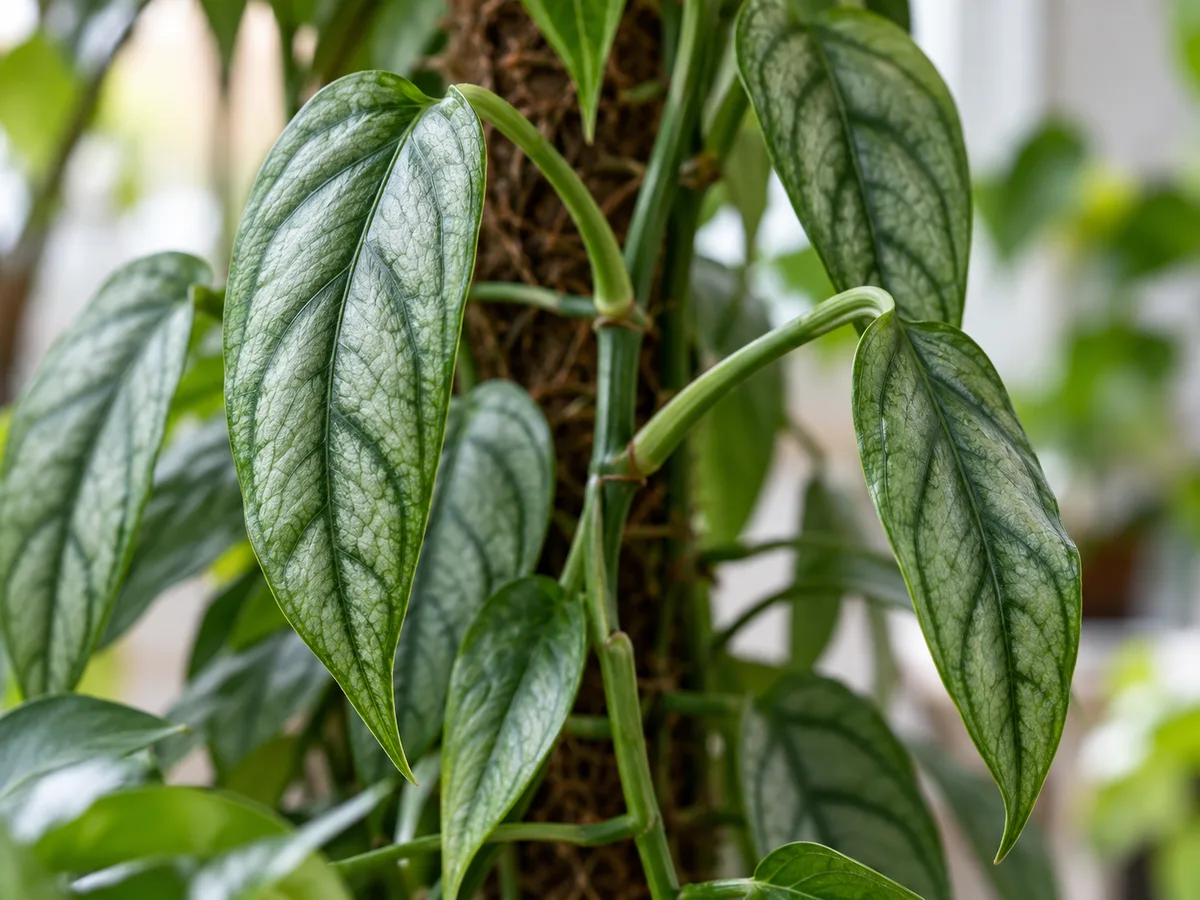
Underwatering symptoms on Monstera siltepecana: thin juvenile leaf curled inward with dry, papery tip while the coarse aroid substrate pulls away from the container edge.
Here is how thirst presents across different plant structures:
- Inward leaf rolling and curling: The juvenile lanceolate leaves curl lengthwise along their margins, rolling slightly inward to reduce exposed surface area and conserve internal moisture.
- Limp, downward-drooping petioles: Petioles lose hydrostatic pressure and sag. On trailing basket specimens, the vines hang limp and vertically lifeless rather than cascading in gentle, bouncy arcs. On climbing poles, leaves point downward against the moss or wood.
- Loss of silver blister variegation and metallic sheen: Healthy juvenile leaves boast an iridescent silver-gray wash between dark green primary veins, as documented by NC State Extension. Botanically, this coloration is a structural “blister variegation” created by sub-epidermal intercellular air pockets that reflect ambient light. Under chronic moisture stress, the loss of cellular vacuolar turgor collapses these reflective air cavities against underlying mesophyll, causing the foliage to lose its metallic luster and look dull, matte grayish-green.
- Crisp, papery leaf tips and margins: Fine leaf edges turn brown and brittle. Unlike the soft, water-soaked brown patches seen in fungal leaf spot or overwatering, underwatered leaf tissue feels like dry parchment and will crumble between your fingers.
- Contracted, hydrophobic substrate: The potting mix shrinks in volume as organic matter loses moisture. A distinct air gap appears between the substrate perimeter and the pot wall, with dusty bark particles sitting loose on the surface.
- Feather-light container: When you lift the pot, it feels shockingly light, as if filled with empty styrofoam pellets rather than nutrient-holding media.
- Aerial root desiccation: Aerial roots intended to grip climbing poles turn shriveled, brittle, and gray-brown, losing the soft green or white growing tips characteristic of active hydration.
The hallmark confirmation on Monstera siltepecana is how rapidly limp foliage responds to thorough rehydration. If leaves perk up, flatten out, and regain their bouncy turgor within 4 to 12 hours of soaking, the issue was purely thirst. If limp leaves remain collapsed despite heavy watering, the root system is damaged and cannot absorb moisture—meaning you must inspect for Monstera siltepecana root rot or advanced fungal collapse.
Three species-specific factors that accelerate drought
Monstera siltepecana behaves differently from standard indoor monsteras like Monstera deliciosa. Understanding its unique botanical traits reveals why it is prone to sudden, severe drying episodes.
1. Thin juvenile foliage vs. adult coriaceous climbing leaves
Monstera siltepecana is a dimorphic climber. In its juvenile stage—which most indoor growers keep in hanging baskets or small pots—its leaves are lance-shaped, delicate, and relatively thin. Unlike the thick, leathery (coriaceous) leaves of mature Monstera deliciosa, juvenile siltepecana leaves have limited water-storage capacity. When water in the root zone is exhausted, transpirational pull empties leaf cells rapidly.
If your plant is climbing a cedar board or moss pole and beginning to transition toward larger, slightly perforated adult foliage, moisture demands climb steeply. According to Penn State Extension, transpiration rates accelerate significantly under bright light. A climbing specimen with expanding leaf surface area will consume water twice as fast as a trailing juvenile plant, causing rapid dry-down.
2. Hydrophobic chunk collapse in coarse aroid mix
LeafyPixels recommends growing Monstera siltepecana in an open, aerated substrate composed of quality potting soil, perlite, and coarse orchid bark. The University of Florida IFAS Extension (EP512) highlights that epiphytic aroids require porous, well-draining media to maintain high oxygen levels around roots. However, coarse pine bark and peat moss possess a distinct physical vulnerability: extreme hydrophobicity when dried past a critical threshold.
When you miss a watering session during a warm week, the bark chips and peat particles dry completely. Waxy organic substances on the bark repel liquid water. If you water from above with a watering can, surface tension prevents the water from soaking into the bark chips. Instead, the water takes the path of least resistance—flowing straight down the shrinkage gap along the inside edge of the pot and draining out the bottom holes within five seconds. Growers see water pooling in the saucer, assume the plant has been fully watered, and discard the runoff, leaving the root ball 95% dry.
3. The moss pole moisture trap and aerial root starvation
When trained vertically to encourage larger leaves, Monstera siltepecana produces adventitious aerial roots at every node. As noted by Wisconsin Horticulture Extension, aerial roots on climbing monsteras function to absorb environmental moisture and supplemental nutrients from climbing supports.
Unlike smooth coir poles—which shed water and resist root entry—sphagnum moss poles hold moisture that adventitious roots can actually penetrate. However, when indoor air drops below 40% humidity, sphagnum poles dry out into rock-hard pillars within 48 hours. If you only water the potting container at the base and ignore the pole, the climbing nodes cannot draw water. Upper vines located 60 to 100 cm above the pot begin to suffer drought stress even while the lower pot retains moderate dampness. The uppermost growing tips will produce undersized, curled, or aborted leaves because water transport from the bottom pot cannot overcome the combined deficit of high vertical drag and desiccated aerial roots.
How to confirm underwatering on Monstera Siltepecana
Before reaching for the watering can, systematically verify that dehydration is truly caused by dry soil rather than root decay. Roots suffocated by saturated mix rot away and can no longer deliver water to the foliage, producing a lookalike wilt on wet soil.
The 3-point diagnostic check
- Lifting weight assessment: Lift the pot with one hand. A container suffering from underwatering feels feather-light, offering almost no counterweight resistance. An overwatered or root-rotted container feels heavy and dense.
- Substrate depth probe: Push a clean wooden skewer or your index finger 3 to 5 cm (1 to 2 inches) into the core of the potting mix, as recommended by Penn State Extension’s houseplant guidelines. In an underwatered pot, the probe will emerge completely clean and bone-dry, with no damp particles sticking to wood or skin.
- Foliage and stem tactile check: Gently squeeze a drooping petiole and leaf blade between your fingers. Underwatered leaves feel thin, dry, and soft, with crisp, crumbly edges. Overwatered leaves feel limp, cool, and somewhat mushy or watery, often displaying yellow halos or dark, wet lesions near petiole bases.
Lookalike symptom comparison
Use this diagnostic matrix to differentiate underwatering from other common issues on Monstera siltepecana:
| Diagnostic Factor | Underwatering (Dry-Mix Drought) | Overwatering / Early Root Rot | Low Humidity Stress | Spider Mite Infestation |
|---|---|---|---|---|
| Pot Weight | Feather-light; zero moisture heft | Heavy, dense, and waterlogged | Normal; dries at standard rate | Normal; depends on watering schedule |
| Soil Texture | Bone-dry, dusty, pulled away from pot edge | Saturated, wet, compacted, or foul-smelling | Standard dry-down; moist below surface | Variable; independent of pests |
| Leaf Texture | Thin, limp, inward curling, papery margins | Limp but soft; watery yellow patches | Firm blades; brittle, brown tips only | Stippled, dusty, rough, webbed undersides |
| Symptom Locus | Whole-vine droop; lower/older leaves dry first | Lower leaves turn bright yellow; black stems | Leaf tips across the vine; newest leaves crisp | Undersides of leaves; new growth distorted |
| Reaction to Water | Perks up within 4–12 hours of bottom soak | Stays wilted or deteriorates further | No immediate change to leaf posture | Pests continue spreading regardless of water |
| Reference Guide | Current guide | Overwatering Guide | Problems Hub | Problems Hub |
If the soil is moist and the pot is heavy, do not water. Stop immediately and check our Monstera siltepecana wilting guide to assess root aeration and disease factors.
The first fix: controlled bottom soaking
When an aroid mix has dried into a hydrophobic block, standard overhead watering is ineffective. The only reliable corrective measure is bottom rehydration (sub-irrigation), which allows capillary action to slowly wet dried bark and peat from the bottom upward.
Step-by-step bottom-soaking protocol
- Prepare a clean basin: Fill a basin, sink, or wide bucket with 5 to 8 cm (2 to 3 inches) of lukewarm, dechlorinated water maintained at 20–24°C (68–75°F). Avoid freezing cold tap water, which shocks tropical aroid roots and triggers cellular chilling injury. If coarse fir bark chips are severely hydrophobic and water beads on contact, add a single drop of mild, unscented liquid castile soap to the water to act as a gentle horticultural surfactant, breaking surface tension and speeding substrate wettability.
- Submerge the nursery pot: Place the potted Monstera siltepecana into the basin. Ensure the container has open drainage holes. The water level should reach approximately one-third to one-half of the container’s height. Do not submerge the pot up to its soil line, as this can float lightweight bark chips away from roots.
- Allow capillary absorption (20–30 minutes): Let the pot rest undisturbed. The dry potting substrate will begin pulling water upward through capillary suction. If the water level in the basin drops rapidly within the first 10 minutes, add a splash more lukewarm water to maintain a 5 cm depth.
- Inspect the top soil layer: Once the top surface of the potting mix feels cool and slightly damp to the touch, or after 25 to 30 minutes have elapsed, the root ball is saturated. If the very top layer remains dusty, gently pour a cup of water from the basin over the surface to bridge the final moisture gap.
- Drain completely (15–20 minutes): Lift the pot from the basin. You will immediately notice it is four to five times heavier than when you started. Hold the pot over the sink and let all gravitational water drain freely from the bottom holes. Never return a dripping pot into a decorative cachepot or saucer filled with standing runoff.
- Rehydrate climbing supports: If your plant climbs a moss pole, slowly drizzle 100 to 200 ml of lukewarm water down the top of the pole, or use a pump sprayer to mist the sphagnum moss until soft and pliable.
According to the Royal Horticultural Society, thorough watering followed by complete drainage ensures root tissues access essential dissolved oxygen while replenishing cellular moisture reserves.
Step-by-step recovery and vine management
After resolving the immediate moisture crisis, implement these care steps over the next 48 hours to support steady vascular recovery:
Managing damaged leaf tissue
Do not aggressively prune all curling leaves immediately after soaking. Leaves that are limp and drooping still contain living chlorophyll and vascular veins capable of full recovery.
- Leave soft, green leaves alone: Even if curled tightly, give green leaves at least 24 hours to rehydrate. In most cases, they will unroll and resume active transpiration.
- Trim necrotic, crumbling tips: If leaf tips are completely brown, dry, and brittle, trim only the dead tissue using sharp, sterilized shears. Leave a hairline margin (1 mm) of brown tissue rather than cutting into live green flesh, which prevents opening fresh wound sites to opportunistic bacteria.
- Remove 100% desiccated leaves: Any lower leaf that has dried into a crisp, yellow-brown husk can be cleanly snipped at the base of its petiole where it connects to the vine stem.
Emergency node salvage for severely desiccated vines
In extreme cases of neglect—such as a plant left dry in an unconditioned room for a month—the root system in the pot may have died completely, and the lower stems near the soil line may have shriveled into hollow strings. However, Monstera siltepecana is an extraordinarily resilient hemiepiphyte. If the upper vine tips remain green, you can propagate and reboot the plant:
- Locate viable nodes: Inspect the vine from the tip downward. Find sections of stem that remain plump and green with intact axillary buds and healthy node junctions.
- Sever stem cuttings: Cut the vine into 2- to 3-node segments using a sterilized blade, making cuts approximately 1.5 cm below each node.
- Root in water or damp sphagnum: Place the cuttings in a jar of clean water or a container of lightly moistened sphagnum moss. Keep them in warm temperatures (21–27°C / 70–80°F) under bright indirect light. Within two to three weeks, new adventitious water roots will emerge from the nodes, allowing you to pot up a fresh, bushy specimen in fresh Monstera siltepecana soil.
Recovery timeline: what to expect
Watching your Monstera siltepecana recover from drought gives clear feedback on the plant’s vascular health:
[Hours 0 - 6]         [Days 1 - 3]          [Weeks 1 - 2]         [Weeks 3 - 4]
Roots absorb water -> Petioles lift and  -> Fine feeder roots -> New silver leaf
Cell turgor rises     leaves uncurl;        regenerate; soil      unfurls cleanly
silver sheen returns dries predictably from apical tip- Hours 1 to 6: Within hours of bottom soaking, water moves up the xylem vessels. Stems stiffen, petioles rise, and the severe inward leaf curl begins to relax. By hour 6, viable juvenile leaves will look largely flat again.
- Days 1 to 3: Foliage regains its reflective silver-green metallic coloration. Stems feel firm and resilient. The soil surface settles into an even, dark, crumbly texture without dry gaps along the pot perimeter.
- Weeks 1 to 2: The plant regenerates microscopic root hairs destroyed during the drought cycle. Because fine root mass is recovering, the pot will dry out slightly slower than usual. Resist watering again until the top 3–5 cm dries naturally.
- Weeks 3 to 4: The terminal growth point resumes cell division. A brand-new juvenile leaf—or climbing leaf if supported—will emerge from the sheath, unfurling smoothly without tearing or getting stuck in dry cataphylls.
Common mistakes to avoid during drought recovery
When trying to rescue a thirsty Monstera siltepecana, enthusiastic growers often make critical errors that cause secondary root damage or fungal infection.
Mistake 1: “Surface sipping” with small splashes
Giving a thirsty plant half a cup of water every two days is the primary cause of chronic underwatering. Surface sipping wets only the top centimeter of mix, evaporating before it ever penetrates the root ball. Meanwhile, the lower root system starves in bone-dry bark. Always water thoroughly until moisture flows from the base, then wait for the top dry-down benchmark before watering again.
Mistake 2: Applying fertilizer to drought-stressed roots
Never feed an underwatered plant with liquid or granular fertilizer during rescue. When roots are dehydrated, mineral fertilizer salts draw moisture out of root cells through reverse osmosis, scorching delicate root tissues. Wait at least two to three weeks until the plant has fully recovered, produced new growth, and stabilized its watering rhythm before resuming light feeding at half strength.
Mistake 3: Immediate emergency repotting
Panicking and immediately unpotting a desiccated plant adds traumatic mechanical root shock to existing vascular stress. Always bottom-soak the plant first, let it regain full turgor over 48 to 72 hours, and evaluate its recovery before deciding whether it needs repotting into a larger container.
Mistake 4: Leaving the pot in standing water overnight
While bottom-soaking for 20 to 30 minutes is therapeutic, leaving the pot submerged for several hours or days cuts off all oxygen to the root zone. Anaerobic conditions develop rapidly, suffocating roots and triggering devastating water-mold infections like Pythium or Phytophthora. Drain thoroughly after 30 minutes.
Mistake 5: Relying on leaf misting instead of watering
Spritzing leaves with a spray bottle does nothing to hydrate a thirsty root ball. While high ambient humidity (50–60%) slows transpirational water loss, misting only deposits droplets on leaf surfaces that evaporate in minutes. Misting cannot rehydrate dehydrated root xylem and, if done excessively in still indoor air, encourages fungal leaf spot.
How to prevent underwatering on Monstera Siltepecana
Preventing recurrent drought episodes comes down to establishing an observational watering routine tailored to your plant’s environment rather than following an arbitrary calendar.
1. Water by dry-down depth, not by the calendar
Check your Monstera siltepecana weekly, but water only when the top 3 to 5 cm (1 to 2 inches) of soil is dry. In peak summer growth under bright indirect light, this dry-down typically occurs every 7 to 10 days. In cloudy, cool winter months when growth slows and transpiration decreases, intervals may stretch to 10 to 14 days. Insert your finger or a moisture meter into the mix each time to verify before pouring.
2. Fine-tune your potting mix composition
If you find yourself needing to water every three days because your mix dries out too fast, your aroid blend may be excessively porous for your home’s dry air. Adjust your substrate during the next spring repotting cycle. Blend 50% high-grade potting soil (or coco coir and peat), 25% coarse perlite or pumice, and 25% orchid bark. Coco coir retains moisture evenly without compacting, providing a buffer against rapid dehydration while bark and perlite preserve necessary air pockets. Review our comprehensive Monstera siltepecana soil guide for tailored recipes.
3. Check for root-bound container crowding
When a vigorous Monstera siltepecana fills its container, dense root coils displace potting soil. With very little soil mass left to hold water, the pot dries out within 24 to 48 hours after every drink. If you notice roots escaping drainage holes, circling the surface, or causing daily wilting, plan to repot in spring into a container 3 to 5 cm larger in diameter. Follow our detailed Monstera siltepecana repotting guide for safe transfer steps.
4. Maintain climbing pole moisture
If training your vine up a moss pole to achieve larger, fenestrated adult leaves, integrate the pole into your watering routine. Spray or trickle water down the moss pole whenever you water the base pot. Keeping the pole lightly damp prevents aerial roots from desiccating and encourages the vine to cling firmly, speeding up the transition to mature climbing morphology.
5. Factor in container material and environmental evaporation
Container material drastically impacts the dry-down rate of chunky aroid substrates. Porous unglazed terracotta pots wick water outward through capillary clay walls, causing root balls to dry 30% to 50% faster than those in non-porous plastic nursery pots or glazed ceramics. If your Monstera siltepecana is potted in terracotta, check moisture levels every 4 to 5 days during warm periods. In glazed or plastic containers, moisture remains enclosed, allowing standard 7 to 10 day dry-downs.
When to use this page vs other Monstera Siltepecana guides
Plant symptoms can overlap. Use these diagnostic routing notes to confirm you are on the right page:
- Use this Underwatering page when: The container is feather-light, the substrate is bone-dry and pulled away from pot walls, and limp leaves perk up within hours of bottom watering.
- Switch to the Overwatering Guide when: The pot is heavy and wet, lower leaves turn bright yellow with soft brown patches, or stems feel mushy at the soil line.
- Switch to the Wilting Guide when: Foliage droops or wilts despite the soil being moist, pointing to root rot, extreme heat stress, or transplant shock.
- Switch to the Brown Tips Guide when: Leaves remain firm and upright, but display localized dry tips caused by low ambient humidity, tap-water fluorides, or fertilizer salt accumulation.
- Switch to the Root Rot Guide when: The mix smells sour or swampy, and unpotting reveals brown, mushy, sloughing roots that separate from their inner string cores.
Related Monstera Siltepecana guides
Deepen your care routine and keep your Silver Monstera thriving with our connected species guides:
- Monstera Siltepecana Care Overview: Complete cultural profile covering light, shingling juvenile habits, mature fenestration, and pet safety precautions.
- Monstera Siltepecana Watering Guide: Detailed seasonal watering intervals, tap water considerations, and drainage benchmarks.
- Monstera Siltepecana Soil Mix Guide: Optimal aerated aroid potting mixes that balance moisture retention with root oxygenation.
- Monstera Siltepecana Problems Hub: Visual diagnostic index for pests, leaf discoloration, fungal spots, and light issues.
- Monstera Siltepecana Repotting Guide: Step-by-step pot sizing, root untangling, and transplant shock prevention.
Related tool
Need help tailoring your watering rhythm to your home’s exact temperature, humidity, light exposure, and pot size? Use our interactive Plant Watering Calculator to calculate an accurate watering schedule for your Monstera siltepecana.