Spider Mites on Monstera Siltepecana: Signs, Elimination &
Quick answer
Spider mites on Monstera siltepecana cause fine yellow stippling and dull metallic sheen, typically triggered by dry indoor air (<45% RH) and warm temperatures. Confirm by inspecting leaf undersides and petiole junctions for moving specks and delicate webbing. Eliminate by isolating the vine, washing foliage thoroughly with lukewarm water, and applying insecticidal soap or horticultural oil every 5 to 7 days for 3 to 4 treatment cycles.
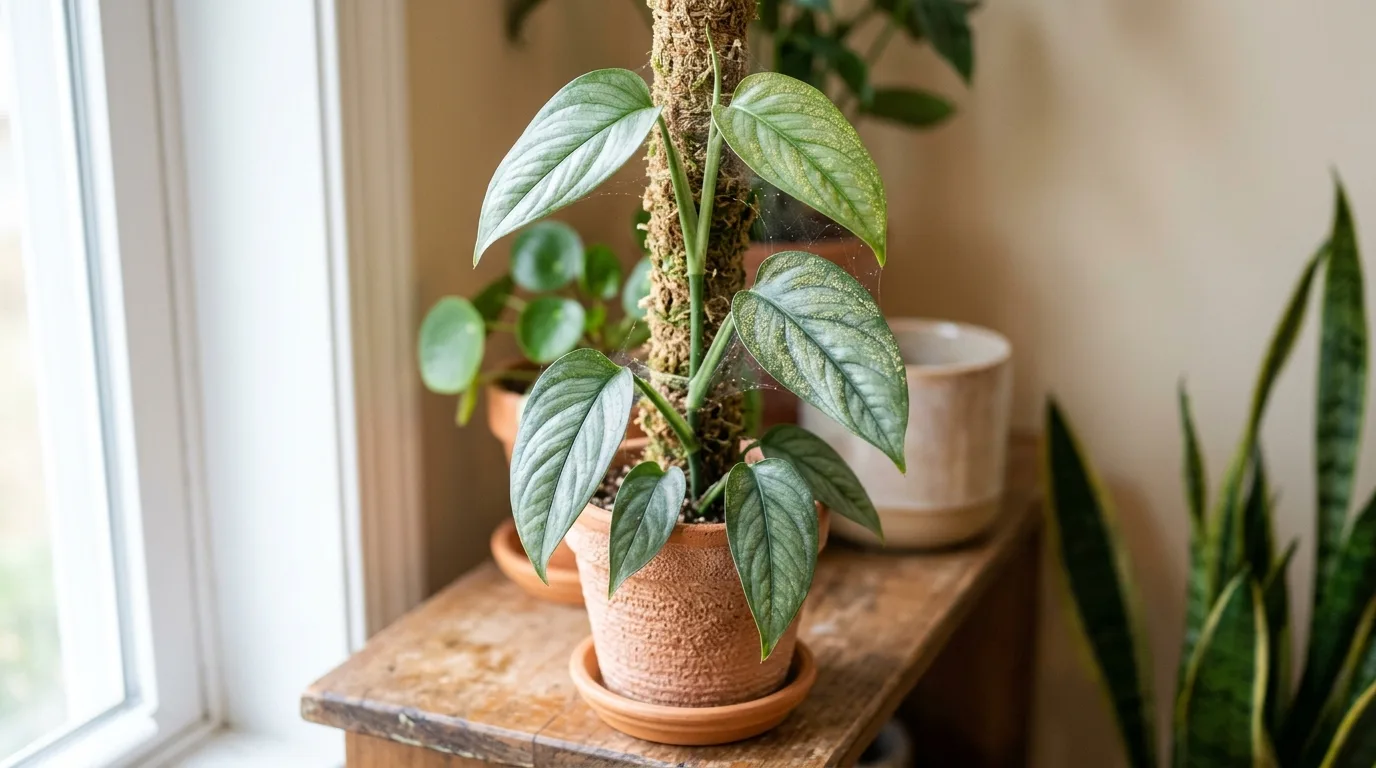
Spider Mites on Monstera Siltepecana: Signs, Elimination & Prevention
This guide covers spider mites on Monstera Siltepecana. See also the general Spider Mites guide, watering, and light pages for this plant.
Spider Mites on Monstera Siltepecana: Signs, Elimination & Prevention
Because Monstera siltepecana produces delicate, lanceolate juvenile leaves with a reflective silvery epidermal layer, early feeding marks often look like subtle dullness rather than obvious discoloration. For broad mite biology, reproductive cycles, and multi-species control principles, consult our comprehensive spider mites pest guide. This guide provides actionable, species-specific protocols designed specifically for the growth habit, climbing structures, and foliage anatomy of Monstera siltepecana.
What spider mite damage looks like on Monstera siltepecana
Two-spotted spider mites (Tetranychus urticae) are sap-feeding arachnids measuring less than 0.5 millimeters in length. On Monstera siltepecana, they pierce individual plant cells using specialized mouthparts called stylets, draining chlorophyll, sap, and cellular fluid. The initial visual symptom is dense chlorotic stippling—tiny, pinpoint-sized yellow or pale white flecks peppered across the leaf surface.
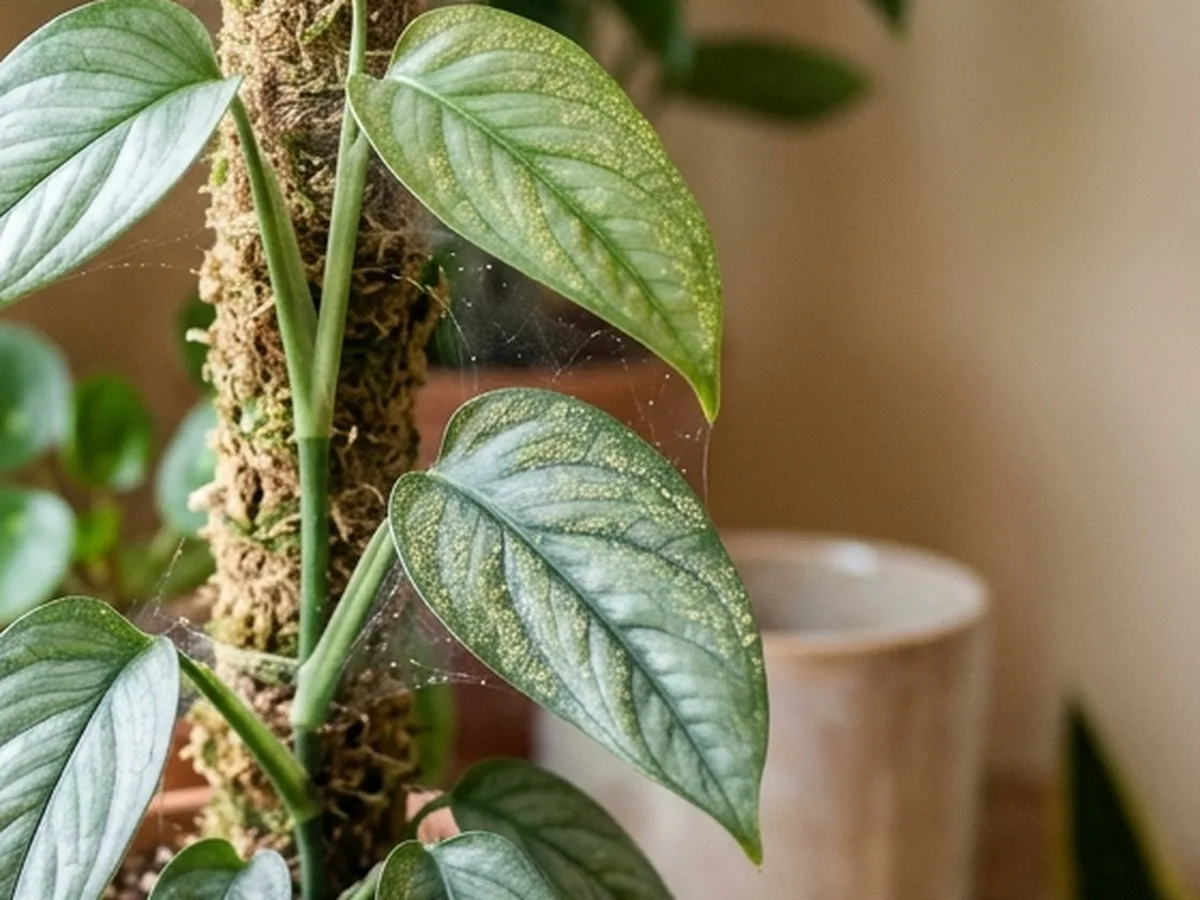
Diagnostic close-up of Monstera siltepecana leaf underside illustrating pinpoint feeding stippling, loss of silvery sheen, and fine webbing along the primary veins. Confirm with a 10x hand lens before applying treatments.
Because juvenile Monstera siltepecana foliage is admired for its silvery metallic sheen set against dark green veins, the loss of this reflective luster is often the earliest warning sign. As cellular damage intensifies, infested leaves lose their crisp contrast, taking on a dusty, faded bronze or greyish cast. According to the UC Statewide Integrated Pest Management Program (UC IPM), feeding injury begins as light mottling or stippling and advances to generalized yellowing, bronzing, and premature leaf drop as cell death spreads.
On climbing vines trained against supports or hanging in baskets, silk webbing becomes conspicuous in moderate to advanced infestations. Spider mites produce microfine silken strands to protect their colonies from environmental turbulence and facilitate movement across plant parts. Look for gossamer webs stretching across the leaf sinuses, petiole junctions, and the sheltered crevices where stems touch moss poles or trellises. As noted by Wisconsin Horticulture Extension, fine webbing on leaf undersides and terminal growth is a hallmark of high mite densities that can trap dust, shed skins, and debris.
Why Monstera siltepecana is particularly vulnerable to spider mites
Several anatomical and environmental factors make Monstera siltepecana a frequent target for two-spotted spider mites in home collections:
- Epiphytic Canopy Habit and Dry Indoor Air: In its native habitats across southern Mexico and Central America, Monstera siltepecana thrives as an epiphytic climber under humid sub-canopy conditions. The NC State Extension Plant Toolbox emphasizes that this species performs best in warm, humid environments (40% to 60%+ relative humidity). Modern indoor living spaces, particularly during winter heating or summer air conditioning, frequently drop below 35% relative humidity. In dry air, the transpiration rate of thin juvenile leaves escalates, while spider mites experience optimal reproductive efficiency.
- Dense Shingling Foliage: When juvenile vines are trained vertically, the leaves tend to overlap or shingle closely against one another and the support medium. This creates sheltered microclimates on the abaxial (underside) leaf surfaces where air circulation is reduced, allowing mite colonies to multiply unnoticed behind the foliage.
- Foliage Sheen Masks Early Damage: Unlike broad, deep green aroids (such as Monstera deliciosa), siltepecana’s natural silver-grey variegation can camouflage minor pinprick stippling during the early phases of colonization. Growers often mistake the initial dullness for natural leaf aging or settled household dust.
- Vulnerable Climbing Intersections: Where aerial roots and petiole nodes anchor into sphagnum moss poles, porous wooden boards, or coco coir, mites find sheltered corridors that shield them from routine surface wipe-downs.
Diagnostic checks: confirming active mites vs lookalike issues
Before applying any foliar spray or chemical treatment, confirm that active mites are present. Treating a plant based solely on generic leaf yellowing risks applying unnecessary chemical stress to an already struggling vine.
1. The White Paper Tap Test
The white paper tap test is the most dependable low-cost diagnostic procedure:
- Place a clean sheet of white printer paper directly under a suspicious leaf or group of leaves.
- Gently tap the leaf blade 3 to 4 times with your fingertip or a pencil.
- Examine the paper under strong directional light. Inanimate specks of dust, potting soil particles, and shed plant hairs will sit completely stationary. Live spider mites appear as tiny specks (yellowish, greenish, or reddish-brown, often bearing two dark dorsal spots) that will begin walking across the white page within a few seconds.
- Crush a speck gently with your fingertip: a smeared greenish or yellowish streak confirms a soft-bodied mite, whereas gritty mineral dust will not streak.
2. Magnified Abaxial Inspection
Use a 10x or 14x jeweler’s hand lens to inspect the underside of affected leaves, especially along the central midrib and lateral veins. The University of Florida IFAS Extension points out that two-spotted spider mites (Tetranychus urticae) aggregate primarily on the lower leaf surface, where they deposit clear to pearl-white spherical eggs suspended among fine web fibers. Look for:
- Tiny eight-legged adults and six-legged larvae moving between feeding sites.
- Spherical, microscopic eggs glued along the vein junctions.
- White cast skins (exuviae) left behind by developing nymphs, resembling tiny white dandruff flakes.
3. Ruling Out Lookalike Conditions
Monstera siltepecana can display chlorosis or spotting from several non-mite issues. Use the comparison below to differentiate:
| Symptom / Condition | Key Diagnostic Marker | Distinguishing Clue vs Spider Mites |
|---|---|---|
| Two-Spotted Spider Mites | Dense pinpoint chlorotic stippling, silk webbing, moving specks under lens | Webbing present; tap test reveals crawling arachnids; silver sheen dulls uniformly. |
| Flat Mites / False Spider Mites (Brevipalpus spp.) | Fine bronze/reddish stippling, slow silver dulling, localized corking | No silk webbing produced; mites are extremely flat, amber-red, and sluggish; requires 20x hand lens. |
| Thrips Infestation | Irregular silvery bleached patches with tiny black varnish-like frass droplets | Slender elongated insects; distinctive black excrement spots; lack of gossamer webbing. |
| Overwatering / Root Rot | Broad, water-soaked yellowing starting at lower leaf margins; limp petioles | Mix remains wet; stems soften; no fine stippling or webbing. See the watering guide. |
| Low Humidity Crisp | Uniform crispy brown leaf tips and dry papery margins | Affects leaf perimeters rather than diffuse stippling; no moving organisms under lens. |
| Light Scorch / Bleaching | Patchy bleached white or straw-colored scorch on upper leaves facing windows | Confined to leaves in direct solar beam; consult the light guide. |
If you suspect multiple overlapping care stressors, visit the complete Monstera Siltepecana problems hub to evaluate root-zone and environmental conditions concurrently.
Step 1: Immediate quarantine and canopy isolation
The moment active spider mites or characteristic feeding stippling are confirmed, physically isolate the Monstera siltepecana from all other houseplants.
Spider mites disperse through several mechanisms. In tight plant groupings, mites easily crawl across overlapping leaves and intertwining vines. Furthermore, when population densities spike or food supplies dwindle, spider mites exhibit ballooning behavior—producing silk strands that catch indoor convective air currents or drafts from HVAC vents, allowing them to drift across the room to infest nearby plants.
Quarantine guidelines for siltepecana:
- Move the plant to a separate room with adequate bright indirect light, situated at least 6 to 10 feet away from any other green foliage.
- If the vine is climbing a tall trellis or moss pole, carefully reposition the entire assembly without letting loose leaves brush against neighboring specimens.
- Thoroughly vacuum the shelf, windowsill, and surrounding surfaces where the plant was previously located, and wipe down hard surfaces with soapy water to eliminate stray mites.
- Inspect every plant that was in direct physical contact with the siltepecana using the white paper tap test.
Step 2: Lukewarm water foliage washdown
Mechanical removal using water is the most crucial initial intervention. Washing immediately knocks down the majority of adult mites, washes away cast skins and feeding debris, and destroys the protective webbing that shields eggs from contact miticides.
- Protect the Potting Medium: Cover the top of the pot and exposed potting substrate with plastic cling wrap or a plastic grocery bag gathered snugly around the base of the stems. This prevents dislodged mites from washing into the soil mix and protects the roots from waterlogging, which could trigger root stress or rot in chunky aroid mixes.
- Transport to Sink or Shower: Carry the vine to a shower, bathtub, or utility sink equipped with a handheld sprayer nozzle.
- Use Lukewarm Water: Ensure the water temperature is lukewarm (around 68°F to 75°F / 20°C to 24°C). Cold water can shock tropical root systems and cause foliar cell collapse, while hot water will scald delicate juvenile tissues.
- Target the Undersides: Adjust the spray to a steady, moderate pressure. Support each leaf blade from behind with your fingers and spray the underside thoroughly from the petiole base out to the leaf tip. Rinse both the adaxial (upper) and abaxial (lower) surfaces.
- Wash the Vine and Moss Pole Safely: Direct water spray along the length of the vine and pole crevices. Tilt the pot horizontally during washing so saturated pole runoff does not pool into the soil root ball. Before standing the pot upright, press a clean dry towel against the lower 4 inches of the sphagnum moss pole to wick away excess pooled water.
- Air Dry in Gentle Circulation: Allow the foliage to drip dry completely in a warm room with gentle air movement before applying any foliar sprays. Never place wet leaves into direct, unfiltered sunlight.
The Royal Horticultural Society (RHS) emphasizes that regular forceful spraying of leaf undersides with clean water physically dislodges mite colonies, ruptures delicate webbing, and creates a microclimate unfavorable to rapid mite development.
Step 3: Targeted eradication treatments (insecticidal soaps and horticultural oils)
While a water rinse dramatically reduces pest numbers, microscopic eggs and sheltered mites nestled in petiole axils will survive. Chemical eradication requires applying labeled contact miticides.
Because spider mites are arachnids rather than true insects, standard systemic insecticides (such as imidacloprid) are ineffective. In fact, research summarized by UC IPM demonstrates that applying certain synthetic pyrethroids or organophosphates can trigger explosive spider mite flare-ups by stimulating female mite reproduction (hormoligosis) and eliminating beneficial predatory organisms.
Use contact-action horticultural treatments:
1. Potassium Salts of Fatty Acids (Insecticidal Soap)
Commercially formulated insecticidal soaps work by dissolving the protective waxy outer cuticle of the mites, causing rapid cell disruption, dehydration, and death.
- Application Method: Dilute according to the product label (typically 1 to 2 tablespoons per gallon of lukewarm water). Use distilled or soft water; hard water contains calcium and magnesium ions that precipitate fatty acids and diminish efficacy.
- Coverage: Drench all foliage until dripping, paying rigorous attention to the undersides of every leaf, petiole joints, and the vine stem. Soap only kills mites it directly contacts while wet; it provides zero residual control once dry.
2. Refined Horticultural Oil or Mineral Oil
Lightweight, highly refined summer horticultural oils (such as paraffinic mineral oils) smother mites and their eggs by blocking their spiracles (respiratory openings).
- Phytotoxicity Precaution: Always conduct a spot test on one lower leaf and wait 48 hours before treating the whole plant. The delicate silver surface of Monstera siltepecana can suffer oil-induced burning if applied at excessive concentrations or under high heat (>85°F / 29°C).
- Application Conditions: Apply in dim light or evening hours. Never spray an oil product on a plant experiencing drought stress.
3. Pure Cold-Pressed Neem Oil
Neem oil contains azadirachtin, which disrupts feeding and molting hormones, alongside fatty acids that provide physical suffocation.
- Mix 1 teaspoon of pure cold-pressed unrefined neem oil and 1/3 teaspoon of mild liquid castile soap (as an emulsifier) into 1 quart of warm water. Shake vigorously before and during spraying.
4. Biological Control (Predatory Mites)
For mature, dense Monstera siltepecana climbing sphagnum moss poles where chemical contact sprays struggle to penetrate overlapping juvenile leaves, releasing beneficial predatory mites provides superior non-chemical control:
- Neoseiulus californicus: Ideal for moderate indoor humidity (45% to 60% RH) and ambient home temperatures. They survive periods of low pest density and actively hunt two-spotted spider mites in leaf axils.
- Phytoseiulus persimilis: A voracious, specialized obligate predator suited for knocking down heavy outbreaks when humidity can be maintained above 60% RH.
- Caution: Never release predatory mites within 7 to 10 days of applying insecticidal soaps or horticultural oils, as chemical residues will kill beneficials.
Step 4: Multi-cycle treatment schedule and egg management
The single most common reason spider mite infestations persist on Monstera siltepecana is stopping treatment after a single spray. Understanding the mite lifecycle explains why multiple rounds are mandatory.
According to data published by University of Florida IFAS Extension, two-spotted spider mites progress through five developmental stages: egg, six-legged larva, protonymph, deutonymph, and adult. At standard room temperatures (70°F to 80°F / 21°C to 27°C), the entire cycle from egg to egg-laying adult takes as little as 7 to 10 days. In hot, dry environments exceeding 85°F (29°C), this lifecycle compresses to an astonishing 5 days. A single mature female can lay hundreds of eggs over her lifespan.
Because insecticidal soaps and light horticultural washes have limited ovicidal activity against thick-shelled eggs, new larvae hatch days after the first application. To eradicate the population:
- Treatment Interval: Spray every 5 to 7 days. This timeline ensures that newly hatched larvae and nymphs are destroyed before they reach sexual maturity and lay a new generation of eggs.
- Foliar Residue Rinse (Day 3 or 4): Applying oil or soap repeatedly without an intervening rinse creates an oily film that suffocates abaxial stomata on thin juvenile foliage. On day 3 or 4 after each treatment, gently wipe leaves with a soft microfiber cloth dampened in plain lukewarm water before the next scheduled application.
- Duration: Continue for 3 to 4 consecutive cycles (spanning 21 to 28 days total).
- Inspection Protocol: Perform a white paper tap test on day 3 following each application. Only declare the infestation resolved when three consecutive weekly inspections reveal zero live mites, zero fresh webbing, and zero new stippling marks.
Recovery timeline and expectations for damaged silver foliage
Understanding what plant recovery looks like prevents unnecessary frustration and over-treatment:
- Permanent Stippling: Spider mite feeding permanently destroys the chloroplasts and epidermal cells in punctured areas. Leaves with existing stippling, bronzing, or dull silver will never regain their original pristine color. Accept these marks as historical scars.
- Retaining Functional Leaves: Resist the temptation to shear off every leaf with minor stippling. Monstera siltepecana relies on these leaves for photosynthesis to fuel root maintenance and new stem elongation. Only prune leaves that are more than 60% yellowed, necrotic, withered, or heavily encrusted in dead silk.
- Pruning Protocol: When removing damaged foliage or cutting back bare, leggy vine sections, sterilize your shears with 70% isopropyl alcohol between cuts to prevent mechanical transfer of pathogens. Review the Monstera siltepecana pruning guide for detailed advice on node preservation and propagation.
- Signs of True Recovery: Within 2 to 4 weeks under proper light and moisture, the terminal vine tip will begin pushing fresh growth. Pristine, glossy silver juvenile blades with crisp dark green veining and firm turgor confirm that the infestation has been completely halted.
What not to do: common mistakes when treating for mites
Avoid these frequent grower errors that exacerbate damage on Monstera siltepecana:
- Do Not Apply Synthetic Pyrethroid Sprays: Over-the-counter multi-purpose insecticides containing bifenthrin, permethrin, or cyfluthrin frequently cause spider mite populations to rebound rapidly. They destroy any beneficial predatory mites and stimulate mite fecundity.
- Do Not Use Concentrated Alcohol Wipes on the Foliage: Wiping the delicate silver surface of siltepecana leaves with undiluted rubbing alcohol strips the protective cuticle layer, causing severe leaf dehydrating and permanent black tissue necrotic burns.
- Do Not Fertilize an Infested, Stressed Plant: Applying synthetic nitrogen fertilizer to a plant fighting spider mites accelerates mite reproduction. Nitrogen-rich sap increases mite egg production and growth rates, while unassimilated fertilizer salts stress compromised root systems. Suspend feeding until active new growth resumes.
- Do Not Rely Exclusively on Foliar Misting: Misting leaves with a hand spray bottle elevates humidity for only 10 to 15 minutes while leaving stagnant water droplets on leaf blades that can encourage fungal leaf spot (Alternaria or Colletotrichum). Misting does not deter or kill established spider mites.
- Do Not Repot During Active Treatment: Unpotting, root washing, and substrate replacement add severe transplant shock to a plant already weakened by foliage sap loss. Unless the potting mix is thoroughly sour or rotting, keep the root zone undisturbed. For potting soil advice, see the soil guide.
Long-term prevention: humidity, vine airflow, and inspection routines
Once eradication is achieved, establish proactive cultural conditions that keep spider mites from returning:
1. Maintain Relative Humidity Above 50%
Spider mites thrive in dry conditions. By maintaining indoor relative humidity consistently between 50% and 65%, you create an environment where mite reproduction is substantially slowed. Utilize a dedicated ultrasonic cool-mist humidifier placed 3 to 5 feet away from the vine. Use an accurate digital hygrometer to monitor room levels.
2. Optimize Bright, Indirect Light
Give Monstera siltepecana ample bright, indirect light near an eastern or filtered southern exposure. Robust photosynthesis produces thicker leaf cuticles that are more resistant to stylet penetration. Avoid dark corners where vines grow weak, thin, and prone to pest colonization. Learn more in our Monstera siltepecana light guide.
3. Maintain Consistent Hydration
Drought-stressed plants pull water from their leaves, concentrating amino acids and sugars in the phloem sap, which makes foliage exceptionally nutritious for spider mites. Water your siltepecana thoroughly whenever the top 3 to 5 cm (1 to 2 inches) of potting substrate feels dry to the touch, and empty saucers promptly. For precise seasonal moisture calculations based on your pot size and home environment, use the Plant Watering Calculator.
4. Implement Weekly Leaf Hygiene
Incorporate a gentle foliage wipe-down into your regular weekend care routine. Wipe both sides of the juvenile leaves with a soft microfiber cloth dampened with lukewarm water to remove accumulated dust and airborne spores. Dust buildup provides a supportive scaffold for mite webbing and blocks sunlight from reaching photosynthetic cells.
5. Inspect Inbound Plants and Vertical Supports
Quarantine every newly purchased houseplant for a minimum of 14 days before introducing it to your main collection. Periodically inspect the rear sides of moss poles, wall ties, and trellis intersections where spider mites can establish early footholds.
When to use this guide vs other Monstera siltepecana care resources
Use this dedicated guide whenever you observe pinpoint yellow stippling, gossamer silk webbing, or crawling specks confirmed by the white paper tap test.
If your plant displays broad, limp yellowing across lower leaves with soggy soil and no webbing, transition to the watering guide and root rot guide to assess root health. If the vine has lost its lower foliage and developed elongated, bare internodes, refer to the pruning guide and light guide to rejuvenate growth. For comprehensive troubleshooting across all symptoms, visit the Monstera siltepecana problems hub.