Yellow Leaves on Monstera Siltepecana: Causes, Node Checks
Quick answer
A single oldest lower leaf yellowing slowly on Monstera siltepecana while the upper vine produces vigorous silver growth is natural senescence as the plant reclaims mobile nitrogen. In contrast, multiple yellowing leaves paired with soggy soil indicate overwatering or root rot, while dry, lightweight pots signal underwatering. Always check pot heft, soil moisture, and node position before applying fertilizer or repotting.
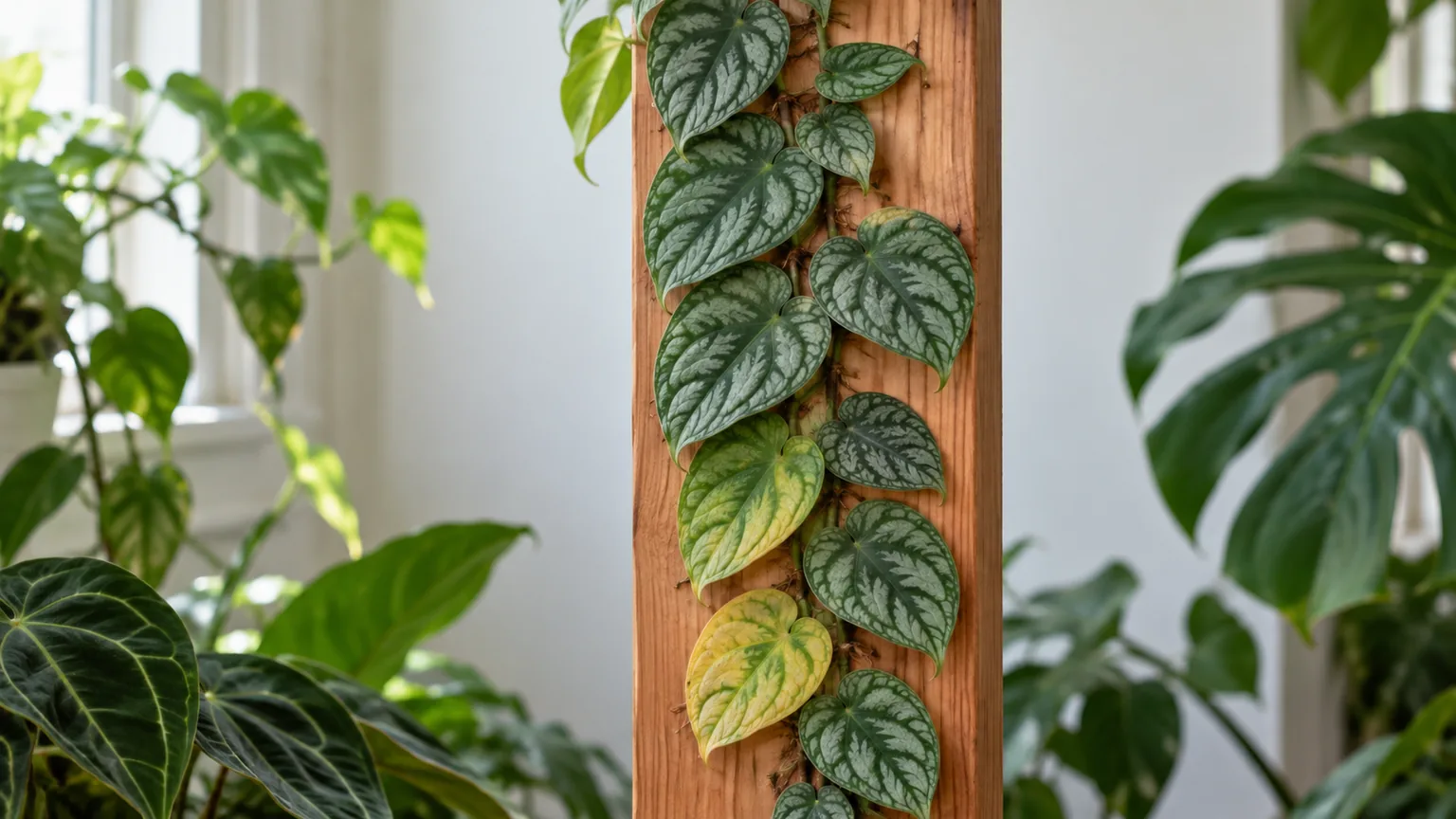
Yellow Leaves on Monstera Siltepecana: Causes, Node Checks & Fixes
This guide covers yellow leaves on Monstera Siltepecana. See also the general Yellow Leaves guide, watering, and light pages for this plant.
Yellow Leaves on Monstera Siltepecana: Causes, Node Checks & Fixes
Quick answer
A single yellow leaf at the very base of your Monstera siltepecana vine is rarely an emergency. When the oldest leaf slowly fades to pale yellow while the rest of the climbing or trailing stem produces firm, silver-sheened juvenile growth, the plant is simply undergoing natural senescence. Aroids reabsorb mobile nutrients—specifically nitrogen and magnesium—from aging foliage to feed expanding shoot tips.
However, when multiple leaves yellow simultaneously, or when chlorosis strikes the mid-vine or newest leaves, you must intervene immediately. The leading culprit is root-zone hypoxia from overwatering or compacted soil. When roots suffocate in waterlogged mix, they can no longer transport moisture or nutrients to the canopy, causing foliage to collapse into a dull, watery yellow. Conversely, prolonged drought, sap-sucking spider mites, low light, and fertilizer deficiencies also cause distinct yellowing patterns. Before changing your watering routine, repotting, or reaching for fertilizer, lift the pot to gauge its weight, probe the top 3–5 cm of mix, and trace the position of every affected leaf along the vine nodes.
For broader causes across all indoor greenery, consult the global yellow leaves guide. To understand this Central American climber’s dimorphic growth habit, review the comprehensive Monstera siltepecana overview.
What yellow leaves look like on Monstera siltepecana
Recognizing chlorosis on Monstera siltepecana requires an understanding of its unique juvenile foliage. In its juvenile form, this species produces lance-shaped leaves with distinct silver-grey interveinal patches bordered by deep emerald-green veins. True yellowing is not a subtle pale silver; it involves a complete loss of green pigment (chlorosis), where the leaf blade shifts to buttery yellow, pale chartreuse, or translucent straw.
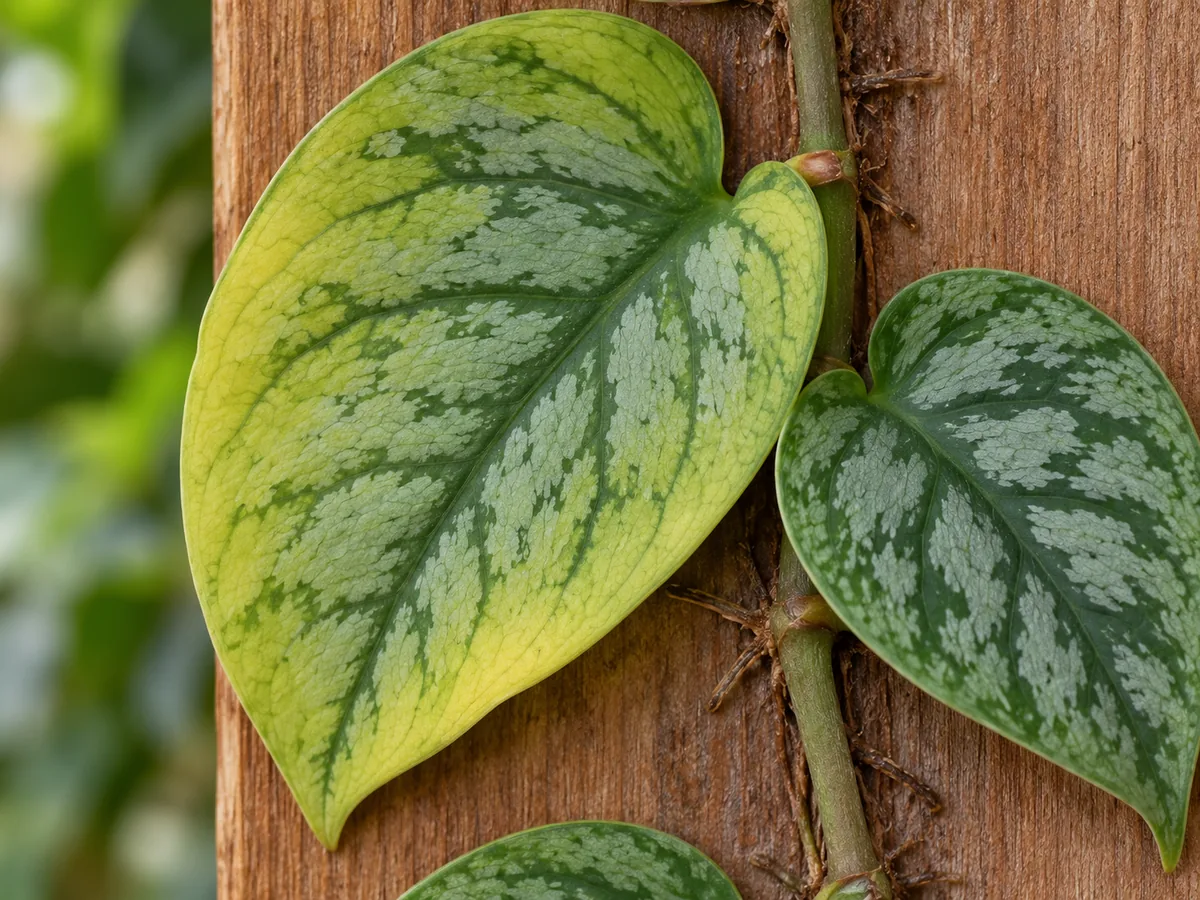
A lower juvenile leaf of Monstera siltepecana exhibits uniform yellowing (chlorosis) while the climbing vine above retains its distinctive silver-green sheen.
The physical texture and distribution of the yellowing provide crucial diagnostic clues:
- Soft, translucent yellowing with limp petioles: The leaf blade turns a watery yellow, losing its structural rigidity. The leaf stalk (petiole) often feels soft or slightly mushy at the attachment point near the stem node. This pattern strongly points to saturated potting soil and root rot.
- Crisp, papery yellowing with brown margins: The leaf turns yellow from the tip or edges inward, drying out until it feels brittle and parchment-like. The underlying soil is typically desiccated and pulling away from the pot rim.
- Speckled or stippled yellowing: Tiny, pinpoint chlorotic flecks dot the upper leaf surface, dulling the natural silver iridescence. Turning the leaf over reveals fine webbing or microscopic crawling specks—classic evidence of spider mites.
- Interveinal yellowing: The tissue between the secondary veins turns pale lime or lemon yellow while the primary veins remain dark green. This pattern indicates a nutrient mobility issue or soil pH lock.
- Gradual, uniform fading on the lowest leaf: The single lowest leaf on a vine stem fades smoothly from dark green to uniform golden yellow over two to three weeks without spots, rot, or sudden wilting.
According to NC State Extension, Monstera siltepecana is a climbing hemiepiphyte whose juvenile leaves remain narrow and silver, while adult leaves on supported vines become broad, deep green, and perforated. Because the juvenile vine produces leaves sequentially along a running stem, observing where yellowing occurs relative to the stem nodes is your most reliable diagnostic baseline.
Reading the node position: Natural aging vs. active crisis
Because Monstera siltepecana grows from apical meristems along extending vines, its foliage forms a chronological record. Each leaf arises from a distinct node separated by an internode space. Reading the vine from the soil line up to the active growing tip separates benign leaf recycling from progressive care failures.
The Royal Horticultural Society notes that the gradual shedding of older lower foliage is a completely normal physiological process in healthy, maturing houseplants. As new foliage develops higher on the vine or moss pole, lower leaves become shaded by the canopy above. The plant recognizes that these shaded leaves consume more energy through respiration than they generate through photosynthesis. In response, it triggers programmed senescence: chlorophyll degrades, allowing yellow carotenoid pigments to show, while nitrogen, phosphorus, and potassium are scavenged and redirected to newly emerging nodes.
Ask these four node-position questions:
- Is the yellow leaf the absolute oldest leaf on the vine? If it is the lowest leaf closest to the roots, and the next 5 to 10 nodes up the stem bear vigorous, pristine silver-and-green leaves, you are seeing natural senescence. No corrective action is required.
- Are multiple nodes yellowing simultaneously? If two, three, or four leaves along the lower-to-middle vine are turning yellow at once, this is premature leaf drop. The plant is under acute systemic stress.
- Is the newest leaf or growing tip yellowing? When newly emerging leaves unfurl yellow, stunted, or blackened, the problem is centered directly in the root system or growing tip, frequently caused by root death, severe overfertilization, or extreme calcium deficiency.
- Is yellowing scattered randomly across the vine? Random yellow leaves across various heights on the vine indicate localized stressors, such as pest hot-spots, cold drafts hitting one side of the plant, or direct sunlight scorching specific leaves.
Primary causes of yellow leaves on Monstera siltepecana
1. Overwatering and root-zone hypoxia
Overwatering is the single most common cause of catastrophic yellowing on Monstera siltepecana. In nature, this epiphyte climbs trees in Central America, anchoring its roots into airy pockets of bark, leaf litter, and moss. Its roots require constant access to atmospheric oxygen to fuel cellular respiration and active ion transport.
When grown in dense, peat-heavy indoor potting soil that is watered too frequently, water displaces all the air pockets in the substrate. Deprived of oxygen, fine root hairs suffocate and die within 48 to 72 hours. Clemson Cooperative Extension emphasizes that houseplant roots require oxygen just as much as water; saturated soil halts water uptake because damaged roots cannot function. Counterintuitively, an overwatered plant wilts and turns yellow with symptoms mimicking dehydration because its decayed roots can no longer pump water upward to the leaves.
As opportunistic soil-borne pathogens exploit the suffocated roots, fungal decay sets in. The Wisconsin Horticulture Extension explains that root rot pathogens cause roots to turn dark brown or black, soft, and water-soaked, easily sloughing off their central stele. On Monstera siltepecana, this damage manifests as multiple lower leaves turning translucent yellow, accompanied by brown water-soaked blotches and a heavy, damp pot that refuses to dry down. For calibrated moisture guidelines, consult the Monstera siltepecana watering guide.
2. Chronic underwatering and dry soil pockets
While Monstera siltepecana abhors saturated mix, allowing the substrate to turn into a desiccated, hydrophobic brick will also trigger widespread leaf yellowing. If the plant goes without moisture for extended periods, the root ball shrinks away from the sides of the container.
When you finally water, the liquid runs down the gaps between the soil and pot wall, escaping out the drainage holes without actually wetting the core root zone. The plant experiences severe chronic drought. In an effort to conserve water, it sacrifices older foliage, drawing moisture and mobile elements out of lower leaves. These leaves turn pale yellow, develop crispy tan margins, and eventually drop. Lifting the container will reveal a feather-light pot, and digging 3 cm beneath the surface will uncover powdery, bone-dry mix.
3. Light stress: Low light vs. sunburn
Light fuels photosynthesis, providing the energy necessary for the vine to maintain its rich chlorophyll reserves. Penn State Extension highlights that Monsteras thrive in bright, indirect light and decline rapidly in deep shade.
If placed in a dim hallway or several meters away from a window, Monstera siltepecana cannot produce enough carbohydrates to sustain a long, leafy vine. It begins dropping lower leaves to reduce its metabolic burden, resulting in bare lower stems and leggy, stretched internodes. Leaves in low light turn a dull, pale yellow before falling.
Conversely, intense direct afternoon sun scorches this understory plant. Direct rays break down chlorophyll molecules faster than the leaf can replace them, creating bleached white or straw-yellow scald marks on exposed leaf surfaces. If yellowing is restricted strictly to the side of the plant facing the glass, review the Monstera siltepecana light guide to reposition the vine into bright, filtered light.
4. Nutrient deficiencies (Nitrogen, Magnesium, and Iron)
Because Monstera siltepecana is a vigorous climber during spring and summer, it rapidly depletes soil nutrients when confined to a small container. The University of Florida IFAS Extension points out that nitrogen and magnesium are mobile nutrients within foliage plants; when supplies run low, the plant mobilizes these elements from older basal leaves and transports them to the active growing tip.
- Nitrogen deficiency: Causes a uniform, generalized chlorosis across the entire blade of older leaves. The leaf turns a soft chartreuse, then pale yellow, while remaining smooth and free of blotches. Growth slows significantly.
- Magnesium deficiency: Because magnesium forms the central atom of the chlorophyll molecule, a shortage causes striking interveinal chlorosis on mature leaves. The web of tissue between the veins turns yellow while the main veins stay green.
- Iron deficiency & pH lockout: Unlike N and Mg, iron is an immobile micronutrient. In tap water environments with high alkalinity (pH > 7.0), iron precipitates out of solution. Deficiency manifests as bright golden-yellow chlorosis on the newest emerging terminal leaves, while older leaves remain green.
If your plant has been in the same potting soil for over a year without supplementary feeding, visit the Monstera siltepecana fertilizer guide for balanced feeding schedules.
5. Pests: Spider mites and sap-feeders
Indoor environmental conditions—particularly dry, heated indoor winter air—frequently invite two-spotted spider mites (Tetranychus urticae). These microscopic arachnids pierce individual plant cells on the undersides of the silver leaves to drink the liquid contents.
In Monstera siltepecana, the characteristic silver foliage coloration is produced by sub-epidermal blister variegation—microscopic optical air spaces between the unpigmented upper epidermis and the underlying palisade mesophyll that reflect ambient light. When spider mites or acute water stress causes cellular plasmolysis, these delicate air micro-cavities collapse first. The leaf loses its reflective metallic luster, turning dull and matte grayish-green well before visible chlorosis develops.
Each feeding puncture destroys local chlorophyll, producing a pinpoint yellow dot (stippling). As thousands of mites feed, the stipples coalesce, giving the leaf a mottled, bleached yellow appearance. Heavy infestations produce fine silk webbing between the leaf petioles and vine stems. Less commonly, mealybugs or scale insects congregate along the leaf axils, draining sap and causing localized yellowing and leaf distortion.
6. Trailing habit vs. climbing support (“Bare runner syndrome”)
When grown in a hanging basket without vertical purchase, Monstera siltepecana undergoes a natural morphological response known as skototropic runner searching. In nature, a trailing vine fallen to the forest floor diverts energy away from basal foliage into thin, elongated, leafless stolons (runners) searching for a vertical tree trunk. In home cultivation, this manifests as lower leaf shedding and bare lower vine sections. This is an evolutionary survival adaptation rather than disease; attaching the vine to a moist sphagnum moss pole restores apical turgor and halts lower leaf abandonment.
Step-by-step diagnostic workflow: What to check first
Never guess when treating a yellowing plant. Applying the wrong remedy—such as saturating an already waterlogged root system or feeding a root-damaged plant—can be fatal. Work through this methodical 5-step triage:
Step 1: Examine the node distribution
Trace the vine from bottom to top. Count how many leaves are discolored and locate their exact node positions. If you find only one yellow leaf at the base of a 1-meter climbing vine, stop. Let the plant naturally reabsorb the leaf’s nutrients and continue your regular maintenance. If multiple leaves are yellowing, proceed to Step 2.
Step 2: Lift the container to check pot heft
Get in the habit of lifting your plant’s pot before every watering. Water weighs 1 gram per cubic centimeter; a saturated 15 cm pot weighs nearly three times as much as a dry one. If the pot feels heavy and dense, and the soil surface looks dark and damp, excess moisture is almost certainly suffocating the roots. If the pot feels weightless, drought stress is the primary suspect.
Step 3: Probe the root zone
Do not rely on surface appearance alone, as peat mixes can look dry on top while staying sodden at the bottom. Insert a wooden chopstick or your index finger 5 cm into the potting mix.
- If the stick emerges with dark, wet soil clinging to it, the root zone is saturated.
- If the stick comes out clean, dusty, and dry, moisture is lacking.
- Sniff the drainage holes at the base of the pot. A healthy aroid root zone smells like clean, earthy forest soil. A sour, swampy, or decaying odor indicates anaerobic bacterial decomposition and root rot.
Step 4: Inspect leaf undersides with magnification
Turn the affected leaves over under a bright light. Inspect the crevices along the central vein and where the leaf blade joins the petiole. Look for tiny moving specks, fine webbing, or cottony white tufts. Wipe the underside with a clean white damp paper towel; a yellowish or reddish-brown streak confirms crushed spider mites.
Step 5: Review recent environmental changes
Did you recently move the plant away from its window? Did winter heating lower the room humidity and dry the mix prematurely? Have you applied fertilizer recently, or has the plant gone unfertilized for a year? Connecting the timeline of care adjustments to the appearance of chlorosis reveals the underlying stressor.
The first fix: Targeted corrections based on diagnosis
Once you have identified the primary cause, take immediate, measured corrective action. Avoid stacking multiple drastic treatments on the same day.
For overwatering and oxygen-depleted soil
- Halt watering immediately: Empty all standing water from saucers or decorative cachepots.
- Increase airflow and light: Move the plant into an area with bright indirect light and gentle air circulation. Light encourages water transpiration through the remaining healthy foliage, helping the mix dry faster.
- Aerate the substrate: Gently poke 4 to 6 pencil-diameter holes into the top 5 cm of potting mix, taking care not to sever primary roots. This introduces fresh oxygen into the anaerobic soil pockets.
- Evaluate recovery: If the mix does not dry within 4 to 5 days, or if additional leaves turn yellow and stems feel soft, you must remove the root ball for inspection.
For severe underwatering and hydrophobic soil
- Bottom-soak the root ball: Place the nursery pot into a basin filled with 5–8 cm of lukewarm water. Allow the pot to draw moisture upward through capillary action for 30 to 45 minutes until the soil surface feels damp.
- Drain thoroughly: Lift the pot from the basin and let all excess water drain away completely for 15 minutes before returning it to its decorative pot.
- Monitor leaf turgor: Within 12 to 24 hours, the foliage should regain firmness. Trim away any leaves that have dried to a crisp.
For spider mites and sap-sucking pests
- Isolate the vine: Move your Monstera siltepecana away from other houseplants immediately to halt pest migration.
- Wash the foliage: Carry the plant to a shower or sink. Using a gentle lukewarm spray, wash down the upper and lower surfaces of every leaf, paying special attention to the petioles and nodes to mechanically dislodge mites and webbing.
- Apply insecticidal soap or horticultural oil: Once dry, thoroughly spray all foliage and stems with insecticidal soap or diluted neem oil, ensuring complete coverage. Repeat the treatment every 5 to 7 days for three consecutive cycles to eliminate newly hatched nymphs.
For nutrient deficiencies
- Flush the substrate: If the plant has been fertilized heavily, flush the soil with generous amounts of distilled or tap water to wash out accumulated mineral salts.
- Apply dilute balanced fertilizer: If the plant has been underfed, apply a balanced liquid houseplant fertilizer (such as a 10-10-10 or 20-20-20 formulation) diluted to one-quarter strength. Ensure the soil is already slightly damp before fertilizing to prevent root burn.
- Provide magnesium supplementation: If interveinal chlorosis dominates, dissolve 1 gram of horticultural Epsom salt (magnesium sulfate) per liter of water and apply once during active growth.
Managing root rot: Emergency unpotting and root surgery
When multiple leaves turn translucent yellow and the root zone smells sour, you must inspect the underground root system. Leaving rotting roots in the container will cause decay to travel up the vascular bundles into the main stem, killing the entire vine.
- Gently extract the root ball: Lay the plant on its side and slide the root ball out of the pot. Avoid pulling on the delicate stems.
- Wash away contaminated soil: Gently rinse the potting mix from the root system under a lukewarm faucet until the root architecture is clearly visible.
- Differentiate healthy vs. rotted roots:
- Healthy roots: Firm, pliable, white or light tan, with crisp growing tips.
- Rotted roots: Brown, black, slimy, water-soaked, easily pulling apart between your fingers to leave behind a thin wire-like thread.
- Prune all decayed tissue: Sterilize a pair of sharp pruning shears in 70% isopropyl alcohol. Prune away all blackened, soft, or foul-smelling roots back to healthy, firm white tissue. Wipe the blades between cuts.
- Sanitize with diluted hydrogen peroxide: Briefly dip the remaining roots in a 3% hydrogen peroxide solution diluted 1:4 with water for 30 to 60 seconds (or spritz thoroughly), then rinse with clean lukewarm water.
- Air-dry for suberization: Allow the pruned root system to rest on clean, dry paper towels for 30 to 45 minutes. This allows severed vascular steles to form a protective suberized callus, preventing opportunistic bacterial soft rot upon replanting.
- Repot into a barely damp, chunky aroid mix: Downsize the container if more than 30% of the root volume was lost. Pot into pre-moistened, barely damp chunky aroid mix (40% orchid bark, 30% perlite/pumice, 30% coco coir/peat). Withhold heavy watering for 48 hours so fresh wounds are not exposed to standing moisture films. For pole-grown specimens, trickle-hydrate the sphagnum moss pole from the top down to support upper aerial root hydration.
If rot has ascended into the lower stem, take stem cuttings from the healthy upper vine above the rotted section to propagate fresh plants in water or perlite, ensuring each cutting has at least one firm node.
Pruning decisions: When to cut and node preservation
Growers often wonder whether to cut off yellow leaves immediately or allow them to drop on their own. The right choice depends on the underlying cause:
- Leave naturally aging leaves alone temporarily: If a basal leaf is slowly yellowing due to natural senescence, leave it attached until it turns completely yellow or brown and detaches with a gentle tug. As long as some green or yellow remains, the plant is actively reclaiming nitrogen, potassium, and magnesium to build new tissue at the climbing tip.
- Prune diseased, pest-infested, or rotted leaves immediately: If the leaf exhibits water-soaked rot spots, fungal leaf lesions, or heavy pest colonization, cut it off promptly to prevent pathogens from spreading to adjacent nodes.
       Proper Pruning Position on Monstera Siltepecana Vine

          [Upper Vine with Healthy Leaves]
                        |
                        |
                 ( Node with Leaf )
                        |
                        | <--- Cut petiole cleanly here (1 cm from stem)
                        |      DO NOT damage the axillary bud at the node!
                 ( Node with Yellow Leaf )
                        |
                        |
          [Lower Stem / Soil Line]
When cutting, always use sterilized pruning shears. Cut through the leaf stem (petiole) roughly 1 cm away from the main vine. Never tear or pull a stubborn leaf from the stem, as this can strip the outer epidermal tissue and damage the dormant axillary bud located at the node. That node contains the dormant genetic material needed to produce new vines if the main stem ever suffers damage.
What not to do: Common mistakes to avoid
When confronted with yellow leaves, well-intentioned plant parents often make critical missteps that compound the plant’s stress:
- Do not apply fertilizer to a sick plant: Fertilizer is plant food for active metabolism, not medicine for root injury. Adding fertilizer salts to damaged or rotting roots draws water out of root cells through osmosis, causing chemical root burn and accelerating total plant collapse. Only fertilize a healthy plant that is actively producing new roots and leaves in good light.
- Do not water on a rigid calendar schedule: Watering every Saturday regardless of seasonal temperatures, humidity, or sunlight guarantees root rot in winter. Always test the soil moisture and pot weight first.
- Do not mist yellow leaves to raise humidity: Misting does not meaningfully raise ambient humidity for more than several minutes, but it does leave stagnant water droplets on the leaf blades. This creates an ideal breeding ground for bacterial and fungal leaf spots, especially on already stressed tissue. Use an evaporative humidifier instead.
- Do not repot a stressed plant unless rot is confirmed: Repotting causes unavoidable transplant shock. If yellowing is caused by low light or underwatering, unpotting the plant will only introduce unnecessary root trauma. Correct the cultural issue first.
- Do not place the plant in direct midday sun to “perk it up”: Moving a struggling shade-tolerant aroid into scorching direct sunlight will bleach the leaves and cause irreversible sunscald.
Lookalike symptoms and differential diagnosis
Yellowing can mimic or overlap with several other foliage disorders on Monstera siltepecana. Use this comparison table to distinguish true systemic chlorosis from lookalike issues:
| Visual Appearance | Primary Identification | Differentiating Characteristics | Related Resource |
|---|---|---|---|
| Uniform yellowing on lowest leaf | Natural leaf senescence | Only affects the single oldest leaf; vine tip is vigorous and green. | Monstera siltepecana overview |
| Limp yellow leaves with dark blotches | Overwatering / Root Rot | Mix remains soggy; pot feels heavy; stems feel soft at the soil line. | Overwatering symptoms guide |
| Yellowing leaf with crispy brown point | Low humidity & tip burn | Discoloration starts at the narrow pointed tip; mix moisture is normal. | Brown tips on siltepecana |
| Fine yellow stippling with webbing | Spider Mite infestation | Leaves feel rough or dusty; webbing visible under bright light. | Spider mites guide |
| Pale, bleached chartreuse upper leaves | Sun scorch / Excess light | Affects only leaves facing intense sun; tissue may feel dry and papery. | Monstera siltepecana light guide |
| Drooping green leaves before yellowing | Moisture stress / Wilting | Entire vine wilts; stems sag; check pot weight to separate dry from wet. | Drooping leaves on siltepecana |
| Stretched stems with tiny pale leaves | Etiolation (Low light) | Internodes are long and bare; vine reaches aggressively toward windows. | Leggy growth on siltepecana |
Long-term prevention: Building a resilient growing setup
Preventing repeat yellowing requires providing conditions that match Monstera siltepecana’s native habitat as a Central American epiphytic climber.
1. Optimize the potting substrate and container
Ensure your plant is potted in an open, aerated aroid mix that drains water within seconds. Use a nursery pot with ample drainage holes—terracotta is an excellent choice for growers prone to heavy-handed watering, as its porous clay walls allow moisture to evaporate from all sides. Never allow the container to sit in runoff water collected in saucers.
2. Calibrate watering to dry-down cycles
Check your plant every 7 to 10 days during the warm growing season, but water only when the top 3–5 cm of mix feels dry to the touch. In autumn and winter, as daylight hours shorten and room temperatures drop, water consumption slows dramatically. Extend the interval between waterings accordingly, always verifying pot lightness before adding water.
3. Provide consistent bright, indirect light
Place your Monstera siltepecana within 1 to 2 meters of an east-facing window or slightly pulled back from an unobstructed south- or west-facing window filtered by sheer curtains. If natural light is limited, install a full-spectrum LED grow light 30–45 cm above the vine for 10 to 12 hours daily.
4. Provide climbing support for larger, healthier foliage
While Monstera siltepecana can trail gracefully from a hanging basket, giving it a moist sphagnum moss pole, cedar plank, or trellis mimics its natural climbing habit. Climbing aerial roots anchor into the moist support, absorbing water and ambient nutrients. Supported vines produce stronger stems, larger leaves, and show greater resistance to lower-leaf shedding.
5. Maintain stable temperature and humidity
Maintain ambient room temperatures between 18°C and 27°C (65°F–80°F), and keep the plant away from cold window drafts, air conditioning vents, or heating radiators. Aim for a relative humidity between 50% and 70%. Running a cool-mist ultrasonic humidifier nearby prevents dry leaf tips and discourages spider mite populations.
Related Monstera Siltepecana guides
Continue troubleshooting or fine-tuning your plant’s care with our companion guides:
- Monstera Siltepecana overview — Essential botanical profile, juvenile vs. adult shingling traits, and general care principles.
- Monstera Siltepecana watering guide — Step-by-step guidance on substrate dry-down, seasonal rhythms, and preventing root rot.
- Monstera Siltepecana light guide — Foot-candle recommendations, window orientations, and scorch prevention.
- Monstera Siltepecana fertilizer guide — Nutrient ratios, seasonal feeding schedules, and salt flush procedures.
- Monstera Siltepecana problems hub — The comprehensive diagnostic directory for pests, diseases, and environmental disorders.
To quickly calibrate your plant’s watering schedule based on pot size, soil composition, and household temperatures, use our interactive plant watering calculator.