White Mold on Monstera Siltepecana Soil: Causes & How
Quick answer
White mold on Monstera siltepecana soil is a harmless saprophytic fungus feeding on organic matter in damp, low-airflow potting mix. While the mold does not infect healthy plant roots, it indicates prolonged moisture that risks root rot. Scrape off the fuzzy top layer of soil, let the top 3–5 cm dry thoroughly before watering again, and improve room airflow.
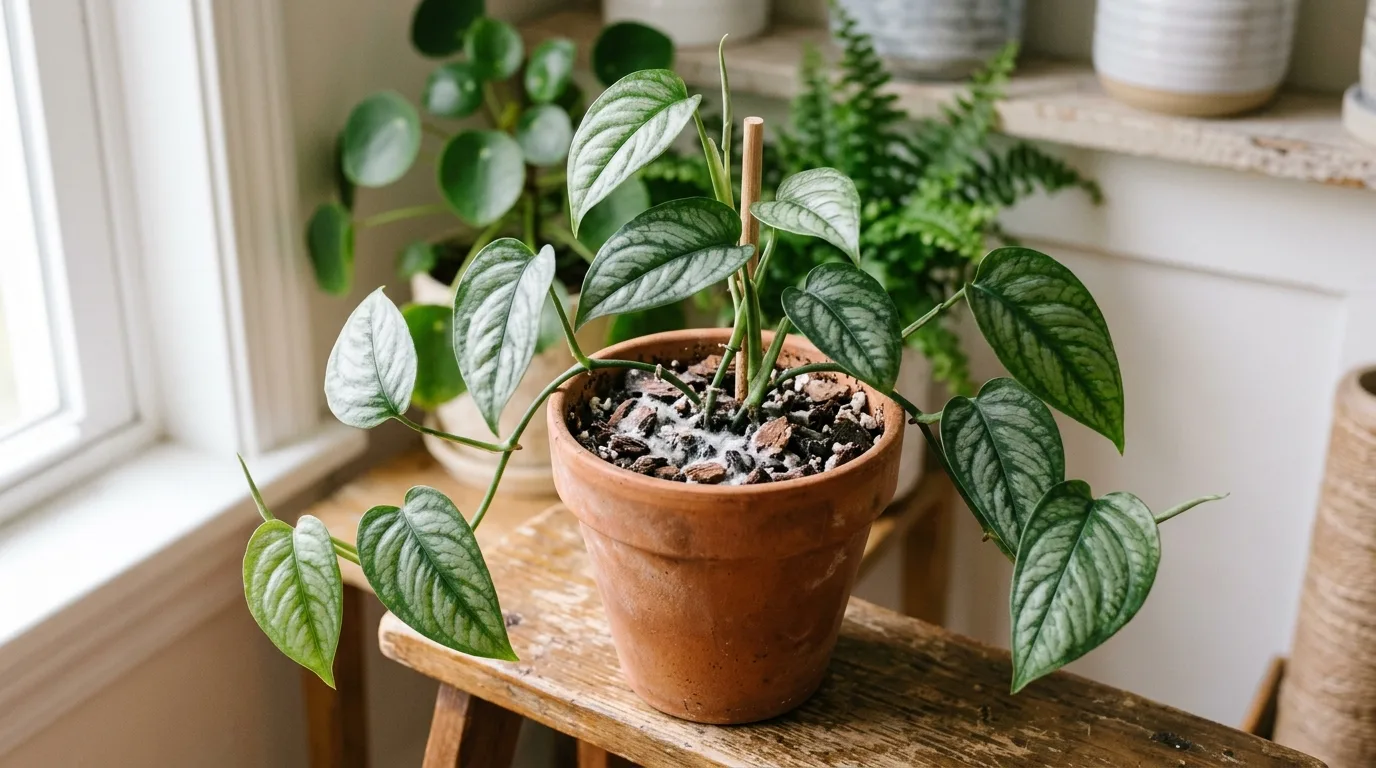
White Mold on Monstera Siltepecana Soil: Causes & How to Fix It
This guide covers mold on soil on Monstera Siltepecana. See also the general Mold on Soil guide, watering, and light pages for this plant.
White Mold on Monstera Siltepecana Soil: Causes & How to Fix It
Quick answer
Noticing a white, cottony fuzz colonizing the surface of your Monstera siltepecana container can trigger immediate concern, but this white soil fuzz is almost always a harmless saprophytic fungus. These fungi consume decomposing organic components—such as peat fines, orchid bark chips, and fallen leaf fragments—rather than attacking living plant tissue. The fungus itself will not poison your Silver Monstera.
However, surface mold serves as a critical environmental red flag. Fungal spores only bloom into visible mycelium when the soil surface remains continuously wet, shaded, and still. While the mold is benign, the prolonged saturation driving it rapidly starves epiphytic aroid roots of oxygen, opening the door to devastating root rot.
First action to take: Stop watering immediately. Use a clean spoon to gently scrape away the top 2–3 cm of moldy soil, discard it in household trash, and let the upper 3–5 cm of potting mix dry thoroughly before watering again. Increase room airflow and verify that the pot drains freely without water lingering in the saucer.
For a deeper look into the general biology of container mycelium across houseplants, consult our global mold on soil guide. On Monstera siltepecana, managing soil mold requires addressing its unique epiphytic roots, climbing habits, and delicate silver juvenile foliage.
Is this harmless surface mold or early root rot?
Before unpotting your vine or applying chemical treatments, identify whether you are facing a simple cosmetic mold bloom or a systemic rot condition using the triage table below:
| Diagnostic Feature | Harmless Saprophytic Mold | Mineral Salt Accumulation | Active Root or Stem Rot |
|---|---|---|---|
| Visual Texture | Soft, cottony, delicate white or light grey fuzz | Hard, crystalline, chalky white crust | Yellowing foliage, black water-soaked stems |
| Location | Spreads across damp soil surface & bark chips | Clings to soil grains, pot rim, and drainage holes | Base of vine petioles and underground root system |
| Odor | Mild earthy smell or slight mushroom scent | Odorless | Sour, sulfurous, swampy, or rotting odor |
| Vine Condition | Glossy silver leaves; firm petioles and nodes | Mild crispy leaf tips; otherwise vigorous | Wilting, yellowing lower leaves, mushy stem base |
| Root Zone Status | Plump, firm, cream-to-tan aerial and soil roots | Healthy root system; slight dehydration | Brown, mushy, hollow, stringy, sloughing roots |
| Immediate Action | Scrape top layer, let dry, improve airflow | Leach soil with distilled water; check fertilizer | Unpot immediately, excise rotted roots, repot |
If your Monstera siltepecana exhibits firm stems, vibrant silver juvenile leaves, and an earthy-smelling root zone, your plant is healthy and simply responding to temporary surface moisture. If stems are soft or leaves are yellowing, proceed directly to our root rot guide.
When to use this page vs other Monstera Siltepecana guides
Monstera siltepecana requires tailored care depending on whether it trails in a basket or climbs a cedar support. Use this guide to resolve surface soil fungus and moisture stagnation, but refer to dedicated cluster resources when deeper care shifts are needed:
- Monstera siltepecana overview — Review full botanical characteristics, lighting requirements, and climbing vs trailing juvenile foliage care.
- Watering guide — Master the exact dry-down intervals and seasonal watering techniques that prevent soil saturation year-round.
- Soil mix guide — Learn how to formulate a custom, chunky aroid mix with orchid bark and coarse perlite to eliminate water retention.
- Repotting guide — Follow step-by-step pot sizing and substrate replacement procedures when your mix breaks down or stays soggy.
- Overwatering guide — Identify edema, leaf yellowing, and persistent dampness before roots incur structural damage.
- Root rot guide — Execute emergency root surgery and stem sterilization if moisture has decayed underground roots.
- Fungus gnats guide — Eradicate small dark flies attracted to the damp organic matter where mold flourishes.
- All plant problems — Browse all pest, disease, and environmental diagnostic resources for Monstera siltepecana.
What mold on soil looks like on Monstera Siltepecana
Surface mold on Monstera siltepecana appears as a delicate, powdery, or web-like white growth creeping across the potting substrate. Because this aroid is ideally planted in a mix featuring orchid bark and coconut coir, fungal hyphae typically establish colonies on the coarsest organic fragments where moisture lingers longest.
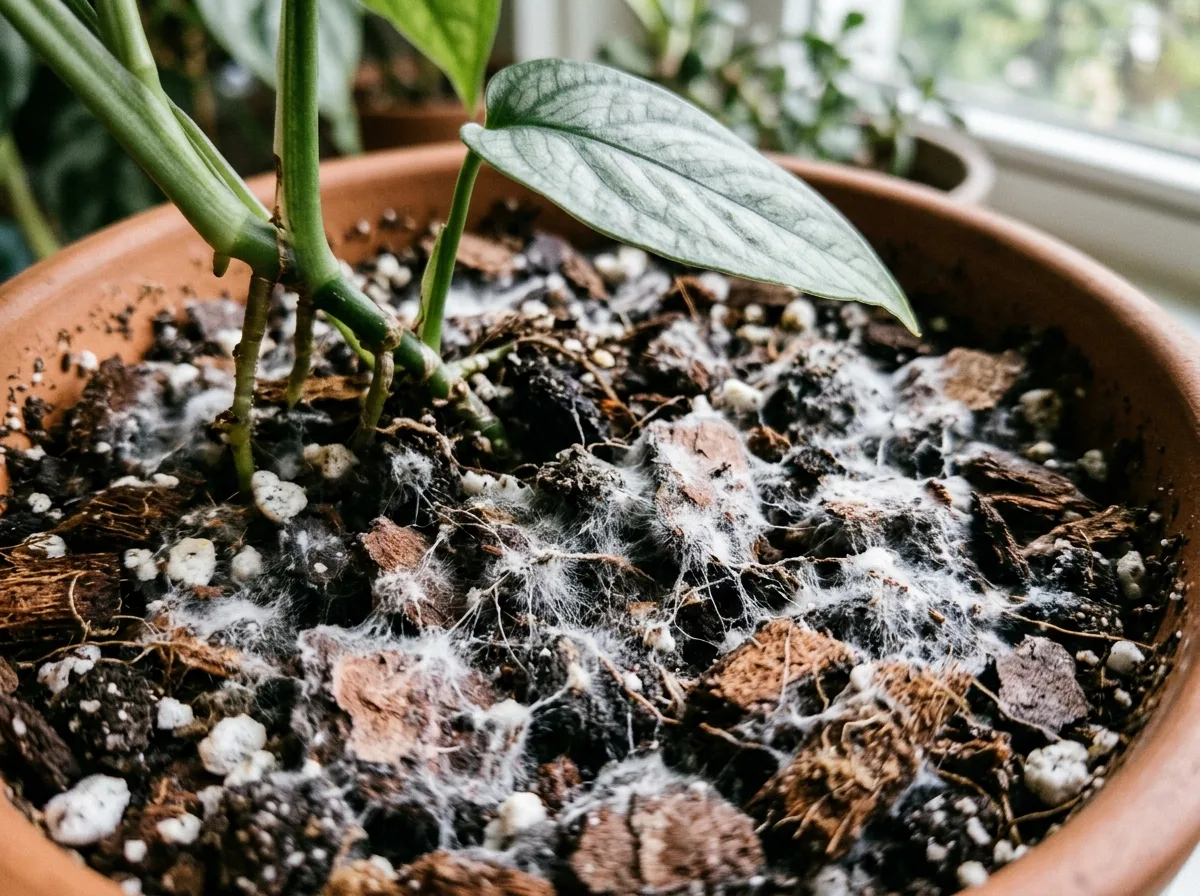
Diagnostic close-up of harmless saprophytic mycelium spreading across moist bark chips and perlite at the base of a Monstera siltepecana vine.
Under close inspection, the fungal colony resembles fine spun cotton or a dusting of white flour. The mycelial threads weave between peat particles and bark chips without penetrating the tough green cuticle of the climbing vine or its adventitious aerial roots.
In healthy conditions, the potting surface of Monstera siltepecana should transition from dark and moist after watering to light, loose, and dry within several days. When mold is present, the soil surface remains noticeably cool, dark, and damp long after irrigation, and disturbing the top layer may release a distinct forest-floor or mushroom-like scent.
Epiphytic root biology and why dense mix promotes soil mold
In its native habitats in southern Mexico and Central America, Monstera siltepecana grows as a hemiepiphyte. It germinates on the rainforest floor and rapidly seeks tree trunks, sending adventitious aerial roots into tree crevices and loose leaf litter. Epiphytic aroids have evolved roots adapted to high-oxygen environments that experience frequent drenching tropical rains followed by rapid air drying.
When grown as an indoor houseplant, potting this species into standard, peat-heavy indoor potting mix creates a biological conflict:
- Capillary Water Retention: Standard peat and coir potting soils contain tiny microscopic pore spaces that hold capillary water tightly. For an epiphyte, this dense medium suffocates root tissues by displacing atmospheric oxygen.
- Abundant Fungal Substrate: Peat moss and decomposed wood fibers provide rich stores of cellulose and organic carbon. Saprotrophic fungi decompose dead organic material, fulfilling their ecological role whenever moisture, warmth, and decaying plant debris converge.
- Impaired Gas Exchange: Unlike terrestrial plants with dense fibrous root mats, Monstera siltepecana develops fleshy feeder roots that depend on continuous oxygen diffusion. When the soil surface is blanketed by damp peat fines, gas exchange halts. Waterlogged potting media deprives root zones of oxygen, fostering fungal blooms on top while suffocating sensitive root tips below.
If your plant sits in a commercial nursery potting soil composed primarily of fine peat or compost without coarse chunks, the potting mix will inevitably retain excessive water and encourage repeat fungal growth. Formulating an airy, open blend using our potting mix guide is the definitive remedy.
Moss-pole runoff and trapped moisture at the climbing stem base
A common factor contributing to soil mold on Monstera siltepecana is the presence of a moss pole or climbing trellis. To encourage the juvenile lanceolate leaves to mature and develop fenestrations, growers frequently mist or soak sphagnum moss poles.
While vertical supports are vital for leaf development, moss poles introduce specific moisture traps:
- Gravitational Funneling: Water poured down a moss pole naturally trickles downward, saturating the specific patch of potting mix immediately surrounding the base of the climbing vine.
- Localized Saturation: Even if the outer edges of the pot feel dry to the touch, the core soil where the vine enters the pot remains chronically soaked. This microclimate fosters dense mycelial mats right against the primary stem nodes.
- Debris Accumulation: As the vine climbs, shed bud sheaths (cataphylls) and dried petiole margins drop directly onto the moist soil-pole interface, providing continuous fuel for saprophytic fungi.
To prevent this issue, water your moss pole with a narrow-spout bottle or targeted sprayer, and position a moisture buffer—such as coarse bark nuggets or inorganic pumice—directly around the stem base so water drains freely away from the main crown.
Step-by-step diagnostic confirmation
Follow this diagnostic checklist to evaluate your Monstera siltepecana container before taking corrective steps:
- Perform the Finger Depth Test: Push your index finger 3–5 cm into the soil. If the top feels crusty or fuzzy but the soil underneath is dry and loose, the issue is purely superficial. If the soil at 5 cm feels cold, muddy, and tightly compacted, the pot is waterlogged.
- Lift and Weigh the Container: Lift the pot. A pot that feels heavy and dense a week after watering confirms severe water retention. A healthy 15 cm pot filled with well-drained aroid mix should feel lightweight within 5 to 7 days in bright indirect light.
- Inspect the Stem Base: Examine the lowest nodes where the vine contacts the potting mix. Firm, green stems with pale green aerial roots confirm the plant is healthy. Any soft, brown, water-soaked, or peeling stem tissue indicates advancing rot.
- Smell the Substrate: Take a close sniff of the soil surface. Fresh potting mix smells like clean forest earth or mild mushrooms. A sour, foul, swampy, or anaerobic odor confirms oxygen starvation and root decline.
- Check for Fungus Gnat Activity: Tap the side of the pot gently. If tiny black gnats fly up, fungus gnat larvae thrive in persistently moist potting soil, feeding on the same fungal mycelium colonizing your mix. Consult our fungus gnats guide to resolve the pest cycle alongside the mold.
First fix for Monstera Siltepecana
Take this single targeted first action to remediate surface mold safely:
Scrape and discard the top 2–3 cm of affected soil using a clean spoon, avoid disturbing the root crown, and withhold all water until the upper 3–5 cm of the remaining mix dries completely.
Scraping removes the physical fungal colony and decaying organic fines before spores can proliferate. Discard the scraped material in the household trash rather than outdoor compost to keep spores contained.
Do not flush the pot with fungicide, do not drench the plant in chemical sprays, and do not immediately repot unless the roots themselves are confirmed rotten. Allowing the upper root zone to dry naturally restores oxygen levels and eliminates the damp habitat fungi require to survive.
Step-by-step soil recovery and remediation
Once you have removed the visible mold layer, execute these secondary steps over the next 10 to 14 days to restore soil equilibrium:
1. Aerate the Soil Surface
Using a clean wooden chopstick or skewer, gently poke 5 to 8 vertical holes around the perimeter of the potting mix, staying 3 cm away from the main vine base. These aeration channels allow trapped moisture deep in the container to evaporate and introduce oxygen directly into the root zone.
2. Boost Ambient Air Circulation
Stagnant air accelerates fungal growth. Place a small oscillating room fan on low speed several feet away from your plant to provide gentle air movement. Avoid pointing forceful cold drafts directly at the foliage, but ensure ambient air circulates across the soil surface to speed drying.
3. Elevate Light Exposure
Move the plant into a location receiving generous bright, indirect light—such as 1 to 2 meters back from an east- or south-facing window. Stronger ambient light increases transpiration, prompting the plant to absorb moisture from the pot more rapidly, while natural light discourages surface fungal spores.
4. Apply a Safe Antifungal Top-Dressing (Optional)
If mold has recurred in your indoor space previously, dust the exposed soil surface with a thin layer of ground Ceylon cinnamon, which contains natural cinnamaldehyde that inhibits fungal sporulation. Alternatively, mist the dry surface lightly with a 1:4 dilution of 3% hydrogen peroxide and room-temperature water.
5. Transition to a Proper Dry-Down Watering Routine
Resume watering only when a wooden skewer inserted 5 cm into the pot emerges clean and completely dry. As supported by NC State Extension, Monstera siltepecana performs best when allowed to water only when the top 1 to 2 inches dry out. When rewatering, pour until water flows freely from the drainage holes, let the pot drain for 15 minutes, and discard all runoff from the saucer immediately.
Node inspection and cutting salvage if mold signals stem rot
If your inspection reveals that the moldy environment has already triggered stem decay, act quickly to save your vine. Because Monstera siltepecana is a dimorphic climbing vine, it possesses tremendous regenerative capacity through its stem nodes.
If the lowest section of the vine feels spongy, discolored, or detached from healthy roots:
- Locate Healthy Vine Tissue: Trace the climbing stem upward until you reach firm, clean green tissue with vibrant silver leaves.
- Sever Above the Rot: Using a sterile razor blade or pruners disinfected with isopropyl alcohol, cut the vine 2 cm above the highest point of soft or discolored tissue. Discard the rotted base and infected root ball.
- Divide into Single- or Two-Node Cuttings: Each cutting must contain at least one healthy leaf and one intact node with an aerial root initial.
- Root in Aerated Medium: Place cuttings in a jar of clean water, damp perlite, or sterile sphagnum moss in a warm, bright room. Monstera siltepecana cuttings develop robust secondary water roots within 14 to 21 days.
- Pot into Chunky Aroid Mix: Once water roots reach 5 cm with visible secondary branching, transplant the cuttings into a small 10 cm container filled with an airy bark-and-perlite aroid mix.
This salvage process guarantees that even if prolonged saturation ruined the original root ball, your prized Silver Monstera clone survives.
Mistakes to avoid when dealing with soil mold
When growers discover fuzzy white mold on their houseplants, panic often leads to well-intentioned mistakes that harm the plant more than the mold itself:
- Drenching the Soil with Harsh Chemical Fungicides: Systemic chemical fungicides are designed for commercial pathogen control, not benign surface saprophytes. Applying them indoors can harm beneficial soil microbiomes and worsen root stress.
- Repotting Traumatized Plants on Day One: Unpotting a plant tears fragile root hairs and exposes the vine to severe transplant shock. Unless roots are black, mushy, and foul-smelling, do not repot.
- Compacting the Soil by Patting it Down: Compacting wet mix to hide mold crushes macro-pores, trapping anaerobic moisture and drastically increasing root rot risks.
- Covering the Mold with Decorative Moss or Rocks: Covering damp potting mix with decorative sphagnum moss or solid pebbles traps moisture underneath, creating a humid terrarium effect that explodes fungal populations.
- Switching to Calendar-Based Watering: Never water on a fixed day of the week. Overwatering and stagnant drainage cause root suffocation, so always verify moisture depth with your finger or a skewer before pouring water.
- Ignoring Standing Saucer Water: Allowing a nursery pot to sit in a decorative cachepot filled with drainage water creates bottom saturation, causing mold to climb upward through bottom drainage holes.
Recovery timeline and what healthy progress looks like
Recovering from surface mold is straightforward when environmental adjustments are implemented promptly:
- Days 1 to 3: Following scraping and aeration, the potting surface remains slightly damp. No new fungal fuzz should appear if room airflow is active and direct watering is withheld.
- Days 4 to 7: The upper 3–5 cm of mix dries to a lighter shade and feels loose and crumbly to the touch. The vine maintains upright, turgid petioles with no signs of yellowing or drooping.
- Days 8 to 14: The pot feels noticeably lighter when lifted. You perform your first scheduled watering using room-temperature water, emptying the drainage saucer completely after 15 minutes.
- Weeks 3 to 4: The vine initiates fresh silver juvenile growth from the apical tip. Aerial roots along climbing nodes appear firm and active, and the potting surface remains clean and mold-free between dry-down cycles.
If fuzzy mold reappears within 48 to 72 hours of scraping, your room airflow remains inadequate or the potting mix is too dense to dry out. In such persistent cases, plan a scheduled substrate replacement into an aerated aroid blend per our repotting guide.
Long-term mold prevention for Monstera Siltepecana
Preventing mold recurrence requires aligning your container conditions with the natural epiphytic ecology of Monstera siltepecana:
- Upgrade to an Airy Aroid Substrate: Replace dense indoor potting soil with an aroid blend containing 40% high-grade potting mix, 35% medium orchid bark, 15% coarse perlite, and 10% horticultural charcoal. This provides broad structural macro-pores that shed excess moisture immediately.
- Select Porous Containers: Plant your vine in terracotta or unglazed clay pots. Terracotta walls breathe, allowing moisture to evaporate through the container sides and keeping the root zone aerated.
- Practice Deep, Observational Watering: Water thoroughly until runoff escapes the base, then wait until the top 3–5 cm feels dry before the next drink. Allowing the top layer of mix to dry disrupts fungal mycelium and insect life cycles naturally.
- Maintain Clear Soil Hygiene: Routinely pick away fallen leaflets, dried cataphylls, and spent organic mulch from the soil surface so saprophytic fungi lack food reserves.
- Adjust Seasonally: Cut back watering frequency sharply in late autumn and winter when indoor light levels drop and plant metabolic rates slow down.
Frequently asked questions
Is white mold on Monstera siltepecana soil dangerous to the plant?
The surface mold itself is a benign saprophytic fungus that breaks down decomposing organic material and does not attack living Monstera siltepecana stems or roots. However, the chronic moisture and stagnant air enabling the mold create the exact anaerobic environment that triggers severe fungal root rot.
Should I immediately repot my Monstera siltepecana if mold appears?
Immediate repotting is unnecessary if the plant shows upright stems, firm silver leaves, and healthy white roots. Scrape off the top 2–3 cm of moldy soil, withhold water until the upper root zone dries, and improve air circulation. Repotting is only required if the pot smells sour, drainage fails completely, or stems soften.
How can I tell the difference between white soil mold and mineral salt buildup?
White mold produces a soft, web-like, fuzzy mycelium that can be swept away easily with a spoon and dissolves under a light water drop. Mineral salt buildup from hard tap water or excess fertilizer forms a crusty, chalky, or brittle white deposit directly on soil particles and pot rims that does not feel powdery or fibrous.
Can I use ground cinnamon or diluted hydrogen peroxide to kill the mold?
Sprinkling ground cinnamon or misting the surface with a 3% hydrogen peroxide diluted 1:4 with water can temporarily suppress surface mycelium due to their mild antifungal properties. However, neither treatment resolves the underlying moisture imbalance; if you do not fix overwatering and poor airflow, the fungus returns within days.
How do I prevent mold from growing on my Monstera siltepecana potting mix long term?
Plant your Monstera siltepecana in a chunky, highly aerated aroid mix composed of orchid bark, coarse perlite, and potting soil rather than dense peat. Water only when the top 3–5 cm of mix feels completely dry, ensure nursery pots drain freely, and provide bright indirect light with steady ambient air movement.
Related Monstera Siltepecana guides
Explore our connected species care resources to maintain peak vine health and avoid common indoor growing hurdles:
- Monstera Siltepecana overview — Primary plant profile covering light, growth rate, and shingling behavior.
- Watering guide — Detailed seasonal moisture targets and pot-weight assessment techniques.
- Soil mix guide — Component ratios and porous amendments for climbing aroids.
- Repotting guide — Pot sizing rules, root inspection, and post-repot care.
- Overwatering guide — Early symptoms of water saturation and preventative dry-down routines.
- Root rot guide — Diagnostic signs, root trimming surgery, and emergency stem salvage.
- Fungus gnats guide — Biological controls and larvae eradication in damp substrates.
- All plant problems — Index of common pests, nutrient deficiencies, and environmental stresses.
Helpful tools for this plant
Calculate exact substrate volumes and custom watering intervals for your specific container size and indoor setup:
- Aroid Potting Mix Calculator — Formulate balanced ratios of bark, perlite, and potting mix calibrated for your pot volume.
- Plant Watering Schedule Calculator — Calculate seasonal dry-down cycles based on container material, room temperature, and ambient humidity.