Underwatering on Oleander: Drought Symptoms, Hydrophobic
Quick answer
Underwatering on Oleander (Nerium oleander) causes stiff, leathery leaves to curl inward longitudinally, turn brittle, and drop, accompanied by shriveled flower buds and dry, shrinking soil. Although mature landscape oleanders possess remarkable drought tolerance, container-grown shrubs and young transplants quickly exhaust root-zone moisture in hot sun. First step: bottom-soak the container in a basin of water for 45 to 60 minutes (or apply a slow, repetitive trickle soak to landscape plants) to overcome hydrophobic soil peat shrinkage and fully rehydrate desiccated roots.
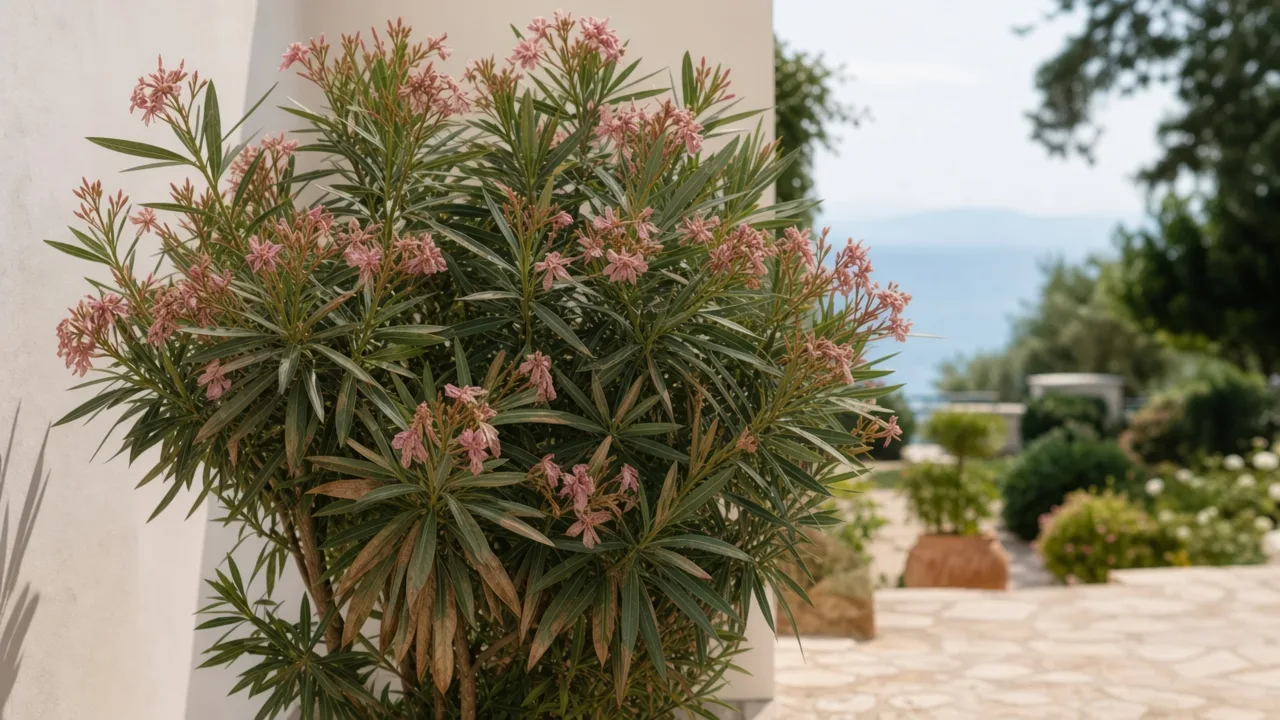
Underwatering on Oleander: Drought Symptoms, Hydrophobic Soil & Recovery
This guide covers underwatering on Oleander. See also the general Underwatering guide, watering, and light pages for this plant.
Underwatering on Oleander: Drought Symptoms, Hydrophobic Soil & Recovery
Quick answer
Underwatering on Nerium oleander occurs when the root zone loses moisture faster than the shrub can draw water to sustain cellular turgor pressure. Because oleander foliage is naturally thick, rigid, and leathery, dehydration does not look like the limp, floppy collapse seen in soft herbaceous houseplants. Instead, underwatered oleanders exhibit inward longitudinal leaf curling, dull gray-green foliage discoloration, brittle, papery texture, and premature abortion of emerging flower buds. In advanced cases, lower leaves develop crispy brown margins and drop in large numbers to reduce surface area.
The first fix for an underwatered oleander is a controlled deep soaking rehydration. For container-grown shrubs, submerge the pot in a shallow tub of water for 45 to 60 minutes to re-expand hydrophobic peat moss and saturate the dry core root ball. For landscape plants, run a slow, direct drip or trickle at the drip line for 1 to 2 hours. Never apply fertilizer or prune severely while the plant is water-stressed.
For universal dehydration mechanics, transpiration physics, and root rehydration across all woody ornamentals, explore our comprehensive guide on underwatering.
Recognizing underwatering on Oleander: Key symptoms
Because Nerium oleander is a broadleaf evergreen shrub with heavily cuticularized leaves, its foliar symptoms differ markedly from soft perennials:
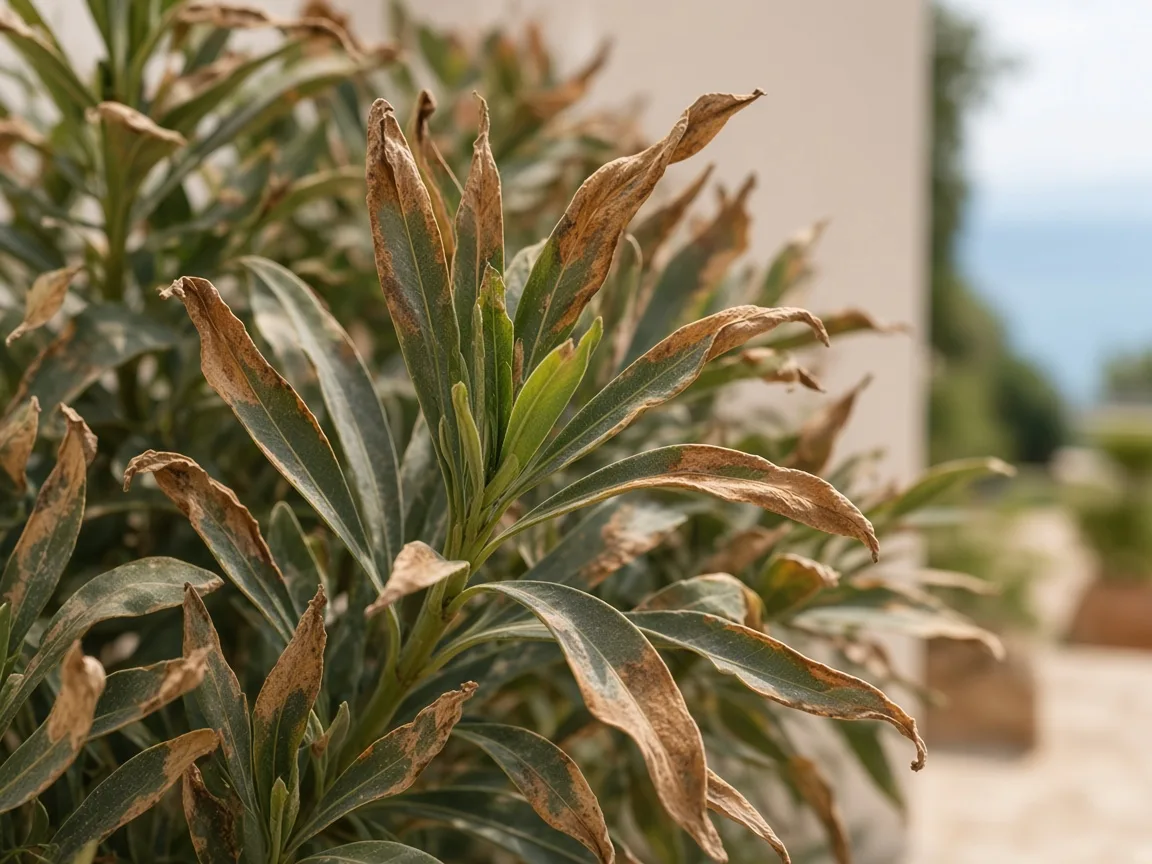
Close-up of Nerium oleander branch showing inward-curling leathery leaves and aborted flower buds caused by severe drought stress.
- Inward longitudinal leaf curling: Leaves fold upward along the prominent pale midrib, curling their margins inward like narrow canoes. This structural reflex shields the stomata located on the lower leaf surface, reducing transpirational moisture loss in drying winds.
- Brittle, leathery foliage: Healthy leaves feel stiff and spring back when bent. Dehydrated leaves feel papery, crack easily under gentle finger pressure, and produce a dry rustling sound when brushed.
- Loss of gloss and olive-drab dullness: The deep, lustrous emerald-green hue fades to a flat, dusty olive-green or grayish tone across the entire branch canopy.
- Floral truss and bud abortion: Flower buds shrivel, darken to tan or brown, and drop cleanly at the pedicel base before opening. Oleanders sacrifice active reproductive tissue first to conserve core branch hydration.
- Lower canopy defoliation (leaf drop): The shrub sheds its oldest, basal foliage along lower branch stems while holding onto smaller apical leaf whorls, creating an open, leggy lower structure.
- Desiccated terminal shoot tips: Tender, newly forming branch tips wilt, turn brown, and stop elongating, leading to prolonged slow growth.
When chronic water deficits continue unaddressed, leaves develop dry brown tips and marginal necrosis that progress inward toward the central vein, eventually mimicking the distress of drooping leaves.
The Oleander drought paradox: Landscape maturity vs. container vulnerability
A frequent source of confusion among gardeners is oleander’s reputation as a virtually indestructible, drought-tolerant shrub. In Mediterranean landscapes and highway medians across USDA hardiness zones 8 through 11, mature oleanders survive scorching summers on natural rainfall alone, as documented by NC State Extension and Missouri Botanical Garden.
However, this legendary drought tolerance is entirely dependent on an extensive, mature root system:
1. Landscape maturity vs. young transplants
In open ground, established oleanders drive powerful taproots deep into the subsoil while radiating extensive lateral roots well beyond their canopy drip line. This enables them to access subterranean moisture pockets during prolonged rainless periods. Newly transplanted oleanders, however, have not yet pushed roots beyond their initial nursery root ball. During their first one to two growing seasons, young shrubs require regular deep irrigation until root networks anchor into surrounding native soil, a cultivation requirement highlighted by Clemson Cooperative Extension.
2. The container moisture trap
Containerized oleanders have strictly limited root volumes. According to container cultural guidelines from UF IFAS Extension, oleander has a rapid growth rate and high transpiration demand during sunny summer weather. Potted plants kept on warm patios, balconies, or concrete terraces experience radiant heat through container walls. The combination of intense oleander light exposure, active blooming, and high ambient temperatures can exhaust container water reserves within 24 to 48 hours. When container roots dry out completely, the shrub enters acute water stress regardless of its genetic Mediterranean resilience.
Peat shrinkage and hydrophobic soil: The hidden cause of persistent drought
One of the most deceptive challenges when caring for container-grown oleanders is hydrophobic soil shrinkage. Most commercial potting mixes consist predominantly of sphagnum peat moss, shredded pine bark, and coconut coir. While these organic components retain excellent moisture when kept moderately damp, they undergo physical and chemical transformations when allowed to dry out completely:
- Volume shrinkage: As moisture evaporates from peat fibers, the soil ball contracts, pulling away from the inside walls of the pot and creating an empty perimeter gap 5 to 15 millimeters wide.
- Surface wax hydrophobicity: Bone-dry peat moss develops a hydrophobic suberin-like chemical coating that repels water molecules.
- Perimeter bypass flow: When a gardener pours water onto the dry surface, water beads on top of the soil, rushes into the side gap, and drains immediately out of the bottom drainage holes into the saucer.
To the gardener, water draining out of the bottom looks like proof of a thorough watering. In reality, the water completely bypassed the dense inner root ball, leaving the core substrate bone-dry and the feeder roots parched. If your oleander continues wilting and dropping buds despite frequent top-watering, hydrophobic bypass flow is almost certainly the root cause. Re-evaluating the physical structure of your oleander soil is essential for lasting recovery.
Diagnostic triage: Underwatering vs. Overwatering vs. Bacterial Scorch
Before administering deep water, rule out other common issues that cause foliage decline:
| Diagnostic Feature | Acute Underwatering (Drought) | Chronic Overwatering (Root Rot) | Oleander Leaf Scorch (Xylella fastidiosa) |
|---|---|---|---|
| Soil Moisture (5–8 cm deep) | Bone-dry, crumbly, dusty; pulled away from container sides | Muddy, waterlogged, cold; retains swampy odor | Variable; occurs in both wet and dry soils |
| Container Weight | Featherlight; lifts with almost no resistance | Unusually heavy and waterlogged | Normal, proportional to recent watering |
| Leaf Blade Texture | Stiff, papery, brittle, curled inward longitudinally | Soft, limp, drooping, spongy | Dry and crispy on tips; normal elsewhere |
| Leaf Color Pattern | Dull gray-green overall; crisp tan leaf tips | Bright chlorotic yellow leaves starting on lower canopy | Vivid golden-yellow halo between dead brown margins and green blade |
| Canopy Distribution | Canopy-wide, concentrated on sun-exposed and lower foliage | Bottom-up across older leaves, progressing upward | Confined to one branch or sector initially (flagging) |
| Root Condition | Tan, fibrous, wiry, dry, firm | Dark brown, black, mushy, rotten, sloughing off | Normal, white to tan root structure |
| Response to Deep Soak | Leaves flatten and uncurl within 4 to 12 hours | No improvement; wilting and yellowing accelerate | No response; infected branch continues dying back |
As outlined by UC IPM, Oleander Leaf Scorch (Xylella fastidiosa) is a vascular disease spread by sharpshooters that blocks xylem vessels. Always look for the characteristic wide yellow margin separating brown tissue from green on individual branch terminals to distinguish incurable bacterial disease from cultural dehydration.
Step-by-step deep soaking recovery protocol
When you have confirmed that your oleander is suffering from acute underwatering, apply this restorative rehydration protocol to break soil hydrophobicity and restore internal vascular pressure.
Phase 1: Rehydrating container-grown Oleanders (Bottom Soaking)
- Prepare a soaking tub: Fill a large tub, bucket, or storage bin with 8 to 12 centimeters of room-temperature water. Avoid freezing-cold tap water, which can shock sun-warmed root tissue.
- Submerge the pot base: Place the nursery container or decorative planter directly into the water bath. Ensure the water level reaches approximately one-third of the container height.
- Allow capillary absorption: Leave the pot submerged for 45 to 60 minutes. Capillary action will draw water upward through the drainage holes, gradually re-moistening the peat moss from the bottom up and forcing trapped air pockets out.
- Top percolation flush: While the pot remains in the basin, gently pour an additional 1 to 2 liters of water across the top soil surface to saturate any dry upper crust.
- Drain completely: Lift the container out of the tub and place it on elevated blocks or gravel for 20 to 30 minutes until gravity drainage ceases. Never allow the container to stand permanently in a filled drainage saucer.
Phase 2: Rehydrating landscape and garden bed Oleanders
- Construct a temporary berm: Mound native soil into a circular ridge 10 centimeters high around the shrub’s outer drip line to prevent surface runoff.
- Apply slow trickle irrigation: Lay a soaker hose or garden hose set to a low, pencil-thin trickle at the base of the shrub. Run the water for 60 to 90 minutes, allowing moisture to percolate 30 to 45 centimeters deep into the subsoil.
- Verify penetration: Push a long metal screwdriver or wooden dowel into the soil near the root zone. It should slide smoothly into moist earth without encountering a hard, dry resistance layer.
Phase 3: Post-soak environment and recovery positioning
- Temporary afternoon shelter: If the plant is in a moveable container, shift it to an area receiving bright morning light and filtered afternoon shade for 24 to 48 hours. Sheltering the foliage from scorching midday sun gives vascular conduits time to re-pressurize without excessive transpirational pull.
- Hold all fertilizers: Do not feed an underwatered oleander. Desiccated root hairs are stripped of protective mucus and cannot regulate salt uptake; introducing fertilizer salts into parched soil will cause severe chemical root burn.
Recovery timeline and realistic expectations
Restoring water to a desiccated oleander initiates an orderly physiological recovery sequence:
- Hours 2 to 6: The re-expanded root system begins absorbing water and pumping it upward through the xylem. Internal turgor pressure rises, and leaves that were not permanently damaged begin uncurling and lifting.
- Hours 12 to 24: Foliage regains its firm, semi-rigid structure. The dull olive-drab color brightens toward healthy emerald green.
- Days 3 to 7: Heavily scorched leaf tips and aborted flower buds dry out completely and fall from the shrub. Do not be alarmed by this secondary drop; shedding unviable tissue allows the plant to direct energy toward surviving shoots.
- Weeks 2 to 4: Dormant lateral buds along the leaf whorls swell and break dormancy, pushing out fresh vegetative growth. If the plant is in active mid-summer growth, new terminal flower cymes will form.
Badly crisped foliage with extensive marginal browning will never turn green again. Once new growth is actively expanding, you can trim off dead leaf tips or prune bare branch stems back to healthy nodes.
Common mistakes to avoid during drought recovery
When attempting to revive a dried oleander, avoid these frequent care pitfalls:
- Fertilizing immediately after watering: Gardeners often assume a struggling shrub needs “food.” Supplying synthetic plant food to a recovering oleander burns delicate newly formed root hairs and exacerbates foliar scorch. Delay feeding until the shrub has produced 5 centimeters of healthy new growth.
- Aggressive immediate pruning: Cutting back dry, bare branches on day one removes energy reserves stored within the woody stems. Wait 7 to 10 days until live wood is clearly distinguishable from truly dead stems (scrape the bark lightly with your thumbnail: green tissue beneath indicates viable wood).
- Overcompensating with daily shallow watering: Watering a small splash every morning keeps the top 2 centimeters of soil damp while leaving deeper feeder roots dry. Oleanders require deep, thorough soakings followed by moderate dry-down periods.
- Leaving pots standing in filled saucers: In an attempt to prevent future drought, some growers leave containers standing in 5 centimeters of water indefinitely. This suffocates lower root hairs, transforming drought stress directly into anaerobic overwatering.
- Unprotected handling of dry prunings: All vegetative tissues of Nerium oleander contain lethal cardiac glycosides (including oleandrin and neriine). When pruning dry branches, always wear heavy waterproof gloves and eye protection. Never burn oleander trimmings, as smoke carries aerosolized toxins that cause severe respiratory and cardiac distress upon inhalation.
Long-term watering and soil practices to prevent dehydration
To keep your oleander healthy, vigorous, and packed with blooms, establish proactive cultural routines tailored to this shrub’s specific physiology:
Soil structure and container sizing
Ensure potted oleanders are planted in a potting medium that balances water retention with rapid drainage. A recommended custom blend consists of:
- 50% high-grade potting soil (loam-based)
- 25% coarse perlite or pumice (to prevent compaction and encourage aeration)
- 25% composted pine bark or coarse builder’s sand (to maintain porous permeability and resist peat hydrophobic collapse)
Repot vigorous container oleanders every 2 to 3 years in early spring. Move up to a pot 5 to 8 centimeters wider with multiple unobstructed drainage holes. A larger soil volume provides a crucial moisture buffer against hot summer drying.
Seasonal watering cadence
Align your irrigation frequency with seasonal light and temperature shifts, following our comprehensive oleander watering guidelines:
- Spring and summer (Active blooming): Water deeply whenever the top 5 centimeters (2 inches) of soil feels dry to the touch. Container plants in full sun may require watering every 2 to 3 days.
- Fall (Cooling transition): Reduce watering as temperatures drop and flowering slows. Allow the top 7 to 10 centimeters of soil to dry between waterings.
- Winter (Semi-dormancy): Water minimally—just enough to prevent the root ball from shriveling completely (typically once every 2 to 3 weeks for potted plants overwintered in cool, bright indoor spots).
Surface mulching
In both garden beds and large outdoor containers, apply a 5-centimeter (2-inch) layer of shredded hardwood bark, pine straw, or gravel over the soil surface. Mulch moderates soil temperatures, shields upper feeder roots from radiant heat, and reduces evaporative water loss by up to 50%. Keep mulch 5 centimeters away from the woody trunk base to prevent stem collar rot.
Related Oleander guides
When diagnosing and caring for your shrub, reference these targeted guides across our oleander care cluster:
- Oleander Plant Overview: Complete botanical profile, cultivar selection, cold hardiness parameters, and landscape design uses.
- Oleander Watering Guide: In-depth seasonal watering schedules, irrigation volume metrics, and winter dormancy management.
- Oleander Light Requirements: Direct solar benchmarks, indoor overwintering lighting, and sunburn prevention.
- Oleander Soil & Repotting: Soil pH parameters, substrate recipes, and step-by-step root-bound repotting.
- Oleander Problems Hub: Triage catalog covering pests, fungal leaf spot, bacterial gall, and abiotic stressors.
- Drooping Leaves on Oleander: How to differentiate acute hydrostatic turgor loss from waterlogged root asphyxiation.
- Brown Tips on Oleander: Separating cultural fertilizer salt scorch and drought from lethal Xylella bacterial leaf scorch.
Related tool
Calculate accurate container water volume, dry-down intervals, and irrigation adjustments for your shrub with our Watering Calculator.